Archives for category: Education Industry

Several authors have filed suit against Meta (Zuckerberg), Bloomberg, and other tech corporations for violating the copyright on their books. Alex Reisner has written three articles in The Atlantic about how the developers of Artificial Intelligence (AI) have used 183,000 books to train AI how to write.

Two of those 183,000 books are mine: The Death and Life of the Great American School System: How Testing and Choice Are Undermining Education and Reign of Error: The Hoax of the Privatization Movement and the Danger to America’s Public Schools. As an author, I am outraged that huge tech corporations used my books as training fodder for their profiteering.

Reissner writes:

This summer, I acquired a data set of more than 191,000 books that were used without permission to train generative-AI systems by Meta, Bloomberg, and others. I wrote in The Atlantic about how the data set, known as “Books3,” was based on a collection of pirated ebooks, most of them published in the past 20 years. Since then, I’ve done a deep analysis of what’s actually in the data set, which is now at the center of several lawsuits brought against Meta by writers such as Sarah Silverman, Michael Chabon, and Paul Tremblay, who claim that its use in training generative AI amounts to copyright infringement.

Since my article appeared, I’ve heard from several authors wanting to know if their work is in Books3. In almost all cases, the answer has been yes. These authors spent years thinking, researching, imagining, and writing, and had no idea that their books were being used to train machines that could one day replace them. Meanwhile, the people building and training these machines stand to profit enormously.

Reached for comment, a spokesperson for Meta did not directly answer questions about the use of pirated books to train LLaMA, the company’s generative-AI product. Instead, she pointed me to a court filing from last weekrelated to the Silverman lawsuit, in which lawyers for Meta argue that the case should be dismissed in part because neither the LLaMA model nor its outputs are “substantially similar” to the authors’ books.

It may be beyond the scope of copyright law to address the harms being done to authors by generative AI, and the point remains that AI-training practices are secretive and fundamentally nonconsensual. Very few people understand exactly how these programs are developed, even as such initiatives threaten to upend the world as we know it. Books are stored in Books3 as large, unlabeled blocks of text. To identify their authors and titles, I extracted ISBNs from these blocks of text and looked them up in a book database. Of the 191,000 titles I identified, 183,000 have associated author information. You can use the search tool below to look up authors in this subset and see which of their titles are included.

The article contains a search tool that anyone can use to see whether their copyrighted work was fed into the AI training process.

As an author whose works were used, I feel aggrieved. I think that all of us whose works were utilized without our knowledge or consent should be compensated.

AI is the latest iteration of big-tech’s efforts to make human beings irrelevant. AI may “learn” how to write well, but AI can never “learn” the wisdom, experiences, memories, fears, hopes, and emotions that lie behind every book.

The National Education Policy Center issued a report about the likely fiscal impact of vouchers, which finds that vouchers are a risky venture with no proven benefits. NEPC is noted for its peer-reviewed reports.

An NEPC Review funded by the Great Lakes Center

Key Takeaway: Tax-credit scholarship programs probably incur more costs than savings for state and school districts, placing financial strain on state budgets and driving the need for future budget cuts.

GRAND RAPIDS, MI (September 26, 2023) – A recent report from the Georgia Department of Audits and Accounts examines the monetary costs and benefits of the state’s Qualified Education Expense Tax Credit (QEEC), a voucher policy that provides a public subsidy for families to pay for private school tuition. A review of the report, however, contradicts its claim that the policy provides a net fiscal benefit to the state budget.

David Knight of the University of Washington reviewed Qualified Education Expense Tax Credit: Economic Analysis, and he found several methodological challenges that undermine the report’s conclusions and its usefulness.

One key claim in the report is that the tax credit results in $81 million of forgone state tax revenue per year. Another key claim is that the vouchers incentivize almost 20,000 students per year to choose private schools instead of public, thus removing the cost of educating those students from state and local budgets. Based largely on these two claims, the report concludes that QEEC provides a net fiscal benefit for Georgia’s state budget.

Professor Knight points to a lack of data about how many students per year do actually switch from public to private schools because of the voucher subsidy and incentive. In fact, existing private-school families have extremely strong incentives to accept the public subsidies. And if most of the vouchers are provided to support these students who were already planning to attend a private school, then the policy only subsidizes private school students with funding that could otherwise be returned to taxpayers or invested in the state’s public education system, which is open to all students.

While these calculations are all necessarily grounded in some speculation because of the unregulated elements of the voucher policy and the resulting lack of hard data, the most likely result of tax credit scholarship programs like QEEC is that the state and school districts incur more costs than savings, placing financial strain on state budgets that could require future cuts.

Because the report relies on unrealistic assumptions, its suggestion that program benefits outweigh costs is tenuous and risks misleading state education leaders. Instead, state leaders should invest educational dollars in policies that have a positive return on investment and therefore help, rather than harm, state and local budgets.

Find the review, by David Knight, at:
https://www.greatlakescenter.org

Find Qualified Education Expense Tax Credit: Economic Analysis, written by Greg S. Griffin and Lisa Kieffer, and published by the Georgia Department of Audits and Accounts, at:
https://www.audits.ga.gov/ReportSearch/download/29827

NEPC Reviews (https://nepc.colorado.edu/reviews) provide the public, policymakers, and the press with timely, academically sound reviews of selected publications. NEPC Reviews are made possible in part by support provided by the Great Lakes Center for Education Research and Practice: https://www.greatlakescenter.org

Indiana blogger Steve Hinnefeld reviews the damage left behind when charter schools close, often mid-year. The possibility of a sudden closing is an unadvertised disadvantage of charters. If they don’t have enough students, if there’s a financial scandal, if lots of other things, the school abruptly closes, leaving students and parents to find another school. Charter school advocates think it’s commendable when the schools close, as that is the market at work. Not so good for the students.

He writes:

Regardless of what you think about charter schools, it’s bad news when one closes unexpectedly. It’s bad for the staff. It’s bad for the people who were committed to the project. It’s especially bad for the students, who will have to find a new school, learn their way around and make new friends.

And it’s not a rare occurrence here in Indiana. A list provided by the Indiana Department of Education includes 50 charter schools that have closed or merged since Indiana began allowing charters in 2002. An analysis by Chalkbeat Indiana found at least 29 charter schools in Marion County have closed.

The latest to fold was Vanguard Collegiate, an Indianapolis middle school that opened with big plans in 2018 but struggled to enroll students. It had only 71 students in grades 5-8 last year, according to Indiana Department of Education data, and was down to about 40 this fall.

Vanguard announced two weeks ago in a letter to parents that it would close Oct. 1. “Please know that we fought hard for you, our beloved school community,” executive director Robert Marshall wrote.

In January, another Indianapolis charter school, HIM by HER, closed abruptly, sending its 200 students scrambling with three months left in the school year. The school, which launched during the COVID-19 pandemic, was authorized by Ball State University and operated for 2½ years.

One charter-school supporter commented online that Vanguard Collegiate shouldn’t have been allowed to open in the first place, Ball State shouldn’t have extended its charter last year, and it shouldn’t have been allowed to close mid-semester. Certainly, the situation could have been handled better.

The fact that the school, over five years, never managed to enroll 100 students should have been a red flag. It reported good attendance rates for a high-poverty school, but its academic performance wasn’t stellar: Only two of 61 test-takers scored proficient on both the math and English/language arts ILEARN assessments in 2023. It’s not clear what the school’s board was doing about this; board minutes haven’t been posted to the school’s website since June 2022.

Then there was the school’s most recent posted audit, covering the 2020-21 school year and submitted to the State Board of Accounts in March 2022. The audit concluded that “substantial doubt continues to exist about the ability of the school to continue as a going concern.”

Nevertheless, the school’s authorizer, the Indiana Charter School Board, approved a 5-year extension of its charter late last year. If the board had rejected the renewal request, the school could have shut down in May in an orderly fashion and its students would have had the summer to find a new school. On the other hand, it might have gone shopping for a different authorizer. That’s what happened with HIM by HER: the Indiana Charter School Board rejected its initial application, but Ball State approved it.

What happens to students when their schools close unexpectedly? Research is mixed, but there’s strong evidence that switching schools has negative academic and behavioral impacts, especially on students of color and students from low-income families – like those at Vanguard and HIM by HER.

Please open the link and finish the post.

The U.S. Department of Education awarded $35 million to St. Louis from the federal Charter Schools Program despite the city’s checkered history with charters. The public schools sure could have used that money to reduce class sizes and improve their offerings. Republicans and DFER-funded Democrats protect the federal charter money from cuts, even though charter expansion harms public schools. (DFER=Democrats for Education Reform, a group of hedge fund managers who support charters, high-stakes testing and other corporate “reforms,” but never support public schools).

ST. LOUIS — The Opportunity Trust education reform group has been awarded a $35.6 million federal grant to expand and open new charter schools across Missouri over the next five years.

The money will be used for 16 charter schools to serve 5,000 additional students, according to the group’s application to the U.S. Department of Education. The federal agency granted a total of $147 million to education departments and reform groups in 10 states for more charter school seats…

The Opportunity Trust launched in 2018 and has helped fund the Leadership School and several other new charters, including Atlas, Kairos Academies and Voices Academy, which opened this fall in downtown St. Louis.

Charters have had a mixed record since they first opened in the city in 2000 with a promise to improve student performance through innovation and independence. More than half of the 37 charter school operators that came to the city have folded due to financial or academic failures, including La Salle and Hawthorn schools this year.

Peter Greene reported the story of West Bonner, Idaho, where a far-right, anti-public school group won control of the school board and began to mess with curriculum and books and to hire a totally unqualified superintendent. When two of the extremists were recalled, the unqualified superintendent remained in place. What will the voters do in Bovember, when they have a chance to restore control to people whose chief interest is the students and the schools?

Greene writes:

The saga of the West Bonner School District and its completely unqualified and unlicensed superintendent continues, with more twists and turns and fairly spectacular dysfunction.

The board had hired Branden Durst, a noisy political wanna-be with a checkered past and zero qualifications, to be superintendent. But his highly unusual contract depended on his procurement of an emergency superintendent certification, and the state board decided that A) he met zero of the qualifications and B) they didn’t have the power to do that anyway.

Some of the story echoes other districts where a conservative group managed to commandeer the school board. People simply became complacentabout board elections, not paying attention to what the board was up to, or not bothering to vote because they assumed the reasonable candidates were shoo-ins.

In the case of West Bonner, the Idaho Freedom Foundation, yet another of those far right groups that wants to do away with public schools entirely, pounced. Dropped textbooks and a curriculum replaced with the far right Hillsdale curriculum and a defeated levy to fund things like books and salaries–those were the prelude to installing Durst as superintendent.

Now, you might think that would be the end of the story, but you’d be wrong.

About the time Durst was hired, a recall effort was under way to remove two of the most right wing board members. Despite any number of nasty tricks, the recall succeeded at the beginning of September. Those seats will be filled in November, but in the meantime, Durst and the board have tried some last minute antics, like moving to dissolve the school board at a board meeting scheduled at the last minute for a Friday evening of a three day weekend. It took a court ordered injunction to stop that nonsense.

The recall has created another problem. It leaves three board members, which means all three must be present to conduct business, and one member, the other third of the conservative coalition, decided not to attend last week’s board meeting, which would have been the first since the state board said that there is “no path” for Durst to become credentialled to fill a superintendent spot. But with only two members present, the meeting was canceled for lack of a quorum.

That means, among other things, that Durst is still in the superintendent’s post and that the district, not the state, will have to pay his salary. One would think he can’t be superintendent on account of, you know, being unqualified and uncredentialed, but Durst has other thoughts.

“But, Durst told KREM 2 he still is the superintendent.

“They don’t make the law,” Durst said. “They aren’t the law. How many people could say that? That they don’t have to follow the laws of Idaho.”

The state board’s action, says Durst, was “pretty discriminatory.” Durst says a lot of things, although nothing about what, other than his ideological bent, qualifies him to be a school superintendent.

There’s a lot riding on the next election for West Bonner, but folks are awake and paying attention now. We’ll see what the next chapter holds.

Greene updated the West Bonner story here: the fake superintendent is still in charge.

Vote! Vote!

Leonie Haimson is executive director of Class Size Matters. She has worked tirelessly to persuade legislators in New York State to limit class sizes. Her efforts were successful in the latest legislative session when both houses passed limits on class sizes.

However billionaire Michael Bloomberg, who was mayor of New York City for 12 years, has been an outspoken critic of class size reduction. In this article that appeared on Valerie Strauss’s “Answer Sheet,” Haimson explains why Bloomberg is wrong.

Strauss writes:

In 2014, I wrote this: “Every now and then someone in education policy (Arne Duncan) or education philanthropy (Bill Gates) …. will say something about why class size isn’t really very important because a great teacher can handle a boatload of kids.”


Well, some can do that, but anybody who has been in a classroom knows the virtues of classes that are smaller rather than larger even without the research that has been shown to bear that out.


Now the issue is back in the spotlight, this time in New York City, where a new state law requires the public school system — the largest in the country — to reduce class sizes over five years. Opponents of the law are pushing back, especially Mike Bloomberg, mayor of New York City from 2002 to 2013. He called for smaller class sizes in his first mayoral campaign but has now changed his mind.


In an op-ed in several publications, Bloomberg says students don’t need smaller classes but better schools — as if the two were entirely unrelated — and he ignores research, such as a 2014 review of major research that found class size matters a lot, especially for low-income and minority students.

This post, written by Leonie Haimson, looks at the issue, and Bloomberg’s position. Haimson is executive director of Class Size Matters, a nonprofit organization that advocates for smaller classes in New York City and across the nation as a key driver of education equity.

By Leonie Haimson


The knives are out against the new class size law, overwhelmingly passed in the New York State Legislature in June 2022, requiring New York City schools to phase in smaller classes over five years, starting this school year. The law calls for class sizes in grades K-3 to be limited to no more than twenty students; 23 students in grades 4-8, and 25 in core high school classes, to be achieved by the end of the 2027 school year. The law was passed despite the opposition of the city’s Department of Education officials, who insist that it will be too expensive, and somehow inequitable, because, they say, the highest-need students already have small enough classes.

Most recently, Mike Bloomberg, the former mayor of New York City and an adviser to Mayor Eric Adams, published identical opinion pieces in three major outlets: Bloomberg News (which he owns), The Washington Post, and the New York Post, inveighing against the goal of lowering class sizes. His piece is clearly meant to sway opinion leaders and legislators to repeal the law, and because of his prominent position, some may listen without knowing about fundamental problems in his op-ed.

Class size reduction has been shown as an effective way to improve learning and engagement for all students, especially those who are disadvantaged, and thus is a key driver of education equity. The Institute of Education Sciences cites lowering class size as one of only four education interventions proven to work through rigorous evidence; and multiple studies show that it narrows the achievement or opportunity gap between income and racial groups.

Bloomberg claims that because of the initiative, “City officials say they’ll have to hire 17,700 new teachers by 2028.” Actually, the estimate from the New York City Department of Education (DOE) itself is far smaller. In their draft class size reduction plan, posted on July 21, DOE officials estimated that 9,000 more teachers would be required over five years. While it’s true that the Independent Budget Office estimated the figure cited by Bloomberg, this large disparity between the two figures appears to stem from the fact that, as the IBO pointed out, the DOE’s budget already includes 7,500 unfilled teaching positions, which schools have not been allowed to fill. While Bloomberg claims the cost will be $1.9 billion for staffing, the DOE’s own plan estimates $1.3 billion — and these costs could be considerably lower if they redeployed teachers who are currently assigned to out-of-classroom positions to the classroom to lower class size.

The legislature passed the new law in recognition that the city’s DOE is now receiving $1.6 billion in additional state aid to finally settle the Campaign for Fiscal Equity lawsuit launched more than 20 years ago. In that case, the state’s highest court found that, because of excessive class sizes, the city’s children were deprived of their constitutional right to a sound, basic education.

Yet since his election, Adams has repeatedly cut education spending, and now threatens to cut it even more, by another 15 percent. As a result of these cuts, class sizes increased last year and will likely be larger this year. Hiring enough teachers to meet the law’s requirements will be a challenge in any case, but it will be impossible to achieve if the administration’s repeated cuts and hiring freezes are implemented.

Yet in the end, smaller classes would likely strengthen teacher quality by lowering teacher attrition rates, especially at our highest-need schools, as studies have shown.

In his op-ed, Bloomberg claims that creating the additional space necessary to lower class size will cost $35 billion, which is misleading. DOE did include this estimate in its original May 2023 draft class size plan. However following pushback by critics who pointed out that this figure bore no relation to reality, they deleted that inflated estimate in their more recent July class size plan. If DOE equalized or redistributed enrollment across schools, this would likely save billions of dollars in capital expenses. Right now, there are hundreds of underutilized public schools, sitting close by overcrowded schools that lack the space to lower class size.

Bloomberg, echoing an erroneous DOE claim that funds spent on lowering class size will not help the highest-need students, wrote: “Under the new mandate, only 38 percent of the highest-poverty schools would see class sizes shrink, compared to nearly 70 percent of medium- to low-poverty schools … it won’t help the students who need it most.”

Actually, only 8 percent of schools with the highest poverty levels (with 90 percent or more low-income students) fully complied with the class size caps last year, according to an analysis by Class Size Matters. Thus, 92 percent of these schools would see their class sizes shrink if DOE complied with the law, rather than the 38 percent that Bloomberg claims.

Moreover, by solely focusing on schools with 90 percent poverty levels or more, his claims are misleading. A piece in the education publication Chalkbeat attempted to make a similar argument, by using class size data provided by DOE that shows that 68 percent of classes in the highest-poverty schools met the class size limit. This is far different than Bloomberg’s claim that 68 percent of these schools are achieving the limits in all of their classes.

In addition, the class size data, analyzed in conjunction with DOE demographic data, shows that there are many more NYC public schools in the other two categories summarized by Chalkbeat, “Low-to-Mid Poverty” (schools with 0-75 percent low-income students) and “High Poverty” (schools with 75 percent to 90 percent low-income students), than those in their “Highest Poverty” category. Most importantly, these two categories of schools enroll a supermajority of our highest-needs students.

In fact, 79 percent of low-income students, 78 percent of Black students, 74 percent of Hispanic students, and 74 percent of English-language learners are enrolled in these other two categories of schools, while only 21 percent to 26 percent of these students are enrolled in the “Highest Poverty” category.

This further indicates that without a citywide mandate to lower class size, smaller classes would likely never reach most of our most disadvantaged students.

Indeed, the highest-needs students, including students of color, low-income students, and English-language learners, have been shown to gain twice the benefits from smaller classes in terms of higher achievement rates, more engagement, and eventual success in school and beyond, which is why class size reduction is one of very few education reforms proven to narrow the achievement or opportunity gap. Thus, by its very nature, lowering class size is a key driver of education equity.

There is also no guarantee that the smaller classes in our highest poverty schools will be sustained without a legal mandate to do so. In July, DOE officials omitted the promise in their May class size plan that schools that had already achieved the caps would continue to do so, as pointed out by a letter signed by over 230 advocates, parents, and teachers. In fact, we found that fewer of the schools in every category achieved the class size caps last year compared to the year before.

Only 69 schools citywide fully met the caps in the fall of 2022, compared to 89 in the fall of 2021, and the number of students enrolled in those schools declined from 18,248 to only 13,905, a decrease of nearly 25 percent. Fewer still will likely do so this year.

So given that the data does not back up his claims, why is Bloomberg so apparently enraged at the notion that public school students would be provided the opportunity to benefit from smaller classes.

One should recall that when he first ran for mayor more than 20 years ago, Bloomberg himself promised to lower class size, especially in the early grades. His 2002 campaign kit put it this way: “Studies confirm one of the greatest detriments to learning is an overcrowded classroom … For students a loud packed classroom means greater chance of falling behind. For teachers, class overcrowding means a tougher time teaching & giving students attention they need.”

Yet class sizes increased sharply during the Bloomberg years, and by 2013, his last year in office, class sizes in the early grades in public schools had risen to the highest levels in 15 years. By that time, he had long renounced his earlier pledge, and had proclaimed in a 2011 speech that he would fire half the teachers and double class sizes if he could, and this would be a “good deal for the students.”

Bloomberg’s main educational legacy in New York City was a huge increase in the number of charter schools as a result of his decision to provide them free space in public school buildings, and his successful effort to persuade state legislators to raise the charter cap. During his three terms in office, the number of charter schools in the city exploded from 19 to 183.

Since leaving office, Bloomberg has continued to express his preference for charter schools, and has pledged $750 million for their further expansion in the city and beyond. A close reading of his op-ed suggests that one of the main reasons for his vehement opposition to the new law is because lowering class size may take classroom space in our public schools that, in his view, should be used instead for charter schools.

Indeed, he concludes the op-ed by saying “it would help if Democratic leaders were more supportive of high-quality public charter schools,” and goes on to rail against a recent lawsuit to block the Adams administration’s decision to co-locate two Success charter schools in public school buildings in Brooklyn and Queens — a lawsuit filed on the basis that it would diminish the space available to lower class size for existing public school students.

Of the $750 million Bloomberg pledged for charter expansion, $100 million was specifically earmarked for Success Academy. Regarding the lawsuit, launched by the teachers union along with parents and educators in the affected schools, Bloomberg writes, “It was an outrageous attack on children, and thankfully, it failed.”

Misleading people about the value of small classes to teachers and students as well as about class size data seems to be an attack on opportunities for New York City public school children, who deserve better. Class Size Matters hopes these efforts fail.

Nick Covington and Chris McNutt of the Human Restoration Project warn that everyone should pay attention to what is happening in Houston. The state takeover of a B-rated majority black-and-brown district demonstrates how far a rightwing governor will go to crush democracy and dissent.

They write:

Houston Independent School District, the largest school district in Texas, is at the center of a controversial state takeover by the Texas Education Agency. After working its way through the legal system for several years, last winter the Texas Supreme Court greenlit the replacement of district superintendent and the locally elected board of trustees by the head of the TEA, appointed directly by the Republican governor of Texas, Greg Abbott. And last month, school was back in session under the newly appointed superintendent, Mike Miles – former US State Department ambassador, charter school CEO, and scandal-ridden Dallas ISD superintendent – amid dozens of pedagogical and policy changes that left teachers, parents, and students confused, frustrated, and afraid.

In an effort to return “back to basics” and reinforce content knowledge to bolster test scores, the district has fundamentally transformed how educators can operate their classrooms in many schools across the district. Despite receiving an acceptable “B” score on the Texas School Report Card, New superintendent Miles stated in a recent district meeting, “We have a proficiency problem, we in HISD have not been able to close [the reading] gap for over 20 years.”

Among the most troubling changes is a strict “multiple-response strategy” where teachers must adhere to a four-minute timer to pause instruction and assess students for understanding – an intervention with seemingly no pedagogical justification. These strategies are paired with heavily scripted activities that are centered on drill and kill: repeat information over and over to memorize content. There has also been an increase in invasive admin walkthroughs to check for compliance with the scripted methods, which teachers and students have described as a distraction from learning. Teachers are required to keep a webcam on in their classroom at all times and their door must remain open. Defending these changes, Miles stated:

“Every classroom has a webcam and a Zoom link, and it’s on 24/7, if a kid is disruptive, we pull that student out of class. We put them in what we call a team center, and they’re being monitored by a learning coach, and they Zoom right back into the class they get pulled from.”

‍Libraries in many schools have been transformed into disciplinary spaces where students are housed for infractions and receive instruction over Zoom. As a result, classrooms are recorded and broadcast at all times. The Houston Education Association and Houston Community Voices for Public Ed have done incredible work documenting dissenting voices. These policies mirror those found in “no excuses” charter schools that police, monitor, and dehumanize students to raise test scores at any cost.

A veteran Houston ISD teacher, who asked to remain anonymous due to fear of administrative backlash, reached out to back up these claims, describing the impact these reforms have had on teachers and students:

…I left to teach at a Title 1 Houston ISD campus, so I’m getting the luxury to watch this mess unfold, and I assure you, there’s definitely ‘something rotten in Denmark” with what’s happening to us.

My school is not NES nor NES-aligned, but Miles has carved his path in such a way that we’re being evaluated multiple times a day, being forced to follow this horrible curriculum in a lesson cycle that as far as my research has found–has no pedagogical roots. It’s literally drill and kill. Apparently this is a trend or something. Miles is something else and when you Google him or any of the administrations around him calling the shots, you’ll not see any pedigree of education, but multi-millionaire board members whose backgrounds are in gentrification projects and such.

I’m exhausted by the end of the day. Texas teachers are evaluated all the same, using the T-Tess system–well except us now. Their move to push through that District of Innovation leads me to believe they simply want to weed anyone who was part of the old system out. It absolutely feels like he’s pushing to make us all quit. We were notified that although we’re given 10 sick days for the year, if we’ve taken 4 days leave by November or so, we will be terminated. We had an impromptu faculty meeting and had to sign that we’d gotten notification of this. Plus that we’ll be evaluated different.

Before the takeover, HISD was told to shape up or that’s the end of the line. We scored a “B” as a district in the last ratings and still are being taken over. The Abbot/Morath/Miles steamroller is moving right along.

Being a District of Innovation will be the coup de gras for us, really. He wants to add weeks to the school year, he’s already firing any teachers who simply ask questions, and he’s even gaming the system in many ways to ensure that he’ll have “results.” Special Education? Accommodations? Support structures for at-risk students? All gutted. It’s hard to believe this stuff is legal.

I’m stressed and miserable. It’s hard to believe some of the insane stories about his demands–but I assure you they are true. Teaching with doors open, such a security risk. Stuff like no snack time in elementary if it’s not tied to a Texas standard. I at least teach…But we all were forced to watch an hour or so musical he put on that would rival anything out of North Korea.

At this pace and the way things are going, I just can’t sustain it. I can’t stand seeing such a grift ruin education as it’s doing. We definitely had issues as a district but this can’t be the best solution. I’ll try to make it this year, but I’m beginning to apply elsewhere. My students were often successful at the state test, but it’s a crazy world when I teach…and am afraid to ask to take a class day to show my students the library and have them check out books. It’s nuts.

Of course please don’t use my name or anything that might come back to bite me… As Miles promised in his introduction to us that “he’d find out whose spreading dissent and act” and by most accounts that’s exactly what’s been occurring.

Parents and community members have flooded school board meetings with accounts from teachers who are similarly afraid to speak out, for fear of losing their jobs, as teachers who question the changes have been labeled “insubordinate” and had their jobs threatened. Parents have also spoken publicly about how the changes have affected their own children, as one mother recounted to the board before having her mic cut-off:

“For the last week, I’ve had a kid that cries every morning and every evening. Crying not to go to school, and beginning not to go in the morning. She says school’s boring, she’s not learning, and she’d rather be homeschooled at this point…She’s miserable. Her confidence is plummeting, and she’s starting to lose her joy for learning.”

At a board meeting on September 14th, a 12-year-old HISD student delivered prepared remarks about the disruptive timers, distracting admin walkthroughs, and palpable teacher stress. The board cut her mic, too:

“Due to the new open door policy, I and many other students have a hard time concentrating due to the many distractions in the hallways. Isn’t it your first priority to have kids in HISD like me learn? Students should be in a place they want to go to inst- (mic is cut off)”

Please open the link and finish reading. Miles apparently wants to turn HISD into a “no-excuses” district.

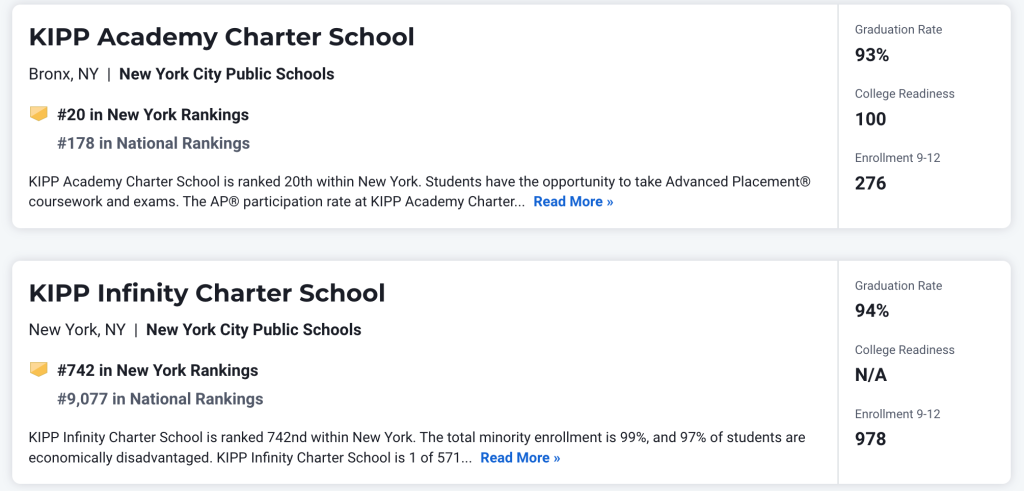
Gary Rubinstein writes here about KIPP’s clever tactics to win a listing as one of the “best” high schools in New York State. He caught them playing similar games several years ago, and U.S. News heard about it and removed KIPP from its rankings.

He begins:

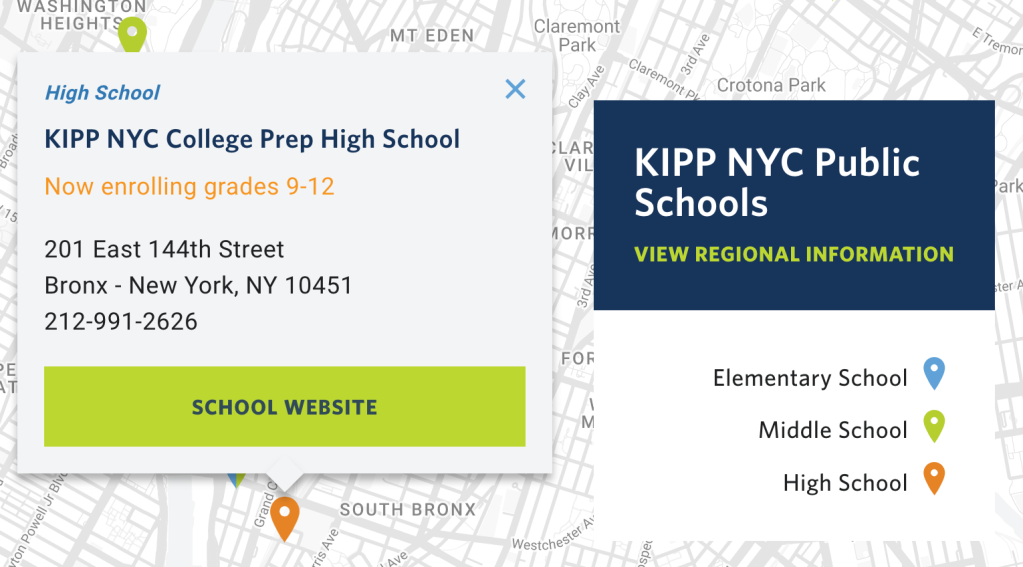
There is exactly one KIPP high school in New York City.

KIPP NYC College Prep High School was started in 2009 to serve students graduating from KIPP middle schools. In 2013 they moved into a new facility that was part of a $100 million project….

Gary figured out that KIPP gamed the system by placing its high-performing students in one middle school and its underperforming students in another middle school. But only one gets counted by U.S. News.

The mystery gets stranger when you search for KIPP high schools in New York and two schools come up, KIPP Academy and KIPP Infinity.

So there is the other KIPP high school in NYC according to U.S. News and that school has 4 times the number of students and in that under performing sibling of the 20th ranked school they don’t have any students passing the AP test. How can this be?

The answer is that there are not two KIPP high schools but only one. These schools, KIPP Academy and KIPP Infinity are actually middle schools. Even in the New York State data, there is not an official KIPP NYC College Prep school but these middle schools have as part of their enrollment the high school students. I don’t know why New York State allows them to do this and why they can assign all the students and only the students who pass an AP exam to KIPP Academy middle school and the students who don’t pass an AP to KIPP Academy Infinity middle school.

Please open the link to understand what a clever move this is. Why do they do it? Gary says it impresses their funders.

Dan and Farris Wilks are politically powerful billionaires who live in Cisco, Texas. They both finished high school but went no further. They got into fracking early on and sold their oil and gas business to the government of Singapore for $3.5 billion in 2011.

They are passionate evangelical Christians. They fund Christian nationalist groups. They fund anti-gay organizations and anti-abortion groups. They consider climate change a hoax. They are major funders of voucher advocacy. They would like to see every student enrolled in a private Christian school or home-schooled.

The brothers are closely associated with ALEC and the Koch network. They are big contributors to Senator Ted Cruz.

Dan and Farris Wilks are major funders of PragerU videos, which present history and economics from a rightwing perspective, echoing the views of Dennis Prager, the talk-show host who created the videos.

Read about Dan Wilks here.

Read about Farris Wilks here.

The Wilks brothers have been described as “the Koch brothers of the Christian right” for their funding of anti-abortion and anti-LGBTgroups. In addition to a variety of groups on the Religious Right, the brothers have funded organizations associated with the Koch brothers’ political network such as the American Legislative Exchange Council (ALEC) and the State Policy Network (SPN). Farris Wilks runs The Thirteen Foundation, which has been described as “one of the biggest and quietest anti-abortion donors in the United States.”

The Guardian summarized their negative influence here.

Experts who follow the influence of the Wilks brothers say their sprawling agendas and big checks spark strong concerns.Videos denying climate science approved by Florida as state curriculum

“Farris and Dan Wilks, who believe their billions were given to them by God, have spent the last decade working to advance a dominionist ideology by funding far-right organizations and politicians that seek to dismiss climate change as ‘God’s will’, remove choice, demonize the LGBTQ community, and tear down public education, all to turn America into a country that gives preference to and imposes their extreme beliefs on everyone,” said Chris Tackett, a Texas-based campaign finance analyst.

“The goal of [the] Wilks and those that share their ideology is to gain control of levers of power and control information. That’s why they invest heavily into politicians, agenda-driven non-profits and media organizations like PragerU and the Daily Wire. It is all connected.”

This is the only post today. Read as much of it as you have time for. The report is a valuable reminder that Ed-tech is oversold and even dangerous. It has its uses, for sure. But it should never replace teachers or parents.

UNESCO released a major blockbuster report warning about the dangers of relying too much on education technology. The author of the report was Mark West. The title of the report is An Ed-Tech Tragedy? Educational Technologies and School Closures in the Time of COVID-19.

An alternate link: https://teachertaskforce.org/sites/default/files/2023-09/2023_UNESCO_An-ed-tech-tragedy_Educational-technologies-and-school-closures-in-the-time-of-COVID19_EN_.pdf

The puzzle at the heart of the document is the clash between learned experience and the imperatives of greed. We learned during the pandemic about the risks of becoming dependent on ed-technology as the main driver of instruction. As we reflect on the period from March 2020 to now, we can discern the damage that occurred to students when their teachers were replaced by virtual instruction: boredom, learning loss, mental health issues, loneliness, lack of socialization with their peers, lack of personal interaction with teachers.

Yet with most people believing that the pandemic (or the worst of it) lies in the past, ed-tech corporations are focused on selling more of what has already failed. Why would we want to expand what has demonstrably proved inadequate and harmful to students?

You probably will take a long while to read the full report, but do read the summary and conclusions to whet your appetite. The overview concludes that the global reliance on ed-tech was necessary in the circumstances, but was a tragedy. Children need human teachers. They need people who look them in the eye and encourage them. Education is not a mechanical process; people are not widgets.

The UNESCO report reviews the global evidence of the harm caused by dependence on ed-tech:

[The report] exposes the ways unprecedented educational dependence on technology often resulted in unchecked exclusion, staggering inequality, inadvertent harm and the elevation of learning models that place machines and profit before people.

The summary says:

An Ed-Tech Tragedy? documents how widespread school closures and the hard pivot to remote learning with connected technology during the COVID-19 pandemic resulted in numerous unintended and undesirable consequences.

Although connected technology supported the continuation of education for many learners, many more were left behind. Exclusion soared and inequities widened. Achievement levels fell, even for those with access to distance learning. Educational experiences narrowed. Physical and mental health declined. Privatization accelerated, threatening education’s unique standing as a public good and human right. Invasive surveillance endangered the free and open exchange of ideas and undermined trust. Automation replaced human interactions with machine-mediated experiences. And technology production and disposal placed new strains on the environment.

Visions that technology could form the backbone of education and supplant school-based learning – in wide circulation at the outset of the health crisis – had promised better outcomes. Ed-tech proponents held that the immense challenges of school closures could be met with technology and that deeper technology integration would transform education for the better. But these high hopes and expectations unraveled when ed-tech was hurriedly deployed to maintain formal education as COVID-19 tore across countries.

An Ed-Tech Tragedy? recounts this tumultuous period, documenting the actions and decisions taken by governments, schools and technology companies. The publication contrasts the promises of ed-tech with the realities of what ed-tech delivered as a response to school closures that impacted over 1.6 billion learners and stretched intermittently from the beginning of 2020 to the end of 2022. The evidence and analysis highlight trends observed across countries and zoom in on the specificities of local experiences, creating a global mosaic of what students, teachers and families experienced when connected technology was elevated as a singular portal to teaching and learning.

Aimed at general and specialist audiences alike, this publication shows how the abrupt and deep changes brought about by the recourse to remote digital learning during the pandemic continue to ripple through the education sector even as schools have fully reopened. It questions whether more and faster integration of technology is desirable for learners, teachers and schools and if ed-tech is, as it is often billed, a key ingredient of educational resilience.

An Ed-Tech Tragedy? posits that new principles are needed to forge more humanistic directions for ed-tech development and use. In-person schooling and teaching should be guaranteed even as technologies improve and connectivity becomes more ubiquitous. Governments need to anchor this guarantee in the legal architecture upholding the right to education, especially for young learners. Moreover, future applications of ed-tech must show greater concern for holistic student well-being. While academic learning is central to education, it is not the only component. Ed-tech needs to support the multiple individual and collective purposes of education, from socio-emotional and personal development, to learning to live together, with the planet, as well as with technology.

In detailing what happened when ed-tech was deployed in response to pandemic school closures, as well as questioning why ed-tech was often elevated as a singular solution, this publication clarifies how the education community can move beyond merely reacting to technological change and instead play a more assertive role steering the digitalization of education towards the more holistic goals of education to shape inclusive, just and sustainable futures.

The future of education needs to be a humanistic one. The lessons extracted from what is premised here as an ed-tech tragedy illuminate the ways technology can better foster education that teaches and revitalizes human values, strengthens human relationships and upholds human rights.

Ed-tech was supposed to solve a problem but it created other problems.

An Ed-Tech Tragedy? examines the many ways that the hurried embrace of technology solutionism steered responses to a global education challenge directly towards ed-tech. Along the way, the logic of technology solutionism changed understandings of educational problems to be solved. The analysis presented here helps reveal, for example, how technological solutions deployed during school closures took a narrow view of education and focused almost exclusively on furthering the academic progress of students in pared-down curricular subjects. This meant that little attention was paid to other education goals, such as fostering curiosity and inquiry and supporting physical health, mental well-being and social and emotional learning. This analysis also shows how ed-tech, originally cast as a solution to maintain learning continuity in the face of widespread disruptions to schooling, has more recently been positioned as a tool to help reverse learning loss. This ‘loss’, however, grew out of the deficiencies of technology-dependent remote learning to preserve the pace of academic learning that would have been typical without school closures stemming from the pandemic. The problem that ed-tech initially set out to solve morphed from assuring the continuity of learning to remedying lost learning. The way the problem was reframed while maintaining connected technology as the centrepiece of the solution is an example of technology solutionism at work.

Recognizing the chaotic pivot from in-school learning to technology-facilitated distance learning as having a tragic arc provides a forceful rebuttal to a growing consensus that the education sector somehow ‘advanced’, ‘leapfrogged’, ‘catapulted’ or ‘disrupted’ itself to a better future when it deployed technology on a massive scale as an interim measure to confront a crisis. The evidence overwhelmingly points in the opposite direction: education became less accessible, less effective and less engaging when it pivoted away from physical schools and teachers and towards technology exclusively. ‘Tragedy’ in this sense signals regression – a denigration of the status quo,rather than a desired evolution. The narrative that ed-tech should be or must be a central component of ‘building education back better’ warrants new scrutiny after a careful examination of the experiences during the pandemic.

The invocation of tragedy also facilitates awareness that connected technologies, despite their growing reach, power and potential, remain tools in a repertoire of many others to construct stronger, more agile and more flexible education systems that can respond and adapt to disruption. Other tools include strengthened teacher training and support; enhanced school leadership and pedagogical management of schools; curricular renewal; smaller class sizes; and improved physical resources and infrastructure for schools and classrooms. Crises that necessitate the prolonged closure of schools and demand heavy or total reliance on technology have been exceedingly rare historically. Future crises may present entirely different challenges. The trauma of the pandemic has, in many circles, functioned to elevate technology as an almost singular solution to assure educational resilience by providing flexibility in times of disruption. Investments to protect education wrongly shifted away from people and towards machines, digital connections and platforms. This elevation of the technical over the human is contradictory to education’s aim to further human development and cultivate humanistic values. It is human capacity, rather than technological capacity, that is central to ensuring greater resilience of education systems to withstand shocks and manage crises.

Overall, the pandemic is a case study in how technology in its current iterations is not yet a suitable foundation for actualizing the diverse goals that communities assign to education. Expectations that technology may, in time, help further increase the reach, improve the quality and strengthen the agility of education are valid. For now, though, the experiences since early 2020 have shown it to be an alarmingly brittle solution – one incapable of effectively responding to widespread and extended school shutdowns. For far too many students, it was a solution that either never started in earnest or quickly broke down. The sudden shift to ed-tech also accelerated a concerning transfer of authority away from teachers, schools and communities and towards private, for-profit interests. Additionally, the censorship, data extraction, advertising, top-down control, intimidation and surveillance that so often characterize current models of digital transformation have made education less free and, arguably, less capable of facilitating critiques of and positive changes to the status quo. [emphasis added by DR.]

Countries made massive investments to digitalize education through much of the COVID-19 pandemic. But it remains far from clear whether these investments will improve education over the longer term and make it an engine of just, inclusive and sustainable development, especially when compared with conventional school-based and teacher-facilitated education. The digital transformation of education may yet be a force for beneficial change. But the logic of technological solutionism and its associated business models currently steering this transformation, led largely by the commercial technology entities that are remaking so many aspects of society, tend to treat education and knowledge as private commodities and not as global public goods that provide collective as well as individual benefits.

It is hoped that this analysis and its use of tragedy as a metaphor might moderate the discourse and popular view that the pandemic has ‘unshackled’ education systems and ‘launched’ them into desirable futures characterized by greater technology use. Documenting the severity and scope of the many negative consequences of ed-tech responses during the health crisis inverts the triumphalist narratives that accompany many descriptions of technology deployments to address the educational disruption caused by school closures. A critical examination of the assumptions of technology solutionism and a review of the existing evidence provide a corrective and a counterargument to notions that more, deeper and accelerated use of technology is uniformly positive for education…

Throughout the review that follows, considerable evidence illustrates how the rush to distance and remote learning with ed-tech accelerated the privatization of education in many contexts. While some countries and localities managed a shift to digital learning with limited privatization of the educational experience, a defining characteristic of the technology-centric response to the educational disruptions of the pandemic tended to be the elevation of for-profit, private ed-tech companies. In addition to considering the ways reliance on ed-tech impacted educational inclusion, equity and quality, this publication also explores the complex and often symbiotic links between ed-tech and the privatization of education during the pandemic.The rush to distance and remote learning with ed-tech accelerated the privatization of education.

Most such reports tend to summarize the status quo. This one challenges it. It’s time to take stock before the Ed-tech industry takes control of our most precious asset: our children.