Tonight, February 3 at 3 p.m. (EST), Public Funds Public Schools and the Network for Public Education are co-sponsoring a Zoom discussion between Nancy MacLean and me about the privatization of public schools.
The Public Funds Public Schools (PFPS) webinar series continues on February 3 with a very special event: “Public Education in Chains: The Road to Privatization of Our Nation’s Schools.” The webinar features Dr. Nancy MacLean, award-winning American historian and author of Democracy in Chains, in conversation with Dr. Diane Ravitch, President of the Network for Public Education.
PFPS webinars explore issues related to private school vouchers and the campaign’s goal of ensuring public funds are used to maintain, support, and strengthen public schools. This webinar is co-sponsored by the Network for Public Education.
Fraud, scandal, embezzlement, failure: Nothing can slow the Republicans’ demand for charters and vouchers. The latest example of charter failure comes from Oklahoma, where the state auditor of Oklahoma reviewed the finances of the Epic charter schools and declared it was the worst abuse of taxpayer funds in the history of the state. And as yet there have been no consequences.
Oklahoma’s state auditor and inspector on Tuesday said mismanagement by co-founders of Epic Charter Schools is “the largest amount of reported abuse of taxpayer funds in the history of this state” — and she has no idea why the attorney general has not brought criminal charges in the case.
“I am shocked this hasn’t been prosecuted yet,” State Auditor Cindy Byrd told lawmakers at a joint meeting of the Oklahoma House of Representatives’ common education committee and Appropriations and Budget education subcommittee. “I do expect charges to be filed — or an explanation for why charges will not be filed….”
Byrd, a Republican serving her first term in elected office, noted that she accepted no campaign funds from education political action committees and has nothing against charter schools, parent choice in education or even free market enterprise.
She likened charter schools like Epic, which she described as “intentionally established” for charter school management companies to milk for profits — as the “Enron of public education.”
Advocates for fair funding for public schools in New York have pursued a remedy from the state for years. They finally won a big increase in the budget, but were shocked to discover that almost the entire increase in funding will be diverted to charter schools, which enroll 14% of the state’s students. Either coincidentally or not, Governor Hochul’s election campaign is heavily funded by charter school advocates from the financial industry.
CHARTER SCHOOL FUNDING INCREASE WIPES OUT STATE FORMULA AID BOOST FOR NYC DISTRICT SCHOOLS
February 2, 2022
In testimony on Governor Kathy Hochul’s FY23 Executive Budget, Education Law Center warned New York lawmakers that a proposed increase in state aid to charter schools in New York City will nearly offset the aid increase to district schools under lawmakers’ promised phase-in to reach full funding of the State’s Foundation Aid Formula.
Last year, after over a decade of resistance, New York elected officials committed to fully funding the Foundation Aid Formula enacted in 2007, with a three-year phase-in. After Andrew Cuomo’s resignation, Governor Hochul declared her intention to fulfill this commitment. Her administration also reached a settlement agreement with the plaintiffs in NYSER v. State, a school funding lawsuit by public school parents in New York City and Schenectady, which conditions ultimate dismissal of the case on reaching full formula funding by 2024. The Governor’s proposed FY23 budget provides for a $1.6 billion increase in Foundation Aid, as required to meet the planned phase-in.
In testimony on the proposed FY23 State Budget, ELC underscored to legislators that the Governor’s proposed 4.7% increase in state aid to New York City charter schools will effectively negate the phase-in of formula funding to the City’s district schools. If the Governor’s proposed budget is enacted, New York City charter schools would receive an increase of $300 million this year, while the City’s district schools will be allocated an increase of approximately $345 million in Foundation Aid. Under state law, New York City is the only district that receives no transitional state aid to offset what the district is required to pay in charter school tuition.
“The math is simple and shocking,” said ELC senior attorney Wendy Lecker. “The increase in tuition payments to charter schools, which enroll just 14% of New York City students, will consume the entire increase in Foundation Aid intended for the almost one million City students enrolled in district schools. Even worse, the City is also mandated by state law to provide space or pay rent for charter schools.”
The ELC testimony also calls out the Executive Budget’s failure to make any additional investments in New York’s preschool program. In a May 2021 ruling, in the “Small Cities” school funding case, a New York Appellate Court recognized preschool as an essential element of a sound basic education guaranteed students under the State Constitution.
It is undisputed that high quality preschool provides a host of academic and life benefits, such as decreased placement in special education, decreased suspension rates, higher educational attainment, higher income, and decreased contact with the criminal justice system. Yet, tens of thousands of four-year-olds across New York lack access to any preschool classes, let alone a high-quality program. ELC is urging the Legislature to invest an additional $500 million to help ensure all four-year-olds access to this essential resource.
ELC also pressed the New York Legislature to maintain and strengthen the Contracts for Excellence (C4E) Law. This law was enacted in 2007 to ensure that struggling school districts receiving additional Foundation Aid would spend those funds on programs proven to improve student outcomes. As districts across the state finally receive these long-awaited increases in funding, it is crucial to have a strong framework for directing the funding to essential resources, including class size reduction in New York City district schools.
Sustained grassroots advocacy – coupled with strategic litigation – has moved New York to make important strides toward providing all students, including students of color, the essential resources required for a constitutional sound basic education. Lawmakers must revise Governor Hochul’s proposed budget to ensure the equitable distribution of increased funding, especially in New York City.
The citizens’ group “Public Schools First NC” has published a scathing critique of the double standards that the General Assembly has inserted into the laws that govern education.
Double Standard!
Proponents of school choice, especially voucher program supporters, are often the most committed to holding public schools accountable for how public funds are spent. They point to the need to monitor the value provided by our tax dollars. Yet these same choice proponents are remarkably silent when asked to apply similar standards to the private schools receiving public tax dollars.
There are many notable contrasts (or rather, contradictions) evident in the 2021-23 budget when it comes to spending on education. The accountability double standard for public dollars spent on public schools versus private schools is especially glaring. For public schools, NC has a well-established NC Report Card that provides a range of information about academic performance and school statistics such as class size and teacher qualifications. In addition, the NC School Finance Dashboard, launched in 2019, provides basic financial information about public schools such as the source of funding and how the funding is spent. For private schools receiving public funds through the school voucher programs (e.g. Opportunity Scholarships), there is no school report card or other public-facing accountability mechanisms. Nothing.
The NC, A-F grading program, one component of the NC Report Card, assigns every NC public school a letter grade. Widely disparaged for their outsized reliance on student achievement test scores, the A-F grades were first assigned to NC public schools in the 2013-14 school year. Each school’s grade is based on a formula where 80% of the grade is based on achievement and 20% on growth. The data used to calculate the achievement scores vary by grade and include end-of-grade and end-of-course test scores, passing rates for Algebra II or Integrated Math III, ACT scores, and graduation rates, There have been a number of bipartisan proposals to change the formula to 50% achievement and 50% growth, but no change has yet been made. NC is an outlier among states with letter grading systems in the resistance to developing a more balanced approach. Kris Nordstrom’s report School Performance Grades: A Legislative Tool for Stigmatizing Non-White Schools describes the grading system and some of its problems in detail.
As NC legislators funnel more money to private schools through voucher programs they are failing to require of private schools similar levels of transparency about student achievement and school finances as contained in the NC School Report Card and School Finance Dashboard. For example, although private schools are required to test students in grades 3, 6, 9, and 11, there is no mandatory public reporting requirement. In addition, individual schools select which test to administer, which creates a system where there is no standardized way to compare student achievement across schools or to public school student achievement. Interestingly, for 11th grade, the guidelines state that “Each private school should establish a minimum score on an achievement test to be administered on or before 11th grade which ensures students possess a minimum of skills for high school graduation.” In other words, each school sets its own passing standard. In the public school setting, this is equivalent to allowing each school to determine its own passing (Level 3) score on an EOG or EOC test.
In addition, private schools are not required to share information about their curriculum, qualifications of instructional staff (teachers are not required to hold a college degree or be certified) , or even basic information such as class size and technology resources. This chart showing the essential differences further illustrates the striking contrast.
Yet with the 2021-23 budget, even though in previous years, demand for Opportunity Scholarships has lagged behind the funds allocated to them, with millions left unspent, the legislature allocated even more money to this unaccountable voucher program. By law, funding for Opportunity Scholarships was set to grow by $10 million each year (on top of base funding) regardless of whether the money was spent. With the 2021-23 budget, the increase was bumped to $15 million each year. More than 3.1 billion will be spent on the program over the next 15 years. To drum up demand, they earmarked $500,000 to market the Opportunity Scholarships. At the same time, the legislature failed in its constitutional obligations to fully fund public schools. Members of legislative leadership have even taken the extreme measure of filing an appeal to stop the courts from requiring that dollars are allocated to fund education at the minimum required by the NC constitution.
So why is there such a double standard?Why are our legislators so resistant to an equal evaluation of public and private schools when private schools are spending public tax dollars? Are they concerned that the private school sector won’t hold up to a fair comparison? Ask your legislator! With the abundant unspent voucher school funds, they could build a private school online dashboard just like the public school dashboards so taxpayers can see all aspects of how tax dollars are being used for education. Better yet, let’s put the public taxpayer funds back into our public schools where it belongs.
The Guardian in the U.K. reports on a study finding that parents in England are unhappy with the past three decades of “school choice.” By contrast, parents in Scotland are satisfied with their local public schools.
Three decades of school choice in England has left parents feeling more “cynical, fatalistic and disempowered” than their peers in other parts of the UK, according to new research.
A study comparing parents in England, where families can name up to six state schools for their children to attend, with those in Scotland, where children are generally assigned to local state schools, found Scottish families were still more likely to be satisfied with the outcome.
While 75% of parents in England said they had enough choice of schools, 76% of those in Scotland said the same, despite their lack of explicit choices within the admissions process.
Parents in England were more likely to express frustration and disempowerment, with several calling the current school choice policies an “illusion”, in surveys and interviews conducted for the research published in the Journal of Social Policy.
Aveek Bhattacharya, the chief economist at the Social Market Foundation and the author of the paper, said: “This research adds to the growing evidence that school choice policies have failed to bring the benefits they were supposed to.
“For all the emphasis that policymakers in England have put on increasing choice, parents south of the border are no happier with their lot than their Scottish counterparts. Indeed, many are disenchanted and dismayed.
“These findings show that parents offered a range of options for their children’s school are no happier than parents who have less choice about education.”
The current Republican Party has reverted to the ace card it held in the 1950s: its followers refer to every government program as socialism. SOCIALISM!! This one word is supposed to terrify everyone into fearing that government is about to take away their freedoms. Those politicians who do this should be asked if they are willing to abandon their own right to Social Security and Medicare. One of their favorite targets in recent years is public education. They are trying to persuade the public that their local public schools are socialism. This is nonsense. The following opinion piece by Janet Ward appeared in the Concord Monitor.
A few years ago at a gathering in my town, a fiery speaker said that our government is reaching into our pockets through taxation in order to steal our hard-earned money to pay for programs that are simply giveaways to growing numbers of the “undeserving.” This is not true.
This lie has been created because the former president, the moneyed interests who support him, and the inventors and funders of the “Big Lie” regarding our free and fair 2021 election are painfully aware that the people they wrongly label as the “undeserving” have the right and the power to vote.
Let us be clear. The former president and his supporters are convinced that our democracy itself poses an existential threat to their way of life. They would prefer a plutocracy, a government controlled by the wealthy.
In our democracy, we, you and I, govern ourselves through representation by legitimately elected legislators. Social programs exist because we the people believe that these programs are necessary and appropriate and that such programs, like our public schools, contribute to the common good, to the well-being of our entire society. But an insidious revolution, decades in the making, is bearing terrible fruit.
The long-standing belief that public schools benefit our entire society has been intentionally and successfully undermined through a decades-long strategy organized and executed by such entities as the State Policy Network and the American Legislative Exchange Council (ALEC) which provides templates of legislation to Republican lawmakers in every state to achieve such things as the dismantling of public education. But why target public schools?
Last year the Republican majority in our New Hampshire Legislature voted to approve a school voucher program. It is now legal for public tax dollars to be used to pay for private, religious or home-schooling programs over which we taxpayers have virtually no oversight. When asked why they supported school vouchers, Republican legislators, most of whom had been educated in public schools, said that they believed New Hampshire public school students were being brainwashed by teachers’ unions to believe in socialism. This is not true.
Good government is not socialism. Socialism is a system of government in which the government owns the means of production. Our country is not socialist. It is a capitalist country where individuals or corporations own the means of production and where decisions regarding prices, production and the distribution of goods are based on competition in a free market….
What will happen if Big Lies are allowed to prevail? Our democracy will be destroyed. The perpetrators of these lies will become the governors of our nation, and the dreams of Americans like Jefferson, Madison and Lincoln will die.
The death of our democracy will happen soon, on our watch, unless each of us uses the powerful weapon that our democracy has provided to us — our vote. Remove the liars and manipulators from office. Vote to restore our democracy.
The event is sponsored by Public Funds Public Schools and the Network for Public Education.
Dr. MacLean is author of the brilliant book Democracy in Chains, which documents the Koch brothers’ relentless efforts to privatize government functions.
Throughout the country and in Illinois, we have seen the rise of well-funded disinformation campaigns targeting school boards and educators.
This event will cover: Who’s behind the disinformation campaign around masks/vaccines mandates, an erosion of LGBTQ+ rights and the way race is being taught in our schools? How can we band together to support our school boards and staff who are being threatened and to protect public education?
Hear from an excellent panel and connect with others around Illinois who are organizing in their communities to stand up for inclusion, safety, and teaching a full and accurate history in our schools that protects all students
Panelists include: — Jennifer Berkshire, Co-Author “A Wolf at the Schoolhouse Door” — State Senator Cristina Pacione-Zayas, Former VP Policy for Erikson Institute and ISBE board secretary and member — Nathaniel Rouse, Director of Equity, Race, and Cultural Diversity Initiatives, Barrington 220 — Julie Harris, Educator of 31 years Tinley Park CCD146
Hosted by Indivisible Illinois, Illinois Families for Public Schools, Indivisible Illinois Social Justice Alliance and more.
North Carolina has been in the forefront of destructive education policies ever since the Tea Party won control of the state’s General Assembly (legislature) in 2010. Charters, vouchers, TFA, high-stakes testing, hostile indifference to teachers, etc.
But the rightwingers in NC wanted more. They wanted their own version of the Tennessee Achievement School District. They knew that Tennessee lawmakers had created a special district containing the state’s lowest-scoring schools; these schools would show dramatic improvement if handed over to charter operators.
The North Carolina legislators ignored the clear evidence that the Tennessee ASD was a failure, despite the state’s investment of $100 million from Race to the Top funding. Failure was no deterrent, no way to dissuade them from launching the magic elixir of privatization.
The Innovative School District was supposed to contain five schools, but every time a school was designated, its district fought to keep the school. The ISD opened with only a single school, and that one school had a principal, a superintendent, and a charter management organization. An awful lot of administrators for one school.
Alex Granados wrote about the collapse of this bad idea in EdNC:
In an experiment, a hypothesis is tested. In the case of the Innovative School District(ISD), the hypothesis was that some of the state’s lowest-performing schools could be improved if they were grouped into one district, given charter school-like flexibility, and turned over to the management of alternative operators.
To judge by the biennium budget passed by the General Assembly in November 2021, North Carolina lawmakers must have concluded that the ISD experiment did not yield the result of improving schools, at least not in the way it was originally conceived. What other conclusion can be drawn from the fact that lawmakers put an end to the project in their two-year spending plan?
Background
The Achievement School District bill was passed during the 2016 General Assembly short session. At the heart of the legislation was the creation of a district that would eventually include five low-performing schools from around the state that could be turned over to charter school operators.
It was originally called the Achievement School District and its first superintendent, Eric Hall, said at the time that it was modeled after similar experiments from other states that had “mixed results.”
“We have an opportunity as a state to redefine what it means in North Carolina,” Hall told the State Board of Education in 2017. But that redefinition never quite came to be.
A single school
The initial plan was that all five schools in the ISD would be up and running by the 2018-19 school year. It is now the 2021-22 school year, and there is still only one school. That is thanks to, in large part, massive resistance from some of the districts approached by the state.
The single school that was taken over as part of the ISD was Southside-Ashpole Elementary School in Robeson County. And it’s been a tough journey both for the school and for the district — since its inception, the ISD has had four superintendents and the school has had three principals.
Current ISD Superintendent Ron Hargrave told the State Board of Education in December 2021 about visiting a kindergarten class at Southside-Ashpole on his first day. A teacher said to him: “‘Well, you’ll be number four,’ and she was talking about the number of superintendents who’ve come through there,” he said.
Hargrave replied, “I’m going to do everything in my power to make sure you don’t need a number five, because I’m here to stay.”
But turnover hasn’t been the only issue.
The nonprofit charter organization that was running the operation was ultimately relieved of its responsibilities by the State Board of Education. You can read about the difficulties with that organization, Achievement for All Children (AAC), in N.C. Policy Watch here and here.
‘No common ground’
Did Southside-Ashpole improve? According to data, no.
Trip Stallings, whose team conducted the external evaluation of the ISD when he was with the Friday Institute for Educational Innovation, said that a single school’s performance can’t really tell us anything about how well the ISD concept might work as a multi-school turnaround program.
“Because they only had one school in three years, you can’t really use that experience to validate or disprove the ISD approach,” he said. But there are a number of issues evident from even the experience of a single school that may have weakened the ISD structurally, according to Stallings.
One issue was that the legislation that created the ISD assumed there would be a wide variety of Charter Management Organizations (CMOs) vying to manage schools in the ISD. Instead, only three CMOs applied to manage Southside-Ashpole. The State Board of Education asked all three to resubmit their original proposals and, ultimately, the revised proposal from AAC was accepted.
“The real question is, ‘Why did other CMOs not apply?’” Stallings said.
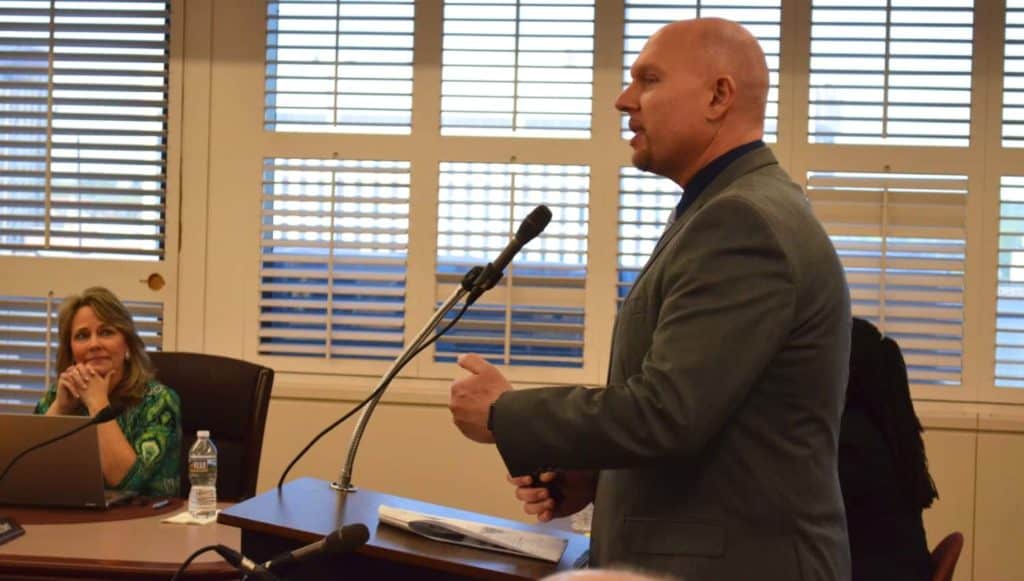
Former ISD Superintendent Eric Hall presents to the State Board of Education Thursday, April 5, 2018. Alex Granados/EducationNC
Another problem, according to Stallings, was the disconnect among the operator, the State Board of Education, and the state Department of Public Instruction (DPI) regarding how the ISD as a program should be implemented and managed.
“For example, none of the parties really reached agreement on the question of what this ‘charter-like flexibility’ means,” he said.
As a result, a superintendent, principal, and CMO leader all tried to assert separately how the single school in the district needed to operate. This led to confusion and dysfunction, he said.
Finally, Stallings said that the remote nature of the program was a “significant handicap.” DPI, AAC, and the school were all in separate locations and remote from each other not just geographically, but also culturally.
“They didn’t see many things in the same way,” he said. “For some issues, there was no common ground.”
According to the budget, Southside-Ashpole Elementary School will continue as part of the ISD until 2023-24 at the latest, when it will be returned to the Public Schools of Robeson County.
Craig Horn, a former Republican state representative from Union County, said this is terrible news. Not because he was a big fan of the ISD — he said he wasn’t — but because it is indicative of how the General Assembly operates.
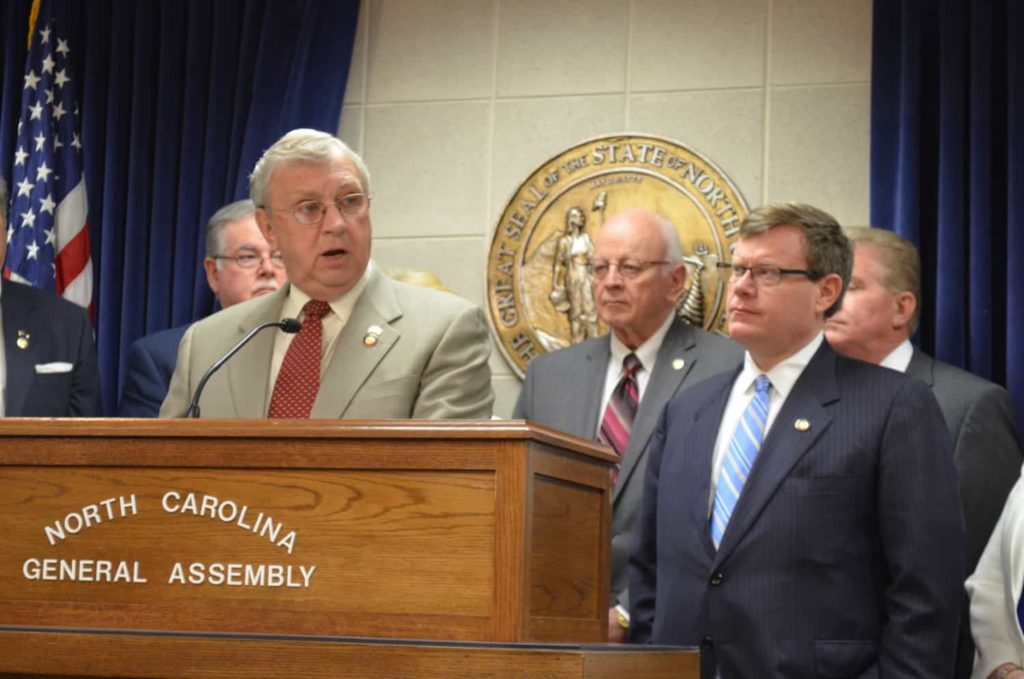
Rep. Craig Horn, R-Union, talking about the education portions of the budget at a 2017 press conference. Alex Granados/EducationNC
Horn, an influential legislator when it came to education, lost his seat when he ran for the state superintendent position and lost to Catherine Truitt in 2020. He was there for the inception of the ISD.
“I’m going to suggest that rather than sit down and work out the problems, it’s easier and faster to say, ‘Ok, we’re done. We’re not doing it,’” he said.
Horn had a lot of problems with the ISD program, but said that if it has failed, he hopes lawmakers have done their homework to understand why.
“If we can say that we did our homework, we actually talked to the people inside, we actually talked to parents and students, we actually made some adjustments and we’re still failing, OK, then we made an informed decision,” he said. “But my experience with the General Assembly is they don’t always make informed decisions.”
Preparing for transition
The State Board of Education heard from the current leaders of the ISD and Southside-Ashpole at the December 2021 meeting.
Derrick Jordan, associate superintendent of agency schools, told the Board that efforts to improve the school are still happening.
“There is absolutely still work to be done, but there is an unwavering commitment to improving outcomes for the students at Southside-Ashpole,” he said.
And Hargrave stressed to Board members that the students in that school are “full of potential.”
“It is a school full of children who desire to be loved and desire to be taught, and they have a hunger for learning,” he said.
Freddie Williamson, superintendent of the Public Schools of Robeson County, said the district is ready to have the school back and is already working with the school and the ISD to prepare for a “smooth, seamless transition.”
There isn’t yet a timeline for the transition, but when Southside-Ashpole does return back to the control of Robeson County schools, State Board of Education member Olivia Oxendine said she hopes it keeps innovation a priority. She said innovation takes a long time, and whatever the ISD, the new teachers, new principal, or the community have done, it should continue.
“Whatever is beginning to happen called innovation, let’s carry it forward,” she said.
Nothing on the record shows that there was either innovation or achievement at the one school in the experimental district. But whatever it is, says Ms. Oxendine, keep doing it, even though it yielded no improvement.
The full story of North Carolina’s failed experiment is fascinating. The bill to create the state’s Innovative School District was sponsored by Republican Rob Bryan. The money to promote the bill was supplied by an ultra-conservative businessman from Oregon named John Bryan (no relation to the legislator). After the bill passed, the state Board of Education selected Achievement for All Children (AAC) as the charter operator, although it had no experience turning around low-performing schools.
Mecklenburg County Republican Senator Rob Bryan sponsored the bill as a member of the House in 2016 that became law and created the ISD. That law specifies that the ISD can have up to five schools, selected from the lowest-performing in North Carolina.
Bryan argued at the time that the new district would provide much-needed reforms, but the following year, as Policy Watch reported, he received at least $5,000 as a “stipend” for his work with AAC.
Several other low-performing schools, including two in Durham, were targeted for state takeover in 2017, but resisted the move. Then-ISD Superintendent Eric Hall ended his pursuit of those schools.
That left Southside-Ashpole, which began operating as the state’s first and only school within the Innovative School District at the start of the 2018-19 school year. Southside-Ashpole has an enrollment of 270, 95% of whom are students of color: Black, Latinx and American Indian.
In its first year as an ISD school, there was a wholesale house cleaning at Southside-Ashpole: After Superintendent Allen abruptly left, the State Board of Education hired Ellerbe to replace her. School principal Bruce Major also suddenly resigned, and AAC then hired Bowen.
It remains unclear whether the changes were due to job performance.
Meanwhile, there has also been a major upheaval within AAC’s business partner, TeamCFA, a Charlotte-based nonprofit that provides financial, instructional and management support to more than a dozen schools in North Carolina and four in Arizona.
TeamCFA is AAC’s curriculum partner, according to the ISD website.
TeamCFA was started by John Bryan (no relation to Rob Bryan), a retired Oregon businessman who has used his wealth to promote school choice causes.
John Bryan is also a major contributor to Republican lawmakers and was instrumental in helping to pass the North Carolina law that created the ISD. From 2013 to 2016, Rob Bryan’s campaign received more than $22,000 in contributions from John Bryan, state reports show. John Bryan also contributed to then-Gov. Pat McCrory, Lt. Gov. Dan Forest, NC House Speaker Tim Moore and Senate President Pro Tem Phil Berger.
Raleigh’s News & Observer reported in October that Bryan and the Challenge Foundation, which Bryan also formed, stopped funding TeamCFA. In his final founder’s letter, Bryan talked about passing on the responsibility to other private investors and philanthropists.
TeamCFA had received as much as 95% of its annual revenue from Bryan and the Challenge Foundation, the paper reported. TeamCFA also receives $510,000 annually from the Charles Koch Foundation.
The NC Republican leadership was heavily funded by John Bryan from Oregon. Bryan was the funder of TeamCFA. TeamCFA was the partner of the only charter operator that applied to manage the district that was created by legislation funded by John Bryan.
What happened to the 270 students in the one school in the Innovative school District? Well, they have had a constant turnover of principals and superintendents. They were Guinea pigs for legislators who don’t know them and apparently don’t care about them.

 Diane Ravitch's blog