Archives for category: Education Industry

Governor Bill Lee of Tennessee invited Larry Arnn, president of Hillsdale College, to open 100 charter schools in Tennessee. Arnn scaled it back to 50, but Hillsdale’s patriotic charters are not getting a warm welcome in the state. A third district rejected an “American Classical Academy.” It seems they like their local public schools and don’t want to divert money away from them. The teachers are their neighbors, and the school board knows them and respects them.

A charter school program tied to the controversial Hillsdale College suffered a third rejection by a Tennessee school board Tuesday night as the Clarksville-Montgomery County school board said it wanted nothing to do with the school pushed by Gov. Bill Lee.

With no debate, the Board of Education unanimously voted to reject the application of the Hillsdale-affiliated American Classical Academy. That follows similar votes by school boards in Rutherford County and Madison County.

The group could still appeal to the Tennessee Public Charter School Commission, which can override the local school board.

School board member Jimmie Garland said Lee needs to understand that local residents do not want a privately operated charter school siphoning taxpayer dollars from a school system that is already serving the community’s needs.

“I am asking him if he sends them here, that he pay for it — not the community, not the Clarksville-Montgomery County school system, not the 200,000-plus residents of Clarksville,” Garland told NewsChannel 5 Investigates.

“We shouldn’t have to foot that bill.”

The community school board was aware of Arnn’s absurd and insulting claim that anyone can teach, and they didn’t like it.

Michael Tomasky, the editor of The New Republic, summarizes the war against public education and why it is so crucial to our society. Yes, everyone must support public schools, whether or not they have children. Everyone must pay to educate all children. Because doing so is for the good of society!

Tomasky is a public school parent. He read the article about the effort by Free Staters to defund the public schools in Croydon, New Hampshire, and he was appalled. Supporting the public schools for all children is

so obviously essential to civilized life that it’s shocking we even have to defend it. But alas, because the American right wing is so bananas these days, defend it we must.

The Free Staters in New Hampshire want to live without any government. They want to live without a state. They already fired the town’s line police officer. Then they went for the town’s public school budget, proposing to cut its budget in half.

I’ve actually been wondering for many years when the right was going to get around to this line of attack. As matters stand in the United States of America, and as far as I know more or less everywhere in the developed world, education is paid for by the state—either mostly by local governments (the United States), or the national government (France). This web page gives a good summary of how public education is funded around the globe. It’s a fairly recent consensus in historical terms—only in the last half of the twentieth century have countries like Brazil, India, and Colombia come to accept that they have to pay the freight for universal education. But accept it they have. As a result, educational inequality around the world has decreased dramatically.

In the U.S., of course, public education is mostly funded by property taxes and financed by local governments. There are problems with this, as there are with any system invented by imperfect human beings, the main one being that rich districts have a lot more money and thus much better schools; but even still, the good part is that we as a society accept the idea that we all have to contribute. It does not matterwhether you have children in the schools. The principle is that even if you are childless, or your children have grown and gone to college, or you send them to private school, or school them yourself at home, you still pay, and you pay because you benefit from a well-educated populace.

I live in Montgomery County, Maryland, home to great schools and high taxes. My daughter happens to go to a public school that is excellent (and happily just up the street). But even if I had no daughter, or sent her to a private school, I would still agree that it was my responsibility to pay for the great public schools my county offers children. It makes for a better county, a better class of citizen, a better nation.

This is a core principle of civilized society: We all contribute to certain activities that have clear universal social benefit. To use Underwood’s sick terminology, that guy pays for that guy’s child to be educated because the first guy benefits when the second guy’s kid is learning math and science and pondering Hamlet’s soliloquy and being prepared for responsible, productive adulthood. Anyone who can’t see that connection is a selfish prick. And if nothing else, even selfish pricks ought to be able to see that good schools increase the value of their homes.The question of political philosophy is this: What is the common good—what must it include, and what is each citizen’s responsibility toward securing it? We decided in the U.S. a little more than a century ago that universal public education, free to every child and paid for by all of us, was central to any definition of a common good. The world, as I noted above, has largely come to agree.

An educated populace serves all of us. Debates about curricula are another issue, and those debates are legitimate, as long as people aren’t lying (my daughter, who just finished sixth grade in a quite liberal school district, reports that yes, she’s learned all about Rosa Parks and so on, but no teacher has ever tried to make her feel guilty about being white).

But even both sides in that debate accept that the public schools are a common good; they just disagree about what should be taught.

More broadly, conservatives have been trying to undermine public education for 70 years now. This goes back to Brown v. Board of Education, in whose wake many Southern school districts set up all-white segregation academies or in some cases stopped collecting the local taxes that supported public schools (it took a Supreme Court decision in 1968, a full 14 years after Brown,to end the most egregious forms of that racist mischief).

Then, starting in earnest in the 1980s, under Reagan-era education secretary and insufferable moral crusader Bill “Snake Eyes”Bennett, the right promoted school vouchers and charter schools, both of which, numerous studies have found, have simply not been the panacea the right advertised them to be. Right-wing rich people and foundations have spent God knows how many millions since then promoting these private educational alternatives. That’s their right, of course. But imagine if they’d spent those millions trying to shore up public schools in poor districts, or financing early reading programs for poor children from Harlem to eastern Kentucky to the reservations of Arizona. The country would be so much better off.

The Free Staters failed in Croydon. The small population mobilized to save their schools.

I expect the coming years will see the mainstreaming of the argument that people who aren’t parents of public-school children shouldn’t have to pay for schools. Liberals must fight back tooth and nail, and not on some statistical point cooked up by some timid pollster, but at the very philosophical root of the argument. We cannot retreat from a century-old consensus that has done the nation enormous good.

  @mtomasky

Michael Tomasky is the editor of The New Republic.

The Supreme Court’s Holy War Against Public Schools

Katherine Stewart

How Leonard Leo Became the Grey Cardinal of the American Right
The Rutherford County School Board in Murfreesboro, Tennessee, rejected the American Classical Academy by a vote of 6-1. The charter school is Art of a chain affiliated with Hillsdale College. Board members were steaming about the derisive comments about teachers and teacher-training colleges recently made by Hillsdale President Larry Arnn. Arnn said in the presence of Governor Bill Lee: “The teachers are trained in the dumbest parts of the dumbest colleges in the country.” Lee did not come to the defense of Tennessee’s 80,000 teachers or its teacher education programs. He praised Arnn’s “vision.”

Educators across the state paid attention. So did school boards. And that is why a charter school affiliated with Arnn’s college did not get a charter in Rutherford County.

That group is affiliated with Hillsdale College, whose president was recently caught on hidden camera badmouthing teachers and the colleges that train them.

Board chair Tiffany Johnson said the people who would have run the school had privately tried to distance themselves from Hillsdale and those remarks, but they decided not to show up to defend themselves.

“The comments that were made by the president of Hillsdale were deeply egregious,” Johnson told NewsChannel 5 Investigates.

“We have wonderful teachers, remarkable educators. We have a fantastic system. What I saw, I didn’t like — and I gave them an opportunity to address them and lay out for us that they were not a part of those comments. So I had a commitment until shortly before the meeting that they were going to be here to address the board.”

American Classical Academy could now appeal to the Tennessee Public Charter Commission, which has the authority to override local school boards.

A review committee had recommended rejection of the application based on a number of factors, including lack of appropriate detail about how the school would serve special-education students and English language learners.

The group amended its application to distinguish itself from Hillsdale College, but reviewers concluded “the separation appears to be superficial.”

“The ties to Hillsdale have become increasingly problematic and heightened our review committee’s concerns of applicant intent due to comments recently made by Hillsdale’s president, Larry Arnn,.” reviewers wrote.

Gary Rubinstein finds that his criticism of Success Academy has caused some parents to reach out to him.

If they attended a public school, they could see the principal, the superintendent, or any number of officials who might be able to intervene.

So Success Academy parents have reached out to Gary to see if he can help them.

But at a charter school, if you have a complaint, they may tell you to choose another school. Leave.

This post is about a mother who was not allowed to attend her school’s graduation. It seems there were a couple of incidents. On one occasion, she failed to buy exactly the right pants for him to wear at school. On another, she went to his classroom without permission.

She had to be punished. She was barred from her son’s graduation.

In Virginia, an evangelical church announced plans to open a new school. They claim that demand for private Christian education has soared due to controversies over critical race theory (i.e., teaching anything about racism, past or present) and masking during the pandemic (they refused to protect their children’s health). Will the new school indoctrinate children to be racist? To hate gays? To look down on other religions? One thing you can be sure of: it will seek government money for its tuition.

MIDDLEBURG, Virginia – Nestled in the rolling hills of northern Virginia sits a sprawling tree-lined campus. Classrooms inside this shuttered private school sit empty. Once-busy halls are eerily silent. Each room looks like a time capsule of better days. But not for long.

“After much prayer and discussion with our elders, and pastoral leadership, we will be launching Cornerstone Christian Academy,” said Senior Pastor Gary Hamrick.

Hamrick got a standing ovation after making that announcement during recent Sunday services at Cornerstone Chapel in Leesburg.

The campus is about 20 miles from Cornerstone Chapel the church that will open the school in the fall of ’23.

Initially, there will be enough space for 500 elementary and middle school students. “They have classrooms, desks, there’s a gym, cafeteria, down the hall. We’re going to repurpose it for the Lord,” said Hamrick.

On Today’s Quick Start Podcast: How Red Flag Laws Failed, Marvel Actors Sound Off on LGBT Message in Thor

There are also plans to expand to high school and online learning.

“Our goal is to provide children an education where they have a biblical worldview. So they can go out into the world and be salt and light,” he said.

Dr. Charles Foster Johnson is hosting a conversation with Beto O’Rourke in Lubbock, Texas, on Zoom this Thursday.

4:30-6:00 pm CDT (central time).

They will discuss the future of public education in Texas.

https://www.eventbrite.com/e/a-conversation-about-public-education-with-beto-orourke-tickets-384095880117

The event is free.

Gary Rubinstein, teacher and blogger, reviewed state data for Eva Moskowitz’s Success Academy charter chain. SA has been widely acclaimed for its high test scores. But Gary found that the attrition rate was astonishing. If low-scoring students leave, it boosts the overall scores.

Gary knew that the overall attrition rate was high but was surprised to see how high it is for students who enter ninth grade.

Over the years I’ve tracked the attrition at Success Academy. They are a K-12 program and I’ve found that generally when I compare the number of kindergarteners entering the school with the number of 12th graders that graduate 13 years later, they lose approximately 75% of their students over the 13 years.

Success Academy has argued that losing 75% over 13 years isn’t actually that bad since it equates to about 10% attrition per year, which is what district schools also have. One flaw in that reasoning is that district schools fill in those 10% of seats each year while Success Academy stops ‘backfilling’ in the 4th grade. Another problem with comparing attrition rates from Success Academy to district schools is that a student can pretty easily move from one district school to another and those schools won’t be all that different. But for Success Academy which are supposedly the best schools in the country, it is a major life change to leave Success Academy for a district school so if they really are as good as they say, you would expect their attrition to be less than the 10% per year that district schools have.

I recently got some data from New York State that puts the attrition of Success Academy in a different and scary context. Since Success Academy is a K-12 school and you can’t get in after 4th grade, any student who makes it to 9th grade there has been at the school for anywhere from 5 to 9 years. After making it that long, the last four years should be pretty easy. It’s like running a marathon and getting to the 25 mile mark, of course you are going to finish the race. But some new data I got reveals that this isn’t the case with Success Academy. In general, only about 60% of the students who become 9th graders there eventually graduate within 6 years. And with certain subgroups it is a lot less than that….

This data is really scandalous. Have you ever heard of a school that sheds almost half their students in a four year period from 9th to 12th grade even though those students have been in the school since kindergarten or maybe 4th grade at the latest? A question I wonder is why do so many students leave the school so late in the game after succeeding there for so many years?

Lisa Haver is a retired teacher and prominent advocate for the public schools of Philadelphia. Those public schools have been subject to state takeover, privatization, and every other failed reformy tactic. She hoped that those bad old days were over. They are not. The new board hired an inexperienced superintendent who needed the help of a much-criticized consulting firm at a cost of $450,000.

She expressed her frustration in this article.

After years of pain and frustration that included the closing of neighborhood schools, privatization driven by standardized tests, crumbling infrastructure, and more than one debacle, the people of Philadelphia were psyched for new leadership in the school district.

The door to new priorities seemed to open with the arrival of Tony Watlington as the next superintendent.

But that door slammed shut before his tenure had even begun with the news that he’d brought in a Tennessee-based consulting firm to help him navigate his first year in the job. In May, the Board of Education voted unanimously and without deliberation to approve a one-year contract with Joseph & Associates. Price tag: $450,000. The board approved this contract — the last on a list of 92 official items — near the end of an 8-hour meeting.

According to a recent Chalkbeat article, the board hired the consulting firm to help Watlington “connect with people,” assist in assembling his transition team, and develop a 5-year plan for the district. Watlington said he asked for the contract so he could “hit the ground running by Day 1,” according to The Inquirer.

Apparently, Watlington decided the district’s current leadership of 16 department chiefs and 15 assistant superintendents could not help him do that, and that people from Tennessee could educate him about the district’s history and needs better than the people who live and work in Philly.

The Alliance for Philadelphia Public Schools, the organization I co-founded, has reported on and analyzed the spending priorities of the district since 2012. We intended to ask the board directly why they hired Joseph & Associates, but all five APPS members who tried to sign up to speak at the June meeting were denied.

Last winter, in public town halls held for the three superintendent finalists, Watlington told parents, students, and educators he had a plan and wanted to meet with district stakeholders to hear their concerns. He didn’t say he could only do that by hiring an out-of-town consulting firm at a price higher than his own $340,000 salary.

The first official act of the new administration signals a continuation of those before him: hiring consultants and outsourcing work that should be done by district personnel. Sending resources into classrooms remains on the back burner.

The scope of the Joseph & Associates contract raises concerns for families and public education advocates for a number of reasons. Watlington said he wants the consultants to help him assess how the district can best meet the board’s “Goals and Guardrails” — a set of priorities based on standardized test data. This approach does not lend itself to creative learning or teaching. The Watlington administration should commit to funding proven reforms: smaller class size, more support staff, and reinstating school librarians.

But it’s the final phase of the Joseph & Associates contract that should sound the alarm for defenders of public education: the compilation of a 5-year “strategic plan” for the district. Many recall what happened a decade ago after the last long-range plan from an outside firm, the Boston Consulting Group: school closings and more privatization of neighborhood schools. Any plan that determines the future of the district and its ramifications for families and neighborhoods should be discussed and formulated in public meetings — not the private boardrooms of an out-of-state consulting firm.

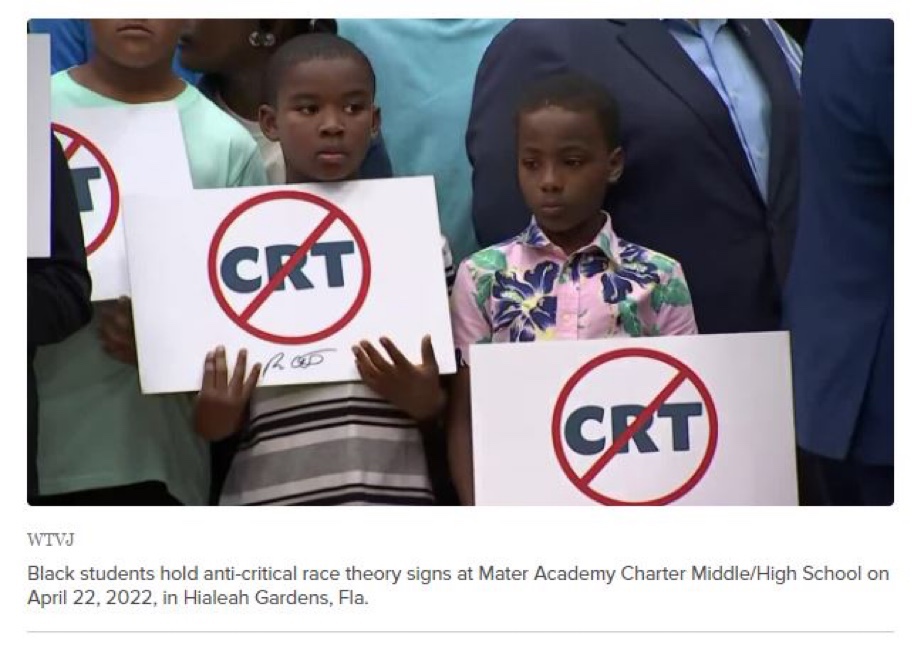
Blogger Carl Petersen posted this photo on Twitter.

Do you sincerely believe that any Black student opposes teaching about the history of racism? Isn’t it amazing to see this photograph of Black students attending the for-profit Mater Academy in Florida , holding up signs opposing critical race theory? CRT means an analysis of the roots of racism in our history, our laws, and our politics.

Governor Ron DeSantis signed the anti-CRT bill at the same charter school. He believes that teaching the truth is hateful.

Do you think these children actually oppose CRT?

Or were they indoctrinated?

Maurice Cunningham wrote in the Tampa Bay Tribune about “Moms for Liberty.” It seems to be a Dark Money front for some familiar billionaires.

Is it Koch? DeVos? Waltons? Or another billionaire?