Archives for category: Democracy

Heather Cox Richardson wrote the following brilliant article about the machinations of the Republican Party in North Carolina. Since winning control of the General Assembly (legislature) in 2010, the state GOP has gerrymandered Congressional districts and state districts to hold onto power. Democrats win statewide races, as they did in 2024, but the legislature strips the powers of the Governor and the state Attorney General.

It’s a shocking story .

She writes:

Almost ten weeks after the 2024 election, North Carolina remains in turmoil from it. Voters in the state elected Donald Trump to the presidency, but they elected Democrat Josh Stein for governor and current Democratic representative Jeff Jackson as attorney general, and they broke the Republicans’ legislative supermajority that permitted them to pass laws over the veto of the current governor, Democrat Roy Cooper. They also reelected Justice Allison Riggs, a Democrat, to the state supreme court.

Republicans refuse to accept the voters’ choice.

In the last days of their supermajority, under the guise of relieving the western part of the state still reeling from the effects of late September’s Hurricane Helene, Republican legislators stripped power from Stein and Jackson. They passed a law, SB 382, to take authority over public safety and the public utilities away from the governor and prohibited the attorney general from taking any position that the legislature, which is still dominated by Republicans, does not support.

The law also radically changes the way the state conducts elections, giving a newly elected Republican state auditor power over the state’s election board and shortening the amount of time available for the counting of votes and for voters to fix issues on flagged ballots.

Outgoing governor Cooper vetoed the bill when it came to his desk, calling it a “sham” and “playing politics,” but the legislature repassed it over his veto. Now he and incoming governor Stein are suing over the law, saying it violates the separation of powers written into North Carolina’s constitution.

There is an important backstory to this power grab. North Carolina is pretty evenly split between Democrats and Republicans. In 2010, Republican operatives nationwide launched what they called Operation REDMAP, which stood for Redistricting Majority Project. The plan was to take control of state legislatures across the country so that Republicans would control the redistricting maps put in place after the 2010 census.

It worked. In North Carolina, Republicans took control of the legislature for the first time in more than 100 years. They promptly redrew the map of North Carolina’s districts so that the state’s congressional delegation went from a split of 7 Democrats and 6 Republicans in 2010 to a 9–4 split in favor of Republicans in 2012 despite the fact that Democrats won over 80,000 more votes than their Republican opponents. By 2015 that split had increased to 10–3.

The same change showed in the state legislature. North Carolina’s House of Representatives has 120 seats; its Senate has 50 seats. In 2008, Democrats won the House with 55.14% of the vote to the Republicans’ 43.95%. And yet in 2012, with the new maps in place, Republicans won 77 seats to the Democrats’ 43. The North Carolina Senate saw a similar shift. In 2008, Democrats won 51.5% of the vote to the Republicans’ 47.4%, but in 2012, Republicans held 33 seats to the Democrats’ 17.

When they held majorities in both chambers, Democrats passed laws that made it easier to vote, and voter turnout had been increasing with more Black voters than white voters turning out in 2008 and 2012. But in 2012, Republicans used their new power to pass a sweeping new law that made it harder to vote.

When courts found those maps unconstitutional because of racial bias, the state legislature wrote a different map divided, members said, not according to race but according to political partisanship, despite the overlap between the two.

“I’m making clear that our intent is to use the political data we have to our partisan advantage,” said state representative David Lewis, who chaired the redistricting committee. “I propose that we draw the maps to give a partisan advantage of 10 Republicans and three Democrats because I do not believe it’s possible to draw a map with 11 Republicans and two Democrats.” Lewis declared: “I think electing Republicans is better than electing Democrats. So I drew this map to help foster what I think is better for the country.”

That map, too, skewed representation. Although Democrats won a majority of votes for both the state House and the state Senate in 2018, Republicans held 66 out of 120 seats in the House and 29 of 50 seats in the Senate. Although they had lost the majority of the popular vote, Republican leaders claimed “a clear mandate” to advance their policies.

The fight over those maps went all the way to the Supreme Court, which said in Rucho v. Common Cause that the federal courts could not address partisan gerrymandering. Plaintiffs then sued under the state constitution, and in late 2019 a state appeals court agreed that the maps violated the constitution’s guarantee of free elections. A majority on the state supreme court agreed.

The court drew a new map that resulted in an even split again in the congressional delegation in 2022 (North Carolina picked up an additional representative after the 2020 census). But Republicans in that election won two seats on the North Carolina Supreme Court. In late spring 2022 the new right-wing majority said the state courts had no role in policing gerrymandering. The state legislature drew a new congressional map that snapped back to the old Republican advantage: in 2024, North Carolina sent to Congress 10 Republicans and 4 Democrats.

But they also reelected Justice Allison Riggs, a Democrat, to the North Carolina Supreme Court, by 734 votes. Her challenger, Republican Jefferson Griffin, has refused to concede, even after the two recounts he requested confirmed her win. He is now focusing on getting election officials to throw out the ballots of 60,000 voters, retroactively changing who can vote in North Carolina.

There has been a fight over whether the case should be heard in federal or state court; Griffin wants it in front of the state supreme court, which has a 5–2 majority of Republicans. Last Tuesday the state supreme court temporarily blocked the state elections board from certifying Riggs’s win while it hears arguments in the case.

As Will Doran of WRAL News explains, Republicans currently have a court majority, but three of the seats currently held by Republicans are on the ballot in 2028. Taking a seat away from Riggs would ensure Democrats could not flip the court, leaving a Republican majority in place for redistricting after the 2030 census.

The Princeton Gerrymandering Project gives North Carolina an “F” for its maps. In states that are severely gerrymandered for the Republicans, politicians worry not about attracting general election voters, but rather about avoiding primaries from their right, pushing the state party to extremes. In December, Molly Hennessy-Fiske of the Washington Post noted that Republican leaders in such states are eager to push right-wing policies, with lawmakers in Oklahoma pushing further restrictions on abortion and requiring public schools to post the Ten Commandments, and those in Arkansas calling for making “vaccine harm” a crime, while Texas is considering a slew of antimigrant laws.

This rightward lurch in Republican-dominated states has national repercussions, as Texas attorney general Ken Paxton in December sued New York doctor Margaret Daly Carpenter for violating Texas law by mailing abortion pills into the state. Law professor Mary Ziegler explains that if the case goes forward, Texas will likely win in its own state courts. Ultimately, the question will almost certainly end up before the U.S. Supreme Court.

In the United States today, a political minority has used the mechanics of government to take power and is now using that power to impose its will on the majority. The pattern is exactly that of the elite southern enslavers who in the 1850s first took over the Democratic Party and then, through it, captured the Senate, the Supreme Court, and the White House and tried to take over the country.

The story of the 1850s centered around the determination of southern planters to preserve the institution of human enslavement underpinning the economy that had made them rich and powerful, and today we tend to focus on the racial dominance at the heart of that system. But the political machinations that supported their efforts came from the work of New York politician Martin van Buren, whose time in the White House from 1837 to 1841 ultimately had less effect on the country’s politics than his time as a political leader in New York.

In the early 1800s, van Buren recognized that creating a closed system in the state of New York would preserve the power of his own political machine and that from there he could command the heavy weight of New York’s 36 electoral votes—the next closest state, Pennsylvania, had 28, after which electoral vote counts fell rapidly—to swing national politics in the direction he wanted. Van Buren’s focus was less on reinforcing enslavement for racial dominance—although he came from a family that enslaved its Black neighbors—but on money and power.

Van Buren set up a political machine known as the Albany Regency, building his power by taking over all the state offices and judgeships and by insisting on party unity. He opposed federal funding of internal improvements in the state, recognizing that such improvements would disrupt the existing power structure by opening up new avenues for wealth. Elected to the U.S. Senate in 1820, he used his machine to elect Andrew Jackson to the White House on a platform promising “reform” of the federal government calling for economic development, a government the Democrats claimed had fallen into the hands of the elite. Once in power, Jackson used the federal government to benefit the enslavers who dominated the southern states.

That focus on preserving power in the states to keep political and economic power in the hands of a minority is a key element of our current moment. After the 1950s, as federal courts upheld the power of the federal government to regulate business and promote infrastructure projects that took open bids for contracts, they threatened to disrupt the economic power of traditional leaders. While state power reinforces social dominance as a few white men make laws for the majority of women and racial, gender, and religious minorities, it also concentrates economic power in the states, which in turn affects the nation.

When a Republican in charge of state redistricting constructs a map based on his idea that “electing Republicans is better than electing Democrats,” and when a Republican candidate calls for throwing out the votes of 60,000 voters to declare victory in an election he lost, they have abandoned the principles of democracy in favor of a one-party state that will operate in their favor alone.
A group of professors in Florida filed a federal lawsuit against the 2023 state law banning teaching about diversity, equity, and inclusion, claiming that it restricts freedom of speech.

The law was enacted as part of Governor Ron DeSantis’s war on “woke,” meaning any teaching about or practice related to DEI.

The Orlando Sentinel reported:

TALLAHASSEE — A group of Florida university professors on Thursday filed a federal lawsuit challenging a 2023 state law and related regulations that prevent colleges from spending money on diversity, equity and inclusion initiatives, saying the restrictions are “punishing educators and students for expressing differing and disfavored viewpoints.”


The lawsuit, filed by the American Civil Liberties Union of Florida and Gibson, Dunn & Crutcher LLP on behalf of six professors, alleges that the restrictions violate educators’ and students’ speech rights and is chilling expression in public universities. It targets the 2023 law (SB 266) and rules passed last year by the state university system’s Board of Governors.


“Continuing its effort to police the marketplace of ideas, the Florida Legislature again passed vague, viewpoint-discriminatory legislation that broadly restricts academic freedom and imposes the state’s favored viewpoints on public higher education, punishing educators and students for expressing differing and disfavored viewpoints,” the lawsuit said.


The restrictions ban funding for programs or campus activities that advocate for diversity, equity, or inclusion or that engage in “political or social activism.”

One of the rules defines DEI as “any program, campus activity, or policy that classifies individuals on the basis of race, color, sex, national origin, gender identity, or sexual orientation and promotes differential or preferential treatment of individuals on the basis of such classification.” Colleges and universities risk losing funding if they violate the restrictions.
The lawsuit alleged that the regulations’ definitions are “ambiguous, inconsistent, and far too broad to provide any real guidance other than indicating the Legislature’s and the BOG’s (Board of Governors’) intent to disfavor certain speech.”


The restrictions “have left instructors and students fearful for the future of not only education, but also free thought and democracy in Florida,” the professors’ lawyers wrote.
The rules have “stripped hundreds of university courses” from being designated as “general education” courses, according to the lawsuit. Universities also have denied scholarship and research money to faculty and students who have received it in the past.

Sherrilyn Ifill is a law professor who holds an endowed chair at Howard University. She is a former president and director-counsel of the NAACP Legal Defense Fund.

In this post, she offers sage advice about how to recharge your batteries and re-engage in the struggle for a better society. She wrote this piece soon after the 2024 election. It’s good advice.

….But ours is a subtle strength
Potent with centuries of yearning,

Of being kegged and shut away
In dark forgotten places.
We shall endure
To steal your senses
In that lonely twilight
Of your winter’s grief.


-Pauli Murray, To the Oppressors (1939)            

The truth is that things are going to get very bad. America has gone over the cliff’s edge. How hard we land in the ravine below remains to be seen. But we are one week in, and things are already quite dire. Trump’s first round of cabinet nominees, and his insistence that his picks be installed without a vote of Congress is a defining moment. It demonstrates that there will be no bottom with this Administration.

Donald Trump and his coterie of supporters are firmly in control of the most powerful and wealthy country in the world. And because they are in charge of this country – which perhaps undeservedly,  has stood as an example throughout much of the world as a symbol of freedom, equality, ethics, the rule of law and democracy – other countries will fall in our wake.

I am saying this now because I have always tried to be honest in my writings and analysis about this country. I say all of this because I have been able over the years to encourage my clients, my colleagues, my staff, my family and community to believe that we can fight and win. I have infected other people with my unshakeable optimism about what we can accomplish to transform this country.

I am going to keep fighting. It’s what I do. But I do not want to lead you astray. Because I do think that many of us – especially those of us in communities likely to be targeted by this Administration – need to see this moment as one in which we are focused on surviving this difficult time. I have faced the fact that we will not be able to move much forward in the next few years. In fact, I expect things to become so dire over the next two years, that we will scarcely recognize the country we live in. I expect that fear and cruelty will become part of our daily diet. We will hear the frightening sound of silence, as those who speak out most boldly against the excesses of the incoming administration, against its policies, against Musk and against Russia, find themselves at cross-purposes with a vindictive and cruel administration with almost unimaginable power to control communications, law, and the sense of reality itself.

Perhaps it won’t be that bad. But we are here in some measure, because far too many failed to imagine that the worst could happen. I have written already about “the nadir,” and I believe we must face it.

And so, our goal now must be first and foremost to survive this dark period with as much of our values, dignity, integrity, work, financial stability and physical and mental health intact as possible. We must also work to protect our families and communities, and to hold in place our most trusted and needed institutions, a modicum of the rule of law, our constitutional commitment to equality and to free expression.
As I have said in earlier pieces, this is “planting time.” Planting is work. That work must be aimed at building ideas, theories, paradigms, institutions, skills, practices, and alliances that we can seed now for a future harvest – a fulsome and lush democracy that will reflect the very best of us.

We are not “watching the Trump show” this time. We’ve seen it already. We can dip in every now and then, but we must not become paralyzed watching the train wreck. We will, of course, push back against injustice, and defend our rights and citizenship when necessary in the courts. We will demand that congressional representatives, our Governors and our Mayors, act to protect our democratic rights. Even when we know they will not stand up for what is right, we must not be silent. We must not make it easy for them to be cowards or to take our rights. We must still call, write and email our representatives and show up at town halls and meetings. Remember that those who have fought for us over these past years are tired too. Let them see us in these spaces and hear from us.

But our primary work must be first and foremost to work in our communities – both physical and ideological. To build them up and to share time and ideas with those committed to democracy and justice. We each need a curriculum of local service.

We also need a personal curriculum that will allow us to contribute to the building of the future we dream of for ourselves and our families. That means that our core work must be to commit during this time to do less watching, and more learning and more growing. We need to become better citizens for the democracy we want. That means we must dedicate time to expanding our thinking and our knowledge, and to building up our democratic imagination. That means our work is to imagine, to ally, to experiment, restore, befriend, study, read, write, serve, and create. Every one of us. Even as chaos swirls around us.

I encourage you to show your children and grandchildren real things – nature, animals, how things are built, how to cook from scratch. Teach them cursive writing, so that they have a signature all their own. Take them to live concerts and theater. Go on field trips. Infuse their lives with memories of things that are true and concrete.

If you teach, use primary documents in your teaching, take your students to historic sites, listen to audio of oral arguments and speeches so that they will feel confident in their understanding of history, and know that history was made by human beings not machines.

If you litigate, do it with the expectation that you will win. And act like it. Show out. Be excellent and remain confident. Those who can still feel shame – whether those at your opponents table or those on the bench – will feel it when you hold the standard high. And your clients will never forget it.

If you organize, never stop. Plant those seeds deep in our communities.

If you hold office. Hold it. Do not give up your power. Use your voice. Master every rule. Make a record. I repeat. Make a record–so that the truth might be known.

To protect ourselves and our loved ones, there are also pragmatic things we must do. I’ve thought of a few:

  • Save some cash. And keep enough in the house for gas and food for a week.
  • Let yourself imagine what you would do if you lost your job in terms of finding new employment, paying rent/mortgage for several months, and start building what you need to be able to meet that moment if it comes.
  • Get needed vaccinations in case new HHS policies result in changes or delays in their development or availability. Stock up on COVID tests, and get the most recent COVID booster. Purchase Plan B if it’s available in your area.
  • Think about tightening security on your electronic devices. Be more thoughtful about social media, and even return to making phone calls and writing letters in some instances. I know it’s old school, but actually memorize the phone numbers of at least two loved ones.
  • Gird yourself spiritually, through your faith or other meditative practices, as we are all likely to hear or confront many disturbing and ugly interactions. Experience art, go on walks, dance, play Spades, Dominoes, Scrabble. We need resilience.
  • Walk away when you need to walk away. Challenge when you need to. Try to always have back up.
  • Take the bystander training offered by groups https://righttobe.org/ so that when you see outrages committed against members of your community or against strangers, you will have practice in how you might intervene or respond.
  • Get an online subscription to a news service from another country so that you have a reliable sense of what’s going on in the world, and how this country is being perceived.  
  • Are your taxes paid, or more importantly, filed?
  • Is your passport up-to-date?
  • If you have money to give – then give to your local library, the food pantry, homelessness services. But also give to cultural institutions. Get a library card and a membership to a museum. Give to organizations working to hold back the worst that this administration may dish out – the NAACP Legal Defense Fund, the ACLU, the National Women’s Law Center, and so many others.
  • I am going to write more in this space. I hope you’ll subscribe and even pay a nominal fee to sustain the writing. I’m right here, going through this with all of you. And for me there is beauty in our shared walk. Let’s do this together.

Doktor Zoom writes on the blog Wonkette. This is an excellent commentary on Biden’s farewell address.

President Biden made mistakes. He was not perfect. But he survived an unprecedented barrage of defamation from the Republications, who did everything possible to portray him as a criminal and to destroy his son. Never mind that the Republican’ star witness against the Bidens was an FBI informant who falsely claimed that Biden and Hunter took millions in bribes, and eventually confessed to being a Russian plant; he was recently sentenced to six years in prison.

Biden is a good man. He is a man with a heart. He is deeply empathetic. We can’t say the same for the felon who succeeds him.

And, despite razor-thin numbers in both houses of Congress, he managed somehow to pass a remarkable lot of legislation that will rebuild our nation’s infrastructure, create good jobs, attract new industries, revive technology manufacturing, and address climate change. Trump inherits a thriving economy–the best in the world–and will claim credit for it. In the 48 months of Biden’s time in office, there was job growth inbb by every single month. Furthermore, he relieved the debts of millions of students, prioritizing those who got debt forgiveness in return for public service. The Republicans accused him of buying votes, but they lied: Biden continued to forgive college debt after the election.

And that Norman Rockwell painting portrayed in the post? It hangs in Biden’s White House. You can be sure it will be moved to storage on Monday.

Doktor Zoom writes:

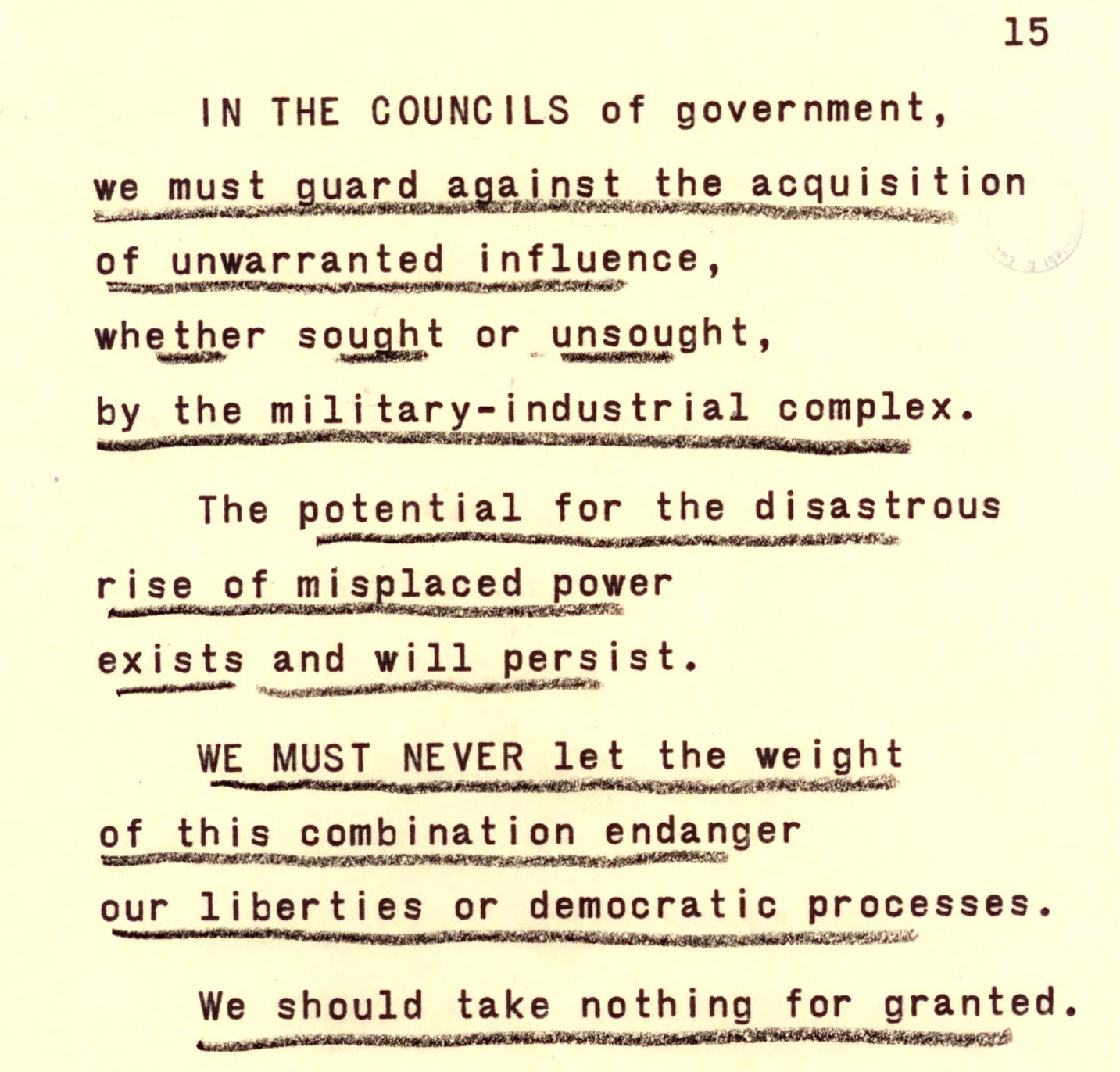
….Biden made an explicit parallel to Dwight D. Eisenhower’s farewell address, which warned about the threat of the “military-industrial complex” that nevertheless still has a stranglehold on our economy and politics in a “disastrous rise of misplaced power.” 

Today, Biden said, we should be wary of the “potential rise of a tech-industrial complex”: 

“Americans are being buried under an avalanche of misinformation and disinformation enabling the abuse of power. The free press is crumbling. Editors are disappearing. Social media is giving up on fact-checking. The truth is smothered by lies told for power and for profit.”

He didn’t name Donald Trump explicitly, just some of those forces that helped him retake power, and which threaten to help Trump and his billionaire buddies undo democracy.

Biden also offered some very concrete steps that might help rein in the destructive forces, although the chances they’ll be enacted during the tenure of the Lord of Misrule seem slim. He started with the easy stuff that won’t happen under Trump. 

“We must reform the tax code. Not by giving the biggest tax cuts to billionaires, but by making them begin to pay their fair share.

“We need to get dark money — that’s that hidden funding behind too many campaign contributions — we need to get it out of our politics.”

Then it was on to three ideas that will almost certainly have to wait until we bury Trumpism, at the very least. 

“We need to enact an 18-year time limit, term limit […] and the strongest ethics reforms for our Supreme Court. We need to ban members of Congress from trading stock while they are in the Congress. We need to amend the Constitution to make clear that no president, no president is immune from crimes that he or she commits while in office. The president’s power is … not absolute. And it shouldn’t be.”

OK, maybe the second one, the ban on members of Congress trading stocks, has some ghost of a chance; it also wouldn’t really do anything to keep Trump in check, though it’s certainly a general good-government idea. Maybe Biden threw it in for the sake of parallelism, to call for reforms in all three branches of government. 

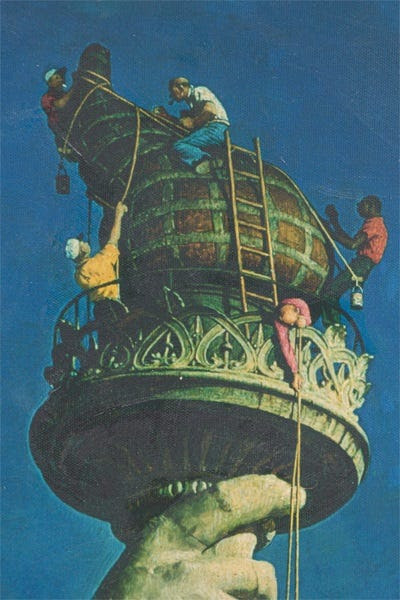
Letting the super-wealthy run things, Biden reminded us, is a recipe not just for oligarchy, but for despair: If everyone knows the system is rigged, we all too often give up, or lash out in violence, neither of which is good for democracy. He offered as a hopeful metaphor an image from a 1946 Norman Rockwell painting that hangs in the White House, showing a crew of workers cleaning the torch on the Statue of Liberty, so its “rays of light could reach out as far as possible.” Keeping that torch lit is the work we all have to do as citizens. And while Biden didn’t mention this detail, do keep in mind that Liberty is not enlightening the world with a damn tiki torch, either. 

The bald guy with the pipe is a caricature of Rockwell. Wikipedia notes that ‘The inclusion of a non-white figure working with whites, apparently only noticed in 2011, contravened a Saturday Evening Post policy of only showing people of ethnicity in subservient roles.’ Darn that DEI! 

Biden closed with a rather remarkable passing of the torch, not so much to the incoming wrecking crew, but to the only people who can stop those bastards: Us. 

“I still believe in the idea for which this nation stands — a nation where the strength of our institutions and the character of our people matter and must endure. Now it’s your turn to stand guard. May you all be the keeper of the flame. May you keep the faith. I love America. You love it, too.”

What a contrast to the rhetoric of Ronald Reagan, who blithely called America a “shining city on a hill” because it’s so plainly the bestest place possible. (As Sarah Vowell reminds us, adding “shining” was a sunny perversion of the original Puritan metaphor’s dour intent, which warned that everyone would see our sins, like Abu Ghraib). 

But America isn’t a self-illuminating beacon of virtue that’s virtuous just because it’s America. Instead, Biden argues, the light of freedom requires constant maintenance and renewal — and it only keeps shining if we do the hard, even risky work of participatory democracy. 

We’re going to miss that guy.

James Fallows is a veteran journalist who has covered national and international politics for decades.

In this post, he explains why Joe Biden’s farewell address surprised him. He expected the same tone and substance he had heard for years. But the last eight minutes were different.

He writes:

I turned on Joe Biden’s Oval Office speech last night mainly from a sense of duty. I’d followed this man’s discourse generally over the decades, and very closely through these past few years. So I might as well see him out.

(For instance, with this look at a State of the Union address two years ago; this about the “music” of Biden’s rhetoric — “like the joke about Wagner’s music, it’s better than it sounds”; this about his challenges as “explainer”; these two—first, and second—about his speeches on the future of democracy one year after the January 6 attacks; and this about his powerful speech at Morehouse College last year. I even proposed a draft speech Biden could give about choosing not to run again, several weeks before he made that announcement for real.)

A running theme in these speech-related items has been Biden’s preference to “deliver tough messages softly,” rather than in a combative tone like Harry Truman’s or Teddy Roosevelt’s. And that is what I expected last night.

Through the first half of the speech, I listened on cruise-control, thinking that I’d been right on how the speech would go. Then suddenly I realized I had been wrong. The final eight minutes of Joe Biden’s final presentation in public life were different from the thousands of hours of rhetoric by him through his career, in a dramatic and instructive way. 

A comparison with another old, departing president is inescapable, and clarifying.


January, 1961: Dwight Eisenhower on the ‘military-industrial complex.’

Dwight Eisenhower is known as the great Allied commander of D-Day, and as a hero who became the first Republican to win the White House since 1928. He was so popular that after incumbent president Harry Truman decided not to run again himself, he tried to persuade Eisenhower to run as a Democrat.

But in rhetoric Eisenhower is known only for two things. One is the speech he did not have to give, in 1944. That is the statement he would have issued if the D-Day landing had failed, in which he would have taken personal responsibility for what had gone wrong. (As he put it in his handwritten draft, “If any blame or fault attaches to the attempt, it is mine alone.”)

The other is the final speech he gave as president, his televised “Farewell Address” from the White House three days before he stepped down. The speech got only limited attention at the time. The incoming Kennedy team was young, exciting, a magnet for news. Eisenhower was old, tired, yesterday’s story. 

But as the years go on the Farewell Address has steadily grown in attention and importance. There’s a whole, thick book about the crafting and consequences of this one speech. (That is Unwarranted Influence, by the late James Ledbetter, back in 2011.) This was the speech that delivered the hard-edged warning about the growing anti-democratic influence of the “military-industrial complex,” and introduced that term to popular discourse. The warning was all the more powerful in coming from a revered five-star general. 

You can hear the original audio of Eisenhower delivering the speech in the embedded clip just below. The part that lives in history begins around time 7:30. The 100 seconds that follow are truly remarkable rhetoric, which repay very careful listening. This part is worth actually hearing for yourself.¹LISTEN NOW · 15:31

And here is the script from which Eisenhower read those words, as his final message as an office-holder. The underlines were for his planned cadence—pauses, emphases, multi-word phrases that should be read legato-style, as a smoothly connected whole. 

Share


January, 2025: Joe Biden, on the ‘tech-industrial complex.’

Nothing in Dwight Eisenhower’s previous rhetoric prepared the public for his farewell address. Nothing in Joe Biden’s pattern of speeches prepared me for the way he ended last night.

Through the first few minutes of Biden’s farewell presentation, I had a sense of the familiar. As expected, the speech took us through highlights of his administration’s achievements, especially on the economy, which (as I’ve frequently argued) will be judged much more favorably by history than they have been by the press or the 2024 electorate.²

And just as predictably, the speech would give us the story of Scranton Joe, and why his long journey has made him believe all the more deeply in the American Dream. That is where he seemed to be going with the elaborate curlicues of his Statue of Liberty analogy, which he pushed to the breaking point and which took nearly three minutes of the speech to spell out.³

Most of Biden’s recent speeches have ended with the assurance that he has “never felt more positive about America.” That’s what he still seemed to be saying when talking about the upcoming “peaceful and orderly transition of power.” A reference to this “peaceful transition” has been part of every farewell address I’ve ever looked at, and to every Inaugural Address⁴—even, grudgingly, the one given eight years ago

Indeed, because of his commitment to that process, Biden said, he “had no doubt that America is in a position to succeed.” But as soon as he had finished those words, about half way into the speech, everything changed.


‘I want to warn the country…’

He paused. He sat up straighter. Until then his body language and tone had seemed valedictory and going-through-the-motions. Suddenly he seemed urgent and engaged. His hands had been neatly folded. Now he gestured directly toward the camera with a pen in one hand. And he said these words:

In my farewell address tonight, I want to warn the country of some things that give me great concern. 

I said to Deb, “Eisenhower.” And our body language, as listeners, also changed. We leaned closer to the TV as Biden laid out his blunt indictment of “the dangerous concentration of power in the hands of a very few ultrawealthy people, and the dangerous consequences if their abuse of power is left unchecked.” 

What were these “concerns,” that troubled a president at the end of four years in the White House, and of half a century in public life? Biden dug right in, including using a word (oligarchy) I don’t think has appeared in presidential annals before.

Today, an oligarchy is taking shape in America of extreme wealth, power and influence that literally threatens our entire democracy, our basic rights and freedoms and a fair shot for everyone to get ahead. We see the consequences all across America. And we’ve seen it before.

Biden went on for a full three minutes in this vein, with comparisons to the worst of the robber barons of the Gilded Age. Only then did he make another historical connection explicit: 

You know, in his farewell address, President Eisenhower spoke of the dangers of the military-industrial complex.

He warned us about, and I quote, “The potential for the disastrous rise of misplaced power.” Six decades later, I’m equally concerned about the potential rise of a tech-industrial complex that could pose real dangers for our country as well.

He went on to detail, much more specifically than Eisenhower had, exactly why this new oligarchy imperiled democracy. He referred to technologies and challenges that didn’t exist in Eisenhower’s time—TV itself was relatively “new” in 1961—and expressed concerns are at the center of tech-savvy debate in 2025:

Americans are being buried under an avalanche of misinformation and disinformation enabling the abuse of power. The free press is crumbling. Editors are disappearing. Social media is giving up on fact-checking. The truth is smothered by lies told for power and for profit. We must hold the social platforms accountable to protect our children, our families and our very democracy from the abuse of power.

The was nothing quaint or old-timey—Bidenesque—about this. It was as direct an indictment of the corruption of money-power as we’ve heard from a serving president in our times. From FDR or Truman? Sure, but that was long ago. …

To finish reading this insightful post, you must subscribe to Fallow’s Substack blog.

For decades, The Washington Post has been one of the nation’s premier newspapers, widely admired for its fearless journalism. During the McCarthy era in the 1950s, The Post held the reckless Senator from Wisconsin to account. It took the lead in exposing Watergate. A job at The Washington Post was a prize for any journalist.

Jeff Bezos bought the paper in 2013. It was widely assumed that he had “saved” the paper from its financial woes because of his wealth and that he would not interfere with its editorial independence.

But recently, Bezos’ stance changed. He hired Will Lewis, an editor from the despicable Murdoch empire, to turn the paper around financially. The paper has experienced layoffs and censorship. When Bezos’ spiked the editorial board’s endorsement of Kamala Harris last fall, more than 300,000 subscribers canceled. When an editorial cartoon lampooning billionaires (including Bezos) courting Trump was killed, the cartoonist quit.

The morale of the staff hit rock-bottom.

David Folkenflik of NPR reported on the rebellion among the journalists:

One debacle after another has engulfed The Washington Post since veteran newspaper executive Will Lewis became CEO and publisher a year ago this month, with the charge from owner Jeff Bezos to make the storied newspaper financially sustainable.

The appointment of a new executive editor was botched. A killed presidential endorsement led hundreds of thousands of subscribers to cancel. Top reporters and editors left. Scandals involving Lewis’ actions as a news executive years ago in the U.K. reemerged. A clear vision to secure the Post’s financial future remains elusive.

Frustration boiled over on Tuesday night. More than 400 Post journalists, including some editors, signed a petition asking Bezos to intervene.

“We are deeply alarmed by recent leadership decisions that have led readers to question the integrity of this institution, broken with a tradition of transparency, and prompted some of our most distinguished colleagues to leave,” it reads, in part.

The petition never cites Lewis by name, but it reads as a sharp indictment of his leadership. Through a spokesperson, Lewis and the Post declined comment for this story. A representative of Bezos did not return a request for comment.

For this story, NPR interviewed 10 Washington Post staffers inside the newsroom and on the business side of the paper, including some who did not sign the petition. They agreed to speak to NPR under condition of anonymity for fear of repercussions inside the paper.

They say the backlash against Lewis encompasses Bezos to some degree, as he has publicly warmed up to President-elect Donald Trump. (The Post declined comment.)

Bezos’ decision to kill a planned endorsement of Vice President Kamala Harris just days before the November election led more than 300,000 subscribers to cancel, wiping out much more modest gains The Post had achieved under Lewis. (A spokesperson says The Post has convinced about 20% of those cancelling over the endorsement to remain subscribers.)

The decision also led to some resignations. Recent days at the Post have witnessed the continuation of a months-long parade of departures of highly regarded newsroom veterans — most recently, Pulitzer Prize-winning reporter Rosalind Helderman, investigative reporter Josh Dawsey and columnist Jennifer Rubin. Pulitzer-winning cartoonist Ann Telnaes quit after her sketch showing Bezos kneeling before Trump with a bag of money was rejected.

The tech titan’s business interests, including Amazon Web Services and the space company Blue Origin, receive billions of dollars from federal contracts. He’s given $1 million toward Trump’s inauguration costs and traveled to Mar-a-Lago with his fiancée to meet with the president-elect. Amazon Studios agreed to pay Melania Trump millions of dollars for a documentary project about her, according to Puck News. Come Monday, Bezos is expected to join Trump advisor Elon Musk and Meta founder Mark Zuckerberg on the inauguration platform itself.

The petition asked for a meeting with Bezos.

Open the link to continue reading this important article.

During his campaigns, Trump has insisted that he will ban lobbyists from his team and limit their access to him. This was part of his “drain the swamp” pledge.

But it is a new day in Trump world. Trump hired corporate lobbyist Susie Wiles as his chief of staff, and she will determine who gets meetings with him, which invitations he accepts, which phone calls.

Judd Legum wrote about her role in the new administration:

During the 2024 campaign, Trump condemned the power of lobbyists in Washington, DC, and pledged that, if he returned to the White House, they would have no influence. “Above all, you deserve leadership in Washington that does not answer to the lobbyists… or to the corrupt special interest but answers only to you, the hardworking citizens of America,” Trump said during a campaign rally in Butler, Pennsylvania, on October 5, 2024.

During an interview with podcaster Theo Von on August 20, 2024, Trump stressed that the key to effective government is to “stop listening to lobbyists,” describing himself as “not a big person for lobbyists.” Trump bemoaned that the lobbyists were “winning” at the expense of the American public. When Von pressed Trump on how, exactly, he would limit lobbyists’ influence, Trump suggested ending the revolving door between lobbying and the federal government. “[O]ne way you could stop it is to say if you’re going to go into government, you can never be a lobbyist,” Trump said.

Two days after he won the election, Trump announced his first selection for his White House staff. He picked corporate lobbyist Susie Wiles to be White House Chief of Staff.

In 2011, Wiles joined the Ballard Partners, a Florida lobbying firm founded by Republican operative Brian Ballard. In 2015, according to a report in the New York Times, Trump asked Ballard who could help him win the state. Ballard recommended Wiles. After Trump won the 2016 election, Wiles decided to help Ballard “set up a Washington office rather than join the new administration.” Prior to Trump winning the White House, Ballard Partners had no federal clients.

It was a lucrative decision, with Ballard Partners raking in $70 million in lobbying fees during the first Trump presidency. Wiles personally represented numerous corporate clients for millions in fees, including Swisher Sweets, a tobacco company that markets candy-flavored cigars, Republic Services, a waste management company seeking to avoid a federal requirement to remove radioactive material from a dump in the St. Louis suburbs, and the Consumer Energy Alliance, a front group for the fossil fuel industry.

Most controversially, Wiles registered as “a lobbyist for Globovisión, a Venezuelan TV network owned by Raúl Gorrín.” Globovisión paid Ballard Partners “$800,000 for a year of work.” The contract was purportedly to provide advice on “general government policies and regulations.” But it soon became clear that the contract was part of Gorrin’s “quiet charm offensive for Nicolás Maduro’s government that sought closer ties with Trump.” Days after Ballard Partners dropped Globovisión as a client, Gorrin was charged “for his role in a billion-dollar currency exchange and money laundering scheme.” In 2019, Wiles also registered as a foreign agent for a Nigerian political party.

Even after Wiles was tapped to lead Trump’s 2024 campaign, she continued working as a federal lobbyist, this time as the co-chair of the lobbying firm Mercury Public Affairs. Wiles reportedly maintained that position until she was named Trump’s new Chief of Staff. The Trump campaign claimed she stopped doing work for Mercury Public Affairs beginning in November 2022, but that is contradicted by federal lobbying disclosures. Wiles was listed as Mercury’s sole lobbyist for Swisher Sweets’ parent company, collecting $30,000 in fees in the first quarter of 2024.

With Wiles in the White House, corporations rush to hire Ballard

Will Wiles’ position as Chief of Staff give the lobbying clients of Ballard Partners a powerful channel to influence federal policy? Federal lobbying disclosures tell the story. Since Wiles’ was named as Trump’s top White House aide, corporations have rushed to sign up Ballard Partners to represent them.

In the 66 days since Wiles’ role was announced, Ballard Partners has signed 28 new federal clients. The amount these new clients are paying has not yet been disclosed.

Among the new clients for Ballard Partners is the crypto company Ripple Labs. The company signed with Ballard Partners on November 13, 2024 and is seeking to influence “regulation of digital assets, cryptocurrencies and blockchain and related legislation.” Last Tuesday, Brad Garlinghouse, Ripple’s CEO, and Stuart Alderoty, Ripple’s Chief Legal Officer, had dinner at Mar-a-Lago with Trump….

Ballard lobbyist nominated to be Attorney General

Pam Bondi, Trump’s nominee for Attorney General, has worked as a lobbyist for Ballard Partners since 2019. During her tenure, Bondi has represented many clients whom she would be responsible for scrutinizing as the leader of the Department of Justice (DOJ).

Bondi was hired by Uber in 2020. While Bondi was representing Uber, the company allegedly violated the Americans with Disabilities Act by denying rides to blind customers accompanied by guide dogs. According to a July 2024 report by NBC Bay Area, the DOJ is actively investigating these violations. Bondi would now be in a position to decide whether charges should be filed against Uber or her other former corporate clients. Bondi also represented General Motors, which paid a $500,000 criminal fine in November 2024 for submitting a false report regarding its self-driving cars. The fine was paid as part of a deferred prosecution agreement with the DOJ.

Geo Group, a private prison company, hired Bondi in 2019 to lobby the first Trump administration, “promoting the use of public-private partnerships in correctional services.” As Attorney General, Bondi could play a key role in Trump’s promised mass deportation campaign, an effort that could mean hundreds of millions in annual revenue to Geo Group. Amazon also employed Bondi as a lobbyist. The massive online retailer and tech company has attracted interest from the DOJ’s antitrust division and, in July 2023, paid a $25 million civil penalty to resolve charges by the DOJ that its Alexa service violated child privacy laws.

As Attorney General of Florida, a position Bondi held before joining Ballard Partners, Bondi developed a reputation for her “business-friendly” attitude. Bondi, for example, decided to drop a case involving the underpayment of state taxes by the travel site Travelocity. Contemporaneously, a lobbying firm representing Travelocity “helped cover the bill to charter a plane to fly… Bondi and other attorneys general to Mackinac Island in Michigan for a meeting of the Republican Attorneys General Association.”

Notably, Eric Holder, who served as Attorney General during the Obama administration, also worked as a federal lobbyist before taking office.

Jeff Tiedrich writes a funny, scatologial post about the Pete Hegseth hearings. As he says, it’s going to be a long four years. You should subscribe to his blog so he can continue to write. In the last line of his post, not included here:

Donny Convict is what would happen if Dunning and Kruger had a baby, and then dropped it on its head. he’s too fucking stupid to know just how fucking stupid he is. he has these moronic ideas, and then blurts them out like he’s the biggest genius who ever lived. and the MAGA yokels are right there to gobble it all down. yay, Donny! yay, External Revenue Service

Wikipedia: The Dunning-Kruger effect is a cognitive bias that causes people to overestimate their abilities in a specific area, particularly when they have low ability in that task

Jeff writes:

the Confederacy of Sewer Clowns Big Top Confirmation Circus rolled into DC yesterday, and the first jester to summersault into the ring was Pete Hegseth.

Pete is, of course, the ahem allegedly publicly drunk, ahem allegedly sexual-abusing goon who Donny saw on Fox News and then picked to head the Department of Defense.

here are a few things we learned about ahem allegedly Piss-Drunk Pete.

Pete is catastrophically unprepared and unqualified for the job.

Senator Duckworth: “…you’re unqualified to do that. you can’t do the acquisition and cross-servicing agreements, which essentially are security agreements. you can’t even mention that. you’ve done none of those. you talked about the Indo-Pacific a little bit, and I’m glad that you mentioned it. can you name the importance of at least one of the nations in ASEAN, and what type of agreement we have with at least one of those nations, and how many nations re in ASEAN, by the way.”

Hegseth: “I couldn’t tell you.”

Senator Duckworth: “no, you couldn’t, because you couldn’t bother to—”

Hegseth: “I know we have allies in South Korea, Japan and Australia.”

Senator Duckworth: “none of those countries are in ASEAN. I suggest you do a little homework before you prepare for these types of negotiations.”

this is the crux of the matter. take away Pete’s ahem alleged predatory behavior towards women. take away the ahem alleged public drunkenness. Pete Hegesth utterly lacks the skills and knowledge required to head the Department of Defense — a massive bureaucracy that employs over 2.91 million people

as a member of the Minnesota National Guard, Pete rose to the rank of Major. after that, he became a Fox News morning chat-show bobblehead. there’s a reason that Defense Secretaries are almost always lifetime military officers: it takes a lifetime of experience to acquire the skills necessary to do the job. Pete has none of that.

Pete’s only real qualification for the job — the only qualification that matters to Dear Leader — is that he’ll willingly carry out any order. for instance, Pete seems totally cool with shooting American civilians.

Senator Hirono: “in 2020, then-President Trump directed former Secretary of Defense Mark Esper to shoot protestors in the legs in downtown DC — an order Secretary Esper refused to comply with. would you carry out such an order from President Trump to shoot protesters in the legs?”

Hegseth: [dodges the question]

Senator Hirono: “that sounds to me that you would comply with such an order. you will shoot protesters in the legs.”

Hegseth: [silence]

Subscribed

Pete believes the Geneva Conventions are an intrusive annoyance.

Senator King: “I want to be clear. are we going to abide by the Geneva Conventions and the prohibitions on torture or are we not?”

Hegseth: “what an America First national security policy is not going to do is hand its prerogatives to international bodies.”

oh, that’s lovely. we’re going to ignore a decades-old human rights agreement that almost every other nation on the planet abides by, because AMURRIKKKA FIRST. does Piss-Drunk Pete not realize that the Geneva Conventions also protects American soldiers and civilians? treaties only work when all countries abide by them. Pete should have learned this working well with others crap in kindergarten.

Pete seems totally cool with invading our allies’ territory.

Senator Hirono: “would you carry out an order from President Trump to seize Greenland, a territory of our NATO ally Denmark, by force?” 

Hegesth: “President Trump received 77 million votes—”

Senator Hirono: “we’re not talking about the election. my questions is, would you use our military to take over Greenland, an ally of Denmark?”

Hegesth: [refuses to answer the question]

Senator Hirono: “that sounds to me like you would contemplate carrying out such an order.”

Pete has a real problem with women in the military, and is also a willing firehose of right-wing propaganda.

Hegseth: “commanders meet quotas to have a certain number of female infantry officers or infantry enlisted. and that disparages those women—”

Senator Gillibrand: “commanders do not have to meet quotas for the infantry. commanders do not have to have a quota for women in the infantry. that does not exist. It does not exist. and your statements are creating the impression that these exist. because they do not. there are not quotas.”

Pete absolutely does not want women serving in the combat. he wrote a book about it. he thinks women serving in the military is just more DEI crap that the commie Democrats cooked up to make America weak. and Pete’s willing to lie and claim that female combat soldiers are being forced upon commanders.

this ‘women can’t do a man’s job’ nonsense is the same misogynistic bullshit we’re hearing from the screech monkeys, about how Los Angeles is burning to the ground because the LA fire chief is a lesbian.

in Donny Convict’s America, only white men should be in positions of authority.

now let’s ask a Republican why he’s on Team Piss-Drunk Pete.

Senator Rounds: “he wants to bring lethality back in.”

here’s the dictionary definition of lethalitythe capacity to cause great harm, destruction, or death — basically, what the United States Military already has.

so, why is Senator Rounds so excited to have the military “restored” to its current state? because MAGA Republicans have been brainwashed into believing that commie-marxist Democrats have turned the US armed forces into a bunch of emasculated sissiex who can’t fight. it’s why Esteemed Senator Fidel Cancun practically orgasmed over Russian army propaganda — because he believes this shit, too.

Donny Convict buys into this nonsense as well. he claims that when he took office in 2017, the army didn’t have any bullets.

it’s a lie so patently dumb that only a MAGA would believe it — but it’s why Republicans are so hot to have Pete come in. he’s going to bring back lethality — and brutality — against our allies, against American protesters, against anyone Dear Leader tells him to.

what could possibly go wrong?

Our reader who calls him/herself “Democracy” writes here about Jeff Bezos’ shameless betrayal of the founding principles of The Washington Post, as well as its recent motto “Democracy dies in darkness.” He not only canceled the editorial board’s endorsement of Kamala Harris (to avoid taking sides), but he (or David Shipley, editor of the editorial page), canceled a cartoon critical of billionaires (including Bezos) who rushed to pay court to the new, felonious president.

Why would a titan with assets of more than $200 billion bend his knee and kiss the ring of a convicted felon? Why would Mark Zuckerberg, also with assets of more than $200 billion, immediately made his peace with Trump by eliminating content moderation from Facebook, welcoming the return to FB of Nazis, conspiracy theorists, racists, and other malefactors. Are they fearful of losing a few billions? Are they worried about being left out of dinners at Mar-a-Lago?

Bear in mind that The Washington Post led the way in discrediting Joseph McCarthy (those who were alive then will never forget Herblock’s cartoons, portraying him as a thug) and exposing the Watergate Scandal, which led to the resignation of Richard Nixon.

Bezos’s cowardice is causing the loss of excellent journalists, readership, revenue–and most important–reputation.

“Democracy” wrote, as a comment on this blog:

When Eugene Meyer bought The Washington Post in 1933 he established seven “guiding principles” for the newspaper. At the very top was this:

“The first mission of a newspaper is to tell the truth as nearly as the truth can be ascertained.”

Some of the other principles were these:

*  “The newspaper’s duty is to its readers and to the public at large, and not to the private interests of its owners.”

*  “The Newspaper shall tell ALL the truth so far as it can learn it.”

*  “In the pursuit of truth, the newspaper shall be prepared to make sacrifices of its material fortunes, if such course be necessary for the public good.”

*  “The newspaper shall not be the ally of any special interest, but shall be fair and free and wholesome in its outlook on public affairs.”

Given what has happened to The Post in the last couple of years under Jeff Bezos, one of the richest people in the world, Eugene Meyer must be spinning in his grave.

Prior to the election, The Fiscal Times reported this:

“23 Nobel Prize-winning economists expressed support for the policies proposed by Kamala Harris, warning that the policies of her opponent would be ‘counterproductive.’…The 23 Nobel laureates — more than half of all living recipients of the economics award — said that the Harris agenda focused on the middle class and entrepreneurship would ‘improve our nation’s health, investment, sustainability, resilience, employment opportunities, and fairness.’…By comparison, Trump’s agenda of high tariffs and regressive tax cuts would ‘lead to higher prices, larger deficits, and greater inequality.’ In addition, in their view Trump represents a threat to the rule of law and political stability, necessary components of a thriving economy.”

The New York Times reported this:

“More than 80 American Nobel Prize winners in physics, chemistry, medicine and economics have signed an open letter endorsing Vice President Kamala Harris for president…The letter praises Ms. Harris for understanding that ‘the enormous increases in living standards and life expectancies over the past two centuries are largely the result of advances in science and technology.’ Former President Donald Trump, by contrast, would ‘jeopardize any advancements in our standards of living, slow the progress of science and technology and impede our responses to climate change,’ the letter said.”

And yet, Jeff Bezos SPIKED a Post endorsement of Harris, and then lied about it in a column that was shameful, dishonest, and disreputable to The Post and the quality journalists who work there, or who used to, because a number of them have already quit or are planning on exiting.

Bezos had a relatively simple choice.

Honor The Post’s masthead logo — “Democracy Dies in Darkness — AND the principles established by Eugene Meyer, OR not.

Bezos chose racism and misogyny and sedition, and fascism.

The Atlantic published a piece three days ago by historian Timothy Ryback on Adolf Hitler.Here’s an overview:

“Monday, he swore an oath to uphold the constitution, went across the street for lunch, then returned to the Reich Chancellery and outlined his plans for expunging key government officials and filling their positions with loyalists and  turned to his main agenda: an empowering law that would give him the authority to make good on his promises to revive the economy…withdraw from international treaty obligations, purge the country of foreigners, and exact revenge on political opponents. ‘Heads will roll,’ Hitler vowed…

“When Hitler wondered whether the army could be used to crush any public unrest, Defense Minister Werner von Blomberg dismissed the idea out of hand, observing ‘that a soldier was trained to see an external enemy as his only potential opponent.’…Blomberg could not imagine German soldiers being ordered to shoot German citizens on German streets in defense of Hitler’s government…Hitler had campaigned on the promise of draining the “parliamentarian swamp”—den parlamentarischen Sumpf—only to find himself now foundering in a quagmire of partisan politics and banging up against constitutional guardrails. He responded as he invariably did when confronted with dissenting opinions or inconvenient truths: He ignored them and doubled down.”

https://www.theatlantic.com/ideas/archive/2025/01/hitler-germany-constitution-authoritarianism/681233/

Sound familiar? 

You’d think that Jeff Bezos might be aware of all of this. He likely is. But he’s chosen to collude with Trump, presumably because it helps his bank account – as if he needs that. Bezos gave $1 million to the Trump inaugural fund, which presumably Trump will pocket, and he coughed up $40 million to produce a “documentary”on Melania Trump, set to air later this year. A. Documentary. On. Melania. Trump.

Honestly, given her “accomplishments,” couldn’t a suitable “documentary” be produced for about $40?

As someone who used to deliver The Post, and who has been a reader for more than 50 years, I think it only appropriate to tell Jeff Bezos from the bottom of my heart that he can Kiss My Ass.

The American democratic republic deserves better.

This was one of Jennifer Rubin’s last columns for The Washington Post. She resigned on January 13 to start The Contrarian, to be free of the whims of billionaire Jeff Bezos. Bezos wants to be Trump’s ally. Rubin wants to be an independent journalist.

She writes here about the mainstream media’s newfound appreciation for Biden’s economic policies. The latest jobs report showed a healthy increase of 256,000 new jobs, which stunned economists. During the Biden administration, new jobs were created in every quarter for four years. This is an enviable record.

Currently, Trump and Vance are saying on social media that they are inheriting “a dumpster fire.” It won’t take long until they claim credit for the vibrant economy they are inheriting from Joe Biden.

She writes:

The New York Times wrote a few days ago, “President Biden is bequeathing his successor a nation that by many measures is in good shape, even if voters remain unconvinced.” Just how good are things? Here’s how the Times described the state of the economy:

For the first time since that transition 24 years ago, there will be no American troops at war overseas on Inauguration Day. New data reported in the past few days indicate that murders are way down, illegal immigration at the southern border has fallen even below where it was when Mr. Trump left office and roaring stock markets finished their best two years in a quarter-century.

The Financial Times reported last week on “why America’s economy is soaring ahead of its rivals.” Time published an essay in November that said, “President-elect [Donald] Trump is receiving the strongest economy in modern history which is the envy of the world.”

Gosh, you are not alone if you are wondering where such upbeat reporting has been for the past few years. After all, “The economy had a strong 2024: robust growth, low unemployment and inflation descending to 3%,” former car czar Steve Rattner told us. Moreover, he has said, “All told, Biden has added 693,000 factory jobs while Trump added just 425,000 before Covid hit.7 … The rate of grocery inflation — particularly troubling for everyday Americans ­— has subsided to less than 1.6%.” Real median incomes are higher than when Trump left office, border crossings are lower.

Overall, the Biden record is impressive, especially in light of the recession and pandemic he inherited. Researchers at the University of Chicago told us: “Under the Biden administration, real GDP rose 12.6 percent, rightly cheered … as ‘a historically robust expansion’ that repeatedly defied forecasts. Since the pandemic, economic growth in the US has far outpaced that of our peer nations. Business investment is up; unemployment is low.”

There are several explanations for why we did not have coverage commensurate with the success President Joe Biden enjoyed. The news media’s fixation on polls showing what voters thought about the state of the economy and its negative news bias (which I have written about) that refused to give proper weight to Biden’s successes failed to give voters an accurate picture of Biden’s achievements. And yet now, somehow, with the election over, the media widely acknowledges that Biden’s record is strong, something they downplayed during the election.

We should not discount the disproportionate impact of rising costs (again, echoed without sufficient context in political coverage) on the public perception of the economy (which in turn got amplified to the exclusion of “good news” by the media). “Inflation in the United States reached 9% in 2022, meaning that the average cost of goods and services went up by that amount,” Johns Hopkins University’s David Steinberg explained. “That is the highest rate of inflation that this country has experienced in over 40 years.” While inflation has now dropped close to the Federal Reserve’s 2 percent benchmark, “the price level today is more than 20% higher than it was four years ago. As a result, many Americans cannot afford to buy as many things as they otherwise would.”

There is something else at work as well. Utilizing 89 years’ worth of data, University of Chicago researchers found, very simply, “It is not enough to say that a strong economy favors the incumbent. … A strong economy favors Republicans, and a weak economy favors Democrats, regardless of the incumbent.” They postulate that “when the economy is weak, Americans become more risk averse, and that’s why they favor the party that promises redistribution and social insurance — Democrats. During booms, by contrast, voters are more willing to take risks and therefore more likely to elect Republicans, who favor lower taxes.”

Democrats, including Biden and former president Barack Obama, like to point out that Democrats routinely inherit recessions from Republicans, clean up the mess and yet get no credit for it. (“In finance, there’s a phenomenon known as the ‘presidential puzzle’ — stock returns have been higher under Democratic administrations than Republican ones,” the research showed. “Between 1927 and 2015, the period analyzed in our study, the average excess market return was nearly 11 percent per year higher under Democrats than Republicans.”)

And yet this does not explain why, after inheriting great economies, Republicans manage to mess things up, ushering in the conditions for Democrats to return. Let me suggest the most simple explanation: The sugar-high from the only consistent economic policy Republicans favor (supply-side economics) quickly wears off, leaving the country with higher debt, more economic inequality and underinvestment in critical areas (e.g., education, infrastructure). Coupled with reckless deregulation that often results in financial crisis (as in 2008), Republicans’ policies leave Americans reeling, ready to bring back the only party of responsible governance: the Democratic Party.

Democrats should extract several lessons from this pattern. First, the media cannot be relied on to tell the success story. Republicans have a reliable propaganda machine in right-wing media; Democrats enjoy no such luxury. (One need only look at the economic coverage during Biden’s term to see this is true.) Second, it follows that Democrats must do a much better job touting their own successes and communicating with low- and no-information voters. Biden joked he should have put his name on the stimulus checks; he was right.

And finally, before Democrats change their philosophy or dump capable leaders, they might simply run a 24/7 hard-hitting critique of the Trump economic agenda. That will set the stage for the midterms.

We already have hints what Trump will do: run up big deficits, cut taxes for the super rich, slash entitlements, enact inflationary tariffs that provoke trade wars, undertake mass deportations that prove economically disastrous and do corporation’s bidding in enacting reckless deregulation.

Voters may not have long memories (amnesia about Trump’s first term pervaded the campaign) but, fortunately for Democrats, Trump’s failures and scandals will be fresh in the minds of voters when they go to the polls in 2026