Ashton Pittman is the news editor of the Mississippi Free Press and a fine writer. I get my news about Mississippi by reading MFT, reported by people who live there. Pittman describes in this article why he debated whether to leave Twitter. When Musk bought Twitter, he knew it was going to be bad. He had spent years building up a following there and didn’t want to give it up. He investigated other social media platforms, but they weren’t right.
Then came the 2024 election, and Twitter turned into a political platform that favored Trump, where nasty trolls and bots created a toxic atmosphere.
For a long time, it seemed like nothing was going to replace Twitter, even as it further devolved into a hellscape that seemed as if it were overrun by the trolls of 4chan, the neo-Nazis of Stormfront and the dullest AI bots Chat GPT ever powered. Twitter transformed into X, a place where racism, misogyny, homophobia and especially transphobia run rampant under the guise of “free speech,” but where using the word “cisgender” can get your account restrictedbecause Musk (who has described his very-much-alive transgender daughter as “dead”) considers it a slur.
I had really wanted one of the Twitter alternatives to take off, but one of the biggest impediments was the lack of buy-in from major journalists, publications, celebrities and other figures who could draw audiences away. A familiar pattern developed: People would leave X in hopes of joining another platform, then come back.
Then came the election. Twitter turned into a Trump propaganda site. And Ashton was done.
But you know what I really enjoy about BlueSky? It doesn’t pigeonhole me. On other platforms, particularly X, you choose one facet of yourself and that’s the following you get, and the algorithm recommends you based on that. On BlueSky, I get to be a Mississippi journalist whose news stories draw engagement from people who care about news, but I also get to be a film photographer whose posts about my black-and-white film adventures spark conversations, too. None of us is just one thing, no matter what some lousy algorithm thinks, and it’s affirming to be able to build communities around shared interests beyond just news and politics. Social media should be social, not anti-social….
My experience as a journalist on BlueSky has reminded me that my job is to provide good information to those who want it, not to argue with trolls and validate attention-seeking behavior from the worst people on the internet. My desire to reach a diverse audience does not have to entail subjecting myself to constant abuse. I am not obligated to stay on a platform where Nazi trolls with 1488 in their usernames and cartoon frogs as their profile images regularly hurl the word “fagg-t” at me and issue veiled threats. I do not have to entertain the endless stream of incels who think “soy boy” is some sort of profound insult. I do not have to accept being under the thumb of an algorithm that prioritizes crypto scams, AI bots and conspiracy theorists over my voice.
And you know what? You don’t either.
Some of the smarter people among us have said that BlueSky is an echo chamber. Well, right now, it’s a place where I hear the echoes of artists, writers, cinephiles, scientists and neighbors caring about their neighbors. And that’s a hell of a lot better than being trapped in a chamber that’s increasingly filled with the echoes of Adolf Hitler.
For five days, the public was obsessed with the search for the man who murdered the CEO of United Healthcare. For a while, he seemed to be a mastermind, evading the surveillance state that so closely monitored his movements. But then he was caught while eating breakfast at a McDonald’s in Altoona, PA.
There is no excuse for murder. None, unless you are acting in self-defense, which Luigi Mangione was not. He has ended the life of Brian Thompson, the CEO of UHC, and simultaneously destroyed his own life. He is likely to spend the rest of his life in prison. Couldn’t he have thrown a bucket of red paint in protest? Or a cream pie?
The health insurance industry in this country is a mess. Most insurance companies operate for profit, and their actions seem to based on the prospect of profit, not the well-being of their customers. The industry makes obscene profits, based on its frequent denials of reimbursement.
This post was written by Qasid Rashid. When he learned that his child had a deadly disease, he sought help from his insurance company but was repeatedly denied any help. Read the story. It shows how repellent privatized for-profit insurance is. The insurance company was willing to let the child die rather than pay the cost of her desperately needed treatment.
He and his wife wrote:
This article is a deeply personal and vulnerable piece about our daughter Hannah Noor. It is primarily written by my wife Ayesha Noor. We are sharing this not because our daughter’s story is special, but sadly, because her story is all too common. Every year thousands of children and adults suffer incomprehensible pain, suffering, and even death. They suffer not because we lack the means to treat them, but because exploitative insurance companies, incompetent bureaucrats, and apathetic politicians deny them access to the life saving care they need. In light of recent events [See: America’s Violent Health System], we are sharing this story to bear witness to the preventable suffering of so many, the deadly violence imposed upon them, and to give hope that even in the darkest of times things can get better if we demand it. Let’s Address This.
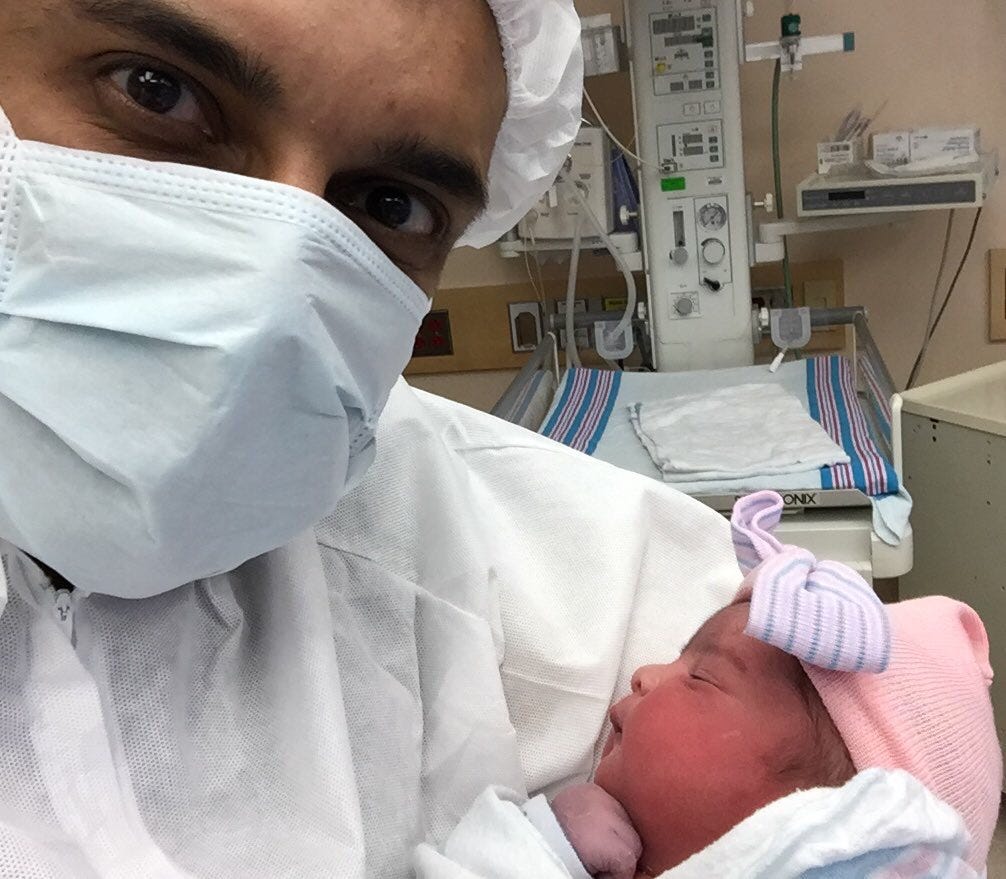
Hannah Noor (Pictured Right) at 5 hours old.
A Scream in the Dark
It was just after her sixth birthday in 2021 when our daughter screamed from her bed in the middle of the night. We rushed to her room to find she had thrown up all over her bed. We cleaned her up, changed her sheets, and blamed the incident on the Oreos she’d eaten after dinner. The next day she complained of a stomach ache and rushed to the bathroom, experiencing diarrhea. Like most parents, we dismissed it as a passing bug—kids get diarrhea now and then. But something felt different this time, even though it was her first experience.
When it happened again just a short time later, the stomach pain was more severe. She screamed, cried, and rushed to the bathroom, but this time there was blood—so much blood. It terrified us. Before we could even make it to urgent care, she had another episode with even more bleeding. We hurried her in, only to be told by the nurse practitioner to “keep her hydrated” and that it was probably a stomach virus. But again, something in our gut told us otherwise.
This was just before Thanksgiving 2021, and I convinced myself she’d recover over the break and be able to return to school. She loved school, as most kindergarteners do. But the bleeding continued. The pain worsened. More urgent care and pediatrician visits followed, but answers did not. By now, our once energetic and chatty daughter was pale, frightened, and visibly losing weight.
Navigating Through the Dark
We reached out to a close friend who happened to be a pediatric gastroenterologist. His questions and careful listening indicated it was not a simple virus, but he didn’t say much directly. He urged us to connect with the GI team at Children’s National Hospital in Washington D.C. Unfortunately, we were met with insurance hurdles and skepticism from her pediatrician. Weeks passed, and her condition deteriorated until, thanks to our friend’s intervention, we finally secured an appointment with a pediatric GI doctor in December.
Hannah Noor, now frail and scared, was put on iron supplements, and an colonoscopy was scheduled for January. She now weighed just 30 pounds—skin and bones, and we feared the worst. Her fear of eating, going to the bathroom, or even moving too much consumed her days. Our winter break became a period of sleepless nights, endless tears, and prayers. We felt like prisoners trying to navigate through treacherous terrain while blindfolded and shackled.
The preparation for the scope was grueling—a 24-hour liquid diet. To make matters worse, a severe snowstorm in early January 2022 left us without power for three days. Despite the chaos, we made it to the hospital. As I held her tiny hand, she bravely went under anesthesia. Hours later, the doctors confirmed what we feared: Hannah had ulcers all over her colon.
Inflammatory Bowel Disease (IBD) was the diagnosis—a chronic, lifelong condition that would require extensive management. Even as the doctor explained, I couldn’t fully grasp the gravity of it. I naively asked, “How long will she need the medication?” The doctor replied—“Do you understand what it means to have IBD? This is for life.”
It shattered me. My world crumbled.
Steroids, with their array of side effects, initially helped stabilize her condition, and she was subsequently started on mesalamine. However, managing IBD is never straightforward. Moving homes and finding a new doctor compatible with our insurance became an uphill battle. Procuring mesalamine was a nightmare, as our insurance kept on requiring prior-authorization—a term we’d never even heard before. Evidently, even though our doctor had prescribed a specific medication to save our daughter’s life, the insurance company required their non-medically trained admins to agree that our board certified physician knew what she was doing in prescribing the medication she prescribed. Spoiler: They disagreed and repeatedly denied the critical medication our daughter needed.
Making matters worse, moving meant we were in between doctors. Desperate to try anything to improve Hannah’s quality of life, we spent hours consulting with a nutritionist to see if dietary changes could make a difference. We invested extensive time and resources into a gluten-free diet, but it did not help at all; in fact, it made her averse to eating. We also tried the FODMAP diet, which was recommended during a flare, but it added to the confusion of what she should or shouldn’t eat. Every day became a battle over something as simple as food—one filled with uncertainty and frustration. Despite our efforts, Hannah’s condition remained unpredictable, with debilitating flares continuing to disrupt her life. By late 2023, we had pursued every imaginable route to find a way to protect our daughter’s health and life, and yet felt exhausted and at a dead end.
It was clear that only one option remained—she needed a quickly advancing form of therapy known as biological treatment. This would be a direct IV infusion of medication to stabilize the IBD, every six to eight weeks, forever.
A Dark Dead End
We were at the end of the road. If we couldn’t access biologic treatment, there was nowhere left to go. But what we hoped would finally bring us closure and healing, resulted in yet another emotional roller coaster and painful circus—our insurance corporation blocked us. Turns out, insurance corporations block more than 51% of patients whose doctors prescribe them biologic treatment to save their lives.
The recommended biologic promised not a cure, but a chance at living a healthy life. Our insurance rejected us outright reasoning that we hadn’t tried other medications first—a policy called “step therapy.” Despite our daughter’s life threatening condition, they wanted us to try every other variation of every other possible medication—knowing full well they would likely fail just as much and make our daughter suffer, vomit, bleed, and lose weight. But that did not matter to them, because that was the preferable path to ensure they “maximized shareholder value.”
Our doctor stepped in and conducted a peer-to-peer direct meeting with the insurance company to show all the data, blood tests, and medical reports to prove that our daughter needed biologics to live. To show without a shadow of a doubt that the yet untried medications they demanded we try were not substantively different than the plethora of medications we had tried and had not worked. Yet, that meeting also went in vain. The insurance company still refused to approve our claim. And Hannah Noor’s condition worsened. She was pale, swollen from steroids, in pain, losing weight, and back to missing school.
We finally contemplated paying for the biologic treatment out of pocket. We knew it would only require six doses a year. How much could one dose be, after all? We checked and our hearts sank once more. Each dosage cost and administration would run into the tens of thousands of dollars. A year’s supply to keep our daughter alive would run into the hundreds of thousands. We certainly did not have that kind of money. We were cornered and desperate.
We contemplated what any parents might. Do we sell the house and cars and move into a small apartment? Do we set up a GoFundMe? Do we borrow money from family and friends? Do we take out a second mortgage?
Do we file for medical bankruptcy, as 500,000 Americans do annually?
But we soon learned another sinister result of hyper-privatization of health insurance—even if we had the excessive means to pay the hundreds of thousands of dollars out of pocket, the hospital would not accept the funds. Why? The industry is such that not only do insurance companies deny 51% of claims, they have enacted policies forbidding people from paying for the critical medication they need out of pocket, lest the insurance company lose control and revenue. “Either you pay us, or you pay no one,” is a line you’d expect out of a mafia handbook—not out of a health provider. This is not health insurance, this is health exploitation.
A Spark of Light in the Darkness
In that moment of confusion we happened to run into to a fellow parent who, now is a great friend, and learned her children shared a similar medical struggle. She suggested calling the biologic manufacturers directly and applying for their patient assistance program. An idea that seems so obvious now, but something we did not even know was a possibility then.
The application process was tedious, and even then, it was initially rejected. But after weeks of back-and-forth, countless phone calls, and sleepless nights, a miracle happened—we finally secured approval. We let out a cathartic sigh of relief after more than two years of suffocation. And to be sure, the approval was not through our insurance company, who never even bothered to offer such an option, likely because it would cost them money. Rather, the approval was from the drug manufacturer directly. To this day our health insurance company has refused to budge on their cruel and calloused “maximizing shareholder value” decision to deny our daughter the medicine she needs to live.
On March 6, 2024—more than two months after the doctor first prescribed it, a period in which our daughter suffered horrific and unimaginable pain, bleeding, and vomiting—Hannah Noor received her first infusion at Comer Children’s Hospital in Chicago. And since then, everything has changed. Her spark of light returned. Our daughter was back.
The Light We Create
A process that should have only taken 30-60 days from the night we heard that scream in the dark, took us on a 28 month torturous journey to finally see light again. Hannah Noor’s journey since starting biologic treatment has been a blessing. She’s eating, playing, drawing, and even learning karate (currently a Yellow Belt). The last three years of her life had been a torture for her, but now she is finally thriving as any 9-year-old girl should. Though the fear of flares always looms, we refuse to let it dictate our lives. Herbal and homeopathic treatments complement her medical regimen, and her strength inspires us daily.
As for our insurance company? Those corporate leeches also denied covering the hospital costs as well. Fortunately, despite that high price tag still running into the thousands, we tightened our belts and found a way to pay for that out of pocket, and continue to pay for that out of pocket. (We were shocked there wasn’t some additional insurance rule preventing us from paying our hospital directly). Despite us paying our insurance premiums every single month without exception, our insurance company has not covered a single penny of our daughter’s critical healthcare needs. The care she needs to live. But at least they’re maximizing shareholder value.
This story isn’t just about one child’s struggle with IBD; it’s about the systemic barriers hundreds of millions of families face every single day. From insurance denials to inaccessible care, to step therapy nonsense, to prior authorization red tape, the system fails the most vulnerable. What if we didn’t speak English? What if we couldn’t afford out-of-pocket costs for tests and treatments? What if one of our close friends didn’t just happen to be a national expert on this particular rare disease, and couldn’t leverage his relationships to get us access to a world leading expert? What if we didn’t have a network of supportive friends to recommend new ways to acquire this life saving medicine?
A Brighter Future Is Possible
We named our daughter Hannah Noor because Hannah was the mother of Mary Mother of Jesus, and Noor means light. We couldn’t think of a more beautiful name for our only daughter, and she has lived up to it every day of her life.
In these darkest of times, she is the Light of our eyes.
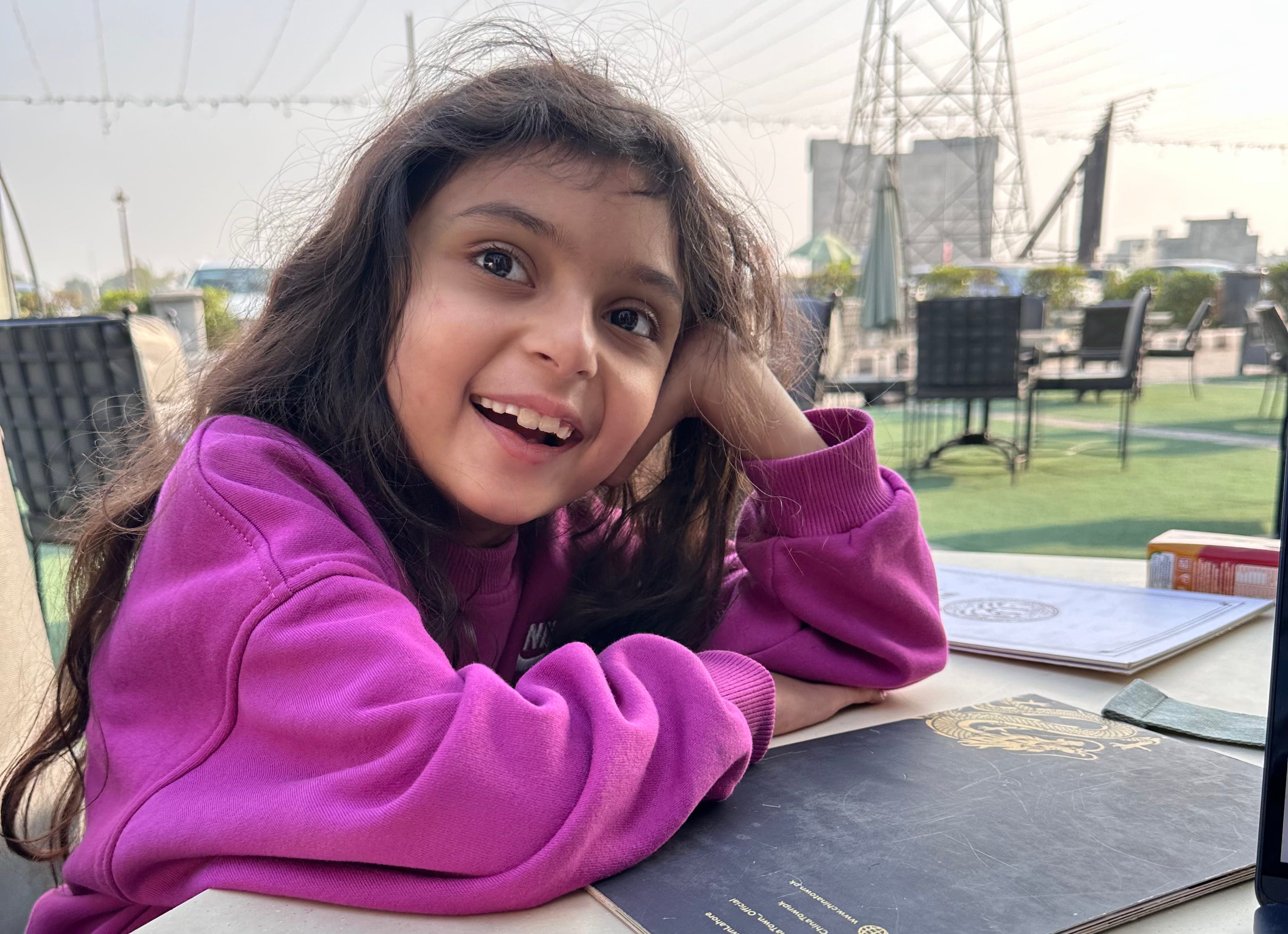
Hannah Noor (now 9) at a recent family vacation in Lahore, Pakistan. Here she is giggling at a cat that wandered over to say meow, which Hannah Noor reminded us means “hello” in cat language.
Hannah Noor’s story highlights a flawed and cruel system that places profits over people. Yet it also underscores the power of advocacy, persistence, and community. To every parent navigating the complexities of chronic illness: stay strong, fight relentlessly for your child, and lean on the resources available, like the Crohn’s and Colitis Foundation, and do not underestimate support groups on Facebook. If I can be of any support, do not hesitate to reach out at ayesha [dot] noor @ gmail.com.
Hannah Noor is living proof that even in the darkest moments, there is hope. She teaches us daily to believe in miracles—and to fight for them when necessary. It is also a reminder that our for profit exploitative health insurance system will always only serve the wealthy elites, the stock market, and whatever private investor who decides to buy and sell these corporations. They will not serve the people. Not our beautiful baby girl, nor the nearly 70,000 Americans who die annually due to lack of care, nor the 500,000 Americans who are forced to file for medical bankruptcy every single year. It is by the sheer grace of the Almighty that we still have our wonderful Light with us today. But for so many parents and families, the end result is not so fortunate.
Perhaps the most frustrating part about all of this is that the medication to save our child’s life existed all along. But because some calloused business person decided her life wasn’t profitable enough and worth saving, it was an acceptable cost to reject her claim and let her die.
It is our responsibility to demand better, not just for our daughter, but for all the daughters, sons, and children out there. We do not suffer from a lack of resources, but from an excess of greed. We can ensure high quality, accessible, and affordable healthcare for all people in this country—but we cannot ensure the satiation of greed for the billionaire corporations, corrupt politicians, and elitists who care more about shareholder value than the survival of innocent children. We have to choose one side. And we choose the children of this great country—we hope you do too.
Carol Burris, executive director of the Betwork for Public Education, describes the devastating advance of privatization in West Virginia. In 2019, the teachers of West Virginia banded together and went on strike, closing down every school in the state.
Burris writes:
West Virginia is closing its public schools. Seven schools will close in the next few years due to declining enrollment. These schools will join the 53 that closed in the past five years, and there are an additional 25 that counties have proposed or approved to close.
These numbers are not small in the context of West Virginia. The National Center for Education Statistics reported only 643 public schools with enrollment in the state in 2023-2024.
West Virginia’s population and student enrollment were in decline. In 2015, there were 277,452 students in West Virginia public schools. By 2020, enrollment was down to 253,930. In 2021, however, the drop seemed to level off—the public schools lost only 1,100 students the next year.
And then school privatization began.
In 2019, the legislature passed a charter law. It was cautious. Three charter schools were allowed to open as pilot schools under the control of districts, but none opened.
And then greed kicked in. The for-profit operators wanted to open schools in the state. In 2021, the legislature expanded the number of charters to ten a year, not including online schools, which they then approved. The authority to approve them was given to a politically appointed state board.
Six charter schools were rapidly approved, five of which are open.
Three of those five are run by for-profit corporations. In 2023-2024, those three for-profit-run charters enrolled 87% of the charter school students in the state.
Charter schools in West Virginia operate on the “money follows the child” system, depleting school district budgets. That money accounts for a whopping 99% of state per-pupil funding, even though most charter students (70%) attend low-cost, low-quality online schools run by for-profits.
To add insult to injury to the state’s public schools, the U.S. Department of Education, under Secretary Cardona, awarded $12.2 million to the state’s charter board to open new charter schools or expand existing ones in West Virginia.
Over $905,000 was given to open a “classical” academy run by the notorious for-profit ACCEL. ACCEL already operates two of the state’s five charter schools. The new school will be operated on a sweeps contract, violating 2022 CSP regulations. Three of the existing five charter schools would be given funds to expand.
I registered a complaint with the U.S. Department of Education regarding West Virginia’s violation of its own regulations. I have not received a response.
In 2022, the same year that the law to expand charter schools was enacted, the state passed a voucher law called the Hope Scholarship, heralded by Ed Choice as one of the most expansive voucher laws in the country. That law gives vouchers to fund homeschooling, private schooling, tutoring, and “enrichment” activities for students who do not attend a public or charter school.
The scholarship is worth 100% of the average per-pupil state funding. There are no income limits. Beginning in 2026, any student, including a private school student or home-schooled student who has never attended public school, can apply.
In 2023-2024, West Virginians used a voucher. In 2024-2025, the number jumped to 10,000.
Let’s do the math.
During the 2021-2022 school year, there were 252,830 students in public schools. That was the year before charters and the voucher law. In 2023-2024, that number dropped to 243,560.
Just when West Virginia enrollment had begun to stabilize, 2,277 students were siphoned off along with funding to charter schools, and 6,000 students received vouchers. In West Virginia, privatization through charter schools and vouchers is now the primary source of public school enrollment and funding decline.
As charter schools continue to expand, thanks in part to the federal Charter School Program, and vouchers become accessible to 100% of students in the state, school closings will accelerate.
For the right-wing Libertarians who run education policy for the Republican Party, this is not a bug; this is the main feature.
Dan Patrick is the Lieutenant Governor of Texas, a powerful position in the state. He used to be a rightwing radio talk show host, a little Rush Limbaugh. Now he’s in a position to do real damage, not just blow off steam. He recently told the superintendents of rural schools that the state couldn’t afford to give them any new money, although not long ago Governor Greg Abbott bragged about a $30 billion surplus and about cutting property taxes.
Lt. Gov. Dan Patrick has laid out his plan for dismantling public schools, even if it means failing to produce a workforce that will keep Texas’ economy going.
The man who calls himself a Christian first, a conservative second and a Republican third exercises an iron fist over the Texas Senate. He recently told the Texas Association of Rural Schools & Texas Association of Midsize Schools not to expect a significant increase in state funding, which has been unchanged since 2019 despite rampant inflation.
Instead, Patrick has promised to divert taxpayer money to private, mostly Christian schools backed by his billionaire benefactors.
Texas Republicans are heading into the 89thLegislature in honey-badger mode, heedlessly pursuing ideological goals regardless of public opinion. Because just like the honey badger that has become an Internet meme, Patrick “don’t care.”
“We’re not underfunding you in our view,” Patrick told school superintendents on Dec. 6, my colleague Jeremy Wallace reported in his newsletter. “We are funding you the most we can.”
Correction: it’s the most he’s willing to do.
The state provides a basic allotment of $6,160 per student, which is $4,000 less than the national average. School districts are slashing budgets and laying off staff due to inflation. Advocates have asked for another $1,000 per student to keep providing essential services.
“I’m just being honest with you; there is no way we can increase the student allotment by $1,000,” Patrick said.
That’s a lie. The state left $30 billion unspent in 2023 when Patrick refused to increase school funding until lawmakers approved taxpayer funding for religious private schools. An extra $1,000 per student would cost $14 billion, well within the budget.
Patrick frequently claims he supports public schools, but actions speak louder than words. He criticizes teachers, prioritizes tax cuts and praises religious education, falling back on a clichéd conservative playbook.
Step One: Underfund and hamstring a government service, in this case, public schools, until it starts falling apart. Step Two: Blame underpaid, under-resourced public servants for the failure and proclaim only the private sector can help. Step Three: Send taxpayer money to your cronies to provide the service, with a significant markup, and make the public pay more for it.
Abbott and Patrick say they have the votes necessary to pass a school voucher bill next year. Past promises to boost funding for public schools now appear off the table.
Private schools do not face the same regulation or scrutiny as public schools. Private schools are free to teach whatever the sponsoring group wants outside of a few minimum requirements. Private school students are not required to take the state’s standardized STAAR Test.
Polls show most Texans support public schools and want the state to spend more. But with a handful of donors writing multimillion-dollar checks, Patrick has entered the honey-badger stage of one-party rule.
Most Texans and major corporations think women should have more reproductive rights. Patrick don’t care.
Most Texans support legalized gambling to boost local economies. Patrick don’t care.
Most Texans support legalizing marijuana. Patrick don’t care; he wants to ban the $4 billion-a-year hemp industry.
Republicans have controlled every statewide office for 30 years. At the state and national level, conservatives control every branch of government. The GOP is feeling strong, like they honey badger.
Patrick wants Texas and the United States to be a Christian nation and Texas laws to reflect his interpretation of the Bible. Sabotaging public schools is a key step to fulfilling that dream.
Rick Wilson was one of the founders of The Lincoln Project and one of the leaders of the fallen-away Republicans. He posted this remarkable comparison of Trumpworld to hell in Milton’s Paradise Lost. I didn’t post it all. To finish reading, open the link.
Yesterday, Simon Heffer’s piece in The Telegraph nailed it: Milton’s Paradise Lost reads like a grim prophecy for our current era of authoritarianism and right-wing spectacle.
I promise, this isn’t too much of a classics rabbit hole.
Inspired, I dusted off my old, heavily annotated copy and dove back in. The pages hadn’t seen the light of day in 3 decades. It’s a bit of a slog for modern readers—Milton wasn’t writing for a TikTok audience—but the timeless truths cut through like a knife.
The opening act of Paradise Lost is a strategy meeting in Hell, led by Satan himself and attended by a rogues’ gallery of fallen angels. It’s a masterclass in manipulation, sycophancy, and passive-aggressive ambition—all wrapped in enough rhetorical flourish to choke a camel. Sound familiar?
If you’ve ever suffered through a senior-level government meeting, you’d feel right at home. Except this one is in Pandemonium, the capital of Hell—a place I imagine would look like the worst Trump Transition meeting, complete with gilded tackiness and the faint stench of sulfur. (Or mildew, if you’re at Mar-a-Lago.)
The debate? Oh, it’s a lively one. Some fallen angels suggest making Hell a bit more livable—think “evil gentrification.” Others want to launch a full-frontal assault on Heaven, declaring war on an unbeatable opponent.
Then comes the actual meeting: targeting God’s shiny new creation—us. The idea of corrupting humanity, God’s most beloved project, becomes the chosen strategy. And who volunteers for the job? Satan himself, of course. It was always his plan. When a direct assault on Heaven fails, attacking mankind becomes the ultimate revenge. As Satan puts it:
“To waste his whole creation, or possess All as our own, and drive, as we were driven, The puny habitants, or if not drive, Seduce them to our party, that their God May prove their foe, and with repenting hand Abolish his own works. This would surpass common revenge, and interrupt his joy.”
Does this sound a little… familiar?
It should. The parallels to today’s politics are as subtle as a sledgehammer. The fallen angels in this story aren’t just characters—they’re prototypes. Swap out Beelzebub and Belial for the MAGA brain trust, and you get the same toxic mix of ambition, incompetence, and amorality.
The MAGA operatives, family sycophants, billionaire bootlickers, scamfluencers, and D.C. operatives dreaming of internment camps and deadly revenge which are lining up for Trump’s Cabinet will make Milton’s Hell look like a model of compassion and efficiency.
These are people whose qualifications are as dubious as their morals and whose plans are as dangerous as they are chaotic. Their guidebook for wrecking the American system?
The infamous Project 2025. Remember that? They denied it, of course—counting on the credulous to buy their lies—but it’s as real as Satan’s envy in Paradise Lost.
And speaking of Satan, let’s not tiptoe around it: Trump is the Prince of Darkness in this particular drama. He wants nothing more than to destroy everything in his path. It’s not always coherent, but it’s always him.
His advisors inside and outside his transition —Susie Wiles, Stephen Miller, Steve Bannon, Stephen Cheung, and the rest of his court—mimic the infernal chatter of Moloch, Belial, and Beelzebub. Like their hellish counterparts, their rhetoric is a corruption of America, their plans for an endless era of cruel spectacle, and their motives are rooted in hatred for the good. Just as Satan hated God and Heaven, Trump despises the institutions, norms, and values that have long preserved this country.
He’s backed by a parliament of Cabinet members and advisors dreaming of a post-American, post-republican, and post-democratic world. (Yes, the lowercase “r” in Republican and “d” in Democratic was deliberate.) Trump’s attention span may be short, but their ability to execute the commander’s intent will be boundless. They, and he, hate this country as it exists today.
What does he love?
Power. Obedience. Subjugation. Wealth. Immunity from consequences. These are the dark desires of every dictator, tyrant, and abuser in history. And Trump revels in them. His demonic minions—think Elon Musk as Moloch—are already busy concocting spectacles of suffering and chaos across America.
Meanwhile, we’re stuck debating the quality (or lack thereof) of Trump’s Cabinet picks and whether Joe Biden’s pardon of Hunter makes him Worse Than Trump. (Spoiler: it’ doesn’t.)
Almost none of them would survive scrutiny in a rational world. But here’s the thing: their very terribleness is the point. Trump’s goal isn’t just to govern badly—it’s to corrupt every institution they touch. By forcing Americans to accept criminals, incompetents, and lunatics as leaders, he’s marking this country indelibly. This is his revenge, his legacy: a nation bent to his will and broken beyond repair.
Jeff Tiedrich proposes in his blog that President Biden should operate a “pardon factory” to protect everyone who has been threatened by Trump or Kash Patel.
One of the features of democracy is an assumption that parties will contend for power, accept their win or loss graciously, then prepare for next time. There will always be the next election to try again.
The threats by Trump and his toadies to prosecute his critics disrupts the comity on which a democratic system depends.
Trump thinks of his critics as “enemies,” not critics. He has made clear repeatedly that he will use his power as President to prosecute, imprison, and crush his enemies.
He said recently that the members of the January 6 Commission “should be in jail.” Why? Is it normal or acceptable that a mob summoned by the President descends on the U.S. Capitol as they meet to certify the election, smash through the windows and doors, beat up police officers, and rampage through the building? What was criminal? The summoning of the mob? The actions of the mob? Or the investigation of the events of the day?
Biden, writes Tiedrich, should issue pre-emptive pardons to all those whose lives and freedom might be endangered by Trump, Kash Patel, or Pam Bondi.
The next four years will be a trial for our democracy. Will the norms and institutions survive the reign of this bitter, vindictive old man?
Florida is one of 18 states that allow the children of undocumented immigrants to receive a lower tuition rate on state colleges. That law is under attack by Randy Fine, a state legislator who is running for Congress. Fine is an ardent supporter of Trump.
TALLAHASSEE — For a decade, children brought into the country illegally by their undocumented parents could enroll in a state college or university for the same fee as in-state residents, if they attended a Florida high school for three years.
But now, State Sen. Randy Fine, a Brevard County Republican who plans to resign mid-session to run for Congress, wants to repeal that law and end the educational benefit designed to help young immigrants known as “dreamers.”
Fine wants to end “sweetheart deals for college degrees to those who should not even be here,” he said in an email put out by his senate aide. “President Trump has made clear it is time to close the border and stop giving illegal immigrants rewards for breaking the law.”
His bill revives an effort to squelch the dreamers’ benefit that Gov. Ron DeSantis and some other Republicans tried — and failed — to make part of an immigration reform package in 2023.
Fine claimed the state spent $45 million to provide out-of-state tuition waivers to undocumented college and university students in 2021, but his staff did not respond to questions about the source of that figure.
Fine, a combative conservative who calls himself the “Hebrew Hammer,” filed a bill Monday that would repeal the waiver, which was signed into law in 2014 — two years before he was elected to the Legislature. The law was sponsored by Lt. Gov. Jeanette Nunez when she was a state senator. It was approved with bipartisan support and signed into law by then-Gov. Rick Scott, now the junior GOP senator from Florida.
Under the law, undocumented students who attended a Florida high school for three years and enrolled in a state college or university within 24 months of graduation would pay in-state tuition rates. But they are not eligible for state financial aid.
Without that waiver, they would pay out-of-state rates that are three to four times more. At the University of Central Florida, for example, the in-state rate is about $6,300 while out-of-state tuition is over $22,000…
More than 43,000 undocumented students are currently enrolled in Florida’s public colleges or universities, according to the American Immigration Council and the Presidents’ Alliance on Higher Education and Immigration. They make up just a sliver of the more than 1 million enrolled.
The state university system said it issued 2,005 nonresident tuition waivers last year but does not track how many of them went to undocumented students. The state also doesn’t track of the number of undocumented students enrolled in its universities.
Florida has already invested millions of dollars into the K-12 education of these students, and the 2014 law was seen as an incentive to get them to stay in Florida and complete their postsecondary education, said Renata Bozzetto, deputy director of the Florida Immigrant Coalition.
The result is a “a higher educated population and individuals who can pursue a career while working on their immigration status,” Bozzetto said.
Florida’s undocumented workers contribute $1 billion in spending power and $113 million in state and local taxes, according to the American Immigration Council….
“It’s a publicity stunt,” Sen. Carlos Guillermo Smith, a Democrat from Orlando, said of Fine’s new bill. “I’d be surprised if my Republican colleagues in the Senate even give it a hearing. It’s a mean-spirited and petty attack on immigrants that really defines the MAGA base.”
All in-state residents pay a tuition rate lower than the cost of their education, so state taxpayers are subsidizing all of them, and there is not a limit on the number of students who can receive in-state tuition, he said.
“They are paying tuition like every other student ,” Smith said. “They are not taking something away from other Floridians.”
Peter Greene writes about the contradiction at the heart of Trump’s education goals. On the one hand, Trump says he will eliminate the Department of Education and turn federal funding over to the states, to use as they wish. At the same time, he says that he will punish schools if they persist in teaching liberal ideas that Trump dislikes, like diversity, equity and inclusion, or if they are insufficiently patriotic.
How will he punish schools if the federal funding has been relinquished to the states?
Greene writes:
It has been on the conservative To Do list for decades, and the incoming administration keeps insisting that this time it’s really going to happen. But will it? Over the weekend, Trump’s Ten Principles for Education video from Agenda 47 was circulating on line as a new “announcement” or “confirmation” of his education policy, despite the fact that the video was posted in September of 2023.
The list of goals may or may not be current, but it underlines a basic contradiction at the heart of Trump’s education plans. The various goals can be boiled down to two overall objectives:
1) To end all federal involvement and oversight of local schools.
2) To exert tight federal control over local schools
Trump has promised that schools will not teach “political indoctrination,” that they will teach students to “love their country,” that there will be school prayer, that students will “have access to” project-based learning, and that schools will expel students who harm teachers or other students.
He has also proposed stripping money from colleges and universities that indoctrinate students and using the money to set up a free of charge “world class education” system.
Above all, he has promised that he “will be closing up” the Department of Education. Of course, he said that in 2016 with control of both houses of Congress and it did not happen.
Are there obstacles? The Department of Education distributes over $18 billion to help support schools that educate high-poverty populations, providing benefits like extra staff to supplement reading instruction. The Project 2025 plan is to turn this into a block grant to be given to the states to use as they wish, then zeroed out. Every state in the country would feel that pinch; states that decide to use the money for some other purpose entirely, such as funding school vouchers, will feel the pinch much sooner. The department also handles over $15 billion in Individuals with Disabilities Education Act (IDEA) funding, which helps cover the costs of special education; Project 2025 also calls for turning it into an unregulated block grant to states with no strings attached, meaning that parents would have to lobby their state government for special ed funding.
Cuts and repurposing of these funds will be felt immediately in classrooms across the country, particularly those that serve poor students and students with special needs. That kind of readily felt, easily understood impact is likely to fuel pushback in Congress, and it’s Congress that has the actual power to eliminate the department.
Beyond the resistance to changing major funding for states and the challenge of trying to move the trillion-plus-dollar funding system for higher education, the Trump administration would also face the question of how to exert control over school districts without a federal lever to push.
Previous administrations have used Title I funding as leverage to coax compliance from school districts. In 2013, Obama’s education secretary Arne Duncan threatened to withhold Title I funds if a California failed to adopt an “acceptable” standardized testing program. In 2020, Trump himself threatened to cut off funding to schools that did not re-open their buildings. And on the campaign trail this year, Trump vowed that he would defund schools that require vaccines. That will be hard to do if the federal government has given all control of funds to the states.
The Department of Education has limited power, but the temptation to use it seems hard to resist. Nobody wanted the department gone more than Trump’s education secretary Betsy DeVos, who was notably reluctant to use any power of her office. But by 2018, frustrated with Congressional inaction on the Higher Education Act, DeVos announced a plan to impose regulations on her own. In 2020, she imitated Duncan by requiring states to compete for relief money by implementing some of her preferred policies.
Too many folks on the Trump team have ideas about policies they want to enforce on American schools, and without a Department of Education that has control of a major funding stream, they’d have little hope of achieving their goals. Perhaps those who dream of dismantling the department will prevail, but they will still have to get past Congress. No matter how things fall out, some of Team Trump’s goals for education will not be realized.
Timothy Snyder is the conscience of America. He has written books on tyranny, on democracy, and on the history of Europe. He cares passionately about the survival of democracy.
Imagine that the day has come for your brain surgery. You are lying, immobilized and vulnerable, on the operating table. Something is wrong, but you hope that it can be repaired. As the anesthesia sets in, you reflect. To be sure, your brain hasn’t always performed the way you wished it had. You have made some mistakes, and done some stupid things, regrettable things, wrong things. But still, it is the brain that allows for a reconsideration of all that, to adjust, to have some hope and some possibility of doing better next time. Your brain keeps you going, keeps you in touch with the world. Hopefully, yours can be repaired, and you can get back to thinking, being, becoming. You could get better. As darkness descends, you catch a glimpse of a person dressed as a surgeon, approaching your head with a knife and a smile. It’s Tulsi Gabbard. Hope gives way to horror.
This dark fantasy suggests, on a very small scale, the national trauma that lies before us. Gabbard is Donald Trump’s choice to operate American intelligence. In the intelligence system, a kind of national brain, the Director of National Intelligence oversees and coordinates the work of agencies charged with knowing the world, protecting the integrity of digital systems, anticipating and preventing terrorism, and evaluating national security threats. Gabbard is the opposite of qualified for such a role: she is a disinformer and as an apologist for the war crimes of dictatorships.
Gabbard appears on the world stage as a defender of a million violent deaths.
She is an apologist for two of the great atrocities of the century: the Russian-Syrian suppression of the Syrian opposition to the Bashar al-Assad dictatorship, which has taken about half a million lives, most of them civilians, some of them by chemical weapons; and the Russian invasion of Ukraine, which has also taken about half a million lives, and has brought the destruction of whole cities, the kidnapping of children, mass torture, and the large-scale execution of civilians.
That is it. That is her profile. Disinformer and apologist. Beyond the United States, in the larger world that US intelligence agencies are tasked to understand, she is associated with her pro-Assad and pro-Putin positions. (In third place, I suppose, would be her propensity to provide the Chinese state media with useful sound bites).
Until 2014, Gabbard said nothing remarkable about foreign affairs. In 2015, just before Putin intervened to save Assad, she began her extraordinary journey of apology for atrocity. In September of that year, Putin sent Russian mercenaries, soldiers, and airmen to Syria to defend Assad. The great advantage Putin could bring to Assad was to multiply the regime’s air strikes, which were turned against hospitals and other civilian targets. Hospitals were and remain a Russian specialty.
In June 2015, as a congresswoman from Hawai’i, Gabbard visited Syria. During her stay, she was introduced to girls who had been burned from head to toe by a regime air strike. Her reaction to the situation, according to her translator, was to try to persuade the girls that they had been injured not by Syrian forces, but by the resistance. But this was impossible. Only Syria (at the time of her visit) and Russia (beginning weeks later) were flying planes and dropping bombs.
Either Gabbard was catastrophically uninformed about the most basic elements of the theater of war she was visiting, or she was consciously spreading disinformation. Those are the two possibilities. The first is disqualifying; the second is worse.
And if she was spreading disinformation consciously, she was also doing so with a pathological ruthlessness. Anyone who would lie to the child victims of an air strike to their burned faces would lie to anyone about anything. In January 2017, she visited Syria again, this time to speak to Assad. She began thereafter to deny that his regime had used chemical weapons on its own people. That was a very big lie.
In Washington, in speeches in Congress, Gabbard showed an uncanny ability to turn almost any issue into a justification for defending the Assad regime. In 2016, concern for Christians in Syria was a pretext to defend the Assad regime. In 2017, she presented worries about terrorism as a reason to defend of the Assad regime. In 2018, the anniversary of 9/11 was her prompt for defending the Assad regime. In 2019, she found her way from the genocide of Armenians a century earlier to the need to defend the Assad regime. She even worked hard to segue from the lack of affordable housing in Hawai’i to the need to defend the Assad regime. Gabbard’s support of Assad was so well known that her colleagues, Republican and Democratic alike, were worriedthat she would reveal the identity of a Syrian photographer brought to Congress to testify about Assad’s atrocities.
For Russia, Syria was a testing ground for Ukraine. The atrocities perpetrated by Russians in Syria were repeated in Ukraine. In 2021, the largest donor to Gabbard’s PAC was an apologist for Putin. When the Russian full-scale invasion of Ukraine began in February of the following year, Gabbard, a consumer of Russian propaganda, was immediately ready as a channel for the Russian line, including obvious Russian disinformation. Again and again, over and over, her public statements were strikingly similar to Putin’s,
Amidst the farrago of lies that Russia used to justify its full-scale invasion invasion was the completely bogus claim that Ukraine was site of American biolabs that were testing which infections would be most harmful to Slavs (and thus Russians). This lie originates in Russia and was spread by Russian media, along with some Chinese and Syrian echo chambers, and with a set of western helpers — one of whom was Tulsi Gabbard. She also urged, “in the spirit of Aloha,” that Ukraine react to the invasion by surrendering its sovereignty to Russia. She later justified Russia’s invasion of Ukraine by the notion, common in Moscow, that Russia was the victim of American attempts to overthrow Putin. She was specifically thankedby Russian state media for defending Russian war propaganda.
To be sure, the wars and the regions are complex. Even if Assad falls, as now looks increasingly likely, Syria will be a mess, with unsavory and dangerous people in power. There is, of course, room for disagreement about American foreign policy, including with respect to Assad and Putin and their twinned atrocities. That can all be taken for granted, and provides no excuse whatever for Gabbard’s very unusual behavior. It is strange, to say the least, that Gabbard says nothing about these regimes that they have not first said about themselves, and that she uses her platform to spread their own very specific disinformation.
One feature of disinformation is that it is factually incorrect: and so the very least (or most?) that can be said about Gabbard is that she is consistently wrong on matters of the greatest moral and political significance. But the other element of disinformation is that it is consciously and maliciously designed to confuse. These memes (biolabs!) are tested and perfected before they are released. Disinformation is the opposite of an innocent mistake: it is concocted to make rational reflection and sensible policy difficult. Disinformation, in other words, is a weapon that one regime tries to spread within another society or — in the dream of a hostile spy chief — within another society’s intelligence service. That is part of what Gabbard offers America’s enemies, and it is bad enough, because it means that systems meant to protect Americans instead put them in danger. It goes without saying that American allies would be unable to cooperate with the United States, and that patriotic intelligence officers would resign in droves. Informers around the world would cease their work. The US government would be cut off from the world.
As Director of National Intelligence, Gabbard would do enormous harm, unwillingly or willingly. She is not just completely unqualified for this role — she is anti-qualified. She is just the sort of person enemies of the American republic would want in this job. This is not a hypothetical — Gabbard is the specific person that actual enemies of the United States do want in the job. The Russian media refers to Tulsi Gabbard as a “Russian agent” and as “girlfriend,” with good reason.
Gabbard is worse than unfit. Her public record is as a disinformer and apologist for mass murderers. And there is nothing on the other side of the ledger. There are no positive qualifications. (Yes, she wrote a bestselling book. It became a bestseller because she scammed her followers into donating to a PAC which bought the book in bulk.)
Gabbard is just as qualified to operate on your brain as she is to operate the national intelligence services. Would you let her? She clearly wants to take up the knife. Whose idea, one wonders, was that?
Imagine, because it is true, that the day will soon come when we name the person who will operate the national intelligence services. To be sure, like our own minds, the intelligence services of the United States haven’t always performed well. There have been mistakes, and manipulation, and downright evil. But there has also been learning, and some recent, impressive showings, as in the precise and public prediction of the Russian invasion of Ukraine. Intelligence services are a central part of government. Just as a brain might need surgery, American intelligence needs reform. But it does not need to be butchered for the pleasure of enemies.
During the campaign, Democrats continually drew attention to the radical proposals of Project 2025 as the agenda for a second Trump term. Trump distanced himself from Project 2025 and pretended to know nothing about it or anyone who wrote it. Now that he is President-elect, Project 2025 is indeed Trump’s agenda.
Someone on social media asked, “If Trump disavowed Project 2025 when campaigning, isn’t I clear that he has no “mandate” to act on it?
The LA Times reports:
Russell Vought, one of the chief architects of Project 2025 — a conservative blueprint for the next presidency — is no fan of the federal government that President-elect Donald Trump will soon lead.
He believes “woke” civil servants and “so-called expert authorities” wield illegitimate power to block conservative White House directives from deep within federal agencies, and wants Trump to “bend or break” that bureaucracy to his will, he wrote in the second chapter of the Project 2025 playbook.
Vought is a vocal proponent of a plan known as Schedule F, under which Trump would fire thousands of career civil servants with extensive experience in their fields and replace them with his own political loyalists, and of Christian nationalism, which would see American governance aligned with Christian teachings. Both are core tenets of Project 2025.
Throughout his campaign, Trump adamantly disavowed Project 2025, even though its policies overlapped with his and some of its authors worked in his first administration. He castigated anyone who suggested the blueprint, which polls showed was deeply unpopular among voters, represented his aims for the presidency.
But last week, the president-elect nominated Vought to lead the Office of Management and Budget, which oversees the White House budget and its policy agenda across the federal government.
Trump called Vought, who held the same role during his first term, an “aggressive cost cutter and deregulator” who “knows exactly how to dismantle the Deep State and end Weaponized Government.”
The nomination was one of several Trump has made since his election that have called into question his claims on the campaign trail that Project 2025 was not his playbook and held no sway over him or his plans for a second term.
He selected Tom Homan, a Project 2025 contributor and former visiting fellow at the Heritage Foundation, the conservative organization behind the blueprint, as his “border czar.” Trump named Stephen Miller, an immigration hard-liner also linked to Project 2025, as his deputy chief of staff for policy. Both also served in the first Trump administration.
He also named Brendan Carr to serve on the Federal Communications Commission. Carr wrote a chapter of Project 2025 on the FCC, which regulates U.S. internet access and TV and radio networks, and has echoed Trump’s claimsthat news broadcasters have engaged in political bias against Trump.
Trump named John Ratcliffe as his pick for CIA director and Pete Hoekstra as ambassador to Canada. Both are Project 2025 contributors. It has also been reported that the Trump transition team is filling lower-level government spots using a Project 2025 database of conservative candidates.
During the campaign Trump said that he knew “nothing about” Project 2025 and that he found some of its ideas “absolutely ridiculous and abysmal.” In response to news in July that Project 2025’s director, Paul Dans, was leaving his post, Trump campaign managers Chris LaCivita and Susie Wiles — whom the president-elect has since named his chief of staff — issued a statement saying that “reports of Project 2025’s demise would be greatly welcomed.”
Asked about Trump’s selection of several people with Project 2025 connections to serve in his administration, Trump transition spokeswoman Karoline Leavitt responded with a statement, saying Trump “never had anything to do with Project 2025.”
“This has always been a lie pushed by the Democrats and the legacy media, but clearly the American people did not buy it because they overwhelmingly voted for President Trump to implement the promises that he made on the campaign trail,” Leavitt wrote. “All of President Trump’s cabinet nominees and appointments are whole-heartedly committed to President Trump’s agenda, not the agenda of outside groups.”
In addition to calling for much greater power in the hands of the president, Project 2025 calls for less federal intervention in certain areas — including through the elimination of the Department of Education. It calls for much stricter immigration enforcement and mass deportations — a policy priority of Trump’s as well — and rails against environmental protections, calling for the demolition of key environmental agencies such as the National Oceanic and Atmospheric Administration and the National Weather Service.
It calls for tougher restrictions on abortion and for the federal government to collect data on women who seek an abortion, and backs a slew of measures that would strip rights from LGBTQ+ people.
For Trump’s critics, his selections make it clear that his disavowal of the conservative playbook was nothing more than a campaign ploy to pacify voters who viewed the plan as too far to the right. It’s an argument many were making before the election as well.


 Diane Ravitch's blog