Archives for category: Courage

Jennifer Mangrum is an intrepid warrior for public schools. She ran for public office twice, first challenging the most powerful man in the General Asembly, then ran for state commissioner of education and nearly won. She’s now signed on with the AFT to organize a state teachers’ union. Jen Mangrum is fearless.

Long odds don’t discourage Jennifer Mangrum.

Mangrum, an associate professor of teacher education at UNC-Greensboro, ran unsuccessfully against the state’s most powerful Republican, state Senate leader Phil Berger in 2018.. She followed that long-shot effort with an unsuccessful run in 2020 for North Carolina superintendent of public instruction, where she drew 48 percent of the vote.

Now the Democratic go-getter is embarked on a new mission: She wants to unionize the state’s public school teachers.

“I couldn’t make politics work. After both losses, I felt discouraged,” Mangrum, a former teacher, told me this week. ”But I had teachers reaching out to me saying, ‘Can you help me with this?’ “

As one person, she can’t help them all, but maybe a union could.

After two years of pushing unionization as a volunteer, Mangrum has taken a part-time, paid consulting role with the American Federation of Teachers (AFT), the nation’s second largest teachers union with 1.7 million members. Her job is to explore the union’s potential to organize a significant share of the state’s 94,000 public school teachers.

“We have members across the state,” Magnum said. “Two years ago we didn’t have any.” Just how many, she wouldn’t say, but she allowed that it’s more than 100.

The North Carolina Association of Educators, an affiliate of the National Education Association, currently advocates for teachers and other school employees, but it is an association, not a union.

The need for united action is clear. North Carolina’s average teacher pay ranks 34th nationally and 46th for beginning teacher pay. In K-12 spending in 2022, North Carolina ranked 45th.

Along with low pay and lack of resources, teachers have endured disrespect by the Republican-controlled General Assembly. They’ve been accused of indoctrinating students with progressive values and told how to teach about the role of race in the nation’s past and present. Extra pay for teachers with master’s degrees and other higher degrees was eliminated a decade ago.

But there are obstacles to translating teachers’ frustration and anger into unionizing. The highest barriers are that North Carolina is a right-to-work state – workers can’t be compelled to join a union or pay dues in a unionized workplace – and state law bars collective bargaining by public employees.

In addition, the legislature’s beating down of teachers has weakened their will to fight back. Many are leaving teaching – the state had more than 4,400 teacher vacancies at the start of the last school year. Older teachers are counting down to retirement and don’t want to join an uphill struggle. Others are intimidated by school boards and administrators and fear losing their jobs if they join a union…

Once union chapters take root, Mangrum said, the next move would be to push for legislation allowing collective bargaining. Teachers in Virginia achieved that goal in 2020, ending the state’s prohibition on collective bargaining for local government workers.

Nationally, union organizing is growing. Given the abuse of North Carolina’s teachers, it’s time that that power came here. If Democrats regain control of the legislature, organized teachers may be able to turn North Carolina from a right-to-work state to one where teachers – and their students – regain the right to thrive.

Go, Jen, Go!!

Dan Rather and Elliott Kirschner publish a blog called “Steady,” which has a consistently steady tone while reflecting on our times. Only minutes ago, they called attention to an important event that occurred 75 years ago, when President Harry S Truman made history.

They write:

At Steady, we sometimes pause from the news of the day to look back and reflect on the journey our nation has taken. With this in mind, we want to acknowledge an anniversary that took place this past week that didn’t get enough notice, even if its importance is as relevant as ever.
On July 26, 1948 — 75 years ago — President Harry Truman signed Executive Order 9981. Its statement was simple but profound:

“It is hereby declared to be the policy of the President that there shall be equality of treatment and opportunity for all persons in the armed services without regard to race, color, religion or national origin. …”

Black people had fought in every war in the country’s history, with great courage and sacrifice. They fought for a nation that violently denied their human rights. During World War II, more than a million Black men and women served in the armed forces, fighting fascism around the world only to return to a country infused with systemic and often bloody racism.

This stark dichotomy became appallingly apparent with the tragic story of Sgt. Isaac Woodard Jr. He had enlisted in the Army in 1942 and served in the Pacific. After being honorably discharged from Camp Gordon in Augusta, Georgia, on February 12, 1946, Woodard boarded a Greyhound bus to see his family in North Carolina. He was wearing his uniform. En route in South Carolina, he was pulled off the bus and beaten by local police, then arrested, then beaten some more. The assault was so violent it left Woodard blind for life.

Woodard’s story soon became a defining moment in post-war race relations. Orson Welles called for justice on his ABC radio program. There was a benefit concert in Harlem headlined by Billie Holiday, Woody Guthrie, and boxer Joe Louis. President Truman ordered a federal investigation, and in 1947 he became the first president to address the NAACP. He said in his speech:

It is my deep conviction that we have reached a turning point in the long history of our country’s efforts to guarantee freedom and equality to all our citizens. Recent events in the United States and abroad have made us realize that it is more important today than ever before to ensure that all Americans enjoy these rights. And when I say all Americans — I mean all Americans.

A year later, Truman ordered the desegregation of the military and the federal workforce. There was, of course, tremendous pushback, and racism persisted in the recruitment and deployment of service members generally, and in the promotion of officers specifically.

(The act very nearly cost Truman his presidency. He almost lost his reelection bid in 1948 because some southern states — previously known as the Democratic Party’s “Solid South” — voted for a third-party “Dixiecrat” ticket. The ramifications of this series of events reverberate today.)

While the Air Force integrated quickly after 1948, the Army didn’t fully integrate until 1954, spurred on by a need to fill its ranks during the carnage of the Korean War. The Marines and Navy took much longer. It is shocking to consider, but it wasn’t until the early 1970s, under the leadership of Admiral Elmo R. Zumwalt Jr., then chief of naval operations, that the Navy was finally forced to fully confront its systemic racism.

In the ensuing decades, the U.S. military, while not entirely free from racism, has become a potent example for the nation of how our diversity is our strength. The military arguably has become the best meritocracy of any American institution. Seeing young men and women from different races, nationalities, cultures, religions, sexual identities, and geographic regions serve alongside each other sparks pride in what our country can and should be. They are beacons of hope.

Yet today, we are once again at a crossroads in the nation’s reckoning with its history. Right-wing extremists seek to downplay our legacies of injustice. We see this effort in distorted school curricula and banned books. We see it in politicians who use divisiveness as a tool to rally votes. The truth is, we still have a long way to go to make sure that the corridors of American power reflect the country as a whole. It should be noted that when the Supreme Court struck down affirmative action recently, they exempted military academies. What is one to make of that?

It is vital that we confront what our nation truly was, and is. Surely it is just that we recognize the tremendous service of those who were denied full rights. White supremacy is on the rise, including among elements of the armed forces. Surely we should agree that this is a great danger needing to be rooted out.

Truman’s executive order was an important step toward our country’s making good on its founding ideals. Much hard work preceded that moment 75 years ago, and much has taken place after it. The journey continues, with new challenges in our present time. We can’t hope for continued progress if we don’t acknowledge the past, honor moments of justice, and vow to do the hard work to build upon them.

We can also find hope in President Truman’s own life story. He was a descendant of slave owners and Confederate sympathizers, and he grew up in a segregated town in Missouri. As a younger man, he himself identified as a segregationist and racist, but he was able to grow to become a champion for civil rights, at least by the standards of his time.

In Truman’s journey, we can find a mirror for the country at large. We have come a long way but still remain very much a work in progress. And the gains we have made are fragile without continued care and effort.

The Washington Post published the following editorial yesterday:

Alexei Navalny has spent more than 900 days behind bars — and nearly 200 in solitary confinement — for having the courage to speak critically of Russia’s despotic president, Vladimir Putin. Now, in addition to his current sentence of more than 11 years, prosecutors in a new trial have asked for an additional 20 years on ludicrous charges of “extremism.” And once again, Mr. Navalny refuses to be silenced.

Speaking at the conclusion of his closed trial in prison this month before 18 court officials — seven of whom wore black masks to hide their identity — Mr. Navalny showed he remains a powerful voice of conscience. And that is why we thought it worthwhile to share his words at length here.

“The question of how to act is the central question of humanity,” he said. “People have searched high and low for the formula of doing the right thing, for something to base the right decisions on.”
Mr. Navalny recalled the teaching of professor Yuri Lotman, who once told students, “A man always finds himself in an unforeseeable situation. And then he has two legs to rest on: conscience and intellect.”

“To rely only on one’s conscience is intuitively correct,” Mr. Navalny added. “But an abstract morality that does not take into account human nature and the real world will degenerate either into stupidity or atrocity, as it has happened more than once before. But the reliance on intellect without conscience is precisely what now lies at the core of the Russian state.”

Mr. Navalny recalled that Mr. Putin set out initially to use Russia’s energy and other resources to “build an unscrupulous but cunning, modern, rational, ruthless state.”

He summed up the rationale of those who rule Russia this way: “We will become richer than the czars of the past. We have so much oil that even the common folk will get something from it. By exploiting this world of contradictions and the vulnerability of democracy, we will become leaders, and everyone will respect us. And if not respect, then at least fear.

“And yet the same thing happens as everywhere else. The intellect, unconstrained by conscience, whispers: Snatch, steal. If you are stronger, your interests are always more important than the rights of others.”

Then came the invasion of Ukraine, in which Mr. Navalny said Russia under Mr. Putin had “slipped and collapsed with a crash, destroying everything around it. And now it is floundering in a pool of either mud or blood, with broken bones and the poor, robbed population, surrounded by the tens of thousands of victims of the most stupid and senseless war of the 21st century.

“Of course, sooner or later, it will rise again. And it is up to us to determine what it will rest on in the future.”

“It may seem to you now that I am crazy,” he told the court. “But in my opinion, it’s you who are crazy. You have one God-given life, and this is what you choose to spend it on? Putting robes on your shoulders and black masks on your heads to protect those who rob you? To help someone who already has 10 palaces to build an 11th?”

Mr. Navalny implored the court officials to join him in the fight for “a free and prosperous” Russia.
“When you’re tired of slipping under this regime, splitting your forehead and your future, when you finally realize that the rejection of conscience will eventually lead to the disappearance of intellect, then maybe you will stand on both of the legs on which every man should stand, and we will be able to bring the beautiful Russia of the future closer, together.”

These brave words, written from the cramped, miserable conditions of solitary confinement, are those of a man who possesses a vision for Russia and the high principles to lead it — unlike the brute who sits in the Kremlin.

Michigan is in track to make record investments in the quality of life for children and schools.

My friend Mitchell Robinson, a member of the State board of education, shared the following good news:

The State of Michigan passed a third consecutive historic education budget last night—and did so with bipartisan support, meaning the changes included in this budget can go into effect immediately.

It’s amazing to see what a state education budget can look like when you have pro-education legislators in charge–and teachers chairing the House and Senate Education Committees and the Senate Appropriations Subcommittee on PreK-12.

The budget includes:

•universal school meals

•foundation allowance increase of 5% — the largest in state history

•fully funded special education programs

•expanded Pre-K programs

•student teacher stipends for K-12

The budget also appropriates $11 million to a K-5 Music Education Pilot Program that provides funding to school districts that currently do not have elementary music instruction to hire certified music teachers.

Budgets are about more than dollars—they are moral documents; and in Michigan we are showing that we value our children, our families, and our future by directing funding to programs and initiatives that strengthen our schools and communities.

edbudget2023.jpeg

As you surely know, any kind of protest against the war is forbidden in Russia. Anyone who dares to speak against the war is immediately arrested and jailed. Even calling the war a war is illegal. Protestors may be sent away for years. In this climate of repression, some bold Russians have found a way to express their anti-war views. The New York Times published some examples of these tiny acts of rebellion. Learn how a fish became an anti-war symbol.

Last year in St. Petersburg, an artist uploaded a few images of tiny clay figurines in a public space to Instagram under the account Malenkiy Piket, meaning Small Protest. In a separate post, he invited others to join him in his silent demonstration.

A yellow clay figurine raises a blank purple poster.

One of Malenkiy Piket’s first posts.

Since that post, he has received almost 2,000 images containing homemade figurines, many holding posters of protest with curious symbology. Contributors are able to preserve their anonymity by sending private messages in the app to the artist, who then posts their images. At its peak, the account received around 60 images daily, the artist told The Times.

Sending such pictures, even privately, carries enormous risk: Sharing antiwar messages can be a cause for imprisonment. Hiding figurines in public spaces could be captured by surveillance cameras. Police used CCTV footage to track and arrest one contributor in 2022.

A red figurine in a window holds a white sign with the inscription “Don’t be silent” in Russian.

“Don’t be silent”

Using strategic ambiguity to protest authoritarian governments is not unique to Russia: pro-democracy demonstrators in Hong Kong held up blank signs as a form of protest, and social media users in China used the candle emoji to commemorate the anniversary of the Tiananmen Square massacre.

The artist told The Times that it’s important for people to see that Russians oppose the war, too. “Not everyone is with Putin. We know how the media just skips this, cuts out everything that shows people against it.”

The messages in the images

An illustration of fish memes that became a symbol of protest.

FISH

In 2022, a woman was arrested for writing “нет в***e” in graffiti in a public square, putting asterisks instead of letters in some places. The police believed she had intended to write the word “война” for war, but the woman said she had written “вобла,” a fish native to the Caspian Sea that Russians traditionally eat with beer or vodka.

The story went viral, producing tons of memes and even a song. The woman was eventually fined, but by then, her story had already turned the vobla fish and asterisks into symbols of protest.

A green figurine holding a yellow poster with asterisks and a drawing of a fish.

Next to a road.

A figurine holding a fish with a red X through it.

At the base of a sculpture.

Two figurines holding antiwar posters, one with asterisks and the other with a peace symbol.

Three asterisks, followed by five more. A code among protesters meaning “нет войне” (No to War).

A yellow and blue figurine holding a poster with the word “No” and a fish drawing.

In a bush.

An illustration of figurines raising blank posters.

BLANK POSTERS

Blank posters underscore how Russia has criminalized free speech. During the first months of 2022, after Russia invaded Ukraine, many Russians took to the streets with blank posters, and the police arrested them.

A mouthless monk wearing red clothes holds a blue poster.

A mouthless monk sitting on a fence.

A sticker of a figure with bunny ears holds a blank banner.

A sticker attached to a lamp post on Bolotnaya Naberezhnaya, Moscow.

Three figurines hold blank posters by a river, a large church in the background.

By a river.

A blue figurine, seated on a post at the side of the street, holds up a blank poster. In the background is a snowy street.

By a road.

An illustration of figurines holding antiwar flags. The flags are white with a blue stripe.

ANTIWAR FLAG

Recognized as an antiwar symbol, the white flag with a blue stripe in the middle was created by Russians who opposed the invasion of Ukraine and disapproved of Putin’s government.

A doll set on grass holds an Ukrainian flag that reads, “Stand with Ukraine.” On its right, another doll holds a white and light blue flag that reads, “No war! No blood!”

A Ukrainian flag is sometimes paired with an antiwar flag.

Two paper silhouettes holding hands, each holding a flag. One is a blank, the other an antiwar flag.

Paper figurines stuck to a graffitied wall.

Two crying figurines hug.

Both flags are again represented in the embrace of these crying figurines, atop a memorial stone.

A figurine with an antiwar flag, perched on a fence.

A fence outside of a Russian government building.

An illustration of figurines raising placards with a letter Z crossed out.

THE CROSSED OUT Z

Members of the Russian army emblazon their tanks and trucks with the letter Z to differentiate themselves from Ukrainians in the field. Many of Malenkiy Piket’s images show the letter Z crossed out.

A figurine wearing the Ukrainian flag colors raises a poster of a letter Z crossed out.

This figurine wears Ukraine’s colors.

A figurine wearing a blue T-shirt holds a placard with a letter Z crossed out.

On a park bench.

A clay figurine with a poster of a letter Z crossed out.

Attached to a wall.

Illustration of seven figurines holding or wearing the peace symbol.

PEACE

About a hundred images shared by Malenkiy Piket show the peace sign.

A blue figurine wearing a yellow T-shirt with a peace sign on it.

At the foot of a statue in a public square.

A Lego figurine holding a peace poster.

On the ground.

A yellow figurine holding a peace card.

At the Moskva River, across from Moscow’s Red Square.

A Lego figurine holding a peace poster.

At a bus stop.

Congressman Adam Schiff replied in the House chamber to the vote to censure him for his role in investigating Trump, including his leadership of the first Trump impeachment trial. The House voted 213-209 to censure him. Watch his five-minute speech. He was censured for doing his job as a member of a Congress.

As Jay Kuo explains in this post, censure is rare, administered for financial or ethical improprieties. A censure vote against Schiff was taken twice. The first time it failed, because 20 Republicans opposed it (some may have thought it was a dumb idea, but most were bothered because it would have fined Schiff $16 million for daring to lead the charge against Trump). The second vote passed for two reasons: 1) the $16 million fine was dropped, and 2) Trump threatened to primary any Republican who opposed it. Trump still terrifies House Republicans.

Schiff is running for the Senate in California. After watching his speech, I went to his website and contributed to his campaign.

Someone left a dead raccoon and a racist note outside the office of the mayor of Redmond, Oregon. The note was directed at the only Black member of the City Council. Redmond is almost 90% white.

The incident is being investigated as a bias crime. The City Council discussed the matter at its next meeting. A 10-year-old boy, Gavin Alston, asked his parents if he could go with them to the City Council meeting. He wanted to speak and share his experience of racism. He wrote some notes to read.

Gavin Alston, aged 10, accompanied his parents to the meeting and read a speech that he, too, had prepared – explaining how, at a different school in third grade, “I felt like I belonged.”

“Now I’m in fourth,” he continued. “A lot of people have been calling me the n-word or a monkey, even ‘Black Boy.’ One girl said to me, ‘I would hit you, but that’s called animal abuse’. We should not get treated like this. We should get treated equally. This is not fair to us Black people.”

His mother, Heather Alston, warned Gavin that “everybody’s going to be looking at you” and he was “going to be the centre of attention,” she told The Washington Post – but he remained unwavering in his resolve to speak and share his experience.

The Washington Post wrote:

He finished his remarks to applause from meeting attendees. But as he walked back to his parents, his speech in hand, tears started flowing down his face. He was thinking back to what he had felt during the incidents he’d written about.

“I was sad because I know how it feels for that to happen,” Gavin said.

Though he’d felt scared to rehash those moments in front of the council and community members, he hoped it had gotten his message across.

“I want people to change and not judge people just because of their skin color,” Gavin said. “They’ve got to know them for their personality, their kindness and respect.”

Mitchell Robinson is a professor of music education at Michigan State University who was recently elected to the Michigan State Board of Education. He shared a resolution that he introduced and that was passed by the State Board. Are there books that are not age-appropriate? Yes. Can we trust teachers and librarians to select the right books for the children in their care? The Michigan State Board of Education thinks we can. Michigan law already forbids pornography in schools.

Robinson sent the following to me:

Proud to introduce the “Freedom to Read” resolution yesterday. The State Board of Education respects the professional judgement of teachers and librarians when it comes to selecting learning materials that support the curriculum in their classrooms, and respects the rights of parents and caregivers to determine the developmental appropriateness of books and other materials for their children.

Teachers and parents are natural partners in the education of our children, and attempts to drive a wedge between schools and families by creating outrage over fabricated “crises” will simply not work.

“Board Of Ed Adopts Resolution Supporting ‘Freedom To Read'”

A resolution to support K-12 students reading whichever books they like as book bans continue to sweep the country was adopted by the State Board of Education Tuesday.

Board member Mitchell Robinson (D-Okemos) introduced the Freedom to Read Resolution. Robinson cited in the resolution that PEN America’s Index of School Book Bans listed 1,477 instances of individual books banned.

The resolution said in the first six months of 2023, 30 percent of the unique titles banned were books about race, racism, or feature characters of color and 26 percent of the unique titles banned had LGBTQ characters or themes.

On Monday, Illinois Governor J.B. Pritzker signed a law that deems Illinois public libraries ineligible for state funding if the library restricts or bans materials because of “partisan or doctrinal disapproval.”

“Closer to home, the Michigan Civil Rights Commission has asked the Attorney General for an official legal ruling on book banning as discrimination in respect to the Elliott Larsen Civil Rights Act that has expanded to include…LGBTQ+ communities,” Robinson said.

During public comment, several parents and organizations, including Moms for Liberty, spoke out against the resolution. They argued that none of their members were in favor of banning books but did not want their children to read what they deemed as inappropriate and pornographic content.

Board member Tiffany Tilley (D-West Bloomfield) introduced an amendment to the resolution supporting parents in their right to choose age appropriateness of material for their child and rights to make “critical decisions with their local schools.”

Tilley said as a child, she read several pieces of literature, including Shakespeare’s “Romeo and Juliet” that included content that some would say was “racy.”

“I got to a certain age, and I realized we were talking about a 16-year-old boy, 13-year-old girl and they both committed suicide,” Tilley said. “I’m not for banning books. My mom allowed me to read those things. I think that made my life richer, but for some parents, they may not be ready for their children to read about something.”

Tilley emphasized that her amendment would signal to parents that the state is not trying to make decisions for them, but also the state is not trying to ban certain books for everyone. If a parent reads a book and decides they do not want their child to read it, then they need to make that decision with their local school district, she added.

Superintendent of Public Instruction Michael Rice said this amendment was similar to resolutions the board supported previously. In February 2022, the Resolution on Sex Education included language that allowed for parents and legal guardians to opt-out of sex education classes without penalty.

Board member Tom McMillin (R-Oakland Township) wanted wording included that would make clear the board was stating pornography should not be allowed in schools. Board member Marshall Bullock (D-Detroit) jumped in, saying that there are already laws forbidding pornography in school. He asked McMillin how he defined pornography, saying his definition may lead to the banning of other subject matter such as the teaching of human anatomy in a biology course.

In the end, the board voted to approve the resolution 6-2, with McMillin and board member Nikki Snyder (R-Dexter) voting no.

Please join me and your many allies in D.C. on October 28-29 for our 10th anniversary conference. It promises to be our best ever! 

Sign up now.

You will have a wonderful time! 

And you will meet your favorite bloggers, hear great speakers, and meet people who are fighting against privatization across the nation.

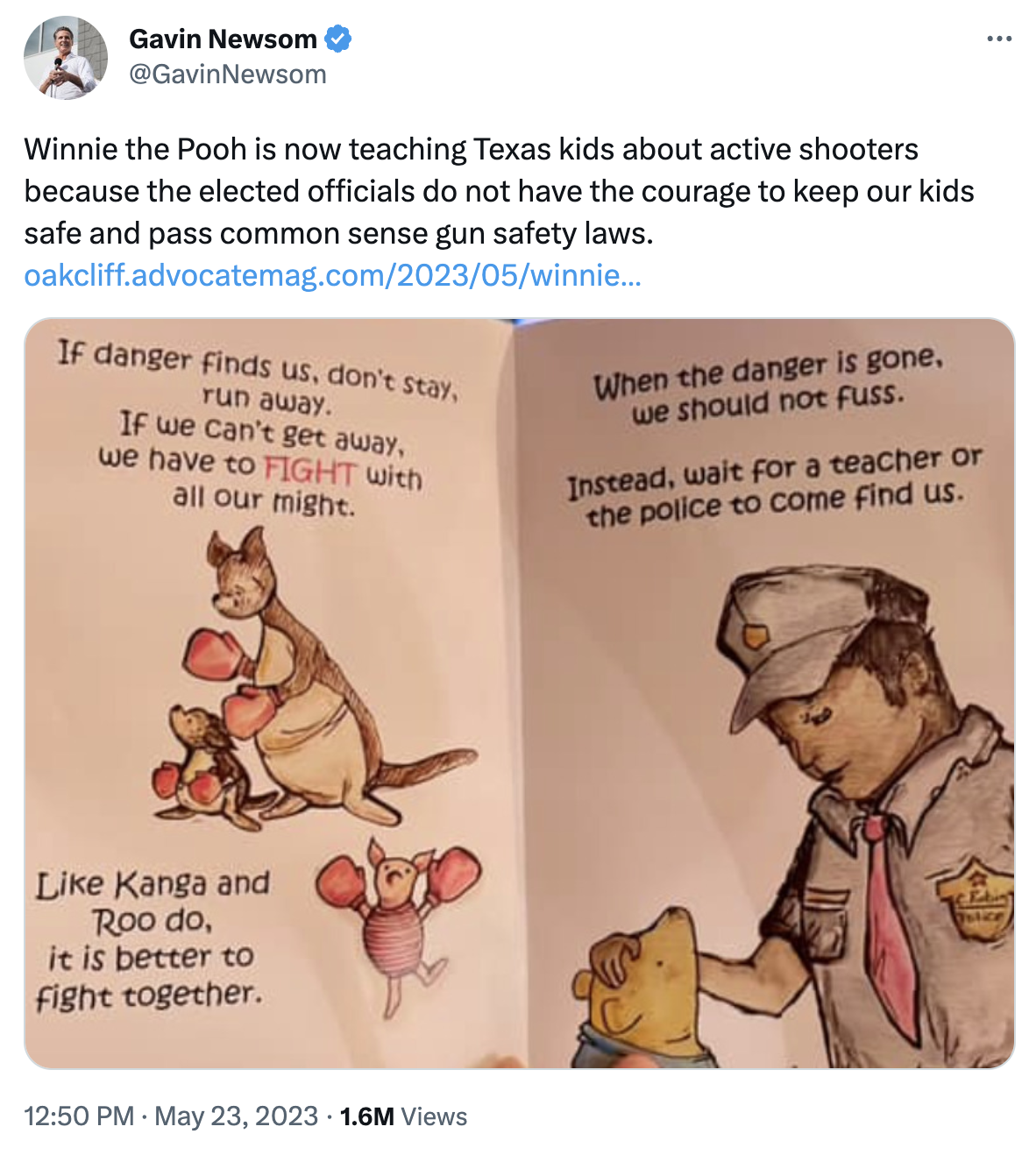
California Governor Gavin Newsom has been blasting away at knuckle-headed Republican governors like Ron DeSantis and Greg Abbott for their cruel indifference to other people. He’s already suggested he may sue DeSantis for kidnapping, after Florida sent two private planes with Venezuelan immigrants to Sacramento. Now, he’s going after Abbott for his refusal to take action against gun violence.

He wrote:

Texas… where elected officials are relying on Winnie the Pooh to teach their kids about active shooters because they don’t have the courage to keep our kids safe.

Tweet from Gavin Newsom: 'Winnie the Pooh is now teaching Texas kids about active shooters because the elected officials do not have the courage to keep our kids safe and pass common sense gun safety laws.'

Texas… where Greg Abbott signed a law to send DNA kits to parents of school children so their bodies can be identified after a shooting.

Tweet from Gavin Newsom: 'Greg Abbott’s solution to gun violence? Send DNA kits to schools so parents can identify their kids’ bodies AFTER they’ve been shot and killed.'

Guns are the leading cause of death for kids in America. Kids!

We’re not talking about accidents, or cancer or something unpreventable. We know the steps to take to save our kids lives. But leaders like Greg Abbott lack the courage to act.

Until then… It’s Winnie the Pooh for Texas families.

Gavin Newsom