Archives for category: Closing schools


Neema Avashia learned that her middle school in Boston was going to close. She decided that she would stand and fight. She did. She is a true patriot. She made a difference. She defeated the powerful. She is a hero of the Resistance. She joins the honor roll of this blog.

She writes:

My gloves came off the day representatives of my school district told us they would be closing our school. Our students would be sent to a turnaround high school that had never taught middle school students. Recently arrived immigrant students in language-specific programs, which the high school did not offer, would be dispersed across the city. As for our staff, the representative from Human Capital glibly told us, “We have no plan for you.”

What does it mean when the school system that you’ve poured your heart into doesn’t have the decency to consider a thoughtful transition plan before making the decision to close your school?

It means they never saw you as human in the first place.

It means that your job, then, is to make it impossible for them to look away from your humanity.

I went home from work that afternoon and opened a Twitter account. Opponents of other district proposals had successfully used Twitter to shame city leadership into changing course.
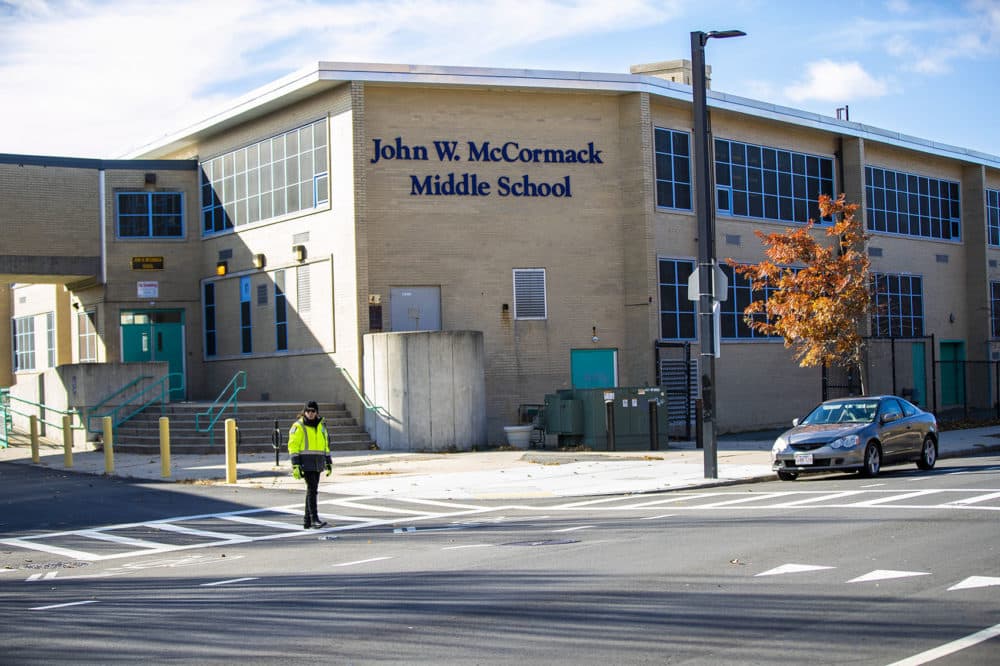
The John W. McCormack Middle School on Columbia Point. (Jesse Costa/WBUR)

“I am a @McCormackMiddle teacher,” my first tweet read. “Today the district announced they will be closing my school, and I am left full of questions.”

Once I began, there was no stopping. I knew that if the McCormack closed, I would not be a teacher anymore. That the work it took to build these relationships, and this community, was not something I could take up a second time under the scepter of further closures.

On Twitter, I relentlessly poked holes in the plan: BuildBPS was founded on the premise of renovating pre-WWII buildings, yet our building was constructed in 1968. Multiple schools have failing heat systems and leaking roofs, but our building had received a new boiler, windows and roof within the last ten years. BuildBPS purported to prioritize the most vulnerable students, yet disrupted the education of our English Language Learners.

My recklessness knew no bounds. I went before the Boston School Committee and announced, “I’m here to give you a history lesson,” then reminded them that our students had merged with a turnaround previously — the elementary school next door — and that doing so had placed the elementary school under even higher scrutiny from the state.

Read her story. Hers is the kind of dedication that the corporate reformers and Disrupters can’t buy. She is a champion of children, not a billionaire’s lackey. She carries within her the spark of revolution that inspired patriots in the 18th century.  She is a patriot for our times, uncowed by  money and power.

Michigan Governor Gretchen Whitmer originally offered the Benton Harbor District a desl that relieves them of their debt if they closed their high school. Residents and students rebelled at the idea of closing the high school. Governor Whitmer has reached a tentative deal with the district to save the high school. 

Representatives from the governor’s office and the Department of Treasury had a productive meeting with Benton Harbor school board members regarding a tentative joint plan that requires the district to meet attainable benchmarks and goals to show improvement in academic outcomes among Benton Harbor area students while stabilizing the finances of the district,” Whitmer spokeswoman Tiffany Brown said.

Brown noted Wednesday that the state has “has identified national experts who have experience turning around school districts that are struggling and we would like to engage in a day of learning alongside the board and community partners.”

Bill Phillis of Ohio writes:

School Bus
Cleveland Plain Dealer analysis of trends in test scores in HB 70 districts: NO IMPROVEMENT
The state takeover of school districts (HB 70 of the 131stGeneral Assembly) has caused chaos in school communities, fattened the wallets of consultants, but has not demonstrated improved test scores.
The federal government, via No Child Left Behind (NCLB), has created chaos in school communities throughout the nation. Every Student Succeeds Act (ESSA) is not much better than NCLB. The feds are attempting to run schools via NCLB and ESSA with no success. Some states like Ohio are also trying to run school districts with no success.
The feds need to help the states implement a system of education in accordance with each state’s constitutional provisions. In turn, the states need to help districts provide equitable and adequate educational opportunities and then butt out of local school management. Communities have far greater capacity to manage their schools than state and federal officials.
William L. Phillis | Ohio Coalition for Equity & Adequacy of School Funding | 614.228.6540ohioeanda@sbcglobal.net| www.ohiocoalition.org
STAY CONNECTED:
School Bus

In no particular order.

These are books I enjoyed and learned from.

Anand Giridharadas, Winners Take All: The Elite Charade of Changing the World

Rucker Johnson, Children of the Dream: Why Integration Works

Noliwe Rooks, Cutting School:  Privatization,  Segregation, and the End of Public Education
Richard Rothstein, The Color of Law: A Forgotten History of How Our Government Segregated America 
Gordon Lafer, The One Percent Solution: How Corporations Are Remaking America One State at a Time
Nancy McLean, Democracy in Chains: The Deep History of the Radical Right’s Stealth Plan for America
Daniel Koretz, The Testing Charade: Pretending to Make Schools Better
Yong Zhao, What Works May Hurt—Side Effects in Education
Pasi Sahlberg and William Doyle, Let the Children Play: How More Play Will Save Our Schools and Help Children Thrive
Eve Ewing, Ghosts in the Schoolyard: Racism and School Closings on Chicago’s South Side
Sent from my iPad

Governor Gretchen Whitmer wrote a letter to the Benton Harbor school board, letting them know that it was up to them to accept the state’s offer, which meant the state would forgive the district’s debts and the district would close its beloved high school.

Excuse me, Governor Whitmer, but why doesn’t the state offer to send support to this impoverished school district, not just forgive its debts. It does not have the tax base to support its schools. Doesn’t the state has a legal obligation to secure equal educational opportunity for every child, regardless of zip code?

Is Governor Whitmer relying on the same education advisors as those who counseled Rick Snyder and John Engler?


Jitu Brown is leader of the Journey for Justice and a national civil rights leader.

In this interview, he explains why he opposes school closings, charter schools, and vouchers, which have been disproportionately imposed on communities of color.

Don’t believe the claims by corporate reformers that black and brown parents want privately managed charters where they have no voice. They want well-funded public schools with experienced teachers and a full array of programs and services, where their voice matters.


Democratic Governor Gretchen Whitme campaigned in Benton Harbor, promising to invest in schools and to reverse Republican Rick Snyder’s ruinous policies of state takeover and school closings. Once elected, she offered Benton Harbor a deal: the state will forgive your debts if you close the high school to cut costs. If you don’t take the deal, the whole district may be closed. The residents felt betrayed.

And rightly so. Poor communities can’t raise as much revenue as rich districts. The state has a responsibility to step in and assure equal educational opportunity, especially for the neediest communities.


BENTON HARBOR, Mich. — In Benton Harbor, a small city beside Lake Michigan, the high school binds generations and strangers. This is a place where basketball games are a highlight of the social calendar, where signs celebrating state championships are placed at the edge of city limits, where residents say what year they graduated when they introduce themselves.

For years, Benton Harbor’s school system had faced dismal fiscal conditions, miserable academic rankings and intense scrutiny from the state. But when Michigan voters chose a new governor last November, it was seen as a hopeful sign in Benton Harbor. Gov. Gretchen Whitmer, a Democrat who won more than 90 percent of the vote in this city, presented herself as a supporter of investment in struggling places, a defender of public schools, someone who cared about Benton Harbor.

But in May, Ms. Whitmer brought a grim message: Benton Harbor should close its high school and the state could forgive the district millions of dollars in debts. Otherwise, the entire school district was at risk of shutting down.

The proposal was seen as a betrayal in Benton Harbor, a predominantly black city where the high school has operated since the 1870s. What would it say to the children, residents asked, if their hometown was deemed unfit for a high school? And without Benton Harbor High School — without Tiger football games and the robotics team and the marching band — what would be left of Benton Harbor?

“It would kill the whole community,” said Greg Hill, 18, who graduated from Benton Harbor High this month and said he hoped to eventually return to the school as a history teacher. He called Ms. Whitmer’s plan “educational genocide.”

Michigan has a uniquely troubled history of state intervention in financially struggling cities with mostly African-American residents. In Inkster, where 72 percent of residents are black, the school district dissolved six years ago after the state deemed it financially unviable. In Detroit, where the population is 79 percent black, the state seized control of the school system and took the municipal government through bankruptcy. In Flint, 54 percent black, a state-appointed emergency manager changed the drinking water source and touched off the city’s water crisis.

So in Benton Harbor, where 86 percent of the 10,000 residents are black, many people saw Ms. Whitmer’s proposal not as an unavoidable end to longstanding academic and fiscal problems with the high school, but as the racist result of years of state meddling and disinvestment.

Attention Editors of U.S. News & World Report!

Gina Caneva teaches in a high school in Chicago that received a high ranking from U.S. News & World Report, but she is not happy. 

She knows the rankings are destructive nonsense. They are a fraud.

I began teaching 15 years ago at Corliss High School in the Roseland community on the Far South Side. Then and now, the school’s student body is nearly entirely African American, and 90% are termed “low income.” Currently, U.S. News and World Report states that Corliss is in between 430-647 in their rankings, CPS gives it a Level 2 rating and the Illinois Report Card designates it as a lowest performing school. Although I don’t have the numbers from 15 years ago, without a doubt these rankings would have been similar as I remember it being a school “on probation.” This meant that it could be closed.

But inside, it was neither a school on probation nor a failing school. Teachers worked together to prepare a rigorous curriculum that engaged students at many different skill levels despite lacking resources. Many students were fully present and active in their coursework. When outsiders stereotyped my students by asking, “Do they listen to you?” and “Do you just pass them through?” I told them story after story about my students reading and analyzing the nearly 600-page “Invisible Man” and writing poetry that rivaled published authors.

But there were some obstacles a rigorous curriculum and student engagement couldn’t overcome. Back in 2004, we only had one working computer lab for over 1,000 students. When we returned from winter break, bullet holes pierced our corridor windows — a glaring reminder of the violence in the neighborhood. Students had very few resources to deal with trauma or social-emotional learning as social work services were slim to none. I remember working with a student who lost her mother and younger siblings to violence over Christmas. She did not need rigorous instruction; we were ill-equipped to supply the emotional support she needed.

My second school, TEAM Englewood Community Academy, was a start-up school that opened because a low-ranked school was closed. Again, teachers and students worked diligently together to achieve district goals. Our students rarely met them, but not for lack of effort or focus. Bodies of research support the impact of poverty and segregation as legitimate factors of limited success on standardized tests. But whatever the factors were, for my students, they proved to be too much as the school would be labeled a failure. Last year, TEAM Englewood closed in much the same fashion as the school it replaced.

Presently, I teach at the 11th best ranked high school in Illinois. Lindblom teachers work diligently and are experts in their fields. We strive to provide a rigorous curriculum as much as teachers I worked with at Corliss and TEAM Englewood did. But there are two major differences at Lindblom. First, our students meet and exceed district, state and national goals. Second, they have to test in to get accepted into our school. As a selective-enrollment school, if a student does not meet the criteria of a certain score on a placement test before ninth grade, they cannot attend Lindblom. Yet our school, with our selective population, is ranked using the same measures against schools that are not selective. Simply put, the process is unfair.


Mercedes Schneider was a little surprised that Bill Gates is setting up a lobbying organization. Why should he? He has been shelling out millions to buy Influence with state and federal policy makers for years.

She writes:

Whereas the idea of Gates paying individuals to lobby to alter policy in line with his billionaire preferences, the public should realize that Gates already has an oversized influence on legislators and other elected and appointed officials.

For example, from 2002 to 2018, the Gates Foundation has paid the National Governors Association (NGA) $33.2M for Gates-approved initiatives, mostly affecting K12 education.

Shall we pretend that Gates’ steadily funding an association of state governors to promote Gates goals does not sway these governors? I think not.

From 2002 to 2018, Gates has also paid $122M to the state education superintendent organization, Council of Chief State School Officers (CCSSO) on his K12 education preferences.

Both NGA and CCSSO were key organizations in promoting Common Core (see here and here, for example). Common Core is a Gates pet; he has been shelling out his billionaire bucks on it for years, even trying to tie it to the Every Student Succeeds Act (ESSA).

Gates has even paid grants to the US Department of Education: $858M (2013 – 2016). Wrap your mind around that one.

But there’s more.

From 2013 to 2016, Gates paid $1.8M to the National Conference of State Legislatures. The largest grant ($1.2M in 2015) was “to support education of state policymakers.”

In 2009, Gates stood before them and, as National Conference for State Legislatures “co-chair,” he told them what he wanted, as excerpted below from my March 20, 2014 post, which also references my March 17, 2014, post about Gates dining with 80 senators:

On March 13, 2014, Bill Gates had dinner with 80 senators and other elected officials. Given his keynote the following day to members of the National Board of Professional Teaching Standards (NBPTS), make no mistake that Gates used his time with the senators and other officials to push the Common Core State Standards (CCSS).

However, Gates is more than CCSS. Gates is the entire spectrum of reforms, and he is more than willing to use his influence to promote his opinion of educational reform to those supposedly elected By the People.

The following text is an excerpt from Gates’ 2009, speech to the National Council of State Legislatures, which“co-chair” Gates offered as part of his complete speech on so-called education reform.

The entire speech is worth a sobering read.

Mercedes links to the Gates’ speech and quotes it.

Please open the link and read what he said in 2009.

Ten years later we know that every Gates Initiative in education has failed.

Testing, measuring teachers by test scores, closing public schools and replacing them with charters, Common Core, data-driven everything.

Do you think he knows it?


Jack Schneider, a historian of education who often collaborates with Jennifer Berkshire, analyzes the fading allure of charter schools. After years of claims that they would “save” public schools and poor children, the public has given up on them. Why? They have not delivered, and the public gets it.

For most of the past thirty years, charters seemed unstoppable, especially because their expansion was backed by billions from people like the Waltons, Gates, and Broad, as well as the federal government. But they have not kept their promises.

Today, however, the grand promises of the charter movement remain unfulfilled, and so the costs of charters are being evaluated in a new light.

After three decades, charters enroll six percent of students. Despite bold predictions by their advocates that this number will grow fivefold, charters are increasingly in disrepute.

First, the promise of innovation was not met. Iron discipline is not exactly innovative.

Second, the promise that charters would be significantly better than public schools did not happen. In large part, that is because the introduction of charters simply creates an opportunity for choice; it does not ensure the quality of schools. Rigorous research, from groups like Mathematica Policy Research and Stanford University, has found that average charter performance is roughly equivalent to that of traditional public schools. A recent study in Ohio, for instance, concluded that some of the state’s charters perform worse than the state’s public schools, some perform better, and roughly half do not significantly differ.

Finally, charters have not produced the systemic improvement promised by their boosters.

Competition did not lift all boats. In fact, competition has weakened the public schools that enroll most students at the same time that charters do not necessarily provide a better alternative.

Schneider does not mention one other important reason for the diminishing reputation of charters: scandals, frauds, embezzlement, and other scams that appear daily in local and state media. A significant number of charters are launched and operated by non-educators and by entrepreneurs, which amplifies the reasons for charter instability and failure.