Archives for category: Class size

Leonie Haimson is executive director of Class Size Matters. She has worked tirelessly to persuade legislators in New York State to limit class sizes. Her efforts were successful in the latest legislative session when both houses passed limits on class sizes.

However billionaire Michael Bloomberg, who was mayor of New York City for 12 years, has been an outspoken critic of class size reduction. In this article that appeared on Valerie Strauss’s “Answer Sheet,” Haimson explains why Bloomberg is wrong.

Strauss writes:

In 2014, I wrote this: “Every now and then someone in education policy (Arne Duncan) or education philanthropy (Bill Gates) …. will say something about why class size isn’t really very important because a great teacher can handle a boatload of kids.”


Well, some can do that, but anybody who has been in a classroom knows the virtues of classes that are smaller rather than larger even without the research that has been shown to bear that out.


Now the issue is back in the spotlight, this time in New York City, where a new state law requires the public school system — the largest in the country — to reduce class sizes over five years. Opponents of the law are pushing back, especially Mike Bloomberg, mayor of New York City from 2002 to 2013. He called for smaller class sizes in his first mayoral campaign but has now changed his mind.


In an op-ed in several publications, Bloomberg says students don’t need smaller classes but better schools — as if the two were entirely unrelated — and he ignores research, such as a 2014 review of major research that found class size matters a lot, especially for low-income and minority students.

This post, written by Leonie Haimson, looks at the issue, and Bloomberg’s position. Haimson is executive director of Class Size Matters, a nonprofit organization that advocates for smaller classes in New York City and across the nation as a key driver of education equity.

By Leonie Haimson


The knives are out against the new class size law, overwhelmingly passed in the New York State Legislature in June 2022, requiring New York City schools to phase in smaller classes over five years, starting this school year. The law calls for class sizes in grades K-3 to be limited to no more than twenty students; 23 students in grades 4-8, and 25 in core high school classes, to be achieved by the end of the 2027 school year. The law was passed despite the opposition of the city’s Department of Education officials, who insist that it will be too expensive, and somehow inequitable, because, they say, the highest-need students already have small enough classes.

Most recently, Mike Bloomberg, the former mayor of New York City and an adviser to Mayor Eric Adams, published identical opinion pieces in three major outlets: Bloomberg News (which he owns), The Washington Post, and the New York Post, inveighing against the goal of lowering class sizes. His piece is clearly meant to sway opinion leaders and legislators to repeal the law, and because of his prominent position, some may listen without knowing about fundamental problems in his op-ed.

Class size reduction has been shown as an effective way to improve learning and engagement for all students, especially those who are disadvantaged, and thus is a key driver of education equity. The Institute of Education Sciences cites lowering class size as one of only four education interventions proven to work through rigorous evidence; and multiple studies show that it narrows the achievement or opportunity gap between income and racial groups.

Bloomberg claims that because of the initiative, “City officials say they’ll have to hire 17,700 new teachers by 2028.” Actually, the estimate from the New York City Department of Education (DOE) itself is far smaller. In their draft class size reduction plan, posted on July 21, DOE officials estimated that 9,000 more teachers would be required over five years. While it’s true that the Independent Budget Office estimated the figure cited by Bloomberg, this large disparity between the two figures appears to stem from the fact that, as the IBO pointed out, the DOE’s budget already includes 7,500 unfilled teaching positions, which schools have not been allowed to fill. While Bloomberg claims the cost will be $1.9 billion for staffing, the DOE’s own plan estimates $1.3 billion — and these costs could be considerably lower if they redeployed teachers who are currently assigned to out-of-classroom positions to the classroom to lower class size.

The legislature passed the new law in recognition that the city’s DOE is now receiving $1.6 billion in additional state aid to finally settle the Campaign for Fiscal Equity lawsuit launched more than 20 years ago. In that case, the state’s highest court found that, because of excessive class sizes, the city’s children were deprived of their constitutional right to a sound, basic education.

Yet since his election, Adams has repeatedly cut education spending, and now threatens to cut it even more, by another 15 percent. As a result of these cuts, class sizes increased last year and will likely be larger this year. Hiring enough teachers to meet the law’s requirements will be a challenge in any case, but it will be impossible to achieve if the administration’s repeated cuts and hiring freezes are implemented.

Yet in the end, smaller classes would likely strengthen teacher quality by lowering teacher attrition rates, especially at our highest-need schools, as studies have shown.

In his op-ed, Bloomberg claims that creating the additional space necessary to lower class size will cost $35 billion, which is misleading. DOE did include this estimate in its original May 2023 draft class size plan. However following pushback by critics who pointed out that this figure bore no relation to reality, they deleted that inflated estimate in their more recent July class size plan. If DOE equalized or redistributed enrollment across schools, this would likely save billions of dollars in capital expenses. Right now, there are hundreds of underutilized public schools, sitting close by overcrowded schools that lack the space to lower class size.

Bloomberg, echoing an erroneous DOE claim that funds spent on lowering class size will not help the highest-need students, wrote: “Under the new mandate, only 38 percent of the highest-poverty schools would see class sizes shrink, compared to nearly 70 percent of medium- to low-poverty schools … it won’t help the students who need it most.”

Actually, only 8 percent of schools with the highest poverty levels (with 90 percent or more low-income students) fully complied with the class size caps last year, according to an analysis by Class Size Matters. Thus, 92 percent of these schools would see their class sizes shrink if DOE complied with the law, rather than the 38 percent that Bloomberg claims.

Moreover, by solely focusing on schools with 90 percent poverty levels or more, his claims are misleading. A piece in the education publication Chalkbeat attempted to make a similar argument, by using class size data provided by DOE that shows that 68 percent of classes in the highest-poverty schools met the class size limit. This is far different than Bloomberg’s claim that 68 percent of these schools are achieving the limits in all of their classes.

In addition, the class size data, analyzed in conjunction with DOE demographic data, shows that there are many more NYC public schools in the other two categories summarized by Chalkbeat, “Low-to-Mid Poverty” (schools with 0-75 percent low-income students) and “High Poverty” (schools with 75 percent to 90 percent low-income students), than those in their “Highest Poverty” category. Most importantly, these two categories of schools enroll a supermajority of our highest-needs students.

In fact, 79 percent of low-income students, 78 percent of Black students, 74 percent of Hispanic students, and 74 percent of English-language learners are enrolled in these other two categories of schools, while only 21 percent to 26 percent of these students are enrolled in the “Highest Poverty” category.

This further indicates that without a citywide mandate to lower class size, smaller classes would likely never reach most of our most disadvantaged students.

Indeed, the highest-needs students, including students of color, low-income students, and English-language learners, have been shown to gain twice the benefits from smaller classes in terms of higher achievement rates, more engagement, and eventual success in school and beyond, which is why class size reduction is one of very few education reforms proven to narrow the achievement or opportunity gap. Thus, by its very nature, lowering class size is a key driver of education equity.

There is also no guarantee that the smaller classes in our highest poverty schools will be sustained without a legal mandate to do so. In July, DOE officials omitted the promise in their May class size plan that schools that had already achieved the caps would continue to do so, as pointed out by a letter signed by over 230 advocates, parents, and teachers. In fact, we found that fewer of the schools in every category achieved the class size caps last year compared to the year before.

Only 69 schools citywide fully met the caps in the fall of 2022, compared to 89 in the fall of 2021, and the number of students enrolled in those schools declined from 18,248 to only 13,905, a decrease of nearly 25 percent. Fewer still will likely do so this year.

So given that the data does not back up his claims, why is Bloomberg so apparently enraged at the notion that public school students would be provided the opportunity to benefit from smaller classes.

One should recall that when he first ran for mayor more than 20 years ago, Bloomberg himself promised to lower class size, especially in the early grades. His 2002 campaign kit put it this way: “Studies confirm one of the greatest detriments to learning is an overcrowded classroom … For students a loud packed classroom means greater chance of falling behind. For teachers, class overcrowding means a tougher time teaching & giving students attention they need.”

Yet class sizes increased sharply during the Bloomberg years, and by 2013, his last year in office, class sizes in the early grades in public schools had risen to the highest levels in 15 years. By that time, he had long renounced his earlier pledge, and had proclaimed in a 2011 speech that he would fire half the teachers and double class sizes if he could, and this would be a “good deal for the students.”

Bloomberg’s main educational legacy in New York City was a huge increase in the number of charter schools as a result of his decision to provide them free space in public school buildings, and his successful effort to persuade state legislators to raise the charter cap. During his three terms in office, the number of charter schools in the city exploded from 19 to 183.

Since leaving office, Bloomberg has continued to express his preference for charter schools, and has pledged $750 million for their further expansion in the city and beyond. A close reading of his op-ed suggests that one of the main reasons for his vehement opposition to the new law is because lowering class size may take classroom space in our public schools that, in his view, should be used instead for charter schools.

Indeed, he concludes the op-ed by saying “it would help if Democratic leaders were more supportive of high-quality public charter schools,” and goes on to rail against a recent lawsuit to block the Adams administration’s decision to co-locate two Success charter schools in public school buildings in Brooklyn and Queens — a lawsuit filed on the basis that it would diminish the space available to lower class size for existing public school students.

Of the $750 million Bloomberg pledged for charter expansion, $100 million was specifically earmarked for Success Academy. Regarding the lawsuit, launched by the teachers union along with parents and educators in the affected schools, Bloomberg writes, “It was an outrageous attack on children, and thankfully, it failed.”

Misleading people about the value of small classes to teachers and students as well as about class size data seems to be an attack on opportunities for New York City public school children, who deserve better. Class Size Matters hopes these efforts fail.

Nancy Bailey, retired teacher, has been blogging for ten years. She reflects on the continuing efforts to destroy public education, based on a false narrative, hubris, and in some cases, the profit motive.

Nancy and I co-authored a book that serves as a glossary about fads and “reforms.”

She begins her new article:

School reform continues to privatize and destroy public schools. August marks ten years since I began blogging. Within that time I have written two books and co-authored a third with Diane Ravitch. I’m proud of all this writing but Losing America’s Schools: The Fight to Reclaim Public Education is the book title that especially stands out today.

Many Americans still don’t understand or value their ownership of public schools, and how they’re losing one of the country’s great democraticinstitutions. Instead of working together to build up local schools, to iron out difficulties, they’re willing to end them.

Thank you for reading my blog, commenting, and for those of you who have written posts. I am amazed at the wonderful educators, parents, students, and policymakers I have met. I have appreciated debate.

Here are some of the main education issues still of concern.

The Arts

School arts programs help children thrive. Those with mental health challenges benefit. Students might find art jobs. Sadly, many poor public schools ditched the arts. Some schools might get Arts Partnerships or entrepreneurships (Hansen, 2019). These programs aren’t always consistent. Public schools must offer well-rounded and fully resourced K-12 arts programs.

Assessment

Assessment is important for teachers to understand students. But high-stakes standardized tests push a narrow, one-size-fits-all agenda used to drive parents to private schools which, on the other extreme, have little accountability. Tests have been harmful to students.

Class Size

Children deserve manageable class sizes, especially for K-3rd grade (STAR Study), and for inclusion andschool safety.

Common Core State Standards

Controversy originally surrounded Common Core State Standards, promoted by the Bill and Melinda Gates Foundation in 2010, but Common Core continues to drive profiteering, especially in online programs.

Stan Karp of Rethinking Schoolssaid CCSS are:

A massively well-financed campaign of billionaires and politically powerful advocacy organizations that seeks to replace our current system of public education which, for all its many flaws, is probably the most democratic institution we have and one that has done far more to address inequality, offers hope, and provide opportunity than the country’s financial, economic, political, and media institutions with a market-based, non-unionized, privately managed system.

Corporations and Politicians

Corporations and politicians continue to work to end public schools and drive teachers out, transferring tax dollars to nonprofit and for-profit entities.

Nancy covers many more topics that have been harmful to public education.

Open the link and read her article in its entirety.

Matthew Chingos and Ariella Meltzer of the Urban Institute published an essay predicting that New York City’s class-size reduction plan is likely to benefit white and Asian students most, thus adding to the inequities in the school system.

Leonie Haimson, executive director of Class Size Matters, has been fighting for class size reduction for years. She responds here to the Chingos paper.

Haimson writes:

Comments on paper by Matthew Chingos and Ariella Meltzer, “New Class Size Mandate May Reduce Education Equity in New York City”

The primary claim made in this paper is that lowering class size would inequitably benefit white and Asian students rather than Black and Hispanic students, who tend to have lower class sizes already in NYC public schools.

However, several points appear to undermine that claim:

  1. As much research shows, Black and Hispanic students as well as students in poverty tend to gain twice the benefits in terms of increased learning and non-cognitive skills from smaller classes compared to their peers. Thus class size reduction is one of only a very few reforms that have been proven through rigorous research to narrow the achievement/opportunity gap and represents a key driver of education equity;
  2. Only 8% of high-poverty NYC schools already comply with the class size caps in the law, according to the Independent Budget Office;
  3. The estimates in this paper in Table A2 project that Black students would see their class sizes reduced on average to 16.7 students per class, the smallest class size of any group, with Hispanic, low-income, and students with disabilities second at 17.3, a highly equitable outcome. English language learners would come next at 17.4. In short, all high-needs groups would receive smaller classes than non-low income students ( t 17.6), White students (at 17.7) or Asian students (at 18 students per class).
  4. Finally, the paper’s findings also show that English language learners students at the elementary school level are more likely than non-ELLs to have large classes even now, and thus would likely gain substantial benefits from class size reduction as well.

There will be challenges for sure, to ensure that lowering class size doesn’t drain more experienced teachers from the neediest schools, but this could be avoided by targeting high-poverty schools first for class size reduction, as the law requires.

In addition, there are several studies that suggest that class size reduction may lower teacher attrition, especially at the highest-poverty schools, so that in the long run, the effort may lead to a more effective, stable, and experienced teaching force over time.

Our questions are these:

  1. Why cite the IBO cost estimates of 17,700 additional teachers needed, of $1.6 to $1.9 billion annually while relegating DOE’s far lower estimates of 9,000 new teachers at $1.3B to a footnote? Did the authors decide one estimate was more authoritative than the other, and if so why?
  2. The authors also cite an early School Construction Authority estimate of $30B-$35B for capital expenses, yet the SCA has admitted that this was “a back of the envelope” estimate and now has been omitted from the DOE’s July version of their draft class size plan, as compared to the earlier version submitted in May.

1. https://classsizematters.org/research-and-links/#opportunity

2. https://www.ibo.nyc.ny.us/iboreports/how-would-the-new-limits-to-class-sizes-affect-new-york-city-schools-july-2023.pdf

3. See https://3zn338.a2cdn1.secureserver.net/wp-content/uploads/2022/06/FAQ-7-myths-6.5.22-update.pdf and https://3zn338.a2cdn1.secureserver.net/wp-content/uploads/2019/05/Summary-of-Class-Size-Reduction-Research-NY-updated.pdf

4. May version posted here: https://drive.google.com/file/d/1gv9DZ6aENexWyzozVWV0SwhnlXLVVJ2a/view July version here: https://drive.google.com/file/d/1_BOYliiFZ5U7Q3q8gN6JRRIHgIf9j_Vp/view

Paul Bowers, who covered education for the Charleston Post and Courier, writes on his blog Brutal South about deteriorating working conditions for the state’s teachers. Class sizes are rising, and the state has chosen to divert funding from the public schools.

Compared to 15 years ago, South Carolina public school teachers are doing more work, administering more tests with higher stakes, for wages that increasingly get eaten by inflation, under intensifying scrutiny from aggrieved political actors — and in many cases, they’re doing it with more students than ever.

The last time I looked into the growth of K-12 classroom sizes in my state was 2019, and the picture was bleak. While state regulations1 set strict limits on student-teacher ratios in most types of classrooms, the state legislature had started granting waivers to those caps during the Great Recession and had not resumed enforcement.

Predictably, median classroom size soared as the state stopped funding its obligations to school districts, teachers’ promised pay increases were frozen, and teachers quit the profession faster than the colleges of education could graduate new ones. When I wrote about the trend for The Post and Courier in 2019, classroom sizes had begun to shrink but were still significantly larger than they were in the 2007-08 academic year…

I’m a graduate of South Carolina public schools who sends his kids to South Carolina public schools, and despite the bad headlines and flagging test scores, I’ve seen firsthand how our education system can change people’s lives for the better. I’m certainly better for it, and my own kids are flourishing.

But after a decade-and-a-half of austerity and a century-and-a-half of backlash to the universal public good of education in South Carolina, I’m left wondering how many more hits the system can take….

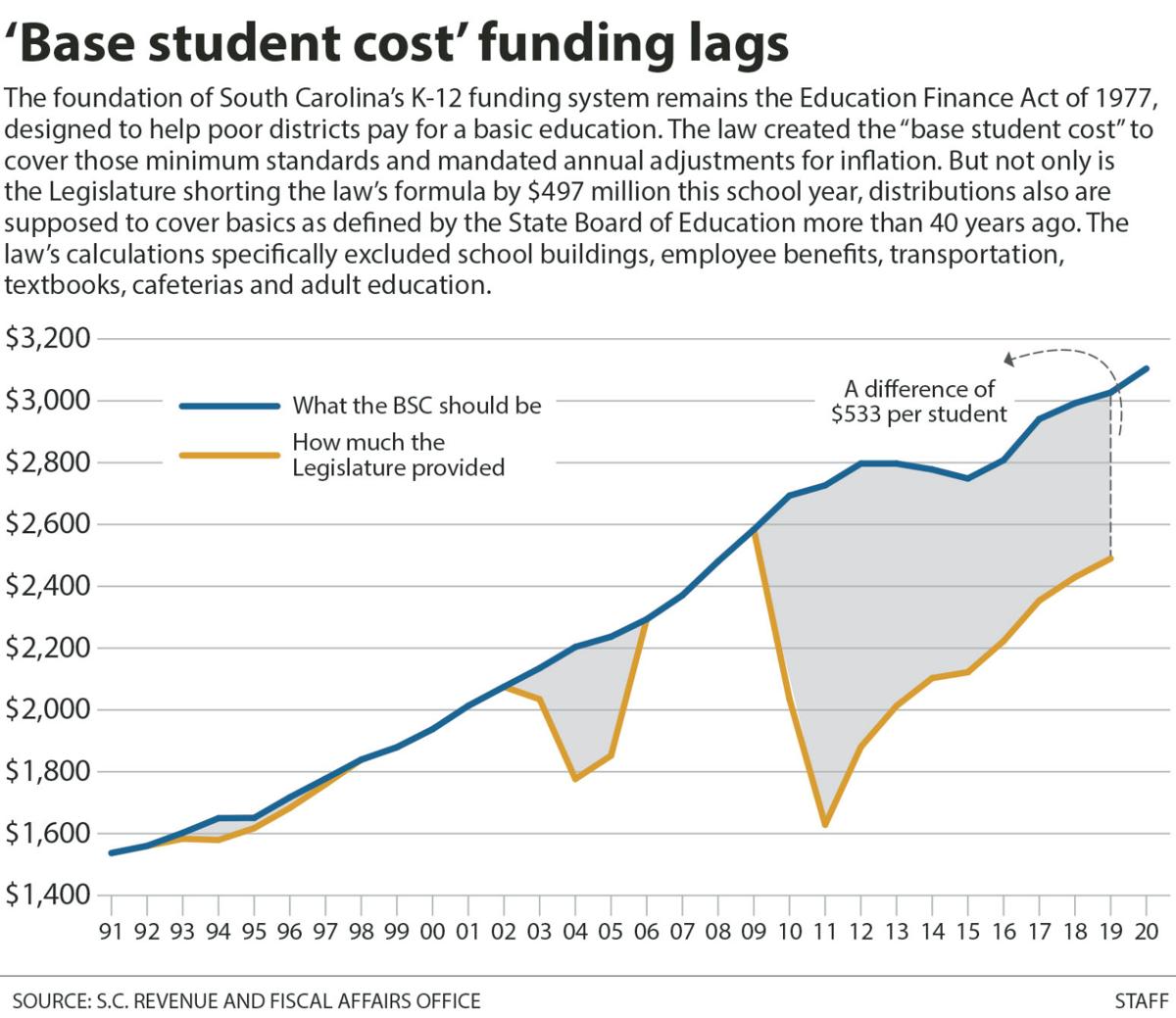
South Carolina Gov. Mark Sanford and the Republican-controlled legislature kneecapped school funding in 2006 with a tax handout to homeowners (Act 388) that routinely wrecks school revenues during economic downturns. As metropolitan school districts have grown thanks in part to an influx of workers for manufacturing concerns like Boeing, Volvo, and BMW, county governments have handed those employers massive tax incentives that cheated schools out of $2.2 billion in the last 5 years alone. And the legislature has not funded its own legally mandated Base Student Cost to districts since 2009, flagrantly violating the law every time it passes a budget — with outsize effects in our poorest rural districts.

Clearly, the leaders of the state don’t understand that their penuriousness towards the schools will hurt the next generation and the future of the state. They think in the moment. They forget about the future. They can attract corporations with a low-wage, non-union workforce, but they can’t build a thriving state unless they educate all the children.

I apologize in advance. I am habitually skeptical of fads and movements. When a hot new idea sweeps through education, it’s a safe bet that it will fall flat in the fullness of time. If there is one consistent theme that runs through everything I have written for the past half century, it is this: beware of the latest thing. Be skeptical.

The latest thing is the “Science of Reading.” I have always been a proponent of phonics, so I won’t tolerate being pilloried by the phonics above all crowd. If you read my 2000 book, you will see that I was a critic of Balanced Literacy, which was then the fad du jour.

Yet it turns my stomach to see Educatuon journalist and mainstream dailies beating the drums for SOR. As you know, I reacted with nausea when New York Times’ columnist Nick Kristof said that the SOR was so powerful that it made new spending unnecessary, made desegregation unnecessary, made class size reduction unnecessary. A dream come true for those in search of a cheap miracle!

Veteran teacher Nancy Bailey, like me, is not persuaded by the hype. She wrote a column demonstrating that the corporate reform world—billionaires and politicians—are swooning for the Science of Reading.

She writes:

Many of the same individuals who favor charter schools, private schools, and online instruction, including corporate reformers, use the so-called Science of Reading (SoR) to make public school teachers look like they’ve failed at teaching reading.

Politicians and corporations have had a past and current influence on reading instruction to privatize public schools with online programs. This has been going on for years, so why aren’t reading scores soaring? The SoR involves primarily online programs, but it’s often unclear whether they work.

The Corporate Connection to the SoR

Bill and Melinda Gates Foundation

The Bill and Melinda Gates Foundation fund numerous nonprofits to end public education. The National Council of Teacher Quality (NCTQ), started by the Thomas B. Fordham Foundation backed by Gates and other corporations, an astroturf organization, promotes the SoR.

SoR promoters ignore the failure of Common Core State Standards (CCSS), embedded in most online programs, like iReady and Amplify. CCSS, influenced by the Gates Foundation, has been around for years.

Also, despite its documented failure ($335 million), the Gates Foundation Measures of Effective Teaching, a past reform initiative (See VAMboozled!), irreparably harmed the teaching profession, casting doubt on teachers’ ability.

EdReports, another Gates-funded group, promotes their favored programs, but why trust what they say about reading instruction? They’ve failed at their past education endeavors.

But the Bill and Melinda Gates Foundation continues to reinvent itself and funds many nonprofits that promote their agenda, including the SoR.

Former Governor Jeb Bush’s Organizations

Former Governor Bush of Florida (1999 to 2007) promoted SoR, but if children have reading problems, states should review past education policies, including those encouraged by former Governors, including Mr. Bush. His policymaking in public education has been around for a long time.

One should question, for example, Mr. Bush’s third-grade retention policy ignoring the abundance of anti-retention research showing its harmful effects, including its high correlation with students dropping out of school.

He rejected the class size amendment and worked to get it repealed. Yet lowering class size, especially in K-3rd grade, could benefit children learning to read.

As far back as 2011, Mr. Bush promoted online learning. He’s not talking about technology supplementing teachers’ lessons. He wants technology to replace teachers!

Here’s a 2017 post written in ExelInEd, Mr. Bush’s organization, A Vision for the Future of K-3 Reading Policy: Personalized Learning for Mastery. They’re promoting online learning to teach reading as proven, but there’s no consistent evidence this will work.

Here’s the ExcelinEd Comprehensive Early Policy Toolkit for 2021 where teachers often must be aligned to the SoR with Foundations of Reading a Pearson Assessment. If the teacher’s role loses its autonomy, technology can easily replace them. 

Laurene Powell Jobs and Rupert Murdoch’s Amplify

How did Rupert Murdoch’s old program Amplify become the Science of Reading?

Rupert Murdoch invested in Amplify, News Corp.’s $1 Billion Plan to Overhaul Education Is Riddled With Failures. Then Laurene Powell Jobs purchased it. Does a change in ownership miraculously mean program improvement?

Teachers from Oklahoma described how student expectations with Amplify were often developmentally inappropriate, so how is this good reading science?

Many SoR supporters who imply teachers fail to teach reading do podcasts for Amplify. Are they compensated for their work? Where’s the independent research to indicate that Amplify works?

Amplify, and other online reading programs, are marketed ferociously to school districts with in-house research relying on testimonials. When schools adopt these programs, teachers have a reduced role in students’ instruction.

Chan-Zuckerberg Initiative (CZI) and Their Data Collection

Priscilla Chan pushes Reach Every Reader, including prestigious universities that write SoR reports.

Why must they collect data involving children and their families?

CZI promotes the Age of Learning and ABC Mouse for young children. The reviews of this program appear primarily negative.

Tom Ultican, retired high school teacher of advanced math and physics, investigates the claims of Nicholas Kristof about a “Mississippi miracle.” In his article in the New York Times, Kristof attributed a rise in Mississippi’s test scores to “the science of reading” plus a policy of holding back third graders who don’t pass a reading test, allegedly proving that spending more money is not necessary, poverty doesn’t matter, and reducing class size is unnecessary.

He begins:

Nicholas Kristof’s opinion piece in the New York Times might not have been blatant lying but it was close. His depiction of the amazing education renaissance in Mississippi as a model for the nation is laughable. Lauding their third grade reading retention policies as enlightened, he claims their secret sauce for success is implementing the science of reading (SoR). This is based on a willful misreading of data while tightly embracing Jeb Bush’s futile education reform ideology.

Ultican then produces a graph showing that Mississippi fourth-graders ranked 20th in the nation in 2022, but its eighth graders ranked 45th.

Misusing data allows Kristof to end the paragraph indicating poverty is not an excuse for education failure. It reminds me of a statement written by education professor Kathryn Strom,

“The “no excuses” rhetoric (i.e, “poverty is not an excuse for failure”) is one that is dearly beloved by the corporate education reformers because it allows them to perpetuate (what many recognize to be) the American myth of meritocracy and continue the privatization movement under the guise of “improving schools” while avoiding addressing deeply entrenched inequities that exist in our society and are perpetuated by school structures.” (Emphasis added)

To add heft to his argument that poverty is no excuse, Kristof quotes Harvard economist David Deming from the Harvard Kennedy School and Harvard Graduate School of Education, saying “Mississippi is a huge success story and very exciting.” He adds, “You cannot use poverty as an excuse.”

It is important to note that Harvard is famous for supporting privatization of public education and promoting failed scholarship. Deming is currently doing research with Raj Chetty and John Friedman. Along with Jonah Rockoff, Chetty and Friedman published the now thoroughly debunked value added measures (VAM) paper. Their faulty research caused many teachers to lose jobs before it was exposed as a fraud. Kristof is using an economist (not an educator) from a group best known for scholastic failure as his expert.

Kristof also indicates that spending is not important. He writes, “Mississippi has achieved its gains despite ranking 46th in spending per pupil in grades K-12.” If we look up at the 8th grade rankings, it seems they are getting what they paid for.

Ultican then goes on to describe the connections between the “Mississippi miracle” and TFA and Jeb Bush and a host of other corporate reform groups.

He concludes:

In this opinion piece, Nicholas Kristof touched on and promoted almost every billionaire inspired agenda item aimed at decreasing money going to public education. He acted as a representative of elites, advancing policies undermining education quality for common people.

This was not about improvement. It was about lowering taxes.

Please open the link and read this interesting article.

Nicholas Kristof is a columnist who is terrific on many issues but consistently wrong when he writes about education. As far back as 2009, I criticized Kristoff for a column in which he called American education “our greatest national shame,” citing Eric Hanushek’s since-discredited work on teachers (the best get students to produce high test scores, bad teachers don’t). Peter Greene took Kristoff to task in 2015 for being an educational tourist, making quick visits and issuing pronouncements that are wrong. I also chastised him in 2017 for endorsing for-profit schools in Africa.

Now, he has outdone all of his previous gaffes. He has discovered the amazing, miraculous, astonishing transformation of Mississippi.

Based on the impressive rise of 4th grade reading scores on NAEP, Kristof proclaims that Mississippi has lessons for the nation.

With an all-out effort over the past decade to get all children to read by the end of third grade and by extensive reliance on research and metrics, Mississippi has shown that it is possible to raise standards even in a state ranked dead last in the country in child poverty and hunger and second highest in teen births.

In the National Assessment of Educational Progress, a series of nationwide tests better known as NAEP, Mississippi has moved from near the bottom to the middle for most of the exams — and near the top when adjusted for demographics. Among just children in poverty, Mississippi fourth graders now are tied for best performers in the nation in NAEP reading tests and rank second in math.

Its success wasn’t because of smaller classes. That would cost money.

It wasn’t because of increased funding.

It wasn’t because Mississippi reduced child poverty.

It wasn’t because of desegregation.

It was because Mississippi embraced the “science of reading,” strict discipline, relentlessly focusing on test scores, and using behavioral methods that sound akin to a “no excuses” charter school.

In 2000, Mississippi received a gift of $100 million from a Mississippi-born tech entrepreneur to launch a statewide reading initiative. In 2013, the legislature invested in full-day pre-K, where children got a start on letters, numbers, and sounds.

The 2013 legislation also enacted third-grade retention. Any child who didn’t pass the third-grade reading test was retained. Most researchers think retention is a terrible, humiliating policy. But Kristof assures readers that failing students get a second chance to pass. 9% of students in third grade flunked. He considers this policy to be a great success, inspiring third graders to try harder, citing a study funded by Jeb Bush’s foundation (Florida also practices third grade retention, which lifts its fourth grade reading scores on NAEP).

Kristof writes:

“Mississippi is a huge success story and very exciting,” David Deming, a Harvard economist and education expert, told me. What’s so significant, he said, is that while Mississippi hasn’t overcome poverty or racism, it still manages to get kids to read and excel.

“You cannot use poverty as an excuse. That’s the most important lesson,” Deming added. “It’s so important, I want to shout it from the mountaintop.” What Mississippi teaches, he said, is that “we shouldn’t be giving up on children.”

The lessons: it’s okay to forget about poverty; forget about segregation; forget about funding. Rely on “the science of reading” and third-grade retention. It’s cheap to follow Mississippi’s lead, which Kristof considers an advantage.

But!

Kristof minimizes Mississippi’s eighth-grade scores on NAEP. He writes: “One challenge is that while Mississippi has made enormous gains in early grades, the improvement has been more modest in eighth-grade NAEP scores.

That’s an understatement.

Eighth grade reading scores in Mississippi have gone up over the past two decades, but scores went up everywhere. In the latest national assessment (NAEP), 37 states had scores higher than those of Mississippi on the NAEP eighth grade reading test. Only one state (New Mexico) was lower. The other 13 were tied. In Mississippi, 25% of the state’s students in 2019 (pre-pandemic) were at or above proficient, compared to 20% in 2003. Nationally, in 2019, 29% of students were at or above proficient*.

In 2019, 42 states and jurisdictions outperformed Mississippi in percentage of students at or above proficient in eighth grade math, eight were tied, and only two scored below Mississippi. 24% were at or above proficient in 2019, a big increase over 2009 when it was 15%. But Mississippi still lags the national average, because scores were rising in other states.

Has Mississippi made progress in the past decade? Yes. Is it a model for the nation? No. When impressive fourth grade scores are followed by not-so-impressive scores in eighth grade, it suggests that the fourth grade scores were anti Oakley boosted by holding back the 9% who were the least successful readers. A neat trick but not an upfront way to measure progress.

It seems fairly obvious that the big gains in NAEP in fourth grade were fueled by the policy of holding back third graders. Jeb Bush boasted of the “Florida Miracle,” which was based on the same strategy: juice up fourth grade scores by holding back the lowest performing third graders.

In 2019, fourth graders in Florida scored 7th in reading and 5th in math on NAEP, by scale scores. However, Florida’s eighth grade scores, like those of Mississippi, are middling, compared to other states. Florida eighth graders ranked #35 in eighth grade math. In eighth grade reading, 21 states and jurisdictions ranked higher than Florida, 21 are not significantly different, and 10 were below Florida.

Florida’s eighth grade reading scores have been flat since 2009; so have its its eighth grade math scores. Florida is a state that has gamed the system. Mississippi is following its lead.

Mississippi has made progress, to be sure. But it is not a national model. Not yet.

What’s worrisome about this article is that Kristof asserts that poverty doesn’t matter (it does); funding doesn’t matter (it does); class size doesn’t matter (it does). In his account, states that want to improve test scores can do it without raising teachers’ salaries, without upgrading buildings, without spending a nickel to improve the conditions of the schools or the well-being of children. Children who are hungry, lack medical care, and are homeless or ill-housed are not likely to learn as well as those who have advantages.

Does this explain why so many rightwingers love “the science of reading”? Publishers are rolling out new programs. Education can be reformed in the cheap. Can’t expect taxpayers to foot the bill, can you?

Kristof’s fundamental error is his determination to find miracles, silver bullets, solutions that fix everything. He did it again.

The U.S. Department of Education appends this disclaimer to every NAEP publication.

*NAEP achievement levels are performance standards that describe what students should know and be able to do. Results are reported as percentages of students performing at or above three achievement levels (NAEP Basic, NAEP Proficient, andNAEP Advanced). Students performing at or above the NAEP Proficient level on NAEP assessments demonstrate solid academic performance and competency over challenging subject matter. It should be noted that the NAEP Proficient achievement level does not represent grade level proficiency as determined by other assessment standards (e.g., state or district assessments). NAEP achievement levels are to be used on a trial basis and should be interpreted and used with caution. Find out more about the NAEP reading achievement levels.

Paul Bonner, retired career educator, debunks the “science of reading” prattle;

Then the New York Times published this…https://www.nytimes.com/2023/04/16/us/science-of-reading-literacy-parents.html

Ignorance about the circumstances that hinder student learning is pervasive among the national media. They report again and again on failed “one size fits all” remedies without understanding that these fail because they do not address the root cause of public school challenges: Poverty.

Advocacy for “The science of reading”, Lucy Caulkins, or whole language all miss the point. Until we are willing to change the instructional delivery system that allows for K-12 class sizes of 20-30+ students per class, a teaching professional day that does not allow meaningful classroom preparation except beyond the school day, equal high quality resources and facilities for all students, and an understanding that this hyper focus on reading fluency actually demonstrates low expectations for our students.

Perhaps the greatest inaccuracy on the NYTimes report is that somehow schools have not been engaged in this “Science of reading” rabbit hole.

The two large districts I served in were all in with massive resources given to administrative and teacher professional development for the purpose of institutionalizing the practice. Yet, scores never moved despite efforts to show improvement through numerous changes in the standardized tests being implemented.

The confirmation bias so prevalent in this ongoing reporting has been troubling since the Clinton Administration introduced the “Standards Movement.” Any challenges to such bias continue to be ignored and often attacked.

The fact that Emily Hanford, Arne Duncan, Bill Gates, Margaret Spellings continue to act as “go to” interviews when their profession experience as practicing educators is woeful at best, demonstrates the little regard reporters have for the professionalism required to teach and administer instructional outcomes.

It is in fact these arbiters of “data” who use anecdotal reporting to misinform politicians and institutions such as the NAACP to continue this malpractice.

Perhaps the one method we have been reticent to use should be to support teaching, adequately resource school facilities everywhere, and get the hell out of the way for the educators who actually know their craft.

Charter “co-location” has become a flash point for conflict in urban districts. In New York City, charter schools were given the right to take space in public schools, and thanks to former Governor Andrew Cuomo, the city is required to pay the charter’s rent if it hires private space. Charter co-locations take up every available empty space in a school, typically disadvantaging the host school, which becomes overcrowded. The charter rooms are newly refurbished even in public schools that have waited years for upgrades.

Recently the New York City Board of Education (known as the “Panel for Educational Policy”) voted to co-locate two Success Academy charters in public schools in Queens and Brooklyn. The co-location conflicts with a class-size reduction law passed by the State Lefislature. Parents, educators and the United Federation of Teachers have gone to court to block the co-location.

For Immediate Release – Tuesday, March 28, 2023

Parents, educators, UFT launch court action to block co-location of two Success Academy charters with Queens and Brooklyn public schools

Lawsuit claims DOE failed to account for state law class size caps, needs of disabled students and more

Parents, a teacher, and the United Federation of Teachers (UFT) today filed a lawsuit in Manhattan State Supreme Court charging that the New York City Department of Education violated state education law and its own regulations when it sought to co-locate two Success Academy charter schools into Queens and Brooklyn public schools without providing an in-depth analysis of how these co-locations would affect the students already in those public schools.

The city’s Panel for Education Policy voted in November and December in favor of the co-locations, but as the lawsuit says, “The DOE has misled parents, the public, and the PEP itself regarding the actual impacts of its proposed co-locations, including both schools’ ability to comply with impending requirements of the new Class Size Law.”

Attorneys for the United Federation of Teachers were joined in the legal action by Advocates for Justice Legal Foundation, along with a teacher and parents of children from the affected schools.

The schools involved include the Waterside School for Leadership in Far Rockaway, Queens, and the Sheepshead Bay Educational Campus that is home to Origins High School, Professional Pathways High School, and New Visions Charter High School for Advanced Math and Science III.

According to the lawsuit, the DOE underestimated the effects of the co-locations by assuming that current class sizes in these schools would continue into the foreseeable future, ignoring the requirements of the new state class size law.

Under that law, all schools will have to cap class sizes in kindergarten through grade three at twenty students; grades four through eight at twenty-three students; and grades nine through twelve at twenty-five students, to be phased in over five years, starting next fall.

According to the lawsuit, many classes in two of the existing schools are already far above those limits and will require additional space to lower class sizes to mandated levels. Yet this need is never mentioned in the legally-required Educational Impact Statements (EIS) for these co-locations, nor is there sufficient space allocated to these schools to be able to reduce class size to mandated levels in the future.

Absent from the EIS is any mention that students at Waterside will lose their science lab, and that all four schools may lose many other dedicated rooms needed to deliver intervention and special education services.


Estherll Dorancy, the PTA President of Waterside School for Leadership said, “Parents weren’t even aware of what was going on when these decisions were being made. Our students will lose classrooms needed to lower their class sizes and their science lab, which is critical if they are going to be able to pass their 8th-grade state science exams.”


As the lawsuit makes clear, the DOE is legally required to produce in-depth EIS reviews. According to the lawsuit, “the DOE is going through the motions of what the law requires instead of actually complying with it.”

Irina Pistsov, another parent at the Waterside School for Leadership said, “The science lab is a critical resource for students at Waterside and it is already a challenge to provide adequate lab time to meet state standards.”

As the lawsuit maintains, there is nothing in any of the EISs produced for these proposed co-locations, or in the Instructional Footprints upon which they are based, “that ensure or even analyze whether there would be sufficient dedicated spaces for students with disabilities to receive their mandated services after the co-locations occur.”

The parties seek an injunction to prevent the co-locations from occurring until and unless the DOE complies with the requirements of the Education law — “to provide the impacted students, parents, community, and members of the Panel for Educational Policy with adequate specific information about major changes to their school’s space and how these changes will impact the education of the existing and prospective students.”


Josh Cowen is a Professor of Educational Policy at Michigan State University. He has spent many years as a voucher researcher and recently concluded that vouchers are a failed experiment, based on a multitude of research studies.

As soon as anyone becomes a critic of charter schools or vouchers, the choice lobby attacks them and claims they are paid by the teachers’ unions. I know this from personal experience. A few years ago, a choice lobbyist accused me of taking union money to buy the house I lived in; I assured her that I paid for my home all by myself.

Funny that the shrill well-paid lobbyists act as though unions are criminal enterprises, when in reality they have historically enabled poor and working class people to gain a foothold in the middle class, to have job security, health benefits, and a pension. They also give public schools a voice at the table when governors propose larger classes, lower standards for new teachers, or decreased funding for schools. I believe we need unions now, more than ever. Whenever I hear of a charter school unionizing or of workers in Starbucks or some other big chain forming a union, it makes my day.

Josh Cowen has undoubtedly been subject to the same baseless criticism from the same union-haters whose salaries are paid by plutocrats. He shares his thoughts here about teachers’ unions.

Here in Michigan, the Democratic legislature just re-affirmed our state’s longstanding commitment to working families by removing anti-labor provisions from state law. The move doesn’t apply to teachers and other public employees, because the conservative U.S. Supreme Court sided a few years back with Right-wing activists in their efforts to hinder contributions to public sector unions, but it’s still good news for the labor movement overall.

And I wanted to use their effort—alongside Republican efforts in other states to threaten teachers for what they say in classrooms—to make a simple point.

We need teachers unions. Other folks more prominent than me, like AFT’s Randi Weingarten, have made this point recently too. But I wanted to add my own voice as someone who has not been a union member, and someone who—although I’ve appeared with Randi on her podcast and count many union members as friends—has never been an employee or even a consultant.

If you want to talk dollars, The Walton Family Foundation once supported my research on charter schools to the tune of more than $300,000. Arnold Ventures supported my fundraising for a research center at Michigan State–$1.9 million from them. And the US Department of Education awarded my team more than $2 million to study school choice—while Betsy DeVos was secretary.

Think about that when I say school vouchers are horrific. And understand, I’m getting no support from teachers’ unions.

Instead it is I who supports them.

I’ve been studying teacher labor markets almost as long as school vouchers. Mostly my research has looked at teacher recruitment and retention. But I’ve also written about teachers’unions specifically. There’s a debate among scholars on what unions do and whether their emphasis on spending translates into test score differences. In the “rent seeking” framework economists use, the concern is that dollars spent on salaries don’t have direct academic payoffs.

There is no question that spending more money on public schools has sustained and generational impacts on kids. Research has “essentially settled” that debate, according to today’s leading expert on the topic.

But I want to branch out from dollars and cents and test scores to talk about teacher voice.

And I want to do that by raising a few questions that I’ve asked myself over the last couple years:

Why should the voice of a billionaire heiress from Michigan with no experience in public schools count for more than the voices of 100,000 teachers in my state’s classrooms every day?

Why should the simple fact that they work with children made by other people mean that teachers surrender their own autonomy and judgment not just as professionals but as human beings?

Why should educators have to work under what amounts to gag orders, afraid to broach certain topics or issues in the classroom? Some states are setting up hotlines to report on teachers as if they’re parolees, and a bill in New Hampshire would essentially give the fringe-Right Secretary of Education subpoena power to haul teachers in front of a special tribunal for teaching “divisive concepts.” This, after a Moms for Liberty chapter put out a bounty on New Hampshire teachers who were likewise divisive on an issue. Read: an issue of race or gender.

It’s not just threats to teacher employment. We know this. There are threats to teachers’ lives. How many teachers have died alongside their students—other people’s children—over the years in school shootings?

Why does the Right claim to trust teachers enough to arm them with guns in response to those shootings, but not enough to let them talk about race, gender, or any other “divisive concept?” Even some conservative commentators have worried publicly that we’re asking teachers to do too much. Why are we asking them to be an armed security force too?

‘In her recent history of “The Teacher Wars”, The New York Times’ Dana Goldstein noted that teachers formed unions, and fought for teacher tenure, to protect themselves not just professionally but personally. For free speech. To prevent harassment from supervisors—then as now, teachers were mostly professional women—and to keep from being fired for pregnancy or marital status.

So really, attacks on teachers are nothing new. Instead, teachers seem to be one of the few professions that it’s still acceptable in political conversation—even a mark of supposed intellectual sophistication in some circles—to ponder the shortcomings of the educators who work with our kids every day.

There’s nothing sophisticated about attacking hardworking, thoughtful, and dedicated people. And the only result of doing so will be the further erosion of our public, community schools. And that’s really the point. Just a few days ago, we learned that the big data that I and many others have gotten used to working with finally caught up to the on-the-frontlines warnings of educators everywhere: teachers are exiting the profession at unprecedented rates.

I’ve taken no money from teachers’ unions for any of the work I do. I’ve never been a member of a union—teachers’ or otherwise. Until now. Because after writing this today, I made a donation to my state’s primary teachers’ union and became a general member: a person “interested in advancing the cause of education…not eligible for other categories of membership.”

There’s a word for that in the labor movement. You hear it a lot here in Michigan, where I grew up and now teach future teachers in a college of education. That word is Solidarity.

Sign me up.