Archives for category: Citizenship

This is one of the best of Jan Resseger’s many brilliant posts.

In it, she quotes a surprising source, who explains the importance, centrality, and  necessity of public schools as anchors of their communities.

As you may have guessed, I am a huge admirer of this insightful, wise woman.

Please print this out, email it, tweet it, put it on Facebook, share it with your friends.

I never quote a post in full. I want you to go to the source and add page views to the author. This is an exception because I can’t find a word to cut.

She writes:

The 2019-2020 school year is now underway, and in an ironic twist, in a business journal, the academic dean of the college of education at the for-profit University of Phoenix has penned a beautiful reflection on the meaning of public education. Dean Pam Roggeman understands the meaning for families and for communities of their public schools.

Roggeman writes: “This early fall, I’d like to honor the millions of parents who…  send their kids to school for the first time. Critics, possibly a bit removed from their neighborhood public schools, at times try to paint public education as a nameless, faceless bureaucratic institution that is riddled with faults. And like many other institutions, our public schools do have flaws. However, those of us rooted in our communities, with or without school-age kids, do not see our schools as faceless institutions. Rather, we associate our schools with our child’s talented teacher, or the principal greeting kids at the door, or the coach waiting for kids to be picked up after practice, or the mom who became this fall’s crossing guard, or the front office staff who commiserate with us as we deliver the forgotten lunch, and… also with the friendly bus-driver who will not move that bus until every child is safely seated. We rely on and embrace our neighborhood public schools as a community enterprise on which we deeply depend.”

Roggeman defines the reason public schools are one of our society’s best opportunities for establishing systemic justice for children: public schools are required by law to serve the needs and protect the rights of all children: “(T)here is one thing that our American public schools do better than any other schools in the country or even in the world: our public schools commit to addressing the needs of every single child. Our public schools are open to ALL children, without prejudice or pause. Our schools attempt to educate EVERYBODY. American students are students who are gifted, students with disabilities, students who need advanced placement, students who have experienced trauma, students who are learning English, students who are hungry, affluent students, students who live in poverty, students who are anxious, and students who are curious.”

Reading Roggeman’s reflection on public education as an essential civic institution caused me to dig out a Resolution for the Common Good, passed by the 25th General Synod of the United Church of Christ more than a decade ago, when I was working in the justice ministries of that mainline Protestant denomination. The resolution was passed unanimously in 2005, in the midst of a decade when an ethos of individualism was accelerating.

The values defined in the introduction to the resolution mesh with Roggeman’s consideration of public schools as the essence of community: “The Twenty-fifth General Synod calls upon all settings of the United Church of Christ to uphold the common good as a foundational ideal in the United States, rejects the notion that government is more unwieldy or inefficient than other democratic institutions, and reaffirms the obligation of citizens to share through taxes the financial responsibility for public services that benefit all citizens, especially those who are vulnerable, to work for more equitable public institutions, and to support regulations that protect society and the environment.”

The introduction of the resolution continues: “A just and good society balances individualism with the needs of the community. In the past quarter century our society has lost this ethical balance. Our nation has moved too far in the direction of promoting individual self interest at the expense of community responsibility. The result has been an abandonment of the common good. While some may suggest that the sum total of individual choices will automatically constitute the common good, there is no evidence that choices based on self interest will protect the vulnerable or provide the safeguards and services needed by the whole population. While as a matter of justice and morality we strive always to expand the individual rights guaranteed by our government for those who have lacked rights, we also affirm our commitment to vibrant communities and recognize the importance of government for providing public services on behalf of the community… The church must speak today about the public space where political processes are the way that we organize our common life, allocate our resources, and tackle our shared problems. Politics is about the values we honor, the dollars we allocate, and the process we follow so that we can live together with some measure of justice, order and peace.”

Recognizing “significant on-going efforts to privatize education, health care, and natural resources, and to reduce revenues collected through taxes as a strategy for reducing dependency on government services,” the delegates resolved “that the United Church of Christ in all its settings will work to make our culture reflect the following values:

  • that societies and nations are judged by the way they care for their most vulnerable citizens;
  • that government policy and services are central to serving the common good;
  • that the sum total of individual choices in any private marketplace does not necessarily constitute the public good;
  • that paying taxes for government services is a civic responsibility of individuals and businesses;
  • that the tax code should be progressive, with the heaviest burden on those with the greatest financial means; (and)
  • that the integrity of creation and the health and sustainability of ecological systems is the necessary foundation for the well-being of all people and all living things for all time.”

Since that resolution passed in 2005, we have watched an explosion of economic inequality, the defunding and privatization of public institutions including K-12 public education, the defunding of social programs; the growth of privatized and unregulated charter schools, the abuse of power by those who have been amassing the profits, and the abandonment of policies to protect the environment.

A just and good society balances the rights of the individual with the needs of the community. I believe that the majority of Americans embrace these values.  I wonder how we have allowed our society stray so far.


This is a powerful documentary about the Great Boatlift on 9/11/01.

Boats of every type and size converged on Lower Manhattan to rescue half a million people who were trapped after the Twin Towers fell.

It reminds us of the power of good that brings people together in common purpose.


A reader who goes by the sobriquet “speduktr” wrote:


I have never really understood the choice mantra. My taxes were not tuition for my children, and they certainly are not intended for someone’s individual use now that I have no children in the system. They were and are meant to support the education of every child in my community. Parents are not entitled to a chunk of that money to be used how they see fit. That money is for the common good. For me, I don’t even have to get into the discussion of charter machinations. They are beside the point.


Charles Foster Johnson, leader of Pastors for Texas Children, reflects on the meaning of citizenship:


America is not a geography. Or nationality. Or ethnicity. 
 
America is an idea. A truth. 
 
That idea, that truth, is this: “That all men are created equal and endowed by their Creator with certain inalienable rights, among them life, liberty, and the pursuit of happiness.”
 
Jefferson was right, that idea is “self-evident.”
 
So, let your life be the evidence. 
 
Do these things:
 
Vote. Register to vote, vote in every election, and get everyone in your family, at your work, and on your street to do the same. When you don’t, bad people win.
 
Read. Be informed. Take the daily newspaper and read it. All of it. Turn off all cable television news. It is all fake. It is designed to entertain you—not inform you. Do it today. When you don’t, bad people win.
 
Serve. Start with your neighborhood public school. It’s right down the street. Make an appointment with the principal and ask how you can help. Defend your neighborhood public school against its privatization. When you don’t, bad people win.
 
Worship. With your neighbors. With folks who know you, love you. Turn off all television and celebrity preachers. Do not listen to any preacher who does not know your name, your face, who will not hold your hand in prayer when you need it— and call you to do the same. When you don’t, bad people win.
 
This land is your land. This land is my land. This land was made for you and me. 
 
Let’s put the idea of America into action.
 
The truth of America is “self-evident.”
 
The evidence is you.


Fred Klonsky proclaims his agreements with NY Times columnist Thomas Friedman. 

“If Democrats can choose a nominee who speaks to our impending challenges, but who doesn’t say irresponsible stuff about immigration or promise free stuff we can’t afford, who defines new ways to work with business and energize job-creators, who treats with dignity the frightened white working-class voters who abandoned them for Trump,wrote Thomas L. Friedman in this morning’s New York Times.

I think this is good advice.

Well, except for that part about “frightened white working-class voters…”

As for promising free stuff we can’t afford? I’m down with that.

Of course, Friedman is probably talking about national health care and free college tuition.

I’m thinking of corporate giveaways and tax breaks to Amazon.

Billions and billions of tax giveaways to corporations. Outrageous.

Be a good corporate citizen. Pay your taxes.

Be a patriot. Pay your taxes.


Neema Avashia learned that her middle school in Boston was going to close. She decided that she would stand and fight. She did. She is a true patriot. She made a difference. She defeated the powerful. She is a hero of the Resistance. She joins the honor roll of this blog.

She writes:

My gloves came off the day representatives of my school district told us they would be closing our school. Our students would be sent to a turnaround high school that had never taught middle school students. Recently arrived immigrant students in language-specific programs, which the high school did not offer, would be dispersed across the city. As for our staff, the representative from Human Capital glibly told us, “We have no plan for you.”

What does it mean when the school system that you’ve poured your heart into doesn’t have the decency to consider a thoughtful transition plan before making the decision to close your school?

It means they never saw you as human in the first place.

It means that your job, then, is to make it impossible for them to look away from your humanity.

I went home from work that afternoon and opened a Twitter account. Opponents of other district proposals had successfully used Twitter to shame city leadership into changing course.

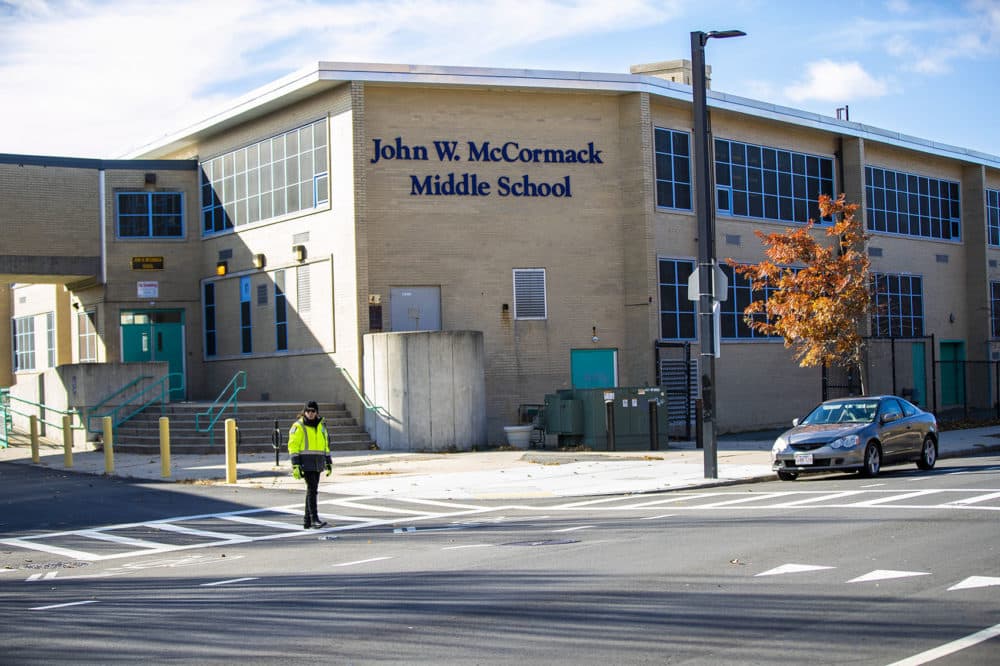
The John W. McCormack Middle School on Columbia Point. (Jesse Costa/WBUR)

“I am a @McCormackMiddle teacher,” my first tweet read. “Today the district announced they will be closing my school, and I am left full of questions.”

Once I began, there was no stopping. I knew that if the McCormack closed, I would not be a teacher anymore. That the work it took to build these relationships, and this community, was not something I could take up a second time under the scepter of further closures.

On Twitter, I relentlessly poked holes in the plan: BuildBPS was founded on the premise of renovating pre-WWII buildings, yet our building was constructed in 1968. Multiple schools have failing heat systems and leaking roofs, but our building had received a new boiler, windows and roof within the last ten years. BuildBPS purported to prioritize the most vulnerable students, yet disrupted the education of our English Language Learners.

My recklessness knew no bounds. I went before the Boston School Committee and announced, “I’m here to give you a history lesson,” then reminded them that our students had merged with a turnaround previously — the elementary school next door — and that doing so had placed the elementary school under even higher scrutiny from the state.

Read her story. Hers is the kind of dedication that the corporate reformers and Disrupters can’t buy. She is a champion of children, not a billionaire’s lackey. She carries within her the spark of revolution that inspired patriots in the 18th century.  She is a patriot for our times, uncowed by  money and power.


In this comment, posted not long ago, reader Laura H. Chapman describes the Ohio view of education as workforce preparation. The pioneers of education had nobler goals. Above all, they considered the purpose of education to be preparation for citizenship in our emerging democracy. That meant literacy and numeracy but also character development with the hope of cultivating a commitment to democratic values and a readiness to participate in improving society on behalf of the community, not just oneself.

A resident of Ohio, Chapman describes the state’s narrow, utilitarian view of the goals of education. She notes that this goal was announced without any public discussion.

Several days ago, she wrote:


Today March 30, 2019, several Ohio newspapers had variations on the same announcement of a new non-profit headed by Lisa Gray, a long standing point person for the Bill and Melinda Gates Foundation. Gray is now the “founder” of Ohio Excels, a corporate-led non-profit intent of making evidence of job preparation the priority for all high school graduates . The mission statement also includes educational choice, a policy perfectly consistent with the view that early apprenticeships and career prep from preschool are the singularly important missions of Ohio’s public schools.

This set of policy and practice priorities, comes to us hard on after the State Board of Education published Each Child, Our Future. Ohio’s Strategic Plan for Education: 2019-2024 in June 2018. That plan also included a strong emphasis on workplace skills and early career education, notably with Lisa Gray participating in a “workgroup” on “ High School Success and Postsecondary Connections ” led by LEAH MOSCHELLA from JOBS FOR THE FUTURE (JFF) where Moschella is a senior program manager for the Pathways to Prosperity Network, a collaboration between the Harvard Graduate School of Education.

I judge that plan 2018 Ohio plan (a conceptual mishmash) left too many CEOs unhappy, so Ohio Excels will be putting a new plan is in place–one that is an offshoot of Jobs for the Future (JFF) and the Pathways to Prosperity Network.

I looked at the board of Ohio Excels and see lots of CEOs, many from activist positions in metro area business committees and civic and cultural groups. One is also on the board of Hillsdale College–a radical right school. I recognize another as a major supporter of the arts. Another was leading an initiative instigated by the MindTrust in Indianapolis, seeking more charter schools in Cincinnati with the usual patter about needing more “high quality seats.”

I am still unravelling the connections among all of these outfits, but so far I have discovered that JFF has received 35 grants for a total of about $122.5 million from the Bill and Melinda Gates Foundation dating from 2002. Early grants pushed the Common Core with “college and career” readiness, beginning in earnest in grade 9.

The Pathways to Prosperity Network has been funded within each member state (e.g., annual participation fee for California, $500,000) in addition to funds from the Carnegie Corporation of New York $450,000, the James Irvine Foundation (about $12 million, most in California), the Noyce Foundation (before it closed in 2015), and SAP an international Software company.

Jobs for the Future,appears to be inseparable from the Pathways to Prosperity Network. JFF has 18 projects in Ohio. All of these are designed to make Ohio education serve corporate interests. I have not yet done research on each of these projects.

Pathways to Prosperity Network (a project and all host to other efforts);
Center for Apprenticeship & Work-Based Learning;
Student-Centered Learning Research Collaborative;
Postsecondary State Network;
Student Success Center Network;
Nudging to STEM Success;
Early College;
Improved Reentry Education;
Jobs to Careers;
Counseling to Careers;
Middle-Skill STEM Pathways Initiative;
New Skills at Work;
Digital Career Accelerator;
Great Lakes College and Career Pathways Partnership;
Lumina Foundation Talent Hubs;
Google IT Support Professional Certificate;
Policy Leadership Trust, and the big surprise:
“Pay for Success in K–12 Education” wherein venture capitalists overtly hope to make money from turning K-12 education into a financial product with little or no public voice and oversight.

Jobs for the Future has “partners.” These are

GOOGLE,
California Endowment,
Salesforce.org (cloud computing, artificial Intelligence),
Educational Credit Management Corporation (ECMC) Foundation,
The James Irvine Foundation,
William and Flora Hewlett Foundation,
Social Finance (Pay for Success contracts), and yes–
US Department of LABOR and US Department of EDUCATION.

This national network of interlocking programs, foundations, and corporate groups has an agenda far removed from vocational eduction.

Ohio Excels, the new Ohio non-profit to be led by Lisa Gray has three staff and a policy agenda for public education that has not been shaped by public discussion. Our students are to part of the “talent pipeline” that CEOs say they want. Never mind what the life of our students may offer or require beyond getting a job and getting ready for a job beginning in Kindergarten. I hope to offer more detail about “Ohio Excels,” Jobs for the Future, and Pathways to Prosperity in another post.


The boys’ volleyball team at Kepler Neighborhood School, mostly 7th and 8th graders, went for a run over a bridge near the school. They spotted a woman attempting suicide, dangling from the bridge. They raced to ask their coach what to do. He said, “Tell her that her life matters,” as he dialed 911.  The boys ran to the woman and told her again and again that her life matters, that people care about her, that she must not give up.

She pulled herself up. She did not commit suicide. The boys persuaded her to go on living.

According to the NAEP data, Fresno schools and students are among the lowest performing in the nation. Their scores are very low.

What do you think of those kids in Fresno now? Put another way, what do you think about using the scores to judge the worth of these boys?


Public Schools Week is March 25-29.

Download the toolkit of the Network for Public Education and do your part to support public schools! 

The forces of privatization are rising up, making promises and failing to keep any of those promises.

Public schools are the bedrock of democracy, doors open to all. Certified teachers in every classroom. Public schools strive for equality of educational opportunity, not privilege for the few.

Get involved. Do yourpart as a citizen.

Whose schools? Our schools!

The Gülen charter schools are one of the biggest chains in the U.S. They have about 160 or more schools. They usually claim they have no connection to Imam Fethullah Gülen, but they can be identified by the unusual number of Turkish teachers in the school, many using H1B visas; by the preponderance of Turkish men on their board of directors; by their inclusion of Turkish language in their curriculum; and by their preference to award contracts to Turkish-owned contractors, even when those firms were not the low bidder.

The Gulen schools call themselves by different names, but they are all somehow connected to a reclusive imam who lives in the Pocono Mountains of Pennsylvania.

I don’t know whether the Gülen schools are good or bad schools, I just think it odd to outsource what are supposed to be American public schools to foreign nationals.

The conservative journal EdNext, funded largely by the conservative Hoover Institution, defends the Gülen charters and critiques those who would dare to criticize them. 

Should we outsource community public schools to Saudi Arabia? to Russia? to China? to North Korea? to Brazil?

Where would EdNext draw the line? Or do they think there should be no line at all? Why should America have public schools?

American public schools are supposed to teach civics, democratic values, and history. Can we turn that over to teachers who have never studied American history or civics? Is it a good idea to outsource our public schools? According to EdNext, yes.

For anyone who wants to learn more about the Gulen charter school movement, I recommend Mark Hall’s film, “Killing Ed” and parent activist Sharon Higgins’ investigative reporting about the Gulen schools. 

Some Gulen schools have been investigated by the FBI. Here is a 2012 report in the New York Times that EdNext won’t mention.

The writer was Stephanie Saul.

A group of three publicly financed charter schools in Georgia run by followers of Fethullah Gulen, a prominent Turkish imam, have come under scrutiny after they defaulted on bonds and an audit found that the schools improperly granted hundreds of thousands of dollars in contracts to businesses and groups, many of them with ties to the Gulen movement.

The audit, released Tuesday by the Fulton County Schools near Atlanta, found the schools made purchases like T-shirts, teacher training and video production services from organizations with connections to school officials or Gulen followers. Those included more than $500,000 in contracts since January 2010 with the Grace Institute, a foundation whose board has included school leaders. In some cases the awards skirted bidding requirements, the audit said.

“I would just question how those vendors were selected when price in many instances wasn’t part of the decision making,” said the Fulton County superintendent, Robert Avossa, who criticized the schools for conflicts of interest. “And those are public dollars.”

Gulen followers run more than 120 charter schools nationwide, making the loosely affiliated network one of the nation’s largest public charter school operators. Despite clear connections, the schools generally deny any affiliation with the Gulen movement, a powerful religious and political force in Turkey whose leader, Mr. Gulen, views establishing schools as part of his mission. While some of the charter schools have been praised for their academic performance, their business practices have raised questions.

The New York Times reported last year that the group’s 36 Texas schools had granted millions of dollars in construction and renovation contracts to firms run by Turkish-Americans with ties to the movement, in some cases bypassing lower bids from firms with no connections to the movement. The Texas schools also awarded deals for cafeteria food, after-school programs and teacher training to organizations affiliated with Gulen followers.

The Georgia audit, posted to the Fulton County Schools Web site Tuesday evening, focused on the Fulton Science Academy Middle School in Alpharetta, Ga., a 500-student school that was recently denied a renewal of its public charter. The school, which had received $32 million in public funds over the past 10 years, said it would operate as a private school. While the audit does not lay out all of the relationships between contractors and the movement, a chart shows connections between the people running the schools, some of the vendors and Gulen-connected groups.

Dr. Avossa said that the audit’s findings had raised concerns about the group’s two other public charter schools in his district: Fulton Science Academy High School and Fulton Sunshine Academy, an elementary school.

He said a full audit would be conducted of those schools “to gauge whether similar wrongdoing is taking place.”

The three schools have enrolled 1,200 students representing a cross section of students in the Fulton County district.

Wells Fargo Bank, trustee of a $19 million bond issue by the schools, told investors on May 15 that the three schools were in default on those bonds. The bank said the default was caused by the group’s failure to disclose in its bond offering last year that its middle school charter renewal might have been in jeopardy. “The failure to disclose the ongoing concerns with Fulton Science Academy’s charter renewal petition constituted an omission of material facts in the public statement,” Wells Fargo said.

A default gives the bondholders the right to demand immediate payment, possibly requiring a liquidation of some school assets. The bonds are trading at about 70 percent of face value.

Concerns about governance and transparency were partly behind the district’s rejection of the Fulton Science Academy Middle School’s demand for a 10-year charter renewal. The school was named a “blue-ribbon” school last year by the federal government for its performance and appealed unsuccessfully to the state.

Kenan Sener, the school’s principal, said that the audit contained significant inaccuracies and that the school would issue a statement on Wednesday, after fully reviewing the document.

Nationwide, the charter schools have pursued an aggressive expansion plan, much of it financed by public bond issues, with the Texas schools borrowing more than $200 million through bond offerings.

In Texas, the group’s spending has been the focus of investigations by the State Legislature and the Texas Education Agency. The federal Department of Education is also investigating the Texas schools, apparently focusing on allegations of discrimination against Hispanic special education students in enrollment. The schools have denied wrongdoing.

One criticism of the schools involves their reliance on teachers imported from Turkey while teacher unemployment in the United States remains high. The audit said the Fulton Science Academy Middle School had paid $75,000 in immigration-related expenses for such employees.

Although the schools are inspired by Mr. Gulen and teach Turkish language and culture, they do not teach religion.