Archives for category: Censorship

Steven Monacelli wrote this article for The Texas Observer about the network of rightwing groups flooding local school board elections with big money. He also supplied the photographs.

As the article points out, about 75% of local school board candidates spend less than $1,000 to run for office. In districts targeted for takeover, such modest spending is no longer a path to success.

Monacelli writes:

Over the last three years, an interconnectednetwork of political action committees (PACs), largely funded by billionaires who support school privatization, has begun to transform the nature of local school board elections across Texas. They’ve done this with the help of consultants whose efforts have largely gone unnoticed.

On August 15, 2022, members of the Carroll Independent School District (CISD) board of trustees, all dressed in Southlake Dragons’ green, posed for a photo with representatives of Patriot Mobile, a Christian Nationalist phone company that spent big last spring to help secure the victories of three trustees. The occasion honored the company’s donation of posters that read “In God We Trust.”

The trustee’s acceptance of the red, white, and blue star-spangled posters immediately drew opposition from critics who see those words not just as a motto that appears on dollar bills, but also as a declaration of allegiance to conservative causes. One disapproving parent attempted to donate signs with the same words in Arabic and on a rainbow background but was rejected; the board president said they already had enough.

Other school districts got the posters around the same time. And not all parents who spoke out were critical.

Erik Leist, who resides in the neighboring Keller ISD area, spoke to multiple news outlets about the posters after they were donated. He approved of the state law passed in 2021 that requires schools to display donated signs bearing the national motto in a “conspicuous place.”

“If it’s important to communities, the community will come behind it,” Leist said, according to accounts published in Fox News and the Texas Tribune that identified him only as the father of a kindergartener.

Leist, however, is much more than a concerned dad: He’s a conservative political consultant who at the time had already been paid tens of thousands of dollars by multiple PACs to support the campaigns of new ultraconservative school board members in Carroll and neighboring school districts, trustees who were eager to accept those posters and who later passed policies restricting students’ access to library books and rolling back accommodations for LGBTQ+ students.

Leist is just one well-connected node in a sprawling, hydra-like network of PACs and consulting firms that increasingly are targeting Texas school board races and politicizing those formerly low-budget, nonpartisan campaigns, an investigation by the Texas Observer reveals.

The Observer’s examination of campaign finance records shows that dozens of ultraconservative school board candidates around the state have been backed by PACs that collectively employ a handful of conservative political consulting firms.

Viewed together, the connections among these individuals and organizations reveal a network of major funders and political operatives focused on winning control of the state’s local school boards. The strategy this network employs has been trumpeted in the right-wing press as a blueprint for school board takeovers: Create a PAC, endorse candidates willing to run on politicized issues, hire a consulting firm with ties to the Republican Party, raise enough to outspend opponents, and if victory is secured, pass policies that align with statewide party priorities. The biggest known backers of this network are conservative billionaires who generally don’t live in the districts being targeted but all of whom support school privatization efforts.

The timing of the network’s activities corresponds to revived efforts by Governor Greg Abbott and Republican lawmakers to support vouchers for private schools in the 2021 and 2023 legislative sessions.

To understand how this network developed over time, it’s best to begin in CISD—a district located in Southlake, a wealthy suburb of Fort Worth that is over 70 percent white. It’s where Leist got his start as a school board campaign consultant, supporting an effort praised by the conservative press as a model for other school districts.

In August 2020, the seven-member CISD board held a hearing on something called a Cultural Competence Action Plan, a proposal created in response to a 2018 viral video of Carroll high school students shouting the N-word.

Less than two weeks later, Tim O’Hare, the former chair of the Tarrant County Republican Party and current Tarrant County judge, teamed up with Leigh Wambsganss, a conservative activist and the wife of a former Southlake mayor, to create Southlake Families PAC.

In November 2020, Southlake Families PAC—which describes itself as “unapologetically rooted in Judeo-Christian values”—paid a Keller-based marketing company called 221b Ingenuity, of which Leist was a managing partner, to help set up a website to promote two conservative CISD school board candidates. They ran in opposition to the Cultural Competence Action Plan in the spring 2021 race that featured PAC-funded mailers accusing opponents of pushing “radical socialism.” Both PAC-backed candidates won.

In June 2021, the right-leaning National Review lauded Southlake Families’ victory as a “model for conservative parents confronted by similar situations around the country.” When Southlake Families helped a third candidate win a special election for a vacant CISD seat that fall, the three joined with a fourth PAC-endorsed incumbent to form a conservative majority on the board.

Since then, seven federal civil rights investigations have been opened into allegations of discrimination against Carroll students based on race, disability, and gender or sexual harassment. The most recent began in January 2023, one month after the board removed references to religion, sexual orientation, and gender identity from the district’s nondiscrimination statement, stoking further controversy and making news.

What has drawn less press attention is that the situation in Carroll has inspired a network of copycat PACs supporting conservative candidates in other historically low-budget nonpartisan school board races across the state, in which PACs and the candidates they endorsed hired from the same handful of consulting firms to help with campaigns.

Tentacles of this big-spending network have already reached more than two dozen Texas school districts. The Observer has identified 20 PACs formed since late 2020 that, through early September, have collectively spent more than $1.5 million to support the campaigns of 105 conservative candidates in 35 districts.

Most of the time, that investment has paid off: 65 PAC-supported candidates—or 62 percent—won their elections from 2021 to 2023.

The majority of those PACs are focused on only one school district each. The ultraconservative committees have typically spent tens of thousands of dollars per election, with less than $100,000 in total expenses since they were formed. A handful of PACs have spent more than six figures in total, including Southlake Families, which has spent more than $239,000 since late 2020.

Campaign finance records show that these seemingly grassroots groups often use the same consulting firms like Leist’s Edgerton Strategies, which has worked on behalf of PACs and candidates in at least 14 school districts. Other consulting firms that have made over six figures working on school board campaigns include Axiom Strategies and CAZ Consulting—and both companies’ subsidiaries. They’re the same consultants used by big-spending conservative political PACs like Patriot Mobile Action and Texans for Educational Freedom, which have respectively spent more than $500,000 and $330,000 on school board races and together have endorsed 66 candidates across at least 23 districts.

At least one federal-level super PAC, the 1776 Project, has also invested in 28 school board candidates across eight Texas school districts that were also endorsed by either Patriot Mobile Action, Texans for Educational Freedom, or one of the Southlake Families-style PACs.

This level of outside spending is highly unusual in school board races. The results of a 2018 survey conducted by the National School Board Association showed that 75 percent of all candidates reported spending less than $1,000 per race, with only 9 percent spending more than $5,000.

Analysis of campaign expenses by the nonprofit OpenSecrets shows that spending more money doesn’t always ensure victory—but often does. Given the relatively low cost of school board races, the influx of even a few thousand dollars of outside funding can transform the nature of such elections at a time of high turnover: According to a 2022 survey from School Board Partners, a national organization focused on recruiting and training anti-racist school board members, nearly two-thirds of school board members nationwide said they planned not to seek reelection…


In the southeast Texas city of Humble, another 2021 school board race became a quieter testing ground for a new conservative PAC. Unlike in Carroll ISD, there was no dramatic national coverage or clash over diversity and inclusion. The district, in one of Houston’s sprawling and forested northern suburbs, was the first foray into school board races for Texans for Educational Freedom, a PAC with a mission of “fighting against Critical Race Theory and other anti-American agendas and curriculums.”

Funded primarily by a coterie of conservative billionaires, Texans for Educational Freedom—originally known as the Freedom Foundation of Texas—was founded in early 2021 by Christopher Zook Jr., a former field director for the Harris County Republican Party and senior fellow at Texans For Lawsuit Reform.

In the May 2021 election, the PAC spent more than $10,000 to help three candidates—a significant investment from one source, given that Humble school board candidates tended to spend only about $3,300 from all contributors in contested races. The PAC money was spent on a national political consulting firm called Axiom Strategies. All three of the PAC’s candidates won.

Unlike in majority-white Southlake, the school board election in Humble—where white students are a minority—didn’t feature inflammatory, politicized rhetoric. That helped Texans for Educational Freedom keep a low profile.

“I wasn’t aware there was outside PAC spending,” said Brian Baker, a father of two students in Humble ISD. “I had been paying attention to stories in other parts of the state and I was looking out for candidates and mailers using certain buzzwords like ‘woke,’ but I didn’t really notice any.”

After the initial victory in Humble, Texans for Educational Freedom targeted two more districts near Houston, Cypress-Fairbanks and Klein, in 2021. This time, messaging around critical race theory came to the fore. All three PAC-backed candidates in Cypress-Fairbanks ran against the ostensible inclusion of critical race theory in school curriculum and teacher training, as did one PAC-backed candidate in Klein. Six of the seven candidates won.

By the end of 2021, candidates backed by Texans for Educational Freedom had established near or outright majorities in all three districts—and all three would later rank on a list of book-banning districts put together by PEN America, a nonprofit organization focused on the protection of free expression.

Texans for Educational Freedom has intervened in races across the greater Houston area, including Houston, Conroe, Katy, and Spring Branch. The PAC has also backed candidates in the wooded Austin suburb of Leander, in the oil-rich flats of Midland, in several suburbs of Fort Worth, and in the Panhandle’s Canyon ISD. The PAC backed 12 candidates in 2021, 10 in 2022, and 20 in 2023, covering a total of 17 school districts. Out of all those candidates, 76 percent won their elections.

“Things like this have happened before but not in such a coordinated way,” said Ruth Kravetz, a retired public school administrator and teacher who co-founded Community Voices for Public Education, an advocacy group that seeks to strengthen Houston’s public school system. “In the past it was to promote charter expansion. And now it seems like it’s about promoting the destruction of public education.”

Candidates backed by Texans for Educational Freedom have regularly run on hot-button issues that tie in with state-level Republican policy and rhetoric, such as notions that children are being “indoctrinated” into radical ideologies or “sexually alternative lifestyles.”

In Conroe ISD, three candidates backed by Texans for Educational Freedom ran as the “Mama Bear” slate and won their November 2022 elections after being involved in a push by a group known as Mama Bears Rising to restrict student access to certain books.

“The PACs were able to support a massive printing of voter guides and distribution of mailers,” said Evan Berlin, a resident who lost to one of the Mama Bears. Berlin, a first-time school board candidate who has a conservative voting record, told the Observer he wanted to run on providing education in a non-politicized manner. “I think with PAC money coming from out-of-district donors, just by nature of that we could assume that it’s part of a larger, more strategic effort,” he said.

Last year, while Texans for Educational Freedom was concentrating on Houston area races, Patriot Mobile Action and another 17 PACs were backing candidates in 22 districts across the Dallas-Fort Worth area. Those candidates largely ran on issues that have become a common refrain: allegations of ideological indoctrination, critical race theory, pornography in schools, and the sexualization of children.

Fifteen of the 18 PACs targeting North Texas school districts tapped either Axiom Strategies, Edgerton Strategies, or CAZ Consulting for campaign consulting—as did many school board candidates in the area. The outliers were: McKinney First PAC, which endorsed candidates that worked with those consulting firms; Metroplex Citizens for a Better Tomorrow and Decatur ISD Parents Unite, two groups primarily funded by a Republican mega donor who has contributed to Texans for Educational Freedom; and Collin Conservatives United, a self-described PAC that does not appear in the state PAC registry, whose endorsed candidates received donations from the same megadonor.

As this larger cluster of PACs and consulting firms has grown, its strategy has proved potent. Fourteen of its 17 candidates won in 2021. Another 42 candidates ran in 2022 and 27 won. And so far in 2023, 48 more candidates ran and 26 won.

Open the link to finish the article. I hope it’s not behind a paywall.

If you open the link, you can then see the diagram that displays the intricate interconnections among the rightwing groups and their funders.

We keep hoping that some sane Republican will emerge and eclipse The Former Guy. It’s probably a vain hope, but one likely prospect was Nikki Haley, former Governor of South Carolina and Trump’s Ambassador to the UN.

While campaigning in Londonderry, New Hampshire, Haley expressed her negative views about the nation’s public schools. Sadly, she parroted the standard Republican tropes.

She said:

“Stop the gender pronoun classes that are happening in the military,” Haley said, as the crowd cheered in response.

Mirroring the recent culture wars that have unfolded in local school districts like Goffstown, Haley called for “complete transparency in the classroom.”

“No parent should ever wonder what’s being said or taught to their children in the classroom,” Haley said.

Haley implored for the end of “national self-loathing” in schools. “Our kids need to know to love America,” Haley said, claiming that kids are being told America is a racist, rotten country.

“I was elected the first female minority governor in history,” Haley said. “America is not racist, we’re blessed.”

Nancy Flanagan thought, as I did, that most parents would be happy to send their children to school when the pandemic ended (note: it’s not really ended). But neither of us anticipated what really happened.

This is an excerpt from a longerpiece. You should read it all.

Flanagan writes:

Here are eight pandemic-driven outcomes impacting the functioning of public schools, as the health crisis fades.

1. Vaccination rates, already worrisomely dropping, now have hit their lowest point since 2011, in spite of laws requiring vaccinations for schoolchildren. You have to ask yourself why parents are not eagerly seeking a vaccination that undoubtedly saved countless lives and reduced hospitalizations: Health officials attributed a variety of factors to this drop in vaccinations, including families being less likely to interact with their family doctor during the pandemic and a “spill-over” effect from misinformation around the COVID-19 vaccine. 

2. Book banning, an issue that schools have perennially wrestled with, especially in conservative communities, has now spread to public libraries.  ALA President Emily Drabinski explained that while “attacks on libraries right now are shaped and framed as attacks on books” these efforts are really “attacks on people and attacks on children.” In retaliation for advocating against book bans, some conservative states — including MontanaMissouri and Texas — have announced they are “severing ties with the ALA.”

3. The four-day workweek and remote work elbowed their way into traditional M-F/face to face classrooms at the same time they were conceived as the solution to keeping a workplace open during a pandemic. For schools in rural areas where transportation eats up budgets, fewer schooldays and more Zoom classes can keep public schools aliveHybrid work arrangements have killed the return-to-office hype. Employees equate a mix of working in the office and working from home to an 8 percent raise. They don’t have to deal with the daily hassle and costs of a commute. Remote work saves companies money. It cuts overhead, boosts productivity and is profitable. And what is profitable in a capitalist economy sticks. Remote work also has major benefits for society, including improving the climate by cutting billions of miles of weekly commuting and supporting families by liberating parents’ time.

4. Higher education also seems to be undergoing a metamorphosis, as high school graduates and returning-to-school adults have reassessed the value of a college degree: In a study conducted by the U.S. Census Bureau, the majority of adults who had household members enrolled in college for the fall 2021 term said that their school plans changed.

32% said their classes would occur in different formats.

16% canceled all plans to attend.

12% took fewer classes.

It goes without saying that what impacts our colleges and universities will trickle down to K-12 public schools.

5. Shifts in the need for labor and workforce development have impacted the need for teachers, and what teachers are willing to work for, especially in long-term careers in education. Perhaps Sean Fain, leader of the UAW best expressed this: “Our fight is not just for ourselves but for every worker who is being undervalued, for every retiree who’s given their all and feels forgotten, and for every future worker who deserves a fair chance at a prosperous life. We are all fed up of living in a world that values profits over people. We’re all fed up with seeing the rich get richer while the rest of us continue to just scrape by. We’re all fed up with corporate greed. And together, we’re going to fight to change it.”

6. The incessant media drumbeat of “learning loss” has persuaded people that test scores are more reliable than our own observations about what students are learning, how they’re progressing. From a brilliant article in Rethinking Schools: Shifting blame away from the for-profit healthcare system and the government’s response to the coronavirus is part of what makes the learning loss narrative so valuable to politicians who have no interest in challenging existing patterns of wealth and power. It is a narrative meant to distract the public and discipline teachers. Here’s the recipe: 1. Establish that closing schools hurt students using a narrow measure like test scores; 2. Blame closure of schools on teacher unions rather than a deadly pandemic; 3. Demand schools and teachers help students “regain academic ground lost during the pandemic” — and fast; 4. Use post-return-to-normal test scores to argue that teachers and schools are “failing”; 5. Implement “teacher-proof” (top-down, standardized, even scripted) curriculum or, more insidiously, argue for policies that will mean an end to public schools altogether. 

7.  School leaders and the education community, used to hard-trimming back budgets year after year, have now witnessed unprecedented levels of greed and corruption in corporate and political circles, taking tax dollars away from struggling schools.  From Heather Cox Richardson’s August 24th newsletter:  The Department of Justice is bringing federal criminal charges against 371 defendants for offenses related to more than $836 million in alleged COVID-19 fraud, most of it related to the two largest Small Business Administration pandemic programs: the Paycheck Protection Program and Economic Injury Disaster Loans. It’s hard not to wonder how many library books, STEM kits and teachers that $836 million could have bought, as we all rebound from disaster.

8. A mishandled pandemic will likely be followed by political unrest—or, at least, uncertainty. In Ottawa County, Michigan, always a solidly red, conservative county, the 2022 election overturned a more moderate governing board and put in place a collection of people who were angry—furious, in fact– about what happened during the pandemic. Here’s a well-written, balanced story on the impact this political shift is having on people in Ottawa County—a young woman who delivers food to families who need it, a local health department administrator, and other essential programs:

Mercedes Schneider wonders when or if the so-called “Moms for Liberty” will get involved in banning the Bible from America’s classrooms and libraries. Should young children be exposed to racy sexual content?

She writes:

Moms for Liberty– a misnomer for Far-right Moms (and Others) for Censorship of What We Disapprove– is into banning books that is loves to tag as “pornography.” The group originally started in Florida in 2021 and having some pretty tight Republican connections(see here also); the October 13, 2023, Salon notes that Moms for Liberty (M4L) is “a GOP darling” pushing a far-right GOP agenda:

A GOP darling, its agenda includes filling school boards with conservatives, a boilerplate Republican strategy for winning wider elections. Under its “parents’ rights” banner, Moms for Liberty pushes core conservative policies: bans on public school education about sex, diversity, LGBTQ issues and the role of race and racism in society.

An April 2023 NewsNation article states that M4L doesn’t want to ban books; it just wants to “prohibit ‘pornographic materials’ from school libraries.”

That got me to wondering whether M4L has ever come on strong against the bible.

I’m guessing not since, well, far-right folks might just implode at the thought.

And yet, those of us who have read the entire bible know that there are some pretty racy situations therein, especially in the Old Testament.

For example, there’s this situation with Lot and his daughters (Genesis 19:30 – 38, NIV):

Open the link to read about another Bible story that will shock you. Worried about sexually explicit materials? Read the Bible!

E.J. Dionne is a thoughtful columnist for the Washington Post. He writes here about the extremists on the left who defend the terrorism and butchery by Hamas. I repost his article because his views are similar to my own. I deplore the callousness and undemocratic policies of the Netanyahu regime. I support a two-state solution. I hope for the day that Israel and its neighbors are willing and able to collaborate to improve the standard of living for everyone in the region. And I deplore the horrific terrorism that Hamas inflicted on Israeli civilians of all ages on October 7. Hamas knew that their attack would provoke a ferocious response by Israel, and that the world would react with fury towards Israel. Hamas uses the Gazans as human shields.

I hope that Netanyahu is permanently disgraced by his failure to seek reconciliation and by the security lapses that allowed Hamas to slaughter civilians. I hope that everyone involved in the attack on Israel is captured and punished. I am deeply concerned about the humanitarian crisis in Gaza and pray for the safety of innocent Palestinians and for a swift end to the Army’s incursion. Above all, I pray for peace among the Israelis and their neighbors.

He writes:

A conversation I had last week with a progressive Jewish friend is, I think, representative of many discussions happening on the left. Most liberals are horrified and outraged over Hamas’s killings and kidnappings in southern Israel but also strongly support a Palestinian state and are deeply critical of Prime Minister Benjamin Netanyahu’s government.

My friend anguished over parts of the left — yes, they are very vocal online but a tiny minority of a broader movement — that not only failed to condemn Hamas’s atrocities but in some cases justified terrorist acts against innocents, many of them left-wing Israelis in kibbutzim who long for peace based on justice for Palestinians and Israelis alike. For my friend, this moral failure signaled that antisemitism had embedded itself in the wing of politics with which she has long identified.

To comment on this intra-left controversy risks distorting the political stakes, since there is a rare consensus in mainstream politics that Hamas’s terrorism was “an act of sheer evil,” as President Biden said in his powerful speechon Tuesday. Little pockets of sympathy for Hamas will have no effect on U.S. politics going forward. The important contrast is between the moral and strategic seriousness of Biden’s response and the petty, unhinged and self-involved rantings of Donald Trump. Maybe, just maybe, Americans pondering a vote for the former president will see more clearly that returning him to the White House would be an act of democratic suicide.

But liberals and supporters of the democratic left like to pride ourselves on being sensitive to injustice, decent in our instincts and capable of making distinctions. To rationalize the sadistic crimes of Hamas meets none of these standards. Doing so also undercuts the arguments that the vast majority on left wants to make about the future of Israel and Palestine.

It’s true that years of right-wing governance in Israel, the spread of settlements on the West Bank and the assault on democracy by the Netanyahu government have altered the balance of forces on the left. Older liberals such as Biden (and, yes, I’m in that camp) have an unshakable and ingrained sympathy for the survival of a Jewish homeland in Israel, while also empathizing with the injustices and suffering that Palestinians confront. We continue to support an increasingly distant two-state solution precisely because we want the Jewish homeland to be democratic and we want Palestinians to have a democratic government of their own.

But the destruction of Israel would be a moral catastrophe, and Hamas longs for that outcome.

Unlike the Palestinian Authority in the West Bank and Palestinian citizens of Israel, Hamas is explicitly antisemitic and will accept nothing short of the end of Israel. Netanyahu thought he could keep Hamas in check and ignore Palestinians, who, like so many of the Israelis slaughtered in the south, were willing to take risks for peace. The strategy of containing Hamas and privileging settlements on the West Bank has failed in an abysmal and tragic way.

The sharp turn to the right in Israel that Netanyahu engineered has undercut support for the country among younger Americans in the United States. Most of these increasingly vocal critics have resisted supporting Hamas, but the gut liberal sympathy for Israel has largely disappeared among those born after Biden’s generation and mine. If Hamas’s shameful attack has mostly restored consensus in the Democratic Party around the need to defend Israel against mass terrorism, the underlying opposition to Israel’s settlement policies and its refusal to engage with Palestinian demands for self-determination remains.

The shock of these traumatic events should shake everyone into a reassessment rooted in moral realism. As my Post colleague Max Bootargued last week, the imperative of accountability should lead eventually to Netanyahu’s ouster. Even as supporters of Israel stand up for its right to self-defense, analysts with long experience in the Middle East, including Thomas L. Friedman of the New York Times and The Post’s David Ignatius, warn of the dangers of overreach in Gaza. Having reported alongside them and learned from them during the war in Lebanon in the 1980s, I share their skepticism of grand military plans that promise to settle a conflict for good. We have seen too many such promises fail in the Middle East. And Biden was right in his speech to call attention to moral obligations that apply even in legitimate wars of self-preservation.

The left should not stop advocating on behalf of justice for Palestinians. And Israel’s center and left should not stop demanding that Netanyahu’s plans to undercut the country’s judiciary be shelved permanently. But terrorism will not create a more democratic Israel or lead to self-determination for Palestinians. The Israeli-Palestinian dispute is rife with ambiguities and conflicting moral claims. This cannot be said of what Hamas did. Its actions are, exactly as Biden said, unambiguously evil.

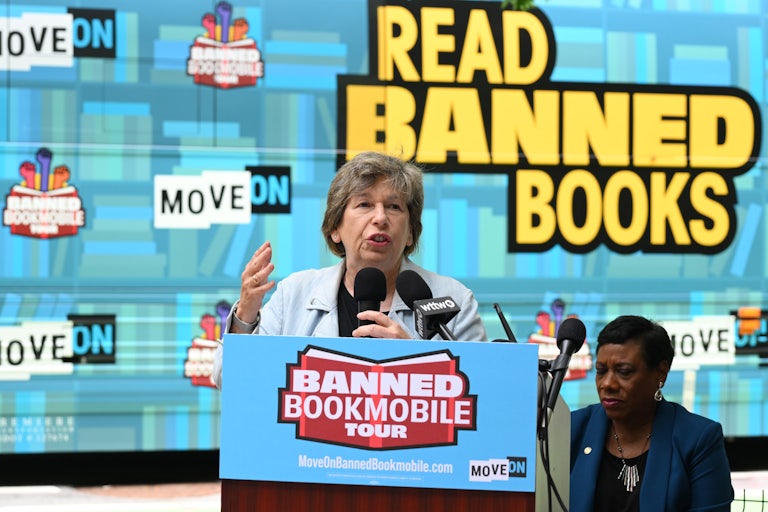
The New Republic convened a meeting to discuss Trump, book banning and the culture wars. Randi Weingarten described the attack on schools as a coordinated strategy to destroy public schools and promote vouchers. Edith Olmsted of The New Republic interviewed her. None of this is new to readers of this blog, but the American public needs to hear this message. Again and again.

Book Bans Are a Conservative Plot to Destroy Public Schools, Says Randi Weingarten, The teachers union head denounced the “extremist strategy,” which also includes voucher campaigns and manufactured outrage over critical race theory.

DANIEL BOCZARSKI/GETTY IMAGES FOR MOVEON

Teachers union head Randi Weingarten says that the campaign by conservatives to ban books isn’t about the books at all, but part of a broader strategy to destroy public schools—one that was supercharged by the pandemic.

“You take the agita and the anxiety that people had at Covid, that fear, and you combine it with a right wing who has wanted to kill public schools for years and take that money for vouchers, and you have the scenario we have,” Weingarten, the president of the American Federation of Teachers, said Wednesday at The New Republic’s Stop Trump Summit.

Vouchers, which use public education dollars to fund private and religious school attendance, are just one pillar of the conservative campaign to “undermine, destroy, and defund” public schools, she said. The other two are book banning and manufactured outrage over critical race theory.

Weingarten pointed to conservative activist Chris Rufo and a comment he made at Hillsdale College, a Christian nationalist school, in which he admitted that focusing on these issues was all part of a master plan to promote universal vouchers: “To get to universal school choice, you really need to operate from a premise of universal public school distrust.”

In an interview with TNR after the event, Weingarten explained the “extremist strategy” Rufo and other conservatives have used to defund public schools. “The hook was trust. If you really create as much distrust as possible in public schooling, then parents will look at privatization as an option,” she said.

That’s where critical race theory comes in.

“[Rufo] tried to make a term that nobody knows so toxic, so that you can weaponize it and make fear,” she said. “Conversations about hard subjects became weaponized as indoctrination. Which is patently ridiculous, and dangerous.”

Race, as well as gender, is the subject conservatives have focused on in their campaigns to ban books in public schools and libraries.

“What [Republican Governor Ron] DeSantis is doing in the so-called ‘war on woke,’ is exactly part of their playbook—to make people afraid of books, and afraid of what we do in school,” Weingarten said. According to Pen America, Florida passed 15 “educational intimidation” bills in the last two and a half years.

The “parents’ rights” movement is made up of a loud minority, Weingarten said, and actively undermines what most parents want. “What we see in Florida is that 60 percent of the book banning has been done by 11 people,” she said.

The AFT has partnered with The New Republic in fighting back against such bans. TNR’s Banned Books Tour has been delivering thousands of banned books across the country this month, most recently in Florida.

Gabriel Arans of the Texas Observer writes about the revival of McCathyism at universities in Texas. Republicans are intent on pushing out professors they think are too liberal.

Arana writes:

Texas A&M University’s disgraceful treatment of celebrated journalism professor Kathleen McElroy should terrify anyone who cares about academic freedom, education, and equality in Texas. The state’s Republican leaders, along with Governor Greg Abbott, have launched a radical, McCarthyite crusade to purge education of liberal bias.

Only in Texas or Florida would decades of experience at the country’s most prestigious newspaper and a track record of championing newsroom inclusivity disqualify someone for a job relaunching A&M’s defunct journalism program, which was shuttered in 2004 after 55 years.

McElroy’s ordeal is just the beginning.

At first, A&M officials seemed to realize how lucky they’d been to snag McElroy, a Black woman who served in various managerial positions at the New York Times for 20 years before completing a doctorate at the University of Texas at Austin, where she served as the director of the School of Journalism and Media and now teaches.

McElroy didn’t want to draw attention to herself, but A&M insisted on a public ceremony to celebrate her appointment as head of the university’s new journalism program. On June 13, she signed an offer accepting a tenured position in front of a crowd gathered at the school’s academic building, pending approval from the Texas A&M University System Board of Regents.

Over the next few weeks, the deal unraveled. After conservative activist site Texas Scorecard published a scare-mongering article about McElroy’s work on newsroom diversity, right-wing ideologues on the board of regents started scrutinizing her hire. Six or seven regents called and texted now-disgraced University President Katherine Banks to express concerns.

“I thought the purpose of us starting a journalism program was to get high-quality Aggie journalist [sic] with conservative values into the market,” regent Jay Graham texted Banks. “This won’t happen with someone like this leading the department.”

Another regent, Mike Hernandez, added that McElroy was “biased and progressive-leaning” and called giving her tenure a “difficult sell” for the board.

Members of a conservative alum group called the Rudder Association and other right-wing Aggies flooded Banks’ office with calls and emails.

Text messages show that Banks—who initially denied any involvement in McElroy’s bungled hiring, then was caught lying—was fully behind conservatives’ efforts to rein in liberal academia: “Kathy [Banks] told us multiple times the reason we were going to combine [the colleges of] arts and sciences together was to control the liberal nature that those professors brought to campus,” Graham wrote.

So Banks watered down the offer to McElroy. Still eager to return to her alma mater to train the next generation of journalists, she agreed to accept a revised five-year, nontenured teaching position, which would not require the regents’ approval.

“You’re a Black woman who worked at the New York Times,” José Luis Bermúdez, the interim dean of the College of Arts and Sciences, warned McElroy. Her hire, he said, had been caught up in “DEI hysteria.”

But then, Banks diluted the offer further, offering McElroy a one-year, “at will” position. McElroy declined and spoke about how the university had treated her with the media.

“I’m being judged by race, maybe gender,” McElroy told the Texas Tribune. “I don’t think other folks would face the same bars or challenges.”

(Editor’s note: McElroy sits on the parent board of the Texas Observer. Because of our editorial independence policy, she has no say in our editorial decisions. Alongside this piece, today the Observerpublished a heartfelt essay from McElroy about her journalism journey and the irony of being the subject of media coverage rather than the one behind it. )


Over the summer, with the governor’s support, the Legislature passed Senate Bill 17 (SB 17), which requires institutions of higher education to do away with all diversity, equity, and inclusion programs and initiatives by 2024. Already, the University of Houston has shut down its Center for Diversity, Equity, and Inclusion as well as disbanding its LGBTQ+ Resource Center (under pressure, however, it appeared to backtrack, but it is only a matter of time before the offices are officially closed). Public universities across the state have formed committees to implement the law and seek input from the academic community. It’s clear, however, that days are numbered for all the offices and programs that help students from different backgrounds.

While the ostensible goal of anti-diversity, equity, and inclusion (DEI) efforts is to prioritize merit over race in higher education—and get rid of all the “divisive” diversity stuff that liberal academics champion—the real intent is to put radical, uppity queers, minorities, and liberals in their place. A key part of the plan is to strip liberal academics of the protections that allow them to pursue research and speak publicly without fear of reprisal; this past session, right-wing legislators tried to get rid of tenure but settled on more modest restrictions. The Senate also passed a ban on “critical race theory,” an academic theory that posits racism is embedded in society, but the House failed to pass the measure….

Anti-DEI hysteria will lead to a brain drain at Texas’ public universities. Academics at most institutions enjoy the freedom to conduct scholarship without interference. To ensure they can pursue ideas that may be unpopular to the public and pursue knowledge for its own sake, they are granted protection after demonstrating excellence in their field. The best scholars don’t want to work in a place where they have to worry that criticizing wingnut politicians will get them put on leave—as A&M did when Lieutenant Governor Dan Patrick complained to administrators about criticism levied against him by opioid expert Joy Alonzo—and the best students from around the country will choose institutions that value academic freedom, openness, and inclusion rather than those under siege by the radical right.

NBCT high school teacher Justin Parmenter has a great story to tell to launch Banned Books Week. The local leader of Moms for Liberty in Charlotte asked the local school board to ban five books from a high school. The board debated her request and rejected it. But they did say she could request that her own child be excused from reading the books she objected to. A brilliant resolution!

He writes:

Here’s some excellent news to kick off Banned Books Week.

An attempt by the Charlotte Mecklenburg Moms for Liberty chair to have five books banned from the Ardrey Kell High School media center has failed.

The school’s School Media Advisory Committee determinedthat all five books will be retained in the media center, and the objecting parent is free to restrict their own child’s access to those titles as permitted by district policy.

Students in Charlotte Mecklenburg Schools were not allowed to check out books for the first two weeks of school while the district waited to hear objections. The library pause came in response to Republicans in the North Carolina General Assembly passing a “Parents Bill of Rights” law which, among many other things, requires superintendents to create a process for objections and provide parents with access to student library records.

After two weeks with more than 140,000 students at 181 schools having no access to media centers, only five objections were lodged.

According to WSOC, all the objections were filed at one school (Ardrey Kell High School) by the same parent. Unsurprisingly, she also happens to be the chair of the local Moms for Liberty chapter, Brooke Weiss. (Moms for Liberty has embarked on a nation-wide crusade to ban books from school libraries.)

Committee meeting notes requested by Weiss and posted to the CMS public records request page show that, after thoughtful consideration and robust discussion, the committee decided to retain all five books in the Ardrey Kell media center. The committee noted that the objecting parent “may use policy to restrict access for their student by request.”

Open the link to read the board’s discussion notes.

Alan Singer is a professor of secondary education at Hofstra University in New York. He is a consistent defender of the right to read. He writes here about Banned Books Week. This recognition is of extraordinary importance this year because of the surge in book banning, fueled by Governor Ron DeSantis in Florida, Governor Greg Abbott in Texas, and extremist groups like Moms for Liberty.

He writes:

This year Banned Books Week is October 1 – 7, 2023. The theme is “Let Freedom Read!” Banned Books Week draws national attention to the harms of censorship. The ALA Office for Intellectual Freedom (OIF) compiles lists of challenged books as reported in the media and submitted by librarians and teachers across the country.

Sixty percent of all banned book demands come from just eleven people who are virtually prurient porn purveyors who see pornography everywhere, but especially in any book that includes homosexual characters or where teenagers have sex. An article in The Washington Post focused on a woman from Spotsylvania County, Virginia who purchases “suspect” books on Amazon, bookmarks pages with color-coded post-it notes, highlights the “disgusting” passages she doesn’t like, and has filed 71 complaints with the local public school board. Based on her complaints, two members of the board recommended burning the books.

Banned Books Week was launched in 1982 in response to a surge in the number of challenges to books in libraries, bookstores, and schools. The annual event highlights the value of free and open access to information and brings together the entire book community — librarians, educators, authors, publishers, booksellers, and readers of all types — in shared support of the freedom to seek and to express ideas.

Reading advocate, writer, and television and film star LeVar Burton is the honorary chair of Banned Books Week. Burton will headline a live virtual conversation with Banned Books Week Youth Honorary Chair Da’Taeveyon Daniels about censorship and advocacy at 8:00 p.m. ET on Wednesday, October 4. The event will stream live on Instagram (@banned_books_week). Visit BannedBooksWeek.org for more details.

Saturday, October 7 is “Let Freedom Read Day,” a day of action against censorship. Call community decision-makers, write them letters, and buy a banned book. For information about ways to participate and resources, visit bannedbooksweek.org/let-freedom-read-day/.

PEN America is calling on supporters to email to their Congressional Representative urging them to support House Resolution 733 introduced by Congressman Jamie Raskin (D-MD) and Senator Brian Schatz (D-HI). The resolution recognizes Banned Book Week and expresses concern about “the spreading problem of book banning and the proliferation of threats to freedom of expression in the United States.”

Charlotte County in Florida is following Governor Ron DeSantis’s “Don’t Say Gay” law with zeal. School officials instructed school librarians to remove all books that have gay characters, even if the books have no sexual content. This is a deliberate effort to make gay people invisible, to erase them. Students may see gay characters in movies or television, but not in school.

Librarians in public schools in Charlotte County, Florida, were instructed by the school district superintendent to remove all books with LGBTQ characters or themes from school and classroom libraries.

Judd Legum at Popular Information reported:

Charlotte County school librarians sought guidance from the school district about how to apply an expansion of the Florida Parental Rights in Education Act, better known as the “Don’t Say Gay” law, to all grades. “Are we removing books from any school or media center, Prek-12 if a character has, for example, two mothers or because there is a gay best friend or a main character is gay?” the librarians asked. Charlotte County Superintendent Mark Vianello answered, “Yes.”

The guidance by Vianello and the school board’s attorney, Michael McKinley, was obtained by the Florida Freedom to Read Project (FFTRP) through a public records request and shared with Popular Information. FFTRP requested “electronic records of district and school decisions regarding classroom and library materials.” In response, FFTRP received a document memorializing a July 24 conversation between Vianello and district librarians, known in Florida as media specialists.

The guidance made clear that all books with LGBTQ characters are to be removed even if the book contained no sexually explicit content. The librarians asked if they could retain books in school and classroom libraries with LGBTQ characters “as long as they do not have explicit sex scenes or sexual descriptions and are not approaching ‘how to’ manuals for how to be an LGBTQ+ person.” Vianello responded, “No. Books with LBGTQ+ characters are not to be included in classroom libraries or school library media centers.”