Archives for category: Budget Cuts

Education advocates put a measure on the ballot in Arizona to raise taxes on the highest-income taxpayers to increase education funding. Voters passed the measure. But a judge struck it down because it exceeded the state constitution’s limit on taxation. This report comes from the Center on Educational Equity at Teachers College, Columbia University.

AZ JUDGE INVALIDATES PROPOSITION THAT WOULD HAVE BOOSTED FUNDING FOR EDUCATION

Maricopa County Superior Court Judge John Hannah has ended the nearly two-year controversy swirling around the constitutionality of Proposition 208, a measure recently adopted by the voters, by ruling last month that the measure is invalid. The Proposition would have boosted the income-tax rate for high income earners by 3.5%, with the money directed primarily to salary increases for teachers and school support personnel. But the judge ruled last month in Fann v. State, that the money the Proposition would raise would exceed the amount permitted by the state’s constitutional spending limit.

The Arizona Supreme Court had indicated that allocation of funds for education under Prop. 208 would likely contravene the Education Expenditure Clause of the state constitution, a constitutional cap that was adopted in 1980. The case had been remanded to the trial court to calculate whether, as most observers anticipated, the amount raised by the proposition would, in fact, exceed the cap.

More than 100 school districts in Ohio have joined a lawsuit against the state of Ohio opposing vouchers.

Bill Phillis, former deputy superintendent of the Ohio Department of Education, now leads a pro-public school advocacy group called the Ohio Coalition of Equity and Adequacy. He and a new group called “Vouchers Hurt Ohio” have organized the campaign to have the voucher program declared unconstitutional. This is their website.

Bill Phillis posted this description of the lawsuit when it was filed in court in Ohio in early January:

Vouchers Hurt Ohio and Ohio E&A Coalition

File Lawsuit Against Private School Voucher Program

COLUMBUS – A coalition of public school districts filed a lawsuit today in Franklin County Common Pleas court challenging the constitutionality of the rapidly growing private school voucher program that is siphoning away hundreds of millions of dollars from public school students, teachers, classrooms and communities.

Former Ohio Supreme Court Chief Justice and current Columbus City Schools board member Eric Brown said the lawsuit asks the judicial system a simple, but critical question:

“Where does the Ohio General Assembly get the power to fund private school vouchers? That power is nowhere to be found in the Ohio Constitution. In fact, the Ohio Constitution forbids it. Lawmakers have the authority and responsibility to fund “a” system of “common schools,” with common standards and resources for all of Ohio’s taxpayers, parents, and students,” Brown said at a press conference today outlining the lawsuit.

“Funding schools that aren’t for everybody is not the business of the Ohio General Assembly, and it is not the responsibility of Ohio taxpayers to pay for these private schools,” Brown said. “The Ohio General Assembly either knows they are violating the Ohio Constitution and doesn’t care or the members who support expanding the private school vouchers need a history lesson themselves.”

William L. Phillis, executive director for the Coalition of Equity & Adequacy of School Funding, was instrumental in leading the successful court challenge to the way Ohio pays for public schools during the ‘90s.

“The DeRolph school funding lawsuit was the case of the 20th century. The EdChoice private school voucher lawsuit we filed today is destined to be the case of the 21st Century,” Phillis said. “In fact, the private school voucher system is siphoning off hundreds of millions of dollars from an already underfunded system of public schools. The legislature and the governor are putting our state and our public school children at risk and they admit it.”

Nneka Jackson, a school board member with the Richmond Heights School District in Cuyahoga County, said private school vouchers are making school segregation in Ohio worse, not better.

“If someone tells you this is about helping poor minority children, hook them up to a lie detector test asap and stand back because the sparks are going to fly,” Jackson said.

“About 40 percent of Richmond Heights residents are white. Before the EdChoice private school voucher program, about 26 percent of the students in the Richmond Heights School District were white and 74 percent were students of color. Today, after EdChoice, Richmond Heights is three percent white and 97 percent students of color,” Jackson said.

“Private schools are allowed to discriminate, plain and simple, based on disability, disciplinary records, academic standings, religion and financial status. These are often proxies for race and other protected characteristics. Ohio is essentially engaged in state-sponsored discrimination in admissions and retention. You know who can’t do this? Public schools. Common schools,” Jackson said.

Dan Heintz, a school board member in the Cleveland Heights-University Heights School District, said his district lost more than $27 million to private school vouchers, and this forced voters to pass two levies to raise property taxes.

Heintz said 95 percent of our EdChoice voucher users have never been enrolled in one of our schools. 

“So, contrary to the narrative, these families aren’t fleeing a failing school.”The only thing they’re fleeing is a tuition bill. A private school tuition bill that is now being paid by Ohio taxpayers,” Heintz said.

Eric Resnick, a school board member for Canton City Schools in Stark County, said high school students receive a $7,500 voucher while public school students receive far less from the state in basic education funding.

There is no truth to the claim by voucher proponents that “the money follows the student,” Resnick said. “To those who say the money should follow the student, I ask why the discrepancy? Why should voucher students get $7,500 and some public school students get one-fifth or less than that amount? If the money was truly following the student, then each public school student would also receive $7,500.”

The complaint can be read here.

School districts in the Vouchers Hurt Ohio coalition can be found here.

The E&A Coalition is working with Vouchers Hurt Ohio, a growing coalition of public school districts that have come together to sue the state over the unconstitutional and harmful private school voucher program. Vouchers Hurt Ohio now has nearly 100 member school districts in 47 of Ohio’s 88 counties that open their doors wide and welcoming to more than 250,000 public school students.

This is Jan Resseger’s commentary about the lawsuit.
Jennifer Berkshire, expert education journalist and co-author of A Wolf at the Schoolhouse Door, writes in The Nation about the forces driving teachers out of the schools.

She interviewed many teachers who explained why they were leaving. Some cited ”the bad teacher” narrative promulgated by Arne Duncan and his insistence that teachers be evaluated, based on their students’ test scores, which is both ineffective and inaccurate. His and Obama’s “Race to the Top” was deeply demoralizing to teachers, and it accomplished nothing positive.

She begins:

Neal Patel survived teaching in the pandemic. It was the culture wars that did him in.

In the fall of 2020, Patel added two flags to the wall of his science classroom in Johnston, Iowa. Now, alongside images of energy waves and the electromagnetic spectrum were the Gay Pride rainbow flag and a proclamation that Black Lives Matter. The flags, says Patel, represented the kind of inclusive space he was committed to creating, sending a signal to all students that even in this conservative suburb of Des Moines, there was a place for them.

School administrators supported him—on one condition. “They’re just there as decoration,” Patel says. “The only time I discuss the flags is when a student asks me about them.”

Patel assumes it was a student who snapped a picture of the display. Somehow it ended up on the Facebook page of a conservative state legislator. Representative Steve Holt, who lives 100 miles from Johnston, pointed to the flags as evidence of creeping left-wing indoctrination in Iowa’s schools and encouraged his constituents to take a stand. Patel says he was shocked by the attention, then upset: “Holt thinks it’s a political issue to try to create an inclusive environment, and he’s using that to try to further divide our community.”Johnston has grown only more divided since Patel became Facebook fodder. At a school board meeting last fall, members debated whether to ban two books on race, including one by the Native American writer Sherman Alexie, after parents complained. The president of the Iowa State Senate, who represents a neighboring county, took the mic during the public comment period, calling for teachers who assigned “obscene” material to be prosecuted. Patel was in the crowd that night, to lend support to minority and LGBTQ students who’d come to speak out against banning the books. And he had an announcement of his own to make: This year would be his last as a teacher in Johnston.

The Obama administration made matters much worse for teachers when it imposed test-based evaluation as the heart of its “reforms.”

The thinking went something like this: Make teacher evaluations tougher, and teaching would get better, which would mean higher student achievement, more students graduating from college, and ultimately a country better able to outsmart China et al. “Tougher” meant holding teachers accountable for how their students fared on standardized tests…

In 2010, Colorado became one of the first states to enact a high-stakes teacher evaluation law; by 2017, nearly every state had one on the books. While the pandemic may have disrupted everything about schooling, policies like Colorado’s Senate Bill 10, with its 18-page evaluation rubric and 345-page user guide aimed at weeding out bad teachers, remain in place.

For Shannon Peterson, an English language acquisition teacher in Aurora, that meant leading her students through a writing exercise last fall as her principal observed. Peterson’s students, many of them immigrants who live in poverty, bore the pandemic heavily, she says: “The kids are stressed, all of their writing is about anxiety, and attendance is way down.”

To her delight, the students responded enthusiastically to the writing prompt she’d come up with: comparing and contrasting the Harlem Renaissance and Black Lives Matter, and how the entertainment industries in their respective eras related to both. In a year of stress and struggle for teachers and students alike, here was something to celebrate. “Excellent writing came out of this,” Peterson says.

Her principal wasn’t convinced. Peterson, he felt, hadn’t done enough actual teaching during the observation. “I just don’t feel comfortable checking off these boxes,” he told her.

The previous year, when the cash-strapped school district had offered teachers buyouts to leave, Peterson turned it down: “I felt an enormous obligation to go back for the kids and my colleagues.” After her evaluation, though, Peterson had reached a breaking point. She quit a week later, walking away from a career that spanned 23 years, 18½ of them in Aurora. “I’m not a box,” Peterson says.

Two weeks after Peterson resigned, a major study came out: The decade-long push to weed out bad teachers had come to naught. The billions of dollars spent, the wars with teachers’ unions, and the collapse in teacher morale had produced “null effects” on student test scores and educational attainment.

Please open the link and read the study. Billions of dollars wasted on ineffective and demoralizing teacher evaluations that produced tons of data but nothing else.

Paul Bowers, previously the education journalist for the Charleston, South Carolina, Post & Courier, writes his own blog. In this post, he calls on the state legislators not to pass voucher legislation that would predictably defund the state’s already underfunded public schools. South Carolina has a large budget surplus and one of the lowest tax rates in the nation. Governor Henry McMaster announced that the surplus would be used to lower taxes instead of funding public schools and other public services.

Paul wrote the members of the S.C. Senate Education Committee in opposition to Senate Bill 935, which is an attempt to divert public school funding to private schools.

Senators Massey, Jackson, Hutto, Rice, and Talley:

I write to you as a South Carolinian and parent of 3 public school students asking you to scrap Senate Bill 935, the so-called “Put Parents in Charge Act,” which would redirect public funds to private schools via the creation of Education Savings Accounts.

Every few years, South Carolina teachers and parents have to band together to fight the latest iteration of the school voucher meme, which has spread virally across the states thanks to millions upon millions of dollars of dark-money political contributions, astroturfed special-interest groups, and a network of libertarian billionaires’ pet thinktanks. We fought this idea when New York real estate investor Howard Rich tried to buy a voucher law here in the early 2000s, and we’re fighting it again now that ALEC, Palmetto Promise, and the like are trying to ram the same idea through the Statehouse in Year of Our Lord 2022. There is truly nothing new under the sun.

As the educator Steve Nuzum has pointed out several times this year, the bill you will be considering in a subcommittee meeting on Feb. 16is largely copied from a piece of “model legislation” churned out by the American Legislative Exchange Council, a right-wing bill mill. I posit that we have enough terrible ideas to go around in this state without borrowing worse ones.

If enacted, this bill would be an obvious violation of the South Carolina Constitution, Article XI, Section 4, which states:

No money shall be paid from public funds nor shall the credit of the State or any of its political subdivisions be used for the direct benefit of any religious or other private educational institution.

Now, I am sure our attorney general would happily defend such an act against the inevitable lawsuits that would follow. I am no legal scholar, but I think it’s reasonable to assume he would employ some of the same arguments used to defend Gov. Henry McMaster when, in the thick of a global pandemic, he tried diverting $32 million worth of federal emergency funding from public schools to private schools. Notably, he lost that fight.

So, I suppose you and your colleagues in the General Assembly could enact this law, and you could win the legal battle that follows. Stranger things have happened. But the question remains whether you should go down this road.

I say no, you should not.

South Carolina’s most reactionary politicians have been clamoring for public divestment from the school system ever since radical Black Republicans created a free public school system for all in the Constitution of 1868. White supremacists clawed back at the notion of public goods with the Jim Crow Constitution of 1895; the Interposition Resolution of 1956; and the cavalcade of privatization laws, segregation academies, and district-level resegregation efforts that have continued without ceasing since Brown v. Board of Education was decided in 1954.

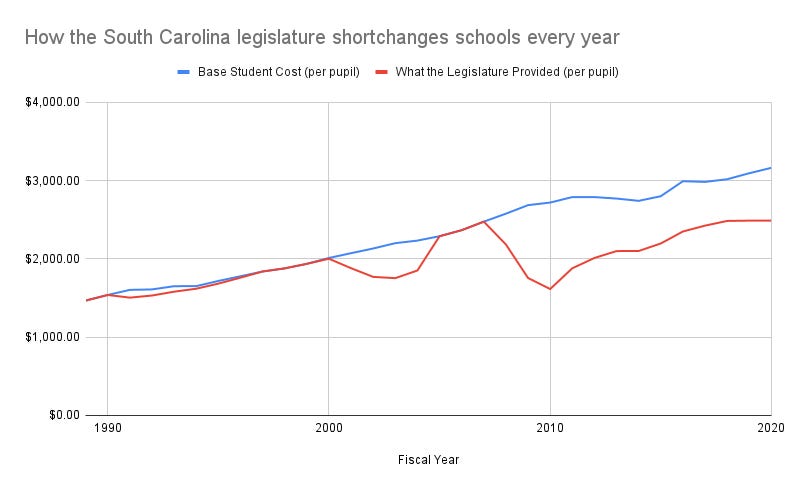
Data compiled by Steve Nuzum, via S.C. Revenue and Fiscal Affairs Office

As a matter of policy, you and your colleagues in the General Assembly have been steadily defunding public education since the start of the Great Recession. You have broken your own promises as outlined in the Education Finance Act and are currently under-funding the Base Student Cost by about a half-billion dollars per year. The results have been disastrous: Our teachers are underpaid and quitting by the thousands, classroom sizes have ballooned, our rural schools are in physical shambles, and a system of separate and unequal education along racial and economic lines has returned with a vengeance.

It is difficult to predict how much money public schools would lose as a result of Education Savings Accounts, which would allow public funds to “follow” individual students to private schools. Our state’s Revenue and Fiscal Affairs Office has tried to guess, though. According to a fiscal impact summary published in December, the ESA program could divert as much as $35 million to private schools within the first year it takes effect, depending how many families participate in the program. By 2026, they estimated the program could cost the state as much as $2.9 billion. Compounded by the General Assembly’s ongoing policy of public disinvestment, this could constitute a death blow to public schools.

The bill is built on a few faulty premises, including the underlying assumption that private schools could or would serve South Carolina students better. The authors of the bill also seem to believe that our state’s private schools could handle a sudden influx of new enrollment while accommodating students’ learning, transportation, and health needs. These are dicey propositions at best.

S. 935 is a direct attack on the notion of education as a public good. Its authors would leave us all to fend for ourselves as atomized individuals, cut loose from mutual obligations that once tied us together. For a certain type of doctrinaire conservative, this may sound like a dream scenario. For the rest of us living in the real state of South Carolina, it is a nightmare come true.

Regards,

Paul Bowers

North Charleston, S.C.

Tom Ultican, retired teacher of physics and mathematics, has been keeping a close watch on the machinations of the privatization movement. He writes here about Oakland, which has suffered two decades of indignities at the hands of corporate reformers. The district was taken over by the state because it had a deficit in 2003. The state gave Eli Broad a free hand in picking its superintendents, who proceeded to open charter schools, close public schools, and drive the district deeper into debt. In time, the state restored Oakland’s elected school board, but kept it under the control of outside monitors who demanded more school closures.

Tultican supplies the background for the Oakland disaster.

He writes:

The map of charter schools in Oakland and proposed school closings shows that both are all in the minority dominated flats (the low lying area between the bay and the hills). With all of these closings, residents in the flats may no longer have a traditional public school serving their community.

Much of this can be laid at the door step of the six billionaire “education reformers” living across the bay – Reed Hastings (Netflix), Arthur Rock (Intel), Carrie Walton Penner (Walmart), Laurene Powell Jobs (Apple), Mark Zuckerberg (Facebook) and Doris Fisher (The Gap).

Reed Hastings established America’s first charter management organization (CMO) in Oakland. There are now six Aspire charter schools serving Oakland families.

Arthur Rock, Doris Fisher and Carrie Walton Penner have been investing in Teach For America (TFA) and charter school growth in Oakland. Mark Zuckerberg and Laurene Powell Jobs have been pushing education technology as well as TFA and charter schools.

Along with these billionaires, New Yorker Michael Bloomberg and Tulsa billionaire Stacey Schusterman have joined in the spending to sway Oakland’s school board elections.

Oakland’s own T. Gary Rogers established a foundation before he died that continues to be central to the local school privatization agenda. It significantly supports and directs privatization efforts by GO public education and Education78. The City Fund created by Reed Hastings and John (Enron) Arnold recently gave GO and Education78 a total of $5 million (EIN 82-4938743).

This brief outline of the money being spent to privatize schools in Oakland would be woefully incomplete if Eli Broad was not mentioned. Although his direct spending to advance privatization in Oakland has been relatively modest, the four Superintendents and many administrative staff members that he trained and got placed in Oakland are central to OUSD being the most privatized district in California. A key training manual developed at the Broad Center was the “School Closure Guide.”

“Black Hole Mike” Hutchinson observed,

“A lot of these policies were first tried out in Oakland. If you go back and look at the Eli Broad handbook on school closures, a lot of the source information that they used for that report is from Oakland.”

The billionaire spending has resulted in 39 charter schools operating in Oakland today. Nine were authorized by the county, one by the state of California and 29 by OUSD. Using data from the California Department of Education, it can be shown that 31% of the publicly supported k-12 students in Oakland attend privatized charter schools.

It is disturbing that 22 of the 39 schools have a student body made up by more than 90% Hispanic and Black students. Overall 67% of Oakland’s charter school children are Hispanic or Black but only 50% of the residents of Oakland are Hispanic or Black. The privatization agenda has driven school segregation in Oakland to new heights.

The other divisive agenda is gentrification. Ken Epstein is a longtime observer of OUSD and a bay area pundit. He observed,

“Many school advocates view these school closures as a land grab of public property by privatizers. Others see this is a way to force Black and Latino families out of Oakland, making education inaccessible for them by closing the schools in the neighborhoods where they live.”

If a well financed developer could gain control of the flats, the profit possibilities are immense. These concerns are further fed when OUSD board President Gary Yee tells a Skyline High School parent that the school should be closed because the property is too valuable to be used for public education.

Arthur Camins, scientist and technologist, warns that public policy in both education and healthcare is deeply flawed and cannot be fixed with patches. No matter how many potholes are fixed, the underlying problems go untouched and unchanged.

Our flawed policy is the result of deeply ingrained flawed thinking.

The United States, he writes, is the victim of a combination of forty years of skepticism of government solutions and acceptance of “let’s be realistic about what we can accomplish” thinking.

For example, for decades scattershot treatments of outcomes have characterized bi-partisan education improvement efforts with little to nothing to show for it except undermined public education and stress. The driving causes of inequitable outcomes, systemic inequity, its enabler, racism, and resultant precarious lives remain rampant and unaddressed. 

Instead, the dominant education interventions have been to push or blame individuals. These include rewards and punishments for educators or students based on standardized test scores; rigid discipline regimes; and, more recently, a focus on developing grit to work through, put up with, or overcome rather than eliminate challenging social and economic conditions.

Equally, if not more, insidious is you-can’t-save-everyone solutions, such as escape hatches for some kids through charter schools and vouchers, most of which are no better than local public schools.  More broadly, the lack of universal health care and inequitable funding of schools through local real estate yield the same help-a-few result.

Open the link and read the rest.

The Republican-controlled legislature in Missouri has imposed charter schools on the state’s two urban districts (but not their own). The legislature is now considering HB1552, which will financially benefit charter schools. Emily Hubbard, a parent in St. Louis, wrote to ask the Budget Committee to stop expanding and favoring charter schools and to fund the state’s public schools equitably and adequately. She sent this email to the Budget Committee, which I am posting with her permission.

Dear Budget Committee Members, 

I am planning to come speak to you in person, so I will keep this email brief. 

I am a parent of four children in St. Louis Public Schools. They are amazing kids who have been loved and taught well from our neighborhood elementary school to the magnet middle school my two oldest attend. With my youngest in second grade, I have another decade in SLPS, assuming that the district manages to survive.

Y’all, I am so tired of certain members of the state legislature pitting charter schools against public school districts. I am especially baffled that this bill is sponsored by someone with no charter schools in his district. Who is he representing with this bill? Because of the laws y’all or your predecessors have already made, this statewide law will only affect two cities (and maybe Normandy?), and I know you know these are the cities with the most Black kids (mine included). 

My new neighborhood school (we recently moved from Rep. Aldridge’s district to the 81st) is a school that serves students who speak many different languages at home. ESOL services cost money. I don’t know if you have the time to watch this video from the October legislative committee of the Board of Education, but let me remind you that around 20% of SLPS kids do not have stable housing. That’s around 5000 children. This data is 2018-2019 (from this site) , but please look at these numbers: 

all SLPS kids: 21,814

all Charter kids: 10,109

homeless population at SLPS: 4,771

homeless population at charters: 470

SLPS homeless percentage: 21.87% 

charter homeless percentage: 4.65% (but some have zero, some are high as 13%, some have closed 2019)

SLPS serves a student population with disproportionately higher needs than charter schools, whether it’s through our fantastic ESOL programs; the difficult task of walking through trauma with kids (one of my daughter’s classmate’s mother was murdered over Christmas break); the cost incurred by the desegregation program which doesn’t seem to have done that much to integrate our schools (especially the neighborhood ones) and instead allows white and privileged parents the ability to cluster in the particular magnet schools and hoard their resources for the sake of their already resourced children; or the special education costs which we shoulder alone, not shared like in the county. 

And then there’s the whole transportation thing–did you know that some charter schools don’t provide transportation? So you can’t really choose that school if you don’t have a safe way to get your kid to school and home again.

I don’t know anything about the education system in Kansas City, so I can’t speak to that, but please please please consider the effect that passing this bill will have on the children of St. Louis. 

I am an evangelical Christian (a pastor’s wife, even), and I have seen our school be the means that does the Lord’s work: they feed the hungry, clothe the naked, take care of the orphan, minister to the foreigners within our gates, not to mention, for our family at least, providing an education that has enabled my children to grow in their faith as we take what they’ve learned at school and use it to glorify God together. 

Please don’t take away from funds that enable SLPS to do the work it does, however imperfectly.

And could we just as a state, fund education at a higher rate all together? I know the rural schools are struggling too. 

Also if we could alleviate homelessness, do what it takes to end gun violence, prioritize the health of all Missourians, raise the minimum wage, deal with our opioid addiction crisis…there are a ton of non-education things that if addressed, would significantly and positively affect not just our district, but all the districts. Just think about it, okay?

Thanks so much for your time–see you on Tuesday! I’m sorry that this wasn’t brief at all, I just care a whole lot.

With appreciation for the difficult work you do,

Emily Hubbard

Carondelet, St. Louis

Ever since Republicans in North Carolina took control of the General Assembly (legislature) in 2010, they have tried to diminish the state’s responsibility for the common good or to extinguish it altogether. No institution has suffered as much by their hostility as the public schools.

NC Policy Watch is an outstanding source of information about the state. It recently reported about the General Assembly’s refusal to obey a court order to rectify the unconstitutional funding of the public schools, which is grossly inequitable. The historic ruling was the Leandro case, and Republicans have offered charters and vouchers instead of equitable and adequate funding. Now they are rumbling about impeaching the judge who told them to fix the funding.

Despite multiple judicial determinations that the state’s K-12 schools are unconstitutionally deficient, the Republican politicians – including, last week, a pair of appellate court judges – say that no court can order the legislature to actually fix the problem.

According to the judges in question, state courts have “no authority to order the appropriation of monies to satisfy any execution of [the Leandro] judgment.”

In effect, they argue, 25-plus years of trials, expert witness testimony, findings, rulings, appeals and remedy planning were all just a meaningless exercise in pushing paper. When it gets right down to it, the power to decide whether to make our K-12 schools constitutional remains right where it’s always been – at the whim of state legislative leaders who are the chief authors of the current failed system.

And just in case anyone had any doubts about the complete power they claim to wield (or had any inkling to question it), GOP lawmakers are firing some unmistakable warning shots designed to intimidate naysayers.

In concert with right-wing allies, lawmakers have sent the clear and appalling message in recent days (see item #8 of the recently adopted adjournment resolution) that they are considering the extraordinary (and deeply treacherous) step of impeaching Superior Court Judge David Lee – the visionary and courageous jurist who has been seeking to enforce the Leandro ruling and make it real.

This article by Ed Montini in the Arizona Republic explains the childish behavior of Republican leaders, who engage in taunts instead of reasoned discourse about their agenda. They don’t want to expand Medicare. They don’t want universal pre-K. They don’t support efforts to combat climate change. They oppose paid family leave for families in need after surgery or childhood. They are against a federal guarantee of two years tuition-free community college. They oppose higher taxes on billionaires. They don’t care about voting rights. They don’t want to expand opportunity. They don’t want to reduce inequality. They don’t invest in the future.

What are they for? Tax breaks for the rich.

Since they have no agenda, their goal is to make sure Biden can’t succeed. After blocking everything he proposes (with the help of Senator Manchin of West Virginia and Senator Krysten Sinema), they have nothing to offer other than the schoolyard chant.

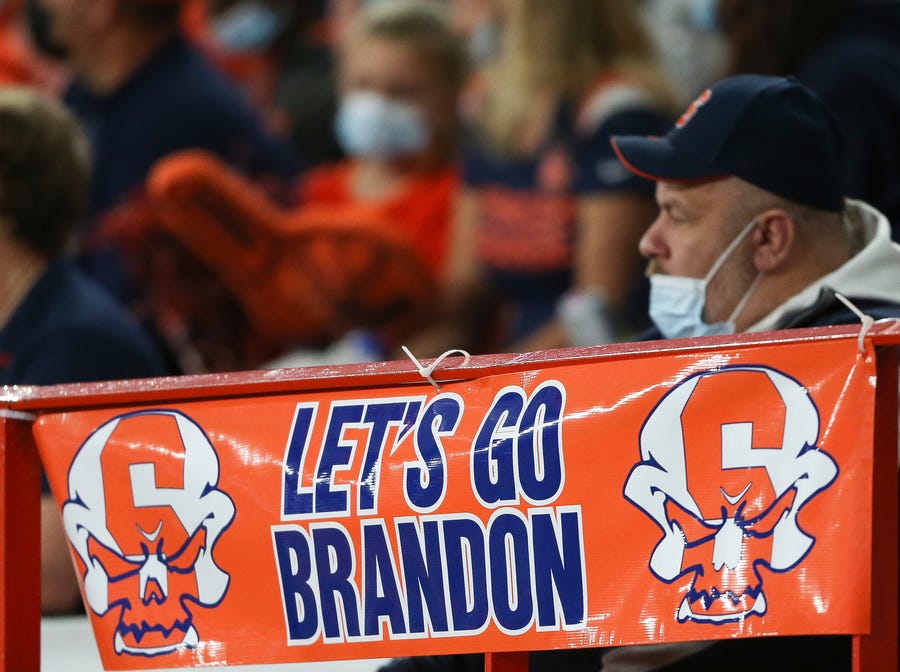
Ed Mancini was walking his dog early one morning, and he saw two other dog owners engage in conversation, a man and a woman. As they part ways, the man says to the woman, “Let’s go, Brandon!” then turning away.

The woman is puzzled and asks Montini if he knows what that phrase means.

So, first thing in the morning I am called upon to explain this recent cultural phenomenon to one of the few American grown-ups who has managed to remain a fully functioning adult, while most of the rest of us have been transformed by social media into crude, smart-alecky 8-year-olds.

There’s that Southwest Airlines pilot

This particular sign was a the Boston College-Syracuse football game Oct. 30. A fan’s juvenile jab at President Joe Biden.Joshua Bessex

For instance, the woman had not heard about the Southwest Airlines pilot who recently signed off on a flight, telling passengers, “Let’s go, Brandon.”

Or about how the whole thing began when a race car driver named Brandon Brown won a NASCAR race and, while being interviewed on TV, the crowd started chanting, “F–k Joe Biden.” The flummoxed interviewer suggested they might be saying, “Let’s go, Brandon.”

After that, the phrase became a way for grown-up 8-year-olds to say the f-word about Biden without actually using it.

Really.

Elected Republican politicians in Washington, D.C., started using the phrase.

Donald Trump began selling “Let’s go Brandon” T-shirts through his Save America PAC for $45, and grown-up 8-year-olds in America actually purchased them.

$45.

There are adults who channel their 8-year-old selves by bringing signs saying, “Let’s go, Brandon” to public events, as well as some who scribble the message in paint on the rear window of their automobiles….

How to answer someone who says such a thing

Of course, we all learned as children that infantile behavior tends to draw some type of backlash….

After I explain the whole “Let’s go, Brandon” thing to the woman who’d been walking her dog she says, “That seems incredibly childish. How are you supposed to answer someone who says such a thing?”

I tell her that, as a grown-up, she would be best served simply ignoring it.

As for the rest of us, suffering as we do from social-media-induced age regression, I’d respond, “I’m rubber and you’re glue …”

Reach Montini at ed.montini@arizonarepublic.com.

Problem viewing email? View in browser

A wave of labor activism is underway. Amazon workers in Staten Island in New York City are trying to organizing a union. Bloomberg News reports:

Deere & Co. employees, who launched a 10,000-person strike Oct. 14, cited the mandatory overtime that can stretch their shifts to 12 hours. At Kellogg Co., the union went on strike this month after decrying the toll of seven-day workweeks that had kept cereal flowing to stuck-at-home customers during the pandemic. And at Frito-Lay Inc., workers have this year challenged what they called“suicide shifts”: being made to leave late and return early, with only eight hours of turnaround time in between.

Scranton teachers announced their decision to strike on November 3.

SCRANTON, Pa.—The Scranton Federation of Teachers, which represents more than 800 teachers and paraprofessionals, announced today that it will set up picket lines and go on strike at 12:01 a.m., Nov. 3. The union has been working under a contract that expired in 2017.

“We’ve reached the end of the line and our patience with the Scranton School District. The district has refused to address our concerns about the slash-and-burn budget cuts that are significantly affecting the quality of education,” said Scranton Federation of Teachers President Rosemary Boland. “Strikes are always the last resort. We held off for many months, hoping, in vain, we could agree on conditions that are good for kids and provide decency, fairness, respect and trust for our educators.”

Boland expressed optimism that new members will be elected to the Scranton School Board on Nov. 2 and that the needs of students and educators finally will be prioritized.

SFT gave the district more than the required 48 hours’ notice before starting a strike. Picket lines will begin early Wednesday morning on Nov. 3 at most schools.

Teachers and paraprofessionals want realistic solutions to reversing the teacher turnover crisis; raising educator pay that has been frozen since 2016; returning Scranton’s esteemed and essential preschool program; and restoring libraries, bus routes and electives such as consumer[LBC1] science and music.

The austerity budget that is starving Scranton classrooms of the necessary resources, coupled with the administration’s disrespect for teachers, are issues reminiscent of what led to the walkouts in West Virginia, Oklahoma, Arizona, Colorado and Chicago in 2018 and 2019, SFT said.

“Teachers and paraprofessionals don’t want to walk out, but they will when their students’ needs are ignored and schools are starved of resources,” Boland said.

Scranton public schools are operating under a state Recovery Plan, which is akin to a state takeover.

“The Recovery Plan prioritizes financial recovery over student achievement, balancing the budget on the backs of students. Yet the plan has not been amended to factor in the $60 million in federal aid that should be used to stabilize the district and pay teachers decent, competitive wages,” she said, noting that the Recovery Plan originally factored in the use of “windfall funds,” such as federal aid when defining “recovery.”

“Since the recovery plan began in 2019, more than 100 teachers and paras have left the district, demonstrating a serious recruitment and retention problem that has harmful ramifications for students,” she said. Classes are severely overcrowded. Special education students are not being served adequately because teachers are pulled into other classrooms. Students aren’t getting individualized attention. In the COVID-19 environment, overcrowded classrooms pose a health hazard.

Boland said teachers and paraprofessionals deserve a pay raise. Teachers have not received a raise for more than four years, which has prompted many of the teacher defections to other school districts. Several paraprofessionals were furloughed, only to be brought back at a lower salary after public outrage. The district also is insistent on an inferior health scheme that would directly impact the Scranton community, as they are still dealing with the impact of COVID-19, the union said.

“It’s time for a contract that’s good for students and fair to educators,” Boland said.