Archives for category: Biden

Is the climate changing? Most scientists who study the environment believe that it is. They agree that human-caused pollution degrades the climate and that the health of the planet requires less reliance on fossil fuels. The Biden Administration passed landmark legislation to encourage the transition from oil and gas to electricity. Trump has rolled back whatever he could of Biden’s contribution to green energy. No more tax credits for electric vehicles or solar panels. Every program that promotes green energy has been dismantled.

The New York Times reported that the Department of Energy has added three scientists to its roster who are known for their criticism of mainstream climate science. The Secretary of Energy is Chris Wright, an entrepreneur who was CEO of Liberty Energy.

The Energy Department has hired at least three scientists who are well-known for their rejection of the overwhelming scientific consensus on climate change, according to records reviewed by The New York Times.

The scientists are listed in the Energy Department’s internal email system as current employees of the agency, the records show. They are Steven E. Koonin, a physicist and author of a best-selling book that calls climate science “unsettled”; John Christy, an atmospheric scientist who doubts the extent to which human activity has caused global warming; and Roy Spencer, a meteorologist who believes that clouds have had a greater influence on warming than humans have.

Their hiring comes after the Trump administration dismissed hundreds of scientists and experts who had been compiling the federal government’s flagship report on how climate change is affecting the country. The administration has also systematically removed mentions of climate change from government websites while slashing federal funding for research on global warming.

In addition, Trump officials have been recruiting scientists to help them repeal the 2009 “endangerment finding,” which determined that greenhouse gases pose a threat to public health and welfare, and which now underpins much of the government’s legal authority to slow global warming, according to two people briefed on the matter who spoke on the condition of anonymity because they were not authorized to comment publicly…

Michael Mann, a climate scientist at the University of Pennsylvania, expressed alarm that the Energy Department had hired the three scientists.

“What this says is that the administration has no respect for the actual science, which overwhelmingly points in the direction of a growing crisis as we continue to warm the planet through fossil-fuel burning, the consequences of which we’ve seen play out in recent weeks in the form of deadly heat domes and floods here in the U.S.,” Dr. Mann wrote in an email.

Dr. Mann added that the Trump administration appeared to have fired hundreds of “actual government science experts” and replaced them with “a small number of reliable foot soldiers.”

Andrew Dessler, a climate scientist at Texas A&M University, said it would be troubling if these three scientists were involved in repealing the 2009 endangerment finding, which cleared the way for the government to regulate the planet-warming gases emitted by cars, power plants and other industrial sources.

Oliver Darcy is a media expert who reports on the media at his blog called Status. He here writes about the unwarranted jubilation of rightwing pundits who believe that their relentless attacks on Biden’s cognition were correct after all. This turns out to be a useful topic for them right now as Trump is hoovering up all the cash he can handle from his profitable dealings in real estate, bitcoin, cryptocurrency, and other lucrative deals.

When you compare the two, it’s clear that Biden’s presidency was unblemished by corruption or scandal. The unemployment rate was low, inflation was dropping, and relationships with our allies in Europe, Canada, Mexico, and Asia were strong. The Economist said that the American economy was “the envy of the world.”

Now we are locked, as Rahm Emanuel wrote in The Washington Post, in a state of chaos, corruption, and cruelty. Every government agency has been ripped apart by Elon Musk’s DOGS, and our democracy is turning into an imperial presidency. Trump has assembled a Cabinet of billionaires and FOX News personalities. From day to day, we wonder which government responsibility will be cast aside.

I don’t know what Biden’s mental state was. But I liked his government far more than Trump’s cruel autocracy.

Darcy writes:

For years, right-wing media pushed a warped narrative of Joe Biden as a brain-dead puppet controlled by sinister, shadowy forces. Now they’re demanding vindication—but they do not deserve it.

Over the last week, Jake Tapper and Alex Thompson’s new book, “Original Sin,” has landed with a flurry of attention-grabbing headlines—not just for the reporting, but for what Tapper has said during the press tour. In an interview with Megyn Kelly on Tuesday, Tapper declared that “conservative media was right and conservative media was correct” about Joe Biden’s mental state. 

But that’s not quite true. Or rather, it simplifies a much more nuanced media and political reality. While it’s fair to argue that the press should have covered Biden’s age with greater urgency—and to acknowledge that Biden clearly lost a step during his presidency—that’s a far cry from validating the deeply irresponsible narrative right-wing media spun for years: that the president of theUnited Stateswas a mentally incapacitated puppet with dementia, unaware of his own surroundings, and propped up by a “shadow government” running the country in his name. 

That was never journalism. It was propaganda. Full stop.

Since the early days of the 2020 campaign, MAGA Media figures—particularly on Fox News—lobbed increasingly absurd claims about Biden’s mental faculties. They painted him as a senile old man who didn’t know what day it was, who couldn’t walk unaided, and who spent his presidency dozing off while Barack Obama or Ron Klain or some other shadowy liberal elite force secretly ran the country behind closed doors.

This wasn’t grounded in evidence. It wasn’t the result of deep reporting or careful observation. It was pure narrative warfare—an attempt to delegitimize Biden not just as a candidate but as a commander-in-chief. And the coverage became so cartoonish at times that no amount of fact-based reporting about Biden could pierce the right-wing media bubble.

None of this is to deny that Biden was aging. He was. By the end of his term, it was obvious to those around him—and to many voters—that he lacked the energy he once had. Even Democratic operatives privately acknowledged that he didn’t have his fastball anymore. But there’s a world of a difference between an 80-something president, who has always been prone to gaffes, showing his age and a man secretly suffering from debilitating dementia or worse. And conflating the two, as Fox News and its allies routinely did, wasn’t just misleading—it was malicious.

Yes, Biden’s debate performance on CNN was troubling. Yes, the press should have been more aggressive in scrutinizing his capacity to serve a second term. But reporters who refrained from joining the right-wing media hysteria were not negligent or part of a cover-up—they were simply cautious. They understood the weight of diagnosing a president with a serious neurodegenerative disorder without hard evidence. And they understood the cost of being wrong, particularly asDonald Trump ran on an authoritarian-like platform that he is now implementing in office.

MAGA Media’s goal was never honest diagnosis. It was political demolition. They weaponized Biden’s verbal gaffes, his slower gait, and his lower-energy demeanor to manufacture the idea that he was mentally vacant. Never mind that Biden managed the job without the chaos and confusion that has markedTrump’s second term. No matter what Biden did—whether it was biking, traveling, or delivering speeches—the same echo chamber smeared him with the same predictable attacks.

That wasn’t journalism. It was performance. And it came from people like Kelly and Sean Hannity, who weren’t doing reporting at all. They weren’t gathering facts. They were throwing mud, hoping some of it would stick. And in many corners of the country, it did.

That’s what makes the current revisionism so maddening. Now, with Tapper and Thompson’s book pointing to Biden’s visible decline, MAGA Media figures are claiming vindication. They’re demanding apologies from journalists who didn’t amplify their dementia narrative—insisting, once again, that they were “right all along.” 

It’s reminiscent of how right-wing media rewrote history around Robert Mueller’s Russia probe or the COVID-19 pandemic: flattening complexity, cherry-picking facts, and pretending their worst-faith speculation was truth from the start.

But they weren’t right. They were irresponsible. They didn’t try to understand what was happening behind the scenes—they invented a version of it that was politically convenient. And just because Biden aged, and struggled in the final days of his presidency, doesn’t make their years of bad-faith character assassination suddenly noble. Notably, while they maligned Biden, they let Trump—a man prone to deranged rants and wild conspiracy theories—off the hook entirely.

Biden didn’t have a perfect presidency, and his age became an unavoidable liability. But he was not an empty shell of a man, either. He governed. He made decisions. He passed legislation. And he did it while under constant attack from a media machine that acted not as a watchdog—but as an attack dog.

No one owes that dishonest machine an apology.

As I was scrolling through Twitter on Sunday, I read a bunch of anti-Biden tweets, so I added my two cents.

I tweeted:

Maybe it’s just me, but I would rather have Joe Biden (surrounded by highly competent people) asleep than Donald Trump at his best (surrounded by Fascists, haters, and law-breakers) on his best day. @jaketapper @AlexThomp

I once wrote on this blog that I would never criticize Joe Biden because he was running against a man who was totally unfit for the job. Several Trumpers has since written to complain about that statement, saying that it demonstrated my bias, but time has confirmed my view.

Regardless of his mental state, Biden would never have appointed a crackpot to run the National Institutes of Health. He would never have defunded USAID, NPR, PBS, FEMA, the Voice of America, the Consumer Product Safety Commission, and the U.S. Department of Education. Nor would he have let loose Elon Musk’s DOGS to ransack federal agencies, fire thousands of expert career officers, mess with the Social Security Administration, and hoover up all our personal data, for whatever nefarious purposes he chooses. Unlike Trump, Biden would not have terrorized institutions of higher education and threatened academic freedom and freedom of speech. Unlike Trump, Biden respected the independence of the Justice Department and the FBI and did not put political lackeys in charge of them or treat them as his personal attack dogs.

Frankly, I can’t keep track of the many federal programs and agencies that Trump has recklessly destroyed. If anyone knows of such a compilation, please share it. Trump and Musk have vandalized our government, and despite the thousands of injudicious, capricious firings, have not saved any money at all.

Then I came across this post by Julie Roginsky, which appeared shortly after the nation learned that former President Biden has prostate cancer, which has metasticized to his bones. She is writing about the new book by Jake Tapper and Alex Thompson that aims to prove that President Biden was experiencing severe mental and physical decline while he was in office and that his family and staff collaborated to conceal that decline from the public.

She wrote:

Maybe now they’ll leave Joe Biden alone — or, better yet, spend some time assessing his actual presidency, both in isolation and in comparison with what has followed.

Stick it to legacy media, which has consistently beaten up on a decent man.

Was Biden operating at half-capacity throughout his term? Was he operating at 10%? Here are some facts, regardless of the opinions rendered by amateur neurologists all over media these days.

“Biden inherited an economy that was flat on its back because of the pandemic, and he’s bequeathing an economy that’s flying high,” said Mark Zandi, the chief economist at Moody’s, which just lowered the credit rating of the United States for the first time in history under Donald Trump. 

Biden’s economic tenure was marred by the inflation that was a hangover of the Covid pandemic. But the numbers don’t lie about the rest of it. On his watch, the Dow Jones rose by over 40%, while the Nasdaq rose by almost 50%. The economy expanded by 11% during his four years in office (compared with under 9% during Donald Trump’s first term). Despite inflation, retail sales grew by more than 20%. Household net worth was 28% higher when Biden left office than when he took over from Trump. Unemployment was 2% lower at the end of Biden’s tenure than when he entered the White House. 

Most importantly, no one was predicting the demise of our 250 year American experiment while Biden was in charge.

Now, Biden is diagnosed with an aggressive form of prostate cancer, which has spread to his bones. You don’t need to be an oncologist to know that the prognosis is not great.

So maybe now is a good time to reflect not just on Biden’s tenure but on what this obsession with his mental health means for the future of this country. Reporters who have spent the past several weeks on the fainting couch about “the cover up” of his mental condition in the Oval Office have consistently failed to acknowledge the successes of his tenure. They have failed to compare that tenure, both in economic and in governance terms, to what has followed. They have never stopped beating up a man who is no longer in the White House to take stock of the mental health of the current occupant of the White House.

Trump’s mental decline (which is apparent to anyone who has lived in the New York media market for the past four decades) is not happening, you see — because he does not stutter, because he shouts with vigor, because he “truths” at all hours of the night, unlike a septuagenarian who might require more rest. 

In short, all this is just “Trump being Trump.” It cannot be that he is stark raving mad. 

And Trump’s economic record, the one that is driving inflation ever higher, the one that is destroying consumer sentiment, the one that has driven both the stock and bond markets crazy? Never mind all that. Have you listened to Biden’s conversation with Robert Hur? Now that’s a scandal. 

Look, I really don’t care if Biden was confined to a gurney for four years. The facts speak for themselves. The country was more prosperous, the democracy was more stable, the nation was more respected, the people were less terrified, when he was in charge. 

Yes, Biden’s staff may have covered up his medical condition while he was in the Oval Office. But the real scandal is the cover up happening now. The media so obsessed with kicking Biden now that’s gone that it is ignoring the very real danger that his successor poses to us all. 

I am not a religious person but I hope that whatever higher power exists will look out for Joe Biden. He is a good man, who did well on behalf of the people who entrusted him with the presidency. That is a hell of a lot more than could be said about his successor.

I repeat:

Maybe it’s just me, but I would rather have Joe Biden (surrounded by highly competent people) asleep than Donald Trump at his best (surrounded by Fascists, haters, and law-breakers) on his best day. @jaketapper @AlexThomp

During Biden’s term in office, Republicans continually complained that Biden was “weaponizing” the Justice Department because it prosecuted Trump for inciting the insurrection of January 6, 2021, and for taking classified documents to his Mar-A-Lago estate.

Days ago, the Trump administration announced that it had reached a settlement with the family of Ashli Babbitt, who was shot and killed by a police officer as she attempted to be first to break into the House of Representatives’ chamber, where members of Congress were fleeing. The family is suing for $30 million. The police officer who shot her was defending the lives of our elected representatives, both Democrats and Republicans. It’s hard to imagine any other administration, whatever the party in power, paying off the family of a woman leading a mob into the House chambers to stop the electoral vote count.

Now that Trump is president again, he has turned the Departnent of Justice into his personal law office and assigned it the mission of prosecuting anyone whoever dared to cross Trump.

Trump is gleefully using his powers to weaponize the Department of Justice and to punish his political enemies. Not a peep from the Republicans, who unjustly accused Biden of doing what Trump is literally doing.

Trump has issued executive orders targeting law firms who had the nerve to represent Democrats or other Trump critics. His orders barred lawyers from those firms from federal buildings and directed the heads of all federal agencies to terminate contracts with the firms he designated. Several major law firms, fearful of being blocked from any federal cases, immediately capitulated. Trump exacted a price for releasing them from his attack: they had to agree to perform pro bono work on behalf of causes chosen by Trump. He currently has close a billion dollars of legal time pledged to him by those law firms that feared his wrath.

Individuals targeted by Trump must either find a lawyer who will represent them pro bono or face personal bankruptcy, that is, if they can find a lawyer willing to take on the Trump administration.

A few law firms have resisted Trump’s tyranny, and one of them–Perkins Coie–won a permanent injunction to block the enforcement of Trump’s ban. Perkins Coie represented Hillary Clinton in 2016, as well as George Soros. U.S. District Judge Beryl Howell said that Trump’s attacks on specific law firms, based on the clients they represented, were unprecedented and unconstitutional.

Judge Howell cited the example of John Adams, who represented the British soldiers accused of killing five colonists in the Boston Massacre of 1770. In two separate trials, Adams prevailed. He believed that everyone deserved a good lawyer and that they had been provoked into firing. Adams was a patriot and a man who defended the law. He was not stigmatized for defending the British soldiers.

An issue that Judge Howell raised but set aside for another time was whether Trump’s orders, which single out specific groups or individuals for punishment without trial are bills of attainder, which the Constitution forbids. They surely look like it, and this issue will come up again in the future.

As law professor James Huffman wrote in The Wall Street journal about Trump’s targeting of law firms:

A presidential bill of attainder places the powers of all three governmental branches in the hands of one man. As James Madison wrote in Federalist No. 47: “The accumulation of all powers, legislative, executive, and judiciary, in the same hands . . . may justly be pronounced the very definition of tyranny.”

Paul Rosenzweig, who worked in the George W. Bush administration, wrote in The Atlantic about Trump’s destruction of the rule of law, which he has twisted into an instrument of retribution for his personal grudges.

He writes:

When Thomas Paine asked what made America different from England, he had a ready answer: “In America, the law is king.” America has not always upheld that ideal, but, taking the long view, it has made great progress toward that principle. In recent decades, the Department of Justice has become an institutional embodiment of these aspirations—the locus in the federal government for professional, apolitical enforcement of the law, which is in itself a rejection of the kingly prerogative. That is why Donald Trump’s debasement of the DOJ is far more than the mere degradation of a governmental agency; it is an assault on the rule of law.

His attack on the institution is threefold: He is using the mechanisms of justice to go after political opponents; he is using those same mechanisms to reward allies; and he is eliminating internal opposition within the department. Each incident making up this pattern is appalling; together, they amount to the decimation of a crucial institution.

Investigations should be based on facts and the law, not politics. Yet Trump has made punishing political opposition the hallmark of his investigative efforts. The DOJ’s independence from political influence, long a symbol of its probity (remember how scandalous it was that Bill Clinton had a brief meeting with Attorney General Loretta Lynch?), is now nonexistent.

This development should frighten all citizens, no matter what their political persuasion. As Attorney General Robert Jackson warned in 1940, the ability of a prosecutor to pick “some person whom he dislikes and desires to embarrass, or selects some group of unpopular persons and then looks for an offense, [is where] the greatest danger of abuse of prosecuting power lies.” Choosing targets in this way flies in the face of the DOJ’s rules and traditions—to say nothing of the actual, grave harm it can inflict on people.

Far from eschewing the possibility of abuse, Trump and his allies at the Department of Justice positively revel in it. The most egregious example was Trump’s recent issuance of an executive order directing the government to investigate the activities of two of his own employees in the first administration, Chris Krebs and Miles Taylor, who later came to be political opponents of his. (Both men are friends and colleagues of mine.)

Their offense of perceived disloyalty is perhaps the gravest sin in Trump world, and as a result, they will now be individually targeted for investigation. The personal impact on each of them is no doubt immediate and severe. Krebs, who is a well-respected cybersecurity leader, has quit his job at SentinelOne and plans to focus on his defense. If Trump’s DOJ pursues this investigation to the limit, the two men could face imprisonment.

The cases of Krebs and Taylor do not stand in isolation. Recently, the U.S. attorney in New Jersey (Trump’s former personal attorney Alina Habba) launched an investigation into the state of New Jersey for its alleged “obstruction” of Trump’s deportation agenda. In other words, because New Jersey won’t let its own employees be drafted as servants of Trump’s policy, the state becomes a pariah in Trump’s mind, one that must be coerced into obedience.

Meanwhile, Attorney General Pam Bondi has announced that the U.S. government is suing Maine because of the state’s refusal to ban transgender athletes from playing on girls’ high-school sports teams. Not content with threatening Maine, Bondi has also announced an investigation of the Los Angeles Sheriff’s Office because of its alleged opposition to the Second Amendment and its “lengthy” process for approval of gun permits. And she recently announced that she would target leakers of classified information by going after journalists, rescinding a policy that protected journalists from being subpoenaed to assist government-leak investigations.

But the most aggressive abuser of the criminal-justice system has to be the interim U.S. attorney for the District of Columbia, Ed Martin. Martin has asked the FBI to investigate several of President Joe Biden’s EPA grantees for alleged fraud—a claim so weak that one of Martin’s senior subordinates resigned rather than have to advance it in court. He has also begun to investigate, or threatened investigations of, Georgetown UniversitySenator Charles Schumer, and Representatives Eugene Vindman and Robert Garcia, among others. More recently, in mid-April, Martin sent a series of inquiry letters to at least three medical and scientific journals, asking them how they ensured “competing viewpoints,” with the evident intention of suggesting that the failure to include certain minority opinions was, in some way, content discrimination.

A less-well-known example of Martin’s excess is his use of threats of criminal prosecution to empower DOGE. When DOGE was first denied entry into the U.S. Institute of Peace, one of the lawyers for USIP got a call from the head of the U.S. attorney’s criminal division, threatening criminal investigation if they didn’t allow DOGE into the building. Magnifying that power of criminal law, Martin sent D.C. police officers to the agency, telling the police that there was “an ongoing incident at the United States Institute of Peace” and that there was “at least one person who was refusing to leave the property at the direction of the acting USIP president, who was lawfully in charge of the facility,” according to the journalist Steve Chapman.

A final example of DOJ overreach is, perhaps, the most chilling of all. In a recently issued presidential memorandum, Trump directed the attorney general to “investigate and take appropriate action concerning allegations regarding the use of online fundraising platforms to make ‘straw’ or ‘dummy’ contributions and to make foreign contributions to U.S. political candidates and committees, all of which break the law.” Were the investigation neutral in nature, this might be understandable. But it isn’t.

In fact, there are two major fundraising platforms in use—WinRed (the Republican platform) and ActBlue (the Democratic one). Even though WinRed has been the subject of seven times as many FTC complaints as ActBlue, the Trump memorandum involves only the latter. By targeting his opponents’ fundraising, Trump is overtly marshaling the powers of federal law enforcement in his effort to shut down political opposition.

In essence, Trump is using the department to try to ensure future Republican electoral victories. One can hardly imagine a more horrifying variation on Lavrentiy Beria’s infamous boast: “Show me the man and I’ll show you the crime.”

There is more to the article. I encourage you to read it in full.

Trump has rolled out multiple executive orders that violate the law. He has installed submissive officials in key departments (like Justice) who will defend his law-breaking. The Republicans (who called Joe Biden a dictator) defend Trump’s reign of lawlessness. They have gleefully given Trump their Constitutional powers. Without a peep.

Dans Milbank advises Democrats: Don’t help him. He doesn’t need your vote.

He writes:

So, here’s a shocker: It turns out that, if you elect a felon as president of the United States, he will continue to break laws once he’s in office.

Who knew?

Ultimately, it will be up to the courts to determine which of President Donald Trump’s actions are illegal. But a case can be made — indeed, many cases already have been made in federal courts — that the new administration over the course of the last fortnight has violated each of the following laws. See if you can say them in one breath. In reverse chronological order of first enactment:

The Protecting Americans from Foreign Adversary Controlled Applications Act of 2024. The Administrative Leave Act of 2016. The Federal Information Security Modernization Act of 2014. The Affordable Care Act of 2010. The Foreign Affairs Reform and Restructuring Act of 1998. The Religious Freedom Restoration Act of 1993. The Computer Fraud and Abuse Act of 1986. The Inspector General Act of 1978. The Privacy Act of 1974. The Impoundment Control Act of 1974. The Rehabilitation Act of 1973. The Federal Advisory Committee Act of 1972. The Immigration and Nationality Act of 1952. The Administrative Procedure Act of 1946. The Public Health Service Act 1944. The Antideficiency Act of 1870.

That’s a century and a half of statutes shredded in just over two weeks. And those don’t include the ways in which Trump already appears to be in violation of the Constitution: The First Amendment’s protections of free speech and association; the Fifth Amendment’s guarantee of equal protection and due process; the Eighth Amendment’s prohibition against cruel and unusual punishment; the 14th Amendment’s promise of birthright citizenship; Article I’s spending, presentment, appropriations and bicameralism clauses; Article II’s take-care clause; and the separation of powers generally.

“The Trump administration so far has been the Advent calendar of illegality,” says Norman Eisen, whose group, State Democracy Defenders Action, has been filing lawsuits against the administration. At least seven federal judges appointed by presidents of both political parties have already blocked Trump’s moves to freeze federal funding, end birthright citizenship, extend a dubious buyout offer to government employees and deny treatment to transgender inmates.

Benjamin Wittes, who runs the popular Lawfare publication, predicts that, of the dozens of instances in which Trump is in conflict with existing law, he will ultimately lose 80 percent of the cases when they eventually arrive at the Supreme Court after 18 months or so of litigation. But that’s a long time to wait while the president’s lawlessness causes chaos and suffering. And even if the pro-Trump majority on the Supreme Court hands him a victory only 20 percent of the time, that could still fundamentally reshape the U.S. government, reducing Congress to irrelevance.

Republicans in Congress have for years asserted their Article I authority, and they howled about encroaching dictatorship when President Joe Biden did nothing more nefarious than forgive student-loan debt. (The Supreme Court struck that down.) So what are they doing about Trump usurping the powers of Congress? They’re applauding.

Sen. Thom Tillis, a North Carolina Republican, acknowledged that what Trump and Elon Musk are doing to cut off congressionally mandated funding “runs afoul of the Constitution in the strictest sense.” But, he told reporters this week, that’s “not uncommon” and “nobody should bellyache about that.”

House Speaker Mike Johnson, at a news conference Wednesday, was asked by Fox News’s Chad Pergram about the “inconsistency” of Republicans who are now “ceding Article I powers to the executive branch under Elon Musk.”

“I think there’s a gross overreaction in the media,” Johnson replied, with a forced chuckle. He admitted that what Trump is doing “looks radical,” but went on: “This is not a usurpation of authority in any way. It’s not a power grab. I think they’re doing what we’ve all expected and hoped and asked that they would do.”

These are not the words of a constitutionally designated leader of the legislative branch. These are the words of a Donald Trump handmaiden. And it is time for Democrats to treat him as such.

Democrats have been negotiating in good faith on a deal to fund the government for the rest of fiscal year 2025; the government shuts down in five weeks if funding isn’t extended. There’s no doubt that Rep. Tom Cole (R-Oklahoma), chairman of the House Appropriations Committee, and Sen. Susan Collins (R-Maine), chairwoman of the Senate Appropriations Committee, are also negotiating in good faith.

But the whole thing is not on the level. Trump has shown that he will ignore the spending bills passed by Congress and fund only those programs he supports — the Constitution, and the law, be damned. And Johnson has made clear that this is “what we’ve all expected and hoped and asked that they would do.”

In a letter to his Democratic colleagues this week, House minority leader Hakeem Jeffries said he told House GOP leaders that Trump’s efforts to cut off programs funded by Congress “must be choked off in the upcoming government funding bill, if not sooner.” But even if Democrats extracted from Republicans language in the spending bill that the programs must be funded as Congress specifies, Trump has already made clear that such a law wouldn’t be worth the paper it’s written on. And Johnson made it clear he has no intention of obliging Democrats with such a guarantee anyway; he said at his Wednesday news conference that Jeffries’s letter “laid out the foundation for a government shutdown.”

Clearly, there is no hope of good-faith negotiation with Trump, or with Johnson. Republicans control the House, Senate and White House. Let them pass a 2025 spending bill on their own. Let them raise the debt ceiling on their own. Let them enact Trump’s entire agenda on their own. They have the votes. Democrats ought not give them a single one.

Good parenting uses the idea of “natural consequences”: If your child refuses to wear her coat, let her be cold for the day. Either way, the voters will provide the consequences: FAFO. Trump knows what this means: He posted a picture of himself next to a FAFO sign, to deliver the message to Colombia’s president during their recent deportation standoff.

Democrats, by withholding their votes, will be giving Trump and Johnson some good parenting. Republicans can shut the government down. Or they can enact the sort of devastating cuts to popular programs that they like to talk about. Either way, the voters will provide the natural consequences.


The third week of the Trump presidency has been just as chaotic as the first two. Trump, who won the 2024 election promising to end wars and to put “America First,” now proposes to take over Gaza and to spend American taxpayer dollars to dismantle bombs and make it a “Riviera” on the Mediterranean. (He later clarified that Israel would handle the forced resettlement of the 2 million Palestinians there — “people like Chuck Schumer” — and then cede the Palestinian land to the United States.) The Trump-appointed chairman of the Federal Communications Commission is using his agency to assist Trump in his personal vendetta against CBS News, forcing the network to hand over unedited tapes of an interview with Kamala Harris that are the subject of a lawsuit Trump filed against CBS.

Funding was shut off to some Head Start programs for preschoolers. And the administration, though it isn’t deporting any more migrants than the Obama administration did, stepped up efforts to humiliate them and is now sending deportees to Guantánamo Bay.

Meantime, the world’s wealthiest man runs amok through the federal bureaucracy, and he appears to have access to private records of all Americans and highly classified information such as the identities of CIA operatives. He is reportedly doing this with a group of unvetted men in their early 20s — as well as a 19-year-old heir to a popcorn fortune who recently worked as a camp counselor. Musk, though he seems to be running much of the country, has exempted himself from all government disclosure and ethics requirements. But fear not: If Musk, whose companies get billions of dollars in federal contracts, “comes across a conflict of interest,” said White House press secretary Karoline Leavitt, he will — Scout’s honor — recuse himself. The administration’s attempt to induce federal employees to take a legally dubious buyout came in the form of an email with the same subject line — “fork in the road” — that Musk used to drive Twitter employees to quit.

The South Africa-born Musk, fresh from his encouragement of far-right extremists in Germany, replied “yes” this week to a post on X that said “we should allow more immigration of White South Africans.”

Musk moved to dismiss staff and shut down the U.S. Agency for International Development, which Musk calls “evil.” Maybe that’s because USAID’s inspector general was investigating the activities of Musk’s Starlink in Ukraine. But the administration and its allies rushed to justify the decision — by fabricating propaganda. At the White House, Leavitt told reporters that she was “made aware that USAID has funded media outlets like Politico. I can confirm that more than $8 million … has gone to subsidizing subscriptions.” Trump inflated the fiction further, to suggest “BILLIONS” went to “THE FAKE NEWS MEDIA AS A ‘PAYOFF’ FOR CREATING GOOD STORIES ABOUT THE DEMOCRATS.” In reality, $44,000 of USAID money went to Politico over several years — not from “payoffs” or “subsidies” but from officials subscribing to Politico Pro, as they did throughout the government (hence the $8 million). On Capitol Hill, Johnson provided a different fabrication, crediting Trump and Musk for stopping USAID from funding “transgender operas in Colombia,” “drag shows in Ecuador” and “expanding atheism in Nepal.” But it appears USAID did not fund any of those things.

The willy-nilly cancellation of all foreign aid would end lifesaving programs and various counterterrorism and counternarcotics efforts, dealing a lethal blow to U.S. soft power and driving countries into the arms of China and Russia, while hurting American farmers in the bargain. But it’s not just USAID. Trump and Musk, with their reckless and unfocused attack on federal workers, are raising the likelihood of any number of crises, at home and abroad. Their hollowing-out of the FBI and the Justice Department (with the notable exception of activities targeting Trump critics and migrants) raises the likelihood of a terrorist attack and foreign infiltration, not to mention more crime domestically. Their attempt to drive workers to quit at the CIA and NSA jeopardizes national security. Depleting the ranks of food-safety inspectors and bank regulators poses obvious dangers, as would Trump’s idea of abolishing FEMA. The administration tried to reduce personnel at the FAA — but last week’s plane crash in D.C. suddenly made it discover we need more air traffic controllers.

Yet Republican leaders on Capitol Hill either salute Trump or look the other way. They’re on their way to confirming all of Trump’s nominees, including vaccines opponent Robert F. Kennedy Jr. to run the federal government’s health programs; Tulsi Gabbard, who has a bizarre fondness for Russia, to oversee intelligence; and Kash Patel, Trump’s agent of vengeance, to run the FBI.

Senate Majority Leader John Thune (R-South Dakota) said the sort of thing Trump and Musk are doing to USAID is “probably true of any administration when they come in.” Handmaiden Johnson even welcomed the proposed U.S. takeover of Gaza, saying, contrary to reality, that it was “cheered by, I think, people all around the world.”

A few Republicans are raising objections. Collins doesn’t think Musk’s upending of USAID “satisfies the requirements of the law,” and she pronounces herself “very concerned.” But what’s the senator from Maine going to do about it? Apparently, nothing.

That will have to be up to Democrats. The out-of-power party has been bashed in the news media and by progressives for doing too little to stand up to Trump. Then, when Democratic lawmakers protested outside USAID headquarters, they were criticized for doing too much. “You don’t fight every fight,” Rahm Emanuel told Politico.

In truth, Democrats have almost no ability to stop Trump, but they do have the power, and the obligation, to stand in lockstep opposition to what the president is doing. Some of them might argue that the only way to protect certain programs, and the vulnerable people who need them, is to cut a deal with Trump and Republicans. But Trump has demonstrated abundantly that he will try to use unconstitutional means to kill off those programs regardless of what Congress does.

But if Democrats can’t stop a reckless president from creating unnecessary crises and harming millions of Americans, they certainly don’t need to give a bipartisan veneer to the atrocity. Let Republicans own the consequences of breaking government. Don’t save Trump from himself.

Not everyone agrees that the ERA is now official. The New York Times explained why:

President Biden declared on Friday that he believes that the Equal Rights Amendmenthas met the requirements of ratification and therefore is now part of the Constitution, but he declined to order the government to finalize the process by officially publishing it.

“In keeping with my oath and duty to Constitution and country, I affirm what I believe and what three-fourths of the states have ratified: The 28th Amendment is the law of the land, guaranteeing all Americans equal rights and protections under the law regardless of their sex,” Mr. Biden said in a statement.

Under the Constitution, however, the president has no direct role in approving amendments and his statement has no legal force by itself. The archivist of the United States, a Biden appointee, has refused to formally publish the amendment on the grounds that it has not met the requirements to become part of the Constitution.

Thomas Jipping, a senior legal fellow at the conservative Heritage Foundation, said that Mr. Biden’s announcement amounted to nothing more than his personal beliefs. He noted that Mr. Biden’s Justice Department had defended the archivist in a legal opinion, arguing that no “relevant legal authority” had been identified establishing that the amendment had been adopted past the congressional deadline.

“If he wants to personally believe that, that’s fine, but it has no legal effect whatsoever, and all of the evidence says that he’s wrong,” Mr. Jipping said. “It’s like talking into the air — it has absolutely no effect beyond symbolism.”

Aides said that Mr. Biden was not ordering the archivist, Colleen Shogan, to reverse her position and publish the amendment, as advocates have urged him to do. Asked for comment on Friday, the archivist’s office referred back to previous statements refusing to publish the amendment, indicating that Dr. Shogan would not change her stance.

Even so, advocates maintained that Mr. Biden’s imprimatur gave the amendment additional credibility for any future court battle over whether it actually had the force of law. In effect, Mr. Biden and his allies are daring opponents to go to court to argue that women do not have equal rights.

The amendment would guarantee equality for women in all facets of life, such as pay, and provide a constitutional guarantee against sex discrimination. Congressional Democrats resurrected efforts to add the amendment as a safeguard for women’s rights after the Supreme Court overturned Roe v. Wade.

Senator Kirsten Gillibrand, Democrat of New York, who led the charge for Mr. Biden to unilaterally establish the amendment, said that the president’s declaration superseded the archivist, and that she was “no longer relevant.”

Ms. Gillibrand said Mr. Biden’s declaration obligated states to enforce the amendment and gave people a right to take legal action.

“I’m calling on plaintiffs to please file their lawsuits,” Ms. Gillibrand said in an interview. “I think it’s very important. Win or lose in the Supreme Court, it is essential this moment in time is recorded. This was the archivist’s job. She refused to do it. President Biden has recorded this moment in time.”

Mr. Biden’s decision to weigh in just three days before he leaves office on an issue that has divided the country for generations amounted to a late effort to bring about profound change and shape his own legacy, but without taking actual action.

The Equal Rights Amendment was first proposed more than a century ago and has taken a circuitous route to ratification. It easily passed both houses of Congress with the required two-thirds votes in 1972 and over the next few years was ratified by most states. But it fell short of the three-quarters of states required under the Constitution until January 2020, when Virginia became the 38th state to ratify it.

Opponents have argued that a seven-year deadline imposed by Congress (and later extended by another three years) meant the ratification was not completed in time, while proponents maintain the deadline was invalid. Moreover, several states that originally ratified the amendment have tried to rescind their approval, adding another point of legal uncertainty to the situation.

Mr. Biden said in his statement on Friday that he agreed with legal groups such as the American Bar Association and constitutional scholars who have since determined that the amendment had “cleared all necessary hurdles to be formally added to the Constitution as the 28th Amendment.” During an address to the nation’s mayors on Friday, the president said he had “consulted dozens of constitutional scholars to make sure it was all within the power to do this.”

“It is long past time to recognize the will of the American people,” Mr. Biden said.

The amendment itself, originally written by the women’s rights activist Alice Paul in 1923 and later modified, essentially is a single sentence: “Equality of rights under the law shall not be denied or abridged by the United States or by any state on account of sex.” The rest of the amendment simply says that Congress can pass legislation to enforce it and that it would go into effect two years after ratification.

While the text of the amendment seems relatively straightforward on its face at a time when federal law already prohibits sex discrimination, it in fact has long been an explosive issue. Advocates argue that such a bedrock principle should be explicitly built into the Constitution, not just statutory law, while critics contend it would have far-reaching consequences on everything from abortion rights to a military draft for women.

Democrats have been pressing Mr. Biden to order the archivist to publish the amendment. Last month, Dr. Shogan and her deputy, William J. Bosanko, issued a statement saying the Equal Rights Amendment “cannot be certified as part of the Constitution due to established legal, judicial and procedural decisions.”

Dr. Shogan and Mr. Bosanko cited various court decisions and memos from the Justice Department in concluding that they “cannot legally publish the Equal Rights Amendment.”

But former Senator Russ Feingold, Democrat of Wisconsin and the president of the American Constitution Society, a progressive advocacy group, who has been among those pushing for the archivist to publish the amendment, said Mr. Biden’s statement was meaningful even if she does not.

“It’s completely historic to have the president of the United States say it’s already in the Constitution,” Mr. Feingold said in an interview. “I believe and many believe that whether or not the archivist certifies it or not doesn’t matter.”

That represents a turnabout more than two years after saying it did matter and advancing the strategy of pressing the archivist to publish it as a way to finally declare the amendment part of the Constitution. Now, Mr. Feingold said, the archivist’s role is “merely ministerial” and the president’s opinion is more meaningful.

“For the president to recognize it as a matter of law is something we’ve been working on for years,” he said. “It is a significant moment after 100 years.”

Back when I was a conservative, I opposed the ERA because I believed that women–as Americans–had equal rights. Now, I admit that I’m happy to see, or hope, that it was ratified. The ERA became a symbolic statement about whether one thought that women should have equal rights. Of course, we should!

And it will be interesting to see the court cases. Who will argue that women do not have equal rights?

Do we have equal rights? The U.S. Supreme Court stripped away a right we had had for 50 years. Dobbs. Shameful.

Laurence Tribe and Kathleen Sullivan report in The Contrarian on a momentous event that was ignored by the media: The U.S. Constitution has a new amendment. In one of his last acts as President, Joe Biden made the Equal Rughts Amendment official.

Critics claimed that the time limit for the ERA had passed, but Tribe and Sullivan explain why the critics were wrong.

With three days left in his presidency, Joseph R. Biden ensured that the United States Constitution, the oldest on earth, would finally include an explicit guarantee of sex equality. In truth, the Equal Rights Amendment should have been recognized as part of our Constitution nearly half a dozen years ago, when Virginia became the 38th state to ratify it on January 27, 2020.

By proclaiming, in effect, “Yes, Virginia, you have made history by repairing a glaring omission in our most fundamental law,” President Biden made official a reality that many Americans failed to recognize at the time: that Article V of the Constitution expressly makes any proposed Amendment to that document “Part of this Constitution, when ratified by the Legislatures of three fourths of the several States.” Nothing in Article V makes the Constitution’s binding contents depend on any further official action by any branch of the federal government, whether Congress or the Judiciary or indeed the Executive.

What makes this action controversial is, of course, the decades that have elapsed since Congress saw fit to propose the ERA to the states for ratification in 1972. But there is no legal basis for treating the ERA as having expired when the arbitrary time limits of 7 and then 10 years set by the House and Senate for the ratification process had run out. The Constitution’s arduous process for amending the document makes it the hardest in the world to revise, with the result that an 18th and 19th century sensibility casts too long a shadow There is no justification for making a uniquely difficult amendment process more difficult by grafting onto it a requirement that amendments must be ratified speedily, a requirement nowhere to be found in the Constitution’s text .

Nor can any such requirement be extrapolated from the history of the amendment process as we have employed it over the years. The most recently ratified amendment, the 27th, was finally approved by the Legislature of Michigan in May 1992, more than two centuries after it was proposed by the First Congress in September 1789. But because its text – unlike that of the 18th, 20th, 21st, and 22nd Amendments – contained no language making it “inoperative unless ratified” by enough states “within seven years of its submission” or indeed within any specified time, that long percolation period made no difference.

So too with the ERA. Congress knew by the date of its submission to the States, March 22, 1972, precisely how to include a shelf date in the text of the amendment , but instead included a time limit only in the advisory resolution . That makes all the difference, because such a resolution is not a binding law, and is not a part of the amendment the States vote whether or not to ratify. Congress recognized as much when it extended that limit by three years in 1982 through a resolution of the two houses.

The Supreme Court, in a case that one of us (Tribe) presented to that court over four decades ago, National Organization For Women v. Idaho, similarly treated the time limit in the resolution as non-binding. And, although five states – Idaho, Kentucky, Nebraska, South Dakota, and Tennessee – attempted to rescind their state legislatures’ earlier ratifications of the ERA between 1972 and 1982, nothing in the Constitution provides for any such turnabout nor tolerates the chaotic and unpredictable legal situation that would be created by permitting states to reverse course as the process proceeds. Ratification is rightly understood as a one-way ratchet.

After careful consideration and consultation with constitutional experts, President Biden – like the American Bar Association last year – concluded that the ERA had met all the requirements for inclusion in the Constitution. He decided that the Oath of Office he took upon assuming the presidency – the Oath to “preserve, protect and defend the Constitution of the United States” – meant that he should formally announce that conclusion to the world.

We welcome debate on the political and moral pros and cons of keeping the ERA alive rather than letting it fade from memory until Congress is again willing to propose similar language for the states to consider – a wait that could be many decades long. And others can debate the implications for the Biden legacy and even the eventual outcome of the multifaceted litigation likely to ensue. Faithful to his Oath and to his duty to execute the laws, this president did not flinch from acting in accord with simple, straightforward, legally impeccable principle.

For that, he deserves our undying gratitude.
It is not necessary for the National Archivist to publish the ERA in order for it to be adopted according to the provisions of the Constitution. The President avoided triggering a clash with the Archivist, who recently announced her intention to defy her statutory, and purely ministerial, duty to publish the ERA. The only reason Congress gave the Archivist such a duty nearly a century ago was to ensure that the Nation got word that an amendment was in force, enabling officials at all levels of government to conform their actions to it. In our modern age of broadcast, cable and internet communication, the President’s announcement itself performed that function.

Accordingly, our Constitution now demands that “equality of rights under the law cannot be denied or abridged by the United States or any state on account of sex.”

It’s long past time!


Laurence H. Tribe is Carl M. Loeb University Professor of Constitutional Law Emeritus at Harvard University.

Kathleen M. Sullivan is former Dean of Stanford Law School and professor of law at Harvard and Stanford.

Doktor Zoom writes on the blog Wonkette. This is an excellent commentary on Biden’s farewell address.

President Biden made mistakes. He was not perfect. But he survived an unprecedented barrage of defamation from the Republications, who did everything possible to portray him as a criminal and to destroy his son. Never mind that the Republican’ star witness against the Bidens was an FBI informant who falsely claimed that Biden and Hunter took millions in bribes, and eventually confessed to being a Russian plant; he was recently sentenced to six years in prison.

Biden is a good man. He is a man with a heart. He is deeply empathetic. We can’t say the same for the felon who succeeds him.

And, despite razor-thin numbers in both houses of Congress, he managed somehow to pass a remarkable lot of legislation that will rebuild our nation’s infrastructure, create good jobs, attract new industries, revive technology manufacturing, and address climate change. Trump inherits a thriving economy–the best in the world–and will claim credit for it. In the 48 months of Biden’s time in office, there was job growth inbb by every single month. Furthermore, he relieved the debts of millions of students, prioritizing those who got debt forgiveness in return for public service. The Republicans accused him of buying votes, but they lied: Biden continued to forgive college debt after the election.

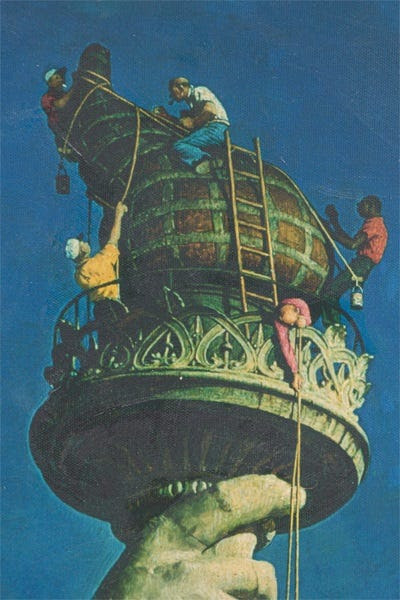
And that Norman Rockwell painting portrayed in the post? It hangs in Biden’s White House. You can be sure it will be moved to storage on Monday.

Doktor Zoom writes:

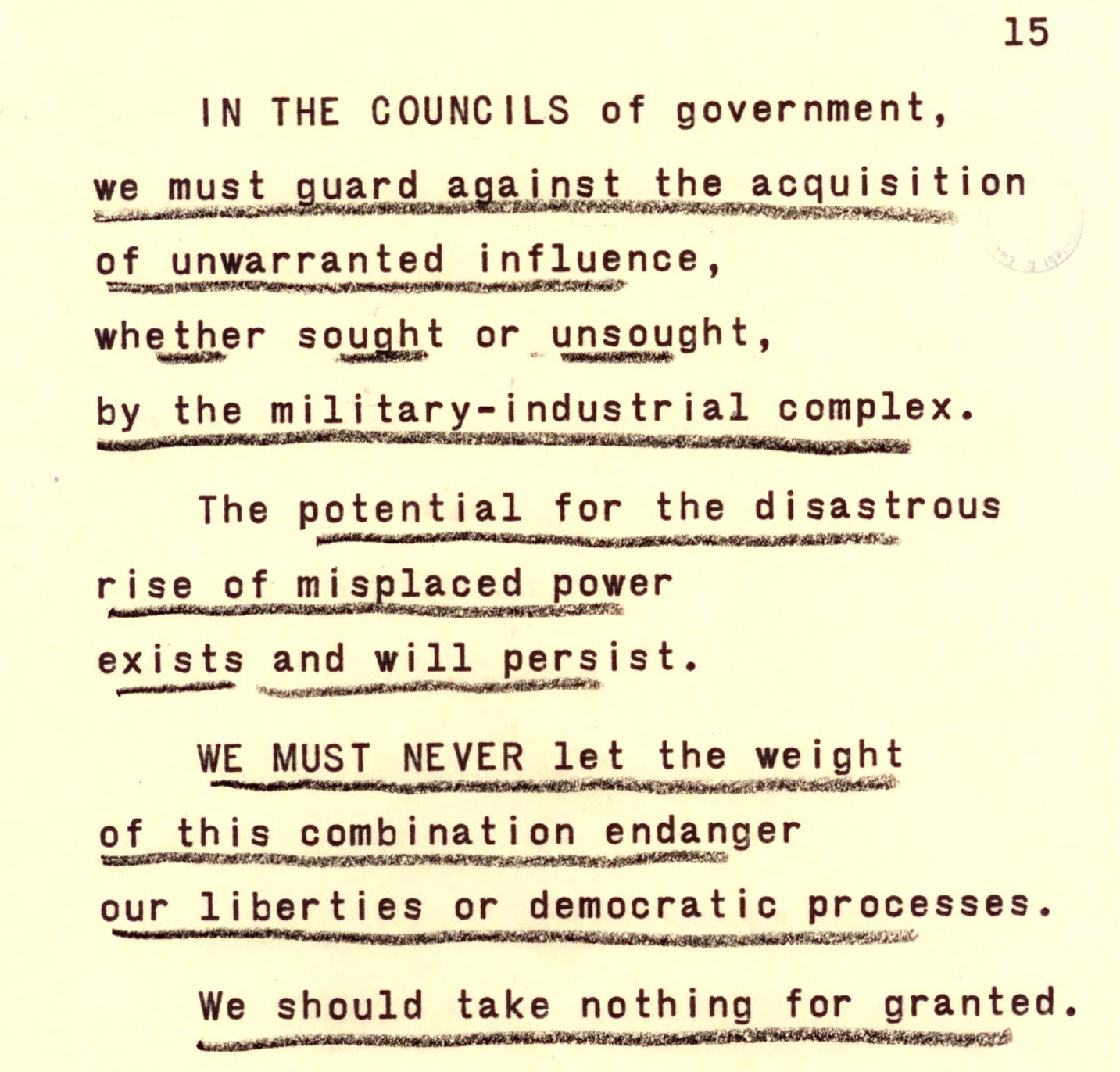
….Biden made an explicit parallel to Dwight D. Eisenhower’s farewell address, which warned about the threat of the “military-industrial complex” that nevertheless still has a stranglehold on our economy and politics in a “disastrous rise of misplaced power.” 

Today, Biden said, we should be wary of the “potential rise of a tech-industrial complex”: 

“Americans are being buried under an avalanche of misinformation and disinformation enabling the abuse of power. The free press is crumbling. Editors are disappearing. Social media is giving up on fact-checking. The truth is smothered by lies told for power and for profit.”

He didn’t name Donald Trump explicitly, just some of those forces that helped him retake power, and which threaten to help Trump and his billionaire buddies undo democracy.

Biden also offered some very concrete steps that might help rein in the destructive forces, although the chances they’ll be enacted during the tenure of the Lord of Misrule seem slim. He started with the easy stuff that won’t happen under Trump. 

“We must reform the tax code. Not by giving the biggest tax cuts to billionaires, but by making them begin to pay their fair share.

“We need to get dark money — that’s that hidden funding behind too many campaign contributions — we need to get it out of our politics.”

Then it was on to three ideas that will almost certainly have to wait until we bury Trumpism, at the very least. 

“We need to enact an 18-year time limit, term limit […] and the strongest ethics reforms for our Supreme Court. We need to ban members of Congress from trading stock while they are in the Congress. We need to amend the Constitution to make clear that no president, no president is immune from crimes that he or she commits while in office. The president’s power is … not absolute. And it shouldn’t be.”

OK, maybe the second one, the ban on members of Congress trading stocks, has some ghost of a chance; it also wouldn’t really do anything to keep Trump in check, though it’s certainly a general good-government idea. Maybe Biden threw it in for the sake of parallelism, to call for reforms in all three branches of government. 

Letting the super-wealthy run things, Biden reminded us, is a recipe not just for oligarchy, but for despair: If everyone knows the system is rigged, we all too often give up, or lash out in violence, neither of which is good for democracy. He offered as a hopeful metaphor an image from a 1946 Norman Rockwell painting that hangs in the White House, showing a crew of workers cleaning the torch on the Statue of Liberty, so its “rays of light could reach out as far as possible.” Keeping that torch lit is the work we all have to do as citizens. And while Biden didn’t mention this detail, do keep in mind that Liberty is not enlightening the world with a damn tiki torch, either. 

The bald guy with the pipe is a caricature of Rockwell. Wikipedia notes that ‘The inclusion of a non-white figure working with whites, apparently only noticed in 2011, contravened a Saturday Evening Post policy of only showing people of ethnicity in subservient roles.’ Darn that DEI! 

Biden closed with a rather remarkable passing of the torch, not so much to the incoming wrecking crew, but to the only people who can stop those bastards: Us. 

“I still believe in the idea for which this nation stands — a nation where the strength of our institutions and the character of our people matter and must endure. Now it’s your turn to stand guard. May you all be the keeper of the flame. May you keep the faith. I love America. You love it, too.”

What a contrast to the rhetoric of Ronald Reagan, who blithely called America a “shining city on a hill” because it’s so plainly the bestest place possible. (As Sarah Vowell reminds us, adding “shining” was a sunny perversion of the original Puritan metaphor’s dour intent, which warned that everyone would see our sins, like Abu Ghraib). 

But America isn’t a self-illuminating beacon of virtue that’s virtuous just because it’s America. Instead, Biden argues, the light of freedom requires constant maintenance and renewal — and it only keeps shining if we do the hard, even risky work of participatory democracy. 

We’re going to miss that guy.

James Fallows is a veteran journalist who has covered national and international politics for decades.

In this post, he explains why Joe Biden’s farewell address surprised him. He expected the same tone and substance he had heard for years. But the last eight minutes were different.

He writes:

I turned on Joe Biden’s Oval Office speech last night mainly from a sense of duty. I’d followed this man’s discourse generally over the decades, and very closely through these past few years. So I might as well see him out.

(For instance, with this look at a State of the Union address two years ago; this about the “music” of Biden’s rhetoric — “like the joke about Wagner’s music, it’s better than it sounds”; this about his challenges as “explainer”; these two—first, and second—about his speeches on the future of democracy one year after the January 6 attacks; and this about his powerful speech at Morehouse College last year. I even proposed a draft speech Biden could give about choosing not to run again, several weeks before he made that announcement for real.)

A running theme in these speech-related items has been Biden’s preference to “deliver tough messages softly,” rather than in a combative tone like Harry Truman’s or Teddy Roosevelt’s. And that is what I expected last night.

Through the first half of the speech, I listened on cruise-control, thinking that I’d been right on how the speech would go. Then suddenly I realized I had been wrong. The final eight minutes of Joe Biden’s final presentation in public life were different from the thousands of hours of rhetoric by him through his career, in a dramatic and instructive way. 

A comparison with another old, departing president is inescapable, and clarifying.


January, 1961: Dwight Eisenhower on the ‘military-industrial complex.’

Dwight Eisenhower is known as the great Allied commander of D-Day, and as a hero who became the first Republican to win the White House since 1928. He was so popular that after incumbent president Harry Truman decided not to run again himself, he tried to persuade Eisenhower to run as a Democrat.

But in rhetoric Eisenhower is known only for two things. One is the speech he did not have to give, in 1944. That is the statement he would have issued if the D-Day landing had failed, in which he would have taken personal responsibility for what had gone wrong. (As he put it in his handwritten draft, “If any blame or fault attaches to the attempt, it is mine alone.”)

The other is the final speech he gave as president, his televised “Farewell Address” from the White House three days before he stepped down. The speech got only limited attention at the time. The incoming Kennedy team was young, exciting, a magnet for news. Eisenhower was old, tired, yesterday’s story. 

But as the years go on the Farewell Address has steadily grown in attention and importance. There’s a whole, thick book about the crafting and consequences of this one speech. (That is Unwarranted Influence, by the late James Ledbetter, back in 2011.) This was the speech that delivered the hard-edged warning about the growing anti-democratic influence of the “military-industrial complex,” and introduced that term to popular discourse. The warning was all the more powerful in coming from a revered five-star general. 

You can hear the original audio of Eisenhower delivering the speech in the embedded clip just below. The part that lives in history begins around time 7:30. The 100 seconds that follow are truly remarkable rhetoric, which repay very careful listening. This part is worth actually hearing for yourself.¹LISTEN NOW · 15:31

And here is the script from which Eisenhower read those words, as his final message as an office-holder. The underlines were for his planned cadence—pauses, emphases, multi-word phrases that should be read legato-style, as a smoothly connected whole. 

Share


January, 2025: Joe Biden, on the ‘tech-industrial complex.’

Nothing in Dwight Eisenhower’s previous rhetoric prepared the public for his farewell address. Nothing in Joe Biden’s pattern of speeches prepared me for the way he ended last night.

Through the first few minutes of Biden’s farewell presentation, I had a sense of the familiar. As expected, the speech took us through highlights of his administration’s achievements, especially on the economy, which (as I’ve frequently argued) will be judged much more favorably by history than they have been by the press or the 2024 electorate.²

And just as predictably, the speech would give us the story of Scranton Joe, and why his long journey has made him believe all the more deeply in the American Dream. That is where he seemed to be going with the elaborate curlicues of his Statue of Liberty analogy, which he pushed to the breaking point and which took nearly three minutes of the speech to spell out.³

Most of Biden’s recent speeches have ended with the assurance that he has “never felt more positive about America.” That’s what he still seemed to be saying when talking about the upcoming “peaceful and orderly transition of power.” A reference to this “peaceful transition” has been part of every farewell address I’ve ever looked at, and to every Inaugural Address⁴—even, grudgingly, the one given eight years ago

Indeed, because of his commitment to that process, Biden said, he “had no doubt that America is in a position to succeed.” But as soon as he had finished those words, about half way into the speech, everything changed.


‘I want to warn the country…’

He paused. He sat up straighter. Until then his body language and tone had seemed valedictory and going-through-the-motions. Suddenly he seemed urgent and engaged. His hands had been neatly folded. Now he gestured directly toward the camera with a pen in one hand. And he said these words:

In my farewell address tonight, I want to warn the country of some things that give me great concern. 

I said to Deb, “Eisenhower.” And our body language, as listeners, also changed. We leaned closer to the TV as Biden laid out his blunt indictment of “the dangerous concentration of power in the hands of a very few ultrawealthy people, and the dangerous consequences if their abuse of power is left unchecked.” 

What were these “concerns,” that troubled a president at the end of four years in the White House, and of half a century in public life? Biden dug right in, including using a word (oligarchy) I don’t think has appeared in presidential annals before.

Today, an oligarchy is taking shape in America of extreme wealth, power and influence that literally threatens our entire democracy, our basic rights and freedoms and a fair shot for everyone to get ahead. We see the consequences all across America. And we’ve seen it before.

Biden went on for a full three minutes in this vein, with comparisons to the worst of the robber barons of the Gilded Age. Only then did he make another historical connection explicit: 

You know, in his farewell address, President Eisenhower spoke of the dangers of the military-industrial complex.

He warned us about, and I quote, “The potential for the disastrous rise of misplaced power.” Six decades later, I’m equally concerned about the potential rise of a tech-industrial complex that could pose real dangers for our country as well.

He went on to detail, much more specifically than Eisenhower had, exactly why this new oligarchy imperiled democracy. He referred to technologies and challenges that didn’t exist in Eisenhower’s time—TV itself was relatively “new” in 1961—and expressed concerns are at the center of tech-savvy debate in 2025:

Americans are being buried under an avalanche of misinformation and disinformation enabling the abuse of power. The free press is crumbling. Editors are disappearing. Social media is giving up on fact-checking. The truth is smothered by lies told for power and for profit. We must hold the social platforms accountable to protect our children, our families and our very democracy from the abuse of power.

The was nothing quaint or old-timey—Bidenesque—about this. It was as direct an indictment of the corruption of money-power as we’ve heard from a serving president in our times. From FDR or Truman? Sure, but that was long ago. …

To finish reading this insightful post, you must subscribe to Fallow’s Substack blog.

This was one of Jennifer Rubin’s last columns for The Washington Post. She resigned on January 13 to start The Contrarian, to be free of the whims of billionaire Jeff Bezos. Bezos wants to be Trump’s ally. Rubin wants to be an independent journalist.

She writes here about the mainstream media’s newfound appreciation for Biden’s economic policies. The latest jobs report showed a healthy increase of 256,000 new jobs, which stunned economists. During the Biden administration, new jobs were created in every quarter for four years. This is an enviable record.

Currently, Trump and Vance are saying on social media that they are inheriting “a dumpster fire.” It won’t take long until they claim credit for the vibrant economy they are inheriting from Joe Biden.

She writes:

The New York Times wrote a few days ago, “President Biden is bequeathing his successor a nation that by many measures is in good shape, even if voters remain unconvinced.” Just how good are things? Here’s how the Times described the state of the economy:

For the first time since that transition 24 years ago, there will be no American troops at war overseas on Inauguration Day. New data reported in the past few days indicate that murders are way down, illegal immigration at the southern border has fallen even below where it was when Mr. Trump left office and roaring stock markets finished their best two years in a quarter-century.

The Financial Times reported last week on “why America’s economy is soaring ahead of its rivals.” Time published an essay in November that said, “President-elect [Donald] Trump is receiving the strongest economy in modern history which is the envy of the world.”

Gosh, you are not alone if you are wondering where such upbeat reporting has been for the past few years. After all, “The economy had a strong 2024: robust growth, low unemployment and inflation descending to 3%,” former car czar Steve Rattner told us. Moreover, he has said, “All told, Biden has added 693,000 factory jobs while Trump added just 425,000 before Covid hit.7 … The rate of grocery inflation — particularly troubling for everyday Americans ­— has subsided to less than 1.6%.” Real median incomes are higher than when Trump left office, border crossings are lower.

Overall, the Biden record is impressive, especially in light of the recession and pandemic he inherited. Researchers at the University of Chicago told us: “Under the Biden administration, real GDP rose 12.6 percent, rightly cheered … as ‘a historically robust expansion’ that repeatedly defied forecasts. Since the pandemic, economic growth in the US has far outpaced that of our peer nations. Business investment is up; unemployment is low.”

There are several explanations for why we did not have coverage commensurate with the success President Joe Biden enjoyed. The news media’s fixation on polls showing what voters thought about the state of the economy and its negative news bias (which I have written about) that refused to give proper weight to Biden’s successes failed to give voters an accurate picture of Biden’s achievements. And yet now, somehow, with the election over, the media widely acknowledges that Biden’s record is strong, something they downplayed during the election.

We should not discount the disproportionate impact of rising costs (again, echoed without sufficient context in political coverage) on the public perception of the economy (which in turn got amplified to the exclusion of “good news” by the media). “Inflation in the United States reached 9% in 2022, meaning that the average cost of goods and services went up by that amount,” Johns Hopkins University’s David Steinberg explained. “That is the highest rate of inflation that this country has experienced in over 40 years.” While inflation has now dropped close to the Federal Reserve’s 2 percent benchmark, “the price level today is more than 20% higher than it was four years ago. As a result, many Americans cannot afford to buy as many things as they otherwise would.”

There is something else at work as well. Utilizing 89 years’ worth of data, University of Chicago researchers found, very simply, “It is not enough to say that a strong economy favors the incumbent. … A strong economy favors Republicans, and a weak economy favors Democrats, regardless of the incumbent.” They postulate that “when the economy is weak, Americans become more risk averse, and that’s why they favor the party that promises redistribution and social insurance — Democrats. During booms, by contrast, voters are more willing to take risks and therefore more likely to elect Republicans, who favor lower taxes.”

Democrats, including Biden and former president Barack Obama, like to point out that Democrats routinely inherit recessions from Republicans, clean up the mess and yet get no credit for it. (“In finance, there’s a phenomenon known as the ‘presidential puzzle’ — stock returns have been higher under Democratic administrations than Republican ones,” the research showed. “Between 1927 and 2015, the period analyzed in our study, the average excess market return was nearly 11 percent per year higher under Democrats than Republicans.”)

And yet this does not explain why, after inheriting great economies, Republicans manage to mess things up, ushering in the conditions for Democrats to return. Let me suggest the most simple explanation: The sugar-high from the only consistent economic policy Republicans favor (supply-side economics) quickly wears off, leaving the country with higher debt, more economic inequality and underinvestment in critical areas (e.g., education, infrastructure). Coupled with reckless deregulation that often results in financial crisis (as in 2008), Republicans’ policies leave Americans reeling, ready to bring back the only party of responsible governance: the Democratic Party.

Democrats should extract several lessons from this pattern. First, the media cannot be relied on to tell the success story. Republicans have a reliable propaganda machine in right-wing media; Democrats enjoy no such luxury. (One need only look at the economic coverage during Biden’s term to see this is true.) Second, it follows that Democrats must do a much better job touting their own successes and communicating with low- and no-information voters. Biden joked he should have put his name on the stimulus checks; he was right.

And finally, before Democrats change their philosophy or dump capable leaders, they might simply run a 24/7 hard-hitting critique of the Trump economic agenda. That will set the stage for the midterms.

We already have hints what Trump will do: run up big deficits, cut taxes for the super rich, slash entitlements, enact inflationary tariffs that provoke trade wars, undertake mass deportations that prove economically disastrous and do corporation’s bidding in enacting reckless deregulation.

Voters may not have long memories (amnesia about Trump’s first term pervaded the campaign) but, fortunately for Democrats, Trump’s failures and scandals will be fresh in the minds of voters when they go to the polls in 2026