Archives for category: Bias

Back in the days when the Republican Party was actually conservative, Republicans believed in small government. They said repeatedly that the federal government should not interfere with decisions made by local governments and private institutions.

The Trump administration is not conservative. It believes that it should impose its ideology on every kind of institution and every level of government.

Trump’s personal hatred of immigrants, of affirmative action, of any kind of program to help members of historically disadvantaged groups knows no bounds. His administration is on the hunt to stamp out anything that promotes diversity, equity, and inclusion. In addition to satisfying his (and Stephen Miller’s) personal hatreds, the war on DEI appeals to unsuccessful white men who think that underrepresented groups got advantages unavailable to them.

Here is the latest intrusion: Trump officials want to stamp out any reference to DEI in college admission essays. Students who have prevailed over adversity should be careful not to mention it, especially if they are Black or immigrants. Colleges are wondering how they will pay for this new federal demand.

This student was warned not to write about her life!

Mo Marie Lauyanne Kouame, 18, dreams of being an aerospace engineer and building spacecraft. This fall, she applied to MIT, Princeton, and Columbia. 

For one college essay, she wrote about being homeless at 8 years old, when she came to the United States from France. 

She recalled watching her parents fight for help from the Department of Transitional Assistance and sleeping in hospital beds at Boston Medical Center when they didn’t know where else to go. That early experience changed her, she said. 

“Homelessness,” she wrote, “taught me resilience.”

Kouame’s essay, which recounts how she learned to thrive as a low-income student of color “surrounded by classmates whose lives felt worlds apart from mine,” is about overcoming adversity. 

That’s a theme the White House has identified as a problem in its campaign against diversity, equity, and inclusion. Over the past year, the federal government has flagged “cues” such as personal essays, along with narratives about “overcoming obstacles” and “diversity statements,” as being potentially unlawful: a stand-in for talking about race.

More than two years have passed since the Supreme Court ended race-conscious affirmative action, and the Trump administration has since demanded colleges submit data proving they don’t consider race in admissions. It has also expanded what it sees as “discriminatory admissions processes” to include considering a student’s sexual orientation, gender identity, ethnicity, nationality, political views, and religious associations.

For Kouame, not writing about her identity felt “impossible,” she said in a Zoom interview, “because the things that I’ve gone through in life make me who I am now.” 

Other students are weighing the pros and cons, said Ethan Sawyer, founder of College Essay Guy, which offers one-on-one coaching and free online resources through the admissions process. He added the key is “to step back and take stock” of what colleges are actually looking for. Essentially: “How will you be a valuable, contributing member of the community?” 

Navigating the college admissions landscape has never been easy, but for the class of 2030 it’s particularly fraught. Plenty of advisers can be hired for a fee: Private consulting is a $3 billion industry, with parents paying tens and even hundreds of thousands of dollars to give their kids an edge. Community organizations, college-prep programs, and high schools are also on hand to assist students. 

There’s no question it’s an uneven playing field, though this year there is one equalizer in the college admissions game: No one really knows what’s coming next.

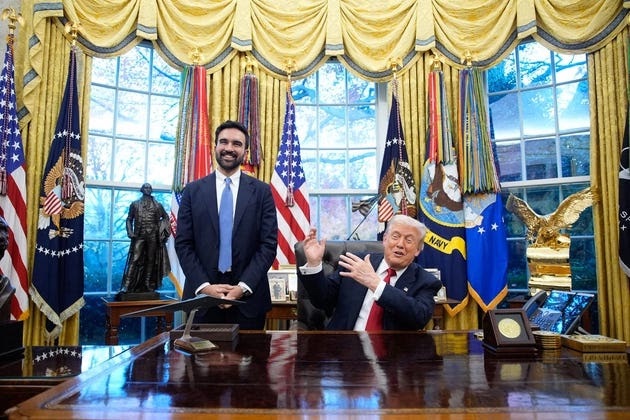
Watching the press conference that followed NYC Mayor-elect Zohran Mamdani’s meeting with Trump felt like stepping into an alternate universe.

Before they met, Mamdani called Trump names and promised to “Trumpproof” the city. Trump called Mamdani a “radical lunatic,” “a communist,” and lots of ethnic and religious slurs. He also threatened to cut off federal aid to the city.

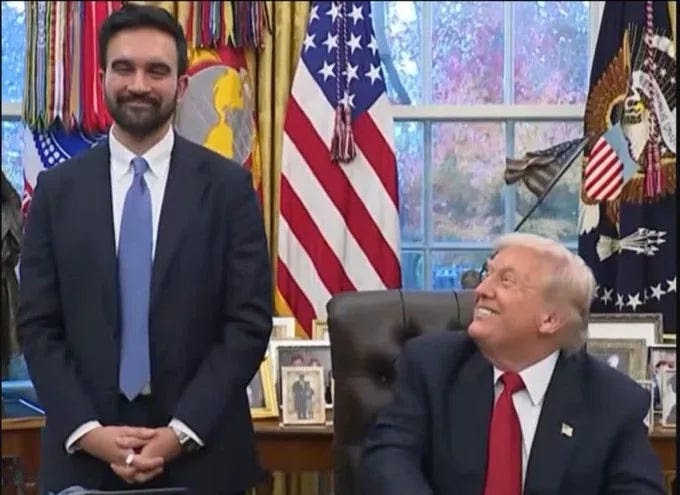
But after they met, Mamdani was beaming and Trump was gushing with praise for the vibrant young Mayor-elect. He even gave Mamdani that special smile that he usually reserves for Putin.

As a resident of NYC, I’m very happy with the outcome but puzzled. I haven’t met Mamdani but he clearly has magic powers.

Dean Obeidallah, who is Muslim, explains what happened on his blog:

For those shocked by how smitten Donald Trump was with Zohran Mamdani during their Oval Office meeting on Friday, it’s simply because you don’t know about the special powers, we, Muslims have. One of them is the ability to mesmerize people. Now, we only use this super Muslim power in special moments. We just can’t go around captivating people all day because we would have too many people chasing us around like smitten puppy dogs.

How does this spell get cast? Some online have speculated that Zohran called Trump “Habibi.” I can neither confirm nor deny that the word “Habibi” –or “Habibiti” for a woman—is part of how we do this.

But the trance I saw Trump in means Zohran likely dropped a special potion of Middle Eastern spices into Trump’s Diet Coke or McDonald’s cheeseburger. While I’m sworn to secrecy on the full list of ingredients, it likely involves sumac, cumin, cardamom with a hint of Trump’s favorite Doritos nacho cheese flavor. How powerful is it? Just look at the photo below. We all want someone to look at us with that type of affection!

Now with the kidding aside-or could it there really be a Muslim superpower?! I get why people would be stunned by what transpired. Trump had slammed Zohran days before the meeting as a “communist.” And during the mayoral campaign, Trump had attacked Zohran on everything from his looks —“TERRIBLE”—to his voice—“grating”—and even threatened to look into stripping him of citizenship and arresting him.

And Zohran in return had repeatedly trashed Trump calling him everything from “corrupt” to a “fascist” to a “despot.” He even mocked Trump during his victory speech a few weeks ago taking a shot at him being nearly 80 years old with the comment “I know you’re watching, I have four words for you: Turn the volume up.”

That was all gone yesterday—at least from Trump’s point of view. There was Trump pushing back on reporters that are from pro-Trump media outlets saying at one point, “I’ll stick up for you.” Trump added later he would live in New York under Mayor Mamdani and even said he was “confident that he [Zohran] can do a very good job”.

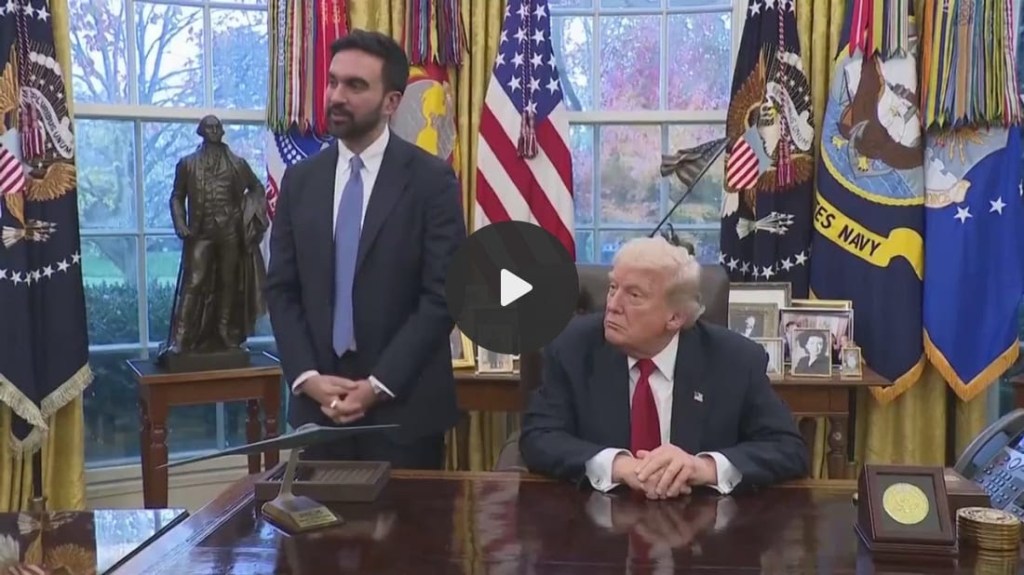
Now if you watch the clips– such as the one below– as Trump is defending Zohran and looking at him with puppy dog eyes, Zohran is simply being Zohran. He’s professional, poised and like always focused on his message of affordability for New Yorkers.

Trump ❤️ Mamdani

People can debate why Trump was glowing. I’ve met Zohran and chatted with him here in NYC over the past few years. He’s exceedingly smart—plus he does his homework on issues, etc. That means Zohran knew exactly what to say to Trump to elicit this response—and executed it perfectly.

In addition, Trump is at his lowest point in the polls in the second term. Trump is especially underwater on the economy with a Fox News poll this week finding that 76 percent now rate the U.S. economy negatively under Trump.

Trump needs to be near a winner—and that is what Zohran is. But while this meeting was both entertaining and inspiring, the best part was what happened immediately after it ended. And that was the outrage from the anti-Muslim bigots who to put it bluntly: Lost their sh*t.

For starters, there was GOP Rep. Elise Stefanik who is running for New York governor in 2026. Her campaign has been focused on smearing Zohran and all Muslims. She’s like a female George Wallace but instead of demonizing Blacks–she is hating on Muslims. 

Her main line of attack is to call Zohran a “jihadist.” Well in the Oval Office meeting, Trump was asked if he agreed that Zohran was a jihadist? In response Trump said no, adding, “I just met with a man who’s a very rational person.”

In response, Stefanik became hysterical because this undermines her campaign based on hate. She quickly vented her anger online repeating Zohran is a jihadist. Her freak out was a joy to behold.

Then there were bigots like Laura Loomer—who increasingly looks a cautionary tale for Botox abuse. After Zohran won, she posted a series of anti-Muslim comments such as calling Zohran a “jihadi” and writing “Mamdani will encourage Muslims to commit political assassinations to acquire power and silence critics.”

Yesterday, she was outraged with the Zohran-Trump love fest. She went on a long Twitter rantslamming the meeting and that Republicans need to oppose his agenda or lose. But deep down with Loomer it’s always about anti-Muslim hate.

Others like WABC radio’s Sid Rosenberg—who inadvertently helped Zohran win with his anti-Muslim comments that Andrew Cuomo joined in during the campaign—loves Trump. But he was fully triggered by this meeting. He told the NY Times “to watch them shake hands and smile” made him want to lose his lunch.

Of course there were countless other MAGA loving, Muslim hating scumbags on social media who went ballistic over the meeting. They live to be outraged.

Only time will tell if this meeting helps the people of New York City, Trump’s sagging approval numbers, etc. But one thing we knew it did already was piss off the anti-Muslim haters. If enjoying that is wrong, I don’t want to be right!

A Trump-appointed judge overturned the Trump administration’s ban on policies of diversity, equity and inclusion in schools and colleges, according to Collin Binkley of the AP. Will her ruling stand?

WASHINGTON (AP) – A federal judge on Thursday struck down two Trump administration actions aimed at eliminating diversity, equity and inclusion programs at the nation’s schools and universities.

In her ruling, U.S. District Judge Stephanie Gallagher in Maryland found that the Education Department violated the law when it threatened to cut federal funding from educational institutions that continued with DEI initiatives.

The guidance has been on hold since April when three federal judges blocked various portions of the Education Department’s anti-DEI measures.

The ruling Thursday followed a motion for summary judgment from the American Federation of Teachers and the American Sociological Association, which challenged the government’s actions in a February lawsuit.

The case centers on two Education Department memos ordering schools and universities to end all “race-based decision-making” or face penalties up to a total loss of federal funding. It’s part of a campaign to end practices the Trump administration frames as discrimination against white and Asian American students.

The new ruling orders the department to scrap the guidance because it runs afoul of procedural requirements, though Gallagher wrote that she took no view on whether the policies were “good or bad, prudent or foolish, fair or unfair.”

Gallagher, who was appointed by President Donald Trump, rejected the government’s argument that the memos simply served to remind schools that discrimination is illegal.

“It initiated a sea change in how the Department of Education regulates educational practices and classroom conduct, causing millions of educators to reasonably fear that their lawful, and even beneficial, speech might cause them or their schools to be punished,” Gallagher wrote.

Democracy Forward, a legal advocacy firm representing the plaintiffs, called it an important victory over the administration’s attack on DEI.

“Threatening teachers and sowing chaos in schools throughout America is part of the administration’s war on education, and today the people won,” said Skye Perryman, the group’s president and CEO.

The Education Department did not immediately comment on Thursday.

The conflict started with a Feb. 14 memo declaring that any consideration of race in admissions, financial aid, hiring or other aspects of academic and student life would be considered a violation of federal civil rights law.

The memo dramatically expanded the government’s interpretation of a 2023 Supreme Court decision barring colleges from considering race in admissions decisions. The government argued the ruling applied not only to admissions but across all of education, forbidding “race-based preferences” of any kind.

“Educational institutions have toxically indoctrinated students with the false premise that the United States is built upon ‘systemic and structural racism’ and advanced discriminatory policies and practices,” wrote Craig Trainor, the acting assistant secretary of the department’s Office for Civil Rights.

A further memo in April asked state education agencies to certify they were not using “illegal DEI practices.” Violators risked losing federal money and being prosecuted under the False Claims Act, it said.

In total, the guidance amounted to a full-scale reframing of the government’s approach to civil rights in education. It took aim at policies that were created to address longstanding racial disparities, saying those practices were their own form of discrimination.

The memos drew a wave of backlash from states and education groups that called it illegal government censorship.

In its lawsuit, the American Federation of Teachers said the government was imposing “unclear and highly subjective” limits on schools across the country. It said teachers and professors had to “choose between chilling their constitutionally protected speech and association or risk losing federal funds and being subject to prosecution.”

During Biden’s term in office, Republicans continually complained that Biden was “weaponizing” the Justice Department because it prosecuted Trump for inciting the insurrection of January 6, 2021, and for taking classified documents to his Mar-A-Lago estate.

Days ago, the Trump administration announced that it had reached a settlement with the family of Ashli Babbitt, who was shot and killed by a police officer as she attempted to be first to break into the House of Representatives’ chamber, where members of Congress were fleeing. The family is suing for $30 million. The police officer who shot her was defending the lives of our elected representatives, both Democrats and Republicans. It’s hard to imagine any other administration, whatever the party in power, paying off the family of a woman leading a mob into the House chambers to stop the electoral vote count.

Now that Trump is president again, he has turned the Departnent of Justice into his personal law office and assigned it the mission of prosecuting anyone whoever dared to cross Trump.

Trump is gleefully using his powers to weaponize the Department of Justice and to punish his political enemies. Not a peep from the Republicans, who unjustly accused Biden of doing what Trump is literally doing.

Trump has issued executive orders targeting law firms who had the nerve to represent Democrats or other Trump critics. His orders barred lawyers from those firms from federal buildings and directed the heads of all federal agencies to terminate contracts with the firms he designated. Several major law firms, fearful of being blocked from any federal cases, immediately capitulated. Trump exacted a price for releasing them from his attack: they had to agree to perform pro bono work on behalf of causes chosen by Trump. He currently has close a billion dollars of legal time pledged to him by those law firms that feared his wrath.

Individuals targeted by Trump must either find a lawyer who will represent them pro bono or face personal bankruptcy, that is, if they can find a lawyer willing to take on the Trump administration.

A few law firms have resisted Trump’s tyranny, and one of them–Perkins Coie–won a permanent injunction to block the enforcement of Trump’s ban. Perkins Coie represented Hillary Clinton in 2016, as well as George Soros. U.S. District Judge Beryl Howell said that Trump’s attacks on specific law firms, based on the clients they represented, were unprecedented and unconstitutional.

Judge Howell cited the example of John Adams, who represented the British soldiers accused of killing five colonists in the Boston Massacre of 1770. In two separate trials, Adams prevailed. He believed that everyone deserved a good lawyer and that they had been provoked into firing. Adams was a patriot and a man who defended the law. He was not stigmatized for defending the British soldiers.

An issue that Judge Howell raised but set aside for another time was whether Trump’s orders, which single out specific groups or individuals for punishment without trial are bills of attainder, which the Constitution forbids. They surely look like it, and this issue will come up again in the future.

As law professor James Huffman wrote in The Wall Street journal about Trump’s targeting of law firms:

A presidential bill of attainder places the powers of all three governmental branches in the hands of one man. As James Madison wrote in Federalist No. 47: “The accumulation of all powers, legislative, executive, and judiciary, in the same hands . . . may justly be pronounced the very definition of tyranny.”

Paul Rosenzweig, who worked in the George W. Bush administration, wrote in The Atlantic about Trump’s destruction of the rule of law, which he has twisted into an instrument of retribution for his personal grudges.

He writes:

When Thomas Paine asked what made America different from England, he had a ready answer: “In America, the law is king.” America has not always upheld that ideal, but, taking the long view, it has made great progress toward that principle. In recent decades, the Department of Justice has become an institutional embodiment of these aspirations—the locus in the federal government for professional, apolitical enforcement of the law, which is in itself a rejection of the kingly prerogative. That is why Donald Trump’s debasement of the DOJ is far more than the mere degradation of a governmental agency; it is an assault on the rule of law.

His attack on the institution is threefold: He is using the mechanisms of justice to go after political opponents; he is using those same mechanisms to reward allies; and he is eliminating internal opposition within the department. Each incident making up this pattern is appalling; together, they amount to the decimation of a crucial institution.

Investigations should be based on facts and the law, not politics. Yet Trump has made punishing political opposition the hallmark of his investigative efforts. The DOJ’s independence from political influence, long a symbol of its probity (remember how scandalous it was that Bill Clinton had a brief meeting with Attorney General Loretta Lynch?), is now nonexistent.

This development should frighten all citizens, no matter what their political persuasion. As Attorney General Robert Jackson warned in 1940, the ability of a prosecutor to pick “some person whom he dislikes and desires to embarrass, or selects some group of unpopular persons and then looks for an offense, [is where] the greatest danger of abuse of prosecuting power lies.” Choosing targets in this way flies in the face of the DOJ’s rules and traditions—to say nothing of the actual, grave harm it can inflict on people.

Far from eschewing the possibility of abuse, Trump and his allies at the Department of Justice positively revel in it. The most egregious example was Trump’s recent issuance of an executive order directing the government to investigate the activities of two of his own employees in the first administration, Chris Krebs and Miles Taylor, who later came to be political opponents of his. (Both men are friends and colleagues of mine.)

Their offense of perceived disloyalty is perhaps the gravest sin in Trump world, and as a result, they will now be individually targeted for investigation. The personal impact on each of them is no doubt immediate and severe. Krebs, who is a well-respected cybersecurity leader, has quit his job at SentinelOne and plans to focus on his defense. If Trump’s DOJ pursues this investigation to the limit, the two men could face imprisonment.

The cases of Krebs and Taylor do not stand in isolation. Recently, the U.S. attorney in New Jersey (Trump’s former personal attorney Alina Habba) launched an investigation into the state of New Jersey for its alleged “obstruction” of Trump’s deportation agenda. In other words, because New Jersey won’t let its own employees be drafted as servants of Trump’s policy, the state becomes a pariah in Trump’s mind, one that must be coerced into obedience.

Meanwhile, Attorney General Pam Bondi has announced that the U.S. government is suing Maine because of the state’s refusal to ban transgender athletes from playing on girls’ high-school sports teams. Not content with threatening Maine, Bondi has also announced an investigation of the Los Angeles Sheriff’s Office because of its alleged opposition to the Second Amendment and its “lengthy” process for approval of gun permits. And she recently announced that she would target leakers of classified information by going after journalists, rescinding a policy that protected journalists from being subpoenaed to assist government-leak investigations.

But the most aggressive abuser of the criminal-justice system has to be the interim U.S. attorney for the District of Columbia, Ed Martin. Martin has asked the FBI to investigate several of President Joe Biden’s EPA grantees for alleged fraud—a claim so weak that one of Martin’s senior subordinates resigned rather than have to advance it in court. He has also begun to investigate, or threatened investigations of, Georgetown UniversitySenator Charles Schumer, and Representatives Eugene Vindman and Robert Garcia, among others. More recently, in mid-April, Martin sent a series of inquiry letters to at least three medical and scientific journals, asking them how they ensured “competing viewpoints,” with the evident intention of suggesting that the failure to include certain minority opinions was, in some way, content discrimination.

A less-well-known example of Martin’s excess is his use of threats of criminal prosecution to empower DOGE. When DOGE was first denied entry into the U.S. Institute of Peace, one of the lawyers for USIP got a call from the head of the U.S. attorney’s criminal division, threatening criminal investigation if they didn’t allow DOGE into the building. Magnifying that power of criminal law, Martin sent D.C. police officers to the agency, telling the police that there was “an ongoing incident at the United States Institute of Peace” and that there was “at least one person who was refusing to leave the property at the direction of the acting USIP president, who was lawfully in charge of the facility,” according to the journalist Steve Chapman.

A final example of DOJ overreach is, perhaps, the most chilling of all. In a recently issued presidential memorandum, Trump directed the attorney general to “investigate and take appropriate action concerning allegations regarding the use of online fundraising platforms to make ‘straw’ or ‘dummy’ contributions and to make foreign contributions to U.S. political candidates and committees, all of which break the law.” Were the investigation neutral in nature, this might be understandable. But it isn’t.

In fact, there are two major fundraising platforms in use—WinRed (the Republican platform) and ActBlue (the Democratic one). Even though WinRed has been the subject of seven times as many FTC complaints as ActBlue, the Trump memorandum involves only the latter. By targeting his opponents’ fundraising, Trump is overtly marshaling the powers of federal law enforcement in his effort to shut down political opposition.

In essence, Trump is using the department to try to ensure future Republican electoral victories. One can hardly imagine a more horrifying variation on Lavrentiy Beria’s infamous boast: “Show me the man and I’ll show you the crime.”

There is more to the article. I encourage you to read it in full.

During his Senate confirmation hearings, Robert F. Kennedy Jr. tried to downplay his decades-long reputation as an opponent of vaccines. He even persuaded a Republican physician, Senator Bill Cassidy of Louisiana, that he would be guided by science, not his ideology. Why Senators believe nominees who try to disown their past is a mystery.

Dr. Paul Offit is a pediatrician who specializes in communicable diseases, vaccine research, and immunology. He teaches at the University of Pennsylvania. In this piece, he chastises RFK Jr. for his indifference to the death of a child because of his failure to get vaccinated.

On February 26, 2025, a school-aged child in West Texas died from measles. This marked the first child death in the US from the disease since 2003. The death was part of a larger outbreak in this Mennonite community that included 146 people, 20 of whom were hospitalized. The outbreak wasn’t an isolated event. Additional cases of measles had been reported in Alaska, California, Georgia, Kentucky, New Jersey, New Mexico, New York City, and Rhode Island. Measles is a winter-spring disease. We still have at least three months to go before the end of a typical measles season.

At a White House meeting on February 27th, the newly installed Secretary of Health and Human Services, Robert F. Kennedy Jr., responded to the events in Texas. Failing to immediately acknowledge the tragedy of a preventable death, he said that “measles outbreaks are not unusual” and that they happen every year. In truth, measles had been eliminated from the United States by 2000. At that time, due to a high level of population immunity, the virus wasn’t transmitted from one American child to another even after people with measles from other countries entered the United States. Unfortunately, owing to unfounded fears about measles vaccine safety, a critical percentage of parents have now chosen not to vaccinate their children, dropping immunization rates below the level required for herd immunity.

RFK Jr. also tried to dismiss the nearly two dozen hospitalizations in West Texas by claiming that they were “mainly for quarantine,” when in fact children were hospitalized for severe measles pneumonia. RFK Jr. apparently doesn’t understand that children exposed to measles are quarantined at home, not in the hospital. Indeed, the last place you would want to quarantine a child would be in a hospital filled with a vulnerable population of children, many of whom are particularly susceptible to the disease.

RFK Jr.’s dismissal of the Texas outbreak as “nothing to see here” was even more disheartening in that perhaps no one has contributed more to the perception that the measles-mumps-rubella (MMR) vaccine is dangerous than him. For 20 years, he and his organization, Children’s Health Defense, has claimed that the MMR vaccine causes autismdespite studies showing that it doesn’t.

The West Texas measles outbreak wasn’t RFK Jr.’s first experience with a Mennonite community. On July 31, 2021, in the middle of the Covid pandemic, RFK Jr. stood in front of 1,500 people in Lancaster County, Pennsylvania, home to one of the largest Mennonite communities in the United States, and talked about his experiences with measles as a child. The transcript from his talk later surfaced:

He said that “the cure for measles is chicken soup and vitamin A.” In other words, measles is no big deal. Two years earlier, RFK Jr. had traveled to Samoa before an outbreak of measles that had caused 5,600 cases and 83 deaths, mostly in children less than four years old. Despite this experience, he was still capable of dismissing the disease as a trivial, harmless infection of children.

RFK Jr.’s comments at the White House the day after the measles death were most remarkable for what he didn’t say. He didn’t say that the death was especially tragic because it was entirely preventable. And he didn’t say loudly and clearly that under-vaccinated communities in the United States needed to get vaccinated to avoid a similar tragedy. And that they needed to do it soon. This wasn’t surprising. For RFK Jr. to have spoken forcefully about the importance of vaccines in the face of a growing epidemic would have gone against everything that he had said and done for the last 20 years.

Anti-vaccine activists don’t change their stripes. Even when they’re given the enormous responsibility of protecting the nation’s children.

Scott Maxwell, opinion writer for The Orlando Sentinel, points out a glaring example of double standards of justice: Matt Gaetz and anyone else charged with the same behavior. Matt Gaetz got away with behavior that would land anyone else in jail. It is astonishing that Trump thought he was the right person to hold the highest position in the Justice department.

Maxwell writes:

By now, most of you have probably heard about the U.S. House report on the behavior and actions of former Florida Congressman Matt Gaetz.

If you haven’t actually read the full report, I’d encourage you to do so.

The descriptions of drug- and sex-fueled parties seem like something you’d expect in a tabloid report about Charlie Sheen — not an American lawmaker recently nominated to be this country’s attorney general.

But the most important thing to know about this report is that House investigators concluded that Gaetz repeatedly broke the law.

The report mentioned “illicit drug use” a half-dozen times and said there was “substantial evidence that Representative Gaetz met with women who were paid for sex and/or drugs” on “at least 20 occasions.”

It cited testimony that “Victim A recalled receiving $400 in cash from Representative Gaetz … which she understood to be payment for sex. At the time, she had just completed her junior year of high school.”

The report’s conclusion: “… there was substantial evidence that Representative Gaetz violated House Rules, state and federal laws, and other standards of conduct prohibiting prostitution, statutory rape, illicit drug use, acceptance of impermissible gifts, the provision of special favors and privileges, and obstruction of Congress.”

Maybe none of this surprises you.

What should outrage you, though, is that virtually all of this behavior — including multiple accusations of law-breaking — was greeted with a collective shrug by Florida law enforcement.

I know it’s tempting to consider this story just another report about slimy behavior from another slimy politician. But I’d encourage you to look at this report in terms of how justice is generally doled out in this state and country — with powerful and connected people getting a pass while we throw the book at low-level offenders.

In fact, I’d like to juxtapose the Gaetz report to another Florida case I wrote about just two weeks ago in a column titled: “Prison for poor addicts. Deals for wealthy crooks. Twisted ‘justice’ ”

That piece featured a federal judge from Orlando who was incredulous that federal mandatory-minimum sentencing laws required him to send a homeless drug addict to prison for five years for taking $30 from a man who asked him to deliver a package of drugs.

Judge Roy “Skip” Dalton argued that this destitute man of the streets with no history of drug dealing needed treatment for his addiction, not five years in prison. Dalton said a lengthy prison sentence wouldn’t make the community any safer, wouldn’t help the man with his addiction and would cost taxpayers gobs of money.

The justification for tough sentences is supposedly that lawbreakers deserve no mercy or sympathy — unless you’re a member of Congress.

Or a fraud-committing CEO.

Or the kid whose parents cut big campaign checks.

The reality is that this country has two systems of “justice” — one for the powerful and privileged and one for everyone else.

Politicians and law enforcement love to talk about how they’re “tough on crime” — until they or their friends are involved.

Need proof? Consider the long list of lame excuses by Florida law enforcement agencies for why they didn’t pursue charges against Gaetz.

Remember: The House report said that Gaetz “Violated State Laws Related to Sexual Misconduct” and “Used Illegal Drugs” — with some of those alleged activities taking place in Seminole County at the home of former legislator-turned-lobbyist Chris Dorworth.

But when the Orlando Sentinel asked state and local law-enforcement agencies why they didn’t do anything, they merely made excuses and pointed fingers.

Attorney General Ashley Moody’s office said local police or FDLE should’ve handled things.

The FDLE wouldn’t answer questions.

And the Seminole County Sheriff’s Office said that no one came to them with allegations and that they thought the feds were on the case.

I’ve seen less buck-passing at the U.S. Mint.

Imagine how ridiculous it would sound if you heard that chorus of excuses from authorities for some street-level criminal:

We thought the other guys were handling this. This isn’t our job. Nobody directly complained to us about these activities (that were widely documented in the media)

Also, it’s worth noting that none of these investigative agencies said they didn’t think crimes were committed — just that they didn’t think they were the ones who should be doling out justice.

For his part, Gaetz, who comes from an extremely wealthy family in Florida’s panhandle, has denied any legal wrongdoing.

“My 30’s were an era of working very hard — and playing hard too,” he said. “It’s embarrassing, though not criminal, that I probably partied, womanized, drank and smoked more than I should have earlier in life. I live a different life now.”

Way back in his 30s. Gaetz is 42.

Most Floridians would be quaking in their flip-flops if Congress released a report that said they had broken all kinds of laws. Not Gaetz. He’s already back on Twitter (X), promoting Bitcoin and fuming about immigration proposals.

Why? Because Gaetz knows how justice in this country works.

If you’re poor and lacking connections, you’ll be sent to prison for small-time crimes. But if you’re powerful and connected, you’ll get a pass — and maybe a talk-show deal or Cabinet nomination.

smaxwell@orlandosentinel.com

Texas is offering a curriculum for K-5 classrooms that is infused with Biblical stories. It is called the Bluebonnet Learning Materials. Its proponents contend that this cultural knowledge will prepare students to understand art, literature, and history, but the children are way too young to absorb the religious lessons as part of their lifelong knowledge. Critics also complain that one religion is favored above all.

The Houston Chronicle reported:

Controversy has surrounded new state-approved lessons referencing the Bible that are being offered as part of the Texas Education Agency’s elementary reading curriculum, with some confusion on financial incentives to adopt the materials. Months after the State Board of Education approved the materials created through House Bill 1605, some districts still don’t know exactly how the funding will be used and what the limitations are….

The TEA’s Bluebonnet Learning materials are free educational resources owned by the state of Texas. The resources Texas has commissioned include textbooks for grades K-5 in reading and math materials through algebra.

The bill bans materials associated with “Balanced Literacy.”

All materials approved had to meet certain requirements, such as being free of three-cueing content in kindergarten through third grade, the practice of using context clues to find the meaning of unknown words before sounding them out. The law also mandated that materials not be obscene or include harmful content, as delineated in the Texas Penal Code, and that they have parent portal compliance. ..

The resources were built off materials from Amplify, a New York-based publisher, that were purchased during the COVID-19 pandemic. But Amplify declined to supply further revisions, according to a story from The 74, after they were allegedly asked to create lessons around certain stories from the Bible but not other world religions. TEA officials said this claim was “completely false” and the material “includes representation from multiple faiths…”

If districts choose a resource from the State Board of Education’s approved list for high-quality instructional materials, they receive an extra $40 per enrolled student on top of the instructional materials and technology allotment, or IMTA, of $171.84 per student. If the district chooses to adopt Bluebonnet, they would also receive an extra $20 for printing the materials, totaling $60 per student…

Both Republicans and Democrats have condemned the Bluebonnet resources for their inclusion of certain Bible-specific lessons and stories. Other religions are referenced in the resources, but according to a study commissioned by the Texas Freedom Network,the religious source material addressed is overwhelmingly Christian. Hinduism is briefly mentioned, despite the significant population of Hindus in Texas. Buddhism and Sikhism are also briefly mentioned. The first version of the Bluebonnet Learning did not include references to Hinduism, Buddhism or Sikhism, and some deities were characterized as “mythical,” while the truthfulness of the Christian God was not qualified. 

In one kindergarten lesson, students are asked to use sequencing skills to order the creation events as portrayed in Genesis. 

Critics also had concerns that the textbooks whitewashed historical events by using gentler language to describe colonization, such as “share” or “introduce.” In some units, the lessons teach students that abolitionists used their beliefs in Christianity to argue against slavery, without noting that Christianity was also used as a justification for slavery in U.S. history. 

“I really struggled with the Bluebonnet materials, especially on the (English Language Arts) side of things, because, while there was representation from other religions, other faith-based communities, it was overwhelmingly written with Christian bias,” Perez-Diaz said. 

Texas law does require districts to include “religious literature, including the Hebrew Scriptures (Old Testament) and New Testament, and its impact on history and literature” in curricula, but critics felt that the reliance on Christianity at an early age for students goes beyond what the law requires. Conservative critics had said that the interpretation of certain Bible passages was not in-line with all Christian belief systems and that only parents should have the right to teach their children about their religion. 

Jeff Tiedrich proposes in his blog that President Biden should operate a “pardon factory” to protect everyone who has been threatened by Trump or Kash Patel.

One of the features of democracy is an assumption that parties will contend for power, accept their win or loss graciously, then prepare for next time. There will always be the next election to try again.

The threats by Trump and his toadies to prosecute his critics disrupts the comity on which a democratic system depends.

Trump thinks of his critics as “enemies,” not critics. He has made clear repeatedly that he will use his power as President to prosecute, imprison, and crush his enemies.

He said recently that the members of the January 6 Commission “should be in jail.” Why? Is it normal or acceptable that a mob summoned by the President descends on the U.S. Capitol as they meet to certify the election, smash through the windows and doors, beat up police officers, and rampage through the building? What was criminal? The summoning of the mob? The actions of the mob? Or the investigation of the events of the day?

Biden, writes Tiedrich, should issue pre-emptive pardons to all those whose lives and freedom might be endangered by Trump, Kash Patel, or Pam Bondi.

The next four years will be a trial for our democracy. Will the norms and institutions survive the reign of this bitter, vindictive old man?

Dr. Patrick Soon-Shiong, the billionaire publisher of the Los Angeles Times, recently revealed that the newspaper would employ a technology that will tell “both sides” of every story. Journalists are outraged by the implication that their stories are biased. After the publisher’s decision to prohibit an endorsement in the Presidential race, the chief editor of the editorial board resigned, followed by others.

At that time, the published defended

The New York Times reported:

Dr. Patrick Soon-Shiong, the billionaire owner of The Los Angeles Times, said on Thursday that he planned to introduce a “bias meter” next to the paper’s news and opinion coverage as part of his campaign to overhaul the publication.

Dr. Soon-Shiong, who in October quashed a planned presidential endorsement for Vice President Kamala Harris from The Los Angeles Times’s editorial board, said in an interview that aired on Scott Jennings’s podcast “Flyover Country” that he had begun to see his newspaper as “an echo chamber and not a trusted source.”

He previously said he planned to remake the paper’s editorial board and add more conservative voices. He has asked Mr. Jennings, a CNN political commentator and a Republican strategist, to join it.

Dr. Soon-Shiong, who bought The Times in 2018, said on the podcast that he had been working with a team to create the so-called bias meter using technology he had been building in his health care businesses.

On news and opinion articles, “you have a bias meter so somebody could understand, as a reader, that the source of the article has some level of bias,” he explained in the interview. “And what we need to do is not have what we call confirmation bias, and then that story automatically — the reader can press a button and get both sides of that exact same story based on that story, and then give comments.”

He said he planned to introduce the tool in January.

Dr. Soon-Shiong’s latest comments set off immediate pushback from the L.A. Times Guild, which represents journalists at the paper.

“Recently, the newspaper’s owner has publicly suggested his staff harbors bias, without offering evidence or examples,” the union’s leadership said in a statement on Thursday. The union said all Times staff members abided by ethics guidelines that call for “fairness, precision, transparency, vigilance against bias and an earnest search to understand all sides of an issue.”

In the comments that followed the article, many ridiculed the idea of the “bias meter.” One imagined an article that reported on an earthquake rated 9.5, which said that people feared that the earthquake would cause massive destruction of lives and property; those seeking a different perspective would press the bias meter to read an article saying that most people were not afraid of a 9.5 earthquake and say it’s no big deal.

Trump is demonstrating his intention to purge the FBI by naming his close associate Kash Patel as FBI Director. Patel has said repeatedly that the FBI is loaded with “Deep State” enemies, and he plans to fire them.

The FBI is supposed to be an independent agency, not a vengeance weapon belonging to the President. Patel has made clear that he will find and punish Trump’s enemies. He will run the FBI, if confirmed, as Trump’s man, serving Trump, not justice and not the American people. He will be Trump’s avenger, as he destroys the reputation of the FBI.

Politico described him:

President Donald Trump announced Saturday night that he has picked staunch Trump loyalist Kash Patel as the next director of the Federal Bureau of Investigation.

Patel, a Trump transition insider, has been one of Trump’s most visible and vocal allies, showing up at his criminal trial in Manhattan, perpetuating conspiracy theories about the 2020 election. He worked as chief of staff to the secretary of Defense during the first Trump administration, and has been outspoken about calling for a purge of Trump’s enemies from the Justice Department, FBI and other intelligence agencies.

The New York Times wrote:

President-elect Donald J. Trump said on Saturday that he wants to replace Christopher A. Wray, the F.B.I. director, with Kash Patel, a hard-line critic of the bureau who has called for shutting down the agency’s Washington headquarters, firing its leadership and bringing the nation’s law enforcement agencies “to heel.”

Mr. Trump’s planned nomination of Mr. Patel has echoes of his failed attempt to place another partisan firebrand, Matt Gaetz, atop the Justice Department as attorney general. It could run into hurdles in the Senate, which will be called on to confirm him, and is sure to send shock waves through the F.B.I., which Mr. Trump and his allies have come to view as part of a “deep state” conspiracy against him.

Mr. Patel has been closely aligned with Mr. Trump’s belief that much of the nation’s law enforcement and national security establishment needs to be purged of bias and held accountable for what they see as unjustified investigations and prosecutions of Mr. Trump and his allies.

Mr. Patel “played a pivotal role in uncovering the Russia, Russia, Russia Hoax, standing as an advocate for truth, accountability and the Constitution,” Mr. Trump said in announcing his choice in a social media post….

Mr. Patel, a favorite of Mr. Trump’s political base, has worked as a federal prosecutor and a public defender, but has little of the law enforcement and management experience typical of F.B.I. directors.

He served in a series of administration positions at the tail end of Mr. Trump’s first term, including posts on the National Security Council and in the Pentagon. Before leaving office in early 2021, Mr. Trump floated the idea of making Mr. Patel deputy director of either the C.I.A. or the F.B.I. William P. Barr, the attorney general at the time, wrote in his memoir that Mr. Patel would have become deputy F.B.I. director only “over my dead body.”

FBI directors are appointed for a 10-year term, so their tenure is allegedly nonpolitical. Although Trump appointed Christopher Wray as FBI Director, Trump soured on him after the FBI raid on Mar-a-Lago to recover hundreds of top/secret documents. Trump made clear to Director Wray that he should resign or be fired.

Current and former law enforcement officials have worried that a second Trump term would feature an assault on the independence and authority of the F.B.I. and the Justice Department, and for many of them, Mr. Patel’s ascension to the director’s role would confirm the worst of those fears.

Mr. Patel laid out his vision for wreaking vengeance on the F.B.I. and Justice Department in a book, “Government Gangsters,” calling for clearing out the top ranks of the bureau, which he called “a threat to the people.” He also wrote a children’s book, “The Plot Against the King,” telling through fantasy the story of the investigations into Mr. Trump’s 2016 campaign’s possible ties to Russians.

He has vowed to investigate and possibly prosecute journalists once he is back in government, adding that he would “follow the facts and the law.”

“Yes, we’re going to come after the people in the media who lied about American citizens, who helped Joe Biden rig presidential elections — we’re going to come after you,” he said last year. “Whether it’s criminally or civilly, we’ll figure that out.”

An article in the New York Times in October described how deeply hated Patel was by other high-level members of the Trump administration. He was considered a boastful self-promoter.

After Mr. Trump lost the 2020 election and staff members began an exodus from the White House, Mr. Patel’s upward trajectory continued. Mr. Trump named him to one of the most important jobs at the Pentagon: chief of staff to Christopher Miller, the acting defense secretary.

Gen. Mark A. Milley, then chairman of the Joint Chiefs of Staff, was shocked when Mr. Patel presented him a document signed in Sharpie by the outgoing Mr. Trump ordering a full withdrawal of all American troops from Afghanistan by Jan. 15. General Milley, the top military adviser to the president, had never even seen the order, and neither had several other senior advisers. It turned out it was drafted by Douglas Macgregor, a retired colonel named as an adviser to the Pentagon after he impressed Mr. Trump with his appearances on Fox News, according to an account in “The Divider,” a book by Peter Baker and Susan Glasser.

Mr. Trump backed away from the Afghanistan plan, but soon sought to again elevate Mr. Patel by making him deputy director of either the C.I.A. or the F.B.I. Only after Gina Haspel, the C.I.A. director, and William P. Barr, the attorney general, both threatened to quit — Mr. Barr vowed that Mr. Patel would become F.B.I. deputy only “over my dead body”— did Mr. Trump abandon the idea.

Mr. Patel stayed at the Pentagon for three months, crediting himself in his book with leading “the biggest transition’’ of the Defense Department “in U.S. history.”