Archives for category: Arizona

Yeah, yeah, I know it’s a strange headline, but it’s true.

Here is the story: Politico reporter goes to Arizona to cover the voucher story. Discovers that the chief advocate for vouchers is a beautiful, charming mom who uses state money to home-school her five children.

Writer is wowed by this mom. Writer notes that mom is funded by DeVos and Koch machine. It doesn’t matter. She’s so charming and pretty, who cares that vouchers are busting the state budget?

Writer pays more attention to the adorable mom than to those fighting to stop the damage she is doing to kids, public schools, and communities. Somehow she becomes the hero of the story.

Who cares that vouchers are used mostly by families whose kids never went to public schools? Who cares that vouchers are harming the state’s public schools?

Who cares that Arizona voters overwhelmingly rejected voucher expansion? Who cares that the legislature ignored their vote?

Who cares that less than 5% of the state’s students are undermining the state budget and the schools that educate the other students?

Families, mostly from high-income zip codes, have applied the taxpayer funds for everything from ski lift passes to visits to trampoline parks, a $4,000 grand piano, more than a million dollars in Legos, online ballet lessons, horse therapy and cookie-baking kits. Proponents justify expenditures like these in the name of parents’ prerogative to shape their children’s education or by pointing to wasteful spending by public schools. As a result, ESA costs have ballooned from the legislature’s original estimated price tag of $100 million over two years, to more than $400 million a year — a figure, critics have noted, that would explain more than half of Arizona’s projected budget deficit in 2024 and 2025.

Ain’t it grand?

Love is love, even when it is underwritten by billionaires!

ProPublica published a story about which families benefit from Arizona’s universal voucher program. It is not low-income families.

The state’s so-called Education Savings Accounts (or Empowerment Scholarship Accounts) were enacted by the Legislature in 2011. Whatever they are called, they are vouchers, which violate Arizona’s Constitutional ban on public funds for religious schools. They initially contained restrictions as to which students qualified to receive a voucher. The usual claim for vouchers was that they would “save poor kids from failing public schools.” However, that never happened.

From the start, the Republicans in control wanted vouchers for all students, not just those from low-income families. Even though there was a state referendum in which voters overwhelmingly rejected voucher expansion in 2018, the Legislature ignored the vote and passed universal vouchers in 2022. Any student, whatever their family income, is entitled to use public money for tuition in a private or religious school or for home schooling.

The result: few students from low-income families use vouchers.

The article in ProPublica explains why.

Vouchers don’t cover the cost of most private schools.

Most private schools are not located in low-income neighborhoods.

Low-income families can’t afford the cost of transportation to and from private schools.

In Arizona, as in other states, most students who take vouchers were already enrolled in no public schools. Their parents can afford to pay the tuition. Now the state subsidizes them. And in many cases, the schools raise their tuition in response to the state subsidy.

EJ Montini of the Arizona Republic thinks something is not quite right with Arizona’s State Superintendent of Education Tom Horne. He rejects federal funding for poor kids and promotes rightwing groups and theories. He explains:

I’m not yet prepared to call Arizona Superintendent of Public Instruction Tom Horne incompetent, though I’d have to admit, he’s recently made a very good case for himself.

The Arizona Republic’s Nick Sullivan outlined in a blow-by-blow article the misrepresentations Horne made while trying to explain to state lawmakers what could have been the loss of millions of Title I federal dollars meant for schools that serve low-income households.

For example, Horne told lawmakers that a deadline for allocating the money had expired. The U.S. Department of Education said such a deadline does not exist.

His administration said there was no possibility of receiving a deadline waiver. The Republic contacted the feds, who, in turn, told Horne’s people it was not too late, and a waiver was subsequently granted.

It goes on. One bumbling bit of misinformation after the next.

All of which would be easy – and even logical – to write off as incompetence, were it not for some of the other things Horne has done.

A lawsuit on accountability Horne wants the state to lose

Most recently, for example, his department was sued by The Goldwater Institute after Attorney General Kris Mayes cracked down on ridiculous purchases being made by people collecting Empowerment Scholarship Account money.

Taxpayer money. Your money.

ESA recipients were buying stuff like $1,000-plus Lego sets, pianos, luxury car driving lessons, ski resort passes and much more.

Given that, new rules came into play requiring school voucher recipients to actually justify their expenses.

The parents suing with Goldwater’s help called such demands “bureaucratic hoops” and “arbitrary paperwork,” instead of, you know, common sense.

Meantime, Horne said he wants the state to lose the lawsuit. Really.

A nonprofit that teaches kids the ‘softer side’ of slavery

You might also recall how, a while back, Horne opened up the education department’s website to lessons from PragerU, an kooky, extremist nonprofit claiming to be an alternative to “dominant left-wing ideology in culture, media and education.”

About this Horne said, “It’s alright for teachers to teach controversial views as long as both sides are presented, and the problem we’ve had is in some classes, only the extreme left side has been presented, so these present an alternative.”

An alternative? One PragerU video shows an animated Christopher Columbus presenting the softer side of slavery, saying, “Being taken as a slave is better than being killed, no? I don’t see the problem.”

Neither does Horne. Which is a problem.

A group that promotes book bans and quoted Hitler

Just as it was a problem when Horne spoke before a group of East Valley supporters of Moms for Liberty, a right-wing operation out of Florida that believes “liberty” involves book banning, victimizing LGBTQ children, suppressing accurate American history and more.

The group has as one of its goals filling school boards with like-minded individuals and Horne pledged to join them in their effort, saying, “That’s going to be my main occupation for 2024.”

A pledge he made even after the group got national attention when the leader of a chapter in Indiana published a newsletter for members that prominently displayed a quote attributed to Adolf Hitler: “He alone who OWNS the youth, GAINS the future.”

Horne is an intelligent man. His official government profile proudly notes that he “graduated Magna Cum Laude from Harvard College and with honors from Harvard Law School.” And that he is a “classical pianist who has soloed with local orchestras” and has “taught legal writing at ASU Law School.”

All of that argues against the notion that Horne is incompetent. In fact, it seems to suggest just the opposite. Something much worse.

He does this stuff on purpose.

Reach Montini at ed.montini@arizonarepublic.com.

The National Coalition for Public Education published valuable information contrasting the actual cost of vouchers to overly optimistic projections by their advocates. In every state that has adopted vouchers, most vouchers are used by students already enrolled in private schools. In states such as Florida and Arizona, vouchers are “universal,” meaning there are no income limitations or other restrictions on their accessibility. In essence, vouchers provide public dollars to subsidize the tuition of students in private and religious schools. They are a welfare program for the affluent.

The NCPE concluded:

When lawmakers consider expanding or creating private school voucher programs, their projections often drastically underestimate the actual costs. They sell a false promise that vouchers will save money, do not budget adequate funds, and then wind up with million dollar shortfalls, necessitating cuts from public education and even tax increases. 

Some voucher advocates incorrectly claim that if the amount of the voucher is less than the average expenditure spent to educate a student in public school, the state will save money. Existing voucher programs prove this false.  

First, it costs less than the average expenditure to educate some students, and much more to educate others who need additional support and services–like those with disabilities, English language learners, and low-income students. The students who are most expensive to educate, however, tend to remain in public schools  because they cannot find a private voucher school willing to accept them. Yet, because of the voucher program, the public schools are left with fewer resources. Furthermore, in a voucher program, the state now pays tuition for private school students who never attended public schools, which is an altogether new cost for taxpayers.

This all adds up to more, not less, spending.


Here are several examples of the skyrocketing costs of voucher programs:

ARIZONA’S VOUCHER IS COSTING 1,346% MORE THAN PROJECTED, CONTRIBUTING TO A $400 MILLION BUDGET DEFICIT.

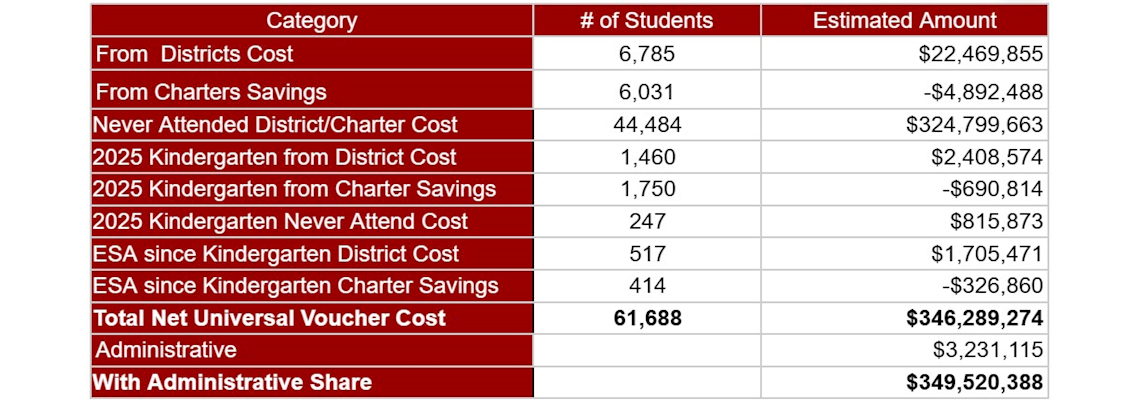
  • The fiscal note attached to Arizona’s universal voucher program projected the program would cost the state about $65 million in 2024 and $125 million in 2025. But once students’ applications started to come in, state leaders realized these estimates were woefully inadequate. The Arizona Governor’s Office now estimates that the price tag is more than 1,346% higher at a cost of $940 million per year. This is one of the main causes of a $400 million budget shortfall in the state’s general fund, which funds the state’s public schools, transportation, fire, police, and prisons.

THE FLORIDA VOUCHER IS ALREADY MORE THAN $2 BILLION OVER BUDGET IN YEAR ONE.

  • The Florida Senate projected that its voucher expansion would cost $646 million. But independent researchers estimated that the program would actually cost almost $4 billion, and actual costs are already approaching that amount—$3.35 billion in the first year. In just one county, Duval, school officials report a $17 million budget shortage due to funds lost to the vouchers.

WEST VIRGINIA’S VOUCHER DRAINS MORE THAN $20 MILLION FROM PUBLIC SCHOOLS PER YEAR.

  • During the 2024 – 2025 school year, the West Virginia voucher program is expected to funnel $21.6 million away from the state’s public schools–enough to pay the salaries for 301 professional teachers and 63 school service workers. As a result of the voucher and other declines in enrollment, multiple school districts are already warning residents that they need to impose property tax increases in order to continue to pay current teachers’ salaries.

Linda Ronstadt, one of the greatest singers of our time, posted her endorsement in the 2024 Presidential campaign.

“Donald Trump is holding a rally on Thursday in a rented hall in my hometown, Tucson. I would prefer to ignore that sad fact. But since the building has my name on it, I need to say something.

It saddens me to see the former President bring his hate show to Tucson, a town with deep Mexican-American roots and a joyful, tolerant spirit.

I don’t just deplore his toxic politics, his hatred of women, immigrants and people of color, his criminality, dishonesty and ignorance — although there’s that.

For me it comes down to this: In Nogales and across the southern border, the Trump Administration systematically ripped apart migrant families seeking asylum. Family separation made orphans of thousands of little children and babies, and brutalized their desperate mothers and fathers. It remains a humanitarian catastrophe that Physicians for Human Rights said met the criteria for torture.

There is no forgiving or forgetting the heartbreak he caused.

Trump first ran for President warning about rapists coming in from Mexico. I’m worried about keeping the rapist out of the White House.

Linda Ronstadt

P.S. to J.D. Vance:

I raised two adopted children in Tucson as a single mom. They are both grown and living in their own houses. I live with a cat. Am I half a childless cat lady because I’m unmarried and didn’t give birth to my kids? Call me what you want, but this cat lady will be voting proudly in November for Kamala Harris and Tim Walz .”

Readers know that the State Board of education in Arizona actually turned down a parent’s request to use voucher money to buy three dune buggies. Amazing!

Mercedes Schneider digs deeper. In this post, she transcribes the discussion about the vote at the State Board meeting. She includes a list of eight dune buggies at different price points, from about $600 to $$18,000 each. Which did the parent choose?

And she closes with this pertinent question:

If the state of Arizona approves an educational program that involves riding a dune buggy purchased with state money, does the state then open itself up to liability if something happens to the child while operating that state-purchased dune buggy?

Laurie Roberts, a columnist for The Arizona Republic, asks a sensible question that has probably occurred to most voters in Arizona, but not to Republican legislators. What expenditures should be disallowed with state voucher money? Until recently, the sky was the limit. But then the state board turned down a parent who paid for three dune buggies (each of which costs thousands of dollars).

Under former Governor Doug Ducey, a Republican, the legislature kept expanding the state’s voucher program. Parents and educators organized a state referendum on voucher expansion in 2018, and the voters overwhelmingly opposed it. But the Republicans pushed forward and made vouchers universal, available to every student in the state. And of course, the state board was extremely lax in allowing dubious expenditures.

Roberts wrote:

Good news for taxpayers, especially the ones who think public money ought to go to public schools.

The state is drawing the line at paying for dune buggies.

Kayaks, apparently, still are allowed as an acceptable educational expense under the state’s universal school voucher program, as are $900 Lego sets, trampoline sessions, Broadway tickets and espresso machines.

But isn’t it nice to know we absolutely are digging in our heels at the ridiculous notion of taxpayers shelling out for dune buggies?

So far, anyway.

Dune buggies fail the ‘reasonableness’ test

The Arizona State Board of Education on Monday rejected a parent’s appeal to use her kids’ state school Empowerment Scholarship Accounts to buy three dune buggies.

“At some point, I think the question of reasonableness comes to mind,” Board President Daniel Corr said, in voting to order the woman to pay for her own darn dune buggies.

If you’re inclined to reply, “duh,” know that Monday’s vote overturns the ruling of an appeal hearing officer who recommended that we foot the bill for the buggies.

And the Department of Education, which at first denied the expense then approved it — “mistakenly,” it claims.

DOE in March suspended the family’s school voucher accounts and requested reimbursement for the dune buggies, prompting the mother to appeal and decry “crass incompetence.”

“Telling us months later that we have to pay back something that was approved by the department has to be illegal in 50 states and a few territories,” she wrote in the appeal.

Yeah, and trying to sucker the state into paying for dune buggies ought to be galling in 50 states and more than a few territories.

In this case, the system worked … so far. Though I’ve got to wonder how a dune buggy ever got approved in the first place.

And how the state plans to recover our money.

According to The Arizona Republic’s Nick Sullivan, the parent got an occupational therapist to testify that her kids learn better after a trek through the desert, allowing them “to engage in movement before returning to more traditional learning environments.”

So, buy kids some bikes. With your own funds, not ours.

Or take them to the park.

Save Our Schools Arizona has been sounding the alarm about the state’s runaway ESA program all year, pointing to more than $100 million in non-educational spending approved without any academic justification.

Curiously, those fiscal hawks over at the Legislature had no concerns.

Vouchers shouldn’t leave taxpayers high and dry

Fortunately, Attorney General Kris Mayes does.

In July, she opened an investigation into the ESA program. Specifically, into Superintendent Tom Horne’s well-used rubber stamp — the one his department employs to approve “supplemental” educational expenses like $900 Lego sets and ninja training and ski passes.

Jenny Clark, an ESA parent who runs an organization to help parents get vouchers and was appointed by then-Gov. Doug Ducey to the state Board of Education, cast the only vote Monday to approve the dune buggy boondoggle. She noted that it’s the first time since she joined the board in 2022 that it has rejected a hearing officer’s recommendation in a voucher appeal.

Corr, meanwhile, indicated the parent could appeal the board’s decision.

If ever there was a case that illustrates the need for better oversight of ESAs — something the Republican-run Legislature refuses to consider — surely, this is it.

It shouldn’t have taken a trip all the way to the state Board of Education to declare that you don’t need a recreational vehicle to chase down a good education.

Arizona is truly the Wild West of privatization. Its voucher program started small and grew fast. Parents and teachers organized a state referendum on vouchers in 2018, and the voters overwhelmingly rejected their expansion, by 65-35%.

But the Republican legislature ignored the public smack down and opened the nation’s first universal voucher program. Anyone can get a voucher, even if they are rich, even if they have never attended a public school.

The state’s voucher money could be used for a vast variety of products and services. But a few days ago, the State Board of Education drew a line: voucher money could not be used to buy dune buggies.

ArizonaCentral.com reported:

The Arizona State Board of Education on Monday struck down a parent’s appeal to use state school voucher money to finance three dune buggy purchases.

The parent sought reimbursement for the recreational vehicles through the Empowerment Scholarship Account program, citing her children’s need for interactive learning. Since 2022, the school voucher program has allowed any child in Arizona to receive public money to pay for education expenses such as private school tuition, supplies, tutoring and supplemental materials.

The board’s near-unanimous decision broke from an appeal hearing officer’s recommendation this spring that the family should be reimbursed. Several board members suggested the purchases were needlessly extravagant, even under the broad statute governing the ESA voucher program.

Board member Jennifer Clark, who cast the sole dissenting vote, said the board had voted in line with the hearing officer’s recommendation in every voucher appeal case since she joined in 2022. She said the board should defer to the officer.

The family can appeal the board’s decision, said Board President Daniel Corr.

“Regardless of your feelings on ESA — and I think they range along a spectrum — at some point, I think the question of reasonableness comes to mind,” Corr said. “And this particular purchase, purchases, exceeds my definition of reasonableness.”

The Arizona Department of Education first denied the parent’s request for reimbursement in December. The parent appealed, according to board meeting agenda materials, and then the department “mistakenly approved” her reimbursement request in January. 

The department suspended the family’s school voucher accounts in March and requested repayment for the dune buggies. The parent appealed again to the Education Board and described the department’s handling of her case as “crass incompetence.” 

“Telling us months later that we have to pay back something that was approved by the department has to be illegal in 50 states and a few territories,” she wrote in the appeal.

The department testified during the May hearing that the dune buggies “are not primarily education items, are disallowed by the ESA Parent Handbook, and are not items funded in a public-school setting,” according to the board agenda materials. Textbooks and supplemental materials, such as dune buggies, must be tied to a curriculum for a purchase to be justified under the voucher program, according to the department. 

This interpretation was affirmed by the Attorney General’s Office in a July 1 letter alleging the department had allowed expenditures not supported by curriculum and directing the department to stop approving those expenses. 

The parent later provided a curriculum plan that was “narrowly tailored” with help from an occupational therapist, according to agenda materials. The therapist testified during the hearing that the students engaged more effectively with learning materials that involved physical interaction, such as dune buggies, which allowed them “to engage in movement before returning to more traditional learning environments.”

Voters in Arizona voted overwhelmingly against voucher expansion in a state referendum in 2018, but Republican Governor Doug Ducey and the Republican legislature expanded them anyway. The pro-voucher campaign was funded by Charles Koch and Betsy DeVos.

The financial blow to the state has been devastating. As in every other state, most vouchers are used by private and religious school students from affluent families.

ProPublica writes here about the voucher disaster in Arizona:

In 2022, Arizona pioneered the largest school voucher program in the history of education. Under a new law, any parent in the state, no matter how affluent, could get a taxpayer-funded voucher worth up to tens of thousands of dollars to spend on private school tuition, extracurricular programs or homeschooling supplies.

In just the past two years, nearly a dozen states have enacted sweeping voucher programs similar to Arizona’s Empowerment Scholarship Account system, with many using it as a model.

Yet in a lesson for these other states, Arizona’s voucher experiment has since precipitated a budget meltdown. The state this year faced a $1.4 billion budget shortfallmuch of which was a result of the new voucher spending, according to the Grand Canyon Institute, a local nonpartisan fiscal and economic policy think tank. Last fiscal year alone, the price tag of universal vouchers in Arizona skyrocketed from an original official estimate of just under $65 million to roughly $332 million, the Grand Canyon analysis found; another $429 million in costs is expected this year.

As a result of all this unexpected spending, alongside some recent revenue losses, Arizona is now having to make deep cuts to a wide swath of critical state programs and projects, the pain of which will be felt by average Arizonans who may or may not have school-aged children.

Among the funding slashed: $333 million for water infrastructure projects, in a state where water scarcity will shape the future, and tens of millions of dollars for highway expansions and repairs in congested areas of one of the nation’s fastest-growing metropolises — Phoenix and its suburbs. Also nixed were improvements to the air conditioning in state prisons, where temperatures can soar above 100 degrees. Arizona’s community colleges, too, are seeing their budgets cut by $54 million.

Still, Arizona-style universal school voucher programs — available to all, including the wealthiest parents — continue to sweep the nation, from Florida to Utah.

In Florida, one lawmaker pointed out last year that Arizona’s program seemed to be having a negative budgetary impact. “This is what Arizona did not anticipate,” said Florida Democratic Rep. Robin Bartleman, during a floor debate. “What is our backup plan to fill that budget hole?”

Her concern was minimized by her Republican colleagues, and Florida’s transformational voucher legislation soon passed.

Advocates for Arizona’s universal voucher initiative had originally said that it wouldn’t cost the public — and might even save taxpayers money. The Goldwater Institute, a conservative think tank that helped craft the state’s 2022 voucher bill, claimed in its promotional materialsat the time that the vouchers would “save taxpayers thousands per student, millions statewide.” Families that received the new cash, the institute said, would be educating their kids “for less than it would cost taxpayers if they were in the public school system.”

But as it turns out, the parents most likely to apply for these vouchers are the ones who were already sending their kids to private school or homeschooling. They use the dollars to subsidize what they were already paying for.

The result is new money coming out of the state budget. After all, the public wasn’t paying for private school kids’ tuition before…

Arizona doesn’t have a comprehensive tally of how many private schoolers and homeschoolers are out there, so it remains an open question how much higher the cost of vouchers could go and therefore how much cash should be kept on hand to fund them. The director of the state’s nonpartisan Joint Legislative Budget Committee told lawmakers that “we’ve never really faced that circumstance before where you’ve got this requirement” — that anyone can get a voucher — “but it isn’t funded.

Most importantly, said Beth Lewis, executive director of the public-school-advocacy group Save Our Schools Arizona, only a small amount of the new spending on private schools and homeschooling is going toward poor children, which means that already-extreme educational inequality in Arizona is being exacerbated. The state is 49th in the country in per-pupil public school funding, and as a result, year after year, district schools in lower-income areas are plagued by some of the nation’s worst staffing ratios and largest class sizes.

Spending hundreds of millions of dollars on vouchers to help kids who are already going to private school keep going to private school won’t just sink the budget, Lewis said. It’s funding that’s not going to the public schools, keeping them from becoming what they could and should be.

As you might have noticed, the mainstream media has not paid much attention to the reckless privatization of America’s public schools. This “movement” is a response to billionaire dollars, not to public demand. The beneficiaries are students who were already enrolled in private schools, whose parents can afford the tuition, not poor students.

It’s rare when a major TV show or newspaper features a story on the billionaire funded effort to destroy our nation’s public schools.

CNN recently aired a segment showing how Arizona was sending millions of dollars to voucher schools that discriminate against certain groups of students, while underfunding the public schools that most children attend and that accept everyone.

The feature story aired on Anderson Cooper’s CNN program. Even Ja’han Jones, who writes the blog for Joy Reid’s show, noticed the story.

CNN pointed out that rightwing evangelical churches are expanding as nearby public schools are drained of resources.

CNN reported:

Near the edge of the Phoenix metro’s urban sprawl, surrounded by a wide expanse of saguaro-studded scrubland, Dream City Christian School is in the midst of a major expansion.

The private school, which is affiliated with a local megachurch where former President Donald Trump held a campaign rally this month, recently broke ground on a new wing that will feature modern, airy classrooms and a pickleball court. It’s a sign of growth at a school that has partnered with a Trump-aligned advocacy group, and advertises to parents by vowing to fight “liberal ideology” such as “evolutionism” and “gender identification.”

Just a few miles away, the public Paradise Valley Unified School District is shrinking, not expanding. The district shuttered three of its schools last month amid falling enrollment, a cost-saving measure that has disrupted life for hundreds of families.

One of the factors behind Dream City’s success and Paradise Valley’s struggles: In Arizona, taxpayer dollars that previously went to public schools like the ones that closed are increasingly flowing to private schools – including those that adopt a right-wing philosophy.

Arizona was the first state in the country to enact a universal “education savings account” program – a form of voucher that allows any family to take tax dollars that would have gone to their child’s public education and spend the money instead on private schooling.

A CNN investigation found that the program has cost hundreds of millions of dollars more than anticipated, disproportionately benefited richer areas, and funneled taxpayer funds to unregulated private schools that don’t face the same educational standards and antidiscrimination protections that public schools do. Since Arizona’s expanded program took effect in 2022, according to state data, it has sent nearly $2 million to Dream City and likely sapped millions of dollars from Paradise Valley’s budget.

And Arizona is hardly alone: universal voucher programs are sweeping Republican-led states, making it one of the right’s most successful efforts to rewrite state policy after decades of setbacks.

This expansion of vouchers in red states was facilitated by millions of dollars spent to fund far-right legislators in state races by Betsy DeVos’s American Federation for Children and other billionaires, like Jeff Yass, a Trump supporter and the richest man in Pennsylvania. Yass said to CNN: “School choice is the civil rights issue of our time,” an oft-cited but phony claim.

In fact, school choice benefits the haves, not the have-nots, and it encourages segregation. Schools choose, not students or families.

In an internal presentation obtained by the progressive watchdog group Documented and provided to CNN, AFC boasted that it had “deployed” $250 million “to advance school choice over the last 13 years,” and that that spending had led to “$25+ billion in government funding directed towards student choice.” 

In 2018, nearly 2/3 of Arizonavoters rejected universal vouchers. Koch-funded Governor Doug Ducey kept pushing them, ignoring the will of the voters, and they were adopted in 2022. Now every student in the state can get a voucher, and most who take them come from families that can afford to pay their own tuition bills.

But unlike some other states that have adopted voucher programs, Arizona has no standardsrequiring private schools to be accredited or licensed by the state, or follow all but the most basic curriculum standards. That means there is no way to compare test scores in public schools to students in the ESA program.

“There’s zero accreditation, there’s zero accountability, and there’s zero transparency,” said Beth Lewis, a former teacher who leads an Arizona nonprofit that advocates against school privatization.

Arizona’s voucher program is busting the state’s budget. The state is facing a $1 billion deficit, caused largely by funding private schools that are discriminatory and whose academic progress is unknown.

On the other side of the Phoenix metro area, the private Valley Christian Schools received nearly $1.1 million in ESA funding last year despite facing allegations of LGBTQ discrimination in federal court. Valley Christian fired high school English teacher Adam McDorman after he voiced support for a student who came out as pansexual, McDorman alleged in a 2022 lawsuit. In an email that McDorman provided to CNN, the school’s then-principal argued that the idea that it was possible to be both “homosexual or otherwise sexually deviant and also a Christian” was a “hideous lie.”

Public schools are barred from discriminating against students because of characteristics like their religion or sexuality, but no such rules cover private schools. In court documents, Valley Christian lawyers have argued that the school had the religious liberty to fire McDorman. The school declined to comment because the case is pending.

In an interview, McDorman said his former school taught creationism as a scientific fact, and “whitewashed” American history to downplay the harms of slavery. He was surprised to learn about the level of public funding it was receiving.

Will the defunding of public schools be an issue in the Presidential election? Trump will surely boast about the progress of.school choice. Will Biden speak up against this nefarious effort to destroy public schools?