Archives for category: Accountability
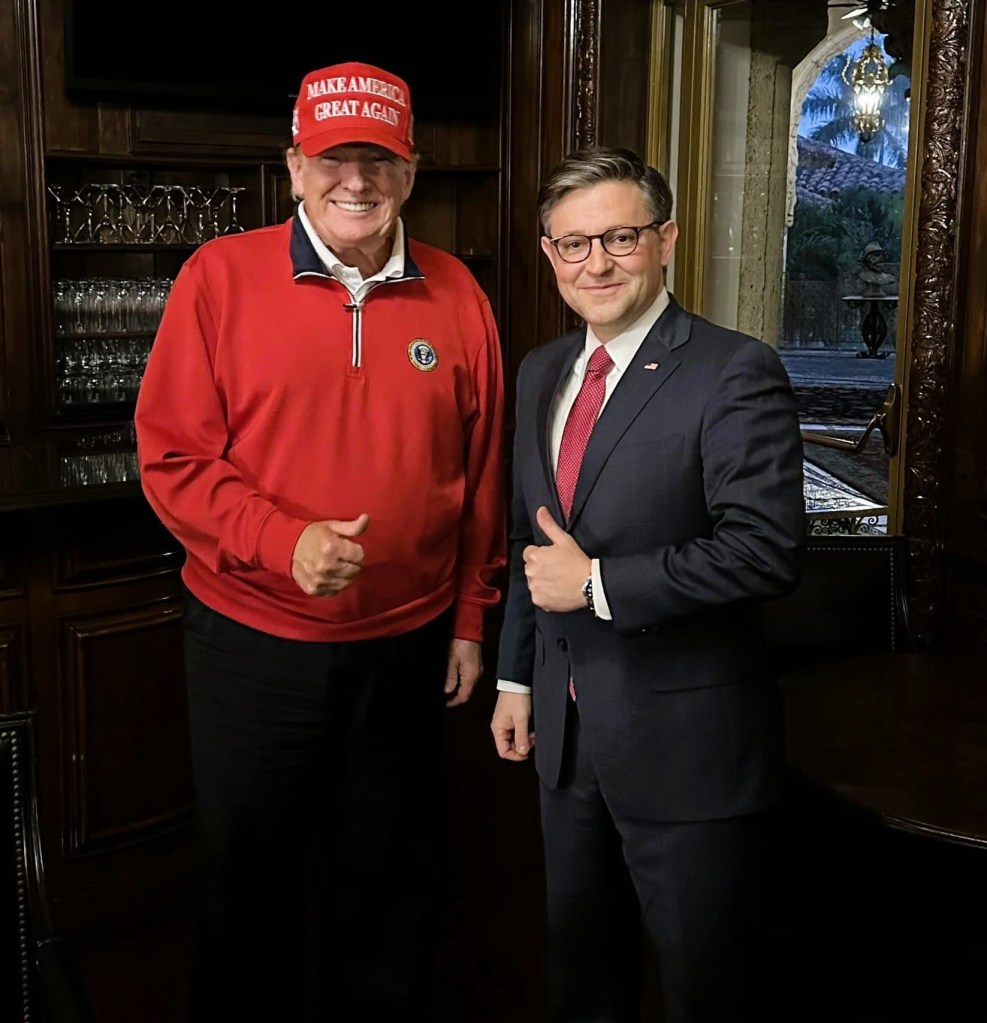
READ NOW: Former President Trump and Speaker Mike Johnson discuss 2024 strategy during a meeting at Mar-a-Lago.
“Not only are we going to grow the majority in 2024, but with President Trump leading the charge, we are going to take back the White House too.” – Speaker Johnson
Read more about their plans here: 2024wave.org/4XUtM8

While Ukrainians are running low on ammunition, the House of Representatives has not passed the authorization to supply them with more arms to defend their nation. Speaker Johnson, who is part of the extrenist Freedom Caucus, says he will not bring the bipartisan Senate bill to a vote. If enough members of both parties vote for a discharge petition, the bill would be voted on and very likely passed.

Meanwhile, Speaker Johnson is having fun with his hero.

In at least 20 states, the College Board collects and sells student data, despite state law forbidding it.

New York was one of those states, but activist parents led a years-long campaign to block the practice.

Recently, State Attorney General Letitia James won a judgment against the College Board for $750,000, and it agreed to stop monetizing student data in New York.

What happens in your state? Does your state protect the privacy of student data? Does it enforce the law?

Read Leonie Haimson’s account of how parents in New York pushed back and finally won. She includes a list of other states that protect student privacy.

She writes:

For decades, the College Board has been selling student names, addresses, test scores, and whatever other personal information that students have provided them,  when they sign up for a College Board account and the Student Search program. According to the AG press release, in 2019 alone, the College Board improperly shared the information of more than 237,000 New York students.  Since New York’s student privacy law, Education §2-d, calls for a fine of up to $10 per student, the penalty for selling student data during that one year alone could have equaled more than $2 million.

And yet for years, on their website and elsewhere, the College Board has also  falsely claimed they weren’t selling student data.  Instead they called  it “licensing” data, a distinction without a difference.  For years, they also claimed that they never sold student scores, though that was false as well, as they do sell student scores within a range.

The College Board urges millions of students to sign up for their Student Search program, with all sorts of unfounded and deceptive claims, including that it will help them get into better schools or receive scholarships.  The reality is that their personal data is sold to over 1,000 colleges, programs and other companies – the names of which they refuse to disclose — who use it for marketing purposes and may even resell it to even less reputable businesses.

Is your state one of them? Is the law enforced?

Heather Cox Richardson writes about the ascendancy of “the Putin wing of the Republican Party.” It’s headed, of course, by Donald Trump, who remains deferential to Putin. He continued to compare himself to Navalny, who was murdered by Putin, since he thinks of his trials as akin to Navalny’s experience.

Aid to Ukraine is stalled in the House of Representatives, where Marjorie Taylor Greene leads the opposition.

Richardson writes:

Both global and national affairs appeared to shift over the holiday weekend. Events of the past week or so highlighted the global stakes of not stopping the aggression of Russia’s president Vladimir Putin. In turn, those global stakes highlighted that Trump’s MAGA Republicans are strengthening Putin’s hand. 

Since October, MAGA Republicans have managed to delay a national security supplemental bill that would provide additional aid to Ukraine. Although a bipartisan majority of Congress supports the measure, House speaker Mike Johnson (R-LA) recessed the House on Thursday without taking it up, just days after former president Trump attacked the North Atlantic Treaty Organization (NATO) and suggested he would urge Russia to “do whatever the hell they want” to U.S. allies if they didn’t meet a guideline of spending 2% of their gross domestic product on their own military forces. 

On Friday, February 16, Russian authorities murdered opposition leader Alexei Navalny in prison, where he was being held on trumped-up charges, and on Saturday, Russian forces advanced into the front-line city of Avdiivka. 

The Munich Security Conference, the world’s largest gathering on international security policy, met this year in the midst of these events, from Friday, February 16, to Sunday, February 18. At Saturday’s lunch, Prime Minister Mette Frederiksen of Denmark made a surprise announcement. Denmark, she said, will donate all its artillery to Ukraine. She suggested other countries, too, could do more than they already have.

According to Jack Detsch and Robbie Gramer of Foreign Policy, Frederiksen’s announcement “left attendees grappling with some existential questions: Are they prepared not just to help Ukraine but also to defend Europe from a possible Russian attack on a NATO country? Are democracies capable of standing up against the threat of territory-grabbing dictatorships like Russian President Vladimir Putin’s?”

Sweden today announced it will donate about $682 million in equipment and cash to Ukraine, its 15th aid package to Ukraine since the 2022 Russian invasion. The European Union today announced it is committing 83 million euros, or about $89 million, in humanitarian aid for those in Ukraine and Moldova affected by the war. Three weeks ago it approved $54 billion in military aid.

There is increasing pressure, as well, to transfer Russia’s frozen assets to Ukraine. On Saturday, February 17, the U.S. Justice Department, which is in charge of a task force called “KleptoCapture,” transferred $500,000 in forfeited Russian funds to Estonia for fixing Ukraine’s electrical transmission and distribution systems. Biden promised more sanctions against Russia on Friday and has again called for House Republicans to pass the national security supplemental bill. 

Indeed, the real elephant in the room is the fact that MAGA Republicans in the House are refusing to commit more U.S. aid. The Institute for the Study of War, a nonprofit research organization, assessed on Sunday that “delays in Western security assistance to Ukraine are likely helping Russia launch…offensive operations along several sectors of the frontline in order to place pressure on Ukrainian forces along multiple axes.” 

MAGA Republicans are refusing that aid although it is popular both in Congress and among Americans at large. A Pew study released Friday, before news of Navalny’s murder broke, showed that 74% of Americans believe the war in Ukraine is important to U.S. interests; 59% say it’s important to them personally. 

House speaker Johnson condemned Putin as “a vicious dictator” over the weekend and said he was “likely directly responsible” for Navalny’s death. But on Monday he posted to Twitter a photograph of him standing alongside Trump, apparently at Trump’s West Palm Beach golf club, flashing a smile and a thumbs-up sign. Representative Marjorie Taylor Greene (R-GA) has vowed to try to throw Johnson out of the speaker’s chair if he even brings Ukraine funding to the floor. Trump himself referred to Navalny’s murder on Sunday simply by calling it a “sudden death” before launching into an attack on the United States.

On Sunday, former representative Liz Cheney (R-WY) came out and said it: the Republican Party has a “Putin wing.” She said: “The issue of this election cycle is making sure the Putin wing of the Republican Party does not take over the West Wing of the White House.” Conservative pundit Bill Kristol agreed, in italics: “The likely nominee of one of our two major political parties is pro–Vladimir Putin.This is an astonishing fact. It is an appalling fact. It has to be a central fact of the 2024 campaign.”

Russian authorities have cracked down on those expressing sorrow for the death of opposition leader Alexei Navalny and are refusing to hand over his body to his mother and lawyer, who flew to the penal colony north of the Arctic Circle to reclaim it, saying they need to keep the body for “chemical analysis.”

Meanwhile, a Russian who defected to Ukraine last year has been killed in Spain, and Russian authorities have arrested for “treason” a dual Russia-U.S. citizen who lives in Los Angeles as she traveled in Russia after having participated in pro-Ukraine rallies.

Putin is facing an election next month, and he may have intended the murder of Navalny to frighten other opponents and intimidate Russian voters. But it is possible it had the opposite effect. 

Yesterday, Navalny’s widow, Yulia Navalnaya, stepped into his place, saying: “Putin didn’t only kill Alexei Navalny as a person. He wanted to kill our hope, our freedom, our future. But the most important thing we can do for Alexei and for ourselves is to go on fighting. I will continue Alexei Navalny’s work. Continue to fight for our country. I call on you to stand alongside me. To share not only the grief and unending pain that has enveloped us and won’t let go. I also ask you to share the fury and hate for those who dared to kill our future. I speak to you in the words of Alexei, in which I believe truly: There is no shame in doing little. There is shame in doing nothing. In allowing them to scare you…. By killing Alexei, Putin has killed half of me. Half of my heart and my soul. But I have another half and it tells me that I don’t have the right to give in.”

Today she urged the European Union not to recognize the results of Russia’s March election, saying that “a president who assassinated his main political opponent cannot be legitimate by definition.”  

In the U.S., there has not been any apparent move from House Republicans to come back into session to approve the national security package. Indeed, Trump appears to be strengthening his hand over the mechanics of the Republican Party, with the state parties he salted with loyalists lining up behind him, supporters in Congress killing legislation at his demand, and lawmakers who are interested in actually making laws exiting Congress out of fear or frustration. 

But the apparent support of MAGA Republicans for Putin is unlikely to play well in the U.S. Today, Republican candidate for president Nikki Haley, former governor of South Carolina, tricked the Fox News Channel into covering live what she said was a major speech, likely leading producers to think she was withdrawing. Rather than doing so, she came out swinging with an attack on Trump. 

Aaron Rupar of Public Notice recorded her comments, spoken with the backdrop of the past week in everyone’s mind. Americans “deserve a real choice,” she said, “not a Soviet-style election where there’s only one candidate and he gets 99 percent of the vote.”
Jonathan V. Last writes for The Bulwark, which was founded by Republican Never Trumpers. It is one of the most engaging websites I read. This post is newsworthy, since so many Trumpers were citing Dinesh D’Souza’s book about election fraud.

Last writes:

Last August we talked about True the Vote, the group whose “data” on election fraud in Georgia constituted a large part of Dinesh D’Souza’s 2000 Mules.

Let me refresh your memory:

True the Vote is a Texas-based group which filed a complaint with the Georgia State Election Board alleging fraud in the 2020 presidential campaign.

The Georgia State Election Board (the SEB) investigated this complaint and found no fraud. So it asked True the Vote to share its evidence. True the Vote declined and instead said—whoopsie!—they’d like to just take the complaint back.

The SEB explained that that’s not how it works with sworn statements and subpoenaed the extensive evidence that True the Vote claimed in its complaint to have.1 The whole thing devolved into litigation that bore a striking resemblance to George Costanza’s attempt to convince his dead fiancée’s parents that he owned a house in the Hamptons.

Anyway, this week the Atlanta Journal-Constitution broke the news that True the Vote finally gave up and told the judge in the case that they don’t have any of the so-called evidence, or data, or names, or identities—or any of those other fancy legal whosywhatsits:

True the Vote said in a recent court filing that it doesn’t know the identity of its own anonymous source who told a story of a “ballot trafficking” scheme allegedly organized by a network of unnamed groups paying $10 per ballot delivered.

True the Vote also told the court it doesn’t have documents about illegal ballot collection, the name of its purported informant or confidentiality agreements it previously said existed.

You can read True the Vote’s filing here. It’s wild. But the cajones on these guys! In a non-court-filed public statement, True the Vote went on to say that while they don’t have any of this stuff they said they had, they know that the Georgia Election Board could come up with it if they really wanted:

“The [Georgia Bureau of Investigation] consequently has ready access to the underlying data, and could, we believe, reconstruct it, but it declines to do that,” True the Vote said in a statement. “At this point, it would be redundant and cost-prohibitive for True the Vote to do so on its own. It is in that sense that there is nothing more for True the Vote to provide that it has not already provided to the GBI.”

Translation: The real evidence of voter fraud isn’t in a computer. It’s in our hearts.

In the Public Interest is an excellent source of information about privatization in every sphere of life, wherever privatizers see a chance to turn a public service into private profit. Its latest post is about the citizens’ fight to overturn a new voucher plan in Nebraska.

Open the link to see the cost of vouchers in Arizona, New Hampshire, North Carolina, and Ohio. Count on costs to go up every year, as legislators expand eligibility and raise income limits.

In early 2023, the Nebraska legislature passed LB753, which created a new private school tax-credit voucher program. The bill allows a dollar-for-dollar tax credit to individuals and corporations that donate to a scholarship granting organization (SGO), which would issue the vouchers to families to pay for private school. Eligibility requirements are broad, allowing, for example, any child entering either kindergarten or 9th grade at a private school, or any student who has spent at least one semester in a public school to apply for a voucher. The bill would divert up to $25 million annually from the state, but that figure could go up to $100 million.

The bill includes a standard “hands off clause,” which prevents the state from exercising any authority over the school and how it operates.  It’s basically a license to discriminate.

Shortly after the bill was passed, public school supporters launched a referendum petition drive to put repeal of the new law on the November 2024 ballot. In fewer than 90 days, the repeal campaign gathered nearly double the number of required signatures from across the state. The effort was led by Support Our Schools Nebraska, a coalition that includes, among others, the Nebraska State Education Association, OpenSky Policy Institute, Parent-Teacher Association of Nebraska, Stand for Schools, League of Women Voters of Nebraska, Omaha NAACP, ARC of Nebraska, Nebraska Farmers Union, and the Nebraska Civic Engagement Table.

In Nebraska, 84% of private schools are religiously affiliated. Many, if not most of these schools are legally permitted to discriminate against applicants based on their gender orientation, religious affiliation, or other characteristics. The Nebraska OpenSky Policy Institute has estimated that state aid distributed to public schools could decrease by almost $12 million in response to the new voucher program.

Forces aligned against the repeal include the usual suspects, like the American Federation for Children, founded by anti-public-education zealot Betsy DeVos, which donated $583,000 along with $103,000 of in-kind services to the pro-voucher effort, on top of money DeVos spent to influence Nebraska state senate races in the last cycle. The Nebraska Catholic Conference, whose coffers stand to gain from LB753, has also thrown its weight and reach behind the anti-public education side. Jeremy Ekeler left his job as associate director of education policy at the Conference in November to become the executive director of Opportunity Scholarships of Nebraska, a state-approved scholarship granting organization helping to implement LB753. They’re not only working to defeat the ballot measure, they’re trying to keep it off the ballot entirely, following a playbook the right has used to subvert a variety of citizen-led, petition-driven initiatives around the country.

As we have pointed out before and as the chart above illustrates, vouchers bleed public school districts of needed funds, allow for discrimination, lower educational standards (by not necessarily having many), and lead to resegregation.

As if that weren’t enough, they turn out to be budget busters for states.

In the Public Interest will keep an eye on this fight because it may be the clearest indication that, while conservative politicians have thrown their support to various schemes that divert public funds from public schools, the public opposes these efforts and will show up at the polls to make their feelings felt.

In today’s Washington Post, Natan Sharansky (a prominent Soviet dissident) and Carl Gershman (former president of the National Endowment for Democracy) write that the death (murder) of Alexei Navalny should encourage those who love freedom and democracy to redouble their efforts. What kind of a country imprisons people for merely acknowledging that Russia is at war with Ukraine? What kind of a country murders journalists, dissidents, and shuts down every independent form of media?

They wrote:

In the long line of people who have been victims of Soviet and Russian dictators, Alexei Navalny was extraordinary. He dedicated himself to unmasking the cynical, corrupt nature of Vladimir Putin’s dictatorship. And he succeeded, revealing the truth to the world.
He was so dedicated to exposing the nature of Putin’s regime that he chose to return to Russia to force his would-be murderers to make their villainy public. In going back, he showed the people of Russia and the world that he was not afraid — and that neither should they be afraid to act.


In a letter he wrote to one of us from prison, Navalny stated that the “virus” of freedom will never be killed and that hundreds of thousands of people will continue to fight for freedom and against the war in Ukraine.


This was also the message that Vladimir Kara-Murza sent earlier this week from his solitary cell in a “special regime” prison colony in Omsk, Russia. Kara-Murza, a Post contributing columnist, suffers from polyneuropathy, a disease affecting peripheral nerves that has resulted from two near-fatal attempts by the Russian regime to poison him, in 2015 and again in 2017. He, too, is fighting on with astonishing courage.


In so doing, Navalny and Kara-Murza, as well as hundreds of other dissenters, activists and protesters, have followed in the footsteps of Andrei Sakharov and other Soviet dissidents who showed that, with courage and moral clarity, it is possible to change the world.

Kara-Murza said after his sentencing that while he had initially expected that his imprisonment and trial would resemble what the Soviet dissidents experienced in the 1960s and ’70s, he now saw parallels with the Stalin period. There is no question that the Kremlin’s campaign of political repression is intensifying. According to Memorial, a human rights organization that continues to monitor the arrest of dissidents despite it being muzzled by courts, Russia now holds 676 political prisoners, nearly four times the number in 2018 and more than in the waning years of the Soviet Union. Nearly all independent political figures from the Russian opposition who have not fled the country are now behind bars or under house arrest, including Kara-Murza’s friend and political ally Ilya Yashin, who is serving an eight-and-a-half year prison sentence for “spreading false information” about Russian massacres of civilians in the city of Bucha, near Kyiv.


The scope of political repression extends far beyond the vocal democratic opposition. According to OVD-Info, a Russian nongovernmental organization that tracks detentions, more than 8,500 administrative cases have been initiated under Article 20.3.3 on “discrediting the armed forces.” This includes Alexei Moskalyov, a single father who was sentenced to two years in jail for discrediting the Russian army after his then 13-year-old daughter drew an antiwar picture in school.


They are not the only victims. Their families, many with young children, have been left to survive on their own, often with no source of income or other support. To help them, Kara-Murza announced from prison, before he was sent to Omsk, that he will donate the funds he received from three human rights prizes — some 110,000 euros — to provide direct financial support to the families of Russian political prisoners. To do this, he and his wife, Evgenia, have founded the 30 October Foundation, named after the Day of Political Prisoners that was established by Soviet dissidents in 1974. The foundation continues in the tradition of Yelena Bonner’s fund to help children of political prisoners and Alexander Solzhenitsyn’s Russian Social Fund to aid political prisoners and their families, both established in the 1970s.

The political prisoners in Russia, along with thousands of antiwar protesters across the country who have risked arrest, are the cutting edge of a larger movement of political opposition. People are mounting a collective response to the growing number of political prisoners. Networks inside and outside Russia continue to organize letter-writing campaigns to these captives, providing them with independent news and information to counteract the propaganda that is prevalent in Russian jails. In addition, crowdfunding campaigns have collected significant donations. A telethon organized by several independent media outlets last June raised 34.5 million rubles ($415,000) to defend people facing criminal prosecution for demonstrating against the war.

It would be profoundly wrong to assume that there is no possibility for a democratic opening in Russia, especially considering the devastating consequences of Putin’s invasion of Ukraine. Navalny and Kara-Murza have said repeatedly that a reckoning will come — that there will be another window of opportunity, not unlike the 1990s following the collapse of Communist rule. But this time, Russians must not repeat the terrible mistake of failing to break with the evils of the past — the brutal dictatorship and repression, the foreign aggressions, the Orwellian system of lies and subverting not just the truth but normal human values.


If these evils are to be vanquished, they must be fully understood — and condemned. There must be a moral awakening. That can’t happen without the leadership of the prisoners of conscience, who — like Navalny and Kara-Murza and the countless others imprisoned alongside them — have the moral courage, democratic vision and political fearlessness to chart a new path for Russia. They deserve our full solidarity since the fate of freedom far beyond the borders of Russia rests heavily on the success of their struggle.

Alexei Navalny’s mother went to the penal colony in the Arctic to claim her son’s body and was lied to at every turn. The story was reported by Emma Burrows at ABC news.

For the mother of Alexei Navalny, the Russian opposition leader who died at age 47in an Arctic penal colony, the journey to recover her son’s body Saturday was an odyssey with no clear destination.

In the end, she didn’t get what she came for.

Lyudmila Navalnaya, 69, received an official note Saturday stating that the politician had died in prison at 2:17 p.m. local time a day earlier, Kira Yarmysh, Navalny’s spokesperson said Saturday.

Together with members of Navalny’s legal team, Lyudmila traveled to the town of Kharp in the Yamalo-Nenets region, some 1,900 kilometers (1,200 miles) northeast of Moscow.

It was there that Russia’s Federal Penitentiary Service said Friday that Navalny felt unwell after a walk and fell unconscious. When Lyudmila arrived less than 24 hours later, officials said that her son had died from “sudden death syndrome,” said Ivan Zhdanov, the director of Navalny’s Anti-Corruption Foundation. He did not elaborate.

Navalny’s death removed the Russian opposition’s most well-known and inspiring politician less than a month before an election that will give President Vladimir Putin another six years in power.

Prison employees told Navalny’s mother Saturday that they did not have her son’s body. They said it had been taken to the nearby city of Salekhard, a little over an hour’s drive away, as part of a probe into his death.

When Lyudmila arrived in the town with one of Navalny’s lawyers, however, they found that the morgue was closed, Navalny’s team wrote on their Telegram channel. When the lawyer called the morgue, they were told that the politician’s body was not there either.

This time, Lyudmila headed directly to Salekhard’s Investigative Committee office. A small group of journalists watched as Lyudmila walked toward the office, dressed in a thick black coat as temperatures hovered close to minus 25 degrees centigrade (minus 13 degrees Fahrenheit). Occasionally, she took the arm of one of those walking next to her as the group made their way along paths edged with thick piles of snow.

Here, she was told that the cause of her son’s death had, in fact, not yet been established, said Navalny’s spokesperson, Kira Yarmysh. Officials told Lyudmila that the politician’s relatives would not receive his body until they had completed additional examinations.

Initially, it seemed as if Lyudmila might head to another morgue. Instead, she returned to her hotel in the town of Labytnangi, another 30-minute drive. Navalny’s team, meanwhile, said they were still no closer to finding out where the politician’s body was being held.

“It’s obvious that they are lying and doing everything they can to avoid handing over the body,” Yarmysh wrote on X, formerly known as Twitter, after Lyudmila’s visit to the Investigative Committee office. The spokesperson also said that Navalny’s team “demand that Alexei Navalny’s body be handed over to his family immediately.”

Navalny, who had been serving a 19-year prison term since January 2021 after being convicted three times for extremism, has spoken several times about whether he might die while in custody.

After the last verdict, which Navalny believed to be politically motivated, he said that he understood he was “serving a life sentence, which is measured by the length of my life or the length of life of this regime.”

This breathtaking film, called “Putin’s Palace: The Story of the World’s Largest Bribe,” documented Vladimir Putin’s corruption. It was made by Alexei Navalny and his team and narrated by Navalny.

It shows Putin’s rise from an obscure KGB agent in Dresden to the most powerful man in Russia and —possibly—the richest man in the world.

Navalny shows that Putin’s success was propelled by corruption.

Anne Applebaum wrote about Navalny and the film in The Atlantic.

Alexei Navalny returned to Russia in January 2021. Right before he boarded the plane, he posted a film titled “Putin’s Palace: The Story of the World’s Largest Bribe” on YouTube. The video, nearly two hours long, was an extraordinary feat of investigative reporting. Using secret plans, drone footage, 3-D visualizations, and the testimony of construction workers, Navalny’s video told the story of a hideous $1.3 billion Black Sea villa containing every luxury that a dictator could imagine: a hookah bar, a hockey rink, a helipad, a vineyard, an oyster farm, a church. The video also described the eye-watering costs and the financial trickery that had gone into the construction of the palace on behalf of its true owner, Vladimir Putin.

The film was viewed, she says, by one of every four Russians.

How could Putin, a vain and bitter little man, let Navalny live after this massive insult?

Leslie Stahl interviewed Alexei Navalny when he was in Germany, having survived an attempt to kill him with a military-grade poison.

You can see why Putin was afraid of him: he was smart and charismatic, handsome and youthful. Left alone, he might have led an uprising against Putin’s dictatorship.

World leaders spoke out about the death of Alexei Navalny, who was obviously murdered on the order of Putin.

One prominent figure said nothing: Donald Trump. Trump has boasted about his friendship with Putin.

Donald Trump, the frontrunner for the GOP presidential nomination, was silent following news of Russian opposition leader Alexei Navalny’s death on Friday. Instead, his campaign referred a reporter to a statement that didn’t reference Navalny or Russian President Vladimir Putin.

“In just three and a half years under Crooked Joe Biden, the World has experienced Misery, Destruction, and Death. America is no longer respected because we have an incompetent president who is weak and doesn’t understand what the World is thinking. I am the only one who can bring Peace, Prosperity, and Stability like I did during my first term. America will be respected and feared (if necessary!) again,” Trump said in the vague statement posted to Truth Social.

Nikki Haley blasted Trump.

“Putin murdered his political opponent and Trump hasn’t said a word after he said he would encourage Putin to invade our allies. He has, however, posted 20+ times on social media about his legal drama and fake polls,” Haley said on X, formerly known as Twitter, several hours after Navalny’s death was first reported.

“Putin did this. The same Putin who Donald Trump praises and defends,” Haley wrote in a social media post reacting to the news earlier Friday morning.

“The same Trump who said: ‘In all fairness to Putin, you’re saying he killed people. I haven’t seen that,’” Haley continued, referring to comments Trump made in 2015, when he pushed back against the notion that Putin had killed journalists. Trump also praised Putin’s leadership, describing him as “a strong leader.”

Be sure to watch the CNN documentary NAVALNY tonight at 9 pm EST and midnight. It won an Academy Award as Best Documentary of 2023.