Dr. Charles Foster Johnson is hosting a conversation with Beto O’Rourke in Lubbock, Texas, on Zoom this Thursday.
4:30-6:00 pm CDT (central time).
They will discuss the future of public education in Texas.
The event is free.
Dr. Charles Foster Johnson is hosting a conversation with Beto O’Rourke in Lubbock, Texas, on Zoom this Thursday.
4:30-6:00 pm CDT (central time).
They will discuss the future of public education in Texas.
The event is free.
In 2001, libertarian political scientist Jason Sorens proposed the creation of a “free state.” He appealed to other libertarians to cluster in one small state, where enough of them would be able to eliminate laws and authority and “live free.” That state was New Hampshire, and the libertarians have joined hands with Republicans to impose their agenda on others who don’t share it. Earlier this spring, Free Staters proposed that New Hampshire secede and became an independent nation, but that proposal failed overwhelmingly, in part because enough people realized it was nutty and/or they didn’t want to give up their Social Security.
Dan Barry wrote in The New York Times about an effort by Free Staters in Croydon, New Hampshire, to cut the town’s school budget in half.
As is typical in many towns and cities across the nation, not many people show up for local elections, or in this case, the town meeting. One of the members of the Croydon board of selectmen, Ian Underwood, proposed cutting the town budget for schools by more than half, from $1.7 million to $800,000.
In pamphlets he brought to the meeting, Mr. Underwood asserted that sports, music instruction and other typical school activities were not necessary to participate intelligently in a free government, and that using taxes to pay for them “crosses the boundary between public benefit and private charity.”
The pamphlet did not note that its author was a 1979 graduate of the public high school in Chesterton, Ind., where he starred on the tennis team, ran track, played intramural sports and joined extracurricular activities in math, creative writing, radio and student government. Also: National Honor Society member, National Merit finalist and valedictorian.
One person not completely gobsmacked by Mr. Underwood’s proposal was the school board chairwoman: his wife, Jody Underwood. The Underwoods, who do not have children, moved to Croydon from Pennsylvania in 2007 in part to join the Free State mission; they are now considered a Free State power couple.
Underwood’s radical proposal passed by 20-14. It was a victory for the Free Staters. As the Underwoods did media interviews, they gloated:
Mr. Underwood asked what for him appears to be a fundamental question — “Why is that guy paying for that guy’s kids to be educated?” — and denied that he and his wife were “in cahoots.”
Many people in Croydon were “livid.” They realized this radical act was the result of their indifference.
But they were also chastened. They hadn’t attended the town meeting. They hadn’t fulfilled their democratic obligation. They hadn’t kept informed about the Free State movement. To some observers, they had gotten what they deserved…
From this muddle of anger, confusion and regret, though, a movement was born. It came to be known as We Stand Up for Croydon Students.
Conservatives, liberals and those who shun labels — “an entirely nonpartisan group,” said Ms. Damon, one of the members — began meeting online and in living rooms to undo what they considered a devastating mistake. They researched right-to-know laws, sought advice from nonprofits and contacted the state attorney general’s office to see whether they had any legal options.
They did: Under New Hampshire law, citizens could petition for a special meeting where the budget cut could be overturned — if at least half the town’s voters were present and cast ballots.
Ms. Beaulieu, 44, a project manager for a kitchen and bath store, helped to gather enough signatures for the necessary petition. Once a date in May was set for the special meeting, she and other volunteers spread the word, knocking on doors, conducting phone banks and planting lawn signs…
The crisis in Croydon generated a curious democratic dynamic. Since the law required that at least half the town’s electorate participate in the special meeting’s vote for it to be binding, those trying to overturn the Underwood budget encouraged people to attend, while those hoping to retain it encouraged people to do just the opposite and stay home.
On the chilly Saturday morning of May 7, Croydon residents filed into a spacious building at the local YMCA camp for their special meeting. The We Stand Up contingent needed at least 283 voters.
The turnout: 379.
The vote in favor of overturning the Underwood budget: 377.
The vote against: 2.
The We Stand Up crowd cheered and hugged, leaving Mr. Underwood to vent online with posts titled “Your House Is My A.T.M.” and “Possibly Dumbest Thing I’ve Heard Someone Say, Ever,” and Dr. Underwood to frame the moment as both an impressive voter turnout and a victory for “mob rule.”
“It felt to me like a bunch of woke people came to Croydon,” she said.
What happened in Croydon is a lesson for us all.
Get out and vote.
Do not let the neo-fascists, neo-Confederates, racists, and conspiracy theorists take over.
Fight for democracy or lose it.
Gary Rubinstein, teacher and blogger, reviewed state data for Eva Moskowitz’s Success Academy charter chain. SA has been widely acclaimed for its high test scores. But Gary found that the attrition rate was astonishing. If low-scoring students leave, it boosts the overall scores.
Gary knew that the overall attrition rate was high but was surprised to see how high it is for students who enter ninth grade.
Over the years I’ve tracked the attrition at Success Academy. They are a K-12 program and I’ve found that generally when I compare the number of kindergarteners entering the school with the number of 12th graders that graduate 13 years later, they lose approximately 75% of their students over the 13 years.
Success Academy has argued that losing 75% over 13 years isn’t actually that bad since it equates to about 10% attrition per year, which is what district schools also have. One flaw in that reasoning is that district schools fill in those 10% of seats each year while Success Academy stops ‘backfilling’ in the 4th grade. Another problem with comparing attrition rates from Success Academy to district schools is that a student can pretty easily move from one district school to another and those schools won’t be all that different. But for Success Academy which are supposedly the best schools in the country, it is a major life change to leave Success Academy for a district school so if they really are as good as they say, you would expect their attrition to be less than the 10% per year that district schools have.
I recently got some data from New York State that puts the attrition of Success Academy in a different and scary context. Since Success Academy is a K-12 school and you can’t get in after 4th grade, any student who makes it to 9th grade there has been at the school for anywhere from 5 to 9 years. After making it that long, the last four years should be pretty easy. It’s like running a marathon and getting to the 25 mile mark, of course you are going to finish the race. But some new data I got reveals that this isn’t the case with Success Academy. In general, only about 60% of the students who become 9th graders there eventually graduate within 6 years. And with certain subgroups it is a lot less than that….
This data is really scandalous. Have you ever heard of a school that sheds almost half their students in a four year period from 9th to 12th grade even though those students have been in the school since kindergarten or maybe 4th grade at the latest? A question I wonder is why do so many students leave the school so late in the game after succeeding there for so many years?
A few weeks ago, a story surfaced that Biden planned to nominate an anti-abortion lawyer in Kentucky to a federal judgeship. Apparently, he cut a deal with Mitch McConnell to speed up judicial confirmations in exchange for speeding up some of Biden’s judicial appointments.
But apparently the deal fell apart and Biden will not give Chad Meredith a lifetime appointment.
WASHINGTON — The White House is abandoning plans to nominate a Kentucky lawyer who opposes abortion rights and is backed by Senator Mitch McConnell to a federal court seat, citing opposition from Senator Rand Paul, Mr. McConnell’s home-state colleague.
The resistance from Mr. McConnell’s fellow Republican marked a new twist over a potential nomination that had prompted outrage on the left. Democrats were incensed that President Biden’s team had agreed to advance a conservative chosen by Mr. McConnell to fill a district court vacancy as the party is stepping up its focus on countering new abortion restrictions.
The prospective nominee, Chad Meredith, had successfully defended Kentucky’s anti-abortion law as a lawyer for the state. Mr. Biden’s plan to nominate him was made public by The Louisville Courier-Journal just before the Supreme Court overturned the Roe v. Wade precedent that established abortion rights…
The blue slip tradition followed by the Senate Judiciary Committee effectively gives home-state senators veto power over the selection of federal district court judges for their states.
“In considering potential district court nominees, the White House learned that Senator Rand Paul will not return a blue slip on Chad Meredith,” Andrew Bates, a White House spokesman, said Friday in a statement. “Therefore, the White House will not nominate Mr. Meredith.”
Lisa Haver is a retired teacher and prominent advocate for the public schools of Philadelphia. Those public schools have been subject to state takeover, privatization, and every other failed reformy tactic. She hoped that those bad old days were over. They are not. The new board hired an inexperienced superintendent who needed the help of a much-criticized consulting firm at a cost of $450,000.
She expressed her frustration in this article.
After years of pain and frustration that included the closing of neighborhood schools, privatization driven by standardized tests, crumbling infrastructure, and more than one debacle, the people of Philadelphia were psyched for new leadership in the school district.
The door to new priorities seemed to open with the arrival of Tony Watlington as the next superintendent.
But that door slammed shut before his tenure had even begun with the news that he’d brought in a Tennessee-based consulting firm to help him navigate his first year in the job. In May, the Board of Education voted unanimously and without deliberation to approve a one-year contract with Joseph & Associates. Price tag: $450,000. The board approved this contract — the last on a list of 92 official items — near the end of an 8-hour meeting.
According to a recent Chalkbeat article, the board hired the consulting firm to help Watlington “connect with people,” assist in assembling his transition team, and develop a 5-year plan for the district. Watlington said he asked for the contract so he could “hit the ground running by Day 1,” according to The Inquirer.
Apparently, Watlington decided the district’s current leadership of 16 department chiefs and 15 assistant superintendents could not help him do that, and that people from Tennessee could educate him about the district’s history and needs better than the people who live and work in Philly.
The Alliance for Philadelphia Public Schools, the organization I co-founded, has reported on and analyzed the spending priorities of the district since 2012. We intended to ask the board directly why they hired Joseph & Associates, but all five APPS members who tried to sign up to speak at the June meeting were denied.
Last winter, in public town halls held for the three superintendent finalists, Watlington told parents, students, and educators he had a plan and wanted to meet with district stakeholders to hear their concerns. He didn’t say he could only do that by hiring an out-of-town consulting firm at a price higher than his own $340,000 salary.
The first official act of the new administration signals a continuation of those before him: hiring consultants and outsourcing work that should be done by district personnel. Sending resources into classrooms remains on the back burner.
The scope of the Joseph & Associates contract raises concerns for families and public education advocates for a number of reasons. Watlington said he wants the consultants to help him assess how the district can best meet the board’s “Goals and Guardrails” — a set of priorities based on standardized test data. This approach does not lend itself to creative learning or teaching. The Watlington administration should commit to funding proven reforms: smaller class size, more support staff, and reinstating school librarians.
But it’s the final phase of the Joseph & Associates contract that should sound the alarm for defenders of public education: the compilation of a 5-year “strategic plan” for the district. Many recall what happened a decade ago after the last long-range plan from an outside firm, the Boston Consulting Group: school closings and more privatization of neighborhood schools. Any plan that determines the future of the district and its ramifications for families and neighborhoods should be discussed and formulated in public meetings — not the private boardrooms of an out-of-state consulting firm.
A new study by University of Kentucky Dean Julian Vasquez. Heilig and Professor David G. Martinez demonstrates the inequity built into school funding., to the disadvantages of the poorest communities.
A newly published analysis of how dollars are distributed to schools in the U.S. posits that funding allocation models continue to disadvantage those in low-income communities, despite long-standing evidence that equitable funding is critical to students’ capacity to learn and achieve.
The article, authored by University of Kentucky College of Education Dean Julian Vasquez Heilig, Ph.D., and Davíd G. Martínez, Ph.D., an assistant professor at the University of South Carolina, appears in the latest issue of the Minnesota Journal of Law & Inequality.
Due to the reliance on local property values to fund schools, property poor districts are prevented from increasing or equalizing school revenue to the level of wealthier districts. This poverty is unequally distributed across racial and ethnic backgrounds. Recent peer-reviewed research has shown that in gentrifying urban communities, as the proportional intensity of white students increases in schools, so do the resulting resources and demands for schools, the authors write.
“Education is a human right and a civil right, but our school finance policies are failing to treat it as such,” Martínez said. “Access to quality education is necessary for communities to thrive. When there are major educational disparities that exist between communities, it impacts everyone. This is demonstrably true if those educational disparities are predicated on community wealth, or race and ethnicity. Policy makers must do more to understand the history of school finance disparity in their community, and take steps to ameliorate its impact.”
Martínez and Vasquez Heilig say in their analysis that, despite countless attempts to reform school finance policy, the U.S. has historically been unable to improve school funding inequity and injustice. Without creating a more equitable system, resolving challenges for marginalized students will continue to be difficult.
“We looked at numerous studies showing increases in funding resulted in greater academic success for marginalized students. For instance, when more resources were put into majority LatinX urban schools, reading and math achievements increased,” Vasquez Heilig said. “Quite simply, money does matter and investing in education early and often matters in the everyday life of a student.”
The authors suggest federal policymakers adopt a framework known as Opportunity to Learn that would put in place a set of minimum standards for equitable learning in U.S. schools. These standards would include well-trained and certified teachers and administrators, timely curriculum and texts, up-to-date facilities and wrap-around services to support neuro-divergent learners and the health, nutrition, housing and family wellness of students. As a civil right, the authors argue for complete and differentiated levels of service for every student and funding that allows for the provision of those services.
After these standards for learning are set, it would enable state policymakers to raise revenue to proper levels of fiscal support for meeting the standards. The authors say this model deviates from past school reform and finance models that have focused on test scores and the need for increased student achievement. They, instead, support a model where success is determined by how policymakers are supporting high-quality educational access and availability in every community, promoting alternatives to the historical resource disparity that has oppressed BIPOC students and families.
“Ultimately, as a civil right, we need to support students through the P-20 pipeline, which includes high school completion and earnings later in life, with the ultimate goal of reducing adult poverty,” Vasquez Heilig said.
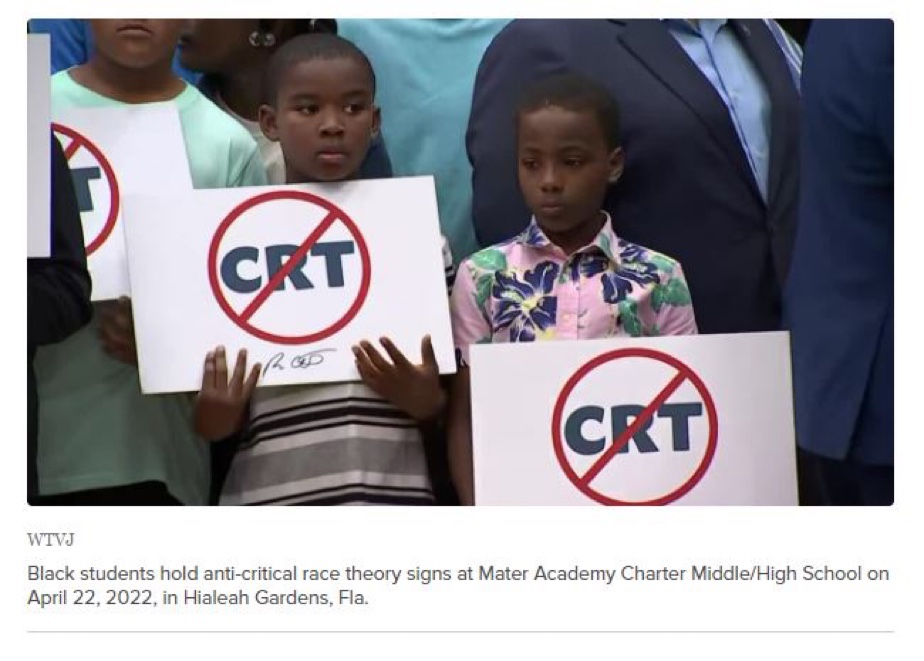
Do you sincerely believe that any Black student opposes teaching about the history of racism? Isn’t it amazing to see this photograph of Black students attending the for-profit Mater Academy in Florida , holding up signs opposing critical race theory? CRT means an analysis of the roots of racism in our history, our laws, and our politics.
Governor Ron DeSantis signed the anti-CRT bill at the same charter school. He believes that teaching the truth is hateful.
Do you think these children actually oppose CRT?
Or were they indoctrinated?
Kathryn Joyce is an investigative reporter for Salon. In this article, she shows how the Republican leaders of Arizona have decided to end the teacher shortage by reducing standards for teachers. They have decided that teaching is not a profession. Anyone, they think, can do it.
She writes:
Last week, just days after the Arizona legislature passed the most expansive school voucher law anywhere in the nation, Gov. Doug Ducey signed into law another education measure decreeing that public school teachers are no longer required to have a college degree of any kind before being hired. Instead of requiring a masters degree — which has long been the norm in the profession — Arizona teachers will only have to be enrolled in college in order to begin teaching the state’s public school students.
The law, SB 1159, was pushed by conservatives on the grounds that Arizona has faced a severe teacher shortage for the last six years, which, by this winter, left 26% of teacher vacancies unfilled and nearly 2,000 classrooms without an official teacher of record. That shortage has led supporters of the bill, including business interests such as the Arizona Chamber of Commerce, to claim that loosening teacher credential requirements will help fill those staffing gaps. Opponents of the bill, however, point to the fact that Arizona has the lowest teacher salaries in the country, even while boasting a budget surplus of more than $5 billion.
“Arizona’s teacher shortage is beyond crisis levels,” tweeted Democratic state Rep. Kelli Butler this March. “Instead of offering real solutions (like increasing pay & reducing class sizes) the House Education Committee passed a bill to reduce the requirements to teach.”
“With Arizona trying to get education monies to parents directly to pay for schooling — including homeschooling — you see more evidence that the state doesn’t care who teaches its kids,” said David Berliner, an education psychologist at Arizona State University and former president of the American Educational Research Association. “Charters and private schools for years have not needed certified folks running schools or teaching kids — as long as the voucher for the kids shows up.” Combined with its new law creating a universal voucher system, Berliner added, “Arizona may now be the most radical state in terms of education policy.”
Please open the link and read the article in full.
Arizona doesn’t care about its children.
Dana Milbank is a wonderful columnist for the Washington Post. He writes here about the death of state decisis, the legal principal of respecting precedent. The six-person majority on the Supreme Court have thrown away precedent. They are drunk with power. They are free to do whatever they want with no restraint, and they are rolling back decades of social progress. They are not conservatives. They are radicals.
Now begins the era of stare indecisis.
Respect for precedent — known by the Latin stare decisis, “to stand by things decided” — had been a centuries-old cornerstone of the rule of law, necessary so “the scale of justice” doesn’t “waver with every new judge’s opinion,” as the 18th-century legal philosopher William Blackstone wrote.
But — et tu, Alito? — the Supreme Court’s radical right put the knife in stare decisis in its decision overturning Roe v. Wade and destroying 50 years of precedent upon precedent.
The dissenting justices wrote that “the majority abandons stare decisis,” an act that “threatens to upend bedrock legal doctrines,” “creates profound legal instability” and “calls into question this Court’s commitment to legal principle.”
The majority protested that it didn’t abandon stare decisis — then explained why it did: “Stare decisis is not an inexorable command. … Stare decisis is not a straitjacket.”
The burial of stare decisis leaves us, ipso facto, with a void: Which Latin phrase best describes the legal doctrine of this new era, in which judges rule by whim, not precedent? Well, thank your lucky stares, because my classics consultant, Vanessa (she asked that her surname not be used in order to speak Latin frankly), has many options.
Labels such as “judicial modesty,” “judicial restraint” and “originalism” were trashed along with stare decisis. For this radical majority to claim “restraint” now would be the very definition of stare mendaciis — to stand by lies. Other better labels for the court majority’s new philosophy are stare deviis (to stand by inconsistent things), or perhaps stare fetore (to stand by a foul odor), in honor of the question Justice Sonia Sotomayor posed during oral arguments: “Will this institution survive the stench that this creates?”
But maybe most accurate is stare sodalitate — to stand by your political party. To the Romans, this meant either “electioneering gang” or “religious fraternity,” apt descriptions both of this court’s right wing.
There are other potential principles being thrown about. This week’s Jan. 6 committee hearing revealed that President Donald Trump, upon receiving displeasing information (such as his attorney general’s refusal to bless his election lies), would hurl his meal at the wall. This would be stare cibo iacto — to stand by thrown food (although other scholars use stare vasis fractis — to stand by broken dishes).
The Republican Party, even now, remains steadfastly loyal to Trump, adhering to something called the Wynette Doctrine, stare homine tuo — stand by your man.
Sen. Susan Collins (R-Maine) is claiming she was deceived by Justices Brett Kavanaugh and Neil Gorsuch into thinking they wouldn’t overturn Roe — an instance of stare credulitate, to stand by gullibility.
At a Trump rally, Rep. Mary Miller (R-Ill.) practiced stare hominibus albis — to stand by White people — when she called the abortion decision a “victory for White life.” (She said she misspoke, although the crowd cheered.)
Congressional candidate Yesli Vega, the GOP nominee to replace Rep. Abigail Spanberger (D-Va.) said “it wouldn’t surprise me” if it were difficult for a woman to get pregnant from rape, “because it’s not something that’s happening organically,” according to an Axios recording. That’s called stare rapina legitima — to stand by legitimate rape — affirming the precedent set by Senate candidate Todd Akin (R-Mo.), who said in 2012: “If it’s a legitimate rape, the female body has ways to try to shut that whole thing down.”
Texas Attorney General Ken Paxton is reviving the doctrine of stare contra pedicandum (to stand against sodomy) by saying he would defend a 1973 anti-sodomy law struck down two decades ago. Justice Clarence Thomas has invited challenges to that decision, as well as others protecting same-sex marriage and contraception.
Texts show that Thomas’s wife, Ginni, meanwhile, urged the Trump White House to “release the Kraken” of false election-fraud allegations — a philosophy known as stare monstris, to stand by sea monsters.
The court’s right-wing majority might also share the belief of Rep. Lauren Boebert (R-Colo.) who said she’s “tired of this separation of church and state junk,” which she said came from a “stinking letter” by Thomas Jefferson, not the Constitution. Demonstrating stare templo — to stand by the church — Boebert decreed that “the church is supposed to direct the government.”
Another creed comes from Sen. Ted Cruz (R-Tex.) who attacked Elmo because Sesame Street encouraged coronavirus vaccination. That’s stare contra pupas — stand against Muppets.
The court’s recent rulings invite many other Latin descriptors: stare atrocitate (to stand by cruelty), stare decuriatione (to stand by intimidation), stare deminutione capitis (to stand by the loss of liberties). But ultimately a court that has abandoned precedent stands for nothing (stare nullis) except for the raw exercise of power — stare imperio. And that leads to one place: stare ruina, to stand by destruction.
For years, reformers celebrated the grand success of Ohio’s Electronic Classroom of Tomorrow. Politicians lauded it and poured money in. ECOT’s owner reciprocated by giving generously to politicians. Governor John Kasich gave the commencement address one year; Jeb Bush did another year.
But the state auditor (who was also a commencement speaker in 2015) checked the books and the whole ECOT edifice came crashing down. Ghost students, payments to companies owned by the founder, numerous ways to profit from the state’s generosity.
ECOT still owes Ohio more than $100 million.
Theodore Decker wrote in the Columbus Dispatch:
If there is such a thing as justice in this imperfect world, investigators in a federal building somewhere in Columbus are nudging ever close to it while digging into the billion-dollar boondoggle once known as the Electronic Classroom of Tomorrow.
ECOT, at one time the state’s largest online charter school, collapsed four years ago amid claims that it had taken millions in undeserved state aid.
Allegations of wrongdoing were traded by the school and state education department. Lawsuits were filed. And about 12,000 students were left in the lurch when the school imploded.
Then ECOT fell out of the public view, overtaken by a thick layer of general dirtiness at a time when political scandal was the norm from the White House to the Statehouse.
An audit just released this week, though, found that ECOT still owes the state more than $117 million.
Ohio Auditor Keith Faber on Tuesday said the shuttered school owes $106.6 million to the state Department of Education and another $10.6 million to the state Attorney General’s office.
As others have before them, Faber’s auditors found that ECOT wasn’t entitled to all the state money it received, including some in 2016 and 2017 and none in 2018.
ECOT as an entity may be gone, but for the sake of all taxpaying Ohioans, it had better not be forgotten.
Looking at the broad sweep of the ECOT swindle, it seems unfathomable that not a single indictment has been lodged against anyone in connection with its shady operations.
The main man behind ECOT was William Lager, a man with a host of Statehouse connections who founded the school in 2000. He also operated Altair Learning Management Inc and IQ Innovations LLC, which had lucrative contracts with ECOT to provide support services. After ECOT fell apart, Attorney General Dave Yost called Lager “the principal wrongdoer“ in the case.
The series of lethal blows to Lager’s empire began in 2016, when the Department of Education demanded repayment of $80 million.
But ECOT’s attendance numbers had been disputed by the state long before that, as far back as 2006. Going back even further, to 2001 and 2002, an audit determined that the state had been overpaying the school by millions.
That ECOT’s attendance numbers were disputed so early on in its existence – and how that problem regardless went unaddressed for so long by a string of governors, legislators and state officials – are looming questions that must be the stuff of any civic-minded federal prosecutor’s dreams.
And maybe, we can hope, they still are.
Yost, while still the state auditor, excoriated ECOT in 2018 and referred his findings to both county and federal prosecutors.
The feds are a secretive lot who have a habit of neither confirming nor denying the existence of any pending investigation, but there have been a few dropped clues through the years that a probe of ECOT is afoot.
One of the biggest came in 2019, when the FBI and U.S. Department of Justice subpoenaed nearly 20 years of ECOT’s campaign contribution records.
More than three years have passed since that development, but the feds also don’t have a habit of rushing their investigations.
Maybe they will wrap things up without uncovering a single instance of criminal behavior.
If you possess a lick of common sense, given what we know already, that outcome would boggle the mind.
But even if that is how an investigation concludes, prosecutors at the very least should know many more details about how ECOT and its principals were permitted to run amok for so long.
Considering Ohio’s taxpayers footed the bill, we have the right to know each and every one of them.


