Archives for category: Accountability

Remember how voucher advocates claim that vouchers will “save” poor kids from “failing public schools”? T’aint so.

Stephen Dyer compared the progress of Ohio students in voucher schools to those in public schools. Guess what? The longer students are enrolled in voucher schools, the farther behind they fall.

He writes:

One thing you’d expect to hear a lot from voucher proponents is that students taking private school tuition subsidies do better the longer they’re in the private schools taxpayers are paying.

I mean, assuming these “choices” are so vastly superior to “failing” public schools, right?

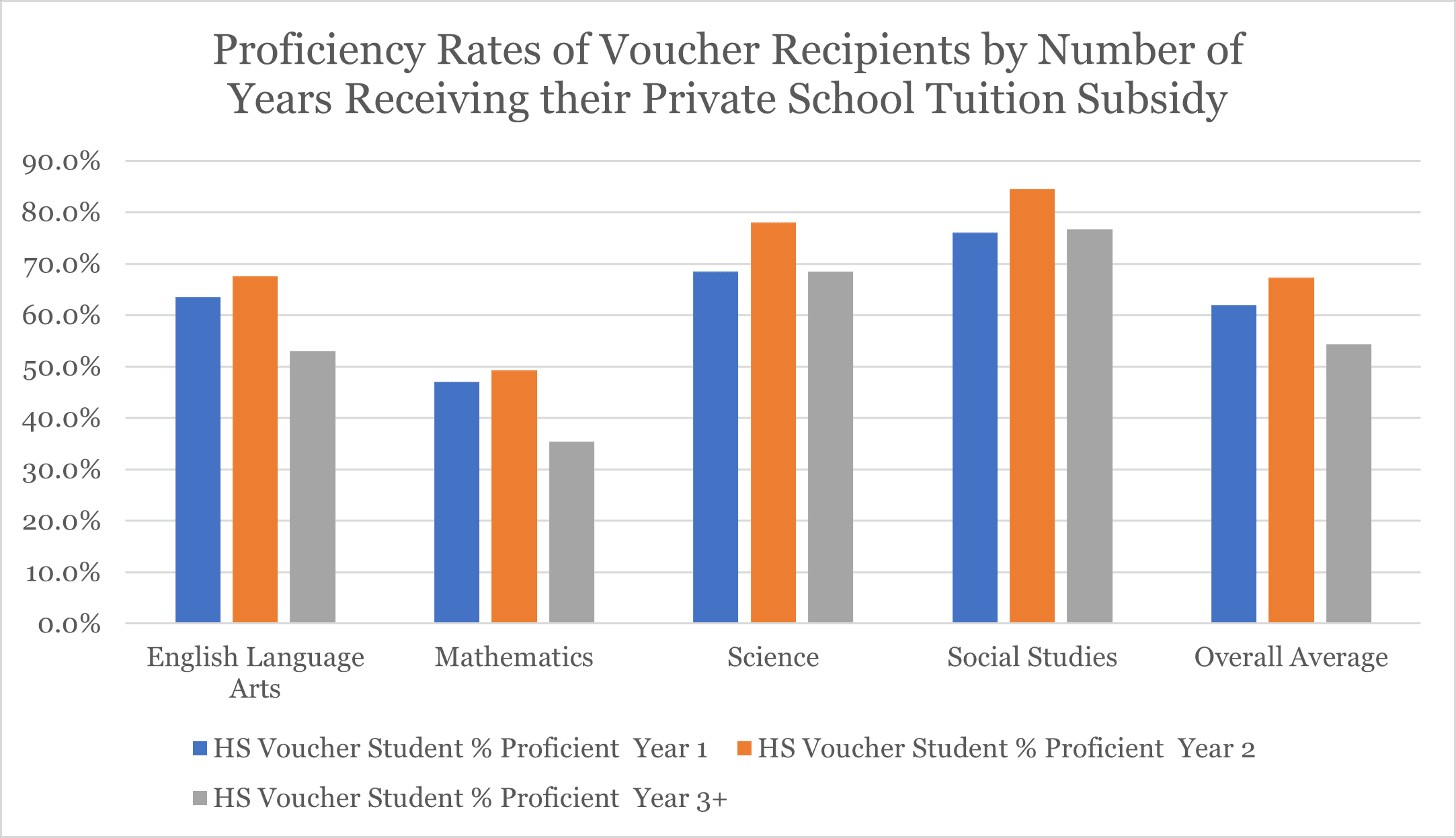
Yet you never hear that argument. Now I know why: according to state test data, the longer students take vouchers, the worse they do on state tests — in some cases a lotworse. Especially in high school.

Here is how students perform on state High School proficiency rates, depending on how long they’ve been taking vouchers. You can see pretty clearly that especially in English and Math, students do markedly worse if they’ve been taking vouchers for 3 plus years than they do if they’ve only been taking it for a year.

This provides some pretty compelling evidence that students taking vouchers are better prepared by public schools, but once they enter the private system, that success wanes. Only in Social Studies is there an increase, but it’s only a 0.9% increase. Math drops by nearly 1/4. Overall, there’s, on average, a 12.1% drop in proficiency rates the longer a high school student takes a voucher….

Let me put it simply:

  • Generally, Voucher students do worse on state tests the longer they take vouchers.
  • The Black-White achievement gap is much greater among voucher students than public school students.
  • Private Schools that accept Vouchers take a Whiter population of students than the districts from whence the students come.

I just have one simple question: How is it again that Vouchers provide “better” opportunities for students of color who are being “failed” by public schools, as voucher proponents continuously claim?

Because Ohio data sure suggest that students of color are best served by their local public schools, not the private schools who are more reluctant to take them, even with significant taxpayer-funded tuition subsidies.

Marty Levine wrote for the Nonprofit Quarterly for many years, where he distinguished himself as a skeptic of billionaires buying good press. He now writes his own blog, where this post appeared. He calls this post “The Corrosive Nature of Mega-Philanthropy.”

He writes:

I want this world to be a kinder, gentler place for all of its people. I want to admire those who sacrifice their own time and money in order to help those in greater need. I try, however imperfectly, to do the same. But I remain concerned about the growing power of those with great wealth to, even with the best of motives, turn their charity and philanthropy from acts of kindness to tools of power and control.

The Seattle Times opened a recent article about a project of the Bill and Melinda Gates Foundation with a recognition of how big gifts have an impact. “When philanthropists spend vast sums of money on a project, jubilation and high expectations ensue.” But it was the sentence that followed, “But money doesn’t necessarily produce results,” that grabbed my attention.

In this age of mega-philanthropy vast sums are donated with great frequency; as I write this the list of gifts of more than $1 million in 2022, as reported by the Chronicle of Philanthropy, is approaching 400. 18 individual gifts have exceeded $100 billion!

While we laud the act of giving, we ignore that these gifts are too often just another way for wealthy people to flex their muscles and continue to inappropriately exert social and political influence. And they do this with little or no public oversight, or with any public accountability for the effectiveness of their gifts or for the harms they may do.

The Bill and Melinda Gates Foundation and its associated Trust, with assets now in excess of $70 billion, stand as a stark example of this flawed system of philanthropy. The Gates’ philanthropic organizations are tax-exempt, which means that the Gates have personally benefited from the tax savings that our nation grants to donors. Because the Gates are allowed to donate funds to a structure they control, donating for them does not require them to relinquish the power at all. Their charitable venture just provides another mechanism of control, perhaps with a softer, kinder wrapping, but still a mechanism of influence and control.

And with that power, the Gates have brought their belief that they have the answers to some of the world’s most challenging problems and can impose those answers on those desperate for the resources they chose to give away. They have been able to put their solutions into action across the globe with little need to ensure that those whose lives they will be impacting agree with their directions or their proposed solutions. Their definition of philanthropy appears to begin with a belief that because they have amassed great wealth they are wise; that the size of their bank account is a measure of their intelligence and it gives them the authority to act. They act with a belief that because they are wealthy, they have no need to be accountable to those without wealth.

Read on to learn more about the philanthropists who use their gifts to control the lives of others.

Jeremy Mohler is communications director for the nonpartisan organization “In the Public Interest,” which fights the privatization of public goods and services. This article draws a link between policies of privatization and the rise of rightwing populism

He writes:

It’s one sentence in a 1,244-word article, but it made me pause and think deeply.

The article is a guest essay in the New York Times about the rise of Sweden’s far-right political party, which was created out of a neo-Nazi group and resembles the increasingly Trumpian Republican Party with its hatred of immigrants, journalists, and others.

The sentence: “Once one of the most economically equal countries in the world, Sweden has seen the privatization of hospitals, schools and care homes, leading to a notable rise in inequality and a sense of profound loss.”

That makes me wonder: How much has privatization contributed to soaring far-right populism, white nationalism, and fascism in the U.S.?

In Sweden, argues journalist and author Elisabeth Asbrink, high levels of political and economic inequality leaves people looking for answers to why they’re suffering and who is to blame—and far right leaders are happy to provide them.

“It was better in the good old days, [those leaders] say, and people believe them,” Asbrink writes. “Back to red cottages and apple trees, to law and order, to women being women and men being men.”

Sound familiar?

As we have documented, the privatization of public schools, water, and other public goods increases inequality. Government contractors create new fees for things like delinquent tax payments and probation. They lower wages and benefits for workers. Privatization also has helped shred crucial parts of the social safety net, like Medicaid.

Scholars have argued along these lines for some time now. “Neoliberalism creates a failed democracy,” says cultural critic Henry A. Giroux, “and in doing so, opens up the fascists’ use of fear and terror to transform a state of exception into a state of emergency.”

But I think it’s important to highlight the role of privatization—something embraced by both parties for the past 40 or so years.

A Democratic candidate for governor of Pennsylvania, Josh Shapiro, recently endorsed private school vouchers, which would take public money from the state’s lowest funded public schools and give it to private schools.

Like privately operated charter schools, private school vouchers might help some students, but they leave most of the others behind in public schools starving for resources.

Conservatives have long pushed for such privatization schemes, and Democrats have too often joined them. Meanwhile, America’s far too many underfunded schools continue to suffer—with policies like charter schools and vouchers only making things worse.

And we wonder why “Make America Great Again” resonates with so many people.

Jerry Zahorchak, a former Secretary of the Pennsylvania Department of Education, explains why the Republicans’ voucher bill would harm students and public schools and deepen inequity.

He writes:

Imagine a school district with $4,000 less to spend per student than its wealthier neighbors with many students who lack supports to reach grade-level. How would you help?

Most people would guarantee that this school district had funds to hire enough teachers and aides to give students who are behind supports. Indeed, nearly two-thirds of Pennsylvania parents in a recent PSBA (Pennsylvania School Boards Association) poll agreed that struggling schools need more resources.

Legislative leaders are instead considering taking taxpayer money away from some of the state’s lowest funded schools and sending it private schools, no strings attached.

The bill, HB 2169, passed the State House in May and could be considered by the state Senate at any time this session. Under the bill, students who live in the attendance zone of public schools with test scores in the bottom 15% statewide would be eligible to receive the average per-student state funding for public schools – around $7,000 per year – as a voucher that can be used for any qualified educational expense, including private school tuition. Funding would come directly from their local school district, and would cost struggling school districts around $140 million annually (PSBA).

Rather than giving students in underfunded schools resources, they would use taxpayer money to fuel the private market. Families would be on their own, forgetting that we all have a stake in making sure that each child learns to cooperate with neighbors of every stripe and become self-supporting, knowledgeable citizens.

Proponents claim these “lifeline scholarships” will help families access quality education they wouldn’t otherwise be able to afford. The real story is not so simple.

Supporters never mention that districts with high academic performance are able to spend around $4,600 more per student on average than low-performing districts. These resource gaps – which will be worse with HB 2169 – closely track local wealth. When we adjust for the fact that poor school districts serve more students in poverty and other students who need more support, the gap between wealthy and poor school districts is more than $7,000 per student.

The fantasy that the private market will provide a better deal for students at a cheaper price falls apart under scrutiny.

Private schools often reject students that public schools rightfully must educate: students who are behind grade-level, have behavioral challenges, are learning English and more. There’s no guarantee to make private schools accommodate students with disabilities, unlike public schools where federal laws guarantee students with disabilities the right to a Free Appropriate Public Education (FAPE). Private schools can reject students simply because they don’t “fit the culture” or can’t pay the entire cost of tuition. Because many of these students need services that cost more, there is an incentive to say no.

Please open the link and read the rest of his article.

The voucher bill was narrowly passed by the Republican-led House and also the State Semate Education committee.

For some inexplicable reason, it was endorsed by Josh Shapiro, the Democratic candidate for Governor.

Arizona voters blocked vouchers in 2018 by a 2-1 margin. The Koch-DeVos machine came back with an even bigger voucher proposal this year. Save Our Schols Arizona, a grassroots group of volunteers once more gathered signatures to compel a state referendum to block vouchers. The billionaires hate democracy and will try to stop the referendum.

The Arizona Republic reported:

A school voucher program scheduled to become law Saturday is on hold after public-school advocates gathered enough citizen signatures to temporarily block the controversial program.

On Friday, the Save Our Schools movement submitted 141,714 signatures to the Arizona secretary of state as volunteers concluded a drive to refer the voucher program to the 2024 ballot for voters to decide.

The law, authorized by the GOP majority in the Legislature and signed by Republican Gov. Doug Ducey, would be the first universal voucher program in the nation, using taxpayer dollars for private education efforts.

It would expand the state’s Empowerment Scholarship Account program to every Arizona schoolchild, providing an estimated $7,000 of taxpayer money per child for a range of educational services, from private school tuition to tutors to support for parents who opt to teach their children at home…

Raquel Mamani, an educator and parent, celebrated the petition drive, saying it puts on hold “the anti-public education, anti-parent, anti-student agenda forced into our state by extremists.”

Volunteers gathered signatures from all 15 counties in 80 days, a sign of widespread support, said Nicky Indicavitch, outreach director for Save Our Schools Arizona.

“Arizonans want top quality, fully funded public schools in every neighborhood,” she said.

This is the second time in five years public-school proponents have taken to the streets to block voucher expansion. In 2017, a similar referendum drive sent an expansion of the ESA program to ballot, where voters in 2018 rejected it by a margin of nearly 2 to 1.

Friday’s filing had echoes of the 2017 effort, but both supporters and opponents of the ESA program expect a more robust, heavily funded fight this time around.

The American Federation for Children [the DeVos organization] has signaled its support for the expanded program, and a “decline to sign” movement that tried to discourage people from signing the referendum petitions said it has proof of illegal signature efforts…

After the universal expansion passed in June, the state started taking preliminary applications. Data released last month showed 6,500 families had applied in just two weeks. Of those families, about 75% indicated they did not have a child previously in public school.

Those early findings solidified opposition from public-school advocates, who argued that the numbers showed the beneficiaries were likely people already paying private tuition and looking to cash in on a hefty state subsidy.

The Guardian reported today that an investigative team from the United Nations documented numerous war crimes committed by Russian forces in Ukraine. Putin announced that he is calling one million men to active duty, and thousands of men are attempting to flee Russia before they are forced into combat. (It is illegal in Russia to call the invasion of Ukraine a “war.”) Protests have erupted in Russian cities, and more than 1,000 protestors have been arrested. Russia is conducting sham referenda in conquered Ukrainian territories, which will enable them to treat their conquests as Russian soil. Putin has said that any attack on Russia will allow him to use nuclear weapons in defense. This is a dangerous moment, to say the least.

The United Nations has said its investigators have concluded that Russia committed war crimes in Ukraine, including bombings of civilian areas, numerous executions, torture and horrific sexual violence.

The UN has made the investigation of human rights violations in the war a priority and in May its top human rights body mandated a team of experts to begin work in the country.

Since then, UN investigators, have risked their lives to collect evidence of crimes perpetrated against civilians, including in areas still threatened by enemy forces or laid with mines.

The team of three independent experts on Friday presented their first oral update to the UN human rights council, after it launched initial investigations looking at the areas of Kyiv, Chernihiv, Kharkiv and Sumy regions, adding that it would broaden its inquiries.

Speaking a day before the seven-month anniversary of Russia’s invasion of its neighbour, Erik Mose, the head of the investigation team, told thecouncil that, based on the evidence gathered by the Commission of Inquiry on Ukraine, “it has concluded that war crimes have been committed in Ukraine”.

The team of investigators visited 27 towns and settlements, as well as graves and detention and torture centres; interviewed more than 150 victims and witnesses; and met with advocacy groups and government officials.

Mose said the team had been especially “struck by the large number of executions in the areas that we visited”, and the frequent “visible signs of executions on bodies, such as hands tied behind backs, gunshot wounds to the head, and slit throats”.

He added it was investigating such deaths in 16 towns and settlements, and had received credible allegations regarding many more cases that it would seek to document. The investigators had also received “consistent accounts of ill-treatment and torture, which were carried out during unlawful confinement”, the council was told.

In the settlements of Bucha, Hostomel and Borodianka, occupied for about a month by Russian troops, Ukrainian investigators found dozens of mass graves where the bodies of civilians, tortured and murdered, had been buried.

Since the Russians withdrew from the area, a group of young volunteers worked tirelessly to exhume the bodies and send them to forensic doctors who have been collecting evidence of crimes perpetrated by Russian troops.

Some of the victims had told the investigators they were transferred to Russia and held for weeks in prisons. Others had “disappeared” after such transfers. “Interlocutors described beatings, electric shocks and forced nudity, as well as other types of violations in such detention facilities,” Mose said.

Mose said the team had also “processed two incidents of ill-treatment against Russian Federation soldiers by Ukrainian forces”, adding that “while few in numbers, such cases continue to be the subject of our attention”.

He said investigators had also documented cases of sexual and gender-based violence, in some cases establishing that Russian soldiers were the perpetrators.

“There are examples of cases where relatives were forced to witness the crimes,” he said. “In the cases we have investigated, the age of victims of sexual and gendered-based violence ranged from four to 82 years.”

The commission had documented a wide range of crimes against children, Mose added, including children who were “raped, tortured, and unlawfully confined”.

Stephen Dyer, a former state legislator in Ohio, writes a blog that tracks funding and privatization in Ohio. It’s called “10th Period.” He relies on state data to tell the truth about the failure of charters and vouchers. Here is the latest data on charter schools.

Dyer’s summary:

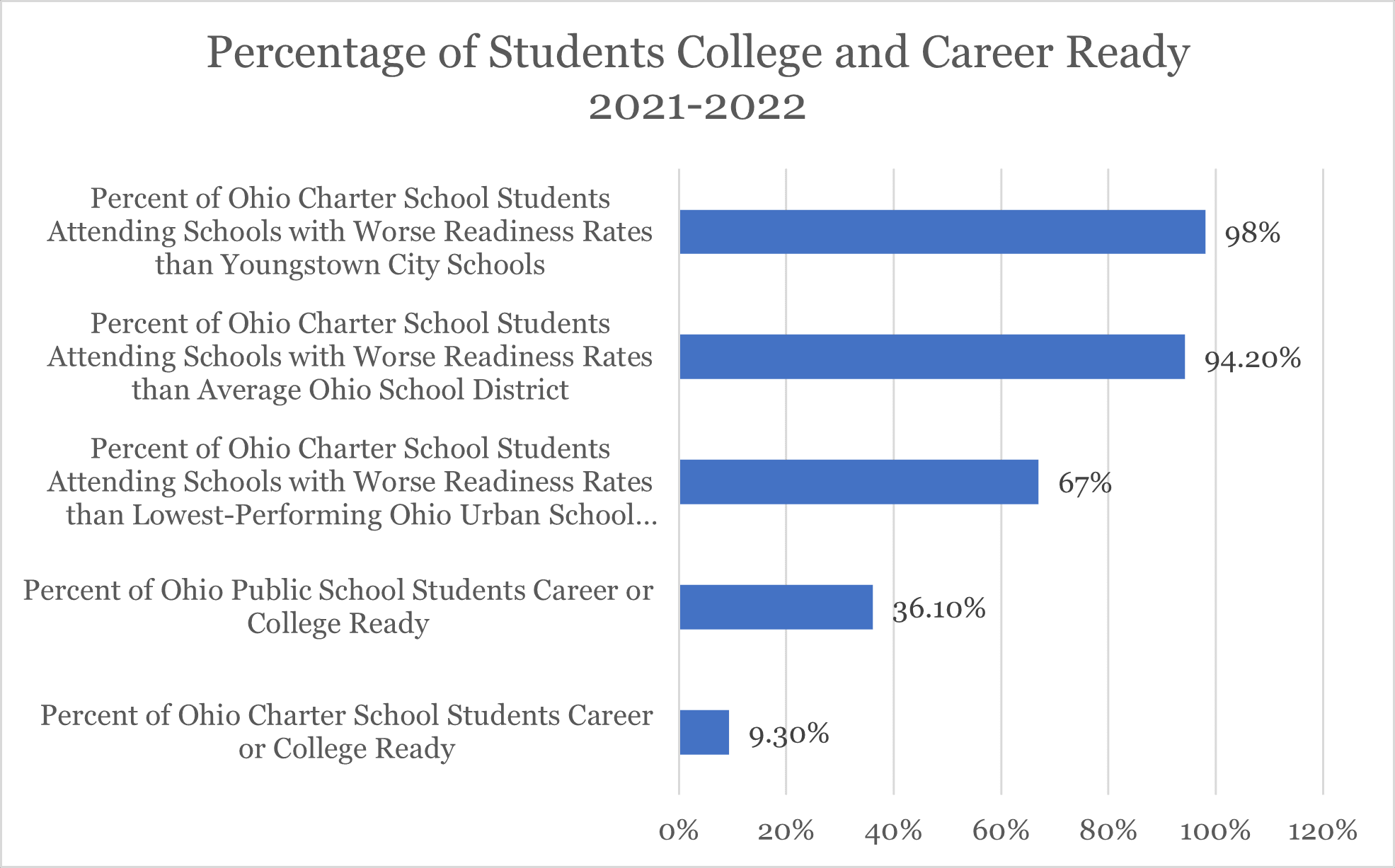
98 Percent of Ohio Charter School Graduates are Less Prepared for Post-Graduate World Than Students in Youngstown City Schools

Dayton is the lowest performing major urban district. Yet 2 out of 3 Ohio charter schools are less prepared than Dayton students

Ohio’s new report card has revealed something extremely troubling about Ohio’s Charter Schools. On a new measure called “Students in the 4-year Graduation Cohort who Completed a Pathway and are Prepared for College or Career Success”, only 9 percent of Ohio’s potential Charter School graduates met those qualifications. More than 36 percent of Ohio’s public school district students met those qualifications.

(Data Note: These data only examine students who could graduate high school, not whetherthey graduated high school. Public School Districts graduated 91.4 percent of their potential 121,968 graduates. Charter Schools only graduated 65 percent of their 4,657 potential graduates — a lower rate than any Ohio Public School District.)

Of the 43 Ohio Charter Schools with enough students to count in this College and Career Readiness measure, 18 schools had zero — that’s right, not a single student —who qualified as college or career ready. That means that 3 out of every 25 Ohio charter school graduates attended a school where not a single potential graduate was considered college or career ready.

But it gets worse.

More than 54 percent of Youngstown City School potential graduates are college or career ready. Only one Ohio Charter School — Dayton Early College Academy — has a higher rate.

That means that 98 percent of potential Ohio Charter School graduates are less prepared for post-high school lives than Youngstown City Schools’ potential graduates. Remember that Youngstown was seen as such a “failed” school district that the state created a new law to take over the district — in large part so more Charter Schools could open there.

Yet that district’s students are more likely to be prepared for post-high school lives than 98 percent of the 4,657 students potential graduating Ohio’s Charter Schools.

But wait. It gets worse.

The lowest-performing major urban school district in Ohio — Dayton — only had 5.7 percent of its students qualify as career or college ready.

Not good.

But before all you pro-charter school/voucher people scream “School Choice, Now!”, an astonishing 2 out of every 3 potential Ohio Charter School graduates attend schools with worse post-graduate preparation measures than Dayton.

Dayton is the home of the Thomas B. Fordham Institute and has been a hotbed of charter and voucher activity for 25 years. It’s not like school choice hasn’t been tried in Dayton.

And it ain’t working.

More Ohio students in all schools need to be career and college ready than they currently are. Full stop.

But what’s clear is that the best place for that to happen is in Ohio’s local public schools, not in Ohio Charter Schools.

I’d also like to use some space to bring up the Ohio Virtual Academy (OHVA) — the ECOT-sized online school. OHVA was paid to educate 14,530 students last year — more students than ECOT ever was paid to educate.

Yet they are just as bad as ECOT at preparing their students for the post-graduate world. An astonishing 87 of 1,820 potential OHVA grads were considered college or career ready. That 4.8 percent rate is lower than all but one Ohio school district — New Miami Local in Butler County, which only had 1 of 44 potential graduates considered college or career ready.

There’s more. If you want to follow the terrible results of privatization in Ohio, subscribe to Stephen Dyer’s blog.

I watched the third episode of the latest Ken Burns’ documentary, and I understand why he said it is the most important documentary he ever made.

As history, it is powerful. And it is even more powerful because there are so many echoes of present events in our own country.

In three episodes, we see one of the most cultured countries in the world fall under the spell of a charismatic madman. We see the German people march to his tune, cheer him, fall in line, then become brutes as they carry out his mission to exterminate the Jews of Europe and to capture the Continent.

We see heroic Americans trying to rescue desperate refugees. And we meet the anti-Semites in the State Department who wanted to keep refugees out and leave them to their fate. and we are reminded again and again that the American public did not want the Jewish refugees.

We learn about the indifference and decided anti-Semitism in other countries, including our own. We learn about Hitler’s admiration for our brutal treatment of indigenous peoples, killing them and then isolating them on reservations. Hitler also admired our harsh treatment and segregation of Black people.

Inevitably, in the third episode, there are graphic videos of the death camps. There are piles of naked bodies. And there are emaciated men and women who survived, barely, their eyes empty.

In the closing minutes, the parallels to the present are presented. Scenes of racism, Young white men in Charlottesville chanting “The Jews will not replace us.” The mob storming the U.S. Capitol on January 6, 2021, one of them wearing a T-shirt saying “Camp Auschwitz.” Having just witnessed scenes from the death camps, the T-shirt was not just tasteless but horrifying.

This series should be shown to high school students in every school in the U.S.

You no doubt heard or saw or read that a three-judge federal appeals court threw out part of the ruling that barred federal investigators from using classified documents in Trump’s home. Two of the three judges were Trump appointees.

Blogger Ryan Grim explains what a setback this ruling was for District Judge Aileen Cannon, whose decision to appoint a special master to review thousands of documents and to bar federal investigators the power to use highly classified documents was puzzling to many legal experts.

There was no reason to believe that highly classified documents were Trump’s personal property or covered by executive privilege.

Grim writes:

You’ve probably seen by now that a federal appeals court has sided against former President Trump and allowed the government to start looking at its own classified information again. News reports have described the ruling as “strongly worded,” but I don’t think that really gets at it effectively. Antonin Scalia and Ruth Bader Ginsberg used to write “strongly worded” opinions. This reads more like disappointed professors correcting a student who clearly hadn’t been doing the reading or paying attention in class.

Rather than engage in any sophisticated legal reasoning or deep exploration of precedent, the judges here – two appointed by Trump and one appointed by Obama – simply laid out how and why Judge Cannon wasn’t even remotely close to being right in appointing a “special master” to review these documents.

I won’t run through the full 29-page ruling, but here’s a fairly representative moment from it. In order to seize the power needed to appoint a special master, Cannon had to explain how Trump would be irreparably harmed if she didn’t intervene. What she came up with is head-scratching even to non-lawyers like me. The harm to Trump, she argued, is that he might be prosecuted.

On a law school test, you can imagine a professor reading an answer like that and shaking their head.

That’s just plain silly, writes Grim.

Nobody wants to be prosecuted, but the harm of prosecution doesn’t give you extraordinary rights like access to a special master. Can you imagine a defendant telling a judge they can’t show up for a court date because doing so could lead to irreparable harm, namely their own prosecution?

The Texas Tribune and ProPublica collaborated in an investigation of the school massacre in Uvalde, Texas.

We know that Governor Greg Abbott immediately responded to the massacre of students and teachers at Robb Elementary School by congratulating the Texas State Police for their prompt and effective response. Either he was misinformed or he lied. The school was full of law officers but no one made a move to save the children for over an hour.

The investigation revealed that the state is withholding records of that terrible day.

Ever since the Uvalde elementary school shooting left 19 students and two teachers dead, blame for the delayed response has been thrust on local law enforcement. The school police chief was fired and the city’s acting police chief was suspended.

But the only statewide law enforcement agency, the Texas Department of Public Safety, has largely avoided scrutiny even though it had scores of officers on the scene. That’s in part because DPS leaders are controlling which records get released to the public and carefully shaping a narrative that casts local law enforcement as incompetent.

Now, in the wake of a critical legislative report and body camera footage released by local officials, law enforcement experts from across the country are questioning why DPS didn’t take a lead role in the response as it had done before during other mass shootings and public disasters.

The state police agency is tasked with helping all of Texas’ 254 counties respond to emergencies such as mass shootings, but it is particularly important in rural communities where smaller police departments lack the level of training and experience of larger metropolitan law enforcement agencies, experts say. That was the case in Uvalde, where the state agency’s 91 troopers at the scene dwarfed the school district’s five officers, the city police’s 25 emergency responders and the county’s 16 sheriff’s deputies.

The state police agency has been “totally intransparent in pointing out their own failures and inadequacies,” said Charles A. McClelland, who served as Houston police chief for six years before retiring in 2016. “I don’t know how the public, even in the state of Texas, would have confidence in the leadership of DPS after this.”

Instead of taking charge when it became clear that neither the school’s police chief nor the Uvalde Police Department had assumed command, DPS contributed to the 74-minute chaotic response that did not end until a Border Patrol tactical unit that arrived much later entered the classroom and killed the gunman.

“Here’s what DPS should have done as soon as they got there,” said Patrick O’Burke, a law enforcement consultant and former DPS commander who retired in 2008. “They should have contacted [the school police chief] and said: ‘We’re here. We have people.’ They should have just organized everything, said, ‘What are all of our resources?’ And they should have organized the breach.”

DPS has fought the release of records that could provide a more complete picture of the role state troopers played during the mass shooting. Agency officials declined to answer repeated questions from ProPublica and The Texas Tribune for more than three months, citing an ongoing investigation. On Tuesday afternoon, DPS officials said they had referred five responding troopers to the agency’s internal affairs division, the Office of Inspector General, for an investigation into whether they broke any department policies. Two have been suspended, according to DPS.

DPS also released a July email in which its director, Col. Steve McCraw, said the agency would “provide proper training and guidelines for recognizing and overcoming poor command decisions at an active shooter scene.” The agency has refused to share its active shooter policies and training manuals.

The latest moves by DPS come a week after reporters from ProPublica and the Tribune sought comments from the four appointed members of the Public Safety Commission, which oversees the agency, about the response by state troopers.

DPS did not identify which officers were being investigated or detail potential wrongdoing.

Previously, agency officials referred reporters to comments made by the head of DPS during a June legislative hearing in which he largely blamed the Uvalde school district’s police chief, Pete Arredondo, for the failed response.

During that testimony, McCraw told lawmakers that the time it took for law enforcement to rescue teachers and students at the elementary school was an “abject failure.” He called Arredondo the only obstacle between armed police and the teenage shooter while dismissing the idea that DPS could or should have taken control of the emergency response.

“I’m reluctant to encourage or even think of any situation where you’d want some level of hierarchy where a larger police department gets to come in and take over,” McCraw said.

Yet, DPS has sprung into action time and again when disaster strikes in Texas, which has proved key during mass shootings and public emergencies, local officials across the state said.

More than three decades ago, for example, state troopers helped local law enforcement confront a gunman after arriving within minutes of a shooting at a Luby’s Cafeteria in Killeen, about 60 miles north of Austin. The shooter killed himself after a brief exchange of gunfire.

“They knew that people were dying, and so they acted,” said Suzanna Hupp, a former Republican state representative whose parents died during the 1991 Luby’s massacre. She said that didn’t happen in Uvalde, adding that “clearly there was a command breakdown there.”

In a 2013 chemical explosion in West, about 70 miles south of Dallas, state troopers immediately took control of the law enforcement response at the request of the county’s emergency management coordinator. And in the 2018 shooting at Santa Fe High School, about 30 miles south of Houston, state troopers quickly fired at the gunman, according to local law enforcement officials who initially responded. The rapid engagement by school police and DPS was key to the gunman surrendering, district and county officials said.

Please read the rest of the article.

How do you spell “COVER-UP”?