The board of the John F. Kennedy Center for the Performing Arts may go bankrupt as soon as tomorrow. The only way to avoid bankruptcy, the board says, is to put Trump’s name back on the building so he will save it.
The board was hand-picked by Trump right after he returned to office.
This is the definition of chutzpah. He destroyed the Kennedy Center by taking personal control of it, naming it for himself, and driving it into the ground, as he has repeatedly done to multiple businesses before he became president. He bankrupted six casinos, as well as Trump Airlines, Trump University, and a long list of Trump–branded items, like Trump wines, Trump steaks, Trump vodka, Trump magazine, and various other failed ventures.
Make no mistake. No other president has packed the board with his cronies, who named him chair of the board. The board immediately put his name on the Center, making it the Trump-Kennedy Center.
As soon as he politicized the Kennedy Center, its reputation was tarnished. Artists and performers canceled, ticket sales plummeted, the National Opera moved out, the National Symphony went into financial crisis.
A federal judge ordered the board to remove Trump’s name. Congress named it; only Congress could change its name. The board reluctantly removed his name but has not removed the tarps covering the Center’s original name.
And now, the board says the Center will be bankrupt unless Trump’s name is restored!
He destroyed it. Only he can save it.
With the billions of dollars he and his family have friends have profited from crypto and other deals in the past year, maybe they will.
But as long as his name is attached to the Center and his board controls it, it will be shunned by the nation’s leading performers. It can’t buy back its tarnished reputation.
In the new world of school choice, parents have to be savvy shoppers. Opening up K-12 education to all comers, regardless of their background or qualifications, is a risky business. And when the “business” of school is run for profit, parents should beware. They and their children are usually pigeons, drawn in to fatten the founders’ bank account.
I attach a gift article so you can read the story in full. It is not behind a paywall.
Suddath wrote:
A man with a vision set out to revolutionize preschool. It became a $440 million fiasco.
Ten years ago, a Montessori enthusiast named Ray Girn had a vision. He wanted to bring high-quality, child-led education to as many babies and toddlers as possible, with a chain of for-profit schools that would grow at the pace of a tech start-up. He spoke about doing for preschools “what ride-sharing apps or Airbnb have achieved,” and he raised $335 million from investors, including venture capital and private equity firms, to make it happen.
For a while, Mr. Girn’s schools, which operated under the brand Guidepost Montessori, appeared to be successful, with 150 locations that served tens of thousands of children. But they also ran up an astonishing $440 million in losses. The parent company, Higher Ground Education, filed for bankruptcy in June 2025 and shuttered about 60 schools.
In Oregon, parents received an email notification on a Sunday afternoon that their school effectively no longer existed. In Wisconsin, a father went to drop off his 5-month-old son at a Guidepost only to find it had closed. In California, a mother learned that her children’s Guidepost had been sold and that its Montessori curriculum would be replaced with artificial intelligence. Guidepost teachers and parents lit up Facebook and Reddit groups with horror stories — allegations of neglect and mistreatment that made a lot more sense now that everyone knew how mismanaged the company had been.
For-profit education ventures are notorious for disappointing investors and leaving parents fuming. But even in this context, the Guidepost story is striking. “Schools close sometimes, but usually not this many, and not all at once,” said Rebecca Winthrop, who directs the Center for Universal Education at the Brookings Institution.
What could have caused such a collapse? More than two dozen former teachers, administrators and corporate employees told me that they were deeply concerned by the company’s business model. Seven independently described it as a pyramid scheme. “We were calling it the Montessori Ponzi scheme internally,” said Alex Richardson, a teacher at Guidepost’s first school, in Orange County, Calif.
When Higher Ground opened new Guidepost schools, it often received large advances from landlords to improve their properties. As long as the company kept expanding, it seemed from the outside as if it were thriving. But when it came time to repay the landlords, and growth was no longer an option, the company collapsed. By the end, some Guidepost locations were losing $50,000 a month.
Mr. Girn is still active in the education industry. Last year, he and his wife, Rebecca Girn — the other founder of Higher Ground and its general counsel — welcomed me at a converted ranch-style house outside Austin, Texas, where they’ve already opened another school, called Fulcrum. Their three children are among the students…
Guidepost was not the first school chain that Mr. Girn had run at an unsustainable pace. Back in 2003, when Mr. Girn, a Canadian native, was a psychology and philosophy student at the University of Toronto, a friend suggested he come work at a school in Orange County called LePort Montessori. It was founded by a wealthy bariatric surgeon, Peter LePort, who sat on the board of the Ayn Rand Institute. Mr. Girn had no formal training in education, but he ran a Rand-focused club on campus. That was enough for Mr. LePort, who hired him to help start a new elementary school.
Mr. Girn became devoted to the Montessori method, which encourages children to direct their own lessons, with teachers as guides. “It’s as close to perfect as human education has ever gotten,” he once said at an Ayn Rand Institute conference. Traditional schools stifled children’s innate love of learning, he thought, and day care programs could be especially oppressive. “They’re literally putting the child behind bars, moving them from rocker to high chair to container,” he said. Montessori could free them.
In 2009, Mr. Girn became the chief executive of LePort. He envisioned turning the company into a national chain (“We had the opportunity to become the child care provider for SpaceX,” he said). But he was more focused on growth than Mr. LePort was comfortable with. In 2016, Mr. Girn was fired.
He resolved to try again, this time with a chain of schools that he could control. He and Ms. Girn formed Higher Ground and hired several of LePort’s corporate staff members. Some LePort parents soon followed, including Greg Mauro, a founding partner of Learn Capital, a venture firm known for backing education start-ups. Learn Capital invested about $1 million, and Mr. Girn opened his first two Guidepost schools. Within three years, the company had 27.
Guidepost employees describe these early schools as thoughtfully planned. White-walled classrooms were outfitted with charming, toddler-sized furniture made of pale, unfinished wood. “Everyone cared so deeply,” said Kiana Kometani, who in 2019 became the first head of school at a Guidepost in Folsom, Calif. Teachers spoke about fostering each child’s intellectual curiosity, of giving them agency before they could tie their shoes.
Mr. Girn was a skillful pitchman. He promised parents something rare: the rigorous education of a high-end preschool, but with the hours of a commercial day care. Most Guideposts were in wealthy places — Walnut Creek, Brooklyn Heights — and appealed to the kind of dual-income families who could afford the equivalent of a small sedan in preschool tuition.
“Guidepost catered to the elevated intellectual type,” said Emily Tkaczibson, who paid about $4,000 a month for her two children to attend a Guidepost in Tigard, Ore. “We would have recommended the school to anybody.” Matthew Espie, another parent in Tigard, considered himself “lucky” that his youngest child got off the waiting list after only 10 months.
There were signs, though, that the company was trying to do too much too soon. Mr. Girn expanded abroad, opening schools in Hong Kong and mainland China in 2019. Mr. Richardson, the Orange County teacher, said around that time, three Chinese toddlers came to his school for reasons that were never explained. None of them spoke English, and the Guidepost teachers didn’t speak Mandarin.
“One toddler would stand there and cry and say the same word over and over again,” Mr. Richardson said. “We learned later that she was yelling for her mom, but at the time we didn’t know. We couldn’t understand her enough to help her.”
Please open the link and finish reading this fascinating article. Turning education into a business opportunity is dangerous.
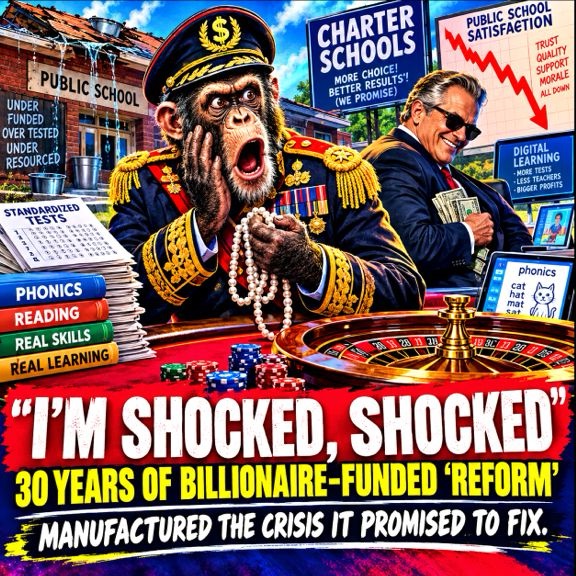
Mike Simpson, known on Twitter as “Big Education Ape,” is known for his brilliant memes and editorial cartoons. Typically, they expose the latest fads and lies that defame teachers and public schools. Every once in a while, he publishes a great post, like this one.
I’M SHOCKED, SHOCKED — HOW 30 YEARS OF BILLIONAIRE-FUNDED “REFORM” MANUFACTURED THE EDUCATION CRISIS IT PROMISED TO FIX
There’s a famous scene in Casablanca where Captain Renault declares he is “shocked, shocked” to find gambling going on — right before a croupier hands him his winnings. That’s essentially the posture of the billionaire reform industrial complex today, clutching its pearls over a Gallup poll showing public satisfaction with American schools has cratered to 32% — an 11-point nosedive in just two years — while quietly pocketing the profits of the crisis they spent three decades engineering.
Shocked. Absolutely shocked.
The Architecture of a Manufactured Crisis
Let’s be precise about the timeline, because precision matters when someone is picking your pocket.
For roughly 30 years, a well-funded constellation of think tanks, philanthropic foundations, hedge fund managers, and tech oligarchs pumped billions of dollars into a single, relentless narrative: public schools are failing. Not “underfunded.” Not “systematically neglected.” Failing — as in, inherently broken, irredeemably incompetent, populated by bad teachers protected by evil unions, and salvageable only by the heroic intervention of the private market.
The messaging was surgical. The money was real. And — surprise! — it worked.
Starve public schools of adequate funding. Declare them “failing.” Ride in on a white charter bus to “rescue” the children.
The chronic underfunding wasn’t fiscal negligence. In many states, it was a feature, not a bug. Squeeze hard enough, the theory went, and disruption would force innovation. What it actually forced was deferred maintenance, teacher shortages, and a generation of kids learning to read in buildings where the roof leaks and the textbooks predate the iPhone.
Now the poll numbers confirm the narrative took hold — and the reformers are citing those same poll numbers as proof they were right all along. The audacity is, genuinely, breathtaking.
The Numbers That Tell Two Very Different Stories
Here’s what the data actually shows — and what it doesn’t show:
Metric: The Headline. What It Actually Means Gallup Public Satisfaction 32% — record low 30 years of “failing schools” messaging worked exactly as intended.
Parent Satisfaction with Their Own School Historically ~2x the national figure People trust what they experience; they fear what they’re told
Math & Reading Scores Declining, especially bottom quartile Tracks directly with funding inequity and screen-time explosion
Top-tier U.S. Student Performance Still globally competitive. The “crisis” is concentrated where disinvestment is concentrated
The gap between how Americans rate schools in general versus their own child’s school is the smoking gun. It has always been the smoking gun. People who actually walk into a public school building — who meet the teachers, see the classrooms, watch their kids come home — consistently rate those schools dramatically higher than the national “failing” narrative suggests.
That gap is the manufactured crisis. It lives entirely in the space between lived experience and media-amplified fear.
$1.8 Billion Worth of Snake Oil, Served Fresh
And just when you thought the reform carousel might slow down, along comes the Science of Reading — the latest Next Big Thing™ in a long line of Next Big Things™ that have collectively cost American taxpayers tens of billions of dollars and produced reading scores that went, as the Big Education Ape’s withering analysis puts it, precisely nowhere.
Remember Common Core? $15.8 billion. A decade of standardized testing theater. Reading scores: unmoved.
Now we have the Science of Reading, $1.8 billion deep and climbing, with the same cast of vendors, the same philanthropic networks, and the same conspicuous absence of a money-back guarantee.
To be scrupulously fair: phonics works. Explicit decoding instruction works. The underlying research on structured literacy is legitimate. But here’s the thing about legitimate research — it doesn’t require a $1.8 billion vendor ecosystem, mandatory state legislation in 40+ states, and the systematic deskilling of teachers who are told to stop thinking and start following the script. When real science gets packaged into proprietary curricula, sold to districts under legislative mandate, and deployed without the trained human educators needed to implement it well, you don’t get science. You get very expensive phonics worksheets.
The question nobody in the reform complex wants to answer remains the same one it’s always been: Where is the money-back guarantee?
The Other Hand: How Tech Bros Broke Kids’ Brains While Selling the Cure
Here is the part of the story that deserves its own criminal investigation — or at minimum, a very uncomfortable congressional hearing.
The same Silicon Valley billionaires who spent decades pushing EdTech into classrooms as the revolutionary equalizer — screens for every student! –are the identical billionaires whose social media platforms have:
Collapsed long-form reading among adolescents at a rate researchers describe as one of the steepest drops in PISA history
Engineered algorithmic doom-scrolling that neurologically rewires 15-year-olds away from the sustained attention that math and reading comprehension require
Distracted over a quarter of students internationally during core academic instruction, by their own PISA survey data
They sold the disease and the cure. They pushed the screens that fragmented attention spans, then sold the adaptive software to remediate the fragmented attention spans, then pointed at the test scores and said: See? Public schools are failing.
None of this is inevitable. None of this is permanent. The No Kings Coalition — the sprawling, nonpartisan civic movement that flooded the streets in March — is now flooding the polls, with a Vote Early Day of Action on October 17 aimed squarely at the November 3, 2026 midterms.
The math is straightforward, even if the billionaires prefer we can’t do it:
Elect candidates who will defend public education funding, not divert it into voucher schemes that enrich private operators at public expense
Overturn the Supreme Court rulings — from Citizens United forward — that transformed American democracy into a billionaire auction
Restore the principle that public money follows public children into public schools, not into the portfolios of private equity firms with a “reform” logo.
The manufactured crisis has a manufactured solution: more billionaire intervention, more privatization, more EdTech, more testing, more disruption. The actual solution is considerably less glamorous and considerably more effective — fund schools equitably, pay teachers competitively, put phones away, and stop letting people who profit from public school failure write public school policy.
The Bottom Line
The 32% satisfaction number is not evidence that public schools have failed. It is evidence that a 30-year, billion-dollar propaganda campaign succeeded. The same people who manufactured the crisis are now selling the cure — at $1.8 billion a pop, no refunds, no guarantees, no accountability.
Meanwhile, the teachers who showed up every day through a pandemic, through chronic underfunding, through a staffing crisis, through the algorithmic dismantling of their students’ attention spans — those people are still in the classroom at 7 AM, doing the work that no EdTech platform, no voucher program, and no think tank white paper has ever actually replaced.
The casino is rigged. Captain Renault is shocked. And the November ballot is the one lever the house can’t control.
Vote like a public school depends on it. Because one does.
All links verified active as of September 9, 2026. Primary polling data sourced from Gallup/Walton Family Foundation. PISA data sourced from NCES/OECD 2025 release.
Or we can say, “Don’t worry, we have the concept of a plan.”
Or we can say, “We’re going to get every penny of it by raising tax rates on corporations and billionaires and by closing tax loopholes that only benefit the rich.” (Which would be the only defensible way to get it.)
Or we can say, “Look. Obviously, we’re no more serious about this than Trump is. He just dangles it out there as a bribe, as he dangled giving everyone “terrific health care at a tiny fraction of the cost.” Or dangled “lower prices on Day One.” Or promised to cherish his first wife “until death did them part.” And his second. And his third.
Once he gets what he wants, what does he care? He breaks his promises on virtually everything, every time. (He did close the border; but is he really deporting just the worst of the worst?)
On the remote chance he’s serious about the $5,000, where would he get it?
Clearly not from taxing billionaires or corporations.
He’d just add it to the National Debt. Because if Republicans have proved anything since Reagan began ballooning it, it’s that they are the “borrow and spend”party.Forty trillion? Fifty trillion? Who cares, so long as they can cut taxes on the wealthy donors who keep them in power.
His other reason for dangling this phony bribe is to deflect attention.
From the Epstein files. From groceries and gas. From the millions about to lose health insurance. From the rural hospitals soon to close. From his staggering corruption. From his disastrous war.
Tobias also noted that the Democrat running for Senate in Kansas was endorsed not only by its Democratic governor but by a former Republican governor.
Kansas’s two-term Democratic governor has endorsed Hamilton — obviously — but get this: Former two-term Republican Governor Bill Graves just endorsed him, too.
For the last six years, Sen. Roger Marshall has turned his back on Kansas. In contrast, Adam Hamilton stands as a bulwark of kindness, humility and service to others. It is for those reasons, and many more, that I believe Kansas should send Adam Hamilton to the U.S. Senate, and I am proud to endorse him. . . .
Heather Cox Richardson writes about an important and devastating turn in Trump’s disastrous war on Iran. The Houthis have captured a key port that enables them to target the transit of oil from the Red Sea. This could drive the cost of oil even higher than it is today, which inflates the cost of most other products.
Think about it: Trump is unqualified to lead the nation into war. He never served, and he has no relevant knowledge or experience. He doesn’t trust American intelligence services, and he has fired top advisors. Pete Hegseth is totally unqualified for his position. He served, but his head is full of nonsense about “manliness” and “the warrior ethic.” He has fired the military’s top generals and admirals.
These two incompetents have dragged us into a war without end.
Heather Cox Richardson describes an ominous development:
We woke up today to news that Yemen’s Iran-backed Houthi militants have taken control of the city and seaport of Mocha and much of the shoreline of the Red Sea near the Bab el-Mandeb strait, another chokepoint for world trade including trade in oil. With the Strait of Hormuz largely closed, Saudi Arabia has relied for seagoing transport on the Red Sea route that empties into the Arabian Sea and the Indian Ocean.
As Diana Roy of the Council on Foreign Relations wrote in July, the Red Sea is one of the most important routes for global shipping. It carries twelve to fifteen percent of the global maritime trade every year, worth about $1 trillion. The waterway extends about 1,400 miles from the Suez Canal—which connects it to the Mediterranean Sea—at the northern end to the Bab El-Mandeb strait in the south.
The Iran-backed Houthis are in a struggle against the Saudi Arabia–backed Yemeni government. A fragile truce has been in place since 2022, but clashes between the two forces have escalated for weeks, and on Tuesday, September 8, Houthi attacks on Saudi targets started fires at oil facilities and wounded more than 70 people.
The Yemeni government told Reuters that Iran’s Revolutionary Guard Corps (IRGC) have guided the Houthi advance, and according to Zachary Cohen, Katie Bo Lillis, and Kylie Atwood of CNN, U.S. officials think that hundreds of IRGC officers are currently in Yemen working with the Houthis to shut down the Bab el-Mandeb. The journalists note that CNN has previously reported that in case U.S. negotiations were unsuccessful, Iran had planned an economic “nuclear option”: closing the Bab el-Mandeb.
Cohen, Lillis, and Atwood reported this afternoon that more than 100 U.S. military advisors are in Saudi Arabia as part of a new joint forces command, providing the Saudis with intelligence and helping them find Houthi targets.
The sources who told the journalists about the joint effort emphasized that the U.S. routinely shares intelligence with the Saudis and that it is neither participating directly in the strikes nor providing operational support. Still, U.S. airstrikes on the Houthis in 2025 killed 153 civilians and wounded 243 others in Yemen in 2025.
The price of oil jumped to $109 a barrel, and U.S. gasoline rose to an average of about $4.28 a gallon. GasBuddy said the national average price of diesel had hit $6.00 for the first time in history. Just a year ago, the national average was about $3.70.
GasBuddy issued a statement, saying: “While gasoline gets the headlines, diesel is the fuel that moves the economy, powering the freight trucks, trains, agricultural equipment, and construction machinery behind nearly everything Americans buy. That means its impact reaches far beyond the transportation sector. As diesel climbs, higher supply chain costs work their way into the price of groceries, household goods, deliveries, and countless other products families rely on every day, even for households that never fuel a diesel vehicle.”
GasBuddy’s head of petroleum analysis, Patrick De Haan, said the new record “will be a particularly painful one for the economy” and is “likely to reignite inflation up and down the supply chain.” He continued: “I suggest Americans anticipate a costlier holiday season, as it appears diesel prices could continue climbing as geopolitical tensions continue to remain a main factor.”
While all this was going on, tonight President Trump attended the second day of his Dallas rally to fire up his base before the midterm elections. There, a video from the Republican National Committee intoned: “And on June 14th, 1946, God looked down on his planned paradise and said, ‘I need a caretaker,’ so God gave us Trump.”
Critics slam teachers and public schools for low reading scores. Much of that criticism is wrong and misses the real problem. The Common Core State Standards (CCSS) and the Science of Reading (SoR) both seriously hamper children’s writing (their voices) and, in turn, their ability to learn to read.
Writing and reading are siblings. They complement each other, and for most children, if one isn’t working, the other isn’t either. That’s why, as children learn to read, they should be learning to write. Good reading and writing instruction involves interactions and feedback from teachers, students, and parents.
Below is a reminder of what makes a good writing program, but first I want to address the problem.
The National Reading Panel, which led to the SoR, failed to adequately research reading (See Yatvin, 2003). They ignored writing!
In 2023, Stephen Sawchuck of Education Week wrote about this omission: How Does Writing Fit Into the ‘Science of Reading’? His points are valid, but his focus on breaking writing into explicit skills, much like the SoR breaks up reading, misses the mark.
The Science of Reading isn’t settled, since believers finally want to address writing. They sound like writing instruction never existed, calling for a Science of Writing. Adding “science” makes it sound legit and lends itself to for-profit programs.
While reading Sawchuck’s report, it’s easy to picture newly minted, skill-oriented, expensive online writing programs for states to add to their already crowded list of online decoding programs.
I would argue that none of that is necessary for children to learn to write (and read better). What’s needed is paper and pencil and adults who care about student writing, will read and value it, and help children improve upon it.
Teachers used to address writing well. They focused on it more and better. What happened?
Remember Common Core and David Coleman’s toxic words about student voice?
David Coleman, a businessman and codeveloper of the CCSS, who now makes millions as the head of the College Board, denounced student voice.
Around 2015, Coleman, discussing student narrative writing, stating to a group of teachers:
You grow up in this world, and you realize people don’t really give a shit about what you feel and what you think.
Along with this, SoR enthusiasts largely ignored the critical connections between writing and learning to read. The heavy focus on decoding and direct instruction still permeate early learning classrooms, and writing has been an afterthought.
Coleman was wrong, of course. The most critical part of writing is student voice. The SoR folks are wrong too. Skills are secondary to writing well. With both writing and reading, children must first understand what’s in it for them.
Please open the link and read Bailey’s explanation of the best approaches to teaching students to write and to find their own voice.
On the morning of September 11, 2001, I was sitting at my dining table, enjoying a cup of coffee. I lived in Brooklyn Heights, about two blocks from New York Harbor. I heard a loud crash, and my first thought was that there had been a terrible automobile accident on the Brooklyn-Queens Expressway, a highway bordering the harbor. Nothing I could do about it. I kept sipping my coffee.
A few minutes later, my partner Mary called to say that a small plane had crashed into the top of the World Trade Center. “Turn on the TV,” she said. She thought it was not an accident. She thought it was terrorism.
I turned on CNN and saw the smoke billowing from the top floors of the north building of the World Trade Center. I grabbed one of our two dogs–(our rescue girl, Lady, a big white Cocker Spaniel)–and headed for the waterfront, some three or four minutes away.
As I got to the waterfront at Grace Court Alley. a tiny block that leads to the harbor, I looked up and saw the second airplane slice into the second WTC building. This was not a small plane. It was not an accident. It was terrorism. I stood there speechless, alongside a couple of others who were there for the same reason as I. We wanted to see for ourselves. And in an instant, we all knew that hundreds and thousands of people were dying as we silently watched.
I ran back home to see what CNN was saying. I could see what was happening with my own eyes, but needed to know more to put it in perspective. CNN filled out the picture. Two large jets hit the two buildings, minutes apart. We did not know at that moment that another jet was on its way to hit the Pentagon and that a fourth jet would crash in Shanksville, Pennsylvania, when brave passengers fought the terrorists and sacrificed their lives.
At the WTC, fire fighters were on the scene, racing up the stairs to try to save people. People in both buildings were told to stay in their offices and wait for help. Most did, assuming that the fires would be put out. The elevators were out of service.
Those on the highest floors had no exit. The elevators weren’t available, and the stairs were filled with smoke. After it was over, word came out that one stairway was not blocked but I don’t know if that was true or if there was time to run down more than 100 flights before the building collapsed.
Some people on the high floors jumped to their deaths, not wanting to die of fire or smoke inhalation. Thank God I was too far away to see them jump to their deaths. People in the buildings were calling their families to say goodbye. So many phones were in use that cell service was intermittent.
But one after the other, the buildings collapsed, pancaked. Almost 3,000 people died, people of many different nationalities, including about 60 Muslims. So did 343 fire fighters, racing up to high floors to try to save those who were trapped. Since 9/11, more than 400 other firefighters died of injuries sustained that day or cancers related to the site.
The first person to die was Father Mychal Judge, a beloved Fire Department chaplain, who was outside the first building to be hit. He was crushed by the body of someone who had jumped. Father Judge was a saintly man.
After the two buildings collapsed, Mary came home from work, and we went to the nearest hospital, hoping to donate blood. The hospital would not accept it. No victims were brought in. None. Blood was not needed.
All transportation came to a halt. Subways stopped. Public buses stopped. The bridges connecting Manhattan to other places were closed to vehicular traffic. The only sound was the intermittent roar of military jets.
Our friend Bernadette attended a meeting that morning on a low floor of the WTC. She tipped the attendant at the garage to leave her car near the entrance, so she could leave quickly. After the attack, she pulled out of the WTC garage, picking up as many people as she could carry, and was the last car to cross the Brooklyn Bridge before it was closed.
We walked past the Brooklyn Bridge and saw scores, hundreds of people crossing it, from Manhattan to Brooklyn. They looked shell-shocked. They were covered in ash, which floated everywhere. Some were barefoot. Some carried sooty briefcases.
We watched the smoke pour out of the tops of the buildings before they collapsed. After they collapsed, there was a thick plume of smoke from the places where the buildings had stood. The wind blew steadily from south to north, away from us.
After a while, the wind shifted to the east, where we were. We could no longer see “the pile,” as the gigantic burning hole was called. What had been a brilliant blue sky turned dark and smoky. We could no longer see anything. Not the sun, not the clear blue sky.
The next morning, there were ashes everywhere in the neighborhood, ashes blown in our direction after the winds turned east. Cars and streets coated with ashes.
In our small backyard we found papers–memos, documents, letters, reports–a day earlier, they had been on someone’s desk. Now they coated our yard, unremarkable except for the tiny burn holes in them.
The pile burned for weeks afterward. We could see the smoke curling up towards the sky. We could smell it–a strange and acrid amalgam of burnt plastic, burnt metal, burnt lives.
We wanted to get out of town, drive far away. But the lines at the gasoline stations were long, and many stations had no gasoline. The city was silent, an eerie silence, not the usual hum.
For months afterwards, I couldn’t fall asleep at night. I imagined the terror of those trapped on the high floors. I felt their terror and panic.
I remembered the wonderful events I had attended at Windows on the World, the spectacular restaurant on top of one of the buildings. No one on those floors–the 106th and 107th–survived.
I will never forget those days, weeks, months. It didn’t happen to me. I was spared. It happened to all of us. Violence begets violence. Hate begets hate.
As W. H. Auden wrote almost a century ago, “We must love one another or die.” He wrote in another version of the same poem, “We must love one another and die.”
Both versions are right. More hate means more violence and death.
Bruce Baker is an expert on school finance and a professor at the Graduate School of Education at Rutgers University.
In this post, he explains the difference between public schools and charter schools in terms of where public money goes. This is one of the biggest differences between the two sectors. Whether you are a journalist, an auditor, or a taxpayer, you should be informed.
Baker writes:
Following public dollars through a traditional school district is, by comparison, straightforward. District budgets are public record. Board meetings are open. Every dollar of state and local revenue flows into a single governmental entity that files public financial statements, undergoes independent audits, and answers to elected or appointed boards bound by open-meetings and public-records law. You can follow the money because the law requires the money to be followable.
Charter school finance doesn’t work that way — not because it’s illegal, but because it’s structured differently from the ground up. A single public funding stream can pass through a nonprofit school corporation, a for-profit management company, a related real-estate entity, and a tax-exempt bond issuance — and at almost every hop, the entity receiving the money is under no obligation to disclose anything to the public. Some links in that chain file a Form 990. Some don’t file anything at all. The paper trail doesn’t disappear, but it moves from one regulatory regime to another — nonprofit tax filings, corporate registries, county property records, municipal bond disclosures — each with its own rules, its own audience, and its own blind spots. Tracing it means knowing which of several unrelated public filing systems to check at each step, and accepting that at some steps, no public filing exists at all.
Open the link to learn how to follow the charter school money trail.
This is one you should read. Consider subscribing.
There are 56 days to the midterms.
My apologies for the late delivery. “Life” got in the way.
Monday morning, as if Sunday’s scheduled daylong Adderall overdose posting memes that could only come from a raving lunatic – one of which resulted in Iceland summoning the U.S. ambassador on Monday after Sundowning Gramps shared a doctored map of the American flag covering Iceland as well as Greenland, Canada, Central America, and the Caribbean in which Iceland’s foreign minister, Thorgerdur Gunnarsdottir, said she demanded answers from Ambassador Billy Long over Trump’s “completely inappropriate” post – wasn’t enough, Doddering Dilbert had his sweet little Natalie post a Lie Anti-Social in which he claimed: “Oil prices will drop precipitously, like everything else is dropping (but more!), when we WIN the war with Iran. Three Dollars a gallon, but ultimately, below Two Dollars a gallon. It will all happen quickly, and Iran will never have a Nuclear Weapon. MAGA!” Interestingly, the shitpost revealed he knows he hasn’t won any part of his war with Iran.
As part of his celebration of Labor Day, Delusional Doddering Dilbert went on Lies Anti-Social to attack a months-old report by the Center for American Progress that found his costly National Guard deployments did not curb crime, going so far as to threaten a lawsuit. He wrote, “The report is just another Radical Left SCAM, as are the people who fund this gaggle of Lunatics.” He went on to name George Soros, Bill and Melinda Gates, Google, Apple, Visa, Goldman Sachs, Citigroup, Wells Fargo, Bank of America, Walmart, Toyota, T-Mobile, NBCUniversal, the Embassy of Japan, the Korea Foundation, Taipei Economic and Cultural Representative Office, and even the Embassy of the United Arab Emirates as fellow perpetraors of the CAP’s “lie,” continuing, “The Dumocrats love it, and are against anything ‘TRUMP.’ These people, and others like them, are so bad for our Country. Their stated course is anything to hate or demean ‘TRUMP.’ This will be met with a lawsuit, which is being drawn now. I am also strongly considering adding some of the contributors to this Fake Organization.”
After posting 24 other equally-demented posts between 0950-1045 Monday, he concluded with his official Labor Day message: “Happy Labor Day to all, including the Radical Left Lunatics, Communists, and Dumocrats who will do anything possible to destroy our Country. These Deranged People, after fighting for 10 years, should finally acknowledge that your Favorite President (ME!), knows how to WIN! They should be exhausted by now but, sadly, they’re not. They’re going to give it one last shot at ruining America, but we’re not going to let that happen. We’re going to win the Midterms, BIG, and SAVE AMERICA!”
Yes – He. Is. Delusional.
Among the delusional droppings on Lies Anti-Social yesterday was one in which Doddering Cilbert unveiled a mockup of proposed Space Force uniforms, which he acknowledged are based on ones worn by fictional fascists, saying that the gray and black look was “inspired by the discipline of the Starship Trooper uniform,” while being “modernized for the guardians of the space domain.” Starship Troopers, the 1997 science fiction film, was intended to undermine what Dutch director Paul Verhoeven interpreted as fascist themes in the 1959 novel of the same name by Robert A. Heinlein. Verhoeven told the Guardian in 2018, “I decided to make a movie about fascists who aren’t aware of their fascism.” Nazi-inspired iconography is prevalent throughout the film. Even Jonah Goldberg had a reaction: “I liked the movie, which was very different from the book. My concern is whether these guys understand the point Verhoeven intended in Starship Troopers. The thing is I don’t know what would be worse: whether they got it or didn’t.” Menswear writer Derek Guy added: “this is the kind of design costume designers make to tell you who are the bad guys in a space movie.” Another user responded: “If the costume designer on Star Wars had suggested this for the Empire uniforms George Lucas would have told them to dial back the Nazi.”
Canada’s retaliatory tariffs against the U.S. went into effect at midnight last night, affecting hundreds of goods, including steel and aluminum, appliances and electronics and wood, pulp and paper products. There are no reports of any negotiations. Maladministration II levied 50 percent tariffs on $27.6 billion worth of Canadian goods two weeks ago, raising tensions between the neighboring countries.On Monday, Trump threatened Canadian aircraft maker Bombardier, posting on Lies Anti-Social that it must start building in the U.S. to access the American market, otherwise he demanded that Bombardier be barred from doing business in the United States altogether, claiming the company’s products “aren’t good enough.” He seemed to have forgotten (assuming he ever knew) that the company has a U.S. headquarters in Wichita, Kansas, where it employs more than 1,000 people. In the meantime, the Canadian Energy Minister said he’s ready to cut off all Canadian electical suply to the U.S. if Doddering Dilbert keeps pushing his crazy trade war.
Bastet
Republican Senator Jerry Moran has represented Kansas since 2011. Trump’s threat to eliminate over 1,000 jobs in the “Air Capital of the World” sent Moran and his team scrambling. He posted to his official social media account that he’d already reached out to the White House to make sure the president understands how significant Bombardier is to Kansas’ economy. In his X post, Moran noted the company’s local workforce includes more than a thousand of his constituents whose skills help the country’s aerospace and defense capabilities. He also promised he’d not only keep working to make sure Bombardier stays in Kansas, but that its presence continues to expand. In its own statement, Bombardier praised its American workers not only in Kansas, but in more than 20 states including Arizona, California, Connecticut, Florida, Illinois and Texas. Delusional Dilbert’s dumbassed trade war is threatening American jobs, to the point a loyal Republican senator is begging him to call off his attack.
Back in 1911, Canada and the United States had a free trade deal on the table until House Speaker Champ Clark boasted that he hoped to see the American flag flying over every square foot of British North America. Canadian voters heard that, threw out the government that negotiated the deal, and killed reciprocity for decades, which is the lesson Dilbert apparently never learned about telling your neighbor you plan to swallow them whole.
Sunday, the Alternative fur Deutschland Party (AfD) won 43.8% of the vote, falling three seats short of the majority necessary to form a government by itself. AfD, a party whose regional branch in Saxony-Anhalt is considered a right-wing extremist group by Germany’s domestic intelligence agency, finished well ahead of the other parties in the regional election. It would need partners from other parties to form a governing coalition. That would normally be difficult, as Germany’s mainstream parties have refused to work with AfD as part of a so-called “firewall” to prevent the party from gaining power. But AfD may reach out to the far-left BSW party. The two parties are on opposing sides of the political spectrum, but AfD and BSW both share anti-immigration and Russia-friendly sentiments. Ulrich Siegmund, AfD’s candidate in the race for governor, responded to Elon Musk’s X post in which the Afrikaner Nazi wrote “Gut gemacht,” which translates to “good job” in English, posting: “Thank you, @elonmusk, for your support and for your clear and highly important perspective on the political developments of our time – including here in Germany.”
Rudy Giuliani, the former mayor of New York City who is the son of a Mafia “button man,” and later worked as Trump’s personal lawyer, publicly criticized current Mayor Zohran Mamdani for planning to attend a 9/11 commemoration ceremony at Ground Zero on Friday. In an interview with Newsmax on Sunday, Giuliani – whose decision to locate the city’s emergency responce HQ in the World Trade Center so he could use the bedroom in the facility for his “nooners” – said: “Frankly, whatever he’d like to say, he doesn’t agree that Sept. 11 was an Islamic terrorist attack on the United States of America. Having lost friends there, and being very close to many of the families, it offends me that he’s coming.” Mamdani has said nothing like that. Most New Yorkers would appreciate it if Giuliani dropped off the face of the earth.
Back in 2023, Ron DeSantis’ short-lived presidential campaign employed Nate Hochman, who was fired that year after posting a video that included the Sonnenrad, a symbol used by neo- Nazis and white supremacists. Before joining the DeSantis campaign, Hochmann worked at the National Review and the Claremont Institute. He eventually lost a journalism fellowship after publicly praising white supremacist Nick Fuentes. Now, the New York Times is reporting Hochman has been hired as deputy director of the State Department’s policy planning office. According to Hochman’s email signature, he’s also serving as Rubio’s chief speechwriter. The policy planning office is a big deal, as it directly advises the Secretary of State on broad strategic priorities. The State Department both confirmed and defended hiring Hochmann, calling him a trusted staffer who has helped advocate for Maladministration II’s foreign policy agenda. It’s amazing how people with a documented history of racist and extreme rhetoric keep getting hired and/or promoted into influential roles in Maladministration II.
Israeli newspaper Haaretz is reporting In the days leading up to Hamas’ deadly attack on Israel on October 7, 2023 – in which, let us remember, 1,200 people were killed – United Arab Emirates President Mohamed bin Zayed Al Nahyan warned Netanyahu that Hamas’ leader in Gaza was planning the deadly attack. According to Haaretz, Netanyahu failed to inform Israeli security agencies of the impending attack. Netanyahu’s office called the report an “absolute lie” and denied speaking to the UAE. Of course he would – what’s 1,200 of his own dead? It was the perfect excuse to start his long-planned genocide of the Palestinians in Gaza. Israeli opposition leaders demanded Netanyahu’s removal from office. Former Prime Minister Naftali Bennett, a candidate in the upcoming vote, said Netanyahu “bears personal and direct responsibility” for the deaths on Oct. 7 and “cannot continue to serve in his position for even one more minute.”
Maladministration II administration must hand over the names of the people who devised the structure of the $1.776 billion “anti-weaponization” slush fund that was of the bogus settlement of President Trump lawsuit against the IRS, a federal magistrate judge in the Eastern District of Virginia ruled in a case challenging the slush fund.
Brian Jose Morales Garcia was born in Denver, Colorado. Thispast spring he was installing air conditioners in Texas. On April 3, his boss got pulled over near Fredericksburg over the car’s window tint. Brian was in the passenger seat. Troopers called in local police to translate, because he speaks Spanish. Then they called ICE. Brian’s birth certificate was sitting at his house. His family drove it over, but agents wouldn’t even look at it. Agents told him he’d go to prison if he kept insisting he was American. He signed their papers rather than disappear for months. On April 7 – four days after the traffic stop – they deported him to Mexico. Then Brian hired lawyers who got him a hearing on Judge Robert Pitman’s calendar. Days before that, the government agreed he could walk back in if he presented his birth certificate and a photo ID at the border. The same birth certificate the government refused to look at in April. On August 30, he walked back across the border into Texas. Nobody had to look at his citizenship until a federal judge was about to make them explain. His damages case is ongoing.
Republicans suffered yet another blow in their legal war against mail-in voting, this time in Delaware. A Delaware court has once again upheld the state’s 16-year-old permanent absentee voting law, dealing a fresh defeat to Republican state Sen. Gerald Hocker in his years-long crusade against the program. Hocker, who is running for re-election, as well as fellow Senate candidate Steven Washington, argued Delaware’s Permanent-Absentee Statute unconstitutionally lets voters receive absentee ballots indefinitely, without reaffirming their eligibility each election, violating the state constitution’s specific list of qualifying reasons for absentee voting. Vice Chancellor David disagreed, ruling the law does no such thing. The court found the law only allows a narrower slice of voters, those with qualifying illnesses, disabilities, military service, or caregiving duties, to skip reapplying every cycle, while still requiring them to notify the state the moment their situation changes. If a voter’s reason for needing absentee status stops applying, the state must cancel it immediately. “’Permanent’ is therefore a misnomer,” the court wrote, explaining the label doesn’t mean what plaintiffs claimed.
Missouri’s redistricting war has spiraled into chaos, and observers say the state’s own emergency filing to the U.S. Supreme Court hints that county officials could defy the courts to keep the Republican map alive. In a reply brief to the justices, Attorney General Catherine Hanaway argued that the Missouri Supreme Court “derailed an imminent federal congressional election” when it threw out the GOP’s “Missouri First” map for November. Buried in that same filing is a line that political reporter Mark Maxwell warned should worry anyone who cares about orderly elections. Now, her brief concedes, “local election officials in counties are now left to make individual decisions” on whether to follow the order or stick with the map used in the primary while they wait on a federal court. Maxwell warned that the filing signals officials could defy the state Supreme Court and keep the Republican map anyway, “which would be absolute chaos. The state court explicitly forbade this.” People Not Politicians attorney Chuck Hatfield has called the state’s position “open defiance of the court.” Meanwhile, candidates don’t know which district they are running in, and lawsuits are piling up.
The Talarico campaign in Texas just rolled out one of its most eye-catching endorsements yet .
The huge development, which comes as Talarico’s Democratic campaign seeks to be the first to win Texas in over 30 years, was revealed in a brief political ad on Tuesday. The ad said: “This is Ken Paxton, and this is Ken Paxton firing an honest Texas Ranger. David Maxwell spent five decades in law enforcement and was inducted into the Texas Ranger Hall of Fame. The best of the best. Let’s just say he knows a bad guy when he sees one. So when he saw his boss, Ken Paxton, trading favors with a convicted felon, he had to speak up. He reported Ken Paxton to the FBI and Ken Paxton fired him for it. Ranger Maxwell testified in Ken Paxton’s impeachment trial. Ken Paxton was impeached by his own party. But Ranger Maxwell isn’t done speaking up against bad guys.” Ranger Maxwell concludes the commercial:”My name is David Maxwell. Ken Paxton ended my five-decade career because I blew the whistle on his corruption. I am supporting James Talarico for the U.S. Senate … He’s one of the good guys.”
Don’t worry, there will be far more presidential looney toonies to come this week.
Remember, you are not the crazy ones, and we were made for these times. Regardless of what you may feel right now, act as if you believe that and redouble your efforts.
“Neither let us be slandered from our duty by false accusations against us, nor frightened from it by menaces of destruction to the Government, nor of dungeons to ourselves. Let us have faith that right makes might; and in that faith, let us, to the end, dare to do our duty, as we understand it.” – Abraham Lincoln
The Center for Research on Education Outcomes (CREDO) has positioned itself as the think tank that writes trustworthy evaluations of charter schools. In a sense, this is strange because CREDO’s leadership and its funding are not neutral on the subject of charter schools; they are decidedly pro-charter.
Freddie DeBoer argues on his blog that CREDO has consistently reported that charter schools find no gains for charter schools as compared to public schools. But it’s 2023 report was widely reported as the year of the Big Charter Breakthrough. He believes they are honorable in reporting their findings, but they pulled a fast one on the media and public by inventing a new metric that cannot be compared to other measures: “days of learning.”
DeBoer shows how the CREDO metric magnifies charter school results, which are actually small enough to be counted as “no effect.”
DeBoer begins:
In 2023 the Center for Research on Education Outcomes, known as CREDO, released its third national study of charter schools. The research covered 1.8 million students across twenty-nine states plus Washington D.C. and New York City. CREDO’s study purported to offer the most definitive evidence yet about the relative school quality of charter schools as compared to traditional public schools. Certainly our media, political establishment, and the nonprofit sector have acted as though what CREDO has to say is definitive; the 2023 study is, I believe, the most-cited piece of charter research in existence. Every pro-charter politician reaches for it, your Jonathan Chait neoliberal “reform” types treat its findings with near-mythic reverence, people who otherwise have no exposure to educational research wave at it as the final word on the subject. When the average person talks loosely as though there’s some sort of generic charter advantage, they’re usually referencing CREDO research, even if they don’t know they are.
This is all rather surprising, given that CREDO has not produced robust evidence in favor of charter schools, not in the 2023 study or its precursors. As we shall see, even if we assume that CREDO has solved the problem of the fundamentally non-random samples inherent to the task of comparing charter to public – which we should not, because they have not – the evidence supplied by CREDO in the favor of charter schools is so marginal and so noisy as to be meaningless from a policy perspective. And yet the message that the media took and shared from that report – the good news!, the vindication!, the headlines in Education Week and the New York Post!, the press releases from the National Alliance for Public Charter Schools! – was that the typical charter student was the beneficiary of a meaningful learning boost compared to their traditional public school counterpart. Why did this message spread so widely and resonate so loudly, if I’m right that even CREDO’s own numbers show very modest differences? Because of a remarkably savvy bit of marketing in how CREDO’s numbers were presented. The report did not show its findings in terms of effect size differences between charter and public, which would be the field’s standard way of sharing results. Rather, the outcome that was shared again and again was that a typical charter school student in the dataset had gained sixteen additional “days of learning” per year in reading and six in math. For a few months there you couldn’t read educational media without running into those numbers: sixteen additional days of learning in reading per year, six in math. It became a bit of holy writ in the endless quest to make bad students good with ACCOUNTABILITY and market reforms.
Now, me, I immediately gravitate to that last bit: what on Earth is a “day of learning,” and since when is that a statistical measure? “Days of Learning”: A Jury-Rigged Metric Invented for the Purpose of Inflating the Effect If you share my confusion over that metric, don’t blame yourself. “Days of learning” is not merely an unusual measure of student performance; it’s a boutique metric that CREDO invented themselves for their charter studies. It’s like YouTube changing how views are counted so the numbers look bigger.
This should raise a number of red flags, most importantly when it comes to comparison with other research. We have standardized metrics in social science research for a reason. One core reason among them is mutual interpretability, the ability to compare outcomes involving different interventions that are measured with different instruments and in different units. That’s why effect size exists, and various expressions of effect size have served as the dominant measure of interest in all manner of human research for decades precisely because effect size enables ease of comparison. If you want to compare the influence of the same intervention when one study uses grades as the DV and another used test scores, effect size enables you to do that. If you want to compare two different types of intervention, effect size enables you to do that too. There are some caveats, as there always are, but the basic, elegant logic of effect size makes the measure remarkably flexible and portable: effect size tells us how a given intervention moves average outcomes along the distribution of outcomes. If you want to know more there are plenty of simple explainers of effect size out there; here’s mine. There are some fields where effect size is used less often (economics, for example) but the interpretability and flexibility of effect size metrics like Cohen’s d are powerful advantages. Not surprisingly, then, it’s the dominant reported measure in education research.
So if effect size is both useful and common, and is in fact the dominant measure of interest in the relevant field, why would CREDO come up with its own boutique measure? Why invite the potential for confusion with such consequential research? Occam’s razor suggests a simple answer: because CREDO is a pro-charter organization that’s intent on convincing stakeholders that charters have meaningfully superior outcomes when compared to traditional public schools… and their own research demonstrates the opposite. Their own numbers, in fact, suggest that the returns on charter schools are meager even if we ignore the selection problems that continue to plague charter advocacy.
This is a much longer post about the inadequacy of research on charter schools. It’s well-written and thoughtful. Please open the link and finish reading.


 Diane Ravitch's blog