Archives for the month of: May, 2024

Ron DeSantis has been determined as governor of Florida to privatize the funding of schools, and he has had a compliant legislature to help him achieve his goal of destroying public schools.

Andrew Atterbury of Politico wrote about the fiscal crisis of many public school districts as they lose students to private schools, charter schools, religious schools, and home schools.

Most vouchers are claimed by students already enrolled in private schools—a subsidy for the rich and upper-middle-class—but the public funds are causing serious enrollment declines in some districts. Those districts are now considering closing public schools as tax money flows to unaccountable private schools.

Atterbury writes:

Gov. Ron DeSantis and Florida Republicans have spent years aggressively turning the state into a haven for school choice. They have been wildly successful, with tens of thousands more children enrolling in private or charter schools or homeschooling.

Now as those programs balloon, some of Florida’s largest school districts are facing staggering enrollment declines — and grappling with the possibility of campus closures — as dollars follow the increasing number of parents opting out of traditional public schools.

The emphasis on these programs has been central to DeSantis’ goals of remaking the Florida education system, and they are poised for another year of growth. DeSantis’ school policies are already influencing other GOP-leaning states, many of which have pursued similar voucher programs. But Florida has served as a conservative laboratory for a suite of other policies, ranging from attacking public- and private-sector diversity programs to fighting the Biden administration on immigration.

“We need some big changes throughout the country,” DeSantis said Thursday evening at the Florida Homeschool Convention in Kissimmee. “Florida has shown a blueprint, and we really can be an engine for that as other states work to adopt a lot of the policies that we’ve done.”

Education officials in some of the state’s largest counties are looking to scale back costs by repurposing or outright closing campuses — including in Broward, Duval and Miami-Dade counties. Even as some communities rally to try to save their local public schools, traditional public schools are left with empty seats and budget crunches.

Since 2019-20, when the pandemic upended education, some 53,000 students have left traditional public schools in these counties, a sizable total that is forcing school leaders to consider closing campuses that have been entrenched in local communities for years.

In Broward County, Florida’s second-largest school district, officials have floated plans to close up to 42 campuses over the next few years, moves that would have a ripple effect across Fort Lauderdale and Hollywood.

The district has lost more than 20,000 students over the last five years, a decline that comes as charter schools in particular experienced sizable growth in the area. Enrollment in charters, which are public schools operating under performance contracts freeing them of many state regulations, increased by nearly 27,000 students since 2010, according to Broward school officials.

Broward County Public Schools claims to have more than 49,000 classroom seats sitting empty this year, a number that “closely matches” the 49,833 students attending charter schools in the area, officials noted in an enrollment overview.

These enrollment swings are pressing Broward leaders to combine and condense dozens of schools, efforts that would save the district on major operating costs. So far, some of the ideas are meeting heavy resistance…

Enrollment among charters has increased by more than 68,000 students statewide from 2019-20 to this school year, according to data from the Florida Department of Education. More than a third of that rise happened in Broward, Duval and Miami counties alone.

Private school enrollment across Florida rose by 47,000 students to 445,000 students from 2019-20 to 2022-23, according to the latest data available from the state. Much of that growth is from newly enrolled kindergartners, with only a small fraction of these students having been previously enrolled in public schools, according to Step Up for Students, the preeminent administrator of state-sponsored scholarships in Florida.

A growing number of families also chose to homeschool their children during this span, as this population grew by nearly 50,000 students between 2019-20 and 2022-23, totaling 154,000 students in the latest Florida Department of Education data.

As all of these choice options ascend, enrollment in traditional public schools across the state decreased by 55,000 students from 2019-20 to this year, state data shows. But enrollment isn’t down everywhere. While Duval County has lost thousands of students, enrollment is up by more than 7,700 students at neighboring St. John’s County, the state’s top-ranked school district…

The state’s scholarship program is expected to grow, which could lead to more students leaving traditional public schools. While most new scholarship recipients previously attended private schools already, there is space for 82,000 more statewide — nearly 217,000 total — to attend private school or find a different schooling option on the state’s dime next school year.

Across the state, public schools are facing budget cuts, layoffs. and school closures, all to satisfy Gov. DeSantis’ love of school choice. Over time, billions of public dollars will flow every year to unaccountable private schools that are allowed to discriminate. And the outcomes will be worse, not better, as students flock to low-cost schools whose teachers and principals are uncertified.

It the main win for DeSantis is to subsidize the cost of private schools for parents whose children were already enrolled in private schools.

Good news in New Hampshire! Federal Judge Paul Barbadoro threw out the state’s “divisive concepts” law, which banned the teaching of anything that might be “divisive.” The same kind of law has been used in other states to ban the teaching of historical facts and literature about Blacks and gays. The judge declared it was too vague to be Constitutional and created confusion about what was and was not allowed in the classroom. In an ironic twist, the law that censors teaching and curriculum is titled “The Law Against Discrimination.”

Nancy West of InDepthNH.com wrote about the decision, which certainly must have upset State Commissioner Frank Edelblut and Governor Chris Sununu, as well as the state’s busybody Moms for Liberty.

West writes:

CONCORD – A federal judge on Tuesday struck down the state’s controversial ‘divisive concepts’ law, which had its roots in an executive order by former President Trump, that limited how teachers can discuss issues such as race, sexual orientation and gender identity with students.

The law, passed in a budget rider in 2021, created a chilling atmosphere in classrooms around the state with teachers unsure of what they could discuss about those issues without fear of being suspended or even banned from teaching altogether in the state.

The four banned concepts include:  That one’s age, sex, gender identity, sexual orientation, race, creed, or color is inherently superior or inferior; that an individual, by virtue of age, sex, gender identity, sexual orientation, race, creed, color…is inherently racist, sexist, or oppressive, whether consciously or unconsciously; that an individual should be discriminated against  because of his or her age, sex, gender identity, sexual orientation, race, creed, color; and that people of one age, sex, gender identity, sexual orientation, race, creed, color…cannot and should not attempt to treat others without regard to age, sex, gender identity, sexual orientation, race, creed, color…., according to the judge’s ruling.

In New Hampshire it’s called the Law Against Discrimination and makes it unlawful for a public employer to “teach, advocate, instruct, or train” the banned concepts to “any employee, student, service recipient, contractor, staff member, inmate, or any other individual or group.”

U.S. District Court Judge Paul Barbadoro ruled the law is unconstitutional under the 14th Amendment because it is too vague.

In the suit filed against Education Commissioner Frank Edelblut and the Department of Education by the National Education Association of New Hampshire and the American Federation of Teachers of New Hampshire, Barbadoro sided with the teachers and granted their motion for summary judgment.

  “The Amendments are viewpoint-based restrictions on speech that do not provide either fair warning to educators of what they prohibit or sufficient standards for law enforcement to prevent arbitrary and discriminatory enforcement. Thus, the Amendments violate the Fourteenth Amendment to the U.S. Constitution,” Barbadoro wrote…

The controversy escalated after Edelblut posted a page of the Department of Education website to file complaints against teachers for allegedly discriminating and a group called Moms for Liberty offered a $500 reward “for the person that first successfully catches a public school teacher breaking this law.”

Barbadoro wrote: “RSA § 193:40, IV provides that a “[v]iolation of this section by an educator shall be considered a violation of the educator code of conduct that justifies disciplinary sanction by the state board of education.

“An ‘educator’ is defined as ‘a professional employee of any school district whose position requires certification by the state board [of education].’ RSA § 193:40, V. Potential disciplinary sanctions include reprimand, suspension, and revocation of the educator’s certification.

“In other words, an educator who is found to have taught or advocated a banned concept may lose not only his or her job, but also the ability to teach anywhere in the state,” Barbadoro wrote…

Barbadoro was critical of Edelblut’s two op-ed pieces in the New Hampshire Union Leader.

“Despite the fact that the articles offer minimal interpretive guidance, Department of Education officials have referred educators to them as a reference point. For example, after showing two music videos to her class as part of a unit on the Harlem Renaissance, Alison O’Brien, a social studies teacher at Windham High School, was called into a meeting with her principal and informed that she was being investigated by the Department of Education in response to a parent’s complaint.

“Department of Education Investigator Richard Farrell recommended that Windham’s administrators consult Edelblut’s April 2022 opinion article to understand the context of the investigation against O’Brien, without otherwise explaining why O’Brien’s lesson warranted investigation. After witnessing her experience, O’Brien’s colleagues grew anxious about facing similar actions,” Barbadoro wrote.

What did she do wrong? She doesn’t know.

Edelblut, the state’s top education official, homeschooled his children. He was appointed by Governor Sununu. The governor likes to pretend he is a Republican moderate. Don’t be fooled.

Judge Barbadoro was appointed by President George H.W. Bush.

Open the link to finish reading the article.

.

Speaking at a private fundraising event, Donald Trump said that he would put a quick end to campus protests against Israel’s war in Gaza. When Trump was president, he moved the American Embassy to Jerusalem, which previous presidents refused to do and took other actions that endeared him to Prime Minister Netanyahu, like canceling the multinational Iran nuclear deal, which Israel opposed. Netanyahu called Trump “the best friend Israel has ever had in the White House.”

According to The Washington Post:

Former president Donald Trump promised to crush pro-Palestinian protests on college campuses, telling a roomful of donors — a group that he joked included “98 percent of my Jewish friends” — that he would expel student demonstrators from the United States, according to participants in the roundtable event with him in New York.


“One thing I do is, any student that protests, I throw them out of the country. You know, there are a lot of foreign students. As soon as they hear that, they’re going to behave,” Trump said on May 14, according to donors at the event.


When one of the donors complained that many of the students and professors protesting on campuses could one day hold positions of power in the United States, Trump called the demonstrators part of a “radical revolution” that he vowed to defeat. He praised the New York Police Department for clearing the campus at Columbia University and said other cities needed to follow suit, saying “it has to be stopped now.”

Politico reporters Liz Crampton and Andrew Atterbury report on Governor Greg Abbott’s determination to purge the Republican Party in Texas of any elected official who opposes vouchers. He managed to defeat some rural Republicans who put the needs of their communities over the demands of the governors. He has driven the state party to the extremist right by targeting moderate Republicans. He is fighting for a voucher program that will cost the state $2 billion a year by 2028 and serve mainly students already in private schools. In effect, the state would transfer billions to the mostly white, affluent kids in private schools while underfunding the public schools that enroll five million children, mostly black and brown.

Today are the runoffs that will determine whether Abbott has enough votes to pass a voucher bill. If he wins, he can deliver a plum to his wealthy and upper-middle-class supporters who send their kids to private schools.

Crampton and Atterbury write:

When nearly two dozen Republican state lawmakers defied Texas Gov. Greg Abbott to oppose a centerpiece of his agenda — the creation of a school voucher program — they knew they’d face political payback. 

But Abbott’s vengeance has been ferocious, even by Texas standards.

He helped knock off seven incumbents in the Republican primary in March and is targeting a handful more contests at the end of the month by handpicking conservative challengers and collecting millions of dollars from donors in Texas and beyond. Another two anti-voucher incumbents lost even though they weren’t specifically blacklisted by Abbott.

The enormous amount of money pouring into Texas Republican primaries from national pro-school-choice groups sets a new precedent as national interests become increasingly intertwined in state legislatures. Abbott’s targeting of former allies has escalated a Republican civil war that is defining Texas politics today, all in pursuit of enacting a voucher law that stands to remake K-12 education in the nation’s second biggest state.

“It’s just so unusual for an incumbent governor to campaign against members of his own party,” John Colyandro, a Texas lobbyist and former top aide to Abbott, said in an interview. “He was the pivot around which everything turned here.”

Texas Gov. Greg Abbott arrives to speak at the State Capitol during a rally in support of school vouchers.
Gov. Greg Abbott’s targeting of former allies has escalated a Republican civil war that is defining Texas politics today. | Ricardo B. Brazziell/Austin American-Statesman via AP

Backed by deep-pocketed conservative figures like former Education Secretary Betsy DeVos, and Republican megadonor Jeff Yass, the school-choice movement has leveraged Republican majorities in state legislatures across the country to pass laws that provide families with lump sums to spend on private school tuition. The efforts, according to supporters, are meant to bolster parental rights by giving families the financial freedom to choose a different option for schooling their children.

Anti-voucher Republicans “thought they had a stronghold,” said Hillary Hickland, a candidate who was backed by Abbott and won her race in March. “They had this elitist air, that they know better for a community than the taxpayers, or the parents. And they were wrong.”

[Of course, it’s the height of irony to refer to the supporters of public schools as “elitists.” Abbott could not have knocked off his critics without the millions sent by out-of-state billionaires DeVos and Yass and in-state billionaires Dunn and Wilks.]

Ten states passed or expanded school-choice laws in 2023 alone. There are now 18 states that have education savings accounts, which allow parents to spend state funding on a variety of choices including private schools. Students are flocking to these programs, yet data shows that the majority of scholarships or vouchers are going to wealthier families already enrolled in private schools — not students leaving their traditional public schools.

But despite all the momentum across the country, voucher bills have repeatedly failed in Texas. That’s why Abbott and pro-school-choice advocates are continuing their big money push as early voting is underway for the primary runoffs next week. Even after knocking out a number of party defectors in March, Abbott and aligned Republicans are teetering on securing enough votes to pass school-choice when the Legislature returns with a new class in January 2025.

“We’re not counting our chickens, not stopping, not laying off,” said David Carney, a consultant with Abbott’s campaign, in an interview.

Abbott’s vendetta comes as other GOP figures are also going after fellow Republicans for perceived crimes against the party, notably Attorney General Ken Paxton’s targeting of incumbents for voting to impeach him. House Speaker Dade Phelan is among those under siege as he fights to defend his own hold on power in the runoffs next Tuesday.

In prior years, state legislature races in Texas typically cost about $250,000. But spending in some of these primaries has been upwards of $1 million, thanks to the involvement of pro-voucher interests attacking Republicans.

“We are outgunned here big time,” said Rep. DeWayne Burns, a Republican lawmaker fighting to keep in his seat representing a district encompassing Cleburne, Texas, a town on the outskirts of Dallas-Fort Worth. “This is a true David v. Goliath situation and I’m the David here.”

The negative attacks on anti-voucher Republicans financed by PACs have gone beyond school-choice and targeted the incumbents for lacking conservative bona fides on issues like guns and the border — often in false or misleading mailers, texts and advertisements.

In one example, residents of Mineral Wells, Texas received mailers paid for by Libertarian PAC Make Liberty Win going after incumbent Rep. Glenn Rogers, who lost his primary in March to an Abbott-backed challenger. That mailer accused him of being “anti-gun” and warned that “if we don’t vote Rogers out, he will only drift further left.”

Rogers, a fifth-generation rancher and veterinarian who was first elected in 2021, said that he was also accused of being soft on the border, an attack line he believes Abbott chose because that issue resonates more with voters than vouchers.

“If you tell a lie often enough, it becomes truth to a low-information voter,” Rogers said. “Unfortunately we have a lot of low-information voters. That doesn’t have anything to do with their mental ability, it has to do with them keeping up. Eventually it becomes truth in their minds.”

Although Republicans boast big majorities in both chambers and control the governorship, school-choice proposals were repeatedly swatted down in 2023, even after Abbott made them a top priority and called special sessions to address the issue. The latest proposal would have given around 40,000 students access to about $10,500 in vouchers for private schooling or $1,000 toward homeschooling.

Republicans, many from rural areas, who have long been opposed to vouchers over concerns that it would jeopardize public education funding, banded with Democrats for an unlikely alliance that proved to be a thorn in Abbott’s side. Those lawmakers were spooked by an estimate that the vouchers program would cost the state more than $2 billion annually by 2028.

“I voted for my district and I have no regrets,” said San Antonio Rep. Steve Allison, who lost his primary. “What the governor did is extremely wrong. Me and the others that he came after have been with him 100 percent of the time on every issue except this one.”

Abbott has major money on his side. Among the constellation of PACs and donations from wealthy political players dumping money into Texas elections this year, there’s Pennsylvania billionaire Yass. A major school-choice supporter, Yass personally cut a check to Abbott for $6 million last year, which the governor called the largest single donation in Texas history.

Yass has also given to PACs backing pro-voucher candidates, like the School Freedom Fund, which is affiliated with the Club for Growth and has run multi-million-dollar TV blitzes.

DeVos’ PAC, the American Federation for Children Victory Fund, has pumped $4.5 million into the races — nearly half of what the PAC has promised to spend nationwide this cycle. Of the 13 anti-school-choice lawmakers zeroed in on by the PAC, 10 candidates either lost their race or were forced into an upcoming runoff.

“If you’re a candidate or lawmaker who opposes school-choice and freedom in education — you’re a target,” Tommy Schultz, CEO of AFC, said when the fundraising organization was createdin 2023. “If you’re a champion for parents — we’ll be your shield.”

Another group, the Family Empowerment Coalition PAC, launched in June 2023 with the singular goal of defending incumbents from both parties who voted for school-choice. But the organization expanded its mission a few months later to include supporting primary challengers to incumbents who voted against the measure — and has spent at least $1.4 million this election cycle, according to data from Transparency USA, a political spending database.

Texas is just one state where the groups are getting involved. Make Liberty Win is also singling out anti-voucher Republicans in Tennessee and Ohio.

All that outside money comes on top of typical spending from big-name conservative donors in Texas, like Tim Dunn and Farris Wilks who each have donated at least $1.7 million to various lawmakers since July 2023, according to data from the Texas Ethics Commission compiled by Chrisopher Tackett, a campaign finance watchdog.

Abbott’s own PAC has donated hundreds of thousands of dollars this cycle to candidates seeking to unseat incumbents who opposed vouchers. He has handed out endorsements to challengers and shown up for appearances to back them on the campaign trail.

The Abbott campaign is projected to spend some $11 million during the primary races, including $4 million on the runoffs alone, Carney said. That’s a massive jump from the $500,000 he would typically spend for primaries, he said.

The governor touts school-choice as a means for parents to leave struggling campuses, often using districts in Houston and Dallas as punching bags. He recently pointed to Dallas schools having a resource guide about students identifying with a different gender and a Lewisville teacher dressing in drag as examples of why vouchers are needed — demonstrating how Republicans are leveraging the culture war to bolster support for vouchers.

“If you’re a parent in that situation, should you be trapped within a school district that’s focusing on issues like that?” Abbott said during a keynote address to the Texas Public Policy Foundation in March. “Of course not.”

By Abbott’s math, the Texas House is sitting at 74 votes in favor of school-choice considering who won their primary race and the candidates that reached a runoff. That count, though, would still put the House two votes shy of passing the landmark policy — upping the stakes for the runoffs.

“I came out with no ambiguity about where I stood or what I expected,” Abbott said. “If the governor puts something on the emergency item list, that means this is something that must pass. And if it doesn’t pass, there’s going to be challenges to deal with.”

Alexandra Berzon and Michael C. Bender report in The New York Times that Donald Trump now relies on Florida Congressman Byron Donalds for advice on education. Think of Byron Donalds as a 2024 version of Betsy DeVos, except that he’s Black, he’s a Congressman, and he’s not a billionaire. In all other respects, there’s not a dime’s worth of difference between them. Byron Donalds is viewed as a future governor or even Trump’s running mate.

In early 2021, Representative Byron Donalds, Republican of Florida, and his wife, Erika, took the stage at an event hosted by the Truth & Liberty Coalition, a group that pushes to inject Christianity into public schools and other institutions and whose leader has described homosexuality as Satan’s work.

The couple was warmly welcomed as allies in the cause. Mrs. Donalds was singled out for opening a charter school in Florida. As a state legislator, Mr. Donalds had created a school voucher program that, in the words of one speaker, let children “get a biblical worldview education….”

Mr. and Mrs. Donalds were early activists in an increasingly influential network seeking to transform traditional public education — in Florida and beyond. Long before the recent battles over book bans and critical race theory, the effort cast public schools as failing laboratories for liberal ideas and pushed to funnel public education funds into charter or private schools.

Mr. Donalds backed legislation that gave outside groups a bigger say in school curriculums, years before Gov. Ron DeSantis of Florida set off a national debate by making it easier for groups to remove books from school libraries and limiting teaching about sexuality and gender.

The couple has deep ties to leading forces in those debates, including Moms for Liberty, Hillsdale College and the Florida Citizens Alliance, which has pushed to remove books that it deems inappropriate from schools. Both Mr. and Mrs. Donalds have made remarks disparaging homosexuality.

Speaking at the Conservative Political Action Conference in February, Mr. Donalds described heterosexual relationships as “the natural order that keeps society progressing.” In a tweet in 2017, Mrs. Donalds wrote, “Homosexuality is a sin just like any other sexual sin, and all of us sinners need forgiveness & mercy for our shortcomings.”

The couple’s work has been both advocacy and income. As Mr. Donalds pushed legislation expanding access to charter schools and voucher programs, Mrs. Donalds began to build a company and a nonprofit that took advantage of that expansion.

“Byron and Erika have been known for years in Florida as warriors in the fight for all children to have a quality education,” said Tina Descovich, a co-founder of Moms for Liberty, a conservative education group that began in Florida but has emerged as a political power broker. “That reputation is spreading nationally.”As Mr. Trump campaigns, he has embraced the new education politics, suggesting that public schools have been overrun by “pink-haired communists” and promising to close the Department of Education if re-elected. And he has surrounded himself with like-minded supporters, such as the Donaldses….

It was Mrs. Donalds, whom he met in college, who drew him into evangelical Christianity. His full conversion came when he was 22, waiting tables at Cracker Barrel. He felt the call and “gave my life to Christ,” he said….

In 2017, Mr. Donalds was sworn in to the Florida House of Representatives, serving a Naples-area district. That same year, Mrs. Donalds started OptimaEd, a charter school management operation.

The couple’s work often intersected. Mr. Donalds was a co-sponsor for a bill that, among many other things, allowed charter schools to secure additional funding from local tax initiatives. He backed term limits for school board members, a proposal that Mrs. Donalds had long sought as a way to force turnover and potentially open up seats for charter school advocates…

In 2022, Mrs. Donalds was managing several charter schools in Florida. According to contracts, her company was paid a share — around 10 percent — of the schools’ public funding to provide human resources, marketing and other services. That year, the company collected about $4 million in public money and put around $2.6 million back into the schools, public records show, while Mrs. Donalds was paid a salary of about $180,000.

Those figures became a source of tension with the schools. Since then, three charter schools managed by OptimaEd ended their contracts with the company amid complaints that it was putting too little money back into the schools, according to public records and three people involved in the schools who asked for anonymity to discuss private negotiations.

Mrs. Donalds did not respond to a request for comment.

She has increasingly focused her business on an online academy and virtual classes that accept vouchers. In 2017, her husband led a successful effort to offer the private school tuition reimbursements to students who said they were bullied. Last year, Florida went much further, expanding its voucher programs to all students, regardless of circumstances or income, and opening a new flow of public money to private schools.

Seeding the ‘parents’ rights’ debate

Advocates described how the couple had helped lay the groundwork for pandemic-era policies that put Florida at the center of the education debate.

In 2015, Mrs. Donalds started a network of conservative school board members with women who went on to lead Moms for Liberty. (Mrs. Donalds is a Moms for Liberty adviser.)

The Donaldses were some of the first members of the Florida Citizens Alliance, according to the group’s founder, Keith Flaugh. The alliance has pushed to remove books from schools that it claims indoctrinate children with liberal ideas, including Toni Morrison’s “Beloved” and other classics from African American authors.

Jack Burgess, retired teacher, military veteran, added his own poem in the comments section. Thank you, Jack!

How War Ends

by Jack Burgess, Sp3, US Army, 894th Tank Battalion 

…and they shall beat their swords into plowshares, and their spears into pruning hooks: nation shall not lift up sword against nation, neither shall they learn war any more. 

                             Isaiah

This is how war ends:

The guns stop everywhere.

Fifty-ton tanks roll to a stop,

war ships dock,

fighters and bombers come down from the sky,

and two moments of silence follow.

The war dead honored by the first,

the 2nd silence is for reflection,

for hearing frogs, and your own breath.

This is followed by a single voice,

then a murmur. Screwdrivers and crow bars

come out, and the green tanks are

dismantled, gas siphoned for school buses.

Troop ships sail home from a hundred shores,

so that husbands and wives can kiss unvirtually,

and children see the strong eyes of their fathers,

feel their love and their arms about them.

Uniforms become keepsakes and relics.

All flags are fine and flying.

Those in congresses clear their throats

apologetically and say, “What shall we do with

the leftover money?”  Children with swollen bellies,

working as lobbyists, shout, “Food!” Others say,

“Let’s build a thousand new schools and parks.” 

Lots of people hug and dance

and make love.  Some cry.

The news is good at 6:00 o’clock.

More at 11:00.

Our reader “Democracy” offered this comment, citing a post on another blog, EmptyWheel:

This piece at emptywheel was a goodie too:

“Memorial Day has its roots in the US Civil War, and has expanded to include remembrance of all those who have served their country… Hugh Thompson, Jr., Glenn Andreotta, and Lawrence Colburn were three members of the US Army, who received the Soldiers Medal on March 6, 1998 for their actions 30 years earlier…for their actions in 1968, Thompson. Andreotta, and Colburn received the Soldier’s Medal, given to ‘any person of the Armed Forces of the United States or of a friendly foreign nation who, while serving in any capacity with the Army of the United States, including Reserve Component soldiers not serving in a duty status at the time of the heroic act, distinguished himself or herself by heroism not involving conflict with an enemy.’”

“Thompson’s medal was awarded with this description:

Soldier’s Medal, Hugh C. Thompson, Jr., then Warrant Officer One, United States Army:

‘For heroism above and beyond the call of duty on 16 March 1968, while saving the lives of at least 10 Vietnamese civilians during the unlawful massacre of noncombatants by American forces at My Lai, Quang Ngai Province, South Vietnam. Warrant Officer Thompson landed his helicopter in the line of fire between fleeing Vietnamese civilians and pursuing American ground troops to prevent their murder. He then personally confronted the leader of the American ground troops and was prepared to open fire on those American troops should they fire upon the civilians. Warrant Officer Thompson, at the risk of his own personal safety, went forward of the American lines and coaxed the Vietnamese civilians out of the bunker to enable their evacuation. Leaving the area after requesting and overseeing the civilians’ air evacuation, his crew spotted movement in a ditch filled with bodies south of My Lai Four. Warrant Officer Thompson again landed his helicopter and covered his crew as they retrieved a wounded child from the pile of bodies. He then flew the child to the safety of a hospital at Quang Ngai. Warrant Officer Thompson’s relayed radio reports of the massacre and subsequent report to his section leader and commander resulted in an order for the cease fire at My Lai and an end to the killing of innocent civilians. Warrant Officer Thompson’s Heroism exemplifies the highest standards of personal courage and ethical conduct, reflecting distinct credit on him, and the United States Army.’”

Today is a day to remember and honor those who gave their lives and suffered for the sake of our nation. Young men and women enlist in the military to serve their country, and we owe them our gratitude.

We honor their sacrifice but not war itself. War represents a failure of reason, a failure of negotiations. In the face of aggression, war becomes necessary to preserve life and liberty. In the face of greedy and power-hungry fascists like Hitler and Putin, democracies go to war to avoid being conquered and subdued by them.

We have fought just wars, and we have fought unjust wars. It’s usually easier to know which is which when it’s over. Hindsight is 20/20 vision.

In honoring those who fought for our country, we honor them, not war.

I am tired and sick of war. Its glory is all moonshine. It is only those who have neither fired a shot nor heard the shrieks and groans of the wounded who cry aloud for blood, for vengeance, for desolation. War is hell.

William Tecumseh Sherman

Go to the parades, fly the flag of our nation (not the flag of insurrectionists), read the Constitution and its amendments. Do your part as a citizen to strengthen our democracy and protect our freedoms in your community, your city, your state, and our nation.

Jeff Stein writes a blog called SpyTalk. I was deeply moved by his post today. You might be too.

As has become an annual habit, I began watching Band of Brothers yet again this Memorial Day weekend. I’ll probably tune in again on Veterans Day. It’s not exactly because I seek it out: HBO and Amazon Prime advertise it prominently on these heavily commercialized 3-day weekends.

My feelings about these federal holidays have evolved through the years. Like many veterans who came home from Vietnam thoroughly disillusioned with “American values,” I dismissed these days off as no more worthy of my attention than the F-15 flyovers, God Bless America singalongs, and stadium events singling out veterans for applause. 

As the decades ground on, fewer and fewer people standing in solemn participation with these ritual events had any military service of their own to fully understand them. As Andrew Bacevitch, a retired Army colonel and esteemed military and diplomatic historian put it after one post-9/11 Fenway Park game, they are a “masterpiece of contrived spontaneity,” which “leaves spectators feeling good about their baseball team, about their military, and not least of all about themselves—precisely as it was meant to do.”

I still abhor these cheap, Pentagon p.r. exercises, along with the flag-waving mattress sales and “start of summer” alcohol-soaked barbecues. I also respectfully decline to stand up, with thousands of other baseball fans, hand over heart, for the socially coercive playing of the religio-nationalist “God Bless America,” during the 7th inning break. 

But my feelings about Memorial Day have steadily changed since the post-9/11 wars in Afghanistan and Iraq and so many soul draining counterterrorism missions gave lie to our proclaimed values. As with Vietnam, the veterans of these conflicts participated in expeditions that most quickly saw were doomed, or worse—meaningless. But they soldiered on, mostly out of their own self-respect and the respect of their battle buddies. 

The butcher’s bill inevitably came due: A 2021 study showed that “four times as many active duty service members and veterans died by suicide as died in battle since 9/11.” This was a scourge that exploded in the wake of  Vietnam and has never been solved,  although the VA keeps trying.  (You can reach its suicide hotline here.)

So I am very sorry for these veterans, as sorry as I am when I go down to the Vietnam Veterans Memorial here in Washington and touch the name of Ed Sonnichsen, an Army intelligence buddy who was assassinated in a Viet Cong setup in 1968.  My surviving veteran friends still have lots of mixed feelings about serving in Vietnam.

Somewhat ironically, I’ve come to increasingly value the sacrifice of veterans by repeatedly watching Band of Brothers, which dramatizes the real life history of “Easy” Company, 2nd Battalion506th Parachute Infantry Regiment of the 101st Airborne Division, from their training in Georgia through their occupation of Hitler’s abandoned mountain retreat in Berchtesgaden in May 1945. Sure, the gun-battle heroics tend to dominate each episode, but the carnage and horror are very much there, too—along with their real life, retrospective confessions of some participants that they were forever haunted by their war experiences. Watching the series has helped me understand my own enduring rage at chickenhawks, the (mostly) men who cheer on war while choosing to sit it out themselves. You can find many of them on any given Sunday in the football stands.

So this Memorial Day, and on Veterans Day in November, God willing, I’ll raise a solemn glass to all the walking wounded who came before me, and of course those who gave the ultimate sacrifice—and their families. If you want to do a good deed, tell their surviving relatives you’re sorry for their loss. Reaching out by phone or, if you must, email, is a much better way to honor them than singing God Bless America.

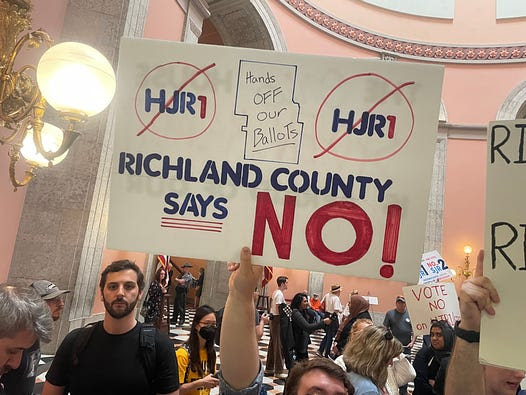
David Pepper describes a stunning victory for democracy in Missouri for outnumbered Democrats. Remember how the Republican-controlled Ohio legislature promoted a referendum called Issue 1 to require all future referenda to get 60% of the vote to pass? They were trying to defeat a referendum on abortion by raising the bar. Voters got wise and defeated the measure. Voters then protected abortion rights with 58% of the vote. Democracy means majority rule, not tampering with the process to defeat majority rule.

On May 18, David Pepper posted this good news on his blog Pepperspectives:

Yesterday proved once again why you never stop fighting for democracy. 

Anywhere. Ever!

For months, Missouri Republicans have been scheming to bring an Issue 1-style attack on direct democracy to their state, where voters have a tradition of using ballot initiatives to exercise their will—including recently expanding Medicaid and legalizing marijuana. And the GOP plan was to sneak the attack through this August, right before a November referendum on reproductive freedom.

You remember Issue 1, right? Where they tried to raise the threshold for constitutional amendments in Ohio to 60%?

Our amazing campaign to crush that monstrosity heated up about a year ago. (Yes, time flies):

Well, as I wrote in “Laboratories of Autocracy,”GOP statehouses always learn from their failures. And adjust. 

And in Missouri, the GOP response was a more sneaky version of Issue 1—where they would’ve required that in addition to a simple up or down vote across the state, a majority of voters in 50% of House districts (you know, highly gerrymandered districts) would have been required for any referendum to gain approval. And that essentially would have locked in a severe form of minority rule even more onerous than a 60% threshold. One study found that as few as 20% of Missouri voters could block an effort under such rules. 

Still, the GOP would’ve falsely insisted that majority rule was still protected. They even tried to add “ballot candy”—such as a ban on non-citizens voting even though they already can’t vote in Missouri—to fool voters into supporting an attack on their own rights. And this could’ve been voted on in August, months before Missouri voters would be voting on an amendment on reproductive freedom in November. 

Overall, it felt like stopping this would be an uphill battle. Downright scary. 

But… 

…Democrats, although outnumbered in Missouri, resisted at every turn. Many more are running this year, bringing accountability to far more sitting incumbents. And current Democratic state senators held the Senate floor in a more than two-day filibuster (the longest in state history) earlier this week.

And yesterday? The Missouri GOP ran out of time. 

The awful, anti-democracy bill died. 

As my friend Jess Piper told me:

“The Freedom Caucus was dead set on stealing one person, one vote. They were beaten by a 50 hour filibuster by Senate Dems and by reading the room. This is the first in their defeats…we’ll also win on the abortion question in November.”

Amazing. Keep going!