Archives for the month of: March, 2024

Laura Hancock wrote at Cleveland.com about the expansion of Ohio’s voucher program. The state now offers a voucher to everyone, but most vouchers are claimed by students who never attended public schools.

COLUMBUS, Ohio – The number of Cuyahoga County students receiving state-funded scholarships to attend private schools has skyrocketed this year after state lawmakers expanded a voucher program, but state data suggests that doesn’t necessarily mean more kids have opted out of public schools.

Across the county’s 31 districts, the number of students receiving tuition payments in the EdChoice-Expansion scholarship  one of five school voucher programs run by the state, and the one lawmakers expanded over the summer to give at least partial tuition payments to families of all income levels— has increased nearly four-fold, from about 2,500 students last year to nearly 9,200 this year.

Those districts, however, have not seen a corresponding loss in student population, indicating that most of the families newly benefitting from the vouchers were already enrolled in private schools, rather than fleeing a school district besieged by violence or bullying, mediocre test scores or other problems.

The data cut against arguments lawmakers and advocates have made over the years that vouchers are necessary to give families a chance to choose private schools over the public school district where they live.

In Rocky River, EdChoice-Expansion scholarships were nearly 20 times higher on Feb. 1 than last year. In Bay Village, they increased 17 times. Westlake’s increase is 14 times higher, according to an analysis of state data by The Plain Dealer / cleveland.com.

The number of students across Ohio who are attending private schools on state-funded scholarships spiked this year because the legislature — in the two-year budget bill signed by Gov. Mike DeWine — removed income eligibility caps for EdChoice-Expansion. Last year, the cap was 250% of the federal poverty level for a scholarship, or $75,000 for a family of four. Now, there are no income caps, although families only get partial scholarships when they earn above 450% of the poverty level, or above $135,000 for a family of four.

Full scholarship amounts are $6,167 for grades K-8 and $8,407 for grades K-12.

Enrollment losses in Cuyahoga County district classrooms, however, are more modest than the jump in private school vouchers. State data shows that families that live in the boundaries of suburban district schools— some of which are among the best performing in the state — but may have never set foot in a public school now are receiving vouchers.

Enrollment in Rocky River City School District fell by just 22 students between last year and this year, even though the number of kids receiving vouchers shot up from 16 to 309. In Bay Village City School District, there are 30 fewer students, despite a voucher jump from 13 to 229. Westlake City School District has 19 fewer students; vouchers in the district spiked from 41 to 581.

In the Cleveland Metropolitan School District, the number of kids receiving EdChoice Expansion vouchers increased from nine to 28 this year, a miniscule number compared against its student population of more than 32,000. But students in Cleveland also are eligible for the Cleveland Scholarship, which has no income caps, and is the oldest in the state, having been established in 1995. As of Feb. 26, there were 8,218 students in the Cleveland Scholarship program.

Open the link to finish the article.

Following a vigorous debate on the blog about the Supreme Court’s decision to reverse Colorado‘a disqualification of Trump from the ballot, our reader Democracy reviews the article in The Atlantic by Laurence Tribe and Michael Luttig. (It is available on The Atlantic website for a free trial.)

Democracy writes:

I don’t know who titled the piece by Luttig and Tribe in The Atlantic, but I thought it was both brilliant and accurate. The title:

“Supreme Betrayal”

These are some of the most compelling passages in the article:

“What ought to have been, as a matter of the Constitution’s design and purpose, the climax of the struggle for the survival of America’s democracy and the rule of law instead turned out to be its nadir, delivered by a Court unwilling to perform its duty to interpret the Constitution as written. Desperate to assuage the growing sense that it is but a political instrument, the Court instead cemented that image into history. It did so at what could be the most perilous constitutional and political moment in our country’s history, when the nation and the Constitution needed the Court most—to adjudicate not the politics of law, but the law of the politics that is poisoning the lifeblood of America.”

Bam!

“As the extraordinary array of amicus briefs filed in Trump v. Anderson made clear, the voluminous historical scholarship exploring the origins of the disqualification clause and its intended operation left no genuine doubt that the Colorado Supreme Court got it exactly right in its decision explaining why the former president was ineligible to ‘hold any office, civil or military, under the United States,’ certainly including the presidency.

The Colorado Supreme Court entered into some extensive fact-finding in declaring Trump an insurrectionist. None of those facts has been questioned, even at the Supreme Court, where the justices just tiptoed around the factual issues and pretended they didn’t exist. Oh, but they did:

https://www.usatoday.com/picture-gallery/news/nation/2021/01/07/front-pages-capture-chaos-riots-us-capitol/6577931002/

Back to Luttig and Tribe, and the three “liberal” justices:

“For Justices Sonia Sotomayor, Elena Kagan, and Ketanji Brown Jackson—who wrote a separate concurrence that in parts read more like a dissent—we can only surmise that any discomfort they felt was outweighed by the extra-constitutional allure of going along with the other justices on the decision’s bottom line and thus enabling the nation’s electorate to work its will, rather than the Constitution’s. Those three justices took the opportunity to distance themselves from at least part of what the Court’s majority did by criticizing its ‘attempts to insulate all alleged insurrectionists from future challenges to their holding federal office.’ Sotomayor, Kagan, and Jackson convincingly dispatched as ‘inadequately supported as they are gratuitous’ the majority’s unnecessary holdings that only Congress can enforce the disqualification clause and that Congress’s implementing legislation must satisfy the majority’s made-up insistence upon ‘congruence and proportionality.’ Those three justices left in tatters much that all the other justices, with the exception of Amy Coney Barrett, wrote about the operation of the disqualification clause against federal officeholders, making plain that the majority’s ‘musings’ simply cannot be reconciled with the Fourteenth Amendment’s language, structure, and history.”

Luttig and Tribe note clearly that there were two “majorities” in this case. There was the 9-0 majority, that some commenters here cling to, and there was the 5-4 majority that went w-a-y too far in insulating Trump from disqualification even though he IS an insurrectionist. And that 9-0 majority? Luttig and Tribe state that the step “that all nine justices took represents a constitutionally unforgivable departure from the fundamental truth of our republic that ‘no man is above the law.’ ”

And that Colorado decision?

“… the week-long trial by the Colorado state court, which had indisputable jurisdiction to consider the matter, undoubtedly more than satisfied the constitutional requirements for disqualifying the former president under Section 3. At that trial, he was afforded every opportunity to defend himself against the charge that he had personally ‘engaged’ in an ‘insurrection or rebellion’ against the Constitution. Not a single justice suggested that the process was less than what the former president was due. That trial ended in a finding by ‘clear and convincing evidence’ that he had not only engaged in that insurrection but had orchestrated the entire months-long effort to obstruct the joint session’s official proceeding, preventing the peaceful transfer of power for the first time in American history. Not a single justice suggested that a more stringent standard of proof was required or that the courts below applied an insufficiently rigorous definition of insurrection. No justice suggested that the First Amendment or anything else in the Constitution shielded the former president from the reach of Section 3.”

And yet they shielded him.

Luttig and Tribe conclude with this:

“Our highest court dramatically and dangerously betrayed its obligation to enforce what once was the Constitution’s safety net for America’s democracy. The Supreme Court has now rendered that safety net a dead letter, effectively rescinding it as if it had never been enacted.”

I’m curious. Is there anyone commenting on this blog who genuinely believes that Trump is NOT an insurrectionist?

MacKenzie Scott received billions of dollars in Amazon stock when she divorced Jeff Bezos. Every year, she gives large awards to mostly worthy groups. Up to now, she has not made a gift to a group that supports public schools. She just gave $2 million to a great organization in Austin, Texas.

I confess that I washed my hands of MacKenzie Scott and her advisors in 2022 when I read that she gave $25 million to Teach for America. TFA undermines the teaching profession by sending in amateurs to teach for two years. Worse, TFA has no financial need. It has way more than $300 million in assets and a long list of overpaid executives. With so many worthy and penniless groups struggling to survive, why enrich a bloated TFA?

But here is a good grant, though much smaller than what Scott gave TFA:

Austin Voices for Education and Youth Receives $2 Million Gift From the Yield Giving Open Call


For Immediate Release


Contact: Allen Weeks, Executive Director, Austin Voices


March 19, 2024

Today, MacKenzie Scott’s Yield Giving announced Austin Voices for Education and Youth as one of the Yield Giving Open Call’s awardees working with people and in places
experiencing the greatest need in the United States.

Austin Voices received $2 million.


Founded in 2003, Austin Voices for Education and Youth creates community collaboration to
strengthen families, support kids and improve schools. We believe our public schools can serve
as powerful hubs for bringing neighborhoods, families and students together to increase equity
and achieve positive change.

More information about Austin Voices, including our most recent Impact Report, can be found at http://www.austinvoices.org.


In March 2023, Yield Giving launched an Open Call for community-led, community-focused
organizations whose explicit purpose is to enable individuals and families to achieve substantive
improvement in their well-being through foundational resources.


“Receiving this generous gift from MacKenzie Scott and Yield Giving will allow us to serve more families in Austin, help more kids succeed in schools, and expand the next generation of student and parent leaders. In a time when schools are squeezed for resources, this gift is tremendously helpful,” says Allen Weeks, Executive Director of Austin Voices for Education and Youth.


The Open Call received 6,353 applications and initially planned for 250 awards of $1 million
each. In the Fall of 2023, organizations top-rated by their peers advanced to a second round of
review by an external Evaluation Panel recruited for experience relevant to this cause, and
underwent a final round of due diligence. In light of the incredible work of these organizations,
as judged by their peers and external panelists, the donor team decided to expand the awardee
pool and the award amount.

“We are excited that our partnership with Yield Giving has resonated with so many organizations,” said Cecilia Conrad, CEO of Lever for Change. “In a world teeming with potential and talent, the Open Call has given us an opportunity to identify, uplift, and empower transformative organizations that often remain unseen.”


More information on the Yield Giving Open Call and other initiatives can be found at


http://www.leverforchange.org.


Yield Giving


Established by MacKenzie Scott to share a financial fortune created through the effort of
countless people, Yield Giving is named after a belief in adding value by giving up control. To
date, Yield’s network of staff and advisors has yielded over $16,500,000,000 to 1,900+ non-
profit teams to use as they see fit for the benefit of others.

To learn more, visit
http://www.yieldgiving.com.


Lever for Change


Lever for Change connects donors with bold solutions to the world’s biggest problems—
including issues like racial inequity, gender inequality, lack of access to economic opportunity, and climate change. Using an inclusive, equitable model and due diligence process, Lever for Change creates customized challenges and other tailored funding opportunities. Top-ranked teams and challenge finalists become members of the Bold Solutions Network—a growing global network that helps secure additional funding, amplify YIELD GIVING OPEN CALL AWARDEE TOOLKIT members’ impact, and accelerate social change. Founded in 2019 as a nonprofit affiliate of the John D. and Catherine T. MacArthur Foundation, Lever for Change has influenced over $1.7 billion in grants to date and provided support to more than 145
organizations. To learn more, visit http://www.leverforchange.org.

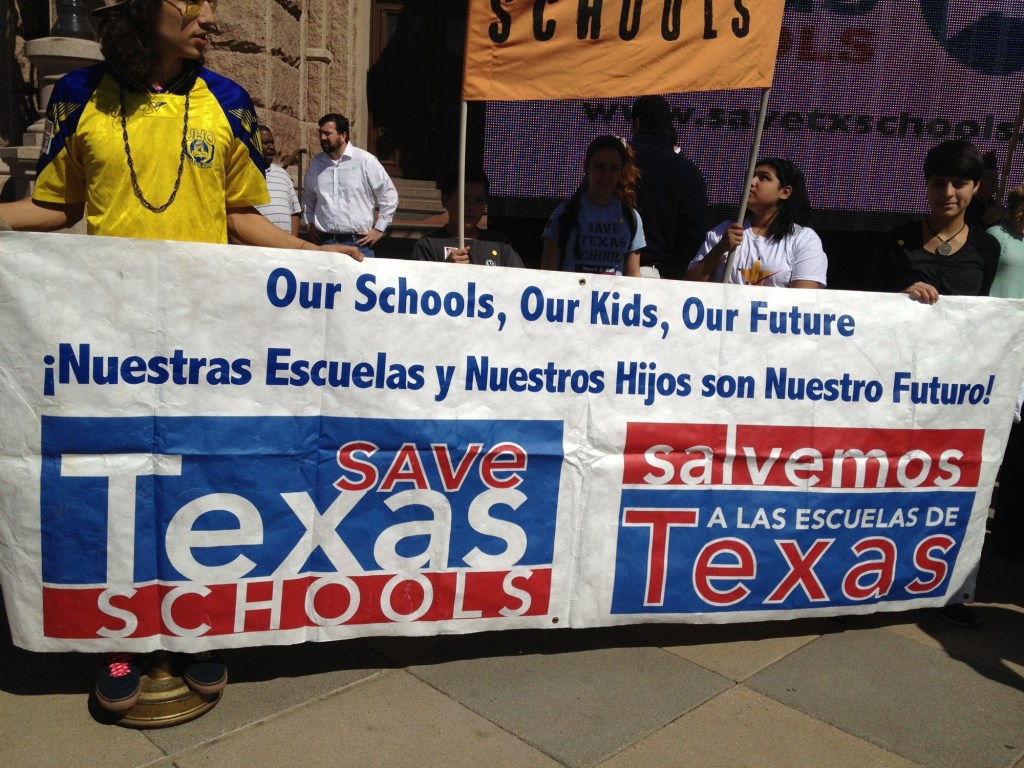
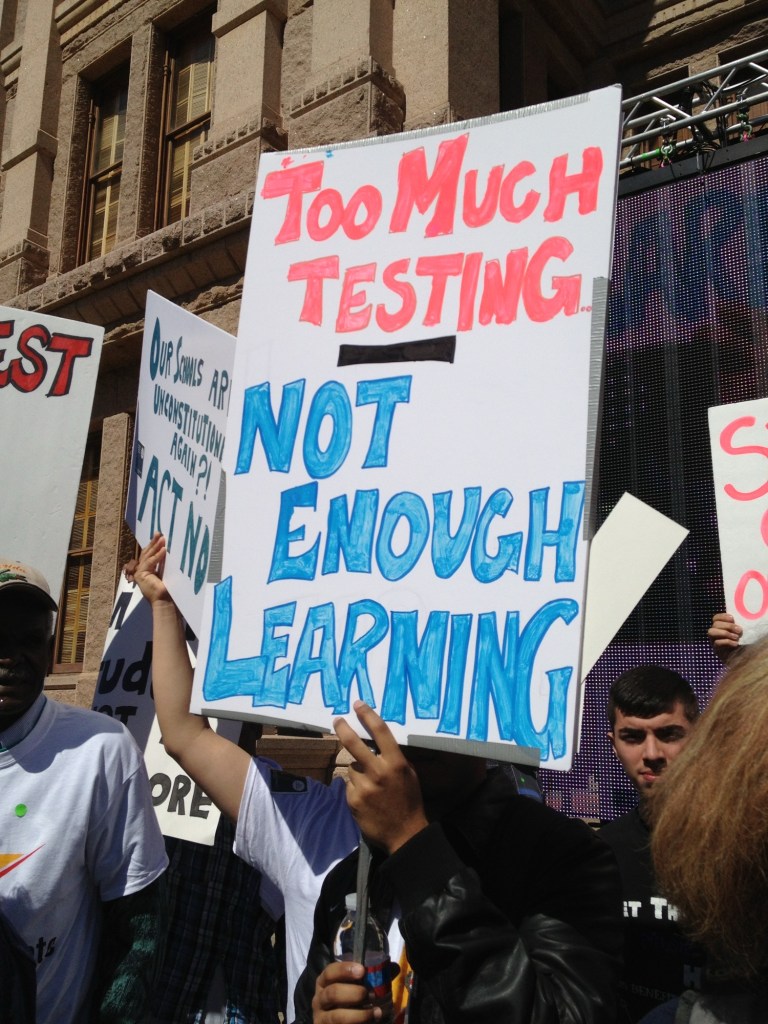
I spoke at Austin Voices for Education and Youth at a rally in front of the State Capitol in 2013
This is Allen Weeks

Mackenzie Scott should give $25 million to Austin Voices for Education and Youth and another $25 million to Community Coices for Education in ZHouston.

Garry Rayno writes about state politics for InDepthNH, a subject he has covered for the past three decades. Here he explains how the old adage that “all politics is local” has been reversed. Now, with the advent of big money, all local politics is influenced by national agendas. Read what he has to say about vouchers. As in every other state, most vouchers are claimed by students already enrolled in private and religious schools. There has been no mass exodus from public schools. In fact, there has been almost no decline in public school enrollment. Taxpayers are now subsidizing families who can afford private schools on their own.

Rayno writes:

CONCORD – You can expect partisan politics to play a larger role in the legislature during the second year of a two-year term.

It is an election year and both parties are hard at work appealing to their bases and defining the other party as the bad guy.

However, the ill-will appears to be growing over the last decade and there is a reason or two for what is occurring.

More and more state legislatures are put in the middle of national issues that once were the purview of the political professionals.

One of the major reasons for the national attention is the US Supreme Court’s Citizens United decision swinging open the doors of the Brinks Trucks to let millions of dollars of outside money pour into a small state like New Hampshire to sway the outcome of elections.

The $1.3 million of campaign funds spent in 2022 on the New Hampshire Legislature by groups affiliated with the Koch Foundation would have been unimaginable before the court’s decision giving corporations first amendment rights as if they were individuals.

The national parties are also reaping the rewards of the decision and in turn spend rigorously to elect their candidates.

All that money investment does not come free as the people contributing expect a hefty return on investment.

Consequently many national wedge issues find their way into the legislative agendas of both parties.

The last few sessions of the House this month reflect some of what there was little of in years past.

For example House Bill 1156, which targets the World Health Organization and the Centers for Disease Control over their guidance during the pandemic and its future guidance coming in a couple of months on pandemics to come.

The contention is that the two organizations put the state’s sovereignty at risk while revisiting the shutdown and masking debates from the pandemic’s greatest impact.

On its own, given the political philosophy of the majority of the Republican House members, it does not appear to be unusual.

But if you Google state sovereignty and WHO and CDC you will see that many other state legislatures have similar if not identical bills before them this year.

The national battle over electronic vote counting machines made it all the way down to town meeting votes this year, although the ban was not very successful, the push has been ongoing since the “Big Lie” over voter fraud in the 2020 election.

The National Republican Party had touted “voter integrity” which really means disenfranchising as many voters as possible before the 2024 election.

House Bill 1569 would do away with the affidavit exemption allowing a person to vote if a registered voter forgot a photo Id or the proper paperwork for same-day registration. That in itself will disenfranchise thousands of voters, and essentially does away with same-day registration, which New Hampshire adopted so it would not have to have motor-voter registration under the Help America Vote Act. 

This change is likely going to court if it passes the Senate and the governor signs it.

The bill also expands the challenged voter provision, which puts the onus on the challenged voter to go to superior court to prove otherwise which means thousands more will be disenfranchised.

Other bills approved by the House last week would shorten the time period for voter purges from the checklist.

On the other side, the House killed House Bill 1364 which would have resulted in criminal charges if someone intimidated an election official, exerted improper influence over the election process or tampered with electronic ballot counting devices.

While that has not been an issue in New Hampshire as it has in some other states, mostly in the south and southwest, you have to wonder why the House killed the bill unless some of what would be illegal is planned for the next election.

Democrats also pushed a bill to have the state join the Election Registration Information Center, which has not interested the state in the past, and was killed last week.

Democrats proposed a series of House resolutions, which indicate the wishes of the legislature, but do not have the weight of law that included universal health insurance, and differentiating between individual and corporate rights (sound familiar).

Perhaps the most costly example of New Hampshire following a national agenda is the Education Freedom Account program, which began three years ago following other nearly identical programs in places like Arizona, Florida, Wisconsin and Louisiana.

A recent study by the Cleveland Plain Dealer of the program in Ohio which greatly expanded its program last year, noted that despite the number of new students in the program, the enrollment in the public schools did not decline, meaning most of the students benefiting from the expansion were already in private schools meaning it’s ultimately a subsidy for parents who already could afford to pay the tuition. 

The study found that about 65 percent of the total grants were private school grants and most were to religious schools.

Those numbers also reflect what the New Hampshire program has seen, that most of the students enrolling in the program were already in private or religious schools, or homeschooling when the program began with 1,635 students in the 21-22 school year and growing to about 4,500 students for the 23-24 school year.

The year before the program began there were 164,918 students in public schools, according to data on the Department of Education’s website, and the first year of the program there were 164,950 students in public schools, the second year, 163,681 and this school year 165,082. [Emphasis added]

That too would indicate that most of the students receiving EFA grants are not leaving public schools to join the program.

The program’s income cap is expected to increase to 500 percent of the federal poverty level, next school year — the House has passed the bill, it is expected to pass the Senate and the governor has said he would sign it.

Parental rights are another issue that has been targeted nationwide by Republicans while Democrats continue to push for raising the minimum wage, which is a national issue since the state did away with its own minimum wage in the 2011-2012 term and moved to the federal rate.

And transgender issues have been before the legislature, particularly for minors, as they have been in many other states.

All the same issues surfacing at the same time would certainly indicate that some groups or organizations are behind the efforts.

And the political parties are also using state legislatures to continue what they hope will be the dividing lines in the upcoming election.

Oh for the days of clashes over education funding and shoreline protection.

But we are still fighting over education funding, but it’s at least our own fight.

Garry Rayno may be reached at garry.rayno@yahoo.com.

Laurence H. Tribe, the eminent professor of constitutional law at Harvard Law School (Democrat), and Judge Michael Luttig, a retired federal judge (Republican), co-authored a lengthy article in The Atlantic, condemning the U.S. Supreme Court’s decision to overrule the Colorado Supreme Court, which removed Trump from the 2024 ballot.

It seemed, after the Court’s decision, that Section 3 of the Fourteenth Amendnent had been excised from the Constitution. But just yesterday the Supreme Court rejected an appeal by a New Mexico man who was convicted for taking part in the January 6 insurrection.

Couy Griffin was convicted for his role as a member of the mob that stormed the U.S. Capitol. Because he previously served as a member of the Otero County board of commissioners, the courts in New Mexico said he was ineligible to hold office ever again. Griffin was a founder of Cowboys for Trump and an outspoken purveyor of lies about election fraud.

The Supreme Court concluded that states could disqualify persons from attempting to hold state offices, but Congress had to enact legislation to implement the disqualification of federal officials.

Since Congress is unlikely to muster a majority of both Houses—or 60 votes in the Senate to avoid a filibuster—oath-breaking insurrectionists will not be barred from seeking or holding federal offices.

One good thing: the Griffin decision implicitly agreed that the mob action of January 6 was an insurrection.

Last week, before the Griffin decision, Tribe and Littig wrote in The Atlantic:

The Supreme Court of the United States did a grave disservice to both the Constitution and the nation in Trump v. Anderson.

In a stunning disfigurement of the Fourteenth Amendment, the Court impressed upon it an ahistorical misinterpretation that defies both its plain text and its original meaning. Despite disagreement within the Court that led to a 5–4 split among the justices over momentous but tangential issues that it had no need to reach in order to resolve the controversy before it, the Court was disappointingly unanimous in permitting oath-breaking insurrectionists, including former President Donald Trump, to return to power. In doing so, all nine justices denied “We the People” the very power that those who wrote and ratified the Fourteenth Amendment presciently secured to us to save the republic from future insurrectionists—reflecting a lesson hard-learned from the devastation wrought by the Civil War.

For a century and a half before the Court’s decision, Section 3 of the Fourteenth Amendment was the Constitution’s safety net for America’s democracy, promising to automatically disqualify from public office all oath-breaking insurrectionists against the Constitution, deeming them too dangerous to entrust with power unless supermajorities of both houses of Congress formally remove their disability. This provision has been mistakenly described by some as “undemocratic” because it limits who may be elected to particular positions of power. But disqualification is not what is antidemocratic; rather, it is the insurrection that is antidemocratic, as the Constitution emphatically tells us.

In any event, all qualifications for office set by the Constitution limit who may be elected to particular positions of power. And no other of these disqualifications requires congressional legislation to become operative, as the Court now insists this one does. To be sure, the other qualifications—age, residence, natural-born citizenship—appear outside the Fourteenth Amendment, whose fifth section specifically makes congressional action to enforce its provisions available. But no such action is needed to enforce the rights secured to individuals by Section 1 of the same amendment, so deeming congressional action necessary to enforce Section 3 creates a constitutional anomaly in this case that the majority could not and did not explain. For that matter, no other provision of the other two Reconstruction amendments requires congressional enforcement either. As the concurring justices explained, the majority “simply [created] a special rule for the insurrection disability in Section 3.”

To read the rest of this brilliant article, open the link or subscribe to The Atlantic.

The Grand Canyon Institute is a nonpartisan nonprofit research organization in Arizona. Its latest report concludes that charter schools are more accountable than vouchers. Vouchers suck up nearly $1 billion a year in public money and are completely unaccountable. Oucher schools are subject to no financial audits, do not have to comply with the state curriculum, and are not audited for academic performance.

Step right up and get your free money, grifters! Courtesy of Arizona taxpayers and GOP legislators!

FOR IMMEDIATE RELEASE

Charters are Accountable, Independent Private Schools are Not Yet nearly a billion public dollars flow to unaccountable private schools

Phoenix —On Monday, the State Board for Charter Schools, a public body, voted unanimously to issue a notice of intent to revoke the charter contract for ARCHES Academy, currently located in Apache Junction.


The school appears to have both academic and financial problems and recently addressed an issue with a fire marshal. This action represents the kind of responsible oversight of charter schools that serves to protect the interests of students, parents and taxpayers.


In sharp contrast, independent private schools are required to have no such oversight, even though they currently receive nearly $1 billion in state public funding. That nearly matches the state general fund support for the state university system. Public funds that support private schools come from redirected general fund dollars through tax credit donations to Student Tuition Organizations and by funds from Empowerment Scholarship Accounts (ESA)/vouchers directly from the General Fund. Last year GCI estimates private school tax credits cost $285 million (the formal report is due by March 31) and ESA/vouchers cost $592 million, so, collectively, nearly $900 million in public support for unaccountable private schools (note: this figure includes an amount for ESA homeschooling). 

The table below uses the case of ARCHES Academy to  contrast charter schools (which are privately owned public schools) with private schools that operate independently with the level of oversight and accountability required.

Please open the link to see the table comparing Arches charter school and private schools receiving vouchers.

For more information, contact:

Dave Wells, Ph.D., Research Director

602.595.1025, Ext. 2, dwells@azgci.org

Michael Tomasky writes for The New Republic. He understands that when Trump goes off-script, as he often does, he becomes incoherent. But whenever he can’t read the teleprompter, he goes to stream-of-consciousness and whatever he says is difficult to decipher. That’s because he tends not to speak in complete sentences and forgets what he was talking about. Trump is obsessed with doom and gloom. If he’s elected, America will be great again, but if he is not elected, the country will continue to be a “third-world country,” a cesspool of despair, a failed state. Ronald Reagan, by contrast, spoke of America as “a city on a hill,” “morning in America,” not a country trapped in “carnage.” Reagan tried to lift spirits. Trump aims to encourage desperation and fear. Trump’s dystopian perspective is always there. He can’t hide it.

Tomasky wrote:

Saturday afternoon, at yet another poorly attended rally in Ohio, Donald Trump spoke these shocking words: “Now if I don’t get elected, it’s gonna be a bloodbath for the whole—that’s gonna be the least of it. It’s going to be a bloodbath for the country, that will be the least of it.”

As is always the case with a man who only finishes about every seventh sentence that he embarks upon, it’s hard on one level to make sense of what he said. In this short clip, you can see that he’s holding forth on the subject of cars and automobile factories. On Sunday, many outlets reported the “bloodbath” line without much in the way of context, which had MAGA world howling on X (f.k.a. Twitter).

CNN’s reporting added more context. Here’s the fuller quote from the CNN story: “We’re going to put a 100 percent tariff on every single car that comes across the line, and you’re not going to be able to sell those guys if I get elected. Now, if I don’t get elected, it’s going to be a bloodbath for the whole—that’s gonna be the least of it. It’s going to be a bloodbath for the country. That’ll be the least of it.”

It does seem that, in that half-finished sentence, he was briefly heading in the direction of saying, “It’s going to be a bloodbath for the whole auto industry.” If he’d said that and stopped there, I’d agree that his words were being taken badly out of context.

Notably, he didn’t stop there. What made him say “that’s gonna be the least of it”? Where was he going, in that mildewed brain of his? He stopped himself mid-sentence. Why? Based on what he went on to say, it’s a reasonable guess that he stopped himself because the words that were about to come out of his mouth, “auto industry,” just weren’t big enough—weren’t aggressive enough. So he had to amplify it and make it more threatening. The auto-industry bloodbath, he said twice, will be the least of it. It will be a bloodbath “for the country.”

Still, maybe he only meant an economic bloodbath. In fact, that’s just typical Trump bluster—built as usual on lies. The Biden economy as we all know reeled from inflation in 2022 and 2023, and that overwhelmed the narrative. Beyond that, the 289,000 jobs gained per month during Biden’s term is the highest for any president in modern history. And I could offer similar huzzahs with respect to wages and GDP.

To drill down to the auto industry, it’s doing far better during Biden’s tenure than it did during Trump’s. In the first place, the auto industry under Trump lost jobs, but here we need to provide the fuller context that those losses came after the pandemic.

Nevertheless, even if we don’t count the pandemic against Trump, the Biden-era numbers easily top the Trump-era numbers. Trump’s pre-pandemic tally saw auto and parts manufacturing employment go up by 27,900. Under Biden, those two categories have gained 127,800 jobs.

Moreover, it shouldn’t go unmentioned that slapping hefty tariffs on certain imports might make for a great applause line at a rally. But outside of the sugar high that comes from that, they pave the way for retaliatory tariffs that hurt U.S. consumers. The U.S.-China Business Council, that well-known outpost of Marxist vermin, estimated in a 2021 study that Trump’s trade policies cost nearly 250,000 American jobs.

So much for the economic bloodbath if he’s not elected. But now let’s cut to the chase.

It is true that many outlets Sunday yanked the “bloodbath” remark out of context. But this is also true: Trump is the king of no context. He speaks in constant half-utterances, uncompleted thoughts, sentences constructed like straw huts in hurricane zones (“Nobody’s been treated like Trump, in terms of badly”), and even facial expressions and grunts…

So: Did Trump call for a bloodbath if he loses? No. However: Did Trump stop himself mid-sentence to broaden his indictment and deliberately use a phrase—not once but two times, for emphasis—that is ambiguous, open to dark interpretation? He most certainly did.

And having done that, he will now, at some future rally, get a little closer to just saying it. And then a little closer, and then a little closer still. By October—still probably without Trump ever saying it outright—the message will have been clearly communicated that any scenario that ends with Trump as the loser, even a clear-cut one that isn’t close enough to dispute, will be one in which the shedding of blood to water the tree of liberty will be necessary…

So let’s not exaggerate what Trump said Saturday. But let’s be clear—it wasn’t just car talk.

In 2022, the U.S. Supreme Court ruled that Maine must pay the tuition of children at religious schools if it pays any private school tuition. Maine has a historic system of paying for students to go to private high schools if their own district does not have a public high school.

The state of Maine insisted that it would not pay tuition to schools that violate the state’s anti-discrimination. The two Christian schools that won the case did not accept LGBT students or students who practice a religion different from that of the church.

The state refused to pay Bangor Christian Academy for violating its human rights law. BCA sued. The court barred then from receiving public funds.

The Christian Post reported:

A Christian school in Maine must adhere to the state’s LGBT antidiscrimination policy to qualify for a state tuition assistance program while the lawsuit against the state continues, a federal judge has ruled.

U.S. District Judge John Woodcock, a George W. Bush appointee, denied a preliminary injunction Tuesday requested by Bangor Christian Schools run by Crosspoint Church, concluding that the church’s lawsuit against assorted state officials is not likely to succeed.

He ruled that Bangor Christian Schools must follow all the Maine Human Rights Act provisions.

“The Court determines that the educational antidiscrimination provisions do not violate the Free Exercise Clause because they are neutral, generally applicable, and rationally related to a legitimate government interest,” wrote Woodcock.

“The Court concludes further that the educational provisions do not violate the Free Speech Clause because they regulate conduct, not speech. Finally, the Court concludes that the employment provisions do not proscribe any constitutionally protected conduct.”

First Liberty Institute Senior Counsel Lea Patterson, who represents Crosspoint, denounced the decision and expressed plans to appeal the ruling.

“Government punishing religious schools for living out their religious beliefs is not only unconstitutional, it is wrong,” said Patterson, as quoted by Bangor Daily News.

In 2022, the U.S. Supreme Court ruled 6-3 in Carson v. Makin that Maine cannot lawfully stop parents from using a state tuition program to send their children to Christian private schools.

The lawsuit that led to the Supreme Court ruling was driven by parents from Bangor Christian School who sued Maine over the ban on state tuition assistance for families sending their children to a private school that includes sectarian aspects in its curriculum.

Jim Hightower is a Texan who represents the best of the state. He blogs at “Jim Hightower’s Lowdown.” This is a terrific post.

In my view, the greatest of America’s “Founding Fathers” was not Washington or Jefferson – nor, technically, he wasn’t even an American. Rather, he was a British immigrant and itinerate agitator for real democracy, enlightenment, and universal human rights.

He was Thomas Paine, a prolific, profound, persuasive, and widely popular pamphleteer in the movement for American Independence. With plain language and genuine passion for the cause, Paine’s 47-page pamphlet, Common Sense, was so compelling in its support of the Revolution that it was passed around from person to person – and even read aloud in taverns! But Paine wasn’t content with democratic rhetoric – he actually believed in an egalitarian society, and his post-revolution writings (including Age of Reason, and Agrarian Justice) unabashedly demanded that the new hierarchy of US leaders fulfill the promise of democracy.

Even before the War for Independence, Paine called for slaves to be freed and slavery prohibited. After the war, he terrified most of the gentlemen of means who’d signed the Declaration of Independence by insisting that non-landowners be eligible to vote and hold office (John Adams was so appalled by this that he decried Common Sense as a “crapulous mess”).  But Paine just kept pushing, calling for women’s suffrage, progressive taxation, state-funded childcare, a guaranteed minimum income, universal public education, strict separation of church and state, and adoption of some of the democratic principles of the Iroquois Nation.

This is Jim Hightower saying… Don’t tell small-minded, right-wing demagogues like Ron DeSantis and Greg Abbott – but Thomas Paine was WOKE! Some 250 years before their push to impose autocracy, plutocracy, and theocracy over us, this revolutionary founder championed social justice and economic fairness. As one historian noted, “we are today all Paine’s children,” for he imbued America’s destiny with democratic impulse and aspiration.

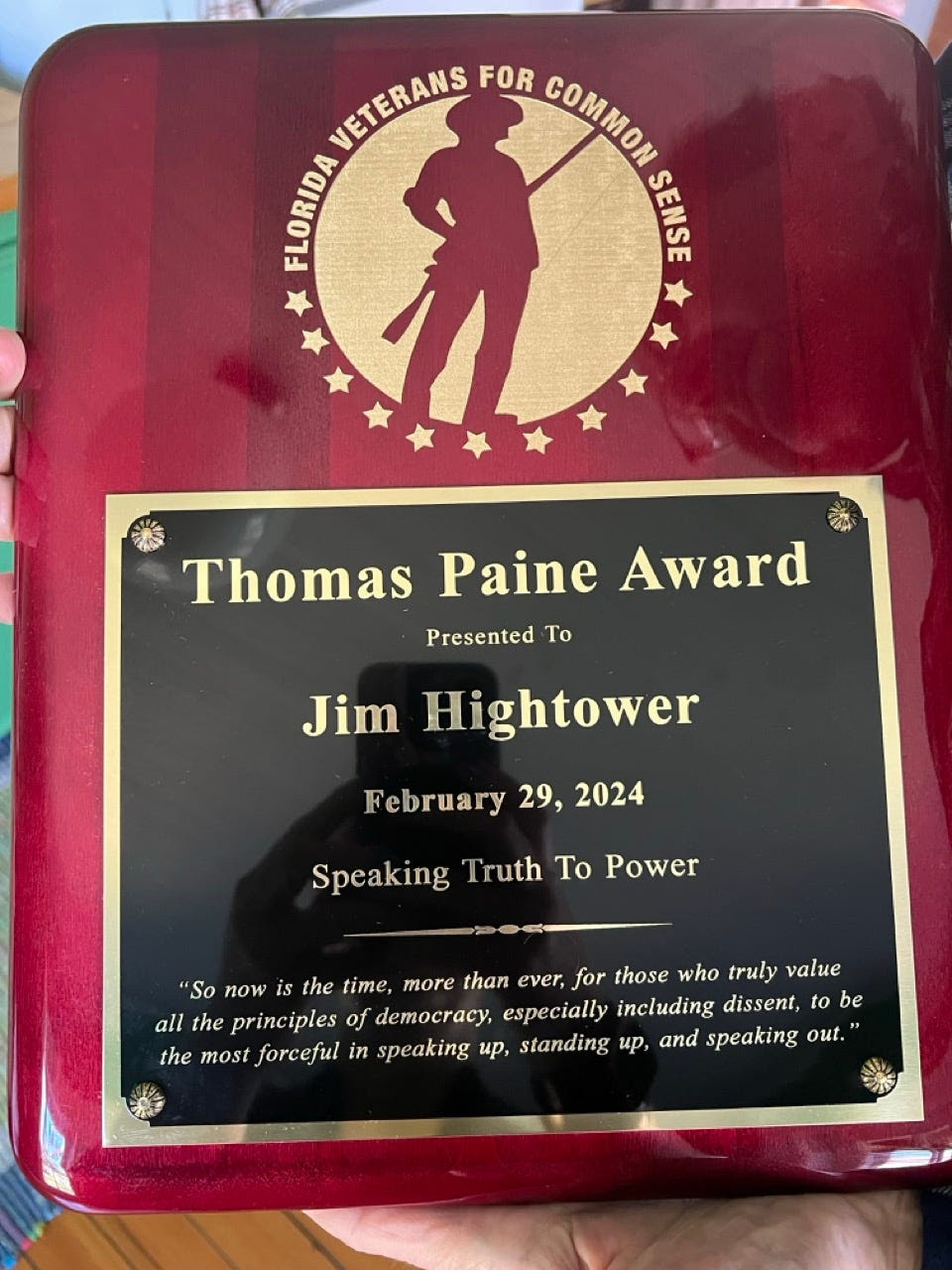
PS, from the staff— Hightower was recently give the Thomas Paine award by the Florida Veterans for Common Sense, where he learned a ton about Paine that he never knew. Hence the inspiration for this commentary! Thanks FLVCS!

Jim Hightower’s Lowdown is a reader-supported publication. To receive new posts and support my work, consider becoming a free or paid subscriber.

Subscribed

Thanks again for being a paid subscriber to the Lowdown. If you like the work we do here, please consider referring your friends— you’ll earn credits towards your own subscription when they sign up. 

Refer a friend

Or consider giving the gift of agitation! A Lowdown subscription makes a great gift:

Give a gift subscriptionLIKECOMMENTRESTACK

© 2024 Jim Hightower
PO Box 40446 Austin TX 78704 
Unsubscribe

Start writing

John Thompson, historian and teacher, asks who was responsible for the death of Nex Benedict. In this article in The Progressive, he blames the hateful anti-rhetoric of Oklahoma’s elected officials. The officials concluded that Nex committed suicide. Who created the environment in which this child was tormented by classmates?

He writes:

We are learning more about the death of Nex Benedict, a non-binary high school student who died on February 8, the day after they were beaten in the school bathroom in Owasso, Oklahoma. We are also learning about ourselves, as Oklahomans, as we deal with the tragedy. But we are not alone. This bitter attack is a case study in the cruelty being spread across the nation by right-wing extremists. 

Vigils were held across the nation in honor of Nex, who has a Choctaw heritage. The diverse crowd I witnessed at the Oklahoma City vigil was so large that I could barely hear the speakers. We still don’t fully know everything about Nex’s death, but it is clear that it must be viewed within the context of vicious attacks on LGBTQ+ youth by State Superintendent of Public Instruction Ryan Walters and Governor Kevin Stitt as well as the fifty-plus Republican legislative bills attacking LBGTQ+ rights across the country.

Since he was elected in 2019, Governor Stitt has signed laws that restrict access to public school bathrooms; ban health care for transgender people under eighteen; ban transgender girls and women from school sports; and prohibit Oklahomans from obtaining nonbinary gender markers on official documents. He also signed, as the LGTBQ+ rights group GLAAD reported, “an executive order that defunds diversity, equity, and inclusion offices and programs in state agencies, including public colleges.”

Walters has a similar record: He has depicted transgender students as a threat in schools, and approved a permanent rule change that requires schools to get state approval before altering gender markers in a student’s records. Walters has advocated for book bans and described LGBTQ+-themed books as “pornographic material.” He also appointed Chaya Raichik, the founder of anti-LGBTQ+ social media account Libs of TikTok, to the education department’s Library Media Advisory Committee.

Beyond Walters and Stitt, state representatives have also spread hateful rhetoric in recent months. State Senator Tom Woods, for example, called LGBTQ+ Oklahomans “filth” during a panel. Days later, Woods chose to stand by his statement, saying:   

We are a religious state and we are going to fight it to keep that filth out of the state of Oklahoma because we are a Christian state—we are a moral state . . . . We want to lower taxes and let people be able to live and work and go to the faith they choose. We are a Republican state and I’m going to vote my district, and I’m going to vote my values, and we don’t want that in the state of Oklahoma.