The coroner of Clark County, Nevada, positively identified the body of Matthew Livelsberger as the driver of the Tesla cybertruck that exploded at the front door of the Trump Hotel in Las Vegas. Livelsberger was a highly decorated soldier who lived with his wife and child in Colorado Springs, Colorado. Investigators have traced his movements from Colorado Springs to the Trump Hotel.
Wednesday morning, a Tesla electric Cybertruck rented in Denver and filled with consumer-grade firework mortars and camp-fuel canisters exploded outside the Trump International Hotel Las Vegas, just 17 seconds after pulling into the valet area. The explosion left seven people with minor injuries.
The body recovered from the metallic truck was “burnt beyond recognition,” Sheriff Kevin McMahill of the Las Vegas Metropolitan Police said during a news conference on Thursday.
But police announced hours later that the Clark County, Nevada, coroner positively identified the driver as 37-year-old Master Sgt. Matthew Alan Livelsberger of Colorado Springs.
Livelsberger died by suicide, the corner ruled. Police investigators said he shot himself moments before the explosion outside the Las Vegas hotel. A handgun was found near his feet inside the burned-out vehicle.
It wasn’t yet clear how Livelsberger detonated the explosives in the back of the Cybertruck, investigators said. But Kenny Cooper, assistant agent in charge of the Bureau of Alcohol, Tobacco, Firearms and Explosives’ San Francisco Field Division, said they did little damage, and a number of unexploded fuels and mortars were found in the truck.
“The level of sophistication is not what we would expect from an individual with this type of military experience,” Cooper said during Thursday’s news conference.
Damage from the blast inside the steel-sided vehicle was mostly limited to the interior of the truck because the explosion “vented out and up” and didn’t hit the Trump hotel doors just a few feet away, the sheriff said.
Livelsberger’s military ID, passport, phone, credit cards and a smart watch were found in the vehicle, alongside two guns he bought this week, McMahill said. Livelsberger rented the Cybertruck in Denver on Dec. 28 and drove it to Las Vegas, McMahill said.
Local FBI agents searched Livelsberger’s home in northeast Colorado Springs on Thursday as they began to piece together his movements and dig for a motive — which they have yet to find.
“We know we have a bombing, absolutely, and it’s a bombing that certainly has factors that raise concerns,” Las Vegas FBI Special Agent in Charge Spencer Evans said during the news conference. “It’s not lost on us that it’s in front of the Trump building and that it’s a Tesla vehicle, but we don’t have information at this point that definitively tells us… it was because of this particular ideology or any reasoning behind it.”
A law enforcement official told the Associated Press that investigators learned through interviews that Livelsberger may have gotten into a fight with his wife about relationship issues shortly before he rented the Tesla and bought the guns. The official spoke on the condition of anonymity because they were not authorized to discuss the ongoing investigation.
Decorated solider, normal life
Livelsberger’s neighbors on Thursday described him, his new baby and his wife as normal by all appearances. A welcome mat at their home encourages visitors to “Stay awhile,” and a Christmas wreath hung on the door Thursday.
The couple’s home was well-lit and they often opened their windows when the weather was pleasant, neighbor Keni Mac said.
“It doesn’t seem like they were trying to hide anything,” she said.
Livelsberger was a decorated soldier who previously deployed twice to Afghanistan, served in the National Guard and split most of his time between Fort Carson in Colorado Springs and Germany, McMahill said.
He served in the Green Berets, highly trained special forces who work to counter terrorism abroad and train partners, the Army said in a statement. He had served in the Army since 2006, rising through the ranks with a long career of overseas assignments, deploying twice to Afghanistan and serving in Ukraine, Tajikistan, Georgia and Congo, the Army said.
He was awarded a total of five Bronze Stars, including one with a valor device for courage under fire, a combat infantry badge and an Army Commendation Medal with valor.
Livelsberger currently served as a special operations soldier assigned to 10th Special Forces Group in Stuttgart, Germany, but was back in Colorado on approved leave, according to the Army’s statement and the sheriff. Neighbors said he’d recently had a baby.
Investigators on Thursday outlined his movements in the days before the bombing.
Livelsberger rented the Cybertruck through the car-rental app Turo in Denver on Dec. 28. Police then tracked him on his multi-state road trip through his stops at Tesla charging stations along the way, McMahill said.
He charged the vehicle in Monument on Dec. 30, then in Trinidad on Dec. 31. He charged at three spots in New Mexico later on Dec. 31. On Jan. 1, he charged in three cities in Arizona and was last tracked in Kingman, Arizona, before entering Las Vegas.
Camera footage shows Livelsberger was the man driving the truck and no one else was seen in the vehicle, McMahill said.
“We’re not aware of any other subjects involved in this particular case,” the sheriff said.
He legally purchased two semi-automatic handguns on Dec. 30 — guns later found in the Cybertruck, the ATF’s Cooper said. Officials did not say where he bought the guns.
On Wednesday, cameras captured the Cybertruck driving to the Trump hotel valet at about 7:35 a.m. The driver quickly pulled away and spent 45 minutes in a parking lot at a nearby business before driving back to the hotel, arriving at 8:39 a.m. The explosion immediately followed.
Colorado Gov. Jared Polis holds up a copy of Project 2025 as he speaks during the Democratic National Convention Wednesday, Aug. 21, 2024, in Chicago. (AP Photo/J. Scott Applewhite)
Polis, a Democrat, faced quick pushback on social media after he said he was “excited” by President-elect Donald Trump’s selection, and he posted againan hour later to clarify his thoughts. A spokesman for the governor then further walked back Polis’ support for Kennedy in a statement to The Denver Post.
Kennedy has pushed a number of public health conspiracies, most prominently around vaccines, and has advocated for other positions that are generally out of the mainstream, such as more availability of unpasteurized milk. He has said he wants to remove fluoride from the American water supply, and when he ran for president, he said he wanted to pause research into pharmaceuticals and infectious diseases for at least eight years.
He has falsely suggested that COVID-19 was “ethnically targeted” to “attack” certain groups and that mass shootings have been caused by prescription drugs, among other debunked conspiracy theories.
Kennedy has adopted some mainstream health positions, such as limiting ultra-processed foods and the use of pesticides in growing crops. Polis, citing specific quotes by Kennedy, focused on those latter views in his first post Thursday afternoon on the social platform X.
“‘In some categories, there are entire departments, like the nutrition department at the (Food and Drug Administration) that are — that have to go, that are not doing their job, they’re not protecting our kids,” Polis quoted Kennedy as saying, then added himself: “YES! The entire nutrition regime is dominated by big corporate ag rather than human health and they do more harm than good.”
Polis — who’d previously criticized Kennedy’s anti-vaccine stances this summer — acknowledged those positions in his posts Thursday but urged his 136,000 X followers to hold off on mocking or disagreeing with Kennedy.
He said Kennedy had “helped us defeat vaccine mandates in Colorado in 2019.” He was referring to a defeated legislative measure that would have made it harder for parents to opt out of vaccine mandates for public schools.
Polis wrote that he hoped Kennedy would make vaccines a matter of choice, not about bans or requirements.
Polis’ comments drew swift backlash. Outgoing state Rep. David Ortiz, a Littleton Democrat, called the governor’s endorsement “pathetic pandering.” Rep. Javier Mabrey, a Denver Democrat, quipped on X: “Yikes.” Shad Murib, the chair of the Colorado Democratic Party, tweeted “Welp” shortly after Polis’ comments, and he subsequently criticized Kennedy’s conspiratorial history in a Thursday evening statement from the party.
Sen. Kyle Mullica, a Thornton Democrat and emergency room nurse, was blunter.
“This is just complete bullshit,” he said in an interview, and then repeated that point for emphasis.
Mullica rejected Polis’ suggestion that state officials had sought vaccine mandates in the past. He said legislators worked to improve immunization rates through medical exemption reform and through education. Polis previously supported parents’ ability to opt out of vaccinations — drawing support from anti-vaccine advocates — despite the state’s poor rankings for pediatric immunization.
“The biggest thing is — look, science matters, man,” Mullica continued. “And with all the disinformation and misinformation that’s being put out by people like RFK Jr. and the internet, we need leaders who can stand up, follow the science, understand it and (make) sure we are making decisions based on evidence and science.”
Asked why Polis endorsed Kennedy in light of his often-conspiratorial stances, a spokesman for the governor responded by referring to a subsequent Polis social media post. The spokesman, Eric Maruyama, then issued a statement distancing the governor from the controversial figure he had just backed.
Maruyama wrote that Polis “does not endorse actions that would lead to measles outbreaks and opposes unscientific propaganda.”
“Governor Polis has not changed his view as a whole on RFK Jr. or on the Governor’s previously stated concerns regarding some of RFK Jr’s positions,” Maruyama wrote. “While opposed to RFK’s positions on a host of issues, including vaccines and banning fluoridation, (Polis) would appreciate seeing action on pesticides and efforts to lower prescription drug costs and if Trump is going to nominate someone like him then let them also take on soda, processed food, pesticides and heavy metals contamination.”
It’s looking like Coloradans have rejected an effort to enshrine school choice in the state Constitution.
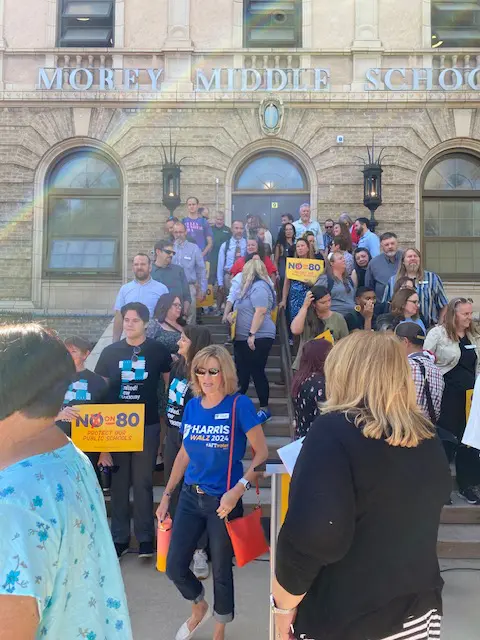
As of 9:45 p.m., Amendment 80 was losing, with 52 percent opposed to 48 percent in support. This measure, which would have been the first of its kind in the nation, needs 55 percent of the vote to go into the state constitution.
It would have added language stating each “K-12 child has the right to school choice” and that “parents have the right to direct the education of their children.” It explicitly named charters, private schools, home schools and “future innovations in education” as options guaranteed by the state constitution.
Opponents celebrated the amendment’s apparent defeat.
“We find it really encouraging that people understand what this ballot measure was really trying to do, which was to create a pathway for a private school voucher system,” said Kevin Vick, president of the Colorado Education Association. “And we’re also really encouraged that Colorado voters really value public schools and don’t want to see that happen.”
A legislative analysis concluded that the measure would have no immediate impact on education in Colorado but could have opened the door to future changes to laws and funding for education.
Vick said the vagueness of the measure would have created a “legal quagmire,” which he said, in a worst-case scenario could have meant millions of dollars taken out of the public education system.
The battle over the measure drew millions of dollars from both sides and complaints against proponents alleging deceptive campaign practices. Amendment 80 was a nuanced ballot issue and difficult for many to understand.
When Denver voter Kyle Slusher first read Amendment 80, he thought giving children options would be a good thing.
“But if it is actually just creating a lane for private schools to take from public school funding, that’s not obviously something that needs to be occurring,” he said.
After doing more research he changed his mind and voted “no.”
Advance Colorado, a conservative action committee that doesn’t disclose its donors, proposed the amendment. They argued Amendment 80 would protect families’ right to choose the school — public, private or home school — that they deem is the best fit for their child. It was also backed by Ready Colorado, the Colorado Catholic Conference and the Colorado Association of Private Schools.
The measure was opposed by a coalition that included the Colorado Education Association, the Colorado PTA, the Christian Home Educators of Colorado, Colorado Democrats, Stand for Children, the ACLU Colorado and others.
School choice is popular in Colorado, with nearly 40 percent of public school students choosing a school outside their assigned neighborhood school. The 30-year-old school choice law has bipartisan support. Critics of the measure argued that the constitutional amendment wasn’t needed because laws giving Coloradans the right to attend the school of their choice for free already exist.
But proponents worried about what they said were increasing attempts to erode choice by local school boards, the state legislature and the State Board of Education. Proponents said Amendment 80 would be a backstop to any legislative attempt to reverse decades of bipartisan work to expand choice for students.
I have been puzzling over this question since the Democratic National Convention.
Like most people, I didn’t know much about Kamala Harris when she became Vice President. Now that I have seen her speak, now that I saw her debate Trump, I feel very energized to support her campaign for the Presidency.
She is smart, well informed, experienced, committed to the U.S. Constitution and the rule of law. She is thoughtful and composed. She laughs, she smiles, she seems like a kind and thoughtful person. She is well prepared for the presidency, having won election as the District Attorney of San Francisco, as Attorney General of the State of California, as U.S. Senator from California, and as Vice-President of the United States since Joe Biden and she were elected in 2020.
Her opponent is a bundle of equal parts narcissism and hatred. He likes men. He likes white men. He likes to play tough guy. He looks on women as sex objects and feather heads. He doesn’t respect women.
He is crude, vulgar, without a shred of the dignity we expect from a president. The language he uses to ridicule and insult others is vile.
He is a racist, a misogynist, a xenophobe, and a Christian nationalist (without being a practicing Christian).
He is a sexual predator. He is known for not paying people to whom he owes money for services rendered. He has gone through six bankruptcies.
He is ignorant. His former aides say he has never read the Constitution. He is driven by his massive ego. He wants everyone to say he’s the best, the greatest, and there’s never been anyone as great as him.
He is a convicted felon, convicted on 34 counts of business fraud in New York. He was found guilty by a jury in New York of defaming E. Jean Carroll, who accused him of sexually assaulting her many years ago. He was ordered to pay her more than $90 million for continuing to defame her. That judgment is on appeal.
Other trials are pending.
When he lost the 2020 election, he refused to accept his defeat. He schemed to overturn the election by various ploys. He summoned a mob of his fans to Washington on January 6, 2021, the day that Congress gathered for the ceremonial certification of the election. Trump encouraged them to march on the U.S. Capitol, “peaceably….(but) fight like hell.” They did fight like hell. They battered their way into the Capitol, smashing windows and doors, beating law officers, vandalizing the building and its offices, while hunting for Vice President Mike Pence and Speaker Nancy Pelosi. The outnumbered law officers held them off to protect the members of Congress. Many of them were brutally beaten. Some later died. What if the mob had reached the members of Congress? What if they had captured Pence and Pelosi?
It was the most shameful day of our national history. A President encouraging a mob to sack the Capitol and overturn the Constitution.
Ever since that disgraceful day, Trump has reiterated that the election was stolen from him, even though it wasn’t close. He has undermined faith in the electoral process, faith in the judiciary, faith in the law.
These are the two candidates: Kamala Harris and Donald Trump.
Colorado voters, beware! On the November 5 ballot: an amendment to the State Constitution to protect school choice.
If you want to support public schools and a raid on the state’s treasury by privatizers, defeat it!
This proposed amendment is weird. Ever since the founding of this nation, states have had explicit pledges in their constitution to protect public schools, open to all. Colorado’s state Constitution includes such language as well as language explicitly rejecting public funding for religious schools.
Article 9, Section 2 of the Constitution says:
Section 2. Establishment and maintenance of public schools. The general assembly shall, as soon as practicable, provide for the establishment and maintenance of a thorough and uniform system of free public schools throughout the state, wherein all residents of the state, between the ages of six and twenty-one years, may be educated gratuitously.
Article 8, Section 7 of the Constitution says:
Section 7. Aid to private schools, churches, sectarian purpose, forbidden. Neither the general assembly, nor any county, city, town, township, school district or other public corporation, shall ever make any appropriation, or pay from any public fund or moneys whatever, anything in aid of any church or sectarian society, or for any sectarian purpose, or to help support or sustain any school, academy, seminary, college, university or other literary or scientific institution, controlled by any church or sectarian denomination whatsoever; nor shall any grant or donation of land, money or other personal property, ever be made by the state, or any such public corporation to any church, or for any sectarian purpose.
Now, the privatizers want to cancel that language and replace it with language chartering what was previously forbidden.
On November 5, 2024, Colorado voters will weigh in on a hot topic in education today: school choice. Amendment 80 would make the concept of “school choice” a guaranteed right in the Colorado constitution. The text of the amendment reads as follows:
(1) PURPOSE AND FINDINGS. THE PEOPLE OF THE STATE OF COLORADO HEREBY FIND AND DECLARE THAT ALL CHILDREN HAVE THE RIGHT TO EQUAL OPPORTUNITY TO ACCESS A QUALITY EDUCATION; THAT PARENTS HAVE THE RIGHT TO DIRECT THE EDUCATION OF THEIR CHILDREN; AND THAT SCHOOL CHOICE INCLUDES NEIGHBORHOOD, CHARTER, PRIVATE, AND HOME SCHOOLS, OPEN ENROLLMENT OPTIONS, AND FUTURE INNOVATIONS IN EDUCATION. (2) EACH K-12 CHILD HAS THE RIGHT TO SCHOOL CHOICE.
According to University of Southern California Professor Guilbert Hentschke, “school choice has become a catch-all label describing many different programs that offer students and their families alternatives to publicly provided schools.” Since school choice covers many options, it can be confusing, and it is often the “subject of fierce debate in various state legislatures across the United States.” The critical distinction to make regarding school choice is often whether it affects public or private schools.
School choice has been the mantra for voucher-systems currently enacted in at least twenty states. School choice with voucher-type legislation entails using taxpayer dollars for education savings accounts, opportunity scholarships, tax credits, or actual vouchers so families can choose any type of schooling for their child — private, public or home schooling. This idea represents an emphasis on “funding students instead of funding school systems.”
The focus on school choice has resulted in increased enrollment in charter schools, private schools, and home schooling. At the same time, the school choice movement has also created instability, competition, ideological curricula, resource inequities, increased segregation, loss of community, and reduced funding for public neighborhood schools. In Colorado, of all eligible school-age children, about 76% attend public schools, 15% attend charter schools, 8 percent are in private schools, and 1% are homeschooled.
Advance Colorado is the conservative think tank organization that developed the language for Amendment 80, and they coordinated the expensive signature gathering to secure approval for the measure, originally titled Initiative 138. The backers acknowledge that parents already have the right in state statute to “send their kids to a neighborhood school, charter school, private school, home school, or across district lines.”
Advance Colorado’s solution to the “problem” of legislators promoting charter accountability is to put “the right to school choice in the Colorado Constitution” which they assert will give school choice “legal advantages a normal statute does not have.” Over fifty highly paid lobbyists were assigned to kill the charter accountability bill which was publicly opposed by Governor Polis, and was defeated in the House committee.
Even though Advance Colorado states its goal is to protect the charter schools from future legislative interference, Amendment 80 encompasses “private and home schooling” options. Including “private schools as a guaranteed right” is a plan promulgated by Americans for Prosperity and other conservative think tanks in several red states where voucher bills have been passed or expanded. Fields said he thinks “parents should be in charge of education,” adding “I think it’s easier when they have resources to send their kid to the school that they want to.”
Colorado State board of education members Lisa Escárcega and Kathy Plomer wrote in a September 11 op-ed that Amendment 80 is “not just about school choice.” They cautioned that “Amendment 80, brought by wealthy, in and out-of-state organizations, is part of a nationally coordinated master plan to go around voters in states where voucher proponents have been unsuccessful in passing state voucher laws.” They pointed out that in Colorado, “voters turned down three education voucher ballot initiatives in the 1990s.Voucher and private school proponents then tried the legislative route. The Colorado legislature has turned down any type of voucher or education savings account 18 times just since 2016.” While the amendment doesn’t mention vouchers, the state board members expressed their concern that “If parents have a right to send their children to private schools, then shouldn’t the state pay for it?”
Using public taxpayer dollars for children to attend private schools or for home schooling is not legal in Colorado, nor is it currently popular. (They can get some indirect support.) Kevin Welner of the National Education Policy Center stated that “it would be hard to persuade voters or politicians that Colorado should join the ranks of states that provide taxpayer subsidies for private schools or homeschooling.”
Even though Fields insists this amendment “is not paving the way for a voucher program in Colorado,” the far-right conservative groups providing the money to promote Amendment 80 have tried to enact vouchers in Colorado for years.
Vouchers are not necessarily an effective system to improve student learning and according to recent research, they can hinder state budgets significantly. Josh Cowen, senior fellow at the Education Law Center, pointed to decades of evidence showing private school vouchers have led to some of the steepest declines in student achievement on record. He added that measures similar to Amendment 80 passed in Arizona, Florida and Ohio have led to serious budget cuts.
Who is funding this effort to enshrine “school choice” in the state constitution?
In an op-ed about Advance Colorado last year, Colorado Newsline editor Quentin Young wrote that “Coloradans don’t know who’s supplying its money or their true motivations, because nonprofits don’t have to disclose their donors.” Advance Colorado is the same “dark money group” that gathered signatures for Initiative 108, which would have forced over $3 billion in cuts to services to citizens.
Advance Colorado started as “Unite for Colorado” in 2019, which bankrolled almost every major Republican effort in Colorado in 2020. Unite for Colorado spent over $17 million in 2020 on Republican candidates, and they have “become the most important fundraising entity for conservatives and for Republicans,” said Dick Wadhams, a former chairman of the Colorado GOP. Unite for Colorado changed its name to Advance Colorado Action in 2021 due to questionable conflicts over its spending practices, which are still in litigation.
As a “dark money group,” Advance Colorado receives grants from many sources, most of which are unknown, yet there is evidence that connects Advance Colorado to several conservative organizations. There are also reports that tie the group to Phillip Anschutz, Colorado’s richest billionaire. According to Cause IQ, between 2020-2023, over $28 million was funneled to Unite Colorado/Advance Colorado from the Colorado Stronger Alliance.
Colorado Dawn was formed in 2021 to “support organizations who further the efforts to educate the public about western values and economics,” and it has received over $3 million from Unite Colorado (Advance Colorado). Tax records from the Colorado Dawn’s 2022 990’s list state Board of Education member Steve Durham as chairman, Senator Paul Lundeen as Vice-chairman, and Michael Fields as Treasurer. Lundeen announced in 2022 his hopes that Colorado would enact a voucher program after the Supreme Court “cleared the way for public dollars in a Maine tuition assistance program to flow to private religious schools.” The Colorado Secretary of State’s office indicates that Colorado Dawn spent over $1.3 million to collect signatures for Amendment 80.
On Sept 13, 2024, the CEA announced its opposition to Amendment 80 at a press conference in Denver. A coalition of various representatives from across the state, the National Education Association, and the ACLU described their main reasons for opposing Amendment 80.
The speakers at the press conference emphasized that the amendment is unnecessary because school choice is already protected in law and has been for 30 years. In addition, they stated that the amendment opens the door to taking money from public schools to fund private schools. Speakers stressed that funding private schools would drain money away from rural public schools, private schools pose significant civil rights concerns, and they don’t belong in the Constitution.
In interviews with Chalkbeat, several education experts weighed in on the wording in Amendment 80, indicating it could create years of “litigation” order to interpret the amendment’s misleading language, which Kristi Burton Brown also acknowledged in her interview with KOA radio.
Currently, the following groups are opposing the measure: ACLU of Colorado, AFT Colorado, Colorado Fiscal Institute, CEA, The Colorado Association of School Executives (CASE), AFSCME, Advocates for Public Education Policy, Business and Professional Women of Colorado, Colorado Immigrant Rights Coalition, League of Women Voters Colorado, Soul 2 Soul Sisters, Bell Policy Center, Colorado PTA, One Colorado, United for a New Economy, Colorado Democratic Party, American Association of University Women, Colorado WINS, Colorado AFL-CIO, Stand for Children, and New Era Colorado Action Fund.
Colorado voters will need to decide which rationale they support regarding this school choice amendment. Will they agree with Advance Colorado that a constitutional amendment is necessary to ensure that the legislature will not update current charter school laws? Or will they believe that Colorado does not need to go the route of other states and create a pathway to use public funding for private and home schools?
************************************
Mike DeGuire, Ph.D., has been a teacher, district level reading coordinator, and a principal in the Denver metro area for most of his education career.
The following article was written by Beckie Mostello. Beckie Mostello is a public education parent and a former school teacher in Jefferson County Public Schools, Colorado. She has advocated for supportive public education policy for several years and has volunteered with several campaigns to support public education. She currently sits on the advisory board for Advocates for Public Education Policy based in Colorado.
She writes:
On September 12, 2024, the Thomas B. Fordham Institute published an article about Philanthropy Roundtable’s Civics Playbook supported by Denver, Colorado-based Daniels Fund. The Philanthropy roundtable is a non-profit organization that advises conservative philanthropists and advocates for philanthropic freedom and donor privacy.
Two key takeaways from the Fordham Article…
“I’m a huge fan of the Daniels Fund under the leadership of Hanna Skandera, the more so since the national part of their giving has grasped the nettle of civics education. And we at Fordham were longtime members of the Philanthropy Roundtable. (For a time, I served on its board.) So it was great to see funder and Roundtable recently teaming up to develop an online “playbook” for philanthropists wanting to “enhance” civics education around the country.”
“As for what is included, it’s no secret that the Roundtable leans right—amusing when you picture a leaning round table—and that ideology sometimes influences its choices. That’s not the case with most of the groups found in the current Playbook, though the National Association of Scholars’ “Civics Alliance,” which produced a useful draft of state social studies standards, is somewhat tarnished by its executive director’s propensity to engage in cultural warfareagainst other organizations (the Fordham Institute included).”
Over the past few years, Civics Alliance’s American Birthright Social Studies Standards has been a controversial topic at school board meetings in Colorado. In 2022, the Colorado State Board of Education rejected Civics Alliance’s American Birthright Standards; however, because Colorado has extreme local control regarding education, the Woodland Park conservative School Board majority adopted American Birthright Social Studies Standards. Since adopting these standards and passing other extreme board policies, the Woodland Park, Colorado, community has become divided.
At this time, Woodland Park School District is the only Colorado school District that has adopted American Birthright Social Studies Standards; however, a second school district, Garfield Re-2 came close to adopting American Birthright Social Studies Standards. In 2023, the Garfield Re-2 School Board President proposed that the Garfield Re-2 School Board should also adopt American Birthright standards. The Garfield Re-2 School Board did not adopt American Birthright standards and as a result of the American Birthright proposal, the Garfield Re-2 School Board President, who suggested that Garfield Re-2 School Board adopt American Birthright Standards, was recalled.
It is clear that Civics Alliance’s American Birthright Social Studies standards are not widely implemented in Colorado, and evidence from the Garfield Re-2 School community shows that American Birthright standards are unpopular in Colorado. Therefore, it is concerning that the Philanthropy Roundtable and Denver-based Daniels Fund have listed Civics Alliance in the Civics Playbook, neither of these organizations is fully aware of the pushback against Civics Alliance’s Social Studies Standards, curriculum and policies.
Peter Greene examines a proposed amendment to the state constitution in Colorado and its whacko implications. He urges voters to say NO.
He writes:
While other states are stumbling over constitutional language that aims public dollars at public schools (e.g. South Carolina and Kentucky), voucher fans in Colorado have proposed a constitutional amendment that comes up for a vote soon. And it is a ridiculously ill-conceived and hastily crafted mess.
The language is simple enough– here’s the whole text, originally known as Initiative 138 and now as Amendment 40.
SECTION 1. In the constitution of the state of Colorado, add section, 18 to article IX as follows: Section 18. Education – School Choice
(1) PURPOSE AND FINDINGS. THE PEOPLE OF THE STATE OF COLORADO HEREBY FIND AND DECLARE THAT ALL CHILDREN HAVE THE RIGHT TO EQUAL OPPORTUNITY TO ACCESS A QUALITY EDUCATION; THAT PARENTS HAVE THE RIGHT TO DIRECT THE EDUCATION OF THEIR CHILDREN; AND THAT SCHOOL CHOICE INCLUDES NEIGHBORHOOD, CHARTER, PRIVATE, AND HOME SCHOOLS, OPEN ENROLLMENT OPTIONS, AND FUTURE INNOVATIONS IN EDUCATION.
(2) EACH K-12 CHILD HAS THE RIGHT TO SCHOOL CHOICE.
Why does Colorado, a state that has long offered many forms of school choice, even need this? Supporters of the amendment are arguing that they are trying to enshrine and protect choice, just in case those naughty Democrats tried to roll it back some day (Colorado’s Dems once tossed out the pro-choice, not-really-Democrats Democrats for Education Reform). And though they aren’t saying this part out loud, the amendment would be a great set-up for school vouchers.
The language proposed is, however, strictly bananapants. And I’ll bet you dollars to donuts that the people who would most regret passing this amendment would be those who support it.
Let’s say I want to send my low-achieving, non-Christian child to a top-level Christian school. Let’s further presume that I can’t afford even a fraction of the tuition cost. Does this amendment mean that the school has to accept them, and that the state has to foot the entire tuition bill? Wouldn’t any answer other than yes be denying my constitutional to equal opportunity to access a quality education and my constitutional right to direct my child’s education? Does this mean that to have full access the state must also transport my child anywhere I want them to go to school?
What if East Egg Academy has far more applicants than it has capacity? Must it scratch its entire admissions policy and use a lottery instead?
The major obstacles to school choice are not state policies. The major obstacles are, and have always been, cost, location, and the school’s own discriminatory policies. Virtually all voucher policies are set up to protect those discriminatory policies. Wouldn’t an amendment like this require those to be wiped out?
Wouldn’t this language amount to a state takeover of all charter and private schools?
And that’s not all. Wouldn’t this amendment also allow parents to intrude into every classroom. If I have a constitutional right to direct my child’s education, does that not mean that I can tell my child’s science teacher to stop teaching evolution? Or start teaching evolution? Can I demand a different approach to teaching American history? How about prepositions? And how will a classroom teacher even function if every child in the classroom comes with a parent who has a constitutional right to direct their education?
You can say that’s silly, that “obviously” that’s not what the amendment means. But that’s what it says, at least until some series of bureaucrats and courts decide what exactly “direct the education of their children” means.
Kevin Welner (National Education Policy Center)has it exactly right— “It’s really a ‘full employment for lawyers’ act.”
Supporters say this doesn’t establish a right to public funding of private schools, and I suppose they’re sort of correct in the sense that this does not so much establish a right to public funding of private schools so much as it establishes an obligation for public funding of private schools as well as obliterating private school autonomy. Unless, of course, some judge steps in to find that the language doesn’t mean what it says, which is, I suppose, not impossible.
Nobody on any side of the school choice debate should be voting for this amendment. It’s exactly the kind of lawmaking you get from people who have wrapped meaning in particular rhetoric for so long that they have forgotten that the words of their rhetoric have actual meanings outside the meanings that they have habitually assigned them. Here’s hoping the people of Colorado avoid this really bad idea.
Kathy Gebhardt was elected to the Colorado State Board of Education, despite nearly $1 million behind a charter school candidate. Kathy says she is not opposed to charters, but she did stop a Hillsdale College Barney charter school from opening in her district. Governor Jared Polis, a charter enthusiast, backed her opponent; Polis opened two charters himself, years ago. Kathy’s experience was far more extensive that that of her opponent. The voters paid attention. Kathy won. Her election assures that the charter lobby will not control the state board of education.
No one is more qualified to serve. Kathy is an education attorney with expertise in school finance, a long-time school board member, and has served on both state and national school board organizations. All five of her children attended public schools.
The Denver Post reported:
Former Boulder school board president Kathy Gebhardt won the Democratic primary for a seat on the Colorado State Board of Education on Tuesday, despite a group supporting charter schools having spent nearly $1 million to oppose her campaign and back political newcomer Marisol Lynda Rodriguez.
The preliminary results for the 2nd Congressional District seat on the state education board almost certainly ensure Gebhardt will win the seat in November as there is no Republican candidate in the race. She will replace board member Angelika Schroeder, whose six-year term ends in January.
“It shows that money can’t buy an election,” said Gebhardt, adding that the results so far showed that “people were stepping up for public education.”
As of 10:15 p.m., Gebhardt led with 43,156 votes, or 56% of the total. Rodriguez had 33,911 votes, or 44%.
Rodriguez told The Denver Post that she called Gebhardt to concede shortly before 9 p.m.
There’s a crucial election on June 25 in Colorado for an open seat on the state school board.
Carol Burris, executive director of the Network for Public Education, gives her personal endorsement to Kathy Gebhardt. She has worked with Kathy and knows that she has the experience to be an excellent member of the state school board. Her opponent has no qualifications for the seat other than having worked for the charter lobby. Less than 20% of the children in the state attend charter schools but the charter lobby wants to control education policy for the all students, especially so they can keep on expanding the charter sector and opposing accountability and transparency for charters (while insisting on accountability and transparency for public schools).
Burris writes:
The Colorado charter lobby is worried. It may be about to lose its rubber stamp through its majority on the state board. That is because Kathy Gebhardt is running for the Colorado State Board of Education. No one is more qualified to serve. Kathy is an education attorney with expertise in school finance, a long-time school board member, and has served on both state and national school board organizations. All five of her children attended public schools.
I met Kathy when we worked together on the National Education Policy Center’s Schools of Opportunity Project, which honored public high schools that did an outstanding job providing students with excellent and equitable opportunities. Kathy is a smart, serious professional with a kind heart who cares deeply about all children.
From her well of kindness and devotion to equity, she took a courageous stand. As a School Board member, she joined the majority decision to deny an Ascent Classical charter school connected with the Hillsdale College Barney Charter School initiative from opening in her district. The poorly prepared application from Ascent sought waivers from nearly all district requirements, including protections against discrimination based on LGBTQ status and disabilities.
The charter school lobby, like the NRA, is known for its staunch opposition to reforms and regulations. It is not above using NRA tactics to put down challenges to protect its privilege. The lobby and its billionaire supporters view every reasonable denial of a charter school as an attack. This is why Kathy was perceived as a threat despite her track record of supporting high-quality, truly public charter schools that cater to unmet community needs.
In this Forbes article, Peter Greene explains how they put forth an unqualified candidate, a consultant who worked for the Waltons and whose clients include Jeb Bush’s Chiefs for Change, the National Alliance of Charter Schools, and PIE, a network of “reform” organizations.
When the unqualified Marisol Rodriguez jumped in the race at the last minute, dark money flooded the race. Negative ads against Kathy making ridiculous accusations started flooding mailboxes.
Kathy needs your help. Voting has begun by mail and will continue until June 25. She also needs funds to help get her message out and reply to the barrage of dark money-funded deception. Please give here up to the personal legal limit of $450 if you can. And if you know anyone who lives in Congressional District 2 (Joe Neguse’s district), tell them to vote for Kathy Gebhardt for State School Board.
Peter Greene asks and answers a curious question: Why would anyone spend more half a million dollars to win a race for the State Board of Education in Colorado? The money is not coming from the candidate’s bank account. It is coming from unnamed people in the powerful charter school lobby. Right now, the state board has a 5-4 pro-charter majority. One of the five charter supporters is stepping down due to term limits. The charter industry can’t take the risk that someone they don’t control might flip the majority out of their hands.
More than 15% of students in Colorado attend charter schools, one of the highest ratios in the nation. For some reason, the lobbyists representing that small minority of students think they should control the state school board, not people who want to represent the interests of 100% of the state’s students.
As background, be aware that the charter industry fights any effort to require accountability and transparency. They say that any law that requires them to be more accountable or transparent is “an attack” on their right to exist. There used to be a saying that was universally accepted: with public money, there must be public accountability and transparency. But not for the charter industry.
In Colorado, the charter industry has the support of Democratic Governor Jared Polis. He is good on many issues, but not on charter schools. Many years ago, when charter schools presented themselves as “innovative” alternatives to stodgy public schools, Polis sponsored two charters himself and became a charter zealot. Even when it became clear that the charter idea was a Trojan Horse for vouchers and that its backers were right wingers like the Walton family and Betsy DeVos, Polis remained loyal to the original hoax.
An ordinarily quiet primary in Colorado finds a Democrat challenged by a candidate with an extraordinary influx of money apparently from charter school backers.
Marisol Rodriguez is in many ways a conventional Democratic candidate. Her website expresses support for LGBTQIA+ students. She’s endorsed by Moms Demand Action For Gun Sense In America, and the Colorado Blueflower Fund, a fund that supports pro-choice women as candidates. Kathy Gebhardt, the other Democratic candidate, is also endorsed by the Blueflower Fund and Moms Demand Action, as well as the Colorado Education Association, Colorado Working Families, Boulder Progressives, and over 65 elected officials.
Rodriguez is running against Gebhardt for a seat on the state board of education, a race she entered at the last minute. The race will be decisive; the GOP candidate has disappeared from the race, so the Democratic primary winner will run unopposed in the general election.
Gebhardt has served on a local school board as well as the state and national association of school board directors, rising to leadership positions in each. She’s an education attorney (the lead education attorney on Colorado’s school finance litigation) whose five children all attended public schools. Asked for her relevant experience by Boulder Weekly, Rodriguez listed parent of two current students and education consultant.
Besides a major difference in experience, one other difference separates the two. Gebhardt was generally accepting of charter schools while she was a board member, but she drew a hard line against a proposed classical charter, linked to Hillsdale College’s charter program, that would not include non-discrimination protections for gender identity and expression. She told me “charters don’t play well with others.” While Rodriguez has stayed quiet on the subject of charter schools, her allegiance is not hard to discern.
Some of that consulting work appears to have been with the Colorado League of Charter Schools. A February meeting of that board shows her discussing some aspects of CLCS strategic planning.
It is no surprise to find Republicans in Colorado supporting charter schools; this is, after all, the state where the GOP issued a “call to action” that “all Colorado parents should be aiming to remove their kids from public education.”
Support from CLCS is more than vocal. The Rodriguez campaign has received at least $569,594 from Progressives Supporting Teachers and Students. PSTS filed with the state as a non-profit on May 21, 2024; on May 23 CLCS donated $125,000 to the group according to Tracer (Colorado’s campaign finance tracker).
It appears that CLCS created and funded Progressives Supporting Teachers and Students for this election.
The $569,594 are listed on Tracer as PSTS’s only expenditures as of the beginning of June. They consistent entirely of payments for Rodriguez-supporting consultant and professional services to 40 North Advocacy and The Tyson Organization (Tracer shows that CLCS has employed both before). The money has paid for video advertising, digital advertising, phone calling, newspaper advertising, and multiple direct mailings.
When he wrote the article, Greene could not discern who put up the money. No doubt, the usual anti-public school rightwingers with a few pseudo-liberals like Bill Gates or their front groups.
It is typical of the charter industry to name its lobbying group with a deceptive name, so of course they name themselves “Progressives Supporting Parents and Teachers,” when in reality they are “Highly Paid Consultants Advancing the Charter Industry.” Or, HPCACI.
There is nothing “progressive” about the charter industry. They are not more successful, on average, than public schools. They are a foot in the door for vouchers. They are beloved by rightwingers who see them as the first nail in the coffin for public schools. They claim to be “public schools,” but resist the accountability and transparency required of real public schools. Their lobbyists in Washington and in the states are funded by billionaires who want to privatize everything. They swamp state and local school board races with out-of-state dark money, making it hard for regular people to compete.
Will the charter lobby buy that crucial seat on the Colorado State board of Education? The Democratic primary for the State Board of Education is June 25.



 Diane Ravitch's blog