Archives for category: New York City

Recently, superstar journalist Nikole Hannah-Jones wrote a long essay for The New York Times Magazine regretting her decision a decade earlier to put her daughter into a local public school in New York City. Not only was the school segregated, it had a disengaged principal, indifferent teachers, and low-quality academics. She came to realize that she was imposing her ideas on her daughter at the cost of her education. Now that her daughter is in high school, she is attending a highly desirable high school with high standards. Hannah-Jones told her daughter to make her own choice within the public school system. She chose an excellent public school.

There’s hardly a commentator who has not passed judgment on the essay. Right-wingers praised it as an endorsement of school choice or a condemnation of public schools. Former NYC Chancellor wrote in The Wall Street Journal that the persistence of bad public schools was the fault of Randi Weingarten and the teachers’ unions. His article was titled “Nikole Hannah-Jones Vs. Randi Weingarten.” He maintained that it was the unions that preserved bad schools. The solution, he argued, was non-union charter schools.

But his argument dodged the responsibility of school leaders like himself to weed out incompetent principals and replace them with good principals who set high expectations for staff and students. And, of course, he neglected the failure of thousands of charter schools, due to academic failure, misappropriation of funds, or low enrollment.

In the following essay posted on his blog, Cloaking Inequity, scholar Julian Vasquez Heilig presents a different argument. In addition to his professorship at Western Michigan University, he is a founding member of the Network for Public Education.

He writes:

Nikole Hannah-Jones’s essay about her daughter’s education is heartbreaking because it poses a question almost every parent understands: Did I make the right choice for my child?

Hannah-Jones made the choice more publicly and politically than most. A decade ago, she and her husband sent their daughter, Najya, to a predominantly Black, high-poverty public school in Brooklyn. They could afford other options. Instead, they wanted their own choices to reflect their belief that privileged families help reproduce educational inequality when they abandon schools serving poor Black children. Then their daughter grew old enough to judge that decision for herself.

“Did you know my school was bad like this when you decided to put me here?” Najya asked her mother after discovering how her middle school compared with New York City’s most prestigious public schools. Later, she put the question even more painfully: If her parents had the resources to get her a better education, why hadn’t they? That is not really a question about school choice. It is a question about parenthood.

Every parent makes these tradeoffs, although few of us have to explain them in The New York Times. Families choose schools because of academics, income, housing, sports, religion, culture, race, language, safety, disability services, discipline, transportation, friendships, family traditions and often simply what they can afford. Rarely does one school maximize everything a family values.

A parent might choose a Seventh-Day Adventist school with fewer Advanced Placement courses because faith formation matters deeply. Another might choose a suburban school for its academics but watch a Black child struggle culturally. A family might remain in a less prestigious district because grandparents live nearby. An athlete may choose a school because of a coach or a starting opportunity. A parent of a child with disabilities may value services more than test scores. Another family may choose a culturally affirming school where their child feels known. None of those choices can be reduced to a ranking on GreatSchools.

That is partly what makes Hannah-Jones’s conclusion so complicated. Najya did experience serious academic failures. Her elementary school sometimes failed to assess her properly, return graded work or even recognize substantial gaps in her mathematics preparation. Her mother eventually discovered assignments riddled with mistakes that had never been corrected. Those are not imaginary problems created by standardized tests or middle-class expectations. Children deserve competent teachers, rigorous instruction and honest feedback.

My own research has found that teacher preparation and teacher quality matter (Darling-Hammond et al., 2005). Defending public education should never require pretending otherwise. But an educator responding to Hannah-Jones’s essay on Facebook raised the concern that has stayed with me: the article can leave readers “to blame structural problems on the usual scapegoats who never had the power to create them.” That is where I think we need to be careful.

Hannah-Jones herself provides the evidence for a more structural conclusion. Najya’s middle-school principal explains that her school enrolled everyone, including children arriving years behind academically, while selective schools concentrated students already prepared to succeed. More than one-third of students at Najya’s middle school had identified learning disabilities, compared with 17 percent at her selective high school. The school was simultaneously expected to remediate years of lost learning, teach grade-level material, manage social and behavioral needs and prepare its strongest students for elite high schools.

That is not simply a teacher-quality problem. It is institutional sorting. My research has documented versions of this dynamic for two decades. Jennifer Holme and I found persistent racial, economic and linguistic segregation long after Jim Crow formally ended (Vasquez Heilig & Holme, 2013). My colleagues and I later found intense racial segregation in charter schools as well, reminding us that giving families more choices does not automatically dismantle inequality (Vasquez Heilig et al., 2019). Research on accountability similarly showed how schools serving marginalized students can be punished for outcomes produced partly by unequal opportunities to learn (Vasquez Heilig & Darling-Hammond, 2008; Vasquez Heilig et al., 2018).

School finance matters too. Davíd Martínez and I have argued that educational opportunity is fundamentally a civil-rights question because children cannot be held equally accountable when they have not been provided comparable opportunities to learn (Martínez & Vasquez Heilig, 2022). This does not absolve the adults who failed Najya. It changes the scale of the indictment. So Hannah-Jones’s story ultimately demonstrates why the parental decision is harder than “choose the better school.”

Najya eventually chose one of New York City’s highly selective public high schools. Academically, she initially struggled because her previous schooling had left gaps. But there was another cost. She had gone from Black schools where, as Hannah-Jones writes, nobody questioned whether Black children could be smart to an environment where classmates used racial slurs and questioned her intelligence. She briefly wanted to leave.

By the end of the essay, Najya herself recognizes the tradeoff. She tells her mother she is glad she did not spend her early childhood in predominantly white schools because her Black schools helped give her a strong racial identity and the confidence to challenge racism. She had also discovered something important about her more privileged classmates: They were not necessarily smarter or better behaved. “They just had more.” That may be the most important sentence in the essay.

Parents make choices. Systems distribute what there is to choose from. Honestly, I personally understand Hannah-Jones’s regret. When your child says, “I never really got the education I wanted,” intellectual arguments about the common good become painfully inadequate. I have heard that same argument from my children. Parents have a special obligation to their own children, and there is no shame in acknowledging that. But we must resist those who are turning this deeply personal story into another argument that the solution to educational inequality is for parents to make better individual choices via vouchers and charter schools. That road leads exactly where we already are.

Families with money purchase tutoring. Families with information navigate admissions systems. Families with mobility purchase homes near preferred schools. Families with social capital advocate successfully. Families without those advantages receive whatever the system leaves behind. The problem is not that parents love their own children too much. The problem is that we have constructed a competitive education system where high-quality education is rationed and doing the best for one’s own child can require leaving other children behind.

The goal should therefore not be to tell parents which sacrifice to make. Choose academics over culture. Choose integration over belonging. Choose religion over coursework. Choose athletics over proximity. Choose the collective over your child. Those are family decisions, and reasonable parents can weigh them differently. Our public responsibility is different. It is to make the consequences of those choices less brutal.

Conclusion

I should also say that I have long admired Nikole Hannah-Jones and her work. I first met her in Oakland in 2017 at the Network for Public Education conference, and I have been a fan of her scholarship and journalism (see photo). That is part of why her essay stayed with me. I read it not as an argument to defeat, but as an extraordinarily difficult question posed by a parent whose choices illuminate the choices millions of families are forced to make.

A Black child should not have to choose between cultural affirmation and rigorous academics. A poor child should not have to attend school with less because her parents earn less. A student should not need admission to a selective school to encounter advanced mathematics. And teachers in high-poverty schools should not be expected to repair years of accumulated inequality while working with fewer resources and then be blamed when they cannot perform miracles.

Hannah-Jones asks whether fighting for every Black child meant betraying her own. I think her essay points to this conclusion: There was never a perfect choice available. That is the real indictment. And it is not an accident. For generations, American education policy has created and maintained systems in which access to rigorous coursework, experienced teachers, enrichment, safety, social capital, and opportunity too often follows race, wealth, and geography. Parents are then asked to make intensely personal choices inside inequalities they did not create.

The question, then, is not whether Hannah-Jones made the right choice for her daughter, or whether another family would have been more virtuous for choosing differently. The harder question is why we continue to tolerate the American education system that makes families choose among things every child should receive together.

Please share.

A decade ago, superstar journalist Nikole Hannah-Jones wrote the cover story of the New York Times Magazine about her decision to send her daughter to a local public school, which was segregated and enrolled a large proportion of low-income students, instead of choosing a high-performing public school, a charter school, or an elite private school.

Last Sunday, she wrote a long story in the same magazine admitting that she was wrong ten years ago. She admitted that she and her husband had made a mistake by pressing their views on their daughter.

Their child was disappointed by the low standards and expectations, the indifferent teachers, and the general disorganization of the school her mother chose. Eventually, her daughter was allowed to choose her high school, and she picked one with high standards and academic challenges. Her elementary and middle schools were segregated Black; her high-performing high school is largely white and probably Asian.

Jones quite rightly complains about the intensification of school segregation in the decades since the federal courts abandoned their commitment to desegregated schools. She is right. The nation turned its back on school integration, in large part because whites opposed it and left cities that tried to integrate their schools. They moved to the suburbs, many or most motivated by their desire to escape school integration.

Numerous studies have documented the positive effects of racial integration, but white parents move out. They leave to avoid the kind of schools that Hannah-Jones’ daughter didn’t like, and by leaving, create many more such schools.

Of the nearly one million students in the NYC school system about 16% are white, 42% are Hispanic, 19% are Black. Almost 19% are Asian. 2% are multiracial. About 1% are Native Americans.

This is a key, unmentioned fact in Jones’ compelling article: only 16% of the students in New York City’s public schools are white. Physically and logistically, it is hard to imagine how the schools can be integrated when there is such a small proportion of whites.

She quite rightly complains about the school system’s tolerance of incompetent administrators and inferior curriculum in many of the city’s segregated Black schools. Black students like her daughter can gain acceptance into high-performing integrated schools, but there is no obvious path to integration for the very large number of schools where the student body is Black and Hispanic and impoverished.

Peter Greene wrote a thoughtful column about Jones’s article and the reactions to it. The usual public school haters loved it. They overlooked the fact that when Hannah-Jones urged her daughter to make her own choice, her only condition was that she had to choose a public school. She did and it is an excellent school.

Please read Peter’s reflections.

On the morning of September 11, 2001, I was sitting at my dining table, enjoying a cup of coffee. I lived in Brooklyn Heights, about two blocks from New York Harbor. I heard a loud crash, and my first thought was that there had been a terrible automobile accident on the Brooklyn-Queens Expressway, a highway bordering the harbor. Nothing I could do about it. I kept sipping my coffee.

A few minutes later, my partner Mary called to say that a small plane had crashed into the top of the World Trade Center. “Turn on the TV,” she said. She thought it was not an accident. She thought it was terrorism.

I turned on CNN and saw the smoke billowing from the top floors of the north building of the World Trade Center. I grabbed one of our two dogs–(our rescue girl, Lady, a big white Cocker Spaniel)–and headed for the waterfront, some three or four minutes away.

As I got to the waterfront at Grace Court Alley. a tiny block that leads to the harbor, I looked up and saw the second airplane slice into the second WTC building. This was not a small plane. It was not an accident. It was terrorism. I stood there speechless, alongside a couple of others who were there for the same reason as I. We wanted to see for ourselves. And in an instant, we all knew that hundreds and thousands of people were dying as we silently watched.

I ran back home to see what CNN was saying. I could see what was happening with my own eyes, but needed to know more to put it in perspective. CNN filled out the picture. Two large jets hit the two buildings, minutes apart. We did not know at that moment that another jet was on its way to hit the Pentagon and that a fourth jet would crash in Shanksville, Pennsylvania, when brave passengers fought the terrorists and sacrificed their lives.

At the WTC, fire fighters were on the scene, racing up the stairs to try to save people. People in both buildings were told to stay in their offices and wait for help. Most did, assuming that the fires would be put out. The elevators were out of service.

Those on the highest floors had no exit. The elevators weren’t available, and the stairs were filled with smoke. After it was over, word came out that one stairway was not blocked but I don’t know if that was true or if there was time to run down more than 100 flights before the building collapsed.

Some people on the high floors jumped to their deaths, not wanting to die of fire or smoke inhalation. Thank God I was too far away to see them jump to their deaths. People in the buildings were calling their families to say goodbye. So many phones were in use that cell service was intermittent.

But one after the other, the buildings collapsed, pancaked. Almost 3,000 people died, people of many different nationalities, including about 60 Muslims. So did 343 fire fighters, racing up to high floors to try to save those who were trapped. Since 9/11, more than 400 other firefighters died of injuries sustained that day or cancers related to the site.

The first person to die was Father Mychal Judge, a beloved Fire Department chaplain, who was outside the first building to be hit. He was crushed by the body of someone who had jumped. Father Judge was a saintly man.

After the two buildings collapsed, Mary came home from work, and we went to the nearest hospital, hoping to donate blood. The hospital would not accept it. No victims were brought in. None. Blood was not needed.

All transportation came to a halt. Subways stopped. Public buses stopped. The bridges connecting Manhattan to other places were closed to vehicular traffic. The only sound was the intermittent roar of military jets.

Our friend Bernadette attended a meeting that morning on a low floor of the WTC. She tipped the attendant at the garage to leave her car near the entrance, so she could leave quickly. After the attack, she pulled out of the WTC garage, picking up as many people as she could carry, and was the last car to cross the Brooklyn Bridge before it was closed.

We walked past the Brooklyn Bridge and saw scores, hundreds of people crossing it, from Manhattan to Brooklyn. They looked shell-shocked. They were covered in ash, which floated everywhere. Some were barefoot. Some carried sooty briefcases.

We watched the smoke pour out of the tops of the buildings before they collapsed. After they collapsed, there was a thick plume of smoke from the places where the buildings had stood. The wind blew steadily from south to north, away from us.

After a while, the wind shifted to the east, where we were. We could no longer see “the pile,” as the gigantic burning hole was called. What had been a brilliant blue sky turned dark and smoky. We could no longer see anything. Not the sun, not the clear blue sky.

The next morning, there were ashes everywhere in the neighborhood, ashes blown in our direction after the winds turned east. Cars and streets coated with ashes.

In our small backyard we found papers–memos, documents, letters, reports–a day earlier, they had been on someone’s desk. Now they coated our yard, unremarkable except for the tiny burn holes in them.

The pile burned for weeks afterward. We could see the smoke curling up towards the sky. We could smell it–a strange and acrid amalgam of burnt plastic, burnt metal, burnt lives.

We wanted to get out of town, drive far away. But the lines at the gasoline stations were long, and many stations had no gasoline. The city was silent, an eerie silence, not the usual hum.

For months afterwards, I couldn’t fall asleep at night. I imagined the terror of those trapped on the high floors. I felt their terror and panic.

I remembered the wonderful events I had attended at Windows on the World, the spectacular restaurant on top of one of the buildings. No one on those floors–the 106th and 107th–survived.

I will never forget those days, weeks, months. It didn’t happen to me. I was spared. It happened to all of us. Violence begets violence. Hate begets hate.

As W. H. Auden wrote almost a century ago, “We must love one another or die.” He wrote in another version of the same poem, “We must love one another and die.”

Both versions are right. More hate means more violence and death.

Eva Moskowitz, founder of Success Academy charter chain, has been everywhere recently, promoting her brand. She has written op-Ed’s for major newspapers, she was interviewed by Margaret Hoover on PBS’ “Firing Line,” she is expanding from New York City to Florida. And just the other day, she published an article in The Washington Post saying that she is suing the New York State Education Department for failing to release the AP scores of her charter schools, which caused her schools’ ranking to plummet in the U.S. News‘ ranking of high schools.

Gary Rubinstein looked at her complaint and dissected it. Gary teaches advanced mathematics at Stuyvesant High School in New York City. Stuyvesant is a highly selective school that accepts only the students who pass a rigorous test. Gary is a crack researcher and examiner of claims, who has repeatedly taken apart the Success Academy marketing brand.

Gary wrote:

No matter where you go in New York City, you are forced to ponder the Success Academy charter network. On bus stops, in your mailbox, even as a commercial during a YouTube video, the school seems to be everywhere. A Success Academy looking student was even saved by Superman in the recent 2025 Superman movie.

Waiting For Superman? He finally came!

Starting in 2006 with about 170 students, it has grown to encompass about 60 schools and about 22,000 students. They are known for having very strict discipline and very high test scores.

Over the years I have examined pretty much every aspect of this school. I’ve done post after post about how it should be a red flag that they only graduate about 150 seniors a year despite having over 2000 kindergarteners and about 800 ninth graders across several schools. I’ve interviewed former students who say that, yes, the school stops everything and does test prep for several months before the state tests. I’ve interviewed parents who have been pressured to transfer their kids out of Success Academy. And if you do a search on reddit you will find page after page of stories that will break your heart.

But Success Academy does seem to have excellent test scores, at least the 3-8 Math and ELA state test scores. Though there are a lot of students who are pushed out of the school, the 3-8 test scores are even good considering that. But for these 3-8 scores to be more than a mirage, they need to translate into good high school scores, and here is where things get a bit complicated.

One metric that Success Academy has been able to boast about in recent years has been their position on the US News & World Report High School rankings. Last year, for example, they were rated the 11th best High School in New York State along with the big guns like Stuyvesant, Bronx Science, Townsend Harris, and Brooklyn Tech. Having a rating like that makes for a nice item to show to donors at fundraisers and can help them start new franchises in Florida, for example.

But the US News & World Report High School rankings have always been flawed. Here’s how they work: Three of the main categories are ‘college readiness’, state assessment proficiency, and graduation rate. The ‘college readiness’ score has been worth 30% and it is calculated by averaging the percent of seniors who took an AP test and the percent of seniors who got a 3 or higher on at least one of those AP exams. So if there is a school where every senior takes a bunch of APs and as long as everyone passes at least one of those APs, that school can get a full 30 points for that metric. So if there is a school where all the students get 5s on multiple APs, it gets the same score as the school where students get a 3 on exactly one AP. So this one is pretty easy to game because all you have to do is force your students to take a bunch of APs and since getting a 3 isn’t so hard as it is like getting a 60% or less on some of them, you can get the full 30 points if you make that the goal for the school. The same is true for the state assessment proficiency where as long as your students pass, even if they barely pass, they get the same rating as a school where the students get near perfect scores on the test.

It is possible to game the math component of the state assessment proficiency metric by not making your students take the Geometry and Algebra II Regents. Most NYC students take Algebra I in 8th or 9th grade and at a high performing school, they generally take those other two Regents the next two years. But those other ones aren’t needed for graduation so if a school doesn’t want those scores to affect their US News & World Report ratings, they might not have their students take math Regents beyond Algebra I. Success Academy is one of those schools whose math component of the US News ranking is based on just Algebra I. They seem to be the only supposedly high performing school whose students do not take the Geometry and the Algebra II Regents so their math score that US News uses is based on one easy test rather than three tests in which the other two are much more difficult.

In 2025 Success Academy was ranked 11th in New York State (out of about 1200 schools). But the latest ranking came out and Success Academy dropped to 196th. This prompted Success Academy to sue the New York State Education Department for what they felt was an unfair change in the reporting of the data to US News & World Report. I will try to explain why the 196th ranking this year is actually a more fair ranking than the 11th from the previous year and how this lawsuit could backfire on Success Academy.

So the big change from last year to this year is that New York State did not report the AP score data to US News & World report. So what US News did was increase the weight of the other categories to compensate for that. In theory, at least, it shouldn’t affect the rankings by so much. A school with good AP scores will also likely have good state assessment proficiency and a good graduation rate. Those things generally go up and down together.

But there was a strange thing in the new rankings. Most of the top 25 schools by the new ranking were not high performing on last year’s rankings. So 25 schools shot to the top and most of the other schools that used to be at the top of the list ended up moving down around 25 spots or sometimes a little more. This happened because though NY State did not report the AP scores, they did report for IB schools those scores and those IB schools got to use the college readiness metric which meant that they got the advantage of inflating their scores while the AP schools didn’t. Of the top 200 schools, 42 of them were IB schools in the new ranking, including about 25 of the top 30 schools. It would have been more fair for NY State to also not give the IB scores since it did make top performing AP schools lose around 25 spots on average.

But Success Academy did not just drop 25 spots. It dropped the most spots of any school in the state that I was able to find. Dropping 185 spots in a ranking revealed why Success Academy never really deserved to be in spot number 11 the previous year.

When the AP scores got eliminated from the calculation, the other scores got increased in weight including the ‘graduation rate’ statistic. Now of the top 20 schools from last year, they all had nearly a 100% graduation rate so changing the weight of that category didn’t change their ranking by much (other than the 25 spot move from the IB issue). But there was one school, Success Academy, that only had a 73% graduation rate. They have this because only 73% of their students graduate in 4 years. But what happens to the other 27%? Many of those are forced to repeat 11th grade. At the school last year there were about 180 11th graders but only 120 12th graders. So this 73% affected their overall score and brought them down so many places.

But that is just the tip of the iceberg. See, when they don’t promote the 11th graders this accomplishes two things with the old US News formula from last year. Yes, it lowered their graduation rate but that was only a small component last year. More importantly, by not promoting those 11th graders, this served to increase their old AP college readiness score since those 11th graders who were left back did not have to try to pass any APs. So that policy to leave back so many 11th graders brought down their graduation rate but brought up their college readiness rate and overall since graduation rate wasn’t a big part of the grade, they were able to become 11th ranked with the inflated college readiness grade.

The big question I have is: Is that the reason that they leave back so many 11th graders? It would seem really unusual to get left back when you’ve been surviving at this school from kindergarten to 11th grade only to get left back just before becoming a senior. No other school that was high rated last year in US News had such a drop in enrollment from 11th grade to 12th grade, generally they had about the same number of 12th graders as they did 11th graders. I would not put it past Success Academy if they were altering the course of those left back students’ lives just so they would not hurt the US News & World Report ranking.

But it came back to bite Success Academy in the butt as the AP score was eliminated from the ranking and the graduation rate’s weight was increased. And now they are suing. As they are the only school to drop by 185 places, they will not have any other schools joining them. I don’t know why NY State chose not to report the AP data. They have had some recent conflict with the college board selling student information, and I think they won a giant settlement from them. Maybe that affected their decision. I don’t think the state was aware that it would affect the relative rankings and, in general, it didn’t. They probably should have anticipated the IB bump that gave the top 20 spots to IB schools but it will be really hard to prove in court that this choice was deliberate. Success Academy could just as well sue US News & World Report since they could have come up with some other creative way to weigh the remaining categories so that the top 20 spots wouldn’t have been dominated by those schools.

In the op-ed that Eva Moskowitz wrote in The Washington Post, she says “Parents deserve to know how well high schools are preparing their students for college-level work. That’s why U.S. News & World Report is a great tool. For years, it has publicized students’ performance on Advanced Placement exams as part of its widely followed national high school rankings.” She also wrote: “We’ve done so [sued NYSED] to vindicate not only our right to make our results known, but also the rights of parents and policymakers to have accurate, objective data about our state’s schools. Parents can’t demand excellence if government prevents them from seeing it.” So here’s my challenge to Eva Moskowitz and if not to her, then to the New York State Education Department: Let’s see the granular data of the AP scores from Success Academy. Moskowitz writes that “students at Success Academy, the network of public charter schools I lead, perform extraordinarily well on those tests. We value each AP exam as an independent benchmark and require our students to sit for at least 18 of them to graduate.” That is quite a large number of APs. She says that most of them pass 3 exams, but that means they failed 15. I would really like to see all the scores, all the 1s and 2s on the different exams that students are forced to take for no other purpose than to increase the college readiness score that ended up not being calculated anyway.

A post on Yahoo! news misrepresents this story (with information likely from Success Academy themselves) as: “Because NYSED declined to authorize the College Board to release 2026 AP scores, U.S. News calculated the advanced course metrics using only International Baccalaureate (IB) data. Because Success Academy offers AP courses rather than IB programs, the network received zero credit for 40% of the ranking’s weighted criteria, causing its statewide ranking to crater from 11th to 196th.” But no, that is not at all what happened. Just like all the AP schools, the other rankings were weighted to make the top score still 100% — Success Academy is the only school to drop this much even though AP scores were dropped from about 1000 schools. I would love to see their lawyer try to misrepresent the facts this way in court.

If anyone should be filing a law suit, it should be any Success Academy 11th grader who was mysteriously left back just when they were about to enter their senior year. If they could prove that they were discriminated against for the purpose of juicing the US News ranking, that seems like a good class action suit.

Most people do not live in New York City and many of them probably wonder why anyone does. There are more than 8 million people here of every possible race, religion, ethnicity, nationality, and gender. Often it seems crowded, busy, and hurried. But it’s never boring.

Because the city is so polyglot, we New Yorkers tend to be unusually tolerant. We are accustomed to living with diversity. Trump is an exception to that tolerance, but then he lived in a golden penthouse and didn’t have much to do with his fellow New Yorkers. Now that he has moved to Mar-a-Lago, we don’t have to dream up reasons for his ingrained racism.

I watched the “ticker-tape” parade in honor of the New York Knicks (on television, not in person). Around two million people lined the streets from Battery Park to City Hall, according to the NYPD. It was a world-class celebration, topped only by the unadulterated joy in the streets and neighborhoods on the night of the Knicks’ fifth game, when they overcame a large deficit and won the championship in the closing minute or two. As the New York Times recorded, people were dancing in the streets across the city.

NYC is filled with surprising and delightful moments.

Let me tell you about a recent day. We drove from Brooklyn to lower Manhattan to go book-shopping at the Strand, a four-story building at the corner of Broadway and 12th Street. The Strand is an iconic bookstore, the largest in the city, with some 2.5 million books–new, used, and rare. It was packed with customers, mostly young people of high school and college age. There were four or five cashiers to handle the long lines. It was a beautiful sight to see.

Then we walked to Veselka, a Ukrainian restaurant, a few blocks away and enjoyed borscht, pierogies, stuffed cabbage, and schnitzel. Authentic and delicious.

The week before, we invited a friend to go to an Austrian restaurant–Cafe Katja– on Orchard Street on the Lower East Side. I remember when the Lower East Side was mostly slums. No more. The streets were crowded, again, mostly with young people. We ate a meal whose highlight was white asparagus, flown in from Holland. Wow.

The street is lined with restaurants, boutiques, and artsy shops. While we were eating our lunch, a pick-up band began playing across the street. In a minute, the street was filled with people enjoying the music.

Another night we went to Broadway to see Mariska Hargitay playing solo in “Every Brilliant Thing.” She was wonderful. We love watching her on “Law and Order: Special Victims Unit.” As we walked out of the theatre, we crossed Broadway, which was aglow with neon lights and alive with visitors and tourists.

Only in New York!

There’s something about living in this city that is simply joyful. Time and again, we experience that joy and understand why young people in search of adventure will always come to big cities. Despite what you may have heard, NYC is very safe. And the possibility of joy is always around the corner.

There is a heated Democratic primary for Congress in NYC’s District 12.

Micah Lasher vs. Alex Bores.

Vote for Bores.

He has led the way in opposing the use of artificial intelligence in the schools.

Micah Lasher was the NYC Department of Education’s chief lobbyist during the Bloomberg era. Lasher helped get the charter cap lifted repeatedly and making it legal to co-locate charters in public schools for free. 

None of this was good for public schools, which saw charter freeloaders wedged into their buildings and taking away prime space.

Lasher then went on to head the NYC chapter of StudentsFirst, the pro-charter organization founded by Michelle Rhee. 

He is no friend to public schools.

Now, Bloomberg is spending $10M to get him elected to Congress. That explains why there are so many Lasher ads air on local TV.

Meanwhile, Bores has been a leader in the battle to regulate AI, and in the Legislature co-sponsored the RAISE Act, the strongest state bill so far requiring large AI developers to have a safety plan to prevent widespread harm and destruction.  As a result, according to NPR, “super PACs tied to investors in ChatGPT maker OpenAI unleashed a torrent of spending aimed at torpedoing his campaign.”   


Did you see the Tony awards last night? It was a great show, celebrating Broadway, celebrating the young people who sing and dance and act, and the creative talent of all ages and kinds that create magic onstage.

It was joyful!

Watch this song from a new rendition of Cats, called The Jellicle Cats. What talent!

For years, I have thought about the contrast between The Oscars and the Tony awards. I watch both, and every year I find the Oscars slow, sometimes tedious, and the musical numbers are usually dull.

Why?

The answer is obvious. The people who do the musical numbers at the Oscars were assembled to perform, they rehearse and rehearse, and they put on a good show. But never as good as the Tony awards.

Why?

Because the musical numbers at the Tony awards are performed by singers and dancers who have performed those numbers hundreds of times, eight shows a week.

What a difference!

I loved the Tony awards 2026.

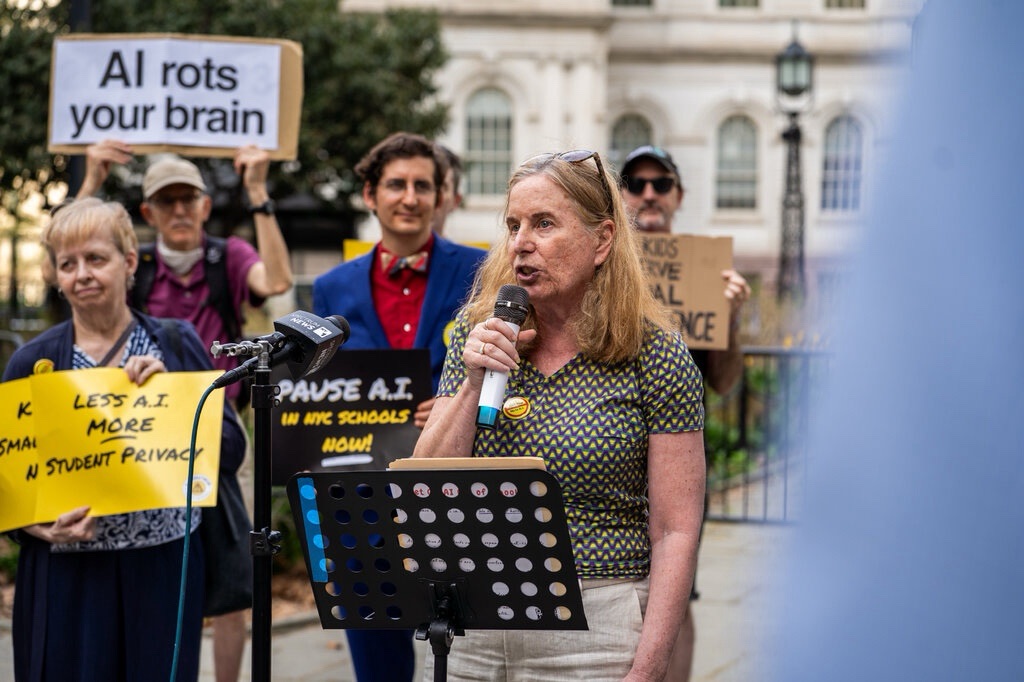
Parents and activists banded together to persuade the New York City Board of Education (aka the Panel on Educational Policy) to reject a proposal to open an AI-themed high school.

Matthew Haag wrote in The New York Times:

In Brooklyn, an artificial intelligence program helps public school students pronounce words. In Queens, high school students ask Google Gemini how to improve their essays. And in the Bronx, students in a robotics lab consult an A.I. tool before building parts on a 3-D printer.

As teachers and students in New York City and across the United States have increasingly embraced artificial intelligence in the classroom, school leaders in the nation’s largest school system were set to make one of their biggest splashes yet — the opening of an A.I.-focused high school in Manhattan next school year.

But on Monday, the new schools chancellor, Kamar Samuels, abruptly halted the creation of the school amid a groundswell of opposition to the rapid adoption of the technology and its potential harms.

In an interview, Mr. Samuels said that he understood the concerns and questions parents have about artificial intelligence in the classroom and its safety and impact on critical thinking. “I want to be able to think about the technology in a very thoughtful way,” Mr. Samuels said.

Despite the decision not to proceed, school leaders in New York City and beyond remain bullish on the future of artificial intelligence in education and its potential benefits. They argue that it could transform teaching and learning, a claim also promoted by companies that sell the tools, and that it would be irresponsible to ignore or restrict the technology.

But New York parents have expressed concern about the artificial intelligence programs used in schools or accessible on students’ computers, as well as the lack of information about the applications and data they collect. Some families recently delivered to Mayor Zohran Mamdani a petition with thousands of signatures calling for a two-year moratorium on generative A.I., such as chatbots.

“The intense outrage among parents in New York City is as great as I’ve seen it on any education issue that I’ve been working on for 25 years,” said Leonie Haimson, an education advocate in New York City and member of the Coalition for an A.I. Moratorium.

Leonie Haimson, a member of the Coalition for an A.I. Moratorium, said that she has witnessed “intense outrage” among New York City parents over A.I. use in schools. Credit…Madison Swart for The New York Times

Under Mr. Samuels’s leadership, the city’s Education Department has started to develop guidelines for how teachers and students should use artificial intelligence. Last month, the school system published its first playbook for A.I., developed in consultation with educators and education technology companies.

The creation of the new high school, known as Next Generation Technology High School and located in the financial district of Manhattan, was expected to be another major step toward the embrace of artificial intelligence in a school system whose decisions, because of its size, often influence other districts. A vote on the creation of the high school by a 22-member education oversight panel was scheduled for Wednesday.

The group’s chairman, Gregory Faulkner, said that he did not believe a single member would have voted in favor of it. Mr. Faulkner said that out of the many emails he received and conversations he had with parents, just a handful of comments were supportive of the school.

“If there’s anything that even has a hint of A.I., there’s strong opposition to it,” Mr. Faulkner said. “People are very nervous about the technology and how it is going to be used.”

Since this is a gift article, feel free to open and finish reading.

A reader who calls himself “Gitapik” shares his experience with the introduction of new technology into the special education programs for which he was responsible in New York City public schools.

He wrote:

As a former tech guy for our five District 75 special education sites in Brooklyn, I had quite a ride on this tech roller coaster. I was in on it from the beginning.

I applied for and received multiple very large state grants in technology. Once the money was received, I would choose, order, and facilitate installation of what technology went where in all the sites. From classroom computers, iPads, laptops, Attainment Stations, and Smartboards to full scale labs. It was a very big undertaking.

This also included conducting professional  development classes and individual training session sessions…very often to an unappreciative audience.

My sales pitch was always the same: this is a wonderful tool for you to incorporate into your standard every day teaching methods. You can turn it on and off in order to create interest and  spur on new ideas. I would even give examples of how I, a teacher, would do a class, using the different devices.

This would’ve been all well and good if it hadn’t been so naïve on my part. I witnessed firsthand how the technology went from being a tool for the teacher to the teacher being the tool of the technology. Might sound like a catchy phrase, but looking back on it I can’t help but see it for what it was. A planned takeover of the school systems. 

I could go into specifics, but this is getting pretty lengthy as it is.

Michael Mulgrew, the president of the United Federation of Teachers in New York City recently endorsed the use of AI in the classroom. He said he had met with top officials who had assured him that teachers and administrators would have a voice in how the technology would be applied. I would like to have his ear, knowing what I know. It’s the same sales pitch as was given to me. They just want to get their foot in the door

I submitted the following testimony to the Committee on Education of the New York City Council, when it held public hearings February 10, 2026, on the current system of natural control of the schools.

I studied mayoral control and other forms of governance when I wrote my first book, The Great School Wars: New York City, 1805-1973.

My testimony follows:

The time has come to rethink the governance of the New York City public schools. 

Mayoral control in its present form was enacted by the Legislature in 2002, at the behest of newly elected  ayor Michael Bloomberg. 

The Legislature was no doubt dazzled by Mayor Bloomberg. He was and is an amazing businessman who built an iconic technology-media corporation. 

To think that this titan of American business was willing to take responsibility for the school system was an exciting prospect. 

What is more, the Mayor boldly said that he could fix the schools. He projected confidence. He believed, and he was convincing. 

The Legislature gave him an unprecedented level of control over the system. The Mayor would appoint a majority of a new board, which he called the Panel on Education Policy, its name a signal of its powerlessness. The eight of 13 members appointed by Bloomberg served at his pleasure, not with a fixed term. This arrangement eliminated any likelihood that his appointees would exercise independent judgment. On the rare occasion that they did, he fired them. 

And of course, the legislation gave Bloomberg the power to pick anyone he wanted as Chancellor. 

For Chancelor, Bloomberg appointed a lawyer, Joel Klein, who had no experience as an educator or an administrator. 

Klein spent 8 1/2 years as Chancellor. 

During the 12 years of the Bloomberg mayoralty, there were many changes–the dissolution of large high schools, the creation of scores of small schools, the opening of charter schools, the imposition of a standardized citywide curriculum in math and science, the launch of a Leadership Academy to train new principals, and a heavy emphasis on standardized testing to judge students, teachers, principals and schools.

Schools received A-F grades, based on whether their test scores went up or down. Schools were closed if their scores were persistently low. Test scores were everything. 

When Klein left on the first day of 2011, the Mayor appointed a retired magazine publisher who had no relevant experience. That didn’t work. After 3 months, she was gone. 

While there was much breathless reporting about a “New York City Miracle,” there was no miracle. New York City’s public schools are not a paragon for other cities to follow. 

The problems of educating New York City’s public school children have not been solved. 

Mayoral control in the administrations of DiBlasio and Adams continued to reflect the inherent flaws of the concentration of power in the hands of the Mayor. 

If we step back for a minute, the nation is now experiencing a Presidency in which almost all power resides in one person: the President. Surrounded by a servile Cabinet, a Congress whose majority supinely obeys almost every Presidential order, and a Supreme Court with a sympathetic conservative majority, Americans can see daily the dangers of a government that has no checks and balances. 

The New York City public school system is no different. Checks and balances are necessary. Presently, there are none. 

Top-down management with no checks and balances is especially inappropriate for the school system. Parents and communities feel that they have no voice, and they are right. 

The truth is that there is no organizational structure that is perfect. Mayoral control has been tried for nearly a quarter-century. We now know that it has multiple flaws. We know that there has been no”New York City miracle.”

Some adjustment is needed now. 

I propose reviving the Board of Education. Every borough should be represented on that Board. The Board should select the Chancellor, who reports to the Board on a regular basis. The Board should be composed of people devoted to improving the public schools–either as educators or community advocates. They should know the schools and school leaders in their borough. They should regularly attend meetings of local school boards. They should serve for a set term and should be free to exercise their independent judgment. They should receive a salary for their time, so that their service on the Board is properly compensated. It would be a full-time position. 

Clearly, the Mayor has a large stake in the schools. He or she should have representatives (but not a majority) on a reconstructed Board of Education. 

The Mayor’s ultimate power is that he or she controls the budget. 

Will such an arrangement solve all problems? No. But it will create a structure where parents and communities have a voice and are heard. The Board, when choosing a Chancellor, should select an experienced educator, whether chosen from the city or from another school system. 

There will still be controversies. It’s inevitable. Over funding. Over building new classrooms to meet the requirement to reduce class sizes. Over charter schools. Over admissions to gifted programs and selective schools. Over racial segregation in a system whose students are overwhelmingly Hispanic, Black, and Asian.  

The Mayor–every Mayor–has a full plate of issues to deal with: economic development, public safety, transportation, natural disasters, building codes, public health, housing, and much, much more. He or she doesn’t have time to run the school system, nor is he or she likely to be an experienced educator. 

I can’t think of any important problem that mayoral control has solved.

My advice: Create a stable and democratic structure.