Stephen Sawchuk is a staff writer for Education Week. He wrote this article back in May, and I missed it. I think it’s one of the clearest, most balanced explanations of CRT that I have read.

Sawchuk writes:

Is “critical race theory” a way of understanding how American racism has shaped public policy, or a divisive discourse that pits people of color against white people? Liberals and conservatives are in sharp disagreement. 

The topic has exploded in the public arena this spring—especially in K-12, where numerous state legislatures are debating bills seeking to ban its use in the classroom. 

In truth, the divides are not nearly as neat as they may seem. The events of the last decade have increased public awareness about things like housing segregation, the impacts of criminal justice policy in the 1990s, and the legacy of enslavement on Black Americans. But there is much less consensus on what the government’s role should be in righting these past wrongs. Add children and schooling into the mix and the debate becomes especially volatile.

School boards, superintendents, even principals and teachers are already facing questions about critical race theory, and there are significant disagreements even among experts about its precise definition as well as how its tenets should inform K-12 policy and practice. This explainer is meant only as a starting point to help educators grasp core aspects of the current debate.

Just what is critical race theory anyway? 

Critical race theory is an academic concept that is more than 40 years old. The core idea is that race is a social construct, and that racism is not merely the product of individual bias or prejudice, but also something embedded in legal systems and policies.

The basic tenets of critical race theory, or CRT, emerged out of a framework for legal analysis in the late 1970s and early 1980s created by legal scholars Derrick Bell, Kimberlé Crenshaw, and Richard Delgado, among others.

A good example is when, in the 1930s, government officials literally drew lines around areas deemed poor financial risks, often explicitly due to the racial composition of inhabitants. Banks subsequently refused to offer mortgages to Black people in those areas.

Today, those same patterns of discrimination live on through facially race-blind policies, like single-family zoning that prevents the building of affordable housing in advantaged, majority-white neighborhoods and, thus, stymies racial desegregation efforts.

CRT also has ties to other intellectual currents, including the work of sociologists and literary theorists who studied links between political power, social organization, and language. And its ideas have since informed other fields, like the humanities, the social sciences, and teacher education.

This academic understanding of critical race theory differs from representation in recent popular books and, especially, from its portrayal by critics—often, though not exclusively, conservative Republicans. Critics charge that the theory leads to negative dynamics, such as a focus on group identity over universal, shared traits; divides people into “oppressed” and “oppressor” groups; and urges intolerance.

Thus, there is a good deal of confusion over what CRT means, as well as its relationship to other terms, like “anti-racism” and “social justice,” with which it is often conflated.

To an extent, the term “critical race theory” is now cited as the basis of all diversity and inclusion efforts regardless of how much it’s actually informed those programs. 

One conservative organization, the Heritage Foundation, recently attributed a whole host of issues to CRT, including the 2020 Black Lives Matter protests, LGBTQ clubs in schools, diversity training in federal agencies and organizations, California’s recent ethnic studies model curriculum, the free-speech debate on college campuses, and alternatives to exclusionary discipline—such as the Promise program in Broward County, Fla., that some parents blame for the Parkland school shootings. “When followed to its logical conclusion, CRT is destructive and rejects the fundamental ideas on which our constitutional republic is based,” the organization claimed.null

(A good parallel here is how popular ideas of the common core learning standards grew to encompass far more than what those standards said on paper.) 

Does critical race theory say all white people are racist? Isn’t that racist, too? 

The theory says that racism is part of everyday life, so people—white or nonwhite—who don’t intend to be racist can nevertheless make choices that fuel racism. 

Some critics claim that the theory advocates discriminating against white people in order to achieve equity. They mainly aim those accusations at theorists who advocate for policies that explicitly take race into account. (The writer Ibram X. Kendi, whose recent popular book How to Be An Antiracistsuggests that discrimination that creates equity can be considered anti-racist, is often cited in this context.)

Fundamentally, though, the disagreement springs from different conceptions of racism. CRT puts an emphasis on outcomes, not merely on individuals’ own beliefs, and it calls on these outcomes to be examined and rectified. Among lawyers, teachers, policymakers, and the general public, there are many disagreements about how precisely to do those things, and to what extent race should be explicitly appealed to or referred to in the process.

Here’s a helpful illustration to keep in mind in understanding this complex idea. In a 2007 U.S. Supreme Court school-assignment case on whether race could be a factor in maintaining diversity in K-12 schools, Chief Justice John Roberts’ opinion famously concluded: “The way to stop discrimination on the basis of race is to stop discriminating on the basis of race.” But during oral arguments, then-justice Ruth Bader Ginsburg said: “It’s very hard for me to see how you can have a racial objective but a nonracial means to get there.”

All these different ideas grow out of longstanding, tenacious intellectual debates. Critical race theory emerged out of postmodernist thought, which tends to be skeptical of the idea of universal values, objective knowledge, individual merit, Enlightenment rationalism, and liberalism—tenets that conservatives tend to hold dear.

What does any of this have to do with K-12 education?

Scholars who study critical race theory in education look at how policies and practices in K-12 education contribute to persistent racial inequalities in education, and advocate for ways to change them. Among the topics they’ve studied: racially segregated schools, the underfunding of majority-Black and Latino school districts, disproportionate disciplining of Black students, barriers to gifted programs and selective-admission high schools, and curricula that reinforce racist ideas. 

Critical race theory is not a synonym for culturally relevant teaching, which emerged in the 1990s. This teaching approach seeks to affirm students’ ethnic and racial backgrounds and is intellectually rigorous. But it’s related in that one of its aims is to help students identify and critique the causes of social inequality in their own lives.null

Many educators support, to one degree or another, culturally relevant teaching and other strategies to make schools feel safe and supportive for Black students and other underserved populations. (Students of color make up the majority of school-aged children.) But they don’t necessarily identify these activities as CRT-related.

As one teacher-educator put it: “The way we usually see any of this in a classroom is: ‘Have I thought about how my Black kids feel? And made a space for them, so that they can be successful?’ That is the level I think it stays at, for most teachers.” Like others interviewed for this explainer, the teacher-educator did not want to be named out of fear of online harassment. 

An emerging subtext among some critics is that curricular excellence can’t coexist alongside culturally responsive teaching or anti-racist work. Their argument goes that efforts to change grading practices or make the curriculum less Eurocentricwill ultimately harm Black students, or hold them to a less high standard. 

As with CRT in general, its popular representation in schools has been far less nuanced. A recent poll by the advocacy group Parents Defending Education claimed some schools were teaching that “white people are inherently privileged, while Black and other people of color are inherently oppressed and victimized”; that “achieving racial justice and equality between racial groups requires discriminating against people based on their whiteness”; and that “the United States was founded on racism.”

Thus much of the current debate appears to spring not from the academic texts, but from fear among critics that students—especially white students—will be exposed to supposedly damaging or self-demoralizing ideas.

While some district officials have issued mission statements, resolutions, or spoken about changes in their policies using some of the discourse of CRT, it’s not clear to what degree educators are explicitly teaching the concepts, or even using curriculum materials or other methods that implicitly draw on them. For one thing, scholars say, much scholarship on CRT is written in academic language or published in journals not easily accessible to K-12 teachers.

What is going on with these proposals to ban critical race theory in schools? 

As of mid-May, legislation purporting to outlaw CRT in schools has passed in Idaho, Iowa, Oklahoma, and Tennessee and have been proposed in various other statehouses.

The bills are so vaguely written that it’s unclear what they will affirmatively cover. Could a teacher who wants to talk about a factual instance of state-sponsored racism—like the establishment of Jim Crow, the series of laws that prevented Black Americans from voting or holding office and separated them from white people in public spaces—be considered in violation of these laws?It’s also unclear whether these new bills are constitutional, or whether they impermissibly restrict free speech.It would be extremely difficult, in any case, to police what goes on inside hundreds of thousands of classrooms. But social studies educators fear that such laws could have a chilling effect on teachers who might self-censor their own lessons out of concern for parent or administrator complaints.

As English teacher Mike Stein told Chalkbeat Tennessee about the new law: “History teachers can not adequately teach about the Trail of Tears, the Civil War, and the civil rights movement. English teachers will have to avoid teaching almost any text by an African American author because many of them mention racism to various extents.”

The laws could also become a tool to attack other pieces of the curriculum, including ethnic studies and “action civics”—an approach to civics education that asks students to research local civic problems and propose solutions.How is this related to other debates over what’s taught in the classroom amid K-12 culture wars?

The charge that schools are indoctrinating students in a harmful theory or political mindset is a longstanding one, historians note. CRT appears to be the latest salvo in this ongoing debate.

In the early and mid-20th century, the concern was about socialism or Marxism. The conservative American Legion, beginning in the 1930s, sought to rid schools of progressive-minded textbooks that encouraged students to consider economic inequality; two decades later the John Birch Society raised similar criticisms about school materials. As with CRT criticisms, the fear was that students would be somehow harmed by exposure to these ideas.

As the school-aged population became more diverse, these debates have been inflected through the lens of race and ethnic representation, including disagreements over multiculturalism and ethnic studies, the ongoing “canon wars” over which texts should make up the English curriculum, and the so-called “ebonics” debates over the status of Black vernacular English in schools.

In history, the debates have focused on the balance among patriotism and American exceptionalism, on one hand, and the country’s history of exclusion and violence towards Indigenous people and the enslavement of African Americans on the other—between its ideals and its practices. Those tensions led to the implosion of a 1994 attempt to set national history standards.

A current example that has fueled much of the recent round of CRT criticism is the New York Times’ 1619 Project, which sought to put the history and effects of enslavement—as well as Black Americans’ contributions to democratic reforms—at the center of American history.

The culture wars are always, at some level, battled out within schools, historians say.

“It’s because they’re nervous about broad social things, but they’re talking in the language of school and school curriculum,” said one historian of education. “That’s the vocabulary, but the actual grammar is anxiety about shifting social power relations.”

In 1996, a group of Black and Hispanic teachers sued the City of New York for requiring them to pass tests that were, they said, racially discriminatory and not relevant to their work. The city will be required to pay nearly $600 million to the 350 plaintiffs, a sum that might rise to nearly $2 billion. The state was dropped from the lawsuit in 2006, even though it imposed the tests as requirements on the city.

A massive decades-long lawsuit against New York City over the use of two teaching certification tests is winding to a conclusion, with nearly $660 million and pension benefits in damages awarded to plaintiffs in the class action lawsuit claiming the tests were discriminatory against Black and Latino teachers and prevented them from achieving full seniority, pay and benefits.

The city could be further liable for hundreds of millions of dollars more in damages yet to be determined, with an estimated maximum payout of about $1.8 billion for the 4,700 plaintiffs in the Gulino v Board of Education class action suit — in what city officials say is the highest amount of damages that New York City has ever paid.

In 1996, three teachers filed the lawsuit against the city and state education departments, claiming that the mandated certification tests—the National Teacher Examination (NTE) and its successor the Liberal Arts & Sciences Test (LAST)—had a “disparate impact on African-American and Latino test takers.”

White test-takers passed the tests 83.7% of the time while Black test takers passed at 43.9% and Latino test takers passed at 40.3% of the time, according to the complaint.

No matter what subject a New York City teacher taught—whether it was preschool, special education, or athletics—they were required to pass these certification tests, which have been described as covering “scientific, mathematical, and technological processes; historical and social scientific awareness; artistic expression and the humanities; communication and research skills; and written analysis and expression.”

“The test obviously didn’t test anything relevant to the jobs that people were doing or being hired to do. But the city used it in many cases to demote people,” said Joshua Sohn, the plaintiffs’ lead lawyer.

Teachers who didn’t pass were paid less, denied full pension, and many were relegated to substitute status, according to a court brief filed with the Second Circuit of Appeals in 2007: “Even though they never achieved a passing score on the LAST, many teachers continued teaching full-time in the City’s schools for many years, albeit at salaries well below that of their certified colleagues. And those teachers who ultimately achieved a passing score, remained at a salary step level far below that of their colleagues with equivalent seniority in the City school system. In practice then, the City and State used the LAST not to determine whether teachers should be allowed to teach, but rather to determine their level of compensation and benefits.”

Charles Pierce is a wonderful writer who has a regular column in Esquire magazine. He often seems to write just what I was thinking. If you truly believe in law and order, which Republicans say they do, you can’t be happy that Rittenhouse killed two people and maimed a third, and will suffer no consequences. To the contrary, Rightwing extremists—now in control of the Republican Party—are treating him as a hero.

Pierce writes:

So the country is pretty broken.

The fact that Kyle Rittenhouse walked away free from the courthouse in Kenosha cannot be a surprise. The trial was headed on a straight line to this verdict for weeks, nudged along by a judge who clearly was enjoying the spotlight that had come down on his private little satrapy, and by a mediocre prosecution that also was hamstrung by the quirks of Wisconsin law. For example, there is no state manslaughter statute, which surely might have been helpful.

The most poignant words out of the courthouse came from the families of the two people Rittenhouse killed, Joseph Rosenbaum and Anthony Huber, who said that they felt abandoned by the prosecution, that the prosecutors did not seem to advocate for the dead and wounded. Given that, in almost every trial, the prosecution spares nothing to use the family members of the victims to inspire sympathy from the jury—and, occasionally, from the judge as well—the fact that the families of the people whom Kyle Rittenhouse killed felt abandoned strikes me as extraordinary. I don’t know where all the Victims’ Rights firebrands are, but they weren’t in Kenosha. Hell, the people Kyle Rittenhouse shot weren’t even allowed to be referred to as victims in court.

What I do not feel right now is safer.

I’ve tried to imagine how I would have felt were I on a sidewalk in Kenosha that night and saw this pudgy little fellow walking up the center of the street with his AR-15, preferred weapon of the Provisional Irish Republican Army, strapped across his chest. I guarantee I would not have felt safer. I would not believe that Kyle Rittenhouse was there to protect me. Upon seeing him, I would’ve concluded that things were getting dangerously out of control and that it was time to find some safe place to be for a while. I would wonder why somebody gave Lumpy Rutherford a military-grade weapon and turned him loose in a situation already grown volatile…

It is only a matter of time, and after yesterday’s verdict, you can reset the Doomsday Clock a little closer to midnight.

Open the link to finish the article.

Sara Stenson was a middle school librarian in Texas for many years. In this post, she calls on Governor Gregg Abbott to stop dragging school librarians into his culture wars with false and salacious claims.

She writes:

Librarians, as public servants, have no secrets. Anyone can access our online library catalogs. It is also important to note that the existence of a book in a library in no way signifies endorsement. Our job is to provide access to our communities and not only to materials which match our personal tastes or values. For example, children have access to “Mein Kampf” by Adolph Hitler in school libraries in Texas. A quick search of the Austin ISD catalog reveals that in the entire district, serving 77,000 students, four copies of “The Dream House” and three copies of “Gender Queer” are on our high school library shelves. And Austin is a liberal city. I suspect only a handful of these two titles exist in Texas school libraries….

Even the legal definition of pornography in Texas states that the term applies to “any visual or written material that depicts lewd or sexual acts and is intended to cause sexual arousal.” Neither book fits this definition.

Just because a book includes some mature content does not make it pornography. School districts have policies for dealing with book challenges, and these should be followed before any books are removed from the shelves.

Does the book have value as a whole? Does it serve certain students in the community? It depends on the local community and if the book is age-appropriate to the patrons. Do librarians make mistakes? I did. At times, I ordered books that ended up not being appropriate for my middle-school library and passed them up to high-school collections. Librarians choose books for their collections by consulting summaries and reviews in selection aids. They cannot possibly read each book entirely before it is ordered…

“The government — in this case, a public school — cannot restrict speech because it does not agree with the content of that speech,” the Bill of Rights Institute says in summarizing the case. “The decisions called libraries places for ‘voluntary inquiry’ and concluded that the school board’s ‘absolute discretion’ over the classroom did not extend to the library for that reason.” “Voluntary” is the key that protects libraries and our freedom to read.

As Kurt Vonnegut wrote in the censorship wars of his day: “If you are an American, you must allow all ideas to circulate freely in your community, not merely your own.”

Read more at: https://www.star-telegram.com/opinion/opn-columns-blogs/other-voices/article256049972.html#storylink=cpy

A reader, Nancy Papat, read Pastor Chartes Foster Johnson’s article about Governor Gregg Abbott’s campaign against pornography in the schools and school libraries. She concluded that the Bible is a dangerous book because it contains sexual innuendoes, violence, and even anti-capitalist propaganda (like driving the money-changers from the Temple).

She posted this comment:

By this standard, schools will have to remove the Holy Bible from school libraries.

* There is much too much sex – that story of David and Bathsheba is for mature audiences only

*There are stories of slavery and abuse which might make some children feel bad because that could be interpreted as Critical Race Theory.

*Then there is the story about Mary and Joseph fleeing Bethlehem for Egypt to protect baby Jesus after the King ordered the killing of male babies. Doesn’t that glorify and even deify refugees?

*Jesus threw moneychangers out of the Temple which could raise questions about wealthy pastors of mega-churches in Texas. Is that anti-religion for a state like Texas? [It is also critical of capitalism.]

*Years later, Jesus himself suffered the gory, torturous death of crucifixion. Clearly the Bible has too much sex, violence, and dangerous political statements for the state of Texas and its students.

Then there is the question of whether Mary and Joseph were married when she got pregnant. If God was the father of Jesus, not Joseph, this raises more questions.

Have you read any licentious or subversive text in the Bible? Please add to her list.

Surely this dangerous book should not be read by children!

As we wade through the muck of a national effort to privatize public schools and replace them with “school choice,” via privately-run charters and vouchers, it’s important to recall why we have public schools. Education is not a consumer item. It is an integral part of a democratic society. Contrary to the propaganda from the right, our public schools do not indoctrinate children. They are tasked with transmitting the knowledge and skills to help young prople become productive citizens and to keep our democracy strong. At their best, they teach young people to question authority and to think for themselves. Thanks to Professor David Berliner for sharing this essay with me.

This article was written by a Canadian educator who was educated in the U.S.

Why public schools are public

Charles Ungerleider, Professor Emeritus, The University of British Columbia

Parents seeking programs that they believe are in the “best interests” of their own children sometimes act as if the education they seek is a private benefit. In seeking an education that is in a child’s or grandchild’s best interest it is easy for parents or grandparents to lose sight of why public schools are public.

If education were primarily a private benefit, it would not be something supported by governments; it would be left to families to determine the why, the what, and the how of educating the young. But in enrolling their children in public school they do not have that discretion.

Governments provide for schooling because it is a public good, something of benefit to everyone. Few people read the legislation establishing public schools but doing so is instructive. The purposes of education are often set out in a public schools or education act that is readily accessible.

The Public Schools Act in Manitoba, for example, proclaims that “a strong public school system is a fundamental element of a democratic society.”[i] Alberta’s act simply says, “Education is the foundation of a democratic and civil society.”[ii] Ontario’s act declares that “a strong public education system is the foundation of a prosperous, caring and civil society.”[iii] Despite differences in the way it is expressed, the contribution of schooling to a democratic, civil society is among public education’s paramount purposes.

Several acts speak specifically about the active connection between public schooling and the health, prosperity, and well-being of society. Manitoba says that “public schools should contribute to the development of a fair, compassionate, healthy and prosperous society.”[iv] Nova Scotia describes that the primary mandate of its publicly funded school system is “to provide education programs and services for students to enable them to develop their potential and acquire the knowledge, skills and attitudes needed to contribute to a healthy society and a prosperous and sustainable economy.”[v]

In the context of setting out the purposes of public schooling, the various statements of purpose refer to individual students. However, they make clear that the development of the individual is in service to the [re]creation of society. Some are quite explicit about the link between the student and the student’s social contribution. Alberta, for example, states “the role of education is to develop engaged thinkers who think critically and creatively and ethical citizens who demonstrate respect, teamwork and democratic ideals and who work with an entrepreneurial spirit to face challenges with resiliency, adaptability, risk-taking and bold decision-making.”[vi]

In addition to the general references to democracy and civil society, some statements of purpose are more specific. British Columbia’s School Act says that educational programs are “designed to enable learners to become literate, to develop their individual potential and to acquire the knowledge, skills and attitudes needed to contribute to a healthy, democratic and pluralistic society and a prosperous and sustainable economy.”[vii] BC complements its School Act with a ministerial order devoted to the mandate of the school system that provides the rationale for the emphasis on social and economic goals:

Continued progress toward our social and economic goals as a province depends upon well-educated people who have the ability to think clearly and critically, and to adapt to change. Progress toward these goals also depends on educated citizens who accept the tolerant and multi-faceted nature of Canadian society and who are motivated to participate actively in our democratic institutions.[viii]

The BC ministerial order makes clear that individuals have an obligation to contribute to the development of that society, and specifies that the educational program is designed to produce citizens who are:

  • thoughtful, able to learn and to think critically, and who can communicate information from a broad knowledge base;
  • creative, flexible, self-motivated and who have a positive self-image;
  • capable of making independent decisions;
  • skilled and who can contribute to society generally, including the world of work;
  • productive, who gain satisfaction through achievement and who strive for physical well being;
  • cooperative, principled and respectful of others regardless of differences;
  • aware of the rights and prepared to exercise the responsibilities of an individual within the family, the community, Canada, and the world.[ix]

The public schools and education acts and related policies make clear that education is instrumental in developing the knowledge, values, and behaviours that citizens need to maintain a socially cohesive and productive society. The territory of Nunavut is perhaps the most explicit about the importance of the education system in preserving Inuit values and traditional knowledge.

It is the responsibility of the Minister, the district education authorities and the education staff to ensure that Inuit societal values and the principles and concepts of Inuit Qaujimajatuqangit are incorporated throughout, and fostered by, the public education system.[x]

The principles and concepts of Inuit Qaujimajatuqangit define what it means to be a citizen in Nunavut:

  • Respecting others, relationships and caring for people (Inuuqatigiitsiarniq);
  • Fostering good spirit by being open, welcoming and inclusive (Tunnganarniq);
  • Serving and providing for family or community, or both (Pijitsirniq);
  • Decision making through discussion and consensus (Aajiiqatigiinniq);
  • Development of skills through practice, effort and action (Pilimmaksarniq or Pijariuqsarniq);
  • Working together for a common cause (Piliriqatigiinniq or Ikajuqtigiinniq);
  • Being innovative and resourceful (Qanuqtuurniq); and
  • Respect and care for the land, animals, and the environment (Avatittinnik Kamatsiarniq)

The curricula of the provinces and territories are intended to express what students must know and be able to do to prepare for adult citizenship. Public schooling benefits all of us by making sure that each student is prepared for adult citizenship. Public schooling is not about you or me, but about us.


[i] Manitoba, The Public Schools Act C.C.S.M. c. P250,

[ii] Alberta, Education Act, Statutes of Alberta, 2012  c. E-0.3

[iii] Ontario, Education Act, RSO 1990, c. E.2 

[iv] Manitoba, Ibid.

[v] Nova Scotia, Education Act,

[vi] Alberta, Ibid

[vii] British Columbia School Act, RSBC 1996

[viii] British Columbia, Statement of Education Policy Order, OIC 1280/89

[ix] Ibid.

[x] Nunavut, Education Act, S.Nu. 2008

oneducationcanada@gmail.com

What are you thankful for today?

I’m thankful to be alive. Eight months ago, I had open heart surgery. I was sedated and intubated for five days and spent a total of two weeks in the intensive care unit.

I’m thankful that I have a loving family. Many people don’t, and I consider myself fortunate. My spouse, Mary, was at my side during my long convalescence and made sure that I walked 2-3 miles every day to regain my strength. My two sons and four grandsons give me joy, for which I am grateful.

I’m thankful that I have the means to live comfortably. Many people don’t, and I hate to think that one of the richest countries in the world is unable to reduce the dramatic income inequality and wealth inequality in our country. People should not go without health care because they can’t afford it. People should not go to bed hungry because they can’t afford food. People should not sleep in the streets or in shelters because they can’t afford housing. We see the gaps and the suffering around us, and we see billionaires flying to space in their own vehicles. Yet Congress is unwilling to tax billionaires. I’m not thankful for that. I’m outraged.

I’m thankful for the many essential workers, including teachers and school staff, who have worked with dedication to enable us to get through the pandemic.

I am thankful, as a woman and a Jew, to live in the USA at this time in history. I never forget that the extended families of both my parents were killed in Europe in the 1930s because of their religion. Sure, we live in perilous times, but I feel that I was born in the right place at the right time to make the most of my life.

I’m thankful for the free press and for journalists who shine light on abuses of power and protect our democracy.

I’m thankful to all those who struggle to improve our society, who fight injustice, who understand the need to safeguard our environment, and who are engaged in the political arena to demand a better, more equitable, peaceful future.

I have a lot to be thankful for. I hope you do too.

Chris Rufo has taken credit for creating the furor over “critical race theory,” leading about a dozen Republican-controlled states to pass laws banning it (whatever they think it is, mostly anything to do with racism). He is widely recognized for inventing the fear that public schools are teaching children to “hate” America or to be ashamed for being white. Despite lack of evidence that critical race theory is taught in K-12 schools, the issue has made many teachers fearful of teaching the history of racism.

Critical race theory originated among black law school professors, and it is in law school where students and faculty analyze the persistence of systemic racism in our laws and institutions.

To the extent that teachers talk about racism, it is because it has existed and does exist. It is literally impossible to teach American history without discussion of racism.

Chris Rufo loves attention, so he upped the stakes and increased his targets on Twitter, where he released this tweet. See @Realchrisrufo.

It’s time to clean house in America: remove the attorney general, lay siege to the universities, abolish the teachers unions, and overturn the school boards.

The comments below this tweet are worth reading.

The Arizona Republic conducted an intensive investigation of the effort by the Trump campaign and discovered some fascinating details.

Rusty Bowers was talking on his cellphone to Karen Fann after church services on the Sunday before Thanksgiving, looking ahead to another hectic week.

It was Nov. 22, 2020. The counting was done and Joe Biden led Donald Trump by a razor-thin margin, but the presidential election results in Arizona still had not been certified.

The state’s House speaker and Senate president have a bond that stretches back decades, forged by family friendships. This time, the two Republicans conferred about something that surprised them both.

Fann told Bowers that the president’s allies had called her repeatedly. They wanted to get her involved in a plan to help deliver an election result more to his liking.

By then, it was clear to most that Trump had lost his reelection bid for the White House and that Arizona had helped elect Biden.

Seconds after Bowers hung up with Fann, and while he still sat parked in his driveway in the driver’s seat of his Toyota Prius, the dashboard on his car lit up.

Bowers had a phone call. It was the White House.

Trump and Giuliani wanted Bowers to help ensure President-elect Biden’s 10,457-vote win in Arizona would not be formalized a week later. They told him “there’s a way we could help the president” and Arizona had a “unique law” that allowed the Legislature to choose its electors, rather than voters, he recalled.

“That’s the first I’ve heard of that one,” a skeptical Bowers told them. He told the men he needed proof to back up their claims: “I don’t make these kinds of decisions just willy-nilly. You’ve got to talk to my lawyers. And I’ve got some good lawyers.”

Bowers told them he supported Trump, voted for Trump and campaigned for him, too. What he would not do is break the law for him.

“You are giving me nothing but conjecture and asking me to break my oath and commit to doing something I cannot do because I swore I wouldn’t. I will follow the Constitution,” he told the men.

Trump, who was gregarious throughout much of the call but quiet during that exchange, told Bowers he understood.

Trump told Bowers, “We’re just trying to investigate.”

Giuliani repeatedly assured Bowers he would send the evidence to attorneys at the state House of Representatives.

The evidence never arrived, Bowers told The Arizona Republic.

But Fann proceeded with the ballot review Trump wanted.

Why did this scene unfold in Arizona?

This is how Arizona plunged into a fog of conspiracies, riven with partisanship and targeted by opportunists from across the country.

Trump led the effort to undermine the results after some projected Arizona to slip to Democrat Joe Biden.

The state was one of two targeted by congressional Republicans on Jan. 6 who were willing to disenfranchise millions of voters in a brash legal experiment that would have redefined the election-certification process.

And even before Trump left the White House, Fann put in motion a ballot review.

Of the swing states, Arizona perhaps was the most susceptible to an election challenge.

Biden’s margin of victory in Arizona was the smallest of any state he won. State government was in Republican hands, providing plenty of potential allies, from the governor to the leaders of the state Legislature to the Maricopa County Board of Supervisors.

Trump, who viewed the focus on Russian interference in the 2016 election as an effort to delegitimize his victory, now heaped doubt on Biden’s win. But Trump’s loyal base didn’t see how tenuous his hold on Arizona had grown. While Trump evinced confidence at rallies, behind the scenes his campaign team knew the state was up for grabs.

Trump’s push to challenge the election results in Arizona provided balm for a man unwilling to accept defeat. It also sowed lingering doubt that would fuel an attack from people all over the country on the state’s election systems.

Many Republicans quickly joined Trump’s unfounded accusations of fraud, some more forcefully than others. A few, such as Bowers and Gov. Doug Ducey, resisted the public and political pressure to get behind the narrative of a stolen election.

One Arizona member of Congress participated in protests outside Maricopa County’s election facilities even as ballots were being counted; three GOP members of Congress from Arizona later voted to set aside the state’s election results.

The circuslike atmosphere drew Trump die-hards, election conspiracy theorists and far-right media that simultaneously created buzz and fed off it.

It raised cash for Republicans and doubts for voters, threatening public confidence in elections here and elsewhere.

Interviews with dozens of people connected with the drama at the Arizona Legislature and the Veterans Memorial Coliseum in Phoenix, where the ballots were examined for months, make this much clear: The spectacle that unfolded here was a partisan obsession pushed by Trump’s close allies and made possible by just a handful of people in Arizona.

It didn’t have to happen this way.

Before Fann ordered the ballot review, for several days in December, Bowers, Fann and the Republican chair of the Maricopa County Board of Supervisors, Clint Hickman, tried to reach a deal for a joint audit conducted by an accredited firm.

Over four months, The Republic examined a trove of text messages, emails and court records, many made public after suing the state for access. Reporters spoke to decision-makers, consultants, staff, contractors, campaign aides and others tied to the review of the presidential and U.S. Senate races. Some talked on the record about their experiences, while others spoke on the condition they not be identified in order to speak candidly about private conversations.

The Republic uncovered efforts to circumvent the popular vote to engineer an illegitimate Trump victory. Once the results were certified, Trump and his allies shifted to a campaign to pressure local Republicans to overturn election results from voters who were using an early ballot system largely shaped over decades by their own party.

Trump, Giuliani, Fann and others who helped bring about the ballot review did not respond to repeated requests to discuss their recollections of the events leading to the review.

Bowers shared his story for the first time over three interviews totaling nearly six hours. The interviews took place by phone, in his office suite, and on the patio of a Cracker Barrel in the East Valley, where he verified key dates from his red leather-bound journal.

Like most of Arizona, the speaker watched the scenes unfold from the periphery as Fann steered the Senate into a probe led by the Florida-based Cyber Ninjas, a company with no prior experience in election reviews that is run by a man who publicly stated the election was tainted by fraud.

Fann has not yet explained her U-turn from favoring an accredited audit to authorizing a review led by partisans. Those who know her and did speak said she sought to quell Republican anger over Trump’s loss and could not resist the pressure campaign from his allies.

Early on, Bowers remembered offering her a stark assessment: Some of Trump’s most ardent supporters in the GOP-controlled Legislature viewed Trump’s election grievances as political opportunity.

“Karen, this is about trophies,” he said he told her. “This is about trophies on the wall — that individual members want to be able to say, ‘I forced them to do this.’”

Before the Veterans Memorial Coliseum became the proving ground for conservative conspiracies, it was the location of a rally at perhaps the high-water mark of Trump’s presidency.

The economy was in the final days of the longest expansion in U.S. history. Coronavirus seemed like a foreign problem in a faraway land. Bernie Sanders, the independent senator from Vermont who described himself as a democratic socialist, had won the New Hampshire primary the week before. Biden finished fifth.

Trump’s approval rating was inching upward after his acquittal in his first impeachment trial.

So it was on Feb. 19, 2020, when Trump strode onstage to a near-capacity crowd at the coliseum. Like most of his campaign events, it seemed to mix the noise of a rock concert, the passion of a religious revival and the sideshow elements of a carnival.

Two supporters carried Ervin Julian, a 100-year-old World War II veteran, down the coliseum’s steep stairs to a front-row seat on stage behind Trump and in front of the boisterous crowd. 

One of the men carrying Julian wore a shirt that said “We are Q” on the front and “17 WWG1WGA” on the back. It is a phrase adopted by the QAnon conspiracy movement that stands for “Where We Go 1 We Go All.”

One by one, Ducey, all four of the state’s Republicans in Congress, Fann, Bowers and Kelli Ward, the state Republican Party chairwoman, took the stage as Trump praised the state’s GOP team.

“With your help, we are going to defeat the radical socialist Democrats,” Trump said early on. “We have the best economy, the most-prosperous country that we’ve ever had and the most powerful military anywhere in the world.”

Trump’s 82-minute, triumphal speech left his supporters delighted and his campaign confident that he was well positioned to again win a state he had narrowly carried in 2016, when he defeated Democrat Hillary Clinton by 91,234 votes.

Trump’s victory that year extended Arizona’s run of wins for Republicans in presidential races. The GOP won 16 of 17 presidential contests in the state beginning in 1952.

Trump’s electrifying optimism, shared by thousands of his supporters inside the coliseum, seemed rooted in political inevitability. In hindsight, Trump’s prospects began dimming almost immediately after that rally.

Less than a month after Trump’s speech, Biden took control of his party’s nomination, pitting Trump against the candidate best positioned to win Arizona and the one Trump worried about most. The coronavirus soon exploded into a pandemic that locked Americans inside their homes, upended the political agenda and brought a sudden end to a decade-long run of economic growth.

The state’s presidential preference election on March 17 and the rapidly worsening health crisis raised the first real concerns about voting and election management in Arizona, and they largely came from Democrats.  

By then, COVID-19 was beginning to spark fear across the country, and the White House had called for a 15-day national quarantine to halt the virus. Democrats moved their final presidential debate to Washington, D.C., from Phoenix because of the widening crisis.

Sinema sent Hobbs a link to a Twitter post by a political website that said polling sites could be hazardous during a pandemic. At the time, little was known about the virus and its spread. Some feared shared items, such as pens, could help spread the coronavirus.

“File a request to the Az Supreme Court ASAP asking you (to) postpone,” Sinema texted. “This is what Ohio just … Did. You can file a special action right now.”  

“Who is this,” Hobbs responded in a text.

“Kyrsten. I would file a special action NOW. We do not want to be the state that violated the 15 day effort to stop the virus. The governor has been very slow to move on every precaution. That is his choice, I guess. But you do not have to be like that. You can do what needs to be done. I am going to say the election should be postponed publicly very soon.”

Hobbs responded, “Understood.”

Maricopa County Recorder Adrian Fontes, a Democrat, wanted to mail ballots to every voter in the primary because of the coronavirus. 

Neither change happened, but for Republicans, who didn’t have a primary election, both ideas raised concerns about voting.

The GOP-dominated Maricopa County Board of Supervisors had taken greater responsibility for management from Fontes in 2019, especially on Election Day operations and emergency issues. But the state’s far-right figures didn’t view board members as reliable allies if there was to be a battle over results.

Meanwhile, Trump had his own worries in Arizona. 

In May 2020, the president held a meeting in the Roosevelt Room in the White House to discuss the state of play in Arizona.

Trump was worried that Sen. Martha McSally, R-Ariz., was losing to challenger Mark Kelly and could “drag” him down as well, those familiar with the discussion said. The president wondered whether the GOP should run someone other than the incumbent against Kelly, the well-known retired astronaut. Then-Senate Majority Leader Mitch McConnell, R-Ky., who had joined the discussion, made it clear he stood by McSally.

The GOP ticket had other worries, too.

On July 1, Vice President Mike Pence flew to Phoenix to assure the public that Arizona would have enough ventilators to manage the rising COVID-19 caseload.

Privately, Pence had other matters on his mind. 

Away from the news cameras, inside a conference room in the Lincoln J. Ragsdale Executive Terminal at the Phoenix airport, Pence asked how the campaign was preparing for November.

“What is your plan for absentee early voting? Are you guys ready for any of the changes that would come of COVID?” Pence asked, according to someone familiar with the conversation. 

People on hand told the vice president that 80% of Arizona’s electorate routinely vote by mail. It startled Pence, who was following up on concerns Trump had raised because other states, such as Georgia, Michigan and Pennsylvania, were expanding mail-based voting because of the pandemic.

Election officials in key 2020 swing states made significant changes to their election systems. For example, Nevada sent every registered voter a mail-in ballot for its summer primary. Several Pennsylvania counties, including those in the Democratic-heavy Philadelphia area, extended the postmark deadline for that state’s August primary. 

Pence learned Arizona has signature verification and other security provisions in place. 

Arizona Republicans assured Pence they were “comfortable” with the state’s early voting system and would “keep our eye on Adrian Fontes.”

Ducey expounded on voting in Arizona during an Aug. 5 public appearance at the White House, with Trump at his side, to discuss their management of the pandemic. Trump groused about mailing ballots to voters in Nevada. Ducey defended the widespread practice in his state.

When the cameras were gone, Trump seemed pleased with the governor’s answer. The president exuberantly asked Ducey if his state needed any additional help. 

But the August primary created more anxiety for Republicans. Democratic turnout matched the GOP’s, and after Trump’s attacks on mail-in voting, many Republicans held onto their ballots until the last moment before dropping them off at the polls.

One GOP figure said the daily mailed-in returns of Republican early votes had “fallen off a cliff.” Trump’s team on the ground in Arizona was alarmed. 

Trump always had another, unique problem in Arizona that would cost him: his feud with the late Sen. John McCain, R-Ariz.

McCain forged a bond with Arizona voters over his almost 36 years in office. He won all 11 House, Senate and presidential races he ran in the state. In 2016, McCain received more votes in Arizona than Trump did.

Trump’s broadsides against McCain, extending even after his death, didn’t matter to most Republican voters. But they did matter to some, and in a close race, it had an outsized impact.

Beginning in the early days of his presidential run in 2015 and continuing into the final months of the 2020 election, Trump attacked McCain in personal terms. 

The attacks cost Trump support among women, moderate Republicans and independent voters who respected McCain and found the attacks unpresidential.

For more than a year ahead of the election, political pollsters and experts warned that Trump was in danger of losing Arizona, in part as support eroded among these key constituencies, especially in parts of Phoenix and its suburbs where the late senator had dominated his races.

Despite the warnings, Trump kept up the attacks.

At one point, Trump personally asked Ducey to help keep the senator’s widow, Cindy McCain, neutral in the race, people familiar with the request said.

A person close to Cindy McCain said the governor never asked her to withhold an endorsement in the race. A spokesman for the governor would not characterize Ducey’s conversations with McCain, saying they were private.

Though Trump’s campaign hoped “to keep her on the sidelines,” they sensed she was “moving in the wrong direction,” someone familiar with the strategy recalled. “And that’s going to be a problem for us.”

In September, The Atlantic magazine published a story citing unnamed sources that said Trump complained when flags were lowered in observance of McCain’s death in 2018.

“What the (expletive) are we doing that for? Guy was a (expletive) loser,” Trump said, according to The Atlantic.

The president denied The Atlantic’s story, although other media outlets substantiated some of the remarks attributed to Trump.

Trump responded with a tweet saying, “Never a fan of John. Cindy can have Sleepy Joe!”

Democrats followed her announcement with an ad blitz that put her words on screens across the country, especially in Arizona.

The Arizona Republican Party later censured Cindy McCain.

In a series of Saturday video conferences from their homes in the final weeks before the election, Ducey and his team advised top staffers in Trump’s campaign to maximize their visits to the battleground state with appearances outside of Phoenix.

Trump and Pence visited eight cities other than Phoenix in the final month in an effort to build a rural firewall. 

Ducey’s team suggested Trump call into country radio shows and talk about how his policies affect their jobs, their pocketbooks and their families. 

One person familiar with the calls said Trump’s political team knew “Arizona was going to be tough.” Election workers drop ballots into a ballot dropbox at the Maricopa County Elections office at 510 S. Third Ave. in Phoenix on Oct. 16, 2020.Arizona counts its mailed-in ballots first, and fewer Republicans sent in early ballots in 2020, instead dropping them off at the polls.Thomas Hawthorne/The Republic
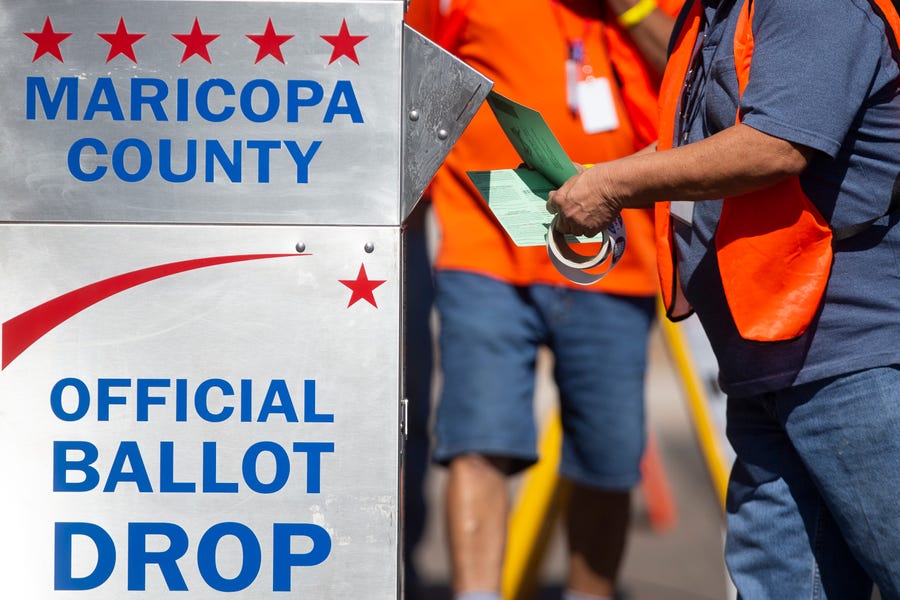
While Trump, Pence and their surrogates zipped in and out of Arizona to try to shore up support, Biden and his running mate, Kamala Harris, barely visited.

The GOP campaign rallies left Republicans fired up about their prospects — and poorly prepared for an election loss.

Hours after the polls closed on Election Day, Fox News made an aggressive, but ultimately correct, call that Biden had won Arizona. Four hours later, The Associated Press followed suit. 

Arizona was the first state projected to fall from Trump’s winning 2016 coalition, and it raised the specter of further losses in states such as Wisconsin, Michigan and Pennsylvania. All of those states, plus Georgia, eventually did flip to Biden, but it wasn’t immediately clear that would happen.

Trump responded to the quick Arizona call in an overnight news conference from the East Room of the White House that effectively gave license to his supporters to cast the election as stolen.

“This is a fraud on the American public,” Trump said at 2:30 a.m. Nov. 4 to a cheering crowd. “Frankly, we did win this election. … So our goal now is to ensure the integrity for the good of this nation.”

The president said he wanted “all voting to stop” and said his campaign would be headed to the U.S. Supreme Court.

Instead, the Trump campaign leaned heavily on officials at Fox News, hoping to undo their Arizona projection. In the days after the quick call, Ducey’s 2018 deputy campaign manager walked conservative host Sean Hannity and two senior executives with Fox News through scenarios that indicated why the state remained within Trump’s reach. The Ducey aide gave a similar briefing to the Trump campaign.

While Trump could not fathom how periodic updates could shift the race so dramatically in Arizona, campaign insiders were long accustomed to close races and results that changed over days as ballots were counted.

Arizona counts its mailed-in ballots first, and fewer Republicans sent in early ballots in 2020, instead dropping them off at the polls. Those votes were tabulated last, after Election Day voters’ tallies.

In 2018, Sinema won her Senate seat after six days of counting. In 2016, U.S. Rep. Andy Biggs, R-Ariz., won his first primary election by 16 votes after a recount shifted only a few dozen votes over 17 days.

After the quick call for Biden in Arizona on Nov. 3, raucous protesters gathered outside the building where Maricopa County officials counted ballots.

By then, some Trump supporters suggested — falsely — that election officials provided them Sharpie pens that could bleed through their ballots and eliminate their votes. It was a conspiracy theory amplified in conservative circles, including by Eric Trump, the president’s son.

For people like Fontes and Maricopa County Sheriff Paul Penzone, also a Democrat, it was not a moment to explain the intricacies of ballot markings; they feared violence.

Dozens of people — some clearly carrying firearms — swarmed the parking lot area outside the county’s election offices.

Mindful of the deadly clash in 2017 in Charlottesville, Virginia, Penzone put several armed response teams inside the building and had dozens of other deputies in the area on standby “to protect the systems, the ballots, the people — everything in there.”

Fontes, the county recorder, called it a necessary response to a charged situation. At one point, the angry crowd pulled an election worker into their unprotected area.

“This person literally had to get physically wrestled away from a group of them and pulled back into the building,” Fontes remembered. “It was in my head that there would be casualties. It was in my head that we would have to be cleaning blood out of the warehouse because they were ready, they were armed. … They came to assault my staff.”

Protests went on for days, with U.S. Rep. Paul Gosar, R-Ariz., fueling accusations of a stolen election. Alex Jones, a conspiracy monger who called the 2012 massacre of children at an elementary school in Connecticut a “giant hoax,” used a megaphone to exhort protesters to maintain their fight for Trump.

The Sheriff’s Office has spent an estimated $1.2 million on law enforcement efforts tied to the election and ballot review, including on demonstrations and protection efforts. The tab may not yet be final.

While Trump signaled the beginning of a drawn-out fight in the hours after the election, McSally, the Republican candidate for the U.S. Senate, all but disappeared from public view.

McSally didn’t formally concede her race for days, but by Nov. 9, several of her key campaign staff were vacationing in Mexico. She wound up losing to Kelly by 78,806 votes.

When the presidential ballots were fully counted on Nov. 14, just 10,457 votes — fewer than the number of people who fit in the coliseum — separated Biden from Trump. The 0.3 percentage point difference made it the tightest presidential race in state history.

Unpredictable: A pandemic and the president’s anti-mail-in ballot rhetoric turned the conventional wisdom about Arizona votes upside-down

It was a bitter disappointment, but it wasn’t a complete loss for Republicans.

The GOP maintained its hold on the Statehouse, and Arizona’s four Republicans in Congress were reelected. Republicans accepted those results, made in the same election that delivered Trump’s loss.

But Republicans loyal to Trump could not accept his defeat.

Along with daily protests at the Capitol, thousands of emails, voicemails and text messages were left for Arizona officials in the days following the election.David Wallace/The RepubliTrump supporters across the country bombarded Arizona election officials and lawmakers with staggering numbers of emails, voicemails and text messages.

Like Trump, many voters could not reconcile the energy of his campaign with the quick call for Biden and the ever-tightening margins in Arizona. Democratic gains in traditionally red Maricopa County fueled suspicions that Trump’s loss owed more to cheating rather than his limited appeal.

State Rep. Shawnna Bolick, R-Phoenix, said she received 57,000 emails in the first two months after the election — and still gets some.

At one point early on, Bowers’ secretary told him the office received more than 20,000 emails and 10,000 voicemails each day. After receiving 9,000 text messages at one point, now-Sen. Paul Boyer, R-Glendale, got another phone number.

The messages often maintained fraud tainted the election, and Democrats and their allies were covering it up. Many were vulgar; some were threatening.

“It is criminal for state legislators to certify a fraudulent election,” one message to Bowers said.

“Rusty is going to prison,” another email said. “80,000,000 patriots will make sure of this.”

“Fix this mess of an election now, do NOT let the people who committed obvious fraud, intimidation, threaten & lie & who did Not win into our Whitehouse,” read another.

The din included more than just Trump supporters, lawmakers said.

“In all of my time in office, I’ve never seen the magnitude or type of people telling me their concerns about the election,” said state Sen. J.D. Mesnard, R-Chandler. 

“Many of them have been from far-off places,” said House Majority Leader Ben Toma, R-Peoria. “It’s safe to say there’s been a ton of pressure to do something.” 

One thing that set Arizona apart from other close states was the trajectory of the race.

In Georgia, Michigan, Pennsylvania and Wisconsin, Biden staged come-from-behind victories. Trump drew closer in Arizona’s initial count before falling short.

Trump and Giuliani zeroed in on people in Arizona who could still make a push.

It wouldn’t be Ducey, who had shown little interest in raising doubts about the election. And it wouldn’t be Hobbs, the Democratic secretary of state, who defended it on national television.

The president and his lawyer targeted Bowers and Fann, the Republican heads of the Legislature. 

The weekend before Thanksgiving, a top White House aide called around, looking for cellphone numbers for both.

Those close to Fann said she felt squeezed by the most conservative members in her caucus. She was preparing for the holidays and didn’t want to discuss the election. She seemed to want to put off talking to the president and his surrogates. 

When the White House came calling, Fann needed a strategy. 

“What are we going to do? … They’re putting pressure on me — the national folks want to have fact-finding committees to find out about the fraud in Arizona,” Bowers remembered Fann saying. “She said, ‘They’re trying to get in touch with me and we’ve got to make sure we’re on the same page.’”Arizona Senate President Karen Fann stands on the floor of the Senate at the Arizona State Capitol in Phoenix on Monday, May 27, 2019.Both Arizona House Speaker Rusty Bowers (top) and Arizona Senate President Karen Fann were in the Trump team crosshairs.Thomas Hawthorne/The Republic

They never had a chance. Right after he hung up the phone with Fann, Bowers received the call from Trump and Giuliani while sitting in his Prius.

By itself, the call was memorable for Bowers. It became amusingly so when he needed to search the small screen on his cellphone to find his lawyer’s contact information for the president. 

A natural raconteur, Bowers joked to Trump and Giuliani he might have a story for his grandkids one day: that he accidentally hung up on the president.

“Trump just busted out laughing,” Bowers remembered. “He said, ‘That’s funny.’”

Then Bowers really did accidentally hang up.

The White House called him back, and Bowers and Giuliani shared a laugh. 

Bowers needed some levity. 

While Arizona’s election stirred national passions, Bowers, 69, was privately tending to his dying daughter. Her liver was failing, and she was rejected for an organ transplant. 

Inside his house, and later in a hospital, Bowers saw his daughter’s life slipping away.

Bowers documented the eventful period, as he routinely does, in his handwritten journal through pages and pages of tight cursive writing. It is a distinctive practice for a man with many interests.

Bowers’ weathered face betrays his love of the outdoors, but perhaps his greatest passion is art. He paints and has sold sculptures. At least once, Bowers passed time in the often-mundane setting of the Legislature by building a miniature pinewood derby car for his grandson on his desk during breaks. 

Bowers’ call with Trump and Giuliani revealed two of his more obvious traits: Bowers can be pleasant, but he’s no pushover.

“Rusty is a cowboy,” said one Capitol insider, in a reference to his independent nature.

Fann, 67, grew up in Prescott, one of Arizona’s most conservative areas. Decades ago, she started a transportation business that puts up guardrails to keep motorists safe. 

She was elected to municipal government around the Prescott area where politicking didn’t overshadow problem-solving. 

‘What’s happened to Karen?’ Election audit puts spotlight on Senate president after decades in office

She brought political pragmatism to a legislative seat at the Statehouse, where she has served for a decade, the past two terms as president of the Senate.

Fann, too, has a life outside politics. She likes to golf and cook. She is known to bring homemade pies to friends and is part of a dinner club. 

Her agreeable nature often leaves her in the middle of the warring factions of her Republican caucus.

Her confidants at the Statehouse include lobbyists from both political camps who have worked with her for years. Her philosophy on the job is “‘We’re in this thing together, we’ve got to pick up the trash, we’ve got to do it, let’s work together, let’s figure things out,’” one Democratic lobbyist friend said. 

If the ballot review sometimes felt like a political crucible, it also gave Fann a national political identity. 

But at the Statehouse, she had one goal: retain her role as Senate president. Unlike Bowers, who won his leadership post despite the misgivings of his party’s far-right members, Fann owed her position to the more conservative members of her chamber. 

Her friend, former state Sen. Steve Pierce, R-Prescott, a relative moderate, lost his title as Senate president after the 2012 elections to then-Sen. Andy Biggs and spent four lonely years out of power. Her friends say it was a loss Fann didn’t want to repeat.

Includes information from Arizona Republic reporter Mary Jo Pitzl.

Three Men Found Guilty of Murdering Ahmaud Arbery

The defendants were found guilty of murder and other charges on Wednesday for the pursuit and fatal shooting of Ahmaud Arbery. They face up to life in prison.

That’s the headline in the New York Times.

I never thought I would live to see the day when a jury of 11 white people and one black person in Brunswick, Georgia, would find three white men, pleading self-defense, to be guilty of murder of a black man.

After Ahmaud Arbery was killed while jogging, local prosecutors didn’t want to bring charges against the men who chased Arbery down and killed him. They said there was no crime. But the victim’s family was relentless in seeking justice.

The New York Times wrote the first national story about this case, following the important work of the local paper, The Brunswick News. We were all following the clamor of hyper-local activism here in Brunswick, where Ahmaud’s family and friends refused to let any of this go. We learned, through a public records request, that a local D.A. was telling the police to make no arrests, because, he argued, these three men had done nothing illegal.

Justice was done.