Last week, I posted my thoughts on “Who Demoralized the Nation’s Teachers?” I sought to identify the people and organizations that spread the lie that America’s public schools were “broken” and that public school teachers were the cause. The critics slandered teachers repeatedly, claiming that teachers were dragging down student test scores. They said that today’s teachers were not bright enough; they said teachers had low SAT scores; and they were no longer “the best and the brightest.”

The “corporate reform” movement (the disruption movement) was driven in large part by the “reformers'” belief that public schools were obsolete and their teachers were the bottom of the barrel. So the “reformers” promoted school choice, especially charter schools, and Teach for America, to provide the labor supply for charter schools. TFA promised to bring smart college graduates for at least two years to staff public schools and charter schools, replacing the public school teachers whom TFA believed had low expectations. TFA would have high expectations, and these newcomers with their high SAT scores would turn around the nation’s schools. The “reformers” also promoted the spurious, ineffective and harmful idea that teachers could be evaluated by the test scores of their students, although this method repeatedly, consistently showed that those who taught affluent children were excellent, while those who taught children with special needs or limited-English proficiency or high poverty were unsatisfactory. “Value-added” methodology ranked teachers by the income and background of their students’ families, not by the teachers’ effectiveness.

All of these claims were propaganda that was skillfully utilized by people who wanted to privatize the funding of public education, eliminate unions, and crush the teaching profession.

The response to the post was immediate and sizable. Some thought the list of names and groups I posted was dated, others thought it needed additions. The comments of readers were so interesting that I present them here as a supplement to my original post. My list identified No Child Left Behind, Race to the Top, and Common Core as causes of demoralization that tied teachers to a standards-and-testing regime that reduced their autonomy as professionals. One reader said that the real beginning of the war on teachers was the Reagan-era report called “A Nation at Risk,” which asserted that American public schools were mired in mediocrity and needed dramatic changes. I agree that the “Nation at Risk” report launched the era of public-school bashing. But it was NCLB and the other “solutions” that launched teacher-bashing, blaming teachers for low test scores and judging teachers by their test scores. It should be noted that the crest of “reform” was 2010, when “Waiting for Superman” was released, Common Core was put into place, value-added test scores for teachers were published, and “reformers” like Arne Duncan, Bill Gates, Michelle Rhee, Joel Klein, and other became media stars, with their constant teacher-bashing. For what it’s worth, the National Assessment of Educational Progress flatlined from 2010 onwards. Test score gains, which were supposedly the point of all this “reform” activity, were non-existent on the nation’s most consequential test (no stakes attached).

Readers also blamed demoralization on teachers’ loss of autonomy, caused by federal laws and the testing imposed by them, and by the weakness of principals and administrators who did not protect teachers from the anti-education climate caused by NCLB, RTTT, ESSA, and the test-and-punish mindset that gripped the minds of the nation’s legislators and school leaders.

Readers said that my list left off important names of those responsible for demoralizing the nation’s teachers.

Here are readers’ additions, paraphrased by me:

Michelle Rhee, who was pictured on the cover of TIME magazine as the person who knew “How to Fix American Education” and lionized in a story by Amanda Ripley. Rhee was shown holding a broom, preparing to sweep “bad teachers” and “bad principals” out of the schools. During her brief tenure as Chancellor of D.C., she fired scores of teachers and added to her ruthless reputation by firing a principal on national television. For doing so, she was the Queen of “education reform” in the eyes of the national media until USA Today broke a major cheating scandal in the D.C. schools.

Joel Klein, antitrust lawyer who was chosen by Mayor Bloomberg to become the Chancellor of the New York City public schools, where he closed scores of schools because of their low test scores, embraced test-based evaluation of schools and teachers, and opened hundreds of small specialized schools and charter schools. He frequently derided teachers and blamed them for lagging test scores. He frequently reorganized the entire, vast school system, surrounding himself with aides with Business School graduates and Wall Street credentials. Under his leadership, NYC was the epitome of corporate reform, which inherently disrespected career educators.

Michael Bloomberg, former Mayor of New York City, billionaire funder of charter schools and of candidates running for state or local offices who supported privatization of public schools. He claimed that under his leadership, the test-score gap between different racial gaps had been cut in half or even closed, but it wasn’t true. He stated his desire to fire teachers who couldn’t “produce” high test scores, while doubling the size of the classes of teachers who could. His huge public relations staff circulated the story of a “New York City Miracle,” but it didn’t exist and evaporated as soon as he left office.

Reed Hastings, billionaire funder of charter schools and founder of Netflix. He expressed the wish that all school boards would be eliminated. The charter school was his ideal, managed privately without public oversight.

John King, charter school leader who was appointed New York Commissioner of Education. He was a cheerleader for the Common Core and high-stakes testing. He made parents so angry by his policies that he stopped appearing at public events. He was named U.S. Secretary of Education, following Arne Duncan, in the last year of the Obama administration and continued to advocate for the same ill-fated policies as Duncan.

Betsy DeVos, Trump’s Secretary of Education despised public schools, unions, and teachers. She never had a good word to say about public schools. She wanted every student to attend religious schools at public expense.

Eli Broad and the “academy” he created to train superintendents with his ideas about top-down management and the alleged value of closing schools with low test scores

ALEC (the American Legislative Exchange Council), which writes model legislation for privatizing public schools by opening charters and vouchers and lowering standards for teachers and crushing unions. More than 2,000 rightwing state legislators belong to ALEC and get their ideas directly from ALEC about privatization and other ways to crush public schools and their teachers.

Rupert Murdoch, the media, Time, Newsweek, NY Times, Washington Post for their hostility towards public schools and their warm, breathless reporting about charter schools and Teach for America. The Washington Post editorialist is a devotee of charter schools and loved Michelle Rhee’s cut-throat style. TIME ran two cover stories endorsing the “reform” movement; the one featuring Michelle Rhee, and the other referring to one of every four public school teachers as a “rotten apple.” The second cover lauded the idea that teachers were the cause of low test scores, and one of every four should be weeded out. Newsweek also had a Rhee cover, and another that declared in a sentence repeated on a chalkboard, “We Must Fire Bad Teachers,” as though the public schools were overrun with miscreant teachers.

David Coleman, the architect of the Common Core, which undermined the autonomy of teachers and ironically removed teachers’ focus on content and replaced it with empty skills. The Common Core valued “informational text” over literature and urged teachers to reduce time spent teaching literature.

Margaret Raymond, of the Walton-funded CREDO, which evaluates charter schools.

Hanna Skandera, who was Secretary of Education in New Mexico and tried to import the Florida model of testing, accountability, and choice to New Mexico. That state has one of the highest rates of child poverty in the nation, and the Florida model didn’t make any difference.

Governors who bashed teachers and public schools, like Chris Christie of New Jersey, Andrew Cuomo of New York, and Gregg Abbott of Texas

“Researchers” like those from the Fordham Institute, who saw nothing good in public schools or their teaching

Senator Michael Bennet of Colorado, who turned Denver into a model of “reform,” with everything DFER wanted: charter schools and high-stakes testing.

Poorly behaving students and parents who won’t hold kids accountable for bad behavior

Campbell Brown and the 74

The U.S. Department of Education, for foisting terrible ideas on the nation’s schools and teachers, and state education departments and state superintendents for going along with these bad ideas. Not one state chief stood up and said, “We won’t do what is clearly wrong for our students and their teachers.”

The two big national unions, for going along with these bad ideas instead of fighting them tooth and nail.

And now I will quote readers’ comments exactly as they wrote them, without identifying their authors (they know who they are):

*Rightwing organizations like the American Enterprise Institute, (AEI), the Thomas B. Fordham Institute, the Heritage Foundation, even the allegedly Democratic-leaning Center for American Progress (CAP) for publishing white papers masquerading as education research that promotes privatization.

*Wall St moguls who invented Social Impact Bonds (SIBs) to gamble on & profit from preK student test scores.

*Rogues Gallery. One body blow after another. A systematic 💦 water boarding with no respite. And then we add the Broad Foundation who sent Broad-trained “leadership” so drunk on arrogance and ignorance that the term “School Yard Bully” just doesn’t capture it.
Operating with the Imprimatur and thin veneer of venture capital, plutocratic philanthropy, these haughty thugs devastated every good program they laid eyes on. Sinking their claws instinctively into the intelligent, effective and cultured faculty FIRST.A well orchestrated, heavily scripted Saturday Night Massacre.

*Congress and the Presidents set the stage, but the US Department of Education was instrumental in making it all happen. They effectively implemented a coherent program to attack, smear and otherwise demoralize teachers. And make no mistake, it was quite purposeful

*This list is incomplete without members of Democrats for Education Reform. Add in Senator Ted Kennedy, whose role in the passage of No Child Left Behind was critical. Same for then Congressman and future Speaker of the House, John Boehner, who noted (bragged!) in his recent autobiography that he was essential in keeping President George W. Bush on track with NCLB.

*Let’s not forget Senate Chair Patty Murray. She has been an important player in keeping the worse of Ed Reform legislation alive.

*You have presented a rogue’s gallery of failed “reformers” that have worked against the common good. In addition to those mentioned, there has also been an ancillary group of promoters and enablers that have undermined public education including billionaire think tanks, foundations and members of both political parties. These people continue to spread lies and misinformation, and no amount of facts or research is able to diminish the drive to privatize. While so called reformers often hide behind an ideological shield, they are mostly about the greedy pursuit of appropriating the education that belongs to the people and transferring its billions in value into the pockets of the already wealthy. So called education reform is class warfare.

*The Clintons, whose 1994 reauthorization of ESEA set the stage for NCLB

*Don’t forget the so called ‘liberal’ media, publications such as the New York Times and the Boston Globe who have published pro charter piece after pro charter piece, while simultaneously dumping all over public schools

*I’d like to include a cast of editorialists like George Will, Bill Rhoden, and many others, who have parroted the plutocratic-backed Ed Reform line. Armstrong Williams would certainly be part of this.

*Going back even further into the origins of this madness, I would add to Diane’s excellent rogues gallery those unknown bureaucrats in state departments of education who replaced broad, general frameworks/overall strategic objectives with bullet lists of almost entirely content-free “standards” that served as the archetype of the Common [sic] Core [sic] based on the absurd theory that we should “teach skills” independent of content, all of which led, ironically, to trivialization of and aimlessnessness in ELA pedagogy and curricula and to a whole generation of young English teachers who themselves NOW KNOW NEXT TO NOTHING OF THE CONTENT OF THEIR SUBJECT, typified by the English teacher who told one of the parents who regularly contributes comments to this blog, “I’m an English teacher, so I don’t teach content.” So, today, instead of teaching, say, Robert Frost’s “Stopping by Woods on a Snowy Evening” as part of a coherent and cumulative unit on common structures and techniques and genres of poetry, one gets idiotic test-practice exercises on “inferencing” and “finding the main idea,” with any random piece of writing as the “text.”

*It’s driven by how teachers have been treated the past 4-5 years, especially during the pandemic. Teachers are first responders. We should have been on the list of first-to-be-vaccinated. Schools should have strict mask and vaccine mandates. Teachers are professional educators. We should not be told what and how to teach by ignorant, conspiracy-driven MAGA parents. Public education is a cornerstone of democracy, and we teachers are motivated by a sense of civic duty. We are demoralized by attempts to destroy public education, led by anti-education bible-thumping “leaders” like Betsy DeVos and (in my home state) Frank Edelblut. Public education is being dismantled by gleeful right-wingers, while naive, well-intentioned moderates wring their hands and do little to defend it. It’s tiring to be under constant attack on the front lines, with no support. That’s why teachers are leaving today.

*One tiny example of a routine phenomenon. Teachers got the message pretty clearly: They were at the bottom of the pecking order. The absolute bottom. Micromanaged and undercut at every turn.Excellent points. The heavy handed top-down, bureaucratic demands for “data,” basically serve one goal, to justify the existence of administration.Don’t forget the voracious appetite of publishing companies…We had a district administrator prance around in our “professional; development days” tell use could not read novels or other picture books to the students…ONLY USE PEARSON.”And then 7 or so years later, the district made us THROW OUT every book from Pearson, and they bought new crap curriculum…that program was written by testing industry, not educators, I think it was “Benchmark,” real junk.

*I’d like to mention how I often lose my student teachers when they see the edTPA requirement. They switch majors, and the teaching pool gets even smaller.

*After Skamdera in NM came the TFA VAM sweetheart Christopher Ruszkowski. At least he had 3 years in a classroom, Skammy had none, but the Florida model, you know?

*Children’s behavior is in large part in response to the drill and kill curriculum and endless testing and teaching to the test that has been driving public education since NCLB and the back-to-basics movement that ushered it in. No room for creativity, no room for self expression, no room for innovation. Highly scripted Curriculum like Open Court turned children into little automatons, barking their answers like well trained dogs and turned teachers into task masters. It was a drive to dummy down the curriculum for fear of teaching too much free thinking. And a drive to turn teachers into testing machines and teacher technicians, easily replaced by anyone who can walk in a classroom and pick up the manual. Only it doesn’t work. It was and is developmentally inappropriate and the resulting rebellion in the classrooms if proof of that. No wonder teachers are leaving in droves!

*Under threat of closure of the MA school board in the mid 1800s, Horace Mann turned to the cheapest labor he could find, literate northern females, and deployed the Protestant ethic “teacher as a calling” trope to institute state free-riding on teachers (as opposed to the free-riding of which teachers are accused). Everything in this piece is correct except for the “almost” in the final paragraph. There’s no “almost” about it … free-riding on teachers is an operational feature of a system imported from Prussia, designed to produce cheap, obedient labor by underpaying women. As of 2012, teachers would need to make around 1/3 higher salaries to be paid on the same level as their professional peers. Everyone mentioned in the article is simply this generation’s enactment of the long-standing, systemic class war that preys on gender and race to continue and exacerbate inequity. While naming the current situation is very important, we also need to discuss, address, and shift these deep issues.

*It’s the boiled frog effect over the last 50 years that began as a response to mini-courses, sixties curriculum, obsession over college attendance, professors and teachers walking out to protest with their students, Viet Nam… and the Civil Rights Act. Since 1964, Intentional segregation influenced Local, state, and federal decision making on transportation, health care, insurance, zoning, housing, education funding, hiring, and more. When whites fled the cities and insured two sides of the tracks in towns and two systems evolved, quick fixes became that accumulation of bad decisions and leadership – and slowly, slowly, deterioration became acceptable.

*The list is not dated. It’s illustrative of the accumulation of negativity, quick-fix seeking, acronym-filled, snake-oil salesmen, desperate mayors and governors, obsession with rankings, publisher fixation on common core, NCLB votes hidden under the shadow of 9/11, and keep-everyone-happy state and national professional organizations.

*At the end of 2021 it is far right and left of politics and their rhetoric like CRT and homophobic slurs. So much for especially the “Christian Right.” In their god’s (yes lower case since not The Lord Jesus Christ’s New Testament words of love) name they exclude instead of include to share the good news/word.

*Data, data, data. Yesterday, I commented that I feel sympathetic toward the anti-CRT petitioners. I do. They’re not bad people. They’re just afraid of changing social rules. Their actions are demoralizing, but not dehumanizing. Wealthy corporations and individuals on the other hand , through their untaxed foundations, gave carrots to governments the world over to give the stick to education so that greater profits could be made through privatization and data monetizing. I was once called a 2. I was once labeled the color grey. I was numbered, dehumanized by test score data in an attempt to make education like Uber or Yelp. Not just demoralized, dehumanized. It’s not just who but what dehumanized teachers. It was the wrongheaded idea that education can be measured and sold by the unit. That idea was insidious. The marketing ploy to make my students into consumers who consider their efforts junk unless they are labeled with the right number or dashboard color was insidious. I have no sympathy for the investor class. They are not people with whom I disagree about social issues; they are hostile, corporate takeover wolves out to tear the flesh of the formerly middle and deeply impoverished classes for profit. Not one of the investors in education “reform” or any of their revolving door bureaucrats is any friend of mine. The list of who is long. The list of what is short.

*Jonah Edelman (Founder, Stand on Children); brother Josh Edelman (Gates Foundation: Empowering-?!–Effective Teaching; SEED Charter Schools); Charles & David Koch. Pear$on Publishing monopoly&, of course, ALEC (interfering in our business for FIFTY long years!)

Tom Ultican has written extensively about the greed and politics behind privatization. In this post, he reviews an important new book about the dangers of privatization by Donald Cohen and Allen Mikaelian. I urge you to buy the book.

Ultican writes:

Ronald Reagan claimed the nine most terrifying words in the English language are “I’m from the government, and I’m here to help.” The new book, The Privatization of Everything, documents the widespread theft of the commons facilitated by Reagan’s anti-government philosophy. His remark echoed a claim from the “laissez-faire cheerleader” Friedrich Hayek that government has us all on the “road to serfdom” (Privatization 120). Sherrilyn Ifill, the former Director-Council of the NAACP Legal Defense Fund observed,

“What we’re seeing in our country today: the rhetoric, the hate, the ignorance, the coarseness, the vulgarity, the cruelty, the greed, the fear is the result of decades of poor citizenship development. It is a reflection of the fully privatized notion of citizenship, a feral conflict for the scraps left by oligarchs (Privatization 13).”

Libertarian politicians like former speaker of the house Paul Ryan and Senators Ron Johnson and Rand Paul claim Hayek and writer-philosopher Ayn Rand as their guiding lights. In a 2012 article, Politico reported, “…, to bring new staffers up to speed, Ryan gives them copies of Hayek’s classic “Road to Serfdom” and Rand’s “Atlas Shrugged” — books he says inspires his political philosophy.” Politico also stated,

“But Hayek and Rand were violently opposed to each other’s ideas. It is virtually impossible to hold them in the same brain. When the termagant Rand met Hayek, she screamed across the room, ‘Compromiser!’ and reviled him as an ‘abysmal fool,’ an “ass” and a ‘totally, complete, vicious bastard.’”  (Termagant: a violent, turbulent, or brawling woman.)

Ayn Rand’s problem with Hayek was that he was not really the “laissez-faire cheerleader” he was purported to be. He certainly opposed many of the ideas emanating from Franklyn Roosevelt’s New Deal believing they would lead to worse problems than the ones being addressed. Fundamentally his thinking was shaped by a fear of communism. However, unlike today’s libertarians, he was not opposed to all government programs or interventions and that is what stirred Ayn Rand’s fury.

Robert Nielsen’s 2012 review of Hayek’s The Road to Serfdom observes,

“He also calls for social insurance in case of sickness and accident, as well as government assistance after a natural disaster. ‘But there is no incompatibility in principle between the state providing greater security in this way and preservation of individual freedom.’ I think most advocates of Hayek have not read this passage and don’t realise he is not an extremist arguing against all forms of government. Let me repeat this, Hayek is arguing there is a good case for the government to get involved in healthcare, either in the form of universal healthcare or government insurance.”

John Maynard Keynes is thought of as the liberal economist whose theories guided President Roosevelt as he grappled with the great depression. Hayek’s and Keynes’s economic theories were in some ways polar opposites. However, Hayek came to London to work at the School of Economics where he and Keynes who was 16-years his senior became friends. They exchanged several letters concerning Hayek’s works in which Keynes found some agreement.

Chet Yarbrough’s audio book review of The Road to Serfdom states,

“Contrary to a wide perception that John Maynard Keynes (a liberal economist in today’s parlance) denigrated ‘The Road to Serfdom’; Keynes, in fact, praised it.”

“Though Keynes praised ‘The Road to Serfdom’, he did not think Hayek’s economic’ liberalism practical; i.e. Keynes infers that Hayek could not practically draw a line between a safety net for the poor, uninsured-sick, and unemployed (which Hayek endorsed) while denying government intervention in a competitive, laissez-faire economy.”

It is disingenuous to cite the theories of Friedrich Hayek as the justification for privatizing government functions and the commons.

The Privatization of Everything

The Privatization of Everything co-author Donald Cohen is the founder and executive director of In The Public Interest. Co-author Allen Mikaelian is the bestselling author of Metal of Honor and a doctoral fellow in history at American University. Besides the authors’ individual work, the team at In The Public Interest contributed significantly to the book with research and documentation.

Of their intention in writing the book, the authors state,

“Our approach is both idealistic and practical. We want readers to see the lofty values and big ideas behind the creation of public goods, and we want readers to feel empowered to question those values and introduce new ones. We want to help change the conversation, so we can stop talking about ‘government monopolies’ and return to talking about public control over public goods (Privatization 19).

They detail several cases showing the downside of the government being forced to give control over to private business. In this era of human-activity-induced climate change, what has been happening at the National Weather Service (NWS) is instructive.

In the 1960s, President John F. Kennedy believed that the US and the Soviet Union could find a field of cooperation in supporting the World Meteorological Organization. As a result, 193 countries and territories all agreed to provide “essential data” on a “free and unrestricted basis.” “Each day, global observations add up to twenty terabytes of data, which is processed by a supercomputer running 77 trillion calculations per second (Privatization 267).”

The book notes, “In the 1990s, at about the same time that forecasting got consistently good, private interests and free-market absolutists started insisting that the NWS and related agencies were ‘competing’ with private enterprise.” Barry Myers, head of AccuWeather was loudly accusing the government of running a “monopoly.” He went to the extreme of calling for the government to get out of the weather predicting business which made no sense since AccuWeather is completely dependent on NWS predictions. (Privatization 268)

After a killer tornado in 2011, NWS employees proposed a smart-phone app to better inform the public. The author’s report, “… this ultimately took a backseat to Myers’s insistence that his AccuWeather apps shouldn’t face ‘unfair’ competition (Privatization 270).” To this day, NWS has no smartphone app.

Weather forecasts are pretty good for up to a week but after that as time passes they become more and more useless. The models for predicting the weather are highly dependent on the preceding day and the farther you get from accurate data for that day the more error invades the predictions. NWS restricts its predictions to a one-week time-frame but AccuWeather and the Weather Channel in order to attract customers provide meaningless 2-week up to 90-days predictions. (Privatization 272)

Extreme weather events are life threatening. The authors state,

“The NWS’s mission includes saving lives. The business model of corporations like AccuWeather includes saving lives of paying customers only (Privatization 273).”

There are many episodes like NWS detailed. In the section on private prisons, we read about such atrocities as the Idaho correctional facility known as the “Gladiator School” (Privatization 140). When detailing the privatization of water we are informed of Nestles CEO, Peter Brabeck stating how extreme it was to believe that “as a human being you should have a right to water (Privatization 54).”

Privatizing Public Education Stabs Democracy in the Heart

The First Public School in America

Boston Latin School was founded April 23, 1635. America’s first public school only accepted boys for their curriculum centered on humanities including the study of Latin and Greek. Its more famous revolutionary-era students were Samuel Adams, John Hancock and Benjamin Franklin. These revolutionary thinkers who gave America democracy were educated in a public school and would latter agree that free public schools were necessary to a functioning democracy.

When Betsy DeVos was calling for vouchers and charter schools, she was implicitly demanding public dollars support religious schools that would not accept transgender students or homosexual teachers. She wanted schools free to teach a doctrine of science denial and religious bigotry. “Freedom of choice in this case meant the freedom to discriminate, with the blessing of public funds (Privatization 210).”

One of the several disturbing stories about the menace of privatizing schools comes from Reynolds Lake Oconee, Georgia. Wealthy real estate developer Mercer Reynolds III made a charter school the center of his community development. The charter school application called for 80% of the children to come from Reynolds properties. The other 12% would go to students in nearby wealthy white communities and the remaining 8% would go to countywide residents. (Privatization 211-212)

With a mix of taxpayer and private funding, Reynolds built an impressive school. It had a piano lab with 25 pianos, a pond and offered 17 AP classes. The school is 73% white. The nearby public school that is 68% black and would never dream of a piano lab has seen the Reynolds school continually siphon off more of their students. They have been forced into laying-off staff and tightening budgets. (Privatization 212)

Cohen and Mikaelian concluded,

“This was a clear-cut case of rich whites diverting money from struggling black families in order to further push them to the margins. And they used the ideas of school choice and free market to justify it.

As the book makes clear, every time a public good is privatized the public loses some of their democratic rights over that lost good. This is a powerful book that everyone should read. In the last chapter the authors call out to us,

“We can’t let private interests sell us public goods as consumers, because the free market can’t avoid creating exclusions. School choice quickly devolves into segregation. Public parks and highways are divided into general versus premium services. In the midst of a notional health crisis, ventilators go to the highest bidder.”

Marion Brady is an educator who has argued for many years that subject-matter based curriculum is wrong. He thinks we need to change our ingrained ways of thinking. He asks for your advice:

Brady writes:

In 1966, the Phi Delta Kappan published an article of mine criticizing the traditional “core” curriculum adopted in 1893 that organizes most of the middle school and high school day. I suggested an alternative organizer. 

In many more journal articles, in books published by respected presses, in chapters in others’ books, in nationally distributed op-eds and newspaper columns and in countless internet blogs, I’ve continued to argue that the core curriculum is the major academic reason for generation after generation of basically flat academic performance, and that a simple, cost-free “fix” for the problem has revolutionary potential.

Pushing back on my contention—at least for the last 25 or 30 years—is a corporately engineered campaign to privatize public schooling without triggering the public debate such a radical change in the bedrock of democracydeserves. That campaign’s wrong assumptions—that the core curriculum provides a “well-rounded” education, that competition is the main motivator of performance, that standardized tests measure what’s important, that rigor must replace “low expectations,” and teachers are the key to improving the institution—lock even more rigidly in place a 19th Century curriculum.

What’s wrong with the core?

There are eighteen items on my list of problems with the core and the way it’s usually taught. For brevity’s sake I’ll address only one of them—the one noted by dozens of well-known and respected thinkers and studies conducted by the Carnegie Foundation for the Advancement of Teaching and the Association of American Colleges.

That #1 problem: The world the core curriculum is supposed to explain is systemically integrated. The core curriculum is not.

In his 1916 Presidential Address to the MathematicalAssociation of England, philosopher and mathematician Alfred North Whitehead put it in simpler words. He said the curriculum’s “disconnection of subjects” was “fatal.”

He was right. Wikipedia explains the failure to react appropriately to that information:

The boiling frog is an apologue describing a frog being slowly boiled alive. The premise is that if a frog is put suddenly into boiling water, it will jump out, but if the frog is put in tepid water which is then brought to a boil slowly, it will not perceive the danger and will be cooked to death.

To see examples of how that works out in human affairs, follow any randomly chosen day’s news.

An alternative

Given institutional inertia, educating’s inherent complexity, machine-scored standardized testing, multi-layered education bureaucracies and education policy made by non-educators in Congress and state legislatures, the core curriculum can’t be dislodged. It can, however, be used in non-traditional ways that circumvent the core’s most serious problems.

The core organizes the study of a mix of math, science, language arts and social studies subjects. What learners need that the core doesn’t provide is an “organizer of organizers” that shows not just how all school subjects but all fields of knowledge fit together and interact to create a whole much greater than the sum of parts. Lacking that master organizer, a few schools use interdisciplinary, multidisciplinary, transdisciplinary and cross-disciplinary studies and project learning, but those can’t be standardized to create the “subjects” that education bureaucracies require.

An organizer of organizers

Fortunately, an organizer of organizers doesn’t have to be invented or developed. All normal humans are born with brains that do that in the manner of the group or society within which individuals have been socialized. To solve most of the core’s problems, that master organizer just needs to be lifted into consciousness and put to useful work, something all adolescents are able to do.

Our organizer of organizers is easily understood. When attention is fixed on a matter of interest, five kinds of information integrate systemically to create sense—the same five kinds of information that structure languages, stories, drama, reports, textbooks, school subjects,conversation and so on: Time. Place. Actors. Action. Cause.

Instructional activities that allow learners to discover for themselves the knowledge-creating process and put it to work, move them to levels of academic performance far beyond the evaluating capabilities of standardized tests, and do so with an efficiency that allows the legitimate aims of a general education to be met in a fraction of the time spent on “covering the content” of the core curriculum.

The most legitimate aim of education is saving humankind. Reality is dynamic. Inexorable environmental, demographic, technological and social change create ever-more complex problems requiring new knowledge. New knowledge is created by the discovery of relationships between and among things not previously thought to relate—a newborn’s fussing and the appearance of a nipple; cigarettes and cancer; moon and tides; justice and societal stability; time and space.

New knowledge is essential, but even more crucial is an increase in depth and breadth of understanding ofcomplex reality by the general public. This is the ultimategoal of what we’re doing.

Proof

About a year after publication of the 1966 Kappan article, James Guiher, Vice-President of Prentice-Hall’s Educational Books Division, called. Could he and P-H’s Head K-12 Editor, Mike McDanield, come to Florida to talk?

Long story, short: They came, starting a long-running conversation ending with a project to produce a middle school-level American history textbook and a world cultures textbook consistent with my thinking.

“Rich” concepts (e.g. cultural assumptions, value conflict, social control, polarization, cultural interaction, system change, and so on) organized several weeks of study for each concept. Prentice-Hall’s college-level history and anthropology authors provided unique and engaging primary data for the concepts, and my brother and I wrote instructional activities using their data.

Traditional schooling emphasizes and rewards passive learner recall of information. The P-H project’s primary sources required learners to hypothesize, infer, value, extrapolate, correlate, imagine, synthesize, predict, estimate, generalize, and so on—exercise the dozens of cognitive processes that make routine human functioning possible and enable civilized life.

Every unit culminated with activities requiring learners to apply the concept to contemporary matters.

P-H’s marketing department printed and distributed the activities to middle school teachers nationwide and invited them to write reports about how the activities worked (or didn’t) and send them to inhouse P-H editors.

At the end of each semester, eight teachers whose reports seemed most perceptive were identified, P-H paid for their substitutes for a week, and flew them and us to a resort somewhere to rework, refine, and replace activities.

Thirty-nine middle school teachers participated.

The books were ready for publication in 1976, but a back-to-basics reaction to what’s now called “constructivist learning” prompted P-H’s marketing department to shelve the project, then change its mind and do a small press run in 1977 with no advertising or follow-up promotion.

End of project.

I know of no other curriculum development project that matches in thoroughness our effort to combine what are generally considered “best practices:” (1) A focus on powerful concepts. (2) Deliberate use of learners’ already-known, simple, comprehensive, natural information organizers. (3) Active use of learner firsthand, immediate, real-world experience. (4) Small-group cooperative learning to minimize threat and encourage “thinking out loud.” (5) Intellectually challenging but interesting, unfamiliar primary sources. (6) Correct modeling of the holistic, systemically integrated nature of reality. (7) Extensive writing and illustrating requirements. (8) Traditional schooling’s emphasis on two thought processes—recalling and applying—replaced by work requiring learners to use a full range of thought processes.

Salvage operation

Watching the destructive chaos created by amateur education reformers, ideologues and privatizers, prompted us to ask P-H about copyrights for the instructional materials we’d created.

They gave them to us in May 1990. We updated and reformatted the lessons to adapt them to the internet, put them online, downloadable free of cost or other obligation, and invited users to suggest improvements.

We’ve added instructional materials for general systems theory, world history, civics and science. That’s at odds with our belief that the general knowledge component of the curriculum should be a single, comprehensive course of study systemically integrating all fields of knowledge, with specialized course offerings expanded and offered as electives. However, recognizing resistance to change and existing bureaucratic boundaries and expectations, we’ve used traditional subjects in non-traditional ways to encourage acceptance and use of systemic conceptions of reality.

Notwithstanding the fact that our instructional activities require thought processes too complex to be evaluated by standardized tests, files routinely download by the hundreds weekly without a dime spent on advertising. If officials would remove the artificial performance ceiling created by the limitations of standardized testing and accompany academic work with exercises to improve classroom culture, we believe the ability of the young to cope with the messes they’re inheriting will be maximized.

Request for Advice

I’ll be 95 years old in May. My brother, Howard, 86. We’d like to donate our work—free of cost or other obligation—to an institution, organization or other entity on condition they create a suitable website, keep the activities downloadable and free for teachers to use with their own students, and encourage their continuous improvement, including across cultural boundaries.

If you a have suggestions for contacts who might be willing to talk about accepting what we’re offering, we’d really appreciate hearing from you.

Marion………… mbrady2222@gmail.com

Howard……….. hbrady1@cfl.rr.com

​​​​​###

My SUNY Press book, What’s Worth Teaching? Selecting, Organizing, and Integrating Knowledge, was published in 1989 and co-published by Books for Educators. The link below is to a pre-publication review by Philip L. Smith, Editor of the SUNY Press series of books Philosophy of Education. Smith is now Professor Emeritus, Ohio State University. https://www.marionbrady.com/articles/WWTReview.pdf

A revised version titled What’s Worth Learning? published by Information Age Publishing, is now free for downloading: https://www.marionbrady.com/documents/WWL.pdf

Links to illustrative instructional activities:https://www.marionbrady.com/documents/samplecontents.pdf

Jack Hassard, retired teacher of science teachers, pays close attention to facts and science.

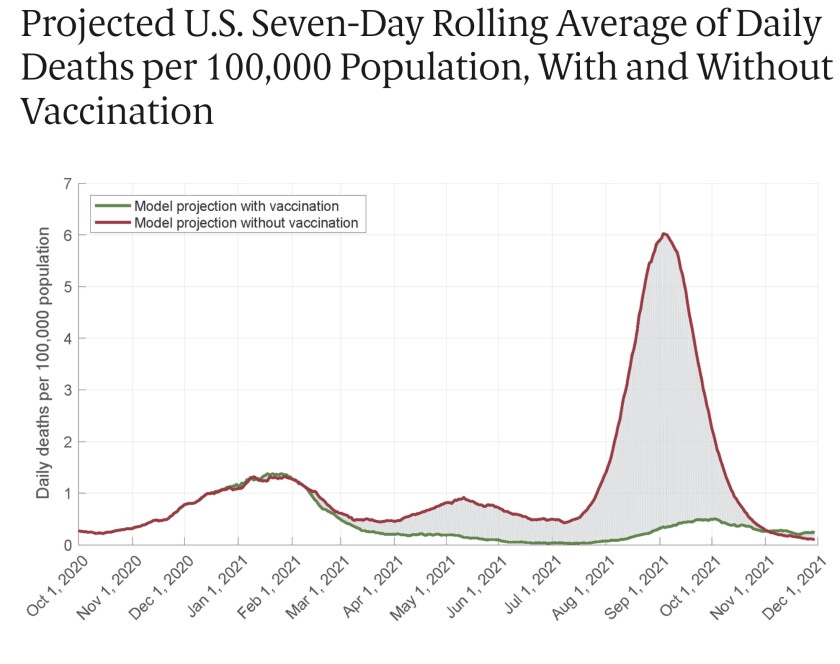
Here he presents the facts about who is getting infected with COVID.

He writes:

Here are two charts from the CDC that we can use to answer that question. Unvaccinated people are 5 – 10 times more likely to get infected than vaccinated people. They are also 14 – 20 times more likely to die from COVID.

Open the post to see the charts.

I sometimes get comments from people who claim that they are waiting for evidence that the vaccines work. The other day I read a news story about a married couple who died of COVID on the same day. They were unvaccinated. The husband said before he died that he was ”doing research” about the vaccines.

The two charts in this post should end the hesitancy of anti-vaxxers. But it won’t..

Why would a Native American tribe in Wisconsin sponsor a MAGA charter school?

The Lake Country Classical Academy, an independent charter school authorized by the Lac Courte Oreilles Ojibwe College in northern Wisconsin, opened in September in the Milwaukee suburb of Oconomowoc, about a five-hour drive south on Interstate 94 from Hayward, where the college is located — about as far away from Ojibwe land and tribal members as you can get without leaving Wisconsin.

The academy advertises itself as a back-to-basics school that emphasizes Latin and phonics and takes a top-down, “teacher-led” approach to education, instilling “virtues of character” in its students. It is the first of its kind in Wisconsin, part of a nationwide network of charter schools that receive curriculum, teacher training, and mentoring from Hillsdale College, a small Christian college in Michigan with deep ties to the Trump administration. The “1776 curriculum” devised by Hillsdale and used by the Lake Country Classical Academy is “the latest push to continue former President Donald Trump’s mission to create a ‘patriotic education,’” according to a July 2021 article in Politico. Larry Arnn, Hillsdale’s president, led the Trump administration’s 1776 Commission, created to promote a positive vision of America, in what Politico calls “a direct challenge to The New York Times Magazine’s 1619 Project, which explored how racism and inequality shaped the founding of the country.”

Wisconsin public school advocates see the new charter school as a backdoor way to divert tax dollars from public schools and into quasi-private academies. Republican legislators have featured the school at hearings as they push for an expansion of tribal colleges’ ability to grant charters. Heather DuBois Bourenane, director of the Wisconsin Public Education Network, particularly objects to what she sees as policymakers “politicking with some of the state’s most vulnerable kids in order to advance a political project or agenda.”

Others see something peculiar about the tribe’s sponsorship of a school curriculum that appears to whitewash history.

“It’s really surprising that a Native American group would be sponsoring a Hillsdale charter school,” says Gary Miron, a professor of evaluation, measurement and research at Western Michigan University and a fellow at the National Education Policy Center. In Michigan, where he lives, Miron says, Hillsdale is “well known as a kind of fortress for conservative, and often racist views.”

Have a happy, HEALTHY New Year!

Get vaccinated if you haven’t already, although I can’t believe that any reader of this blog would not be double vaccinated and boosted by now. Wear an N95 or KN95 mask. (Here is advice from the New York Times about how to buy high-quality N95 masks online.) My friends tell me that this is the N95 mask used by nurses at Mt.Sinai Hospital in New York City.

Georgia Congresswoman Marjorie Taylor Greene has boasted that she is unvaccinated, but news came out last week that she owns stock in three of the four major vaccine manufacturers. At least we can be assured that she’s not fighting vaccines for her own financial benefit. Greene has repeatedly defied rules requiring masking when in the House of Representatives, and she’s so far racked up $80,000 in fines deducted from her salary for failing to wear a mask. She says the federal public health rules are “tyrannical,” “communist,” “authoritarian,” and “unconstitutional.”

This is the kind of ideological insanity that’s fueling the longevity of the pandemic. If you know people like her, avoid them until the danger is past.

Be careful.

You can’t be happy unless you are healthy.

Be healthy. Be happy.

I want you all with me in 2022.

Happy New Year!

Diane

Heather Cox Richardson is an American historian at Boston College. I enjoy reading her views, which are always well-informed.

She writes:

December 30, 2021

Heather Cox RichardsonDec 31

On January 6, insurrectionists trying to overturn the results of the 2020 presidential election stormed the U.S. Capitol and sent our lawmakers into hiding. Since President Joe Biden took office on January 20, just two weeks after the attack, we have been engaged in a great struggle between those trying to restore our democracy and those determined to undermine it. 

Biden committed to restoring our democracy after the strains it had endured. When he took office, we were in the midst of a global pandemic whose official death toll in the U.S. was at 407,000. Our economy was in tatters, our foreign alliances weakened, and our government under siege by insurrectionists, some of whom were lawmakers themselves.

In his inaugural address, Biden implored Americans to come together to face these crises. He recalled the Civil War, the Great Depression, the World Wars, and the attacks of 9/11, noting that “[i]n each of these moments, enough of us came together to carry all of us forward.” “It’s time for boldness, for there is so much to do,” he said. He asked Americans to “write an American story of hope, not fear… [a] story that tells ages yet to come that we answered the call of history…. That democracy and hope, truth and justice, did not die on our watch but thrived.”

Later that day, he headed to the Oval Office. “I thought there’s no time to wait. Get to work immediately,” he said.

Rather than permitting the Trump Republicans who were still insisting Trump had won the election to frame the national conversation, Biden and Vice President Kamala Harris, as well as the Democrats in Congress, ignored them and set out to prove that our government can work for ordinary Americans.

Biden vowed to overcome Covid, trying to rally Republicans to join Democrats behind a “war” on the global pandemic. The Trump team had refused to confer during the transition period with the Biden team, who discovered that the previous administration had never had a plan for federal delivery of covid vaccines, simply planning to give them to the states and then let the cash-strapped states figure out how to get them into arms. “What we’re inheriting is so much worse than we could have imagined,” Biden’s coronavirus response coordinator, Jeff Zients, said to reporters on January 21.

Biden immediately invoked the Defense Production Act, bought more vaccines, worked with states to establish vaccine sites and transportation to them, and established vaccine centers in pharmacies across the country. As vaccination rates climbed, he vowed to make sure that 70% of the U.S. adult population would have one vaccine shot and 160 million U.S. adults would be fully vaccinated by July 4th.

At the same time, the Democrats undertook to repair the economy, badly damaged by the pandemic. In March, without a single Republican vote, they passed the $1.9 trillion American Rescue Plan to jump-start the economy by putting money into the pockets of ordinary Americans. It worked. The new law cut child poverty in half by putting $66 billion into 36 million households. It expanded access to the Affordable Care Act, enabling more than 4.6 million Americans who were not previously insured to get healthcare coverage, bringing the total covered to a record 13.6 million.

As vaccinated people started to venture out again, this support for consumers bolstered U.S. companies, which by the end of the year were showing profit margins higher than they have been since 1950, at 15%. Companies reduced their debt, which translated to a strong stock market. In February, Biden’s first month in office, the jobless rate was 6.2%; by December it had dropped to 4.2%. This means that 4.1 million jobs were created in the Biden administration’s first year, more than were created in the 12 years of the Trump and George W. Bush administrations combined.

In November, Congress passed a $1.2 trillion infrastructure bill that will repair bridges and roads and get broadband to places that still don’t have it, and negotiations continue on a larger infrastructure package that will support child care and elder care, as well as education and measures to address climate change.

Bloomberg and the Wall Street Journal report that U.S. economic output jumped more than 7% in the last three months of 2021. Overall growth for 2021 should be about 6%, and economists predict growth of around 4% in 2022—the highest numbers the U.S. has seen in decades. China’s growth in the same period will be 4%, and the eurozone (the member countries of the European Union that use the euro) will grow at 2%. The U.S. is “outperforming the world by the biggest margin in the 21st century,” wrote Matthew A. Winkler in Bloomberg, “and with good reason: America’s economy improved more in Joe Biden’s first 12 months than any president during the past 50 years….”

With more experience in foreign affairs than any president since George H. W. Bush, Biden set out to rebuild our strained alliances and modernize the war on terror. On January 20, he took steps to rejoin the World Health Organization and the Paris Climate Accords, which his predecessor had rejected. Secretary of State Antony Blinken emphasized that Biden’s leadership team believed foreign and domestic policy to be profoundly linked. They promised to support democracy at home and abroad to combat the authoritarianism rising around the world.

“The more we and other democracies can show the world that we can deliver, not only for our people, but also for each other, the more we can refute the lie that authoritarian countries love to tell, that theirs is the better way to meet people’s fundamental needs and hopes. It’s on us to prove them wrong,” Blinken said.

Biden and Blinken increased the use of sanctions against those suspected of funding terrorism. Declaring it vital to national security to stop corruption in order to prevent illicit money from undermining democracies, Biden convened a Summit for Democracy, where leaders from more than 110 countries discussed how best to combat authoritarianism and corruption, and to protect human rights.

Biden began to shift American foreign policy most noticeably by withdrawing from the nation’s twenty-year war in Afghanistan. He inherited the previous president’s February 2020 deal with the Taliban to withdraw U.S. forces from Afghanistan by May 1, 2021, so long as the Taliban did not kill any more Americans. By the time Biden took office, the U.S. had withdrawn all but 2500 troops from the country.

He could either go back on Trump’s agreement—meaning the Taliban would again begin attacking U.S. service people, forcing the U.S. to pour in troops and sustain casualties—or get out of what had become a meandering, expensive, unpopular war, one that Biden himself had wanted to leave since the Obama administration.

In April, Biden said he would honor the agreement he had inherited from Trump, beginning, not ending, the troop withdrawal on May 1. He said he would have everyone out by September 11, the 20th anniversary of the al-Qaeda attacks that took us there in the first place. (He later adjusted that to August 31.) He promised to evacuate the country “responsibly, deliberately, and safely” and assured Americans that the U.S. had “trained and equipped a standing force of over 300,000 Afghan personnel” who would “continue to fight valiantly, on behalf of the Afghans, at great cost.”

Instead, the Afghan army crumbled as the U.S began to pull its remaining troops out in July. By mid-August, the Taliban had taken control of the capital, Kabul, and the leaders of the Afghan government fled, abandoning the country to chaos. People rushed to the airport to escape and seven Afghans died, either crushed in the crowds or killed when they fell from planes to which they had clung in hopes of getting out. Then, on August 26, two explosions outside the Kabul airport killed at least 60 Afghan civilians and 13 U.S. troops. More than 100 Afghans and 15 U.S. service members were wounded.

In the aftermath, the U.S. military conducted the largest human airlift in U.S. history, moving more than 100,000 people without further casualties, and on August 30, Major General Chris Donahue, commander of the U.S. Army 82nd Airborne Division, boarded a cargo plane at Kabul airport, and the U.S. war in Afghanistan was over. (Evacuations have continued on planes chartered by other countries.)

With the end of that war, Biden has focused on using financial pressure and alliances rather than military might to achieve foreign policy goals. He has worked with North Atlantic Treaty Organization (NATO) allies to counter increasing aggression from Russian president Vladimir Putin, strengthening NATO, while suggesting publicly that further Russian incursions into Ukraine will have serious financial repercussions.

In any ordinary time, Biden’s demonstration that democracy can work for ordinary people in three major areas would have been an astonishing success.

But these are not ordinary times.

Biden and the Democrats have had to face an opposition that is working to undermine the government. Even after the January 6 attack on the Capitol, 147 Republican members of Congress voted to challenge at least one of the certified state electoral votes, propping up the Big Lie that Trump won the 2020 presidential election. Many of them continue to plug that lie, convincing 68% of Republicans that Biden is an illegitimate president.

This lie has justified the passage in 19 Republican-dominated states of 33 new laws to suppress voting or to take the counting of votes out of the hands of non-partisan officials altogether and turn that process over to Republicans.

Republicans have stoked opposition to the Democrats by feeding the culture wars, skipping negotiations on the American Rescue Plan, for example, to complain that the toymaker Hasbro was introducing a gender-neutral Potato Head toy, and that the estate of Dr. Seuss was ceasing publication of some of his lesser-known books that bore racist pictures or themes. They created a firestorm over Critical Race Theory, an advanced legal theory, insisting that it, and the teaching of issues of race in the schools, was teaching white children to hate themselves.

Most notably, though, as Biden’s coronavirus vaccination program appeared to be meeting his ambitious goals, Republicans suggested that government vaccine outreach was overreach, pushing the government into people’s lives. Vaccination rates began to drop off, and Biden’s July 4 goal went unmet just as the more contagious Delta variant began to rage across the country.

In July, Biden required federal workers and contractors to be vaccinated; in November, the administration said that workers at businesses with more than 100 employees and health care workers must be vaccinated or frequently tested.

Rejecting the vaccine became a badge of opposition to the Biden administration. By early December, fewer than 10% of adult Democrats were unvaccinated, compared with 40% of Republicans. This means that Republicans are three times more likely than Democrats to die of Covid, and as the new Omicron variant rages across the country, Republicans are blaming Biden for not stopping the pandemic. Covid has now killed more than 800,000 Americans.

While Biden and the Democrats have made many missteps this year—missing that the Afghan government would collapse, hitting an Afghan family in a drone strike, underplaying Covid testing, prioritizing infrastructure over voting rights—the Democrats’ biggest miscalculation might well be refusing to address the disinformation of the Republicans directly in order to promote bipartisanship and move the country forward together.

With the lies of Trump Republicans largely unchallenged by Democratic lawmakers or the media, Republicans have swung almost entirely into the Trump camp. The former president has worked to purge from the state and national party anyone he considers insufficiently loyal to him, and his closest supporters have become so extreme that they are openly supporting authoritarianism and talking of Democrats as “vermin.”

Some are talking about a “national divorce,” which observers have interpreted as a call for secession, like the Confederates tried in 1860. But in fact, Trump Republicans do not want to form their own country. Rather, they want to cement minority rule in this one, keeping themselves in power over the will of the majority.

It seems that in some ways we are ending 2021 as we began it. Although Biden and the Democrats have indeed demonstrated that our government, properly run, can work for the people to combat a deadly pandemic, create a booming economy, and stop unpopular wars, that same authoritarian minority that tried to overturn the 2020 election on January 6 is more deeply entrenched than it was a year ago.

And yet, as we move into 2022, the ground is shifting. The House Select Committee to Investigate the January 6th Attack on the U.S. Capitol is starting to show what it has learned from the testimony of more than 300 witnesses and a review of more than 35,000 documents. The fact that those closest to Trump are refusing to testify suggests that the hearings in the new year will be compelling and will help people to understand just how close we came to an authoritarian takeover last January.

And then, as soon as the Senate resumes work in the new year, it will take up measures to restore the voting rights and election integrity Republican legislatures have stripped away, giving back to the people the power to guard against such an authoritarian coup happening again.

It looks like 2022 is going to be a choppy ride, but its outcome is in our hands. As Congressman John Lewis (D-GA), who was beaten almost to death in his quest to protect the right to vote, wrote to us when he passed: “Democracy is not a state. It is an act, and each generation must do its part.”

—

Notes:

https://khn.org/morning-breakout/covid-deaths-skew-higher-than-ever-in-red-states/

The “vermin” and “national divorce” quotations are tweets from Representative Marjorie Taylor Greene (R-GA) but I didn’t want to spread them on social media. They were retweeted by several other Republicans.

This is a blogger whose thoughts and writings I enjoy.

Personal Reflections on 2021

December 31, 2021

Comment
Share

Robert B. Hubbell

Dec 31

[Audio version of newsletter here]

Legendary House Speaker Tip O’Neill was fond of saying that “All politics is local.” I would add that “All politics is personal.” My effort to interpret the news each day through “a lens of hope” begins and ends with my family. Above all else, I am trying to sustain and lift-up my family by staring into the noisome stream of information that passes for “news” to find the thread of decency and hope that binds us together as a nation. You get to ‘listen in’ as I write for my wife, my daughters, and (now) my granddaughters.

Every story that passes through the pages of the newsletter affects each of us in very personal ways—some immediately, others over the long term. As we come to the end of 2021, my wife and I are taking this opportunity reflect on how four developments affected our family. We hope that our personal reflections on daily life will resonate with you and encourage you to reflect on 2021 with your family and friends. As you do, let me issue a spoiler alert: 2021 was a rough year, but we endured by binding together as families, communities, and Americans (at least, enough of us did to carry all of us forward). We face many challenges ahead. But having made it through 2021 should give us confidence as we face the challenges of 2022 and beyond.

The coronavirus pandemic.

Twelve months ago, we lived in a constant state of apprehension and anxiety. A vaccine was approved for emergency use but was not generally available to the public until mid-year. My wife and I essentially sheltered in place. We left the house to take walks (with masks) and made a daily drive to a local burger joint to get a diet coke at the drive-through window. (The staff behind the window eventually took pity on us and started giving us a “military discount” on a tab of $2.65.)

In April, we sat in our car in mile-long lines in the Dodger Stadium parking lot to receive our first and second vaccinations. It was reminiscent of standing in line in 1964 with hundreds of children at the local National Guard armory to receive the polio vaccine. The sense of relief was palpable. Despite the long lines, we were filled with pride at the efficiency of the national vaccination effort and the scientific accomplishment of developing a vaccine in less than a year. Our daughters were filled with relief that their “elderly” parents had received protection from the coronavirus. And we heaved a sigh of relief as we were able to gather with family over the summer months and early fall.

And now, Omicron. With two unvaccinated infant granddaughters in the family, we have essentially returned to lockdown. Despite the frustration and new round of anxiety, we feel better prepared and protected (everyone in the family is triple vaccinated). But this wave is more complicated because partisan politics tinges every aspect of the effort to contain the coronavirus. It is difficult to feel charity towards people who turned their backs on science for partisan reasons and now clog the emergency rooms in many states, preventing care for others with conditions unrelated to coronavirus. They are, of course, victims of the disinformation peddled by the right-wing news media and cynical politicians who are seeking re-election by endangering the lives of their constituents.

For me, the biggest casualty of the pandemic is trust in science. The rapid development of the vaccine saved millions of lives. But 40% of Americans believe nonsense about the vaccine and the coronavirus, including its origin, treatment, and damage to the human body from Covid-19. We have a lot of work to do to overcome that blow to science. The health and safety of our children and grandchildren depend on scientific progress, and it is up to us defend science and scientists if we hope to prevent future catastrophes.

January 6th.

There is a “before” and “after” aspect to January 6th. Before the insurrection, the notion that some members of Trump’s base would resort to violence to intervene in the democratic process seemed unthinkable. January 6th changed everything. On that day, for the second time in five years, one of my daughters said, “I told you it would happen; you didn’t believe me.” She was right, and it is humbling to be proven wrong after giving assurances that something would not come to pass. (The first was the accidental election of Trump.)

Perhaps the worst part of January 6th was that, after a few days, Republicans overcame their shock over the assault on the Capitol and began to talk themselves into believing that “It wasn’t so bad; just some overenthusiastic patriots getting rowdy.” In that sense, January 6th is about the utter, complete, and final collapse of the Republican Party. It is not only irredeemable, it is unworthy of being redeemed. It has become an apologist and propagandist for an insurrection against the United States. It doesn’t get any worse than that.

And yet, the media treats Josh Hawley like he is a U.S. Senator rather than a traitor to the Constitution. The same with Kevin McCarthy and Ted Cruz and Ron Johnson and Marjorie Taylor Green and every other member of Congress who encouraged or excused the violence on January 6th. The insurrection continues to this day as Republicans in Congress refuse to cooperate with the Select Committee’s investigation of the assault on the Capitol.

But not every act of partisan politics amounts to rebellion and not every threat by an unhinged Trump supporter portends civil war. January 6thchanged everything, but we cannot let it change us. We must remain vigilant without surrendering to exaggerated fears; we must take threats seriously but retain our ability to assess the scale of threats and likelihood of materialization. We must not suffer from a lack of imagination in anticipating new threats, but we must remain firmly rooted in reality as we defend democracy. Those competing demands will challenge us as we move toward the next presidential election, but we are up to the task.

Climate change.

For nearly two months in 2021, we believed that our small cabin in the Sierras would be destroyed by wildfire. After a monumental effort by CalFire and other agencies, the southern edge of the fire stopped one mile from our cabin. Even then, it smoldered for several months more—until December snows finally extinguished it.

It is always a mistake to point to a single event and declare that it was caused by climate change. But the 2021 wildfires in the Sierras followed a historic drought that killed more than one hundred million trees in the southern Sierras. That is not a once-in-a-generation event. That is a once-in-recorded-history event. Although the snows have returned to the Sierras in December 2021, one wet winter cannot recharge aquifers depleted by a decade of drought. The vast San Joaquin Valley, which produces 25% of the nation’s table food, depends on snowmelt from the Sierras to recharge groundwater basins and aquifers. Friends who farm in the San Joaquin Valley tell us that 100-foot wells are being replaced by 800-foot wells as farmers chase ever receding groundwater. These dramatic changes happened in a generation. Are they permanent? We won’t know the answer to that question until it is too late to do anything about it. The sensible course is to assume that the historic droughts in California are caused by climate change and act accordingly—before it is too late.

The next generation.

At root, this newsletter is about redeeming democracy for the next generation. With the birth of two granddaughters in 2020 and 2021, that task took on greater urgency and a broader time horizon. Being a grandparent is wonderful, but it is also an awesome responsibility—especially so during a pandemic. It is impossible to look at their beautiful faces and not wonder what type of world we are leaving to them. Like climate change, we won’t know the answer to that question until it is too late to do anything to change the outcome. So, the only option is to do everything in our power now to ensure that they will live a country that is free, tolerant, safe, healthy, and peaceful. As one reader reminded me recently, we must “govern for our grandchildren—and their grandchildren.” Taking the long view in governing requires discipline, sacrifice, and wisdom. We should elect our leaders accordingly. In 2020, we made a good start. And yet, despite all we hope to do for them, what they have done for us is incalculable. They are our joy, our hope, and our reason. We feel blessed.

Concluding Thoughts.

This newsletter started in response to Trump’s accidental election in 2016. After Biden’s inauguration, I had no definite plans for the future of the newsletter—except to write the next edition each day. I entertained the vague hope that it would outlive its usefulness and slowly fade away. But the events of 2021 had other plans for the newsletter. Its growth in Biden’s first year has exceeded the newsletter’s growth during four years of Trump. It is clear that we are engaged in an extended fight for the soul of democracy. We will win, but it will require decades of vigilance and effort on our part. I will be by your side every step of the way, offering encouragement, consolation, information, and the collective wisdom of the community of like-minded people who comprise this newsletter. Thank you for accompanying me on this journey. It is an honor.

It being New Year’s Eve, it is not a time for serious thinking.

Thus, I take this opportunity to offer my suggestions for good things to watch on television. Or, to put it another way, things that I really liked watching.

My favorite was the Belgian crime series called “Professor T.” on PBS. Do not mistakenly watch the British version. Professor T. is a highly intelligent, neurotic criminologist who solves difficult crimes. The series is urbane, witty, provocative, and sometimes zany. I enjoyed watching Professor T. think, and I liked his taste in music (mostly Bach.)

The best film I have seen lately is Don’t Look Up. It is a terrifying, sometimes hilarious metaphor for our times. It has a star-filled cast (Merryl Streep as a Trump-like President), Leonardo DiCaprio as a scientist at Michigan State, Jennifer Lawrence as a graduate student at MSU). And many more big names (Tyler Perry, Cate Blanchett, Jonah Hill, Ariana Grande).

The story, in brief, is that a grad student observes a giant comet headed directly for earth. A direct hit will extinguish all life on earth in a bit more than six months. She tells her professor and they contact federal authorities,who bring them to D.C. to meet with officials at NASA, the military, and the White House. The White House decides the story should be buried because it might have a negative effect on the midterm elections. They go to the media. The nation’s biggest talk show treats them as less important than a story about a singing star breaking up with her boyfriend. They get low ratings, and the news media decides their story is not interesting; it won’t sell papers. Basically, their warnings are discredited, and no one takes them seriously.

But the President calls them back, says their calculations have been verified by the scientific community, and she deploys plans to destroy the comet with massive strikes of nuclear missiles.

Then the plot changes as a tech genius convinces the President that the comet can be stopped without destroying it, and its minerals are worth trillions. The profit motive brings a sharp change of plans. I won’t tell you how it ends. You should see it. It captures the essence of our celebrity-driven, superficial mass culture, where power and greed outweigh common sense and integrity.

What are your favorites?

Michael Hiltzik, a superb columnist for the Los Angeles Times, says farewell to “the stupidest year in American history. “ (Again, I violate copyright law by posting this column. I appeal to the good graces of the wonderful L.A. Times. If they object, I will delete the post.)

My one criticism of his incisive critique is that he nearly ignores the astonishing, unprecedented attack on the U.S. Capitol by insurrectionists on January 6, 2021, a day that will live in infamy, a day that a sitting President urged his supporters to overturn the election he lost, a day that the Capitol was breached and ransacked by hundreds or thousands of Trump supporters, who proceeded to attack scores of law officers defending the Constitutional transfer of power and hundreds of legislators. Hundreds of those legislators—all Republicans—soon became defenders and apologists for the insurrectionists who besieged them. It doesn’t get stupider than that.

Hiltzik writes:

One year ago, we were looking forward to a safer and sounder 2021.

The Food and Drug Administration had granted emergency authorization to the Pfizer-BioNTech and Moderna vaccines against COVID-19.

A new presidential administration was poised to take office in the next month, armed with a commitment to bring together a nation cleaved by four years of divisive policymaking.

Instead of unity and immunity, this year has brought us stupidity and insanity on an unimaginable scale. In the categories of public health, education policy, fiscal policy and investment options, we appear to have taken leave of our collective senses.

Certainly there are other years or periods in which stupidity or heedlessness brought civilization in general close to eradication.

Consider 1914, when most of Europe dived hellbent to war for no discernible reason. (Read Barbara Tuchman’s book “The Guns of August” for the full horrific picture.) The Dark Ages were a period benighted by scientific ignorance.

Some individual countries and national leaders stand out for tempting fate, to their and their citizens’ misfortune. Britain in 1938 under Neville Chamberlain. Russia’s warmongering with Japan in 1904-1905. Louis Napoleon poking a stick into the Prussian bear’s cage in 1870-1871. Saddam Hussein invading Kuwait in 1990.

The perpetrators of some of these errors might assert in their defense that they were brought low by circumstances they didn’t know at the time.

But America in 2021 can’t plead that it didn’t know. Didn’t know that vaccines representing stupendous scientific achievements were the solution to the COVID-19 pandemic?

It was not to be.

Didn’t know that Donald Trump wasn’t joking when he demanded that government officials overturn a fair presidential election? Didn’t know that bitcoin, NFTs, SPACs and meme stocks were destined, even designed, to take unwary investors to the cleaners?

Of course we knew, and know. We don’t seem to care.

In reviewing the most intellectually demoralizing events of 2021, I’ll leave aside a few discrete outbursts of asininity.

So I won’t go into detail about the conservative movement’s lionizing of Kyle Rittenhouse, the self-confessed but acquitted killer of two unarmed men at a protest rally in Kenosha, Wis. Or the openly antisemitic ravings by former President Trump. Or the ugly, dishonest attacks that forced the withdrawal of Saule Omarova, one of the most qualified nominees for a federal banking regulatory job in memory.

Or the shameful behavior of congressional Republicans, who cowered in safety during the Jan. 6 insurrection, pleading with Trump to help quell the riot, only to claim ever since that the violence of the crowd was no big deal.

Or the posting of Christmas cards by politicians showing their families hoisting assault weapons, as Rep. Thomas Massie (R-Ky.) did just four days after a gunman killed four students at a Michigan high school. He was followed by Rep. Lauren Boebert (R-Colo.).

Instead, we’ll focus on a few of the bigger pictures. So, as Virgil said to Dante before guiding him into the Inferno, “Let us descend now into the blind world.”

COVID-19

The pandemic is surely the focus of the most obtuse and ignorant public reactions and state and local policy responses to any crisis in American history. It’s as if the grown-ups have all been beamed up, and we are left in the hands of people like Florida Gov. Ron DeSantis. (I am paraphrasing a line from the great pandemic movie “Together.”)

In any rational world, the refusal or failure by some 50 million adult Americans to take a vaccine of known efficacy against a deadly disease would be inexplicable. But this is not a rational world, and the situation is even worse.

Vaccine refusal is seen in many benighted corners of the United States not merely as the exercise of personal choice for personal reasons but as a means of showing moral superiority over the vaccinated.

A conservative critic of anti-pandemic measures writing from rural southwest Michigan for the Atlantic bragged absurdly and selfishly, “I am now closer to most of my fellow Americans than the people, almost absurdly overrepresented in media and elite institutions, who are still genuinely concerned about this virus.”

The author may think he’s remote from virus concerns, but that’s not the case at a hospital visited by CNN in Lansing, Mich., which can’t be much more than 100 miles from his location and where “the latest COVID-19 surge is as bad as healthcare workers there have seen.”

How did it come to pass that Americans, who almost uniformly are inoculated against at least a half-dozen serious diseases in childhood, chose this moment to refuse a spectacularly effective shot against one of the most dangerous diseases to arise in their lifetimes, out of pure ignorance?

Its effectiveness is scarcely disputable: The Commonwealth Fund estimates that the vaccine averted about 1.1 million American deaths from COVID-19 and more than 10.3 million hospitalizations this year.

A chart showing COVID-19 deaths

The Commonwealth Fund estimates that the U.S. would have experienced more than 1.1 million additional deaths from COVID-19 if not for the vaccines.(Commonwealth Fund)

The answer lies in politics.

Trump drew the line first, dismissing social distancing steps and refusing to speak up for vaccination. He established these steps as partisan choices, and his political acolytes followed him over the cliff.

DeSantis has been a leader in this descent into the Inferno. He’s chosen to make Dr. Anthony Fauci, head of the National Institute of Allergy and Infectious Diseases and America’s most respected authority on the pandemic, a target of partisan calumny. He’s appointed a vaccine doubter as his state’s top public health official.

What is the outcome? Florida currently ranks eighth-worst among states in its COVID-19 death rate, with more than 62,000 Floridians having perished from the virus. Of the seven states with worse records, six are red states like Florida.

Corporate America has not showered itself in glory. On Dec. 18, Boeing announced that it was dropping its requirement that all U.S. employees be vaccinated. Its explanation was that a federal judge had blocked the enforcement of a federal executive order that employees of government contractors be vaccinated.

This is absurd. Nothing in the ruling required Boeing to drop its requirement. The company announced its step back just as the Omicron variant was about to produce a surge in infections. The pusillanimity of American corporations on this subject continues to astound. (The Times, which is owned by a physician and biomedical entrepreneur, is requiring all employees to be fully vaccinated by Jan. 31.)

To its credit, on Dec. 17 the Biden White House issued an uncompromising warning about the dangers of remaining unvaccinated.

“For the unvaccinated, you’re looking at a winter of severe illness and death for yourselves, your families and the hospitals you may soon overwhelm,” White House Chief of Staff Ron Klain said. “So, our message to every American is clear…. Wear a mask in public indoor settings. Get vaccinated, get your kids vaccinated, and get a booster shot when you’re eligible.”

Investment follies

In May, I asked whether we were experiencing a peak in investment absurdity. The examples then were bitcoin, dogecoin and nonfungible tokens (NFTs), as well as meme stocks, the prices of which were not tied to sober reflections about their issuers’ business prospects but to internet-fueled speculation.

Assets like these, which are priced in accordance with the “greater fool” theory (they have no intrinsic value beyond what you can cadge from a bigger fool than yourself), have only proliferated since then. Or perhaps it’s only the absurdity that has ballooned.

NFTs, for instance, are tradable digital files that confer no ownership to anything but the digital file, which may be an image of an object that is actually owned by someone else. Someone has parodied the NFT market by purporting to sell NFTs of images of individual Olive Garden restaurants, but it’s the kind of parody that gets at the essential truth of the target.

You don’t get to own the restaurant or the photo. You don’t get a discount on menu items or a guarantee that the photo is even accurate. You supposedly get to own something on the Non-fungible Olive Garden Metaverse, whatever that is, and you can try to find a greater fool to sell it to.

NFTs generally don’t confer ownership of the underlying asset or even the digital representation of the asset. The market doesn’t exist for any reason except to produce activity to suck in greater fools.

The best clue that there’s something hinky about these markets is that the Trump family is going all in. A purported media company started by Donald Trump, for instance, is merging with a special purpose acquisition company, or SPAC.

As I reported, the deal promptly came under the scrutiny of financial regulators. In any case, no discernible business plan of any substance has emerged for the Trump company. People appear to have invested because of his name.

Now Melania Trump has gotten into the act, hawking NFTs of paintings of her eyes—”an amulet to inspire,” the pitch says, though obviously you don’t get to own the eyes or even the original watercolor.

Software developer Stephen Diehl, an established skeptic of these things, writes that we are entering upon “a hustler’s paradise … where the market now provides a financial token game for every meme, every celebrity, every political movement, and every bit of art and culture.” The old saw applies about how if you’re looking around the poker table and can’t identify the mark, it’s you.

Inflation and Build Back Better

Republicans and conservatives have never cottoned to spending on programs that assist the middle and working class. President Biden’s Build Back Better program was destined to get their backs up.

How could they attack a program that provides for universal prekindergarten education, assistance with child care, caps on the price of drugs such as insulin and better access to healthcare? Simple: Raise the old bugaboo of inflation.

That’s been the approach of Sen. Joe Manchin III (D-W.Va.), who recently announced — via Fox News, of course — that he couldn’t support the plan in any way. He’s since backed off a bit from his adamantine opposition, but the core of his position was concern that the measure would add to inflation.

As we’ve reported, that’s just wrong. Not even former Treasury Secretary Lawrence Summers, who sounded an inflation alarm about the pandemic relief package enacted this year, thinks it applies to this measure. The provisions of Build Back Better are paid for and represent investments in the economy, so they’re anything but inflationary.

Indeed, Wall Street views Manchin’s resistance as an economic negative. According to MarketWatch, Goldman Sachs cut its growth forecast for the first quarter of next year to 2% from 3%, for the second quarter to 3% from 3.5% and for the third quarter to 2.75% from 3%.

That’s not counting the direct impact of Build Back Better on Manchin’s own state, which is among the poorest in the nation and one in which government programs are crucial. That’s well understood on the ground: The United Mine Workers union publicly urged Manchin to reconsider his opposition to a program that would have “a meaningful impact on our members, their families, and their communities.”

Much more happened in 2021 that prompts one to hold head in hands. To be fair, however, there were also glimmers of hope.

Biden on Dec. 21 announced steps to strengthen the country’s response to the Omicron variant, including mobilizing troops to help staff overwhelmed hospitals, opening thousands of vaccine sites and sending 500 million free testing kits to households. The Build Back Better plan is not entirely dead, and a revival effort will start in January.

Whether 2022 will be less stupid and insane than 2021 won’t be known until we can view it in a rearview mirror 12 months from now. We can only hope.