John Merrow was the education correspondent for the PBS Newshour for many years. He writes here about the insane insults hurled at our nation’s teachers by MAGA.
The US has nearly 3.6 million K-12 teachers, and another 1.5 million college teachers. One-third of 5.1 million is 1.7 million. Who knew that we have 1,700,000 terrorists in our classrooms!
I certainly had no idea things were that bad, and I’m kicking myself for not knowing. After all, I spent more than 67 years in American classrooms, as a student, a teacher, a parent, and a reporter. I must have interviewed and maybe even socialized with thousands of these terrorists, and I didn’t have a clue.
My 4th grade teacher yelled a lot and banged desks (and some ears too), so I supposed she “terrorized” us, but I don’t think that’s what the accuser had in mind.
I can think of one other possible example of ‘terrorism’ in the classroom: My 10th grade English teacher, Mr. McKinley, would deliberately make mistakes when he wrote stuff on the blackboard and then erupt in (faux) fury if we failed to catch his flubs. Somehow, I don’t think that’s what the accuser had in mind.
Are you questioning the accuracy of the accusation? OK, it came from President Donald Trump’s buddy Steve Bannon, who opened his mouth while in Arizona to pay tribute to Charlie Kirk, the assassinated leader of Turning Point. The podcast host was saying to Bannon that Kirk’s ideas about marrying early and having lots of children were actually not popular with young people, which prompted Bannon to blame teachers for brain-washing their students. Here’s what he said:
“…..those kids — look, from kindergarten all the way up, they are essentially, you know, a third of the teachers are terrorists that are trying to form them.”
Predictably, the right-wing podcaster didn’t challenge Bannon’s wild accusation or even ask him what he meant by ‘terrorist,’ so I’m going to go out on a limb and suggest that Bannon meant that teachers were teaching values that Bannon disapproves of, like tolerance and cooperation. I have seen lots of teachers work hard to inculcate such values, and, if that’s ‘terrorism,’ I approve.
Mocking Bannon is a woefully insufficient response, however, because his blatant teacher-bashing is part of the right wing’s persistent, harsh, and (unfortunately) often successful campaign to bring down public education.
And Bannon’s not even a field general in this war. He’s clearly outranked by Oklahoma’s State Superintendent of Education Ryan Walters, who in January reacted to violence at the Mardi Gras in New Orleans. You may recall that, early on New Year’s Day an army veteran carrying an ISIS flag drove his pickup truck down Bourbon Street and killed 14 people and injured dozens more before the police killed him. It was labeled a possible terrorist incident, prompting Mr. Walters to go off: “We also have to take a look at how are these terrorists coming from people that live in America. …. You have schools that are teaching kids to hate their country, that this country is evil. You have the teachers’ unions pushing this on our kid (sic).”
Mocking the hyperbole of school critics like Walters and Bannon is ineffective, because culture warriors are immune to humor. Instead, they are seriously opposed to just about everything that some of us believe is in the public interest, such as public education, public transportation, public libraries, public parks, public health, and so on. They recognize that public education is a cornerstone of our democracy, and they are going after it, with sledgehammers and other implements of destruction, including lies and absurd accusations from the likes of Bannon and Walters.
(They are anti-public-everything, acronym APE. Don’t be an APE!)
Early in September, the New York Times reporter Dana Goldstein did a deep dive into the impact of vouchers, education savings accounts, tax credit scholarships, and other programs that divert funds from public schools to non-public schools. The entire article is well worth your time.
The number of students whose parents are using these programs has doubled since 2019, nearly all in Republican-led states. Five years ago, only about 20,000 students had education savings accounts (ESA), which allow deducting any ‘educational’ expense from one’s taxes; today, more than 500,000 families have ESA’s.
In the past, eligibility for most of these programs was means-tested because the stated goal was to help low income families. That’s changed, and in the new programs, any family can take advantage, regardless of income.
This ain’t cheap. Indiana’s program, for example, is costing more than $600 million dollars a year, dollars that might have gone to public education.
Joining the 14 states with voucher-type programs is your federal government, because the “Big Beautiful Bill” passed by Congress earlier this year includes a $5,000 voucher.
Do these voucher programs work? The evidence is mixed, at best.
Are they popular with voters? Here the answer is crystal clear: NO! In the 17 opportunities that voters have had to weigh in on vouchers since 1970, they’ve said NO, including three votes in Republican-led states in 2024.
For a critical view of what’s going on, read David Osborne’s analysis here.
If you support public education, begin by thanking teachers. Take a minute to picture the teachers who had changed your lives for the better…and then to ask yourselves if you ever said ‘Thank you’ to those women and men. If it’s too late to connect directly with them, you might write something about them and share it with others.
That’s only the first step. Consider attending school board meetings, perhaps even running for election to your local school board. You might join the parent-teacher organization, or volunteer as a tutor. You might contribute supplies, or help with school fund-raising efforts. Let your elected officials at all levels know that you support public education. If you’re a public school parent, move beyond ‘involvement’ to ‘engagement,’ by getting to know your children’s teachers.
It’s not pie-in-the-sky idealism to believe that a strong public education system is the road to equality and citizenship, or that the real safeguard of democracy is education. Those insights came from FDR and Martin Luther King, Jr., among others.
Please make certain that you are registered to vote, and that your friends and neighbors are as well. This attack on public education is serious, folks. Don’t take our democracy for granted.
Florida, under Ron DeSantis, is determined to defund its public schools.
The first charter law in Florida was passed in 1996, when Democrat Lawton Chiles was governor. The 1996 law said there could be no more than two charter schools in each district, and only local school boards could authorize them. When Chiles left office, the state had 17 charter schools.
From 1999-2007, Republican Governor Jeb Bush removed the caps on charters and encouraged their growth. By the end of his tenure, there were more than 300 charter schools.
Republican Charlie Crist vetoed aggressive charter legislation, but charters increased to more than 300 during his tenure in office (2007-2011).
Republican Rick Scott (2011-2019) strongly promoted school choice, reduced regulation, and the number of charters increased to about 650.
Far-right DeSantis is a cheerleader for charters and vouchers. Elected in 2019, DeSantis has aggressively expanded charters as well as vouchers, while reducing accountability.
Half of Florida’s charter schools operate for-profit. Over the years, nearly 500 charter schools have closed, due to maladministration, low enrollment, finances, or scandal.
Today, Florida has about 730 charter schools, which enroll 13.8% of the state’s students, about 400,000. The cost of charters is about $2.5-4 billion annually that should have gone to public schools.
The state’s Republican-controlled governor and legislature are dedicated to expanding private alternatives to public schools. In 2023, it removed income limits from vouchers, so that all private school students are now eligible to get a state subsidy. The number of students receiving vouchers doubled, from 250,000 to 524,000.
Before and since the voucher expansion of 2023, 70% of the voucher recipients were already enrolled in voucher schools. so Florida offers a subsidy to all students enrolled in private and religious schools regardless of family income.
Florida spends about $4 billion on vouchers each year, subsidizing mostly families who can pay for schooling without state aid.
Thus, between charters and vouchers, Florida is spending at least $6 billion annually on school choice.
Now, Florida has given charter operators another boon, allowing them to co-locate inside public schools. This alleviates their need for facilities funding.
Many Republican legislators have financial ties to the charter industry.
It’s the latest push by Florida officials to expand school choice in a state that has long been a national model for conservative education policy.
The move comes as some public schools are closing their doors as they grapple with declining enrollments, aging facilities and post-pandemic student struggles.The new regulations approved by the state board build on a bill signed into law by Republican Gov. Ron DeSantis this year to allow operators to open more “schools of hope,” charter schools that are meant to serve students from persistently low-performing schools.
Lawmakers created the schools of hope program in 2017 to encourage more publicly funded, privately run schools to open in areas where traditional public schools had been failing for years, giving students and families in those neighborhoods a way to bail out of a struggling school.
This year’s law loosens restrictions on where schools of hope can operate, allowing them to set up operations within the walls of a public school — even a high-performing one — if the campus has underused or vacant facilities.
The board’s new regulations require public school districts to provide the same facilities-related services to the charter schools as they do their own campuses, including custodial work, maintenance, school safety, food service, nursing and student transportation — “without limitation.
”School districts must allow schools of hope to use “all or part of an educational facility at no cost”, including classrooms and administrative offices, the rules read.
“All common indoor and outdoor space at a facility such as cafeterias, gymnasiums, recreation areas, parking lots, storage spaces and auditoriums, without limitation, must be shared proportionately based on total full-time equivalent student enrollment,” the rules continue.
Public school advocates urged the board to vote down the proposal at Wednesday’s meeting. One such advocate, India Miller, argued that schools of hope are designed to be “parasitic” to public schools.
“To me, it would be like asking Home Depot to give Lowe’s space in their store and pay all of their infrastructure costs. It just does not make sense to me,” Miller said.
Board members, who are appointed by DeSantis, defended the new rules and dismissed concerns that the charter expansion could pull critical funding away from traditional public schools.
“Schools of hope wouldn’t be necessary if our public school system had done its job along the way,” said board Vice Chair Esther Byrd.
Associated Press writer Kimberlee Kruesi contributed reporting from Providence, Rhode Island. Payne is a corps member for The Associated Press/Report for America Statehouse News Initiative. Report for America is a nonprofit national service program that places journalists in local newsrooms to report on undercovered issues.
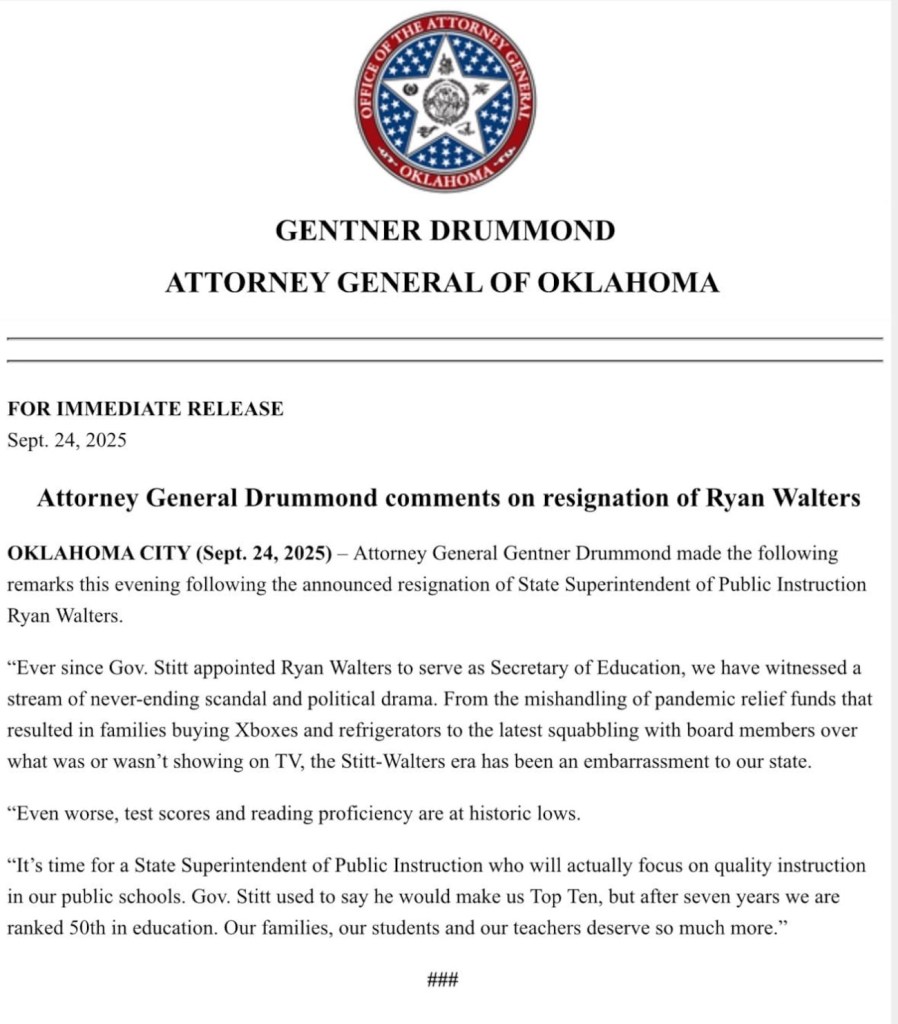
Walters spent most of his energy promoting evangelical Christianity in the public schools. He wanted Bible-based lessons, the Ten Commandments in every classroom, and prayer in the schools. He was an outspoken MAGA guy and tried to insert doubts about the 2020 election in the social studies curriculum.
The final straw may have been the time recently when Walters conducted a meeting with members of the State Board of Education in his office and two attendees saw pornography on his television screen. Walters meanwhile had been ranting about pornography in school libraries.
It’s daunting to try to keep track of the Trump family’s conflicts of interest. They have moved the Overton Window so far that future presidents might accept large cash gifts from corporations and foreign heads of state without anyone caring.
In normal times, the media and the public used to become outraged when an elected official accepted large gifts or had blatant conflicts of interest. Under Trump, no one cared that a foreign state gave Trump a $400 superluxury jet to use as Air Force 1 and to keep after he leaves the Presidency.
The New York Times reported that Tiffany Trump and her husband were enjoying a vacation on a super-yacht owned by an oil company executive even as Tiffany’s father-in-law was negotiating with the owner of the yacht. (And no one cared when Trump appointed his son-in-law’s father as his envoy to Africa on the mistaken belief that the gentleman was a billionaire).
The Times reported:
Massad Boulos traveled to Libya in July as the State Department’s senior Africa adviser. But as he talked to energy executives and government leaders, his other position was no less important. He was also the father-in-law of President Trump’s daughter Tiffany.
That family connection was so significant that some Libyan officials had privately taken to calling him “Abu Tiffany,” Arabic for “Tiffany’s father.”
While Mr. Boulos posed for photographs and announced deals to ramp up Libyan oil and gas production, Tiffany Trump and her husband, Michael Boulos, were cruising the French Riviera aboard one of the world’s largest superyachts — owned by a major broker of Libyan oil.
The yacht, the Phoenix 2, is a floating palace with two helipads, a swimming pool and an 18-foot bronze figurehead of a flaming phoenix rising from its bow. It is not available to charter. But when it last was, it rented for over $1.4 million per week, with the listing highlighting an Art Deco interior and custom Steinway piano.
The vessel is owned by the billionaire oil traders Ercument Bayegan and his wife, Ruya Bayegan. Ms. Bayegan’s energy company, BGN International, stands to benefit from any increase in Libyan oil production.
Massad Boulos is the face of the Trump administration’s diplomacy in Africa, a strategy that prioritizes cutting business deals over international comity and the promotion of democracy. The presence of his son and Ms. Trump on a luxury yacht owned by international billionaire executives is a measure of how hard it is to tell where the interests of government end and the Trump family begins.
Mike DeGuire is a veteran educator in Denver. He says it’s time to take stock and assess the damage that “reform” has inflicted on students and public schools in Denver.
Is public education a public or a private good? This issue is at the heart of the school choice debate sweeping the country.
Advocates for school choice are advancing policies that move us toward the privatization of our schools, treating our children’s futures as commodities rather than community investments. This well-funded bi-partisan coalition promotes privatization through charter school expansion, vouchers, tax credits, and education savings accounts. Republicans use the words “parental rights, freedom and competition,” while neoliberal Democrats brand it as “innovation and expanding opportunity.”
Public education is one of the last shared institutions that binds us together across race, class, and geography; when we weaken it, we weaken democracy itself.
The result is the same for communities when privatization becomes a reality in red states with vouchers or in blue cities where most charter schools are located. Vouchers segregate schools by class and race, diminish the importance of community, and severely limit funding for public schools.
Charter schools operate like private schools, create competition for students, often have unelected boards. Additionally, the charter schools, not the community, get to determine who enrolls, who stays, and what kind of learning takes place. As marketplace ideology takes over, public dollars and democratic control move from local neighborhood schools to private boards and political operatives.
Denver Public Schools (DPS) shows how this movement works in a blue city, and why it matters now in Trump’s vision of America’s education system.
Different slogans, same destination
On the right, and in most Republican-led states, legislatures enacted policies to privatize education with vouchers and education savings accounts (ESAs) designed to route public funds to private and/or religious schools. Often, these tactics originate with model bills written and promoted by the American Legislative Council (ALEC) and their allies. The goal is to let public dollars “follow the child,” which means diverting them away from democratically governed school districts.
On the neoliberal Democratic side, the mechanism is the charter-centric “portfolio model.” Local school boards often elected with large amounts of pro-reform money approve policies to close or “restart” neighborhood schools. Then they open new charters, bring in “operators” deemed to be “effective,” and the district “manages” the schools and their networks like an investment portfolio.
This storyline was supercharged under the Obama administration’s Race to the Top, which rewarded states for removing barriers to charter growth and for aggressively initiating school “turnarounds.”
The overlap with Republicans and Democrats is structural. Both sides define schooling as a marketplace and shift authority from elected school boards to private actors, like charter boards, appointed authorities, and national nonprofits. In their book, “Wolf At the Schoolhouse Door,” Jack Schneider and Jennifer Berkshire describe “how Republicans and Democrats joined to support failed policies whose ultimate goal was to eliminate public education and replace it with a free-market approach to schooling.”
Charles Siler, who worked as a lobbyist for the libertarian Goldwater Institute, told the Washington Post that “Charter schools are part of the incremental march towards full privatization. In many ways, charter schools are the gateway to total public-school dismantling.” Since vouchers are unpopular with the public and some lawmakers, Siler continued, “privatizers have to engage in incrementalism, and they use different names to create a sort of moving target.”
Both camps sell the public on privatization by claiming that “failing test scores” prove neighborhood schools, especially those serving Black and Brown students, are broken beyond repair. They argue the racial achievement gap is proof that these schools must be shut down and replaced with charters through “school choice.”
This narrative is deeply misleading. First, decades of research show that standardized test scores mostly measure socioeconomic status and neighborhood inequality, not the quality of individual schools. Poverty, housing insecurity, and systemic racism drive disparities, not the mere fact of attending a district school.
Second, the research demonstrates that replacing schools with charters has not closed achievement gaps. Denver Public Schools illustrates the point: after years of churn, closures, and huge charter expansion, racial disparities in achievement persist. Black and Latino students continue to score lower on state tests than white peers — not because they are “trapped in failing schools,” but because privatization has siphoned resources from their neighborhoods, destabilized communities, and ignored root causes.
Bipartisan funding for similar goals
The funding networks and foundations knitting these free-market agendas together are deep-pocketed and bipartisan. For instance, the conservative Walton Family Foundation underwrites charter startups and charter facilities nationwide, spending well over $1 billion on this effort. The majority of their political spending goes to Republican causes, with over 2/3 of their PAC money going to Americans for Prosperity, founded by the Koch brothers.
In his book, “Kochland: The Secret History of Koch Industries and Corporate Power in America,” journalist Christopher Leonard describes how the American Legislative Exchange Council (ALEC), a Koch-funded right-wing group, creates model legislation which can be introduced in state legislatures. Many of these bills aim towards privatizing schools by implementing voucher programs.
City Fund raised millions, largely from Netflix founder Reed Hastings and hedge fund manager John Arnold, to spread charter schools in over 40 cities through portfolio management systems and by bankrolling local political action groups. While Hastings supports Democratic causes, he is opposed to teacher unions and believes that local school boards should be abolished. Arnold, also a Democrat, gifted the KIPPcharter network millions, and like many billionaires today, is seen as cozying up to the Trumpadministration for influence.
The Bradley Foundation and ALEC financed the policy and political infrastructure for vouchers and ESAs for decades. The Bradley Foundation, the Colorado-based Coors family, and the Koch foundation were three of the six billionaire families that funded Project 2025, which has been the playbook for Trump since he took office in January.
Many of these same philanthropic and political dollars fund both a Republican voucher push and a Democratic-branded charter expansion — two lanes of the same privatizing highway.
Denver: a “portfolio” laboratory
Denver is often cited by education reformers as a national model as it implemented unified enrollment, systematic school closures, and rapid charter school growth. But the backstory behind who paid for these policies is less sanguine. A Network for Public Education report details how Denver Public Schools became a neoliberal “experiment,” using a web of nonprofits and political groups to expand charters and restructure the school district.
Both Republicans and Democrats contributed large amounts of money in Denver school board elections to promote corporate reforms, such as teacher pay for performance, school choice systems, and enrollment zones. In the 2017 DPS school board election, billionaires gave huge sums to the Denver candidates favoring charter school expansion. According to a report from the Network for Public Education Action, these included “Colorado billionaires Phillip Anschutzand Kenneth Tuchman, and out-of-state billionaires John Arnold of Texas and the Alice, Jim and Stuart Waltons of Arkansas.”
Both sides define schooling as a marketplace and shift authority from elected school boards to private actors, like charter boards, appointed authorities, and national nonprofits.
Meanwhile, years of churn and school closures left communities reeling. Even reform-friendly analyses concede that the “portfolio model” era meant opening lots of charters and closing or “replacing” dozens of neighborhood schools. Researchers studying this model have cited significant concerns with the efficacy of the model, including equity issues, narrow reliance on test scores, instability and churn, tensions among schools, and loss of democratic control and community voice.
In a 2016 article, progressive education advocate David Osborne documented that “Since 2005 [Denver] has closed or replaced 48 schools and opened more than 70, the majority of them charters.”
The billionaires’ money helped maintain a pro-charter majority school board until 2019 when teacher union-backed candidates were elected because of organized community backlash to the reforms and unrest after a teacher-led strike that year. That shift caused alarm bells among the billionaire backers of the pro-charter movement. They moved quickly to expand their funding to two political action groups in Denver.
RootED and Denver Families for Public Schoolsreceived over $38 million from Reed Hastings’ City Fund organization, which they used to promote their pro-charter agenda through grants to charter schools, local think tanks, and other community groups. Their efforts paid off in the 2023 school board election, when three of their endorsed candidates won their elections after Denver Families Action spent nearly $1 million to promote their campaign.
Outside spending has transformed Denver board elections into major dark money funding events, with the 2023 election hitting $2.2 million, just shy of the 2019 record of $2.3 million.
In an op-ed for Charter Folks, Clarence Burton and Pat Donovan, leaders for Denver Families for Public Schools, described their plans to repeat the 2023 wins in the upcoming November 2025 school board election. They may spend some of their vast resourcesfrom City Fund to sway voters.
In the next four years, DPS faces continued enrollment declines, and district leaders seem inclined to approve more closures to rebalance finances. That is the portfolio playbook’s endgame: when money is scarce, close neighborhood schools and expand privately run options. If successful in electing their endorsed candidates, Denver Families Action is poised to help that happen.
Do charters drain district resources? What the evidence says
District leaders and parents feel the fiscal squeeze when enrollment flows to charters. Fixed costs don’t disappear just because 5% or 10% of students leave. Research consistently warns that losses to enrollment can trigger costs that are not fully “variable” — you can’t cut 1/20th of a teacher or 1/10th of a bus route. Studies from New York and other locales estimate significant per-pupil losses in host districts as charter school share rises.
A policy brief from the National Education Policy Center summarizes the structural mechanisms that occur with fixed costs, diseconomies of scale, and shifting student composition. The brief describes how “a network of philanthropists and wealthy donors have reshaped the political economy of school finance, advocating for school voucher policies, charters, and privatization in the face of declining public-school enrollments.”
Pro-charter think tanks argue the picture is “mixed,” especially longer-term if districts close schools and cut staffing, the very things communities have fought against. But even those reviews concede there are short-term inefficiencies and significant harms. In practice, these policies mean closures, layoffs, and program cuts in neighborhood schools.
This bipartisan push undermines neighborhood schools, deepens inequality, and places corporate interests above the common good.
Trump-world raises the stakes
Under President Trump’s second term, privatization is not just encouraged; it’s federal policy. A January 29, 2025, White House directive ordered the Education Department to steer states toward using federal formula funds to support K-12 “choice” initiatives, which was a direct push for vouchers and related schemes.
Trump’s “Agenda47” likewise spotlights universal school choice as a signature plank, tied to dismantlingprior civil-rights guidance and reshaping federal oversight. Plans to weaken or abolish the Education Department are framed as clearing the path for parental choice.
Trump’s Education Secretary Linda McMahon increased the federal department budget for charter schools by $60 million to a historic record of $500 million. At the closing session of the National Democratic Governors Association meeting, McMahonstressed to the governors they should open charterand micro-schools to promote more competition. This is the Republican Lane, wide open.
The Heritage Foundation’s Project 2025 promoted federal tax credits for vouchers, which are now approved federal legislation. The CEO of Democrats for Education Reform is pushing Democratic governors to use these new federal vouchers to expand learning opportunities for economically disadvantaged students or lose “free federal money.”
The policy highway already built by the neoliberal Democrats (charter growth, closures, portfolio management) has made it easier for a voucher-first administration to push public taxpayer dollars out of democratically governed systems. That’s the interlock: Democrats normalized the market; Trump-world aims to privatize the whole store.
The bottom line
Denver is not an outlier — it’s a warning. A bipartisan coalition normalized the idea that public education should be run like an investment portfolio, where schools are opened, closed, and “reconstituted” based on technocratic dashboards and political spending. The Trump administration’s voucher agenda, promoted for decades by the Koch brothers and other conservatives accelerates the same logic, now directs federal policy to help states route public dollars out of public governance altogether.
If we believe education is a public good — funded equitably, governed democratically, and accountable locally — the public must see charter expansion and vouchers as two halves of the same privatization project. When education is treated as a public good, it is essential for democracy, civic participation, economic stability, and social cohesion.
Every child deserves an equal chance in life. Therefore, education must remain a public good — not a marketplace where opportunity is limited to the school’s choice of selecting students. The question isn’t whether our schools should be run like private businesses. It’s whether we are willing to fight for education as a right, not a privilege.
And, if the public cares about our children’s future,they need to vote, organize, and promote legislation accordingly.
Mike DeGuire, Ph.D., is the vice chair of Advocates for Public Education Policy. He has been a teacher, district level reading coordinator, executive coach, and a principal in the Denver metro area for most of his education career. He also worked as a leadership consultant for several national education organizations, and as an educator effectiveness specialist with the Colorado Department of Education. His writing is also featured on a4pep.org.
Ashana Bigard is a parent activist in New Orleans. From her perspective as a parent leader and as the parent of a child with special needs, the New Orleans experiment has been a very expensive flop.
Twenty years after Hurricane Katrina, the nation’s most radical education overhaul has produced stunning inequality alongside modest test gains
As I sit in Bricolage Academy’s office, frustrated but trying to remain pleasant, I’m having the same conversation again about my son. He’s on the autism spectrum. He is high performing, extremely quiet, and sweet. Despite his IEP, he wasn’t receiving the required services. The special education coordinator had quit in frustration, the school counselor was cut due to budget issues, and my fifth-grader was falling through the cracks.
I’m not just any parent. I’m an advocate who has worked with the CEO since the school’s creation. I have written for national magazines about our system’s problems and challenged the school’s “diversity by design” narrative. Yet here I was, fighting for basic services. If this is my experience, imagine what average parents face.
The Numbers Don’t Add Up
Twenty years after Hurricane Katrina replaced New Orleans’ traditional public schools with the nation’s first all-charter system, the grand experiment presents a troubling paradox. With half the students and double the funding, the system has achieved modest academic gains while disempowering the communities it promised to serve.
“When you have half the students and twice the resources, you should see transformational results,” says Neil Ranu, a civil rights attorney with the Southern Poverty Law Center. “Instead, we see money flowing upward to administrators while classrooms struggle.”
Antonio Travis, director of Black Man Rising, mentored several affected students. “There was shame, self-blame. Many felt they wouldn’t be successful in college.” Families canceled graduation celebrations, uncertain about the future.
Right now, Louisiana U.S. District Judge Jay Zainey is currently presiding over the dissolution of the special-needs consent decree related to New Orleans schools. Because New Orleans public schools have no oversight, and no unions to fight to ensure the law is followed, we, as parents of children with special needs, have to fight to get our stories to the judge so hopefully he will keep it in place.
Walk through charter schools and notice what’s absent or insufficient. Arts programs have declined; fewer offer pre-kindergarten, and students average 35-minute bus commutes. Basic skills, such as cursive instruction—required by state law for signing legal documents—are often ignored. “The children only learn what’s tested,” observes one advocate. “Everything else gets cut.”
“When people ask if they should move out of the city for better education,” says one advocate, “my answer is: if you can afford to move, you should. This system is not built to support our children.”
The comment hangs like an indictment not just of a school system, but of a 20-year experiment that promised everything and delivered prosperity for some, displacement for others, and continued struggle for families who need excellent public education most.
Ashana Bigard is a fifth generation New Orleanian and lifelong resident of the Crescent City. A mother of three, Ashana is a tireless advocate for equity and social justice, especially in her work advocating for children and families in New Orleans and Louisiana. She leads the Education Justice Project of New Orleans, where she organizes and advocates for the rights of students and parents. Ashana is an adult ally advisor to United Students of New Orleans. She also serves as a Community Faculty member with Tulane University’s Center for Public Service.
Joe Perticone of The Bulwark describes the committee that has been created by House Republicans to recast what happened on January 6, 2021. They aim to show that it was mostly staged by anti-Trump provocateurs, with substantial help from the FBI. And at the same time, despite what everyone saw with their own eyes, it was “a day of love,” because Trump said so.
Frankly, I can’t make sense of it. Why would Trump praise a large group of people driven and controlled by anti-Trump forces?
A new House subcommittee has been established to finally, at long last, give the January 6th attack on the U.S. Capitol the investigation Donald Trump thinks it deserves. Two weeks ago, Republicans tucked its formation into a rule vote that, among other things, approved a resolution expressing support for the House Oversight Committee’s Jeffrey Epstein investigation. The new subcommittee’s Republican members, appointed by House Speaker Mike Johnson, have all held conspiratorial views about what transpired at the Capitol that day.
Atop the subcommittee will be Rep. Barry Loudermilk (R-Ga.). The other Republicans joining him will be:
Rep. Morgan Griffith (R-Va.)
Rep. Troy Nehls (R-Texas)
Rep. Clay Higgins (R-La.)
Rep. Harriet Hageman (R-Wyo.)
Democrats, for their part, put their more pugnacious members on the subcommittee as a counterbalance of sorts. The list includes Reps. Eric Swalwell (D-Calif.), Jasmine Crockett (D-Texas), and Jared Moskowitz (D-Fla.).
Loudermilk had been advocating for the formation of this panel for quite some time, saying over the summer that setting it up was a high priority for Trump. The nature and extent of the proposed subcommittee’s jurisdiction had been debated for months before Loudermilk introduced the resolution establishing it in July. The Capitol riot has been a consistent focus of Loudermilk’s throughout the 119th Congress and even before it was convened: Back in December, he oversaw the publication of a report that downplayed January 6th by emphasizing—as the lawmaker put it in a prefatory letter—“that there was not just one single cause for what happened at the U.S. Capitol . . . it was a series of intelligence, security, and leadership failures at several levels and numerous entities.”
The committee structure is unique. Loudermilk will have unilateral subpoena authority, allowing him to go through with decisions that even a majority of subcommittee members might oppose.
But I don’t think Loudermilk need worry much about being stymied in his quest to uncover the real truth behind January 6th. The new subcommittee is stacked with lawmakers who have peddled baseless conspiracy theories about that day.
Loudermilk himself claimedwidespread voter fraudleading up to the attack and voted againstestablishing the original January 6th Committee that then-Speaker Nancy Pelosi put together.
Over the years, Higgins’s conspiracy theories have proliferated like daisies in an unmowed field. He claimed that “ghost buses” had provided transportation to many of the rioters, by which he meant that the buses were most likely non-MAGA plants being used to cause trouble for Trump.¹ His evidence for the “ghost buses” claim, which he presented on blown-up posters in a hearing with former FBI Director Christopher Wray, consisted of photographs showing that there were many buses parked at Union Station on the day of the attack. (Union Station hosts more than 2.6 million intercity bus riders per year.)
The FBI was not only involved in actions on January 6th from within. They had, I suspect, over two-hundred agents embedded within the crowd, including agents—or as they would call [them], “human assets”—inside the Capitol dressed as Trump supporters before the doors were opened.
Higgins has also claimed a large portion of the January 6th crowd consisted of actual FBI agents. As he told Newsmax in 2023:
Along with Higgins, Nehls has spread the “fedsurrection” conspiracy theory that the FBI was behind the attack, elevating claims that wedding planner Ray Epps was one of the government’s plants. Epps, a two-time Trump voter who became a central character in a wild yarn of conspiraciesaround that day, later pleaded guilty to January 6th–related charges. He was ultimately pardoned by Trump as part of the mass absolution on the first day of the new administration.
Hageman, who defeated Rep. Liz Cheney (R-Wyo.) in a Republican primary after Cheney worked on the original January 6th Committee, has cosponsored legislation claiming Trump didn’t engage in any wrongdoing with regard to the attack. Hageman also signed on to an October 2024 letter to then–Attorney General Merrick Garland demanding he not withhold any evidence that could show how the FBI may have been involved in January 6th.
“The American people deserve to know those federal employees involved in formulating and carrying out the events on January 6th,” Hageman said in a statement accompanying the letter. “With today’s weaponized federal government, led in no small part by an FBI that continues to target conservatives, we should take every measure to ensure the truth is revealed.”
And while Griffith hasn’t openly promoted conspiracy theories in the way that Nehls and Higgins have, he did, like the others, vote against the 2020 election certification.
If you’re wondering why Republicans feel there is a need to relitigate the findings of the original January 6th Committee, the simplest explanation is purely political. The new subcommittee is meant to downplay the events of the attack, shift blame to the Democratic lawmakers and staff who hid behind locked doors while Trump watched television footage of the mob roaming the hallways of the Capitol, and—perhaps most importantly—to validate the president’s longstanding delusion that January 6, 2021, was a “day of love” for all involved.
For many years, Glenn Kessler was a fact-checker for The Washington Post. He retired and now has his own Substack blog, where he continues doing what he does best.
In this post, he fact-checks a few of Trump’s most egregious claims when he spoke to the United Nations.
To me, what’s most striking about the speech is the fantasy world in which Trump has cocooned himself — with no modesty, he depicts himself as a brilliant peacemaker worthy of a Nobel Prize (or maybe seven), an economic genius and someone who is right about everything.
In my years as diplomatic correspondent for The Washington Post, I watched many speeches delivered during the U.N. General Assembly. When the stage was occupied by a tyrant, such as then-Venezuela president Hugo Chavez in 2006, the insults came fast and furious.
“The devil came here yesterday, and it smells of sulfur still today, this table that I am now standing in front of,” Chavez declared, referring to President George W. Bush.
Well, Chavez doesn’t hold a candle to Donald Trump, who in today’s bombastic speech managed to denounce leaders — once among America’s closest allies — concerned about refugees and climate change and even question the U.N.’s existence. Predictions about climate change “were made by stupid people that have cost their countries fortunes,” Trump fumed.
Of course, much of what he says is false. Here’s just an inkling of the false claims he made to other world leaders.
“We are rapidly reversing the economic calamity we inherited from the previous administration, including ruinous price increases and record-setting inflation, inflation like we’ve never had before.”
Nope. Inflation peaked in 2022, largely because of supply chain issues after the pandemic, and it was far from the worst inflation in U.S. history (or Trump’s lifetime). Two months before the 2024 election, the Economist magazine published a cover story declaring that the U.S. economy was “the envy of the world.”
“Energy costs are down, gasoline prices are down, grocery prices are down, mortgage rates are down, and inflation has been defeated. The only thing that’s up is the stock market, which just hit a record high. Fact, it hit a record high 48 times in the last short period of time.”
Not quite. The Dow Jones Industrial Average has hit seven highs this year. Grocery prices are increasing and mortgage rates have been generally higher in 2025 than 2024. Gas prices have declined slightly but electricity has gone up.
“Workers’ wages are rising at the fastest pace in more than 60 years, and that’s what it’s all about, isn’t it?”
Too soon to say. This is based on a misleading Treasury Dept chart that looks only at the December-May period. In fact, growth stalled in June and July.
“In four years of President Biden, we had less than $1 trillion of new investment into the United States. In just eight months since I took office, we have secured commitments and money already paid for $17 trillion.”
This is made-up math that undercounts Biden’s numbers and inflates Trump’s numbers.
“In my first term, I built the greatest economy in the history of the world. We had the best economy ever, history of the world.”
False. Even before the pandemic sent the economy spiraling, Trump’s economy was not better than under Harry Truman, Lyndon B. Johnson and Bill Clinton. As for best in the history of the world, how can a serious person even say that?
“Hard to believe, because if you look back just a year ago, it was millions and millions of people pouring in from all over the world, from prisons, from mental institutions; drug dealers.”
This is again fantasy. Some bad apples crossed the borders but millions from mental institutions and prisons?
“On the world stage, America is respected again like it has never been respected before. You think about two years ago, three years ago, four years ago, or one year ago, we were a laughingstock all over the world.”
False. By any objective measure, the United States has never been more isolated than under Trump’s current presidency. In a diplomatic defeat, the White House even could not head off a move by close allies, led by France, to recognize Palestine.
“Likewise, in a period of just seven months, I have ended seven unendable wars….No president or prime minister, and for that matter, no other country has ever done anything close to that, and I did it in just seven months. It’s never happened before.”
“I was too busy working to save millions of lives, that is, the saving and stopping of these wars.”
Not the whole story.By one estimate,165,000 adults and 344,000 children likely have died because of funding cuts from Trump’s closure of the U.S. Agency for International Development.
“This [Russia-Ukraine] war would never have started if I were President. This was a war that should have never happened. It shows you what leadership is, what bad leadership can do to a country.”
Another fantasy. When Russia invaded Ukraine, Trump applauded Putin’s savvy, saying “this is genius.”
“Just a few years ago, reckless experiments overseas gave us a devastating global pandemic.”
This is still not proven, but Trump states it as an undisputed fact.
“The previous administration also lost nearly 300,000 children. Think of that. They lost more than 300,000 children, little children who were trafficked into the United States on the Biden watch, many of whom have been raped, exploited and abused and sold. Sold. Nobody talks about that. The fake news doesn’t write about it.”
False. The Biden administration did not lose 300,000 children. Trump is citing a figure that refers to children who were never given a date to appear in immigration court or missed an appearance — including during almost 2½ years of Trump’s first term. He then hypes it up with unverified claims of sex-trafficking.
“Energy is another area where the United States is now thriving like never before. We’re getting rid of the falsely named renewables. By the way, they’re a joke, they don’t work. They’re too expensive, they’re not strong enough to fire up the plants that you need to make your country great. The wind doesn’t blow. Those big windmills are so pathetic and so bad, so expensive to operate, and they have to be rebuilt all of the time and they start to rust and rot.”
Trump hates wind power. He often imagines that if there is no wind, then homes lose electricity. That’s ridiculous. Wind turbines do not generate power when there’s no wind, but the power grid can handle this variability.
“Washington, D.C. was the crime capital of America. Now it’s a totally – after 12 days, it’s a totally safe city.”
Trump invents a problem, and then solves it. Crime was already falling when he sent in the National Guard. Trump likes to cite a 12-day homicide-free period, but in March there were 16 straight days without a homicide.
“In 1982, the executive director of the United Nations’ Environmental Program predicted that by the year 2000, climate change would cause a global catastrophe. He said that it will be irreversible as any nuclear holocaust would be. This is what they said at the United Nations. What happened? Here we are. Another UN official stated in 1989 that within a decade, entire nations could be wiped off the map by global warming. Not happening.”
Trump misquotes Noel Brown, then the director of the New York office of the U.N. Environment Program. In 1989, Noel Brown was quoted by the Associated Press as saying nations had to take action by 2000 or else the damage could be irreversible. He didn’t say nations would be underwater. At the time, UNEP was studying the effect of rising sea levels and the projections made at the time have held up well. Check out this 2019 Pulitzer Prize-winning series in The Washington Post about the impact of extreme climate change.
“And I’m really good at predicting things, you know? They actually said during the campaign – they had a hat, the best-selling hat, ‘Trump was right about everything.’ And I don’t say that in a braggadocious way, but it’s true. I’ve been right about everything.”
Noted without comment.
“Europe loses more than 175,000 people to heat deaths each year cause the costs are so expensive, you can’t turn on an air conditioner.”
This figure — which is correct — demonstrates the risks of climate change. Many European buildings are not fitted with air conditioning because it was not necessary until recently. Trump is apparently ignorant of that.
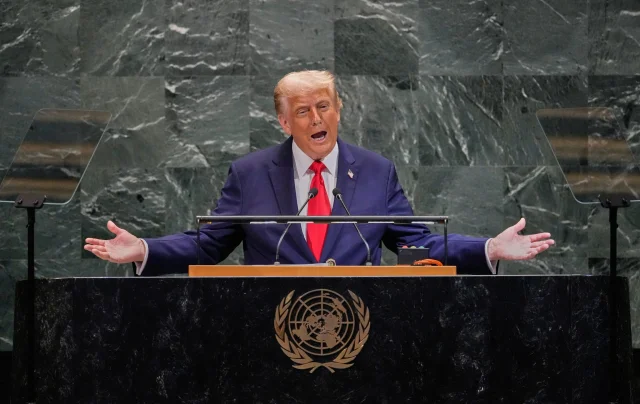
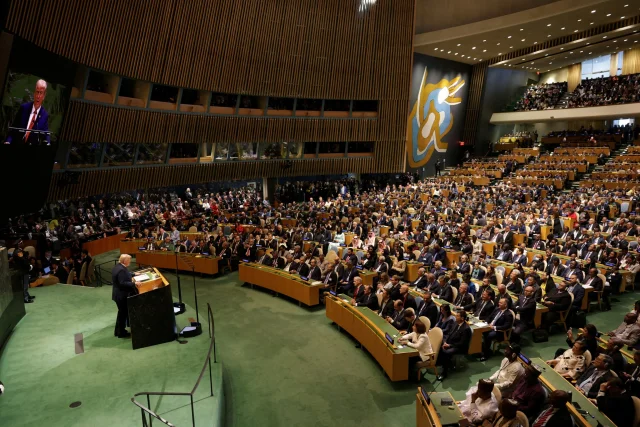
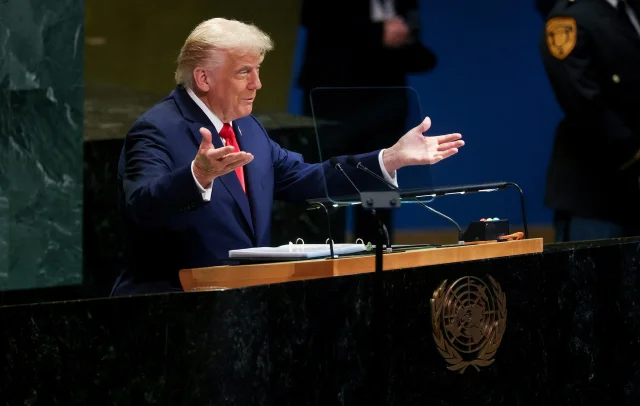
President Donald Trump delivered a combative speech to the United Nations General Assembly on Tuesday morning, lambasting the international body while touting the work of his administration.
Trump spared no criticism in the hourlong address, beginning with his predecessor former President Joe Biden before taking aim at world leaders on everything from migration to the Russia-Ukraine war.
“One year ago, our country was in deep trouble. But today, just eight months into my administration, we’re the hottest country anywhere in the world, and there is no other country even close,” he said at the top of his remarks.
Trump touted the U.S. as having the “strongest” borders, military and relationships around the world.
The president then turned his attention the United Nations, accusing it of not living up to its promise and even accused it of bringing on more problems.
“What is the purpose of the United Nations?” Trump asked. “It has such tremendous, tremendous potential. But it’s not even coming close to living up to that potential. For the most part, at least for now, all they seem to do is write a really strongly-worded letter and then never follow that letter up. It’s empty words and empty words don’t solve war. The only thing that solves war and wars is action.”
Trump accused the organization of ignoring conflicts around the world that he says he solved, casting himself as a peacemaker.
“Everyone says that I should get the Nobel Peace Prize for each one of these achievements,” Trump said. “But for me, the real prize will be the sons and daughters who lived to grow up with their mothers and fathers because millions of people are no longer being killed in endless and inglorious wars.”
Richard Drew/AP – PHOTO: President Donald Trump addresses the 80th session of the United Nations General Assembly, in New York City, Sept. 23, 2025.
Trump threatens Russia sanctions, but says Europe must do more
Trump said the United States is prepared to enforce a “very strong round of powerful tariffs” on Russia should Moscow not be ready to make a peace deal.
But he said other countries need to pull back on buying Russian oil and energy products “otherwise we’re all wasting a lot of time.”
“Europe has to step it up. They can’t be doing what they’re doing. They’re buying oil and gas from Russia while they’re fighting Russia. It’s embarrassing to them,” Trump said.
Trump also took a moment to criticize China and India, calling them the main sponsors of the war in Ukraine because of their purchases of Russian oil.
The president has threatened for months to impose harsher economic penalties on Russia but has yet to do so. He didn’t say on Tuesday what it would take for him to determine Russia doesn’t want peace, though he said the war is “not making Russia look good, it’s making them look bad.”
Jeenah Moon/Reuters – PHOTO: President Donald Trump addresses the 80th session of the United Nations General Assembly, in New York City, Sept. 23, 2025.
Trump bashes world leaders on migration, green energy
Trump said other countries should be modeling the U.S. on the issue of immigration.
“Not only is the U.N. not solving the problems it should, too often it’s actually creating new problems for us to solve,” Trump said. “The best example is the No. 1 political issue of our time, the crisis of uncontrolled migration. It’s uncontrolled. Your countries are being ruined.”
To leaders gathered in the conference hall, Trump said: “Your countries are going to hell.”
He also encouraged leaders to reject policies geared toward fighting climate change and global warming, calling climate change “the greatest con job ever” and touting his administration’s withdrawal from the Paris Agreement.
“If you don’t get away from this green scam, your country is going to fail,” Trump said.
Shannon Stapleton/Reuters – PHOTO: President Donald Trump addresses the 80th United Nations General Assembly at U.N. headquarters in New York City, September 23, 2025.
Trump demands Hamas release hostages, disagrees on Palestinian statehood
On Israel’s war against Hamas in Gaza, Trump said the world has to “come together” to “end the war in Gaza.” He reiterated that he wanted to see the hostages released immediately, but offered no clear path forward on progressing negotiations.
Trump continued to express his disagreement with countries moving to recognize Palestinian statehood. Several key U.S. allies, most recently France, have announced they are recognizing a Palestinian state.
“Now, as if to encourage continued conflict, some of this body is seeking to unilaterally recognize a Palestinian state. The rewards would be too great for Hamas terrorists for their atrocities,” Trump said.
Trump instead called for a united message from the body for Hamas to release hostages.
“Those who want peace should be united with one message: release the hostages now. Just release the hostages now. Thank you,” Trump said.
Trump also boasted about his poll numbers, which he said were the highest ever. His approval rating is 37%.
This post is about the brutal tactics of ICE. In the instance described, ICE agents broke into the home of a U.S. citizen at 5:30 am, smashing his doors. Five people were arrested, two of them American citizens. One who was handcuffed and shown on television being led away by ICE was the homeowner, an American citizen, born in Texas.
Every time I see one of these ICE videos, I get outraged. I have seen them knocking people to the ground who were photographing them. I have seen them smash car windows and drag people out through the window. I have seen them brutalizing people suspected of being illegal. I have seen them beat up protestors. All while wearing a mask, but not a badge or shield. and I keep wondering, “is this America?”
Joyce Vance served as the U.S. Attorney for the Northern District of Alabama. She knows the law and she has a deep love of justice, compassion, and America.
She writes a blog called Civil Discourse, where this excerpt appeared. She is appalled by ICE’s thuggish tactics, and also by Kristi Noem’s showboat tactics. Noem’s behavior towards others reminds us that she killed a young dog because she couldn’t train him. She is known as “Ice Barbie.”
Vance reminds us that ICE in earlier days followed the law. Now, many people object to its actions, specifically, snatching people off the street, throwing them into an unmarked van, disappearing them, all without a warrant. And the masks! Are they being arrested or kidnapped? No one knows. No wonder people call them “Trump’s Brownshirts.”
Vance writes:
For weeks now, the news has been a deluge, making it impossible to keep up with everything. This week so far has been no exception. We know that this is intentional, at least in part. It tends to distract from things like the fact that the Epstein Files have yet to be released. There’s a constant hum of Trump’s incessant push to grow a more muscular, imperial presidency that will allow the Article II branch of government to eclipse the Article I and Article III branches.
But some days, it can be helpful to stop and focus on one small incident to get a snapshot of what’s happening. Today, I focused on some reporting about ICE, one of the agencies under the control of DHS Secretary Kristi Noem.
A lot has been written about how Trump has transformed ICE. I know many of you have seen that and are deeply concerned by it, as am I.
ICE’s congressionally designated mission focuses on immigration enforcement and transnational crime. When I was a prosecutor, we worked serious cases with ICE agents. They were competent investigators. They knew how to get cases done. We did some of the early crypto for crime cases with them and also international networks that were engaged in human sex trafficking, drug trafficking, and elder abuse. They worked computer intrusion cases that had a transnational aspect. We did immigration cases with them, focusing on prosecuting people who were illegally in the U.S. after a prior deportation and who had violent criminal history or were involved in gangs. But what we didn’t do was bust into an American citizen’s house at 5:30 a.m. with the DHS Secretary along.
Newsweek reported that Noem “joined federal immigration agents during an early morning operation in Elgin, Illinois, on Tuesday that resulted in multiple people being led away in handcuffs, and two U.S. citizens being briefly detained.” CBS reported that five people were arrested during the raid, among them two U.S. citizens, who were released after showing their papers.
It’s a simple, red brick, ranch-style house. Witness video, taken after a pre-dawn explosion was heard by neighbors, shows agents peeking into the home, a helicopter flying overhead with a spotlight right on the house in what people in the video describe as a “very quiet neighborhood.”
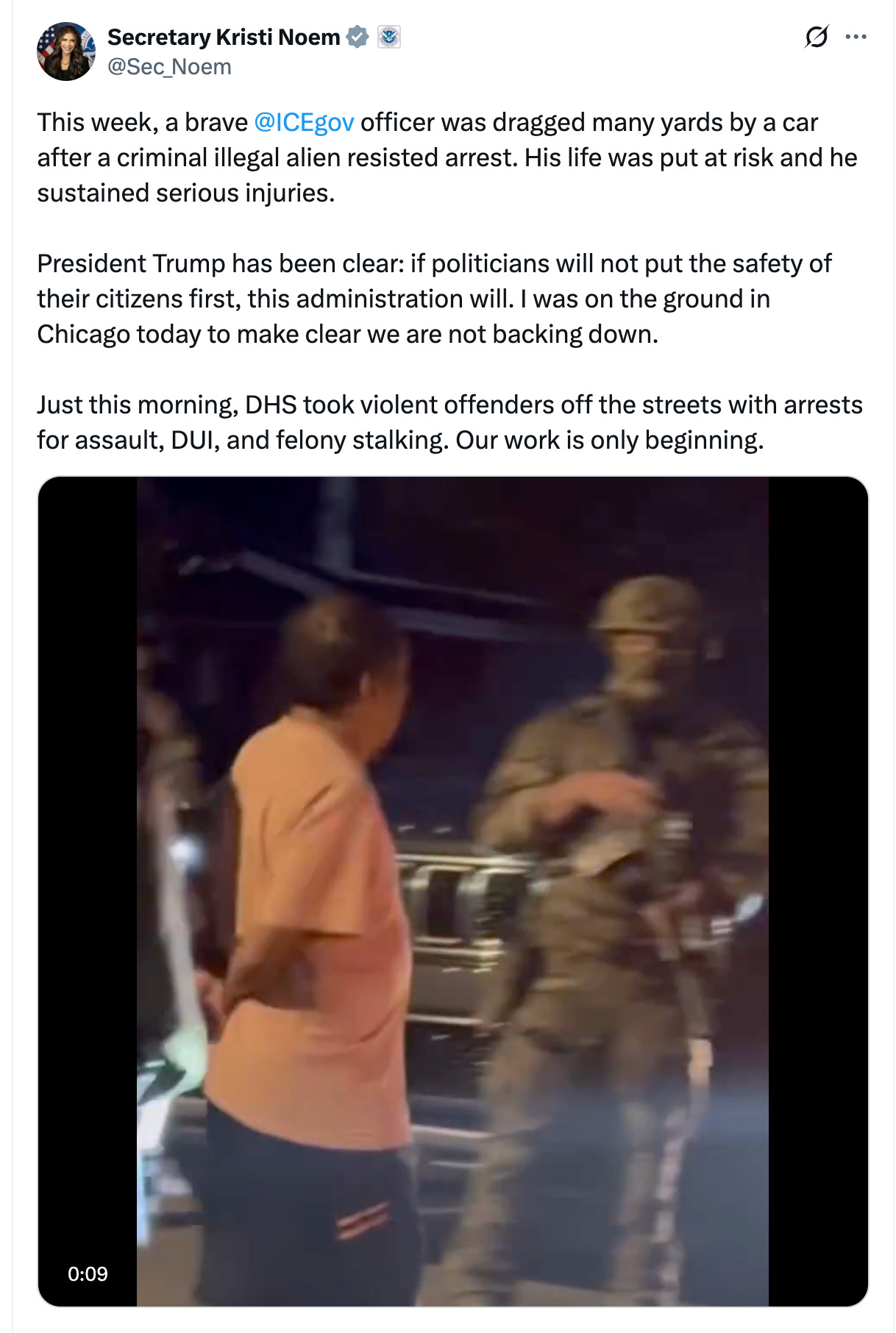
This is what Noem posted Tuesday morning, characterizing the men, including the two U.S. citizens who were subsequently released, as violent offenders.
By 8:30 a.m. local time, DHS was responding to these reports, tweeting that “No U.S. citizens were arrested, they were briefly held for their and officers’ safety while the operation in the house was underway. This is standard protocol. Please see our release on those arrested.”
American Immigration Council Senior Fellow Aaron Reichlin-Melnick tweeted that the man seen in the video was a U.S. citizen named Joe Botello. “They smashed in the doors, dragged him and his roommates out in handcuffs, then posted a video online suggesting he was a criminal, despite knowing he was released soon after,” he wrote, relying on a report from the Chicago Tribune. The agents were masked and armed when they made forcible entry into Botello’s home, destroying both his front door and a glass patio door, according to the Tribune. An agent asked the Texas-born Botello, “how he was able to speak English so well.”
It was another poorly executed raid where people’s rights, in this case, American citizens, were violated.
By the way, the Secretary’s presence might seem like a small thing here, but it’s not. It’s not amusing. It’s not cosplay. It’s not cute. It’s not shake your head and then look away. It’s dangerous. And it was done, apparently, for a photo op.
I spoke with my former colleague Sarah Saldaña, who served as the Director of ICE from 2014 to 2017 and as U.S. Attorney for the Northern District of Texas from 2011 to 2014. She was the last presidentially-appointed, Senate-confirmed Director of ICE. I asked her about participating in law enforcement actions. She told me, “ICE removal operations in the field are highly sensitive and potentially dangerous events. Enforcement removal officers are fully armed and trained to respond to various, often unexpected scenarios that they might encounter. Our focus in removal operations under the Obama Administration was on individuals who presented threats to national security and public safety, and those with convictions of serious criminal offenses. As Director and with training only as an attorney and agency manager, I would never have considered actually interjecting myself into the execution of such an operation. I could easily represent a distraction to officers and, without the proper training, present a danger to them, the persons sought, and to myself.”
Noem, too, should be concerned about the security risk her presence creates. Furthermore, if Noem accompanied agents to the scene, as the reporting indicates, she made herself a witness. If I’m a criminal defense lawyer for one of the men or a plaintiff’s lawyer in a civil suit, I’m cutting the subpoena for her testimony pronto. This is why smart prosecutors know better than to go along when a search warrant is executed, let alone an attorney general or a cabinet secretary. But Noem likes her photo ops. It’s just another sign of the less-than-professional way Trump’s appointees are running government, following Pam Bondi’s comments about prosecuting people for First Amendment-protected speech earlier this week.
Just as members of Congress challenged FBI Director Kash Patel during his oversight hearing on the Hill today, we have to continue to speak out and challenge Noem, Bondi, Kennedy, and others who aren’t up to doing the job the American people deserve. Americans speaking up is precisely what this administration doesn’t want. They want us to be overwhelmed by all the stories about all the things. They want us to be intimidated from exercising our right to speak, lest we fall under attack too. So, our job is to make sure that doesn’t happen. “Courage is contagious” is becoming one of our mottos for this administration. Keep focusing on the truth. Keep speaking out. Keep going.

 Diane Ravitch's blog