Steve Luxenberg, an editor at The Washington Post and the author of a 2019 book on racial separation and the Plessy case, Separate: The Story of Plessy v. Ferguson, and America’s Journey from Slavery to Segregation, wrote to correct important errors in my post about Homer Plessy.

Plessy, you may recall, was arrested in New Orleans for attempting to ride in an all-white train car, thus violating state law. His was a test case of a recently enacted segregation statute. When his case reached the U.S. Supreme Court, challenging the constitutionality of the racial segregation law, the Court issued a ruling in 1896 endorsing the law and the legality of “separate but equal.” This endorsement of de jure segregation remained intact until the Brown vs. Board of Education decision of 1954.

Now, here are the facts about Homer Plessy, as documented by Luxenberg. I am grateful to him for correcting my version (and errors in the article I quoted):

1. Plessy was not found guilty after his arrest (in 1892), and as a result, his lawyers did not appeal that conviction. The case went to the Supreme Court on entirely different grounds. Cutting to the chase for now: Judge Ferguson held off on a trial, instead issuing a ruling on the constitutionality of Louisiana’s Separate Car Act. That was a gift to Plessy’s legal team, because it meant that they could appeal Ferguson’s ruling (he said the Act was constitutional) rather than pursuing a habeas corpus strategy as planned. The Citizens Committee (the group that planned and arranged for Plessy’s arrest as a test case) did not want Plessy in jail while the appeal was wending its way through the courts.

2. Judge Ferguson never found Plessy guilty, and he wasn’t convicted in 1890. In January 1897, nearly eight months after the Supreme Court’s ruling, Plessy pleaded guilty, before a different judge, to close the case. The Citizens Committee paid his $25 fine.

That ruling—Plessy vs. Ferguson— okayed racial segregation statutes that locked millions of Black Americans into second-class status, since separate was never equal in a racist society. Separate but equal remained in place until it was overturned by the Supreme Court in 1954, a decision that was boldly resisted by the South for years.

Homer Plessy will be posthumously pardoned as a result of a sustained effort by his descendant Keith Plessy, and the descendant of Judge John Howard Ferguson.

Keith Plessy and Phoebe Ferguson created a foundation to honor Homer Plessy and to advance the cause of racial reconciliation. Plessy and Ferguson and their allies worked for the past 11 years to get a pardon for Homer Plessy, and they have just succeeded.

Keith Plessy and Phoebe Ferguson’s drive to right a terrible, devastating wrong came to full fruition last month, when they appeared before the Louisiana Pardon Board to ask the board to extend a pardon to Homer Plessy for his conviction in 1890 [this date is wrong]. The board swiftly agreed with the pair and voted unanimously on Nov. 12 to pardon Homer Plessy.

Keith Plessy said that his ancestor Homer was selected by a local group of activists to challenge the law.

Keith Plessy placed their crusade for justice in further historical context, pointing out that Homer Plessy was actually carefully selected by late-19th-century civil rights advocates to test the state’s segregation laws of that era.

The New Orleans organization called the Comite de Citoyens, or Committee of Citizens – a multi-ethnic group of activists dedicated to fighting the 1890 Separate Car Act – chose Plessy, a mixed-race Creole, to test the law by getting arrested and placing the matter in the courts.

Once in court, Plessy’s attorneys argued that the Separate Car Act, and as such Plessy’s arrest, violated his Constitutional rights under the 13th and 14th Amendments, an argument the court rejected with his conviction.

“I feel that working together, we have been trying to tell the whole story of the Citizens Committee and the Civil Rights Movement that continued after this case,” Keith Plessy said. “[The Plessy strategy] was the blueprint that was used over and over again [by Civil Rights advocates] in the 20th century.”

“New Orleans,” he added, “was the crucible of the Civil Rights Movement.”

Governor John Bel Edwards (a Democrat) declared that he would swiftly sign Plessy’s pardon.

I had the pleasure of meeting Phoebe Ferguson and Keith Plessy when I spoke at Dillard University, a historically Black university in New Orleans, in 2010. It was incredible to meet these two people who symbolized such an important and infamous event in American history. Thanks to these two persistent people for their fight to keep Homer Plessy’s legacy alive and to pursue Justice. We are still struggling to overcome the legacy of Jim Crow era legislation.
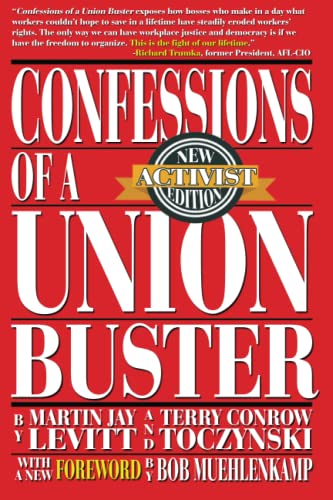


In this article, Marcus Baram of Capital & Main describes a surprising alliance between a veteran labor organizer and his chief nemesis, a man who was a master of union-busting.

He begins:

They were certainly an odd couple, the unlikeliest of allies: the union organizer and the notorious union buster. Bob Muehlenkamp, a stalwart of the modern-day labor movement, has coordinated hundreds of union organizing campaigns and was the organizing director of the Teamsters and SEIU 1199, the hospital workers union. Martin Jay Levitt, a master of corporate skulduggery, did everything he could as a consultant hired by hundreds of companies to intimidate workers into not joining a union. Once, during an organizing effort marked by threats of violence at one of the country’s biggest hospital systems, Muehlenkamp was handcuffed and arrested for trespassing, Levitt relishing another victory as employees voted not to join a union. They were on opposite sides, fighting tooth and nail, for close to 20 years.

Until Levitt had a change of heart, and in the late 1980s reached out to Muehlenkamp about his desire to write a book exposing the dirty tricks of the union-busting industry. Levitt’s Confessions of a Union Buster was published in 1993 and immediately made waves, with Levitt appearing on 60 Minutesand giving lectures around the country to denounce his former colleagues and confess his sins. “Union-busting is a field populated by bullies and built on deceit,” he wrote. “The only way to bust a union is to lie, distort, manipulate, threaten and always, always attack.” He described how his former firm, Modern Management Methods, had developed a methodology for breaking down employee support for unions by using psychological tactics and turning managers into anti-union spokespersons.

His new career as a reformer earned him enemies on both sides — panicking his old colleagues in the union avoidance consulting industry and arousing skepticism among former nemeses in the labor movement, one of whom called him a “cheesy hustler.”

Levitt wrote about his insatiable greed, his alcoholism, a rap sheet that included forgeries, check fraud and arson, and multiple illegal activities on behalf of some of America’s biggest companies. Critics called him an opportunist, but some labor veterans, including Muehlenkamp, saw him as an important ally who could help them learn how to combat the union busters.

Levitt was a complicated penitent — just months after the book was published, he went to jail for obtaining credit by false pretenses — and he passed away in 2004 without having won over that many of his former antagonists.

https://e.infogram.com/047ec8bd-9d2b-43d6-9143-48a3cc2b5b73?parent_url=https%3A%2F%2Fcapitalandmain.com%2Finside-the-secretive-world-of-union-busting-the-story-of-an-unlikely-alliance&src=embed#async_embed

But his seminal book has served as a guide for union organizers and their allies. Levitt describes how his former industry benefited enormously from a 1950s-era loophole in labor law that allowed companies to hire anti-union consultants without disclosing those arrangements — one of the “enormous, gaping errors in the law that have left room for a sleazy billion-dollar industry to plod through,” Levitt wrote. That loophole was closed in 2016 by the Department of Labor, finally shedding light on an industry paid an estimated $340 million a year by companies. The labor victory was short-lived — just a few years later, the loophole was reopened by the Trump administration, and the Biden administration has yet to take action.

The book is being reprinted, with a new introduction and appendix by Muehlenkamp, who writes that “it documents the dirty underside of how U.S. corporations, who routinely bargain with unions in other countries, attacked and weakened American democracy. The question is, what can we do about it? We know how to have the best chance at beating the union busters. It starts with reading Levitt’s book. Know the enemy and take them as seriously as they take a union.”

Muehlenkamp talked to Capital & Main about his experiences in the movement, knowing Levitt as enemy and ally, and what he sees as the biggest challenges facing unions today.

Note: This interview has been edited for length and clarity.

To read the interview, open the link.

This part of Capital & Main’s examination of union busting reviews the targeting of academics who study labor by corporate critics. It was written by Jo Constantz.

Many scholars who study the history and economics of organized labor are sympathetic to the union cause. These academics often encounter threats, harassment, and defunding of their research.

It begins:

Throttled by both strong-arm tactics from anti-union interests and a chronic lack of support from universities, the field of labor studies has dwindled in the U.S. in recent years.

Researchers in the field have been the target of legal threats and lawsuits, onerous public records requests and misinformation campaigns from union avoidance consultants, business executives, corporate lawyers and conservative think tanks. It’s one aspect of the business lobby’s relentless war against unions in recent decades, which has seen companies spend more than $340 million a year on consultants to defeat organizing efforts by their employees and helped sink union membership.

Labor studies, an interdisciplinary field in academia that examines workplace issues and worker organizations, reveals working conditions that motivate people to want to join a union. Much of the scholarship has illuminated the central role that labor’s decline has played in exacerbating income inequality. In doing so, the field has aroused the ire of anti-union companies and their allies. The field has never been a major force in academia and many centers have been gradually shuttered due to lack of funding or merged with other departments. Only a handful of universities currently offer a major or minor in labor studies. Faculty are often untenured, vulnerable to layoffs and budget cuts, and they are often not replaced when they retire.

Open the link and read on.

This article in the Capital & Main series was written by Marcus Baram and is titled ”Inside the Secretive World of Union-Busting: Here’s How Much Corporations Pay to Bust Unions.” Subtitle: “U.S. companies spend hundreds of millions of dollars per year to ensure workers don’t organize.”

It begins:

A handful of workers at the Dollar General In the small Connecticut town of Barkhamsted had grown frustrated last September at being poorly treated by a district manager, amid allegations

The organizing effort involved just six workers (five after one said he was fired for his efforts to unionize) earning $13 an hour — so about $624 a day in total — but the company spent multiples of that to combat the union drive. Dollar General paid Labor Relations Institute, a firm known for its union avoidance consulting, a fee of $2,700 per day for each consultant it brought in, according to filings with the Department of Labor. LRI used five consultants, who reportedly held one-on-one meetings with workers and conducted group sessions to educate them on the risks of joining a union. In the end, the unionization effort failed and the company breathed a sigh of relief. The retail giant posted $33.7 billion in sales and $2.7 billion in profit in 2020, but remains convinced its future earnings might have been hurt if any of its 157,000 workers joined a union.

What do you say when a corporation cares more about profits than the lives of its workers?

In part one of its review of union busting, written by Jo Constantz, Capital & Main examines how employers use technology to defeat unions.

It begins:

During a Zoom call set up by union representatives and employees who had organized a worker organizing committee, “We noticed that managers of the company had busted into the meeting — they had crashed our Zoom call,” recalls Lorena Lopez, a director of organizing with UNITE HERE Local 11. “Workers started to get very nervous and shut down their cameras so they wouldn’t be recognized. I was running the meeting and asked everyone to ID themselves. But the company people refused.” During the meeting, a worker on the cleaning crew had volunteered to be the spokesperson for the group. According to Lopez, this worker was confronted by management the next day and pressured to quit.

“They were spying on us — and it was easy to do via Zoom,” she says. Under a settlement agreement with the NLRB, the company agreed to post flyersinforming employers of their right to unionize and pledged not to ask them about organizing efforts and not to surveil their Zoom meetings. A lawyer for the company did not return requests for comment.

Workplace surveillance, already widespread in the U.S., has become even more prevalent during the pandemic as employers try to enforce public health measures and monitor remote workers. According to research by Gartner, a market research firm, 60% of large employers use workplace monitoring tools, twice as many as before the pandemic. Coworker.org, a labor research nonprofit, recently compiled a database of over 550 of these commercially available products, which it dubs “little tech,” and published a study outlining potential harms and noting the industry’s general lack of regulation.

Open the link and keep reading.

When people bemoan the increasing inequality in American society, they usually fail to mention one of the reasons for the huge gaps between those at the top and those at the bottom of wealth and income: The decline of unions. Unions didn’t disappear because workers lost interest in being represented by them. Major employers never liked unions, which demanded better pay and better working conditions, and thereby raised costs and cut profits. They used every opportunity to dispense with them, whether by automation, outsourcing to non-union states or nations, or intimidation.

California-based Capital & Main has produced an important series about union-busting tactics today. Capital & Main is a fearless, award-winning web journal. it specializes in investigative reporting and is typically on the cutting edge of political issues. It recently published a four-part series on the tactics used by union-busters. I will post them in order today. I strongly support unions. I have never belonged to a union, but I keenly believe in the importance of unions. Unions were the route into the middle class for millions of people. Unions were strong supporters of the civil rights movement in the 1960s. The rightwing attack on organized labor has almost stamped out unions in the private sector over the past half century. The withering of unions coincides with the dramatic increase in inequality of incomeand equality. There are signs of a rebirth of unionism. Terrible working conditions and low pay are spurring on this movement. The big corporations are ripe for change, but as today’s articles show, the powerful oligarchs will fight to maintain union-free workplaces.

This is the introduction.

The company owner was so worried about his employees joining a union that he mounted machine guns to keep labor organizers off his coal mine, launched an anti-union magazine and even secretly funded a Black newspaper to convince African-American workers that unions were dangerous. Those union-busting tactics worked, allowing mine magnate Charles Debardeleben to stop his workers in the industrial Birmingham-Bessemer area of northern Alabama from joining a union during the 1920s and 1930s.

Almost a century later, the tactics have gotten less physically intimidating but remain just as effective. Earlier this year in Bessemer, Amazon was easily able to fend off a well-publicized union organizing effort through a relentless anti-union campaign that included a website, text messages to employees, fliers posted in bathrooms and classic techniques like captive audience meetings, in which workers can be forced to sit for hours and listen to anti-union consulting firms paid at least $20,000 a day. Some of the tactics may have been illegal — the National Labor Relations Board recently authorized a new election after the union argued that the company’s decision to install a mailbox onsite created the false impression that Amazon was running the election, which pressured workers to vote against the union.

https://e.infogram.com/047ec8bd-9d2b-43d6-9143-48a3cc2b5b73?parent_url=https%3A%2F%2Fcapitalandmain.com%2Finside-the-secret-world-of-union-busting&src=embed#async_embed

While union membership has risen slightly since 2018 thanks to some major organizing wins, and public approval of unions is at its highest level since 1965, labor has a lot of ground to make up. Union membership plummeted from 20.1% of American wage and salary workers in 1983 to just 10.8% in 2020. One of the biggest reasons for that decline is the use of well-funded, aggressive campaigns by employers to fight off unions, conducted largely through expensive union avoidance consultants and lawyers. In 2019, it was estimated that companies spend at least $340 million per year on such consultants and often engage in illegal tactics, for which the penalties are minimal.

“They seem to be more aggressive than they used to be,” says Joe Hernandez, an organizer with the United Food and Commercial Workers in Orange County, California. “There was a union election in South Dakota, where pro-union workers who had a couple of tardies that were previously overlooked ended up getting fired. Other times they just close down the store or factory. They’re doing it all — using surveillance technology, social media messaging, whatever they can to beat the union.” (Disclosure: UFCW is a financial supporter of this website.)

In conversations with dozens of union officials, union avoidance consultants, former regulatory officials and workers, we’ve gained insights into union-busting activities by companies ranging from behemoths like Starbucks, Amazon, CVS, Dollar General and Safeway to health care organizations like Kaiser Permanente and HCA-affiliated hospitals to gig economy startups like HelloFresh and Imperfect Foods.

In a series of four stories, Capital & Main will explore the role and impact of union busting: how your favorite companies still aren’t required to disclosehow much they spend on such consultants, how new workplace surveillance technologies have been exploited by some businesses to help them defeat organizing efforts, how labor studies academics have been pressured and intimidated by pro-business think tanks and lawmakers to stop their research into workplace issues — plus an interview with a longtime union organizer about his unlikely alliance with one of the most notorious union busters.


Jennifer Berkshire wrote a fascinating article in The New Republic about the politics and history behind the “parent rights” issue. She reminds us that the issue came to a boil in the 1990s, as the GOP cynically seized upon it as a sure fire winner to motivate the base. And that it has an even longer history, as she shows.

Will it prove to be a winner for the GOP?

Republican candidate Glenn Youngkin jumped on the issue in the Virginia gubernatorial election, and he won.

Berkshire writes:

In Youngkin’s upset win, the GOP saw its path to forever rule. And it was lined with angry parents. In his election-night letter, dashed off as votes were still being counted, House Minority Leader Kevin McCarthy pledged to roll out a “Parents’ Bill of Rights” as a central plank of the GOP’s efforts to retake Congress in 2022 and the White House in 2024. Josh Hawley, who aspires to occupy that residence, announced his own rights bill, one that would “turn back efforts to shut parents out of their children’s education.” The Wall Street Journal made the new cause official: The GOP was now the “Parents’ Party.”

Republicans’ newfound passion for America’s parents has a straightforward explanation. As the Virginia victory demonstrated, parental rage can be mined for electoral gold. And right now parents have plenty of reasons to be unhappy. Pandemic schooling, with its arduous, unpredictable schedule of shutdowns and mandates, is in its third year, with no end in sight. Meanwhile, school districts are fumbling as they grapple with an array of contentious issues, including the appropriate way to teach about racism and how best to accommodate the needs of an increasingly diverse student body. The result has been an incendiary debate about not just what schools teach and how they’re run but whose voice really matters in those decisions.

This is not the first time parents’ grievances have been exploited for politics’ sake. Three decades ago, the GOP and a familiar line-up of conservative groups coalesced behind the same banner of parental rights. The cause even made it into the GOP’s Contract With America, the ambitious legislative agenda laid out by conservatives en route to flipping Congress in 1994. When Pat Buchanan launched his 1996 presidential bid, he declared himself the candidate of parents. “You have my solemn word,” Buchanan intoned on the stump in New Hampshire, a state he went on to win. “I will shut down the U.S. Department of Education, and parental right will prevail in our public schools again.”

And yet within a few years, the issue came to be seen as a stalking horse for the religious right’s agenda of dismantling public education, and it fizzled with surprising speed. Now, as conservatives once more wave the banner of parents’ rights, the sudden demise of a potent political issue 30 years ago offers some valuable lessons.

Once more, the GOP has grabbed the issue, this time to push their privatization agenda. If Democrats are wise, they will read Berkshire’s article and prepare for the GOP offensive. To do so, they must support public schools, unions, and public school teachers vigorously, instead of trying to cut a deal with charter schools, hedge fund donors, and enemies of unions.

Barton Gellman is a staff writer for The Atlantic. He is amazingly prescient. Right before the election of 2020, he wrote an ominous article speculating that Trump, if the election results were close, might refuse to concede. He foresaw the chaos that Trump would indeed unleash, undermining the integrity of the election, which is the central mechanism of democracy.

Now he has written an equally astonishing article in The Atlantic, in which he warns that “Trump’s Next Coup Has Already Begun.” He summarizes Trump’s strategy to overturn the election of 2020 by trying to persuade Republican legislatures to overturn the popular vote (if the Democratic candidate wins it) and submit slates of Trump electors for certification by Congress.

Trump put pressure on Republican state officials in Pennsylvania, Michigan, Arizona, and Georgia to override the popular vote, but that didn’t work. Then he tried to stall the certification of the election on January 6 to buy time to get some of those states to withdraw their certification of Biden’s victory. One of his clown-car lawyers, Sidney Powell, appealed to Supreme Court Justice Samuel Alito on January 5 to halt the official count the next day, hoping to buy time to turn a few states. And of course, Trump pressured Vice President Pence to stop the vote or allow Trump allies to filibuster the count.

The article may be behind a paywall. I subscribe to The Atlantic, so I don’t know. or, the magazine may allow you to read it for free.

Gellman analyzes the ideology of the Trump zealots. Their unifying bond is their belief that they (white patriots) are being replaced by non-whites and Jews. He calls it “The Great Replacement” and reminds us of the white nationalists and fascists who marched in Charlottesville and chanted, ”The Jews will not replace us.”

Gellman describes in detail the actions by Republican legislatures to take control of the vote in 2024, so there won’t be a repeat of 2020. The new laws allow the legislatures to ignore the popular vote and choose the electors themselves. So if a Democratic candidate wins a Republican controlled state, the legislature has given itself the power to choose electors who will cast the state’s electoral vote for the Republican candidate.

He sounds a warning:

A year ago I asked the Princeton historian Kevin Kruse how he explained the integrity of the Republican officials who said no, under pressure, to the attempted coup in 2020 and early ’21. “I think it did depend on the personalities,” he told me. “I think you replace those officials, those judges, with ones who are more willing to follow the party line, and you get a different set of outcomes.”

Today that reads like a coup plotter’s to-do list. Since the 2020 election, Trump’s acolytes have set about methodically identifying patches of resistance and pulling them out by the roots. Brad Raffensperger in Georgia, who refused to “find” extra votes for Trump? Formally censured by his state party, primaried, and stripped of his power as chief election officer. Aaron Van Langevelde in Michigan, who certified Biden’s victory? Hounded off the Board of State Canvassers. Governor Doug Ducey in Arizona, who signed his state’s “certificate of ascertainment” for Biden? Trump has endorsed a former Fox 10 news anchor named Kari Lake to succeed him, predicting that she “will fight to restore Election Integrity (both past and future!).” Future, here, is the operative word. Lake says she would not have certified Biden’s victory in Arizona, and even promises to revoke it (somehow) if she wins. None of this is normal.

Arizona’s legislature, meanwhile, has passed a law forbidding Katie Hobbs, the Democratic secretary of state, to take part in election lawsuits, as she did at crucial junctures last year. The legislature is also debating an extraordinary billasserting its own prerogative, “by majority vote at any time before the presidential inauguration,” to “revoke the secretary of state’s issuance or certification of a presidential elector’s certificate of election.” There was no such thing under law as a method to “decertify” electors when Trump demanded it in 2020, but state Republicans think they have invented one for 2024.

In at least 15 more states, Republicans have advanced new laws to shift authority over elections from governors and career officials in the executive branch to the legislature. Under the Orwellian banner of “election integrity,” even more have rewritten laws to make it harder for Democrats to vote. Death threats and harassment from Trump supporters have meanwhile driven nonpartisan voting administrators to contemplate retirement

Georgia Governor Brian Kemp, excommunicated and primaried at Trump’s behest for certifying Biden’s victory, nonetheless signed a new law in March that undercuts the power of the county authorities who normally manage elections. Now a GOP-dominated state board, beholden to the legislature, may overrule and take control of voting tallies in any jurisdiction—for example, a heavily Black and Democratic one like Fulton County. The State Election Board can suspend a county board if it deems the board to be “underperforming” and replace it with a handpicked administrator. The administrator, in turn, will have final say on disqualifying voters and declaring ballots null and void. Instead of complaining about balls and strikes, Team Trump will now own the referee….

The Justice Department has filed suit to overturn some provisions of the new Georgia law—but not to challenge the hostile takeover of election authorities. Instead, the federal lawsuit takes issue with a long list of traditional voter-suppression tactics that, according to Attorney General Merrick Garland, have the intent and effect of disadvantaging Black voters. These include prohibitions and “onerous fines” that restrict the distribution of absentee ballots, limit the use of ballot drop boxes, and forbid handing out food or water to voters waiting in line. These provisions make it harder, by design, for Democrats to vote in Georgia. The provisions that Garland did not challenge make it easier for Republicans to fix the outcome. They represent danger of a whole different magnitude

There is a clear and present danger that American democracy will not withstand the destructive forces that are now converging upon it. Our two-party system has only one party left that is willing to lose an election. The other is willing to win at the cost of breaking things that a democracy cannot live without.

Democracies have fallen before under stresses like these, when the people who might have defended them were transfixed by disbelief. If ours is to stand, its defenders have to rouse themselves.

Please read this article.

Nine years ago, a deranged gunman blasted his way into Sandy Hook Elementary School in Newtown, Connecticut. He murdered 20 children and six educators, including the principal, Dawn Hochsprung. The children were all 6- and 7-year-olds. Teachers shielded their children as best they could, and some died while protecting the children.

Many thought this slaughter of babies and educators would compel Congress to enact meaningful gun control. It didn’t. It even inspired a ruthless radio host to claim that the massacre never happened. Many grieving parents received death threats, due to the radio host’s lies. A court has held him liable for his cruel campaign. Meanwhile the murders continue, and Congress does nothing.

I received this message from Sandy Hook Promise, which continues to advocate for gun control:

Nine years ago today, our children and loved ones were murdered at Sandy Hook Elementary.

There are no words to describe how deeply we miss them, or how agonizing it is to mark another year since the last hug, smile or laugh we shared with them.

It’d bring such comfort to know you’re standing with us today. Will you sign our remembrance card to honor the precious lives taken from us? http://lil.ms/cydj/8zthf9

-Sandy Hook Promise

Since December 14 also is the date on which my beloved two-year-old died of leukemia many, many years ago, I grieve with and for with the parents of Sandy Hook, and with all families who have lost a child. You never forget.


ATTORNEY FOR STATE OF NEVADA ARGUES THAT 60 THIRD GRADERS PER CLASSROOM WOULD BE CONSTITUTIONAL

State argues that only real requirement is one school per district and that state standards are simply “aspirational” and cannot be a basis to measure students’ right to a basic education


On Monday, December 6, attorneys representing several parents made their case to the Nevada Supreme Court on behalf of public-school students throughout the state. The oral arguments stem from a complaint filed on March 4, 2020, Shea v. Nevada, challenging the constitutionality of Nevada’s chronically under-resourced public education system. A lower court had previously determined that the case presented issues that are nonjusticiable, or not for courts to decide, leading to Monday’s appeal before the Court. 

Parents argued that this case is in fact justiciable and that Nevada courts have a critical role to play in determining whether the public education system is constitutionally adequate and if students have been denied their right to a quality education. Without court intervention, the condition and quality of our schools will continue to decline, as they have for years. 

To the shock of the parent plaintiffs and their attorneys, the State argued that the court’s hands would be tied even if third grade classrooms were filled with 60 students. The State argued that their only obligation under the Constitution is to have at least one school in each district. Nevada has long been ranked as the state with the largest class sizes in the country.

From The Hearing

Justice
: If there are classes in our high schools that have 50 or 60 students is that a basis to challenge whether in fact it is a basic education that is being provided? 

State: As someone who went to a college where I attended classes with hundreds of  students I personally would say no.                                                                             
 

Justice: I would hope that my 3rd grader wouldn’t be in one of those classes though.

State: I do agree with that. The issue is that those are not constitutionally provided.   

Justice: So it would be constitutional if 3rd graders were 50 or 60 students in a            class?                                                                                                                               

State: I do believe so, yes.                                                                                           

“We could not disagree more than we do,” said pro bono attorney representing the plaintiffs,  Bradley Shrager . “We find (educational standards) to be a positive right of the people of Nevada and school children — a right to a meaningful opportunity to a suitable education because when you say suitable, the point is suitable for what? Suitable for the rest of your life.”

As part of their duty under the constitution, our state has set standards to ensure our students are prepared to enter the adult world and even determined what resources are needed to meet those standards. Unfortunately, the State has wholly failed to provide those essential resources. To come before our courts and argue that 60 third graders in a classroom is basic or sufficient for our students shows how desperately our courts need to intervene and why our schools are in such a crisis. 
 

There are already 60 students packed in high school classrooms throughout Nevada schools, despite numerous State commissioned studies identifying small class sizes as essential to students meeting state  academic standards.  The state itself has set class size requirements for grades K-3, but 98% of schools do not meet these requirements, with insufficient funding often cited as the primary reason.   

As written in the complaint, “Plaintiffs ask this Court to determine and find that Nevada public education has fallen short of the requirements of the Nevada Constitution in providing the resources necessary to ensure a basic, uniform, and sufficient education for the schoolchildren of this state.” 
 

Nevada students have a constitutional right to a quality education, but the State has consistently failed in its responsibility to foster a system that delivers on that right. They have an obligation to our students, and they have failed.
 

Since the original filing more than a year ago, achievement results for students have dropped significantly, teachers continue to struggle in the largest class sizes in the country, and the pandemic has only exacerbated long standing resource issues. Nevada’s deficient education system has deteriorated further, with no clear path out of this ongoing crisis.
 

“Without the court’s intervention, I see no solution for our students. I’ve spent years of my children’s education advocating on their behalf and the behalf of all students to no avail, and in that time, resources have actually depleted rather than improved,” said Caryne Shea, one of the parent plaintiffs, “I am shocked and outraged at the state’s arguments which undermines and almost belittles the hard work of our educators and students. What our state leadership has done so far has not been effective and now our only hope for significant change lies in the hands of the court.”
Prior to the original filing, Nevada was one of only three states that had not been sued for failure to provide adequate K-12 resources. States like Wyoming, New Jersey, and many others have seen significant improvements in resources and achievement since victories in their lawsuits. 

As the representative for the state said “words do have meaning” and the words from the state made it more clear why the best hope for students is for courts to intervene. 
About Educate Nevada Now

The Rogers Foundation, a Nevada leader in support of public education, joined with local, state and national partners to launch Educate Nevada Now (ENN) in 2015. The organization is committed to school finance reform and improved educational opportunities and outcomes for all Nevada public school children, especially English language learners, gifted and talented students, students with disabilities or other special needs, and low-income students.

More information about ENN can be found athttp://www.educatenevadanow.com### P O W E R E D   B YCopyright © *2016, All rights reserved.

Our mailing address is:
701 S. 9th Street
Las Vegas, NV 89101