A friend sent this video, which appears on TikTok. The person in the video is Katie Peters, and she teaches in Toledo. Several readers gave me her name, her Twitter handle, and her website address (http://www.katiepeters.org/). I wrote a message to her on Twitter to thank her, and she replied, “I am so lucky to get to do this job everyday.”
Michael Hiltzik of the Los Angeles Times reports on the latest study of Ivermectin, a veterinary drug for animals with parasites. The study found that Ivermectin is useless as a treatment for COVID-19. It is a quack treatment that became popular among Republicans. Anything, anything at all, was acceptable to Trumpers except vacccinations developed by reputable companies.
He writes:
The final results are in, and they’re incontrovertible: Ivermectin, that nostrum assiduously promoted by anti-vaccine advocates and conspiracy-mongers, is utterly useless against COVID-19.
That’s the conclusion of a peer-reviewed studyof more than 1,350 COVID patients treated with the drug, which is customarily used to combat parasitic diseases in humans, livestock and pets.
The study was published this week in the New England Journal of Medicine, but we reported on it last August.
That’s when one of its principal investigators, Edward J. Mills of McMaster University in Hamilton, Canada, disclosed the preliminary results during a research symposium. The data he presented then are essentially the same as the final results published by the NEJM.
Mills said then that ivermectin had “no effect whatsoever” on COVID.
Half were given ivermectin for three days and half received a placebo. The goal was to find whether ivermectin reduced the prospect of hospitalization or an emergency room visit due to a worsening of COVID symptoms. The bottom line is that ivermectin had no statistically significant effect.
“We did not find a significantly or clinically meaningful lower risk of medical admission to a hospital or prolonged emergency department observation … with ivermectin,” the study says.
These findings are important because ivermectin has been so assiduously touted by anti-vaxxers and credulous, irresponsible fools such as Sen. Ron Johnson (R-Wis.), who has also used Senate hearings to promote hydroxychloroquine, another useless COVID treatment
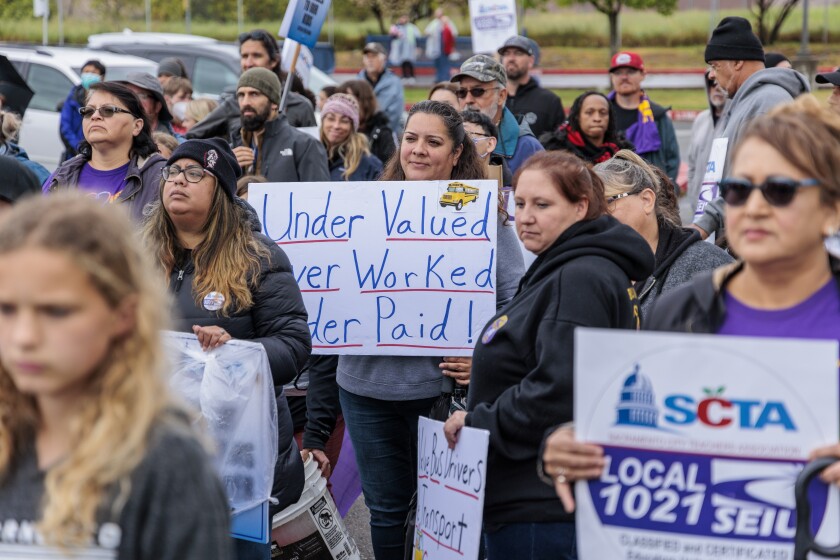
Sacramento City Unified School District teachers, school staff and supporters take part in a rally at Rosemont High School on March 28 as they have been gone on strike due to the staffing crisis in the district . All SCUSD schools shut down and will remain closed for the duration of the strike.
I have read many articles about the shortage of teachers and school staff. I have read many that were laden with statistics. This is one of the best. It appeared in the Los Angeles Times.
BY ANITA CHABRIA COLUMNIST
A few weeks ago, Sacramento teacher Kacie Go had 56 kids for second period.
That day, there were 109 students at her eighth- through 12th-grade school who were without an instructor because of staff shortages. So she crammed the students into her room and made it work, but “it’s not sustainable,” she said.
No kidding.
Go told me the story standing with hundreds of other teachers and support staff Tuesday morning in the parking lot of an empty high school, as “We’re Not Gonna Take It” blared from speakers and the mostly female workers gathered for day five of a strike that has closed down schools in the Capitol City.
Like Go, these teachers, cafeteria workers, bus drivers and instructional aides are fed up with being asked to do more with less. It’s a problem that goes beyond the Sacramento City Unified School District, with 48,000 students in 81 schools. Frustration among teachers and school workers is rampant across California — pushed to a breaking point by the pandemic and a shortage of more than 11,000 credentialed teachers and thousands of support staff as the state tries to expand pre-kindergarten and bring 10,000 mental health counselors on campuses.
From school closure protests in Oakland to Sacramento’s all-in strike, those who work in our schools are telling us they cannot do this job under the conditions we are imposing. These include mediocre pay, sometimes vicious political blowback from COVID-19 safety measures, a witch-hunt-like scrutiny around hot-button topics, a mental health crisis, the reality of too few people doing the work, and the general disrespect of a society that swears it loves teachers and values education but does little to invest in it. Worrying about school shooters, once an urgent concern of educators and parents, doesn’t even make the top three problems anymore.
It’s the same story playing out in hundreds of other districts not just in California but across the country. Minneapolis teachers just ended a 14-day strike that shared some of the same issues of pay and support, underscored by the same teacher chagrin that we talk a good game about supporting public education but don’t always come through with actions. Minneapolis Federation of Teachers Chapter President Greta Callahan summed it up, sounding like she could be standing in Sacramento.
“We shouldn’t have had to [have] gone on strike to win any of these things, any of these critical supports for our students, but we did,” she said.
Go, who has been a teacher for 20 years and earned a master’s degree along the way — bringing her to the top of the district’s salary scale at just more than $100,000 a year — estimates she’s losing about $500 a day during the walkout.
But she’s more worried about support staff such as Katie Santora, a cafeteria worker who was also on the picket line.
Santora is the lead nutrition services worker at a high school, expected to churn out 1,500 meals a day between breakfast and lunch — with a staff of nine people (though they started the year with only five). Most are part-timers because the district doesn’t want to pay them benefits, and they make about minimum wage.
Santora, with 13 years at the district, makes $18.98 an hour for what is essentially a management role. She’s in charge of ordering, planning, receiving and keeping the joint running.
On the last day before the strike, that included making popcorn chicken bowls for lunch. What does that look like? Five 30-pound cases of chicken, oven-baked, 22 bags of potatoes, boiled and mashed, corn and gravy — all assembled after her staff finished making steak breakfast burritos and scrambled egg bowls. Did I mention every student is required to take a piece of fruit, which means washing somewhere along the lines of 1,700 apples?
Santora says high schoolers are the “most misunderstood” people on the planet, teetering between child and adult. Their well-being, she says, depends on being fed so “their bellies aren’t rumbling in class” and seeing a friendly face when they walk in her cafeteria. She loves delivering both.
“When they come through the line, I like to say, ‘Thank you for having lunch with me,’” she says.
But the money isn’t enough to pay her bills. Four or five nights a week, she gets about an hour at home before she heads to her second job loading grocery bags for delivery drivers at Whole Foods. She’s working two jobs just to pay for the privilege of doing the one she likes.
Go, the teacher, feels the hardships in other ways. One of her twin daughters recently had a “pretty severe concussion,” she said, but Go felt like she couldn’t stay home with her. If she did, one of her co-workers would likely be stuck with a jampacked classroom — and all the other unofficial jobs she has to do on a daily basis, from fill-in parent to police officer to relationship advisor when her teenage students’ hormones go into overdrive. Substitutes are hard to come by, she thinks, because the pay — $224 a day — isn’t competitive compared with other jobs with less stress.
“Subs don’t have an easy life,” Go said. “Why would you want to do that when you could go to In-N-Out and worry about if it’s animal-style or not for the same amount of money?”
The unions involved in the Sacramento strike contend that there are hundreds of open positions in the district in virtually every job. Nikki Milevsky, a school psychologist and vice president of the teachers union, puts it at 250 vacancies for teachers and 400 for classified staff — in a district with 2,069 teachers and 1,656 classified staff. That classified staff and teachers walked out together shows the depth of problems in Sacramento — it’s unusual for both to strike at the same time, and it has forced schools to shut down because there was no one left but administrators to watch kids.
Chris McCarthy, a first grade teacher in the Sacramento Unified School District, joined other teachers, parents, students and supporters, in the rain at a rally in support of their strike against the school district at Rosemont High School in Sacramento.
The teachers union says that 10,000 students lack a permanent instructor, and on some days, up to 3,000 don’t even have a substitute. About 547 kids who signed up for independent study haven’t been given a teacher yet, meaning they are learning nothing.
The district says it’s down 127 certificated staff and 293 classified positions. Take the difference as you will, but the district doesn’t dispute it’s in a staffing crisis.
Sacramento teachers want a pay raise to make the district more competitive in hiring. Right now, some surrounding districts pay more but have lesser benefit packages. (Please don’t make me tell you that healthcare is a right, not a privilege.) The teachers want the district to back off of a proposal to make current and retired teachers pay hundreds more to keep a non-HMO health plan. The district says it has made an offer of a pay increase and recruitment bonus and a one-year stipend to offset the health plan issue.
From there it turns contentious. Teachers reject the district’s offer as lowball and assert there is money available to do better, just not the will to invest it in staff. The district says the teachers need to compromise because it can’t afford all of their asks.
For days, there were no negotiations. State Supt. of Public Instruction Tony Thurmond tried to bring everyone to the table, only to be rebuffed by the district. Back home again instead of in the classroom, my eighth grader, a student in Sacramento schools, ate lots of chocolate chip pancakes and watched “Turning Red” on repeat.
There is no end in sight. Though negotiations with both unions have resumed, the shutdown is another blow to parents and families already anxious and stressed out. The last time my daughter had a normal school year, she was in fifth grade. So I understand the frustration, and even anger, of parents that schools are once again closed — and the resentment of parents across the state who are sick and tired of problems with schools, many of which predate the pandemic.
But I went to the strike line three times and I can tell you this — it’s not about the money for these teachers. You can roll your eyes at the unions all you want, but these teachers and support staff want their schools to work, for their students, for themselves, and for our collective future. Because democracy depends on an educated populace and education is a right. And because they are educators, and they’re invested in our kids.
Go doesn’t want to do anything else but teach, even if it means 56 kids sometimes. Even if it means losing $500 a day and striking. Even if it means making some people mad to make schools better.
“I freakin’ love it,” she said. “I do.”
Texas has a teacher shortage, but that doesn’t stop the state from piling new requirements on teachers.
Brian Lopez of The Texas Tribune reports:
It was one thing to ask Texas teachers — during an ongoing teacher’s shortage — to make extra room in their busy home routines for online classroom teaching for months, then to monitor the latest in vaccine and mask mandates while waiting and adjusting yet again for a return to the classroom.
But now, as teachers attempt to restore all the learning lost by their students during the pandemic, the Texas Legislature has insisted those who teach grades K-3 need to jump another hurdle: they need to complete a 60-to-120 hour course on reading, known as Reading Academies, if they want to keep their jobs in 2023.
And they must do it on their own time, unpaid.
For many like 38-year-old Christina Guerra, a special education teacher in the Rio Grande Valley, the course requirement is the final straw and it is sending teachers like her and others out the door.
“I don’t want to do it,” she said. “I refuse to, and if they fire me, they fire me.”
Course adds to teacher workload
In 2019, the Legislature wanted to improve student reading scores and came up with a requirement that teachers complete this reading skills course. Every teacher working in early elementary grades — kindergarten through third — along with principals, had until the end of the 2022-23 school year to complete it.
Governor Greg Abbott is not satisfied with the performance of Texas students on NAEP. But Texas has a growing crisis of teacher shortages.
But the pressures of the pandemic have forced many teachers to reconsider whether to remain in the profession. From 2010 to 2019, the number of teachers certified in Texas fell by about 20%, according to a University of Houston report.
After recent reports of more teacher departures, Gov. Greg Abbott formed a task force to address teacher shortages.
But teachers and public education advocates alike believe the state should hold itself accountable for the teacher departures, especially when adding requirements that add to teacher workload.
“I just feel like a lemon just squeezing, squeezing, squeezing,” said Guerra, a special education teacher in La Joya Independent School District. “But there’s no more, there’s nothing that you squeeze out anymore. There’s no more juice.”
Guerra plans to leave the profession at the end of the school year.
One way to increase the teacher shortage is to crack down on teachers, demanding more while paying less.
This could be a historic moment for the American labor movement. Amazon workers in Staten Island, New York, voted to join a union.
NEW YORK — Workers voted Friday to unionize an Amazon Staten Island warehouse, a historic decision that marks the first successful U.S. effort at the e-commerce giant and a major victory for the domestic labor movement.
Amazon, the country’s second-largest private employer, has long fended off attempts to unionize workers at its warehouse — a highly prized target among traditional labor groups who have seen membership wane in recent years.
But a small, upstart independent union led by a former employee of the Staten Island warehouse mounted the first successful campaign to unionize Amazon workers, breaking many of the traditional organizing rules and relying on workers‘ momentum.
The vote could start a cascading effect on other Amazon warehouses in the country, labor experts say, encouraging others to consider unionizing. That could transform the way the e-commerce giant conducts business and prioritizes the treatment of workers.
The Amazon workers at the JFK8 warehouse on Staten Island will need to ratify a contract to become union members, the next step in an already lengthy process that former Amazon worker Chris Smalls began last year as leader of the Amazon Labor Union.
A separate union vote brought by the Retail, Wholesale and Department Store Union in Bessemer, Ala., was tallied Thursday. The union failed to secure the vote, but it was close enough that the number of contested ballots that are still pending could change the result. The final result won’t be decided for weeks or months.
Michael J. Petrilli drew a lot of criticism a few months ago when he proposed to give NAEP tests to children in kindergarten, arguing that fourth grade was too late to start assessing student skills.
Now he has an even more radical proposal: test the babies, he says.
He writes:
Earlier this year, I took to the pages of Education Next to make the case for NAEP to test starting in kindergarten, stating that, “The rationale for testing academic skills in the early elementary grades is powerful.” Therefore, “Starting NAEP in fourth grade is much too late.”
I was wrong, and I’m sorry.
Kindergarten is much too late. We must begin a program of NAEP testing for newborns. In the hospital. Before parents take them home. Maybe before parents name them.
If we wait until age five to assess students in math and literacy skills, that leaves a half-decade of missing data. How are we to know where our infants fall on a distribution scale of academic achievement? How many of them are already proficient? How can we possibly differentiate preschool playtime with success and rigor?
Some of my critics might point to the difficulty in assessing newborns. Sure, their precious, tiny hands can grip your finger in an act of sublime yet simple affection, but can they grip a pencil? How can they fill in the bubbles on a standardized test when swaddled lovingly in a blanket? How can they deal with a keyboard if they can’t sit up? Do not be swayed by such arguments, which only reinforce the mediocre expectations endemic to America’s nurseries.
Others will assert that newborns are already assessed through the Apgar test. Again, don’t be fooled! The Apgar only measures the ultra-basics, like muscle tone and respiration. Talk about low standards. We’re going to give babies passing marks just for having normal reflexes? Give me a break.
What next? Test the fetuses? Open the link and finish the article. Always good to see people making fun of their own bad ideas on April 1!
A friend forwarded this message from her friend in St. Petersburg, Russia:
1. Russia did not attack Ukraine, but Ukraine must definitely stop defending itself.
2. A special operation is not a war, but economic sanctions are a war.
3. The war began so that the war would not start.
4. Conscripts were not sent to Ukraine, but some of them died there.
5. The maternity hospital was bombed because the Nazis were sitting there dressed as pregnant women, but it was still not bombed.
6. The special operation is proceeding according to plan, the troops do not meet resistance, but in 20 days they only managed to capture Kherson and surround Mariupol.
7. All Ukrainian planes were destroyed by missiles at airfields. But 2 weeks later, Ukraine vilely bombed Belarus.
8. You can wish death on Ukrainians on Russian TV, but wishing death on Russian invaders on Facebook is extremism. 9. Russian troops are fighting not with civilians, but with the Nazis. All 40 million Nazis. You will be surprised, but it easily fits and in all seriousness coexists in the minds of a significant part of Russians.
I added this one, since I recently read a statement from a spokesman for the Russian Defense Agency stating that Russia never targets civilians.
9. Russia never attacks civilians or civilian facilities, like hospitals, apartment buildings, homes, theaters, or civilian evacuees.
With so many laws passed forbidding the teaching of “critical race theory,” Kevin Welner has come up with an ingenious solution. Teach the law itself! Kevin is a lawyer who teaches education policy at the University of Colorado in Boulder. He is also director of the National Education Policy Center. He means this as an April Fool’s joke, but like all satires, there is more than a kernel of truth here:
In high-school classrooms throughout Texas, Oklahoma, Idaho, and other states that have passed laws apparently intended to prohibit the teaching of Critical Race Theory (CRT), a new type of elective course is popping up. Students in the classes read the state legislation and explore its meaning and impact.
One such course offered in Houston, Texas is called, “Get to Know SB 3”, which is a reference to that state’s bill passed in late-2021. Courses in other states and school districts have a variety of names, but what holds them together is an attempt to help students gain a deep understanding of their state’s law and what it accomplishes.
Kim Bell, who teaches the SB 3 course at Ladson-Billings High School in Houston, explained that the course was originally proposed by the school’s students. “None of them had heard of CRT until a couple years ago, but then everyone started talking about it and, more recently, about the law we thought would stop us from teaching it. The students turned to us because they wanted to know more, but at first we told them we were afraid to answer their questions about CRT. We thought that maybe the law stops us from even talking with them about it, so instead we told them about the law.”
Not surprisingly, the students then wanted to know even more about SB 3. “The more we told them, the more questions they asked. So we created this course. It’s not specifically about CRT, but we explain the theory because of its relevance to the legislature’s debates and intentions.”
Among the provisions in the Texas law is a prohibition against “inculcat[ing]” in students, “with respect to their relationship to American values, [that] slavery and racism are anything other than deviations from, betrayals of, or failures to live up to the authentic founding principles of the United States, which include liberty and equality.” As Bell’s students learn, this provision is a push-back against the generally accepted view of historians and other scholars, including those who use a CRT lens, who point to the many ways in which racism has been institutionalized in American laws and society.
The students also read the arguments used by proponents of the state laws. Texas Senator Ted Cruz, for example, charged that CRT is “every bit as racist as a Klansmen in white sheets.” Rhode Island State Representative Patricia Morgan complained that she had lost a black friend to CRT – “I am sure I didn’t do anything to her, except be white.”
This teaching hasn’t gone unnoticed by proponents of laws. “Using things we say – that’s just sneaky and divisive!” protested Rep. Leon Alabaster.
The classes, however, are moving forward. “It seems like the legislature wanted SB 3 to stop us from teaching about the reality of structural racism. Fine. Most students reach that conclusion on their own,” said Bell. “If the legislature prohibited our science teachers from telling students that gravity is real, they’d still reach that conclusion after seeing the objective evidence.”
Bell and other teachers we spoke with pointed out that, by the end of the course, their students often observe that the laws designed to stop them from learning about institutionalized racism are themselves institutionalized racism. Also, these laws that are designed to stop students from learning about CRT have instead resulted in their learning about CRT.
Bell’s students even started a CRT club at the school. These students told us that it’s the CRT lens that really helps them understand the institutionalized racism underlying the anti-CRT laws.
“We’re thinking about creating another elective called, Using SB 3 to Explore Irony,” said Bell.
Steve Nelson, the retired headmaster of the Calhoun School in New York City, has spotted the ironies and hypocrisies in the GOP pandering to the “parent rights” movement.
Read the Bible and gasp at the references to incest and licentiousness.
Nelson writes:
There is a certain hypocritical Victorian flavor to the GOP these days, as they are turgid with moral rectitude when considering – gasp – transgender folks, same sex marriage or pre-marital sex, while embracing the multifaceted lecher who remains their president-in-exile. But back to children . . .
The GOP assault on CRT or any education related to race, gender or sex is partnered with the campaign for parental rights in education. Parental rights in education is further paired with the systematic and relentless attacks on public education. The logic is unassailable; if your schools insist on teaching CRT or mentioning sex despite your parental rights, then you should be empowered to send your child to a good Christian school, where they can learn about these things:
“If two men, a man and his countryman, are struggling together, and the wife of one comes near to deliver her husband from the hand of the one who is striking him, and puts out her hand and seizes his genitals, then you shall cut off her hand; you shall not show pity.” (Deuteronomy 25:11-12)
“When she carried on her whoring so openly and flaunted her nakedness, I turned in disgust from her, as I had turned in disgust from her sister. Yet she increased her whoring, remembering the days of her youth, when she played the whore in the land of Egypt and lusted after her lovers there, whose members were like those of donkeys, and whose issue was like that of horses. Thus you longed for the lewdness of your youth, when the Egyptians handled your bosom and pressed your young breasts.” (Ezekiel 23:18-21)
Keep reading!
Frank Breslin is a retired teacher in New Jersey. This article originally appeared in the NJEA monthly publication.
What if your race had known only tragedy
throughout America’s history? What if your people had been enslaved, murdered, persecuted and denied their civil rights?
And what if, instead of owning up to having inflicted such outrages, showing remorse, asking forgiveness, and making amends, those responsible, their descendants and
sympathizers denied that those actions had ever
occurred or, if they had, they had best be forgotten?
But what if the history of those deeds could
never be taught in our schools, but covered in
silence because it would only be “divisive” or
“racist” against those whites who had committed
them? Rather, let bygones be bygones! We should
forget the past and simply move on!
This is the white supremacist gospel being
preached by some in our country today, especially
by protestors at school board meetings. It is the
New Jim Crowism that would leave no public
record in the classroom of the centuries-old infamy that was inflicted on the Black race.
Moreover, these protestors add insult to injury
by denying the victims of this racism the chance to finally have their story told to America’s children as our schools have done for the Holocaust. Children deserve the truth, not fairy tales, even when the truth makes racists uncomfortable.
Anyone with an ounce of humanity could not
help but be moved when learning about the brutal treatment of Blacks over the centuries. Students would learn that the justification of slavery was preached even from church pulpits. They would learn about the KKK, Jim Crow laws, lynchings, fire bombings of Black churches, racial segregation of our schools today—decorously disguised as “school choice,” the assassination of Martin Luther King Jr., the killing of George Floyd, and the freedom march in Birmingham, Alabama when Commissioner “Bull” Conner turned his fire hoses, attack dogs, and police truncheons on peaceful Black marchers demanding their civil rights, as Americans watched aghast at their TV
screens as it unfolded.
It would be a national catharsis to know that
America was finally coming to terms with the dark
chapters in its history and not-so-distant past. For
this is what great nations do that are big enough,
humble enough, contrite and courageous enough
to admit their failings and vow to do better. The
beginning of healing is the admission of wrong!
Great nations also reverence the sacrosanct
nature of the mind. They do not insult those who
have dedicated their lives to the noble profession of
teaching the young. They do not force teachers to
indoctrinate their students with a sanitized history
that omits the entire truth about their nation’s past.
However, teaching the truth is terrifying to these
protestors who view truth as dangerous, especially
for their children, for it would mean losing control
over their minds. Schools that teach what actually
happened should be shut down because truth
leads to social unrest, and it is better to have peace
based on lies.
In a word, we are dealing with an
educational philosophy that teaches: Thou shalt
not think! Thou shalt not question! Thou shalt
only conform!
These protestors abhor teaching about what
happened to Black people since this would mean
the end of their white supremacist world. Their
protests are an assault on the mind itself, the
importance of truth, and the nature of education.
An education in its ultimate sense is not an
initiation rite into the myths of one’s tribe, but
a personal struggle to free oneself from those
myths. It is escaping from Groupthink. An
education is not about fear of the truth or a blind
acceptance of White supremacist doctrine.
Teachers resist such indoctrination of their
students. They want to teach, not suppress, the
truth of what happened, but these protesters know
what happened and want to suppress it lest it be
taught not only to their children, but to everyone’s
children, as well, a.k.a. censorship.
Teachers refuse to aid and abet this fantasy
of a dying white Supremacy whose days are
numbered as anyone knows who has checked
the demographics, for what we are hearing today
is but its death knell!
A classroom is a sacred place, a temple of
reason, not a recruiting station for a white
supremacist doctrine that would ban the teaching
of Black history because it dismisses Black people
themselves as unimportant in their kind of
supremacist democracy that is not a democracy
at all, but an ethnocentric, xenophobic, wouldbe fascist dictatorship, and not the American
democracy most of us know, cherish, and want
to preserve.
Teachers refuse to violate their consciences by
lying to children and shattering their trust in them,
and when they are forbidden to tell the whole
truth lest it embarrass white racists, they refuse
to betray both children and truth
Frank Breslin is an NJREA member and a retired
English, Latin, German, and social studies
teacher. An educator for over 40 years, he retired
from the Delaware Valley Regional High School.

 Diane Ravitch's blog