Today is the funeral of my former husband, Richard Ravitch. He died on Sunday only days before his 90th birthday.

He was a remarkable man in many ways, not only in his professional, political, and civic life but in his wide-ranging personal interests. Sam Roberts of the New York Times wrote a fulsome account of his life and accomplishments in this obituary.

His grandparents immigrated from Russia to New York City in the 1880s. They came with nothing and lived in tenements on the Lower East Side. His grandfather started a small foundry, making iron gratings, manhole covers, and other such things. Eventually, he entered the construction business and created HRH, which he later turned over to his son (Dick’s father) and son-in-law.

Dick was born in 1933. He attended the progressive Lincoln School and Fieldston School. He started college at Oberlin but transferred to Columbia College to take care of his mother when his father died at a young age. He then went to Yale Law School.

Dick’s parents revered FDR. They were liberal, progressive, and educated (his father went to Tufts, his mother to Hunter). Among their friends were artists, musicians, and writers. Dick learned to love classical music, opera, and Broadway musicals.

We met in 1959 when he was working on the staff of a Democratic congressman in Washington. We married a year later, two weeks after I graduated college. I was 21 and he was 26. We divorced in 1986. We had three sons, one of whom died of leukemia at the age of 2.

After we married, Dick joined his family’s construction company in partnership with his cousin Saul Horowitz Jr., known as JR. JR was interested in construction, Dick was interested in real estate development. As a lawyer, he mastered the federal programs that encouraged middle-income housing. That’s where he directed his energy.

While other developers built only luxury housing, Dick focused on middle-income housing. Whatever he did, he wanted to serve a social purpose. That was his FDR legacy. He wanted to make a difference. Among the buildings he developed are Waterside, on the East River in the 30s; Manhattan Plaza, moderate-cost housing for performing artists on 42nd Street; and Riverbend in Harlem. He built the first desegregated housing in Washington, D.C.

He enjoyed being a developer, but he yearned to have a life of public service. He became the guy that mayors and governors called upon whenever there was a crisis. Governor Hugh Carey asked him to run the Urban Development Corporation, which built low- and middle-income housing. At one point, Dick told me, Donald Trump came to see him about getting tax breaks for the renovation of a luxury hotel; Dick turned him down. Trump threatened to get him fired from his $1 a year job. Dick told him to do something that is anatomically impossible. He considered Trump to be an inconsequential playboy.

When the city was in the throes of a fiscal crisis in 1975, Dick was among a small number of people who helped to end it. I recall a night when Albert Shanker, president of the United Federation of Teachers, came to our home, and Dick spent hours convincing him to use the teachers’ pension funds to bail out the city. The unions saved the city. Dick was always close to labor leaders, including Shanker, Victor Gotbaum, and Lane Kirkland, head of the AFL-CIO. He always believed in the importance of organized labor.

Dick went on to lead the MTA, the state agency that oversees rail and bus transit for the entire metropolitan region. He was in his glory.

After our divorce, there was a period of estrangement but we eventually became good friends and enjoyed talking about our children, our grandchildren, and the world.

He was always very busy solving fiscal crises in different states and cities. When Eliot Spitzer resigned as governor of New York, his Lieutenant Governor David Paterson succeeded him and asked Dick to be his Lieutenant Governor, from 2009-2010.

Dick taught a course in state and municipal finance at Yale Law School right up to last year. He was a philanthropist: he established a chair in pediatric hematology at Mount Sinai on Hospital, named for the son we lost. He served on the Mount Sinai board for more than forty years. He created a program to train journalists to cover fiscal matters at the City University of New York’s Journalism School. A list of the organizations where he was a board member or president would be longer than this post.

Dick was married in 2005 to Kathy Doyle, the CEO of a major auction house. This was a marriage made in heaven. Kathy is a wonderful woman who brought great joy to Dick. She has three beautiful daughters, who adored Dick. Her daughters married and among them had nine children, who were of course his grandchildren. Adding our four grandsons, Dick had 13 grandchildren. He was thrilled to have such a large, beautiful family. And it made me happy to see that he had found a wife who was just right for him.

I mentioned his personal interests. Dick was an accomplished woodworker. He taught himself at first, then took courses. He bought wood turning equipment and heavy duty saws. He loved turning bowls and eventually made beautiful pieces of furniture, reproductions of antiques that he had seen in books. Dick and Kathy’s home is filled with his elegant handmade furniture.

His other passion was gardening. There too he made himself a master, studying the right soil composition and tending to the earth in which he planted.

Dick died just two weeks shy of his 90th birthday. He lived a full and happy life. He was loved by his family, by hundreds of friends, and by uncounted admirers. He was a man of principle and integrity. He believed that political problems could be solved by reasonable people, working things out.

These days, when our politics is so polarized and when many political figures act so unreasonably, I know how Dick would respond. Organize. Build coalitions. Support the good guys. Do what’s right for the underdog. Ignore the extremists who make compromise impossible. Progress requires give and take. Never lose sight of the goal, which is the betterment of life for all people. He loved New York City, New York State, and America, and he wanted to make them better. He was a disciple of FDR to the end.

Rest in peace, dear Richard.

Diane
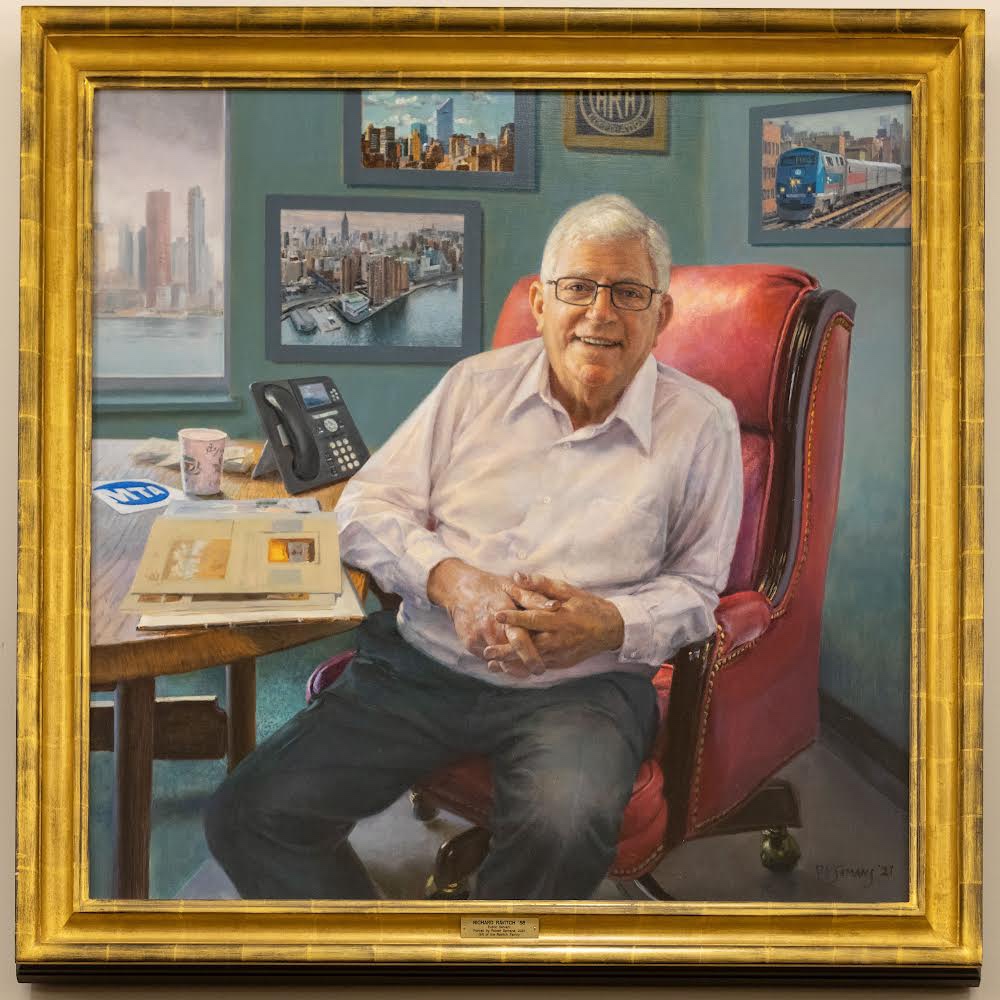
Our son Joe commissioned this portrait of his father. It hangs in the halls of Yale Law School, which both Joe and Dick attended.

News from the Philadelphia Inquirer:

Can you strengthen democracy by dialogue with hate groups? The Museum of the American Revolution thinks so. I agree. But when will the dialogue occur? Not at this event.

The newspaper reports:

What you should know:

  • The Museum of American Revolution is hosting a welcome event for the controversial “parental rights” group Moms for Liberty, which is holding a four-day summit in Philadelphia this weekqqRep PPP featuring former President Donald Trump, Florida Gov. Ron DeSantis, and other speakers.
  • Seven historian groups have written their members and the museum denouncing the event and the organization.
  • Moms for Liberty is best known for its book ban efforts and calls to limit conversations about race, sexuality, and gender identity in classrooms.

Seven groups of historians have now denounced an upcoming welcome reception at the Museum of American Revolution for “parental rights” group Moms for Liberty. They’ve written their members, the museum, and one group has canceled an event they had planned at the Old City institution.

Moms for Liberty, or M4L, has made national headlines since its founding in 2021 for its efforts to lift pandemic precautions, ban books, and limit conversations about race, sexuality, and gender identity in classrooms. Earlier this month, the Southern Poverty Law Center labeled the group an “antigovernment extremist organization.”

The group is scheduled to hold a four-day sold-out summit in Philadelphia starting Thursday where aspiring school board candidates can receive training and hear from guests, including former President Donald Trump and Florida Gov. Ron DeSantis. The group says Pennsylvania has one of its largest membership bases, second only to Florida.

The museum has defended its decision to host the controversial group, arguing its mission is to share diverse and inclusive stories about the country’s history with as broad of an audience as possible and that it hopes to strengthen democracy through dialogue.

But dozens of the museum’s staffers have pushed back. The historian groups are the latest to repudiate the museum’s rationale for hosting the event, acknowledging it’s unusual for them to try to intervene in what’s essentially a space rental. Still, the groups said Moms for Liberty was not a group simply espousing different points of view. They said it has encouraged the harassment of teachers and librarians.

“This organization consistently spreads harmful, hateful rhetoric about the LGBTQIA+ community, including popularizing the use of the term ‘groomer’ to refer to queer people and attacking the mere existence of trans youth,” read a statement from The Committee on LGBT History, the first historian affinity group to condemn the museum.

John Thompson writes here about the negative consequences of shallow reporting on NAEP data. Reporters are sensitive to whether scores are up or down, but tend to ignore contextual factors that may play a role in student performance.

He writes:

Despite the problems with education metrics, the decline in the nation’s 2022 math and reading scores on the National Assessment of Educational Progress (NAEP) test is worrisome – if we look at the big picture. 

As Diane Ravitch explained, the decline in scores during the pandemic was a “duh” moment. Rather than publishing panicky headlines, these predictable drops in scores should be seen in the broader context of the decade of declines which followed the implementation of rushed and simplistic corporate school reforms. And, as we should have done previously, we must acknowledge what reformers should have previously understood – meaningful increases in learning require inter-connected, holistic team efforts, as opposed to metric-driven instructional shortcuts.    

And we should also listen to Peggy Carr, commissioner of the National Center for Education Statistics (NCES), which administers the tests. “The new data, she said, ‘reinforces the fact that recovery is going to take some time.” Carr and other experts also warn that the “academic decline is part of a broader picture that includes worsening school climate and student mental health.”

For example, “Oklahoma NAEP results reflect pandemic-fueled decline in math and reading scores.” Eighth grade reading in Oklahoma (which reopened schools more quickly than most states) declined by 7 points, compared to a three-point average national decline. Our Eighth grade math scores declined by 12 points, compared to a nationwide decline of eight points. And the state’s and the nation’s “plunge” in history scores has been worse.

But the story behind those numbers is complicated. So, before we can understand the mixed messages of short- and long-term NAEP findings, we how they have often been misrepresented by the non-education press.

Chalkbeat properly quoted Peggy Carr, “There is nothing in this data that tells us there is a measurable difference between states and districts based solely on how long schools were closed.” And Education Week appropriately explained that all but the top-performing students saw declines, but the biggest drops were for the lowest-performing students, who were more likely to have parents who were “essential workers” who were disproportionately exposed to Covid, who were more likely to live in multi-generational households, and had the least access to medical care. Moreover, it further explained, “Reading scores for students in cities (where schools tended to be slower to reopen) stayed constant, as did reading scores for students in the West of the country.”

Yes, Covid closures led to an unprecedented decline in test scores, but many commentators should look more deeply at public relations spin dating back to the Reagan administration that inappropriately used NAEP test scores when arguing that public schools are broken. They stressed low levels of “proficiency” claiming that it correlated with grade level. And Jan Resseger explained:

A common error among journalists, critics, and pundits who misunderstand the achievement levels of the National Assessment of Educational Progress (NAEP). “Proficient” on NAEP is not grade level. “Proficient” on NAEP represents A level work, at worst an A-. Would you be upset to learn that “only” 40% of 8th graders are at A level in math and “only” 1/3 scored an A in reading?

On the other hand, the admittedly unprecedented (but expected) fall in NAEP scores during Covid followed a decade of stagnating or declining NAEP scores. Moreover, the recent release of falling history scores should lead to an open discussion about why the U.S. History scores have declined by 9% since 2014.

And Chalkbeat stresses the need for conversations about the last two years, when “nearly every state has considered a bill that would limit how teachers can discuss racism and sexism in their classrooms, and 18 states have bans or other restrictions in place, according to a tracker compiled by Education Week.”  For reasons I explain later, I’m especially impressed with its recommendation regarding the need for “weaving the (historical) material into other places in their (classrooms’) schedule.”

I began teaching History at John Marshall H.S. in the early 1990s during the crack and gangs crisis and after the standardized testing of the 1980s peaked. For the next 1-1/2 decades, outcomes improved at Marshall and in the nation as a whole. Marshall had serious problems, but I couldn’t believe how many great teachers it had. We had the autonomy necessary to teach in a holistic inter-connected, cross-disciplinary manner. When I saw students carrying copies of Ralph Ellison’s The Invisible Man, I had the freedom to deviate from the curriculum schedule, and teach about Ellison’s childhood in Oklahoma City, and how it informed his novel. We took fieldtrips to the Capitol, and had regular classroom visits by legislators and local leaders. And we watched excellent programs on OETA (which our Gov. Kevin Stitt recently tried to defund.).

Rather than teach to the test, I’d post the day’s State Standards, and History in the News topic. Students would drop by before class to peek at the day’s History in the News question. They quickly learned how to “weave” historical narratives into contemporary issues. 

Marshall improved more than any other OKCPS neighborhood high school until the No Child Left Behind Act of 2001’s and Race to the Top’s test-driven mandates became dominant. By the time I retired in 2010, my students who came from the poorest neighborhoods complained that they had been robbed of an education. When guest teaching up to 2020, I saw young teachers who wanted to offer culturally meaningful instruction but it was hard for educators and students to do something that they rarely saw in a 21st century classroom.

Getting back to the type of solutions discussed in Chalkbeat and Education Week, Education Watch’s Jennifer Palmer wrote a hopeful piece about a pilot program at F.D. Moon Middle School. It uses “a social studies curriculum built on encouraging students to engage in civil discourse and celebrate American ideals while also examining darker chapters of history.” The program was created by iCivics, founded by retired U.S. Supreme Court Justice Sandra Day O’Connor. Its U.S. History curriculum is “based on the Roadmap to Educating for American Democracy, a joint project with iCivics, Harvard, Tufts and Arizona State universities.”

Palmer witnessed the energy displayed by Beatrice Mitchell’s 8th grade social studies class. All of them “passed the U.S. naturalization test, a new graduation requirement starting this school year.” This stands in contrast to a recent survey which “found just 1 in 3 adults can pass the exam … Oklahoma’s passing rate was even lower at 1 in 4 adults.”

It is unclear whether this nonpartisan program will clash with the Oklahoma Board of Education’s special report on “diversity, equity and inclusion programs at the request of State Superintendent Ryan Walters.” As Palmer noted, “Walters, a former history teacher, claimed such programs are ‘Marxist at its core.’” At any rate, it’s not just history that must be woven into other subjects. If we hope to teach critical thinking and 21st century skills, schools must abandon their test-driven silos, and teach students to be independent thinkers who listen, and learn how to learn. And, holistic instruction must be restored, as one part of serving each whole child. A first step, however, should be the non-education press shifting from alarmist headlines to meaningful solutions reported in the education press.

I kept seeing references in the news toa documentary called “Shiny Happy People,” so I turned on Amazon Prime and watched four episodes at one sitting. It’s a fascinating look inside the world of Christian fundamentalism. The documentary focuses on the Duggar family, which achieved fame and fortune because they had 19 children. They live in Arkansas.

The Duggar family had its own TV program on TLC. Television cameras recorded every event in the family. They were the perfect, wholesome American family. Until they weren’t.

This is a good summary of the four episodes. You can see that the family was very attractive. Beautiful girls. Handsome boys. All the children did their chores. And all were home-schooled.

The Duggars belonged to a fundamentalist organization (a cult) called the Institute in Basic Life Principles. It was run by an evangelical preacher who taught a strict and patriarchal way of life. God reigns over man. Man rules over his wife. The parents rule over the children. Good parents administer corporal punishment.

The leader of IBLP knew how every family should act, but he was unmarried.

The father of the Duggar family was elected to the legislature.

It was the perfect family until word got out that the oldest son had molested some of his sisters. Eventually, you learn that the leader of the IBLP was accused of sexually assaulting a number of the attractive young women he chose as his assistants.

There are many interviews with thoughtful people, including some of the adult Duggar children, who reflect on being brainwashed.

We need to know who these Christian nationalists are because they are taking a major role in reshaping our nation and its politics. Nothing is said about national politics but it’s clear that the fundamentalists are a rock-solid part of the Republican Party.

To the extent they gain power, this will be a less tolerant, less open-minded society, indifferent to knowledge and hostile to science.

I hope you watch it.

Mayor Eric Adams has previously talked about the importance of bringing religion into public life. He has said that he doesn’t believe in separation of church and state.

On Father’s Day, he expressed his views on religion again and explained that God talks to him.

Mayor Eric Adams said Sunday that his decision to publicly discuss his religion, including controversially dismissing America’s separation of church and state, was actually suggested to him by God himself.

The pious pol was delivering an eight-minute Father’s Day sermon at the historic Lenox Road Baptist Church in Flatbush when he shed light on why he has chosen to speak more publicly on his Christian faith in recent months. A couple of months ago, the mayor said he awoke from his sleep in a cold sweat and was told by God to “talk about God.”

“And I started to say, don’t tell me about separation of church and state,” Adams told the Sunday parishioners. “Don’t tell me that when you took prayer out of school, guns came in. Don’t tell me that I have to remove my feeling of God. And you saw what happened! You saw all the front pages and the national stories, you know, how dare the most powerful mayor on the globe start talking about God! Because I don’t care what anyone say, it’s time to pray….”

Hizzoner’s conversation with God echoed one he says he had over 30 years ago, where the Lord not only told Adams he would one day be mayor, but even said exactly when it would happen: January 1, 2022, the day he assumed office.

“Thirty-something years ago, I woke up out of my sleep in a cold sweat. God spoke to my heart and said, ‘you are going to be the mayor January 1, 2022.’ And the message was clear. God stated, ‘you cannot be silent, you must tell everyone you know,’” preached Adams, who was a police officer at the time and would go on to become a State Senator and Brooklyn Borough President before being elected mayor. “I would go around the city, pastor, and I would tell everybody ‘I’m gonna be mayor January 1, 2022.’ People used to think I was on medication.”

Not forgetting the fatherly theme of the day, Adams began asking “how are the children,” which he said was a greeting used by the Maasai people of eastern Africa, before presenting a vision of crisis and bleakness among the city’s youth. Among other things, he used the opportunity to repeat a dubious claim that children start their days by going to bodegas and buying weed and fentanyl before going to school.

“How are the children? Young children are carving highways of death with 9 mm bullets, taking the lives of other children,” said Hizzoner. “How are the children? They start their day going to the local bodega, getting cannabis and fentanyl, and they sit in the classroom trying to learn, when we know what cannabis does to the brain of a child at an early age. How are the children? Social media is teaching them how to steal cars, how to disfigure their bodies, how to use drugs. How are the children? Depression is how, suicide is how! How are the children? Our children are in a state of disrepair, and we’re so busy trying to be popular to our babies instead of being parents to our children that we have to ask, how are the children.”

Of his relationship with his own son, rapper Jordan Coleman, the mayor said his job was never to be his son’s “buddy;” in fact, he said his son was “supposed to hate me” until he was an adult and realized his reasons for parenting the way he did. Later on Sunday, Adams said in a video that being Coleman’s father is the “best job” he’s ever had.

The mayor concluded his remarks by criticizing press coverage of him and his administration, particularly of his faith, and compared himself to Denzel Washington’s character in the 1989 Civil War film “Glory,” when he is set to be whipped for leaving his squadron to spend time with his love interest. Scars from previous whippings are seen, which Adams said represents how critical press coverage cannot hurt or deter him from his Godly mission.

“What do they think they can do to me? You try to beat me with your news articles? I’ve got the scars already,” said Hizzoner. “You try to beat me with your commentary? I got the scars already. You can’t do anything to me! I know whose voice I hear.”

God could not immediately be reached for comment.

Matt Barnum, writing in Chalkbeat, reports that the U.S. Supreme Court declined today to rule on whether charter schools are public or private.

The case at hand was a charter school in North Carolina that required girls to wear certain types of clothing. If the school were deemed “public,” its rule would be considered discriminatory. If it were deemed “private,” the school could write its own rules about student dress.

So the question remains open, and the Court of Appeals ruling that the school could not discriminate remains in place.

The U.S. Supreme Court declined Monday to hear a case that hinged on whether charter schools are considered public or private.

The decision to punt indicates the highest court won’t offer an early hint on the validity of religious charter schools. It also leaves in place a patchwork of rulings on whether charter schools are considered private or public for legal purposes.

But the legal debates are not over.

“The issue will percolate and the Supreme Court will eventually hear a case,” predicted Preston Green, a professor of educational leadership and law at the University of Connecticut.

The case, Charter Day School. v. Peltier, focused on a dispute over a charter school’s dress code. The “classical” school in southeastern North Carolina had barred girls from wearing pants, as a part of an effort to promote “chivalry,” according to its founder.

Backed by the American Civil Liberties Union, some parents sued over this policy. They argued that the dress code amounted to sex-based discrimination and is illegal under the 14th Amendment to the U.S. Constitution. The school countered that it is not a government-run institution so is not bound by the Constitution, which does not apply to private organizations. (Charter Day also maintains that the dress code is not sexist.)

Last year, a divided circuit court sided with the parents. The majority ruled that charter schools, at least in North Carolina, are bound by the Constitution and that the dress code amounted to illegal discrimination.

The charter school appealed to the Supreme Court. Attorneys for the Biden administration argued that the lower court decision was correct and urged the court to accept that ruling. A string of conservative writers and groups had urged the court to take on the case.

On Monday, though, the Supreme Court declined to grant a hearing, leaving the circuit court decision in place. This indicates that there were not four justices who wanted to take on the case. As is typical, the court did not issue any further comment.

The case turned on whether Charter Day School is a private entity or a public “state actor.” This issue is also crucial for the brewing legal dispute over religious charter schools. If charter schools are state actors then they likely cannot be religious. If they are private, though, religious entities would have a stronger case for running charter schools. These debates will likely be tested in Oklahoma, which recently approved what could be the country’s first religious charter school. Ultimately, this may end up being sorted out via years of litigation — which could end up back at the Supreme Court.

Meanwhile, the court’s decision to pass on the case is a win for the parents who sought to change the North Carolina charter school’s dress codes.

Politico reported on the rising significance of “Moms for Liberty” among leading Republicans. “Moms” are known for their advocacy of censorship, book banning, and hatred for public schools.

BATTLE OF THE MOMS — Moms for Liberty is having a busy month.

— The Southern Poverty Law Center labeled the organization an “anti-government extremist group” at the forefront of a movement to seize control of public schools. One of the group’s chapters in Indiana apologized after featuring a Hitler quote in a newsletter.

— And later this week, one of the country’s fastest-growing conservative political outfits will gather its supporters and Republican presidential candidates at a dayslong rally in Philadelphia. A struggle for the hearts, minds and votes of American mothers ahead of the 2024 election is fully underway.

— Former President Donald Trump is set to be the keynote speaker at Moms for Liberty’s “Joyful Warriors” summit. Florida Gov. Ron DeSantis also has a speaking slot. So do former South Carolina Gov. Nikki Haley, former Arkansas Gov. Asa Hutchinson and biotech entrepreneur Vivek Ramaswamy — as well as a Democratic challenger to President Joe Biden: anti-vaccine activist Robert F. Kennedy Jr.

— “This election is, I think, probably the most important election of my lifetime,”Moms for Liberty co-founder Tiffany Justice told your host. “There are a lot of other parents around the country that feel the same way.”

— Moms for Liberty is not the first organization to capitalize on the political moment surrounding schoolchildren and families.

— But the group’s ability to marshal much of the GOP presidential field to its second-ever national conference illustrates the power of a Florida-founded group that has harnessed pandemic-driven rage, social media and culture war politics to skyrocket to conservative stardom. The group now claims 285 chapters in 45 states and a membership that exceeds 115,000 people.

— Its designation as an extremist group has even sparked fierce resistance from conservative politicians, school officials and media outlets while energizing fundraising. “If @Moms4Liberty is a ‘hate group,’ add me to the list,” Haley tweeted this month. Tickets to attend this week’s event are sold out.

— Yet after a June like this one, don’t expect Moms for Liberty to immediately unite around one presidential candidate.

— “American parents and kids are winning if all of these candidates care about the issues that we care about,”Justice said of the organization’s star-studded speaking list. “And we want to make sure we know where they stand.”

What’s needed now is for a group of activists to form a “Moms for Democracy” to stand up for American values of freedom, justice, equality, and the Constitution.

Gary Rubinstein joined Teach for America in its second cohort, three decades ago. He worked diligently for the organization but became disillusioned by its constant boasting and its in attention to preparing teachers well.

In this post, he notes that TFA has plenty of money j the bank, but it has lost its luster. In its glory days, it attracted 6,000 applicants. Now it gets only 2,000.

He writes:

In the last few years, TFA has shrunk. Their incoming corps size dropped from 6,000 to under 2,000. They recently laid off 25% of their staff. And those alumni education leaders have pretty much all resigned and faded into oblivion. TFA is at its lowest point since the mid 1990s.

So when I read about their big new announcement, I wondered what it might be. It turned out to be a ‘rebranding’ that they are really excited about. Basically, a new logo.

As a companion to the new logo, they released the most bizarre FAQ explaining the rationale of the new logo.

Open the link to understand why TFA is excited about its new logo.

The Houston Chronicle studied the demographics of the 29 schools that were the targets of the state takeover. Most had grades from the state of B. Even the school that precipitated the takeover—Wheatley High School—went from an F to a C. The takeover superintendent, Mike Miles, is a military man and a Broadie with no classroom experience. He was previously superintendent in Dallas, where he boasted of his lofty goals, but left after three years, having driven out a large number of teachers (he claims the only ones who left were those with low ratings). Once again, he has a plan, but his plan lacks any evidence behind it.

It’s now been two weeks since Superintendent Mike Miles announced his plans to overhaul 29 Houston Independent School District campuses under his “New Education System” plan. Now that HISD has released more details, the Houston Chronicle compiled and analyzed data on each of the campuses to get a clearer picture of the schools impacted by Miles’ plan.

Instead of focusing exclusively on struggling campuses, Miles’ New Education System plan mainly targets elementary and middle schools that “feed” into three struggling high schools in the district. Though the plan will reconstitute 29 total schools as a part of the system, a spokesperson for HISD clarified that only 28 traditional campuses will be impacted. The 29th school will be a temporary alternative education program which will be reformed and evaluated separately.

The schools chosen to participate in Miles’ “New Education System” are three high schools and their feeder schools.

The schools are largely low-income, Black and Latino schools

According to the Houston Chronicle’s analysis, each school included in Miles’ plan is either majority Black or majority Hispanic/Latino. The vast majority of students at each campus are also from low-income families.

At the schools impacted by Miles’ plan, the average percentage of economically disadvantaged students – which is measured by the amount of students who qualify for free and reduced price lunches – is higher than the average across HISD. In the 2021-2022 school year, the average percentage of economically disadvantaged students at the campuses in Miles’ plan was 98%, while the district average was 83%, according to data from the National Center for Education Statistics.

New Education System schools demographics

Every school in Mike Miles’ New Education System plan has either a majority Black or majority Latino student population, and most students at the schools are from low-income families, according to data from the 2021-2022.

Most of the schools are 90-95% Black.

Most schools are already performing well

In terms of accountability ratings, many of the schools targeted in Miles’ overhaul have not underperformed in recent years. In 2022, the majority of schools included in the plan received “A” or “B” ratings, and only five of the schools were given a “Not Rated” label under SB 1365 – which exempted schools from ratings that would have received a “D” or “F” last year.

Though the three high schools at the heart of the Miles’ plan – Kashmere, North Forest and Wheatley – have had three of the five highest failure rates in the district, North Forest and Wheatley both received passing ratings in 2022.

Additionally, Miles’ plan includes four campuses that are unconnected to the three struggling high schools. These campuses include Highland Heights Elementary and Henry Middle, which also have some of the worst failure rates in the district, and Sugar Grove Academy and Marshall Elementary, which both received passing ratings in 2022 but have struggled in prior years.

So, at the point of takeover, the most troubled schools in HISD were on an upswing, making progress under the leadership of an experienced educator (who was quickly hired by Prince George’s County in Maryland). And now they are led by a Broadie who failed to make a difference in Dallas.

It would not be a stretch to believe that Governor Abbott, a mean and vindictive man—is punishing Houston for not voting for him.

Dan Rather and his friend Eliot Kirschner recently wrote about Robert F. Kennedy Jr.’s was against vaccines, which is either cynical or insane. You choose.

They wrote on the blog Steady:

When historians look back to analyze this era’s toxic irrationality, they may well focus on the anti-vaccine movement.

How tragic that we have to stand up and defend one of the most successful health innovations in the history of our species. Vaccines have saved hundreds of millions of lives and eradicated or greatly reduced scourges like smallpox and polio. They have protected millions from the worst effects of COVID and hastened a return to our pre-pandemic way of life, even though the dangers of the disease are not fully behind us.

Vaccines are also incredibly safe, especially when compared to all the other things people put into their bodies. There is no reputable scientific debate over any of this.

But none of these facts have dissuaded the instigators of ignorance, the cultivators of conspiracy theories, and the sellers of pseudoscience. They have whipped up their throngs of followers into a mania around vaccines that threatens the safety of this country and the world. And they have targeted doctors, scientists, and other medical professionals — the very people trying to keep us healthy.

This past weekend, we saw a particularly grave example of this destructive dynamic. Joe Rogan, the right-wing podcast host and frequent amplifier of conspiracy theories, welcomed notorious anti-vaxxer Robert Kennedy Jr. to his show. Kennedy is running for president as a Democratic challenger to President Biden, even though he sounds more like a MAGA Republican. Not surprisingly, he spouted his usual nonsense about the alleged dangers of vaccines, and Rogan ate it up.

That would have been bad enough. But the incident quickly escalated across social media and into the general press in a manner that speaks to our particularly troubled times. Pediatrician and vaccine expert Dr. Peter Hotez, dean of the National School of Tropical Medicine at Baylor College of Medicine, shared this article from Vice: “Spotify Has Stopped Even Sort of Trying to Stem Joe Rogan’s Vaccine Misinformation.” Spotify, the online music service, hosts Rogan’s podcast.

The response to Dr. Hotez’s tweet — which has now been viewed more than 28 million times — was a tidal wave of bananas. The doctor, a prominent voice on the importance of reputable science, was already a boogeyman for the anti-vaxxers and COVID deniers. They were ready to pounce. Rogan challenged Dr. Hotez to come on his podcast to “debate” Kennedy.

Then Elon Musk piled on and attacked Dr. Hotez on Twitter, which further empowered the legions of right-wing radicals. Dr. Hotez said he was confronted by anti-vaxxers outside his home. Scientists, journalists, and even business leaders like Mark Cuban jumped to the researcher’s defense against the onslaught of anti-science nonsense from Rogan, Musk, and their confederates.

There are many angles to this particular story that highlight the bad faith of the vaccine critics. They like to paint promoters of inoculations as tools of “Big Pharma.” But Dr. Hotez has developed a patent-free vaccine for COVID, which means neither he nor a big drug company will benefit financially from its use. Furthermore, going onto a podcast to talk about vaccines with Kennedy is not a “debate” — it’s performative nonsense. We don’t have NASA scientists debate flat Earthers.

And the idea that this is a matter of free speech is undercut when Musk uses the platform he bought to intimidate responsible voices by unleashing the mob (not to mention that we aren’t talking about government prosecution). In the wake of this episode, reports indicate scientists are (understandably) leaving Twitter in greater numbers because it has become an increasingly vile environment for mainstreaming anti-science harassment.

More generally, this episode represents another data point in a very disturbing trend, one exacerbated by, but not limited to, COVID or vaccines. Science is under siege from powerful players in American politics, business, and culture. It is largely a phenomenon of the modern Republican party and its reactionary allies, but not exclusively. It can be seen in our haphazard response to the climate crisis but also in a broad assault on data, expertise, and knowledge. This overall, general attack on science as a whole is a threat to our national security, health, and welfare.

Science can be a wonderfully encouraging and hopeful endeavor. It is a means for learning about the mysteries of life and the universe. It can lead to solutions for seemingly intractable problems. It is why cancer is not always a death sentence, why we can turn sunlight into clean electricity and take pictures of distant stars. Scientists aren’t perfect, of course. They are humans, after all. But science offers a way for us to arrive at important truths and then figure out where to go from there.

The likes of Kennedy, Rogan, and Musk are robbing us of this better future. By sowing discord and confusion, they are turning science and medicine into political footballs they toss back and forth at the public’s expense. But ultimately, the truth often wins out. Dr. Hotez and those who support him are standing up to the destructive bullying. In their courage and commitment, we can find reasons for hope.