During the last gubernatorial campaign, the Network for Public Education decided not to endorse Tony Evers. A friend in Wisconsin warned us that he would not be an ally. We endorsed a different candidate, our Wisconsin allies were disappointed in us, and Evers won. Now we know: Evers is not a reliable friend of public schools. He just agreed to a stunning hike in voucher spending.

Ruth Conniff, editor-in-chief of The Wisconsin Examiner, reviews the money and politics behind the campaign to fund private schools and defund public schools in Wisconsin. Despite the failure of school choice, the rightwing money keeps flowing to destroy public schools as the center of community life.

She writes:

Now that the new school year has started, I’ve been volunteering on the Madison East High School cross-country team, trying to keep up with 80 or so kids as they run through Madison’s east side neighborhoods and around the fields behind the school.

A former East runner myself, I’ve always been a Purgolder partisan. All three of my kids have been shaped by the down-to-earth culture of East High School, with its hallmark quirkiness, warmth and inclusive ethic that, to me, captures the social value of public school.

To be sure, there are glaring inequities among public schools in Wisconsin. These are on display to East kids whenever they travel for meets away from their school, with its aging facilities and World War II-era cinder track, to the groomed fields and gleaming stadiums of some of their competitors.

Still, the inequities among public schools in richer and poorer property tax districts are nothing compared to the existential threat to public education from a parallel system of publicly funded private schools that has been nurtured and promoted by a national network of right-wing think tanks, well funded lobbyists and anti-government ideologues.

For decades, Wisconsin has been at the epicenter of the movement to privatize education, pushed by the Milwaukee-based Bradley Foundation, a mega-wealthy conservative foundation and early backer of Milwaukee’s first-in-the-nation school voucher program. That program has expanded from fewer than 350 students when it launched in 1990 to 52,000 Wisconsin students using school vouchers today.

This year school privatization advocates scored a huge victory when Democratic Gov. Tony Evers, a longtime ally of public schools, agreed to a budget bargain that includes a historic bump in the amount of tax money per pupil Wisconsinites spend on private school vouchers. The rate went up from $8,399 to $9,874 for K-8 students and from $9,405 to $12,368 for high schoolers.

Not only is the amount of money taxpayers spend on private education increasing, in just a couple of years all enrollment caps come off the school choice program. We are on our way to becoming an all-voucher system.

This makes no sense, especially since, over the last 33 years, the school voucher experiment has failed to produce better outcomes in reading and math than regular public schools.

So why are we undermining our public school system to continue the voucher expansion?

School Choice Wisconsin would have you believe that vouchers for private school are an improvement on public schools. In a recent report the group claims that publicly funded private schools are more “cost effective” when you compare their academic results to the cost of educating each student. (Behind the scenes, meanwhile, the same group is pushing to prevent the state from publicly disclosing how much taxpayer money we’re spending on publicly funded private schools.)

There’s something fishy going on with the scientific-sounding document School Choice Wisconsin is promoting.

Using the word “report” to describe the document is “the kind of thing that drives school finance experts nuts,” Joshua Cowen, a professor of education policy at Michigan State University who has studied school vouchers for nearly two decades. told me on the phone after he read it.

“A serious version of this would give a range and talk about what would happen if you changed your assumptions,” Cowen said. For example, there are big differences in per-pupil spending across Wisconsin school districts, but the school choice lobby group came up with a “back of the envelope” ratio that doesn’t separate different areas with different costs. Nor does it make an apples-to-apples comparison between particular voucher schools and nearby public schools in the same district.

There’s a much bigger problem, though, says Cowen.

“If you took the report at its word,” he says, “it’s possible to achieve exactly what they’re describing simply by exiting the children who are the most expensive to educate.”

That’s significant, because Wisconsin voucher schools have a long record of expelling and counseling out expensive-to-educate students. The ACLU of Wisconsin called on the U.S. Department of Justice to investigate Wisconsin’s school voucher program for discriminating against children with disabilities in 2011, pointing to the very low number of special needs students in Milwaukee voucher schools.

Last May, Wisconsin Watch reported on how voucher schools continue to discriminate against LGBTQ students and kids with disabilities by expelling them or counseling them to drop out.

“Forget cost-effective,” says Cowen. “they’re just able to reject kids that are more costly to them.”

Meanwhile, touting their dubious record of success in Wisconsin, pro-voucher groups are using Wisconsin kids to push forward vouchers nationally, Cowen says.

“The foot in the door created by the Milwaukee Parental Choice Program in 1990 with 350 kids — that’s what created vouchers everywhere,” says Cowen. He notes a that the School Choice Wisconsin report credits a study by Corey DeAngelis, Ph.D. — a researcher to whom the report attributes a long list of obscure academic journal publications. What the report doesn’t note is that DeAngelis is a fellow at right-wing billionaire Betsy DeVos’ American Federation for Children, a Michigan-based pro-voucher group that has dumped money into Wisconsin elections. His American Federation for Children bio adds his ties to a bunch of other right-wing foundations: executive director at Educational Freedom Institute, an adjunct scholar at the Cato Institute, a senior fellow at Reason Foundation, and a board member at Liberty Justice Center — as well as a contributor to National Review and Fox News.

The idea that public schools have failed and the free market is the solution has been the drum beat from these groups for decades.

The results have not been good.

“The roughly zero difference between voucher students and non voucher students in Wisconsin — that is about as good as it gets nationally,” Cowen says. As unimpressive as the school voucher experiment has been in Wisconsin, things are better here than in other states that followed Wisconsin’s lead, where Cowen describes the outcomes as “catastrophic.”

“We don’t often see programs that reduce student achievement the way vouchers have in Ohio, Indiana, Louisiana, and DC,” he says.

The learning loss caused by what Cowen calls “subprime” voucher schools in church basements and strip malls, where “academics is not their priority,” has had “roughly twice the effect of COVID,” in reducing academic performance, he says.

Please open the link to finish reading this excellent article. As Conniff points out, it’s absurd for a rightwing advocacy group to describe its advertising as a “report.”
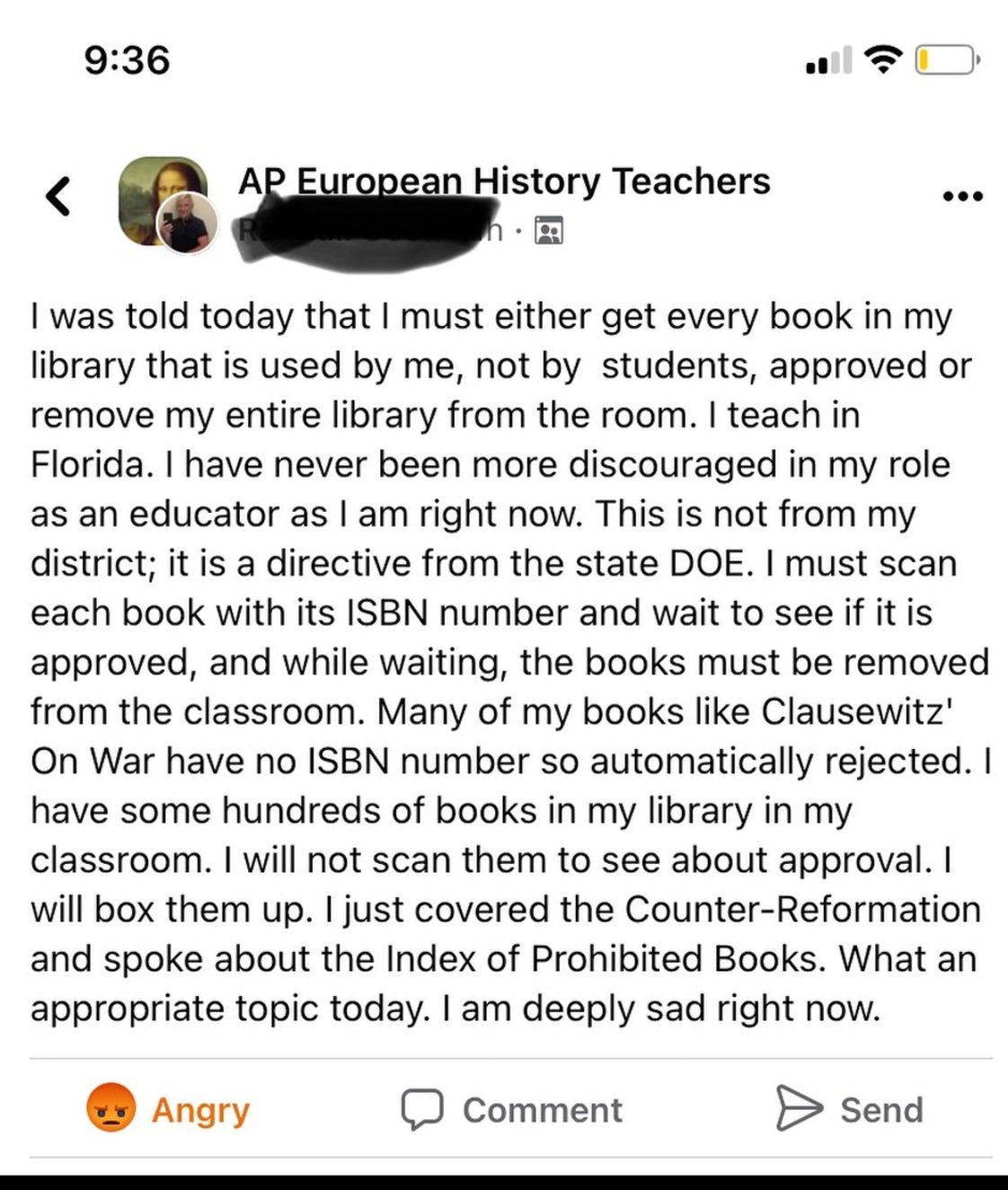
Please, don’t make make America Florida! Fascism starts with book censorship. In this case, a world history must remove his personal books because they are not on the state’s approved list. A book without an ISBN number can’t be in the list. We may assume that The Constitution, the Bible, and The Federalist Papers do not have ISBN numbers.

The more we learn about Ron DeSantis, the more obvious it is that he is unfit for any office due to his lack of ethics, his vindictiveness, and his authoritarianism. The Orlando Sentinel published an article about an investigation into the abusive behavior of a DeSantis appointee, who was appointed by DeSantis—without any background check, references or resume— to lead the state’s multi-billion dollar affordable housing program.

TALLAHASSEE — Gov. Ron DeSantis’ affordable housing executive director yelled and screamed at staff, made sexist comments, talked about their weight and threatened their jobs, employees of the Florida Housing Finance Corp. told an inspector general during an investigation.


The behavior of Mike DiNapoli, a former New York City financial adviser chosen by DeSantis to lead the corporation, created a hostile work environment that violated the organization’s policies, the corporation’s inspector general told board members Thursday.


“The conduct is severe and pervasive enough to create a work environment that a reasonable person would consider intimidating, hostile or abusive,” said Chris Hirst, the inspector general.


The investigative report into DiNapoli, which was not released publicly, was highly anticipated by those in Florida’s affordable housing community. Since the board approved hiring DiNapoli in February, 15 employees — 10% of the corporation’s workforce — were either fired by DiNapoli or quit.

DiNapoli was placed on paid administrative leave by the board in July. Last month, DeSantis reinstated him, with a spokesperson for the governor telling Politico that he never should have been suspended and that the investigation “has found nothing to justify the placement of Mr. DiNapoli on administrative leave….”

DeSantis’ press secretary lashed out at the board in a statement Thursday, calling members “clearly incapable of exercising prudent judgment.”

“If anyone wonders what the deep state looks like, this is it,” Jeremy Redfern said. “It’s clear to us that at least some members of this Board believe they can wield unchecked power to recklessly disparage a public official and tarnish his reputation without basic fairness and due process.”

He added, “We will explore every available tool to ensure proper management and oversight of the board and its staff, including the Inspector General, and to ensure further that this agency ultimately remains accountable to the people of Florida….”

DiNapoli also serves on the board of the First Housing Development Corp. of Florida, which has contracts with the corporation. Three of the corporation’s general counsels, who doubled as ethics officers, said it was a conflict of interest. Hirst agreed and concluded it was a violation of the corporation’s policies.

When asked about the conflict, DiNapoli said it was a “gray line,” and “an appearance of a conflict is not a conflict,” Hirst said….

Hirst also found that the corporation violated its hiring policies when it chose DiNapoli.

The corporation was supposed to advertise the executive director position, conduct interviews, do background checks and call work references. None of that happened, Hirst said. The corporation doesn’t even have an application or a resume on file for DiNapoli, he added.

Instead, DiNapoli was simply appointed by DeSantis, with the only letter of recommendation coming from James Uthmeier, DeSantis’ chief of staff who is currently leading DeSantis’ campaign for president.

The Times/Herald has previously reported that, before taking the job with the Florida Housing Finance Corp., DiNapoli had struggled with financial issues, including a bankruptcy, debtors garnishing his wages and a foreclosure on an Ocala home.

So DeSantis hired a guy with no background checks, not even a resume or references, to oversee the disbursement of billions of dollars for affordable housing. What could possibly go wrong?

How do you measure the value of a novel? By its sales? By its reviews? By its awards?

This article in ArtnetNews by Ben Davis questions the intrusion of metrics into the world of aesthetics. Every teacher and parent should be asking the same questions: can you measure creativity? Can you measure curiosity? Can you measure persistence? Are we measuring what matters most?

He begins:

Let us pause to recall how proud Sam Bankman-Fried was to say that he could prove, with mathematical certainty, that Shakespeare was overrated.

As a matter of fact, the crypto wunderkind who now faces up to 115 years in prison for various crimes, once said the following:

I’m very skeptical of books. I don’t want to say no book is ever worth reading, but I actually do believe something pretty close to that. I think, if you wrote a book, you fucked up, and it should have been a six-paragraph blog post.

In the very recent past—as in a few months ago!—this was considered an obvious example of the unconventional thinking associated with a visionary.

The bit about hating books comes from a worshipful, now-scrubbed interview Bankman-Fried did with Sequoia Capital. As for his bold stand against reading Shakespeare, that dates to 2012, from the personal blog he kept while a student at M.I.T., titled “Measuring Shadows.” There, the future shitcoin entrepreneur held forth on sports statistics and preached the gospel of “effective altruism.

The Shakespeare line appears in a post called “The Fetishization of the Old” which argues that people only pretend to like Much Ado About Nothing, or Pride and Prejudice, or, for that matter, Citizen Kane (“an almost unwatchably empty film”), because they are too deferential toward tradition. People have made good fun of his reasoning. But more notable to me than his ostentatiously callow take on literature is the method Bankman-Fried used to prove it:

About half of the people born since 1600 have been born in the past 100 years, but it gets much worse than that. When Shakespeare wrote almost all of Europeans were busy farming, and very few people attended university; few people were even literate—probably as low as about ten million people. By contrast there are now upwards of a billion literate people in the Western sphere. What are the odds that the greatest writer would have been born in 1564? The Bayesian priors aren’t very favorable.

Simple statistics!

I thought of Sam Bankman-Fried’s numbskull posturing recently when I finally read Nathan Heller’s article about the “The End of the English Major” in the New Yorker. The most-shared tidbit from that piece had a professor lamenting that her Ivy League students who are social-media natives no longer have the attention for reading literature: “The last time I taught The Scarlet Letter, I discovered that my students were really struggling to understand the sentences as sentences—like, having trouble identifying the subject and the verb.”

Heller’s account of the collapse of undergraduate interest in the humanities touched off a lot of anguish, pained tweets, and op-eds this past month. For me, it also clarified something about the trajectory of culture in the recent past, and made me think about the increasing widespread popularity of something I’ll call Quantitative Aesthetics—the way numbers function more and more as a proxy for artistic value….

It manifests in music. As the New York Timeswrote in 2020 of the new age of pop fandom, “devotees compare No. 1s and streaming statistics like sports fans do batting averages, championship, wins and shooting percentages.” Last year, another music writer talked about fans internalizing the number-as-proof-of-value mindset to extreme levels: “I see people forcing themselves to listen to certain songs or albums over and over and over just to raise those numbers, to the point they don’t even get enjoyment out of it anymore.”

The same goes for film lovers, who now seem to strangely know a lot about opening-day grosses and foreign box office, and use the stats to argue for the merits of their preferred product. There was an entire campaign by Marvel super-fans to get Avengers: Endgame to outgross Avatar, as if that would prove that comic-book movies really were the best thing in the world.

On the flip side, indie director James Gray, of Ad Astra fame, recently complained about ordinary cinema-goers using business stats as a proxy for artistic merit: “It tells you something of how indoctrinated we are with capitalism that somebody will say, like, ‘His movies haven’t made a dime!’ It’s like, well, do you own stock in Comcast? Or are you just such a lemming that you think that actually has value to anybody?”

It’s not just financial data though. Rotten Tomatoes and Metacritic have recently become go-to arbitrators of taste by boiling down a movie’s value to a single all-purpose statistic. They are influential enough to alarm studios, who say the practice is denying oxygen to potentially niche hits because it “quantifies the unquantifiable.” (Funny to hear Hollywood execs echo Theodor Adorno’s Aesthetic Theory: “If an empirically oriented aesthetics uses quantitative averages as norms, it unconsciously sides with social conformity.”)

As for art, I don’t really feel like I even need to say too much about how the confusion of price data with merit infects the conversation. It’s so well known it is the subject of documentaries from The Mona Lisa Curse (2008) to The Price of Everything (2018). “Art and money have no intrinsic hookup at all,” painter Larry Poons laments in the latter, stating the film’s thesis. “It’s not like sports, where your batting average is your batting average… They’ve tried to make it much like that, like the best artist is the most expensive artist.”

But where Quantitative Aesthetics is really newly intense across society—in art and everywhere—is in how social-media numbers (clicks, likes, shares, retweets, etc.) seep into everything as a shorthand for understanding status. That’s why artist-researcher Ben Grosser created his Demetricator suite of web-browsing tools, which let you view social media stripped of all those numbers and feel, by their absence, the effect they are having on your attention and values.

Read the whole thing. It makes you think how and why we value what we do. And inevitably draws your attention to the misuse of standardized testing scores.

A reader who signs as “Retired Teacher” posted this astute analysis of how vouchers work. Why are billionaires like Betsy DeVos, Charles Koch, the Waltons, etc. so enthusiastic about vouchers? No voucher will ever be large enough to send a child to the schools their children attend. Why do they want to defund public schools?

During the first phase of the privatization of education was the belief that the private sector can do everything better and more efficiently than the public sector. What ensued was trying to turn education into a commodity. Market based principles applied to education made everything so much worse including hiring the wrong people, endless testing, waste, fraud, firing legitimate teachers and closing public schools. The main goal of privatization has always been to gain access to public funds and transfer it into private pockets. The current interest in vouchers is an extension of this trend. It certainly is not about education as vouchers provide worse education.

Vouchers have always been the goal of DeVos, the 1% and right wing extremists. They are a way to scam the working class out of the public schools that protect their children’s rights and send them to valueless schools with zero accountability while teaching them religious dogma and almost anything else the school deems worthy for less cost. Unfortunately, the students are unlikely get a valid background in science, history, civics or the exposure to diverse students. Vouchers benefit the wealthy and affluent, and they are a losing proposition for the poor and working class.

A 15-year-old boy in New Hampshire, Quinn Mitchell, asked candidate Ron DeSantis a question he couldn’t or wouldn’t answer. At other appearances in New Hampshire, DeSantis’s security guards kept the boy away from the governor.

“Do you believe that Trump violated the peaceful transfer of power, a key principle of American democracy that we must uphold?” Quinn Mitchell asked Mr DeSantis during a town hall event in Hollis, New Hampshire, in June.

“Are you in high school?” the governor asked before he avoided answering the question, instead saying that Americans shouldn’t obsess about the past.

Quinn, who has seen 35 presidential candidates since 2019, also told The Daily Beast that he was physically intimidated when allegedly grabbed by DeSantis campaign security at two events for the governor.

But DeSantis eventually said that he couldn’t comment because he wasn’t there on January 6.

A tweet cited in the article:

Gov. Ron DeSantis (R-FL), when asked if Donald Trump violated the peaceful transfer of power on January 6th: “I wasn’t anywhere near Washington that day. I have nothing to do with what happened that day. Obviously, I didn’t enjoy seeing what happened.”

In response to reporter Kaitlin Collins: Chris Christie ripped DeSantis’s canned response:

@kaitlancollins

Chris Christie on Ron DeSantis’s Jan. 6 answer: “’He wasn’t anywhere near Washington’? Did he have a TV? Was he alive that day? Did he see what was going on? I mean, that’s one of the most ridiculous answers I’ve heard in this race so far.”

The governor’s security guards kept Quinn away from him.

Quinn said he was followed by two guards at an event on 19 August and an attendee told the outlet that they spotted a staffer from DeSantis Super PAC Never Back Down post a photo of him on Snapchat with the caption, “Got our kid”.

The Daily Beast reported that seven other sources confirmed Quinn’s version of events.

Quinn said the campaign’s treatment of him was “really stupid in a small state like New Hampshire”.

The Chicago media and choice supporters are whooping it up because Stacy Davis Gates, the head of the Chicago Teachers Union, sends her child to Catholic school. Big deal. It doesn’t matter where you choose to send your child. What matters is whether you demand that taxpayers pay for your private choice.

Fred Klonsky writes:

I was anxiously waiting for the six o’clock start of the U.S. Open semi final match between Coco Gauf and Carolina Muchova last night.

It was no disappointment.

But I had to wait for the end of the local news.

I thought local political reporter Mary Ann Ahern was going to have a stroke reporting that local Chicago Teachers Union President Stacey Davis Gates sends her kid to Catholic school.

Apparently Ahern has been on this story for days.

This morning the Chicago Sun-Times runs the story front page.

It’s a phony controversy.

Former CPS schools chief and perpetual losing candidate in every office he runs for penned an op-ed piece for the Tribune attacking Gates for her position against taxpayer funding of private and parochial schools.

That’s what this is all about.

It is no coincidence that this phony controversy over where Stacy Gates sends her son to school just happens to take place when the Illinois General Assembly is considering ending public money on private school vouchers.

Former mayor Lightfoot, Rahm Emanuel, the Obamas, and former secretary of education Arne Duncan all sent their kids to private schools.

Paul Vallas sent his kids to parochial school, as did ex-Mayor Richard M. Daley.

As do thousands of Chicagoans who are willing or able to afford it.

Me? I’m a public school grad as are my own kids and grandkids.

And I’m a retired public school teacher.

But my decision to send my children to public school and to teach in a public school was a personal one as is Stacy Gates’ decision to send her son to Catholic school.

The real issue is one of public policy: Should public money go to fund private and parochial schools?

Illinois and Chicago public schools are notoriously underfunded.

The legislature is now debating school funding.

So, suddenly CTU President Stacy Davis Gates sending her kid to a Catholic school is a headline and Mary Ann Ahern is spending days investigating this non-story.

That’s why I say it is a phony distraction.

GOP politicians have become cynically obsessed with “parental rights,” insisting that parents always know best. Parents, the politicians assert, should control what their children learn, how they are taught, what books they should read, etc. Their judgment must take precedence over that of teachers, who are professionals. No one has explained how teachers can respond to the differing views of multiple parents, or why teachers should disregard their professional knowledge and experience and defer to parents.

Hardly a day passes without a news story about parents who abused their children or even murdered them. There are good parents and bad parents. There are well-educated parents who homeschool their children, and there are ignorant parents who pass along their ignorance to their children.

Here is a story that captures some of these points.

Ruby Franke developed a reputation as a child-rearing expert who advises parents to be ultra-strict with their children. She was recently arrested for child abuse after one of her children escaped to a neighbor’s house and asked for food and water. His ankles and wrists were secured with duct tape, and there were lacerations on his legs caused by ropes.

A Utah mother who chronicled her strict parenting style on YouTube and other social media channels was arrested and charged with aggravated child abuse this week after one of her children climbed out a window and ran to a nearby house seeking help, officials said.

Ruby Franke, 41, was arrested on Wednesday in Ivins, a city in southern Utah, at the home of Jodi Hildebrandt, her business partner, who was also arrested. Ms. Franke hosted the now-defunct YouTube channel “8 Passengers,” where she posted videos about her parenting approach with her six children, including refusing them food as a form of punishment.

Ms. Franke and Ms. Hildebrandt were each charged on Friday with six counts of aggravated child abuse, according to the Washington County attorney’s office. Each count carries a maximum sentence of 15 years in prison and a fine of up to $10,000, the attorney’s office said.

According to an affidavit, Ms. Franke’s 12-year-old son, identified as R.F. in the document, climbed out a window at Ms. Hildebrandt’s home and went to a neighbor’s house on Wednesday morning, asking for food and water. The child had duct tape on his ankles and wrists, as well as open wounds. He appeared to be emaciated and malnourished….

At one point, Ms. Franke had nearly 2.5 million subscribers to her channel, following the lives of her six children: Shari, Chad, Abby, Julie, Russell and Eve. In 2020, Chad Franke, then 15, told YouTube viewers in one family video that he had been sleeping on a beanbag for months and that he had lost his bedroom after playing a prank on his little brother, according to Insider.

In one video recorded by Ms. Franke and reposted to TikTok, she said her daughter Eve’s teacher had called her to say Eve had come to school without a lunch. Ms. Franke said the teacher was “uncomfortable with her being hungry” but that Eve was responsible for making her own lunch, and that “the natural outcome is she is just going to be hungry.”

“Hopefully nobody gives her food, and nobody steps in and gives her a lunch, because then she’s not going to learn from it,” Ms. Franke said.

One of my favorite sites for political news is Politico. It posted the following rules of American politics today, submitted by Doug Sosnik, former political advisor to President Bill Clinton.

NEW RULES — Friend of Playbook DOUG SOSNIK is out with a new political memo that he has shared exclusively with us this morning that captures his thinking about the unique circumstances of our current political moment. Sosnik breaks it all down into “Ten New Rules of American Politics.” We think you will want to read the entire memo, which is brimming over with smart insights, but here’s his list and some key excerpts:

1. All politics is now national … “There are currently only five U.S. Senators and 23 members of the U.S. House of Representatives from a different party than the presidential candidate who carried their state or district in 2020.”

2. Education is the new fault line in American politics … “Biden carried white college educated voters by 15 points, which is a 29-point swing from Romney’s 14-point margin. At the same time, Trump carried white non-college educated voters by 32 points.”

3. National polling is not an accurate predictor of presidential election outcomes … “Despite losing the popular vote in seven out of the last eight presidential elections, Republicans held the White House for 12 years during this period.”

4. There are only a handful of states that determine control of power in the U.S. … “[T]here are at most eight states … that will determine the outcome [of the 2024 election]. The only polls that matter in the upcoming presidential election are in these swing states.”

5. The potency of abortion as a political issue will increase over time … “Republican efforts to further restrict a woman’s right to choose at the state level runs counter to the views of a majority of the country and will further increase the political potency of the issue.”

6. The South and the West are now the center of political power … “In the last decade, nine of the top 10 states with the highest increase in population growth were in the South and the West.”

7. The suburbs are the last remaining battleground … “Suburban voters determined the outcome of the last two presidential elections, as well as at least one branch of Congress in each of the last three election cycles.”

8. Online small-dollar donors are the real test of the strength of a candidate … “Over the course of a campaign, big donor contributions are no match for the money that is continuously raised from small donors.”

9. There is no longer a true Election Day in America … “In the 2020 campaign for president, 69% of the country voted before the election — 43% by mail and 26% in person. This was a sharp increase from 40% early voting in 2016.”

10. Political reform is gaining strength across the country … “In addition to taking politics out of drawing congressional and legislative districts, two of the most effective reforms that are increasing in popularity are rank[ed] choice voting and open/jungle primaries.”

Jamelle Bouie is an amazing columnist for the New York Times. if you sign up for his extended column, you get fascinating insights, plus a list of what he’s reading now and even a recipe. This column caught my eye because I was thinking about writing a post about how some counties in Texas are criminalizing travel on roads that lead to the airport or out of state if the traveler intends to get an abortion. They are planning to suspend freedom to travel in order to block abortions. But then I saw that Jamelle Bouie wrote about the same subject, noting that it extended beyond Texas, and drew a parallel with slavery, where different states had different laws regulating human bondage.

Bouie wrote:

One of the ironies of the American slave system was that it depended for its survival on a federal structure that left it vulnerable and unstable.

Within the federal union, the slave-dependent states had access to a national market in which they could sell the products of slave labor to merchants and manufacturers throughout the country. They could also buy and sell enslaved people, as part of a lucrative internal trade in human beings. Entitled to representation under the supreme charter of the federal union, slave owners could accumulate political power that they could deploy to defend and extend their interests. They could use their considerable influence to shape foreign and domestic policy.

And because the states had considerable latitude over their internal affairs, the leaders of slave-dependent states could shape their communities to their own satisfaction, especially with regard to slavery. They could, without any objection from the federal government, declare all Black people within their borders to be presumptively enslaved — and that is, in fact, what they did.

But the federal union wasn’t perfect for slaveholders. There were problems. Complications. Free-state leaders also had considerable latitude over their internal affairs. They could, for example, declare enslaved Black people free once they entered. And while leaders in many free states were unhappy about the extent of their free Black populations — in 1807, as the historian Kate Masur tells us in “Until Justice Be Done: America’s First Civil Rights Movement, From the Revolution to Reconstruction,” Ohio lawmakers passed a law requiring free Black migrants to register with the county clerk and have at least two white property owners vouch for their ability to support themselves — they ultimately could not stop the significant growth of free Black communities within their borders, whose members could (and would) agitate against slavery.

The upshot of all of this was that, until the Supreme Court’s decision in Dred Scott v. Sandford settled the matter in favor of slaveholders, the status of an enslaved Black person outside a slave state was uncertain. It was unclear whether property in man extended beyond the borders of states where it was authorized by law.

It was also unclear whether a slave state’s authority over an enslaved Black person persisted beyond its borders. And on those occasions when a free Black person was within the reach of slave-state law — as was true when free Black sailors arrived in Southern ports — it was unclear if they were subject primarily to the laws of their home states or the laws of the slave states. South Carolina assumed the latter, for example, when it passed a law in 1822 requiring that all “free Negroes or persons of color” arriving in the state by water be placed in jail until their scheduled departure.

One would have to conclude, surveying the legal landscape of slavery before Dred Scott, that federalism could not handle a question as fundamental as human bondage. The tensions, contradictions and conflicts between states were simply too great. As Abraham Lincoln would eventually conclude, “A house divided against itself cannot stand. I believe this government cannot endure, permanently half slave and half free. I do not expect the Union to be dissolved — I do not expect the house to fall — but I do expect it will cease to be divided. It will become all one thing or all the other.”

I want you to keep all this in mind while you read about the latest developments in state and local laws regarding abortion. On Monday, Steve Marshall, Alabama’s Republican attorney general, announced in a court filing that the state has the right to prosecute people who make travel arrangements for women to have out-of-state abortions. Those arrangements, he argued, amount to a “criminal conspiracy.”

“The conspiracy is what is being punished, even if the final conduct never occurs,” Marshall’s filing states. “That conduct is Alabama-based and is within Alabama’s power to prohibit.”

In Texas, anti-abortion activists and lawmakers are using local ordinances to try to make it illegal to transport anyone to get an abortion on roads within city or county limits. Abortion opponents behind one such measure “are targeting regions along interstates and in areas with airports,” Caroline Kitchener reports in The Washington Post, “with the goal of blocking off the main arteries out of Texas and keeping pregnant women hemmed within the confines of their anti-abortion state.”

Alabama and Texas join Idaho in targeting the right to travel. And they aren’t alone; lawmakers in other states, like Missouri, have also contemplated measures that would limit the ability of women to leave their states to obtain an abortion or even hold them criminally liable for abortion services received out of state.

The reason to compare these proposed limits on travel within and between states to antebellum efforts to limit the movement of free or enslaved Black people is that both demonstrate the limits of federalism when it comes to fundamental questions of bodily autonomy.

It is not tenable to vary the extent of bodily rights from state to state, border to border. It raises legal and political questions that have to be settled in one direction or another. Are women who are residents of anti-abortion states free to travel to states where abortion is legal to obtain the procedure? Do anti-abortion states have the right to hold residents criminally liable for abortions that occur elsewhere? Should women leaving anti-abortion states be considered presumptively pregnant and subject to criminal investigation, lest they obtain the procedure?

Laws of this sort may not be on the immediate horizon, but the questions are still legitimate. By ending the constitutional guarantee of bodily autonomy, the Supreme Court has fully unsettled the rights of countless Americans in ways that must be resolved. Once again, a house divided against itself cannot stand.