Archives for category: Vouchers


Andy Spears, publisher of the Tennessee Education Report, explains how voucher forces finally passed a bill in Tennessee.

The FBI is investigating how one vote flipped at the last minute.

But no matter the outcome of these investigations, backers of school privatization can claim public policy victory. It took a new governor, an unscrupulous house speaker, and untold dark money dollars, but after six attempts, Tennessee now has a school voucher plan—one that could shift more than $300 million away from public schools in the state.

The lesson from Tennessee is clear: Advocates for public education face privatization forces with vast resources and patience. The fight is going to be a long one.

Funny thing about these FBI investigations. Years ago, the FBI swooped into Gulen offices in Ohio, carted away many boxes, and nothing more was heard from them.

And then there’s Ben Chavis of the Oakland (CA) American Indian Model Schools, the darling of conservatives, the guy who replaced all the American Indian students with Asians and got the state’s highest scores. He was arrested after a state audit found that he had diverted nearly $4 million to his and his wife’s bank account, much of it federal money. He recently got off with one year of probation, no punishment for his theft, because he had done such good work in education. Vielka MacFarlane, head of the Celerity charter chain in California, admitted embezzling $3.2 million and was sentenced to 30 months in jail. She dealt with state authorities, not federal ones. Maybe she was sentenced, and Chavis got off with only probation because his schools had higher test scores?

The Center for American Progress is considered by the media to be the voice of the Democratic establishment, or at least the Obama-Clinton center of the party. Referred to as CAP, it is resolutely pro-charter school, pro-testing, and anti-voucher (if it were not anti-voucher, its education agenda would be identical to the DeVos agenda).

So who are the experts who speak for the Democratic mainstream?

Our reader Laura Chapman is a dogged and diligent researcher. She studied the CAP website and posted the following review of the members of the CAP staff who write about K-12 education. It is interesting to see overlaps with Jeb Bush’s Foundation for Educational Excellence (which is stridently pro-voucher), the unaccredited Broad Residency (which advocates for closing public schools and replacing them with charters) and other decided not-progressive connections.

She writes here:

In April 2019, CAP had seven “experts” for K-12 education, several more for preschool and postsecondary education. I have looked at the bios of the K-12 experts and read some of their recent articles at the CAP website. Some artiles have appeared in Forbes, US News and World Report, The Hill, Hechinger Report, and The 74 (Walton funded blog). Who are these CAP experts? What do they say?

Neil Campbell, Director of Innovation for K-12 Education Policy. Former Director, Next Generation program for Jeb Bush’s Foundation for Excellence in Education with policy oversight for personalized learning, course access, funding, and student data privacy. Obama’s USDE Chief of staff, Office of Planning, Evaluation and Policy Development; former Director of Strategic Initiatives for tech-based learning at Education Elements.com; work at The Boston Consulting Group. Education: Bachelor economics, political science, Case Western Reserve University; MBA, Vanderbilt University; The Broad Residency in Education. Teaching Experience: Not found.

Sample of writing for CAP: Excerpt from “Teacher Strikes, Charter Schools and Unions, February 26, 2019. “It’s unfortunate that questions about charter schools are diverting attention from the core message of these teacher protests: the need to invest in our schools, teachers and students. Instead of focusing on division, it would be powerful for teachers, unions and charter supporters to advocate together for greater investments in public education across the board. Every student deserves a building, supports and supplies needed to succeed, and every teacher — in traditional or charter schools — deserves to be treated and paid like a professional.”

Excerpt from “Policy Ideas to Improve Private School Voucher Programs,” November 19, 2018. “The Center for American Progress believes that public money should fund public schools, whether they are neighborhood schools, magnet or specialty programs in traditional school districts, or public charter schools that are open to all students and accountable to the public.”

Excerpt from “The Progressive Case for Charter Schools, With a Correction,” October 24, 2017.“Despite recent evidence suggesting that many public charter schools are improving outcomes for students—especially for low-income students of color—broad support for charter schools may be waning. According to one recent poll (Education Next, 2017) support for charter schools among self-described Democrats has fallen over the past year. This decrease in progressive support may be due to a skewed representation of charter schools in the media as well as a conflation of charter schools with ineffective private school vouchers—such as those Secretary of Education Betsy DeVos and the Trump administration champion. However, to simply devalue all charter schools is unreasonable. The highest-quality charters exemplify progressive values and practices, most notably through their foundational principle of providing low-income students of color with equal educational opportunity and access they may not otherwise have.” (Links are to Uncommon Schools, KIPP, and Achievement First).

Khalilah M. Harris, Managing Director for K-12 Education Policy. Former host and producer of Real News Network’s Baltimore Bureau; Founder, 2007, Baltimore City Freedom Academy, a charter school closed in 2013; Co-founder Baltimore Coalition of Black Leaders in Education. Active in EduColor movement; Former Deputy Director, Obama’s White House Initiative on Educational Excellence for African Americans; Manager, Obama’s Diversity and Inclusion in Government Council. Education: Morgan State University; J.D. University of Maryland School of Law; Ed.D. University of Pennsylvania, 2018 Dissertation: “Chasing Equity: A Study on the Influence of Black Leaders on Federal Education Policy-making.” No CAP publications. Teaching: No K-12 Found.

Laura Jiménez, Director of Standards and Accountability. Former Director, College and Career Readiness and Success at the American Institutes for Research (AIR); former Director, American Youth Policy Center. Manager, National Youth Employment Coalition (a three-year pilot funded by the Bill and Melinda Gates and Nellie Mae Foundations); UCLA Minority Training Program in Cancer Control Research. Obama’s USDE, former special assistant on Every Student Succeeds Act “flexibility,” college and career readiness, special populations (American Indian/Alaska Native and English language learners). Education: BA English, UCLA; Master’s Social Welfare, University of California; Berkeley. Teaching (?): Peace Corps, Community Education volunteer.

Sample of writing for CAP: “Furthering the College and Career Readiness of the District of Columbia’s Students” for the Council of the District of Columbia on Education Reform.” May 2018. Her written testimony argues for all high school students to take ”four years of English; three years of math, up to Algebra II; three years of social studies, including U.S. and world history; three years of lab science, including biology, chemistry, and physics; and two years of the same foreign language” with an option in every high school of at least three courses in the same career pathway (e.g., hospitality, science, technology, engineering, and mathematics). She also endorsed these policies: Monitoring chronic absenteeism at every grade, investing in low cost interventions for absences (e.g., postcards to parents), monitoring at risk students in order to target wraparound supports. Frequent reference citations to Gates-funded Data Quality Campaign and The Education Trust.

Lisette Partelow, Senior Director of K-12 Strategic Initiatives. Prior positions: Senior Policy Analyst CAP, Director of Teacher Policy, CAP; Legislative Associate, Alliance for Excellent Education; Senior Legislative Assistant US House of Representatives; Research Assistant American Institutes for Research (AIR). Education: BA Psychology, Public Policy, Connecticut College; Masters in Public Affairs, Princeton University: Masters in Education, George Mason University. Teaching: Teach for America, first grade, two years, Washington, D.C.

Sample of writing for CAP: In August 2018, Partelow and research assistant Sarah Shapiro wrote about “Curriculum Reform in the Nation’s Largest School Districts.” The authors used the Gates-funded EdReports criteria for judging whether fourth-and eighth-grade math and ELA instructional materials were aligned with the Common Core. They also cite the Louisiana Department of Education’s system of rating instructional materials as exemplary for offering “a snapshot of the current status of the adoption of curriculum reform and instructional materials in the districts.” In fact, the rating criteria for Louisiana are nearly identical to EdReports.

Scott Sargrad, Vice President, K-12 Education Strategic Initiatives. Prior positions: VP for K-12 Policy CAP; Managing Director, Education Policy CAP; Director for Standards and Accountability, CAP. Obama’s USDE Deputy Assistant Secretary for Policy and Strategic Initiatives: Senior Policy Advisor, Presidential Management Fellow. Intern, Vietnam Assistance for the Handicapped Hanoi, Vietnam. Education: BA Mathematics, Philosophy, Haverford College; Ed.M. Education and Management, Harvard Graduate School of Education.Teaching: Math and Cross-Country Track Coach, Queen Anne School (private), Upper Marlboro MD; Special education instructional assistant Harriton High School, Rosemont, PA.

Sample of writing for CAP: August 9 2018. “Are High School Diplomas Really a Ticket to College and Work? An Audit of State High School Graduation Requirements”(co-authored with Laura Jimenez) argues for more rigorous standards and courses for high school graduation suitable for “college AND career.” The term “audit” refers to three levels of quality ratings assigned to high school curricula in each state, based on perfect alignment with the specific courses that public colleges in each state seek for admission. No state received the highest rating. The report has other ratings for career and technical education (CTE) and a well-rounded education (e.g., life skills courses, financial literacy, online learning, business and communications, civic engagement). The authors say: “One promising approach to address the alignment and quality concerns is competency-based graduation requirements.” This report recycles ideas from the Education Trust (HS transcript data up to 2013), old data on course availability from the Civil Rights Data Project (2014), among other sources. In Appendix A, there are no active links to 137 of the 238 sources of data. https://c0arw235.caspio.com/dp/b7f930000e16e10a822c47b3baa2

Cynthia G. Brown, Senior Fellow, former Vice President for Education Policy at CAP; former Director “Renewing Our Schools, Securing Our Future National Task Force on Public Education,” a joint initiative (2004) of CAP and the Institute for America’s Future. Thirty-five years of work in education, many as an independent consultant. Former Director of the Resource Center on Educational Equity, Council of Chief State School Officers. First Assistant Secretary for Civil Rights in USDE (1980 appointment, President Carter). Principal deputy, Department of Health, Education and Welfare’s Office for Civil Rights. Other work for Lawyers’ Committee for Civil Rights Under Law, Children’s Defense Fund. Current: Board of Directors of the American Youth Policy Forum; Perry Street Preparatory Public Charter School, District of Columbia. Education: BA, Oberlin College: MPA Syracuse University. Teaching: None found. No CAP publications listed since 2013.

Catherine Brown. In February 2019, CAP replaced Catherine Brown as Vice President for K-12 Education Policy. Brown was “transitioned to a Senior Fellow role at the Center.” As of April 26, 2019 Catherine Brown did not appear on CAP’s website as a Senior Fellow or on the roster for CAP Action. Her LinkedIn bio affirms her recent move to Senior Fellow at CAP.

Brown joined CAP in 2014 after serving as vice president of policy, Teach for America. She directed Teach for America’s Early Childhood Initiative, and successfully lobbied USDE for a $50 million Investing in Innovation grant for TFA. Brown is a longtime insider on Capitol Hill. She was the senior education policy advisor for George Miller chair of the House Committee on Education and Labor offering recommendations on standards, assessments, and charter schools among other issues. Brown was the “domestic policy advisor” for presidential candidate Hillary Clinton and legislative assistant for Senator Clinton on major initiatives (e.g., preschool, college affordability, job training). Brown also served as an organizer for Democrats in Montana and as a research assistant, Mathematica Policy Research. Education: Smith College, Master in public policy, Kennedy School of Government, Harvard University. Teaching experience: None Found.

Writing for CAP. Catherine Brown was a co-author of the“The Progressive Case for Charter Schools,” October, 2017, which was posted on this blog recently. 

Brown’s July 2018 article in Forbes “Proposing A $10,000 Raise For Teachers” highlights a CAP proposal for a federal tax credit for teachers in high poverty schools. Brown developed that idea, reported in detail at. https://www.americanprogress.org/issues/education-k-12/reports/2018/07/13/453102/give-teachers-10000-raise/

Brown was recently credited as “consulting” with presidential candidate Kamala Harris on a similar proposal. Harris has proposed matching teacher salaries with federal funds. http://nymag.com/intelligencer/2019/03/reformers-and-unions-love-harriss-teacher-pay-plan.html#comments

Ulrich Boser, Senior Fellow, Founding director, CAP’s Science of Learning initiative. Founder, The Learning Agency.com. Book: “Learn Better: Mastering the Skills for Success in Life, Business, and School, or, How to Become an Expert in Just About Anything” (2017); also “The Leap: The Science of Trust and Why It Matters,” (2014). Book publicity in Wired, Slate, Vox, Fast Company, The Atlantic, USA Today. Former advisor, Bill and Melinda Gates Foundation, Hillary Clinton presidential campaign. Articles in U.S. News and World Report, Education Week, The New York Times, The Wall Street Journal, Smithsonian, The Washington Post. Education: BA, Dartmouth College, with honors. Teaching: None Found.

Sample of writing for CAP: “How to Match Students With Schools They Choose,” November 13, 2018. (This reflects an uncritical acceptance of school choice and explains one app enrollment) [Editor’s note:. Boser write a strongly critical article about vouchers, but has never written critically about charters. CAP seems to have a party line that protects the legacy of Race to the Top.] 

“Homework and Higher Standards: How Homework Stacks Up to the Common Core,” February 13, 2019. Study based on 187 examples of homework submitted by parents and an opinion survey from 372 parents about that homework. Key findings: Homework is largely aligned to the Common Core standards but often focused on low-level skills that fail to challenge students (especially in primary grades). CAP recommendations for states, districts, and schools: Focus on homework that requires practice of rigorous grade-level content aligned with the Common Core, and/or provide access to Khan Academy’s online homework aligned to Common Core.

Current CAP Experts in K-12 Education strike me as short of teaching experience in classrooms. Recent articles show they are supporters of charter schools, treat the Gates-funded Common Core as if exemplary and look forward to instructional delivery by computers (mislabeled personalized learning). They are arrogant pushers of specific instructional materials and high school curricula, aided by the Gates-funded EdReports scheme. The Center for American Progress is no friend of public education.

CAP also has a news arm, Think Progress, a newletter supported by CAP’s Action Fund but represented as an “editorially independent project.” I wonder. The IRS 990 says: “The Action Fund makes communications to the general public commending or criticizing particular public policy positions taken by various candidates. … The newsletter is intended to “impact the national debate and transform progressive ideas into policy through rapid response communications, public education, grassroots organization and advocacy in partnership with American citizens, executive and legislative branch policymakers and progressive leaders throughout the country and the world.” The Newsletter has a new “Members-Only Commenting” feature available only “to our donors” with perks (e.g., shaping the content) for monthly rates at $5. or $15 or $35.

I looked a recent Think Progress Newsletters dealing with charter schools. I found seven. Of these, most are reports on federal budget and policies under Trump/Devos. The strangest had this headline: “Lawsuit claims that same-sex marriage leads to charter schools, and it may be right.” The author, Ian Millhiser, is a lawyer with expertise on Supreme Court cases. I could not find my way through the legal leaps connecting charter schools with same-sex marriage. The legal objective seemed to be that of establishing a federal law supporting educational choice, that to be justified by past Supreme Court rulings bearing on the 14th Amendment. The case was dismissed 02/20/2019. The law firm advancing this dubious cause also filed the Vergara v. California suit that dealt with a child’s right to instruction by “effective teachers.” That was overturned on appeal. https://thinkprogress.org/tag/charter-schools/

GENERATION PROGRESS is the youth activist and youth journalism arm of CAP. https://genprogress.org/our-issues/

WHO FUNDS CAP? Using the CAP website, I constructed a spreadsheet listing CAP donors for the last five years according to several tiers on money. I will report on some of the key donors later on.
 

Andrew Ujifusa writes in Education Week about a massive number of leaked emails from government officials in Puerto Rico that have caused an uproar on the Island. The emails touch on many issues, and education is one of them. In the wake of the data dump, many people are calling no the governor of Puerto Rico to resign.


Puerto Rico’s political leadership is unraveling at high speed, pushed along by an ex-education secretary’s arrest last week and the leak of private messages between Gov. Ricardo Rosselló and his top officials that include derogatory comments about the teachers’ union president. 

Julia Keleher, who was appointed by Rosselló as secretary in late 2016 and served as the island’s schools chief until April, was arrested last Wednesday on fraud charges related to how she handled millions of dollars in government contracts. Her arrest reignited ongoing debates about her and the governor’s successful push to expand educational choice, close hundreds of schools, and reform the island’s education bureaucracy, as well as her status as a non-Puerto Rican. 

Then on Saturday, the Center for Investigative Journalism in Puerto Rico published hundreds of pages of private messages—mostly in Spanish—between Rosselló and some of his top advisers. The leaked messages have caused a political firestorm on the island, leading to several resignations and growing calls for the governor to step down. 

Among the messages’ targets was the Asociación de Maestros de Puerto Rico, the island’s teachers’ union, and its president, Aida Díaz. In a Dec. 19, 2018 exchange, the then-chief financial officer of Puerto Rico, Christian Sobrino, responded to a statement from AMPR about union negotiations by saying in English, “I DONT [sic] NEGOTIATE WITH TERRORISTS!” 

If that epithet sounds familiar, you might be thinking of former U.S. Secretary of Education Rod Paige, who once called the National Education Association a “terrorist organization.”

Four days earlier, in response to other comments from Díaz in support of San Juan Mayor Carmen Yulín Cruz, Sobrino said he was “salivating” at the idea of shooting a person or people. However, it’s not entirely clear from Sobrino’s remark about shooting if he meant Cruz, Díaz, or both of them, or someone else. In the messages, Rosselló responded that this would be helpful to him. (Sobrino announced his resignation on Sunday after these and other messages were made public.) 

The governor also referred to former Louisiana State Superintendent Paul Pastorek, a staunch proponent of charters and vouchers, as a “monster,” upon learning that he was charging the bankrupt island $250 an hour to be a “consultant.”

On a related matter, a story from the Associated Press says: 

Federal officials said Wednesday morning that former Education Secretary Julia Keleher; former Puerto Rico Health Insurance Administration head Ángela Ávila-Marrero; businessmen Fernando Scherrer-Caillet and Alberto Velázquez-Piñol, and education contractors Glenda E. Ponce-Mendoza and Mayra Ponce-Mendoza, who are sisters, were arrested by the FBI on 32 counts of fraud and related charges.

The alleged fraud involves $15.5 million in federal funding between 2017 and 2019. Thirteen million was spent by the Department of Education during Keleher’s time as secretary while $2.5 million was spent by the insurance administration when Ávila was the director.

Charles Koch and his network of wealthy donors have created a new Astroturf organization called “Yes Every Kid” to promote school choice and take public money away from public schools.

Yes, they are targeting “every kid” as a prime prospect for a charter school or a voucher.

Yes, they want to shrink public schools so that they are no longer the “choice” of 90% of American families.

Koch in June announced the Yes Every Kid initiative as the latest addition to his sprawling network of wealthy donors, political groups and tax-exempt advocacy organizations best known for pushing anti-regulation, small-government policies. Its political arm, Americans for Prosperity, has made waves supporting the tea party and fighting former President Barack Obama’s health care law.

The Yes Every Kid group is tasked with monitoring statehouses where it can be influential on school choice, said Stacy Hock, a Texas philanthropist who is among hundreds of donors each contributing at least $100,000 annually to the Koch network’s wide-ranging agenda.

Hock and officials with the Koch network said it’s too early to provide specifics about what policies the group is pushing.

“The priority is to go where there is a political appetite to be open to policy change and lean in there,” said Hock, who also leads the Texans for Education Opportunity advocacy group that supports charters and other education alternatives.

She cited Texas, West Virginia, Tennessee and Florida as priority states where school choice proposals have flourished.

It is hard to say that West Virginia is a place where school choice proposals have “flourished” since the legislature approved them just weeks ago for the first time, and they have not yet been implemented. So translate: Koch money has successfully bought enough legislators in rural West Virginia to foist “choice” on local communities, although it has not happened as yet.

In Tennessee, Koch money bought the new governor and the legislature to impose charters and vouchers on districts that don’t want them.

Florida is a wholly owned subsidiary of the DeVos-Jeb-Koch combine.

There is no evidence that students benefit by having school choice, although there is plenty of evidence that vouchers underwrite racism and ignorance and there is plenty of evidence that school choice promotes segregation.

This is what the billionaires actually want: ignorance, racism, and segregation. And it is worth paying for. For them. Not for us, and not for our society.

Peter Greene defined this new group of Astroturfers far better than I. 

He calls it the “Astroturducken,” with one deform idea wrapped around another, all of them guaranteed to destroy public schools, trick parents, and generate jobs for the faithful hangers-on from Reformy world.

Greene writes:

Yes, don’t wait for things to come down from above, says this website that has come down from a billionaire who wants to drive the education bus despite his complete lack of educational expertise. But this astroturfery is insistent. “Real change has to start from the ground up. We’re here as your resource to facilitate conversation.” That might be really moving if the very next sentence weren’t “We’re here to foster a culture of disruptive innovation,” which suggests that these facilitaty listeners already have some answers in mind. Also missing– an acknowledgement of where all that negativity came from. Here is yet another reformy outfit talking about negatives from the past as if they simply fell from space, instead of saying, “Yeah, that was us. Sorry.” And here comes the tell:

We want to hear new ideas, new solutions, and new voices. And it can only happen when we listen to the real stakeholders in education: you.

But who is this “we” and why should stakeholders feel any need or obligation to talk to “we” in the first place? This is the same old rich fauxlanthropist baloney– we’re not only going to vote ourselves a seat at the table, but we’re also going to go ahead and give ourselves the seat at the head because, yeah, this is our table now. It’s so big and generous of you to agree to listen to us, Sir, but I still haven’t heard a reason that we should be talking to you. This is the overarching narrative of decades of modern ed reform– actual teachers and educators were working long and hard on the problems of education, and a bunch of rich amateurs strolled up and announced, “Good news! We’re going to take over this whole conversation now!” Thirty years later we’re still all waiting to hear why these guys should be running any part of the show beyond reasons like “I’m rich” and “I want to.”


Jan Resseger writes here about Wisconsin Governor Tony Evers’ efforts to repair the damage done to education in Wisconsin by ex-Governor ScottWalker, who used his time in office to try to destroy education.

She writes about Gordon Lafer’s brilliant book The One Percent Solution as context for the siege of the schools and universities by Walker.

She begins:

In Gordon Lafer’s 2017 book, The One Percent Solution, in the first chapter entitled  “Wisconsin and Beyond: Dismantling the Government,” Lafer makes Wisconsin the emblem of what happened in the 2010 election, as corporate lobbies, the Tea Party, and the collapse of state revenue following the Great Recession converged to fuel a Red-state wave that took over state governments:

“Critically, this new territory included a string of states, running across the upper Midwest from Pennsylvania to Wisconsin, that had traditionally constituted labor strongholds… Starting in 2011, the country has witnessed an unprecedented wave of legislation aimed at eliminating public employee unions, or, where they remain, strictly limiting their right to bargain.  At the same time, the overall size of government has been significantly reduced in both union and nonunion jurisdictions. The number of public jobs eliminated in 2011 was the highest ever recorded, and budgets for essential public services were dramatically scaled back in dozens of states.  All of this—deunionization, sharp cuts in public employee compensation and the dramatic rollback of public services—was forcefully championed by the corporate lobbies, who made shrinking the public sector a top policy priority in state after state.”  (The One Percent Solution, pp. 44-45)

Wisconsin was Ground Zero for the attack o the public sector unions, public schools, and public higher education.

Resseger describes Governor Evers’s first steps toward putting together what Walker destroyed.


Jeb Bush created an organization called Chiefs for Change, whose original membership consisted of state superintendents who shared Jeb’s ideas: high-stakes testing, evaluating teachers by the test scores of their students, school grades of A-F, and school choice (charters and vouchers).

Chiefs for Change has now become a clearinghouse for district superintendents.

You can be sure that anyone recommended by Chiefs for Change is dedicated to disrupting and privatizing your district.

Here are some of the district superintendents that Chiefs for Change points to with pride.

Lewis Ferebee, the new Superintendent of the schools of the District of Columbia.

Susana Cordova, the new Superintendent of the Denver schools.

Jesus Jara, Superintendent of the Clark County (Nevada) Schools. Nevada’s State Commissioner Steve Canovera is a member of Chiefs for Change.

Donald Fennoy, Superintendent of Palm Beach County, Florida.

Deborah Gist, Superintendent of Tulsa, Oklahoma, Schools, along with Andrea Castenada, the district’s “chief innovation officer.”

There are more.

This is the Jeb Bush pipeline, the leaders committed to his vision of disruption and privatization. Of course, you won’t find those two words on Jeb’s website, but those are the results of his convictions, and the proof of those convictions can be found in Florida, the state whose education policy he has controlled for 20 years.


Peter Greene writes here about a case that could knock down the wall of separation between church and state.

With two Trump appointees, the Supreme Court appears poised to rule in favor of state support for religious school tuition.

Despite the fact that voters overwhelmingly reject vouchers (when the public is asked to voice its view). Despite the fact that studies consistently show that children who use vouchers lose ground. Despite the fact that many religious schools are openly discriminatory. This Supreme Court appears ready to give a green light to public funding of religious schools.

This is a huge step backwards. The state will fund yeshivas that do not teach English or science. It will fund fundamentalist Christian schools that use the Bible as a science textbook. It will fund madrassas. You can’t fund one religion without funding all.

Pandora’s Box is about to be opened.

Beth Lewis wrote this report about the great news from Arizona, where SOS Arizona is staying strong, united, dedicated, and powerful.

SOS Arizona won NPE’s first annual Phyllis Bush Award for Grassroots Leadership, presented at the NPE conference last October in Indianapolis.

Beth Lewis writes:

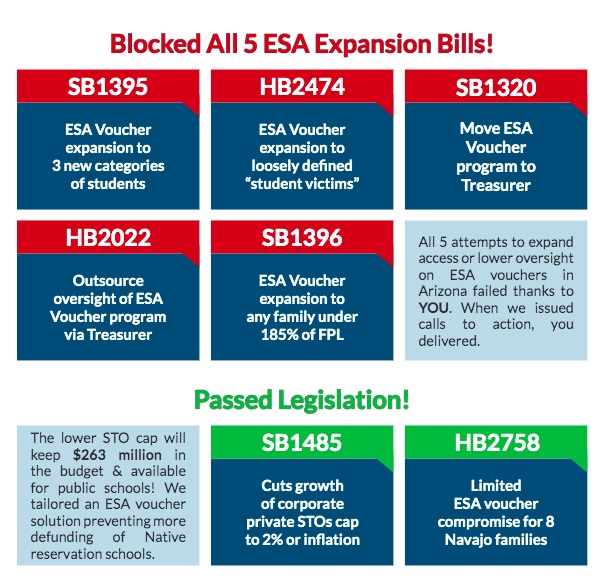
We have good news from Arizona! Coming off of their huge victory in defeating Proposition 305, which would have been the nation’s largest voucher expansion, Save Our Schools Arizona took their fight to the statehouse and won several critical battles.

The grassroots powerhouse stymied all five legislative attempts to either expand access to “Empowerment Scholarship Account” (ESA) vouchers or lower oversight of the existing program.

This marks three years in a row that the national voucher lobby has been defeated by volunteer parents, teachers and retirees in AZ. It’s thanks to mounting pressure to respect voters and fund Arizona schools, as well as wide reaching efforts to educate voters about the harms of privatization. Thousands of everyday citizens called, emailed, and met with lawmakers to make their opposition clear. In the end, the voice of the people prevailed over the various local and national special interest groups trying to push these bills. Arizona, the one-time school choice proving ground, is now demonstrating to the nation how to fight and prevail against privatizers. And that’s exactly why SOSAZ needs our support – to continue prevailing and protecting public schools. Please support their incredible work by donating at sosarizona.org/donate – they are nowhere near done fighting and need massive support to continue their work!


Karen Francisco, editorial page editor of the Fort Wayne Journal-Gazette, is a great defender of democracy, honesty, and public schools. She is a keen observer of the school choice hustle in Indiana, where grifters and entrepreneurs are welcome to rip off the public. Thanks, Former Governor’s Mitch Daniels and Mike Pence, and compliant legislators.

In this editorial, she explains how charter schools and voucher schools evade accountability. One neat gimmick is to change the name of a failing choice School, and the clock gets reset. Presto, Change-O.

She begins:

When Horizon Christian Academy produced some of the lowest standardized test scores in the state in 2015, a spokeswoman for the Institute for Quality Education defended the Fort Wayne school’s poor performance by claiming accountability for Indiana voucher schools is greater than for public schools.

“Traditional public schools as well as public charter schools can receive an F for four consecutive years before the state can intervene,” Erin Sweitzer told The Journal Gazette. “Private voucher schools, however, are required to stop accepting new voucher students after two consecutive years of receiving a D or F.”

What Sweitzer and other voucher proponents don’t acknowledge is the accountability loophole that allows charter and voucher school operators to walk away from a failing school and open shop under a different name – with barely an interruption in the generous flow of state tax dollars. After a D grade in 2015-16, Horizon Christian Academy went on to receive an F for each of the next two academic years. The state prohibited the school from accepting new voucher students last year, but paid $880,000 in vouchers for returning students. That’s on top of the $11.4 million Horizon’s three schools have collected since the taxpayer-funded voucher program began in 2011.

Now, the school’s co-founder has left Horizon and is preparing to open a new faith-based school, Abraham Preparatory Academy.

Tammy G. Henline told The Journal Gazette’s Ashley Sloboda that the school, at Statewood Baptist Church, is planning a “large, public registration soon.” WFFT-TV reported the school will “rely heavily on a virtual curriculum” and is seeking state accreditation, which would make it eligible to receive vouchers.

If the Indiana State Board of Education approves accreditation, it will deliver Exhibit A in the accountability charade supported by voucher proponents.

In the name of parent choice, they ignore policies that allowed the failing Imagine public charter school to reopen as Horizon Christian Academy and for unlicensed educators to earn six-figure salaries overseeing D- and F-rated schools.

Apparently the voters in Indiana don’t care about how taxpayer dollars are wasted.

Stephen Suitts is an adjunct professor at Emory University’s Institute for the Liberal Arts. He is the author of Hugo Black of Alabama: How His Roots and Early Career Shaped the Great Champion of the Constitution. Earlier in his career, Suitts served as the executive director of the Southern Regional Council, vice president of the Southern Education Foundation, and executive producer and writer of “Will the Circle Be Unbroken,” a thirteen-hour public radio series that received a Peabody Award for its history of the civil rights movement in five Deep South cities.

In this illuminating and important article, he examines the roots of the “school choice” movement, which began as an integral part of the segregationist opposition to the Supreme Court’s 1954 Brown decision. Contrary to the rhetoric of Betsy DeVos, Mitt Romney, Donald Trump and even some Democrats, school choice is NOT the “civil rights issue of our time.” School choice was born as a way to maintain segregation of the races. Read this article in full. It is a brilliant and necessary history of the fight to block desegregation of the schools in the South (and other regions), and it is a fight that is ongoing. Next time you hear Betsy DeVos lecture about “educational freedom,” bear in mind that she is echoing dozens of segregationist politicians, like George Wallace. You will meet many more if you this stunning history of school choice and its origins.

He writes:

The political movement for “school choice” is employing the icons and language of civil rights and social justice to advance private school vouchers that fifty years ago were primary tools for segregationists to preserve unequal education for African American and Hispanic children. President Trump’s call for a national program of “school choice” echoes the language of George Wallace and others who demanded the federal government and US courts permit Alabama and the South to administer “freedom of choice” for elementary and secondary schools.

These apparent contradictions emerge from the unexamined legacy of segregationists who designed and developed effective, lasting strategies that frustrated and blocked K–12 school desegregation. It is a legacy that turns the icons and language of civil rights inside-out while thwarting the national goal of an effective, equitable system of education for all children.

So now we see the Heritage Foundation, Betsy DeVos, evangelicals, President Trump, and others who paint themselves as the newly minted defenders of the rights of poor black and brown children. They do so by perverting the language of the civil rights movement to support their goal of transferring public funds to private schools.

Suitts described the broad coalition of white supremacists who used every tool they could fashion to fight desegregation and racial justice. School choice was one of those tools.

Political leaders such as Georgia’s Ernest Vandiver won office by campaigning on a slogan of “No, not one” African American child would ever be allowed in a white school but discovered after entering the governor’s office that complete, absolute segregation was impossible to achieve—and counter-productive to preserving as many virtually segregated schools as possible. There were segregationists such as Alabama state senator Albert Boutwell—who later as a “moderate” mayoral candidate defeated “Bull” Connor—and Birmingham corporate attorney Forney Johnston. While Wallace began as a white liberal before shifting his politics to become governor, Boutwell and Johnston were the first segregationist leaders to develop a variety of strategies, tactics, and rationales for school choice that often delayed and defeated the promise of Brown.

Resistance to school desegregation differed across the states of the former Confederacy according to class, geography, religion, and political ambition.18 Only by recovering and understanding the work of a wider cast of white actors who crafted enduring tools and strategies protecting segregation can the reactionary heritage of today’s school choice become clear. As Justin Driver has found, the efforts of these segregationist leaders “to maintain white supremacy were often considerably more sophisticated, self-aware, and nuanced than the cartoonish depiction of southern stupidity and hostility would admit.”19 These forgotten and ignored strategies help explain how today’s proponents of public financing of private schools can employ the language of civil rights without widespread discredit. They also reveal how the origins and historical development of “freedom of choice” have shaped and continue to define the impact and role of “school choice” and vouchers in public education across the nation.20….

From 1954 to 1965, southern legislatures enacted as many as 450 laws and resolutions attempting to discredit, block, postpone, limit, or evade school desegregation. A large number of these acts allowed the re-direction of public resources, including school resources, to benefit private schools.25 In 1956, the Georgia legislature permitted the leasing of public property to segregated private schools. Five years later, the state enacted a law to provide vouchers for students to attend any non-sectarian private school, boldly declaring the act was to advance “the constitutional rights of school children to attend private schools of their choice in lieu of public schools.”26

The North Carolina legislature enacted eight bills, the first of which was a constitutional amendment to authorize vouchers for private education and to allow whites to close public schools through a local referendum. In Alabama, Louisiana, Mississippi, and South Carolina, legislatures passed laws to publicly fund vouchers for private schools and to transfer public school property to private educational organizations. Citizens’ Councils were active in setting up private schools, especially in Mississippi. The Virginia legislature declared its support for this “freedom of choice” movement by enacting a system of vouchers for private organizations and citizens.27

In addition to direct transfers of public funds and assets, some states employed tax schemes, including tax credits, to build and finance private school systems. In the Little Rock Crisis of 1957, after President Dwight Eisenhower was forced to call out federal troops to protect a handful of black children attempting to attend Central High School, Governor Orval Faubus funneled public monies through contracts and tax credits to the Little Rock Private School Corporation until the federal courts stopped the subterfuge (along with further attempts by Arkansas to enact vouchers). In 1959, Georgia governor Ernest Vandiver led the legislature in passing the six segregation bills, including one that supported “the establishment of bona fide private schools by allowing taxpayers credits upon their State income tax returns for contributions to such institutions…”

By 1965, seven states had enacted some type of voucher that enabled the largest growth of private schools in the South’s history. Yet, vouchers as a preferred and essential method of resistance to Brown did not stand alone but worked most effectively through larger plans that emerged from the different states. These plans were not uniform, but most incorporated strategies and language that have evolved and endured as the ways and means by which vouchers, school choice, and private schooling have escaped the stigma of their segregationist origins without losing much of the same purpose or effect.

Alabama’s Citizens Council proposed legislation to close all public schools and use vouchers for white parents to enroll in private schools in order to “keep every brick in our segregation wall intact.”

The die-hard segregationists came up with a three-way solution. Every student and family would have “educational freedom.” They could choose to go to an all-white school, an all-black school, and an integrated school.

All of the Southern states endorsed vouchers.

In Mississippi, white voters approved state constitutional changes recommended by Governor Hugh White’s advisory group that authorized state funding for children to attend their parents’ choice of a private school and for transferring public school properties to private schools. Afterwards, the strategy committee did little more since Mississippi’s white leaders employed other groups and strategies as their first line of defense. The legislature approved small funding increases for black public schools in an attempt to convince black citizens that the state would move closer to “separate but equal” facilities…

Lindsay Almond became Virginia’s new governor in 1957 after a campaign in which he supported the hardline approach. “I’d rather lose my right arm,” he proclaimed, “than to see one nigra child enter the white schools of Virginia.” He dropped his hardline stance and adopted “freedom of choice” as his policy. Some counties, however, went further.

Prince Edward County in Virginia maintained absolute segregation by closing the county’s public schools and providing county tax credit scholarships to supplement state vouchers for white children to attend private schools. In 1964, however, Justice Hugo Black issued the Supreme Court opinion outlawing the die-hard segregationists’ schemes. The Court ordered the public schools reopened on a desegregated basis and held that both tax credit and direct vouchers were unconstitutional.

Suitts traces the resistance to desegregation and the growth of private “white flight academies” in the South.

By 1980, when Ronald Reagan was elected, this history of die-hard resistance to desegregation and white-supremacist ideology had begun to fade from memory.

President Reagan transformed a “love of white skin” into a color-blind doctrinal belief that individual freedom of choice in schooling created diversity and opportunity for all in an era without segregation. Reagan became the nation’s primary voice for why and how government should support private schools, and, as a former actor and California governor, his own past and national leadership obscured the original role and rationales of southern white supremacists from public memory.

In 1984, in re-nominating Reagan, the Republican Party’s education platformincluded support for the right to pray in public schools, opposition to busing for desegregation, passage of tuition tax credits for private schools, and redirecting billions of federal funds dedicated to assist low-income students in public schools into vouchers for private schools. It was the first time a national political party endorsed school vouchers. In his State of the Union address fourteen months later, President Reagan declared: “We must continue the advance by supporting discipline in our schools, vouchers that give parents freedom of choice; and we must give back to our children their lost right to acknowledge God in their classrooms.”120 It was the first time a US president expressly advocated for school vouchers before a joint session of Congress. Without attribution, the views and tools of southern segregationists had become the official position of the national Republican Party and the Reagan presidency…

With the increased number of conservative justices appointed to the Supreme Court and federal District Courts and Appeals Courts, the judiciary abandoned its activist role in protecting the rights of black students.

The US Supreme Court began to bless these developments. As early as 1973, Justice William Rehnquist became the first member of the Court to issue a dissent from a school desegregation case relying on the precedent of Brown. In a case concerning school segregation in Denver, he condemned the Court’s opinion for requiring a school district to advance desegregation—employing the old scare word, “racial mixing”—where there were “neutrally drawn boundary lines” that sustained segregation.129 Barely a year after the Bob Jones decision held that religious private schools could not hold a tax exemption and discriminate on the basis of race, the Supreme Court slammed shut the courthouse door on those seeking to challenge the IRS’s weak enforcement. Parents of twenty-five black public school children sued the IRS, charging that its standards and procedures were inadequate to fulfill its obligation to deny tax-exempt status to racially discriminatory private schools. In 1984, the US Supreme Court held that the parents had no standing to bring such a suit.130 

With the appointment of other justices across more than three decades, the Court increasingly refused to require school districts to use any method of desegregation that proved effective in dismantling the dynamics of separation. By 2007, the Court had turned Brown on its head as a precedent for backing public school districts’ voluntary efforts to desegregate. Chief Justice John Roberts wrote that Brown commanded school districts to avoid using race as a consideration, even for the purpose of recognizing and diminishing public school segregation. “When it comes to using race to assign children to schools,” Roberts wrote without doubt or irony, “history will be heard…”

During the heyday of the first era of school vouchers, Dr. Martin Luther King Jr. decried that “token integration is little more than token democracy, which ends up with many new evasive schemes and it ends up with new discrimination, covered up with such niceties of complexity.”149 King’s words have proven prophetic, although he could not have foreseen how dramatically the icons and language of the movement he led would be used, even by his own lineage, to develop and advance the tools and strategies that segregationists of his day thought could defeat the promise of Brown…

Even if most Americans find repugnant the absolute separation of the races that George Wallace defiantly championed as destiny in 1963, his words have transformed into a prophesy about schools across the nation that rings true by the most accurate, historical definition of the term: “segregation now . . . segregation tomorrow . . . segregation forever.”