Archives for category: Vouchers

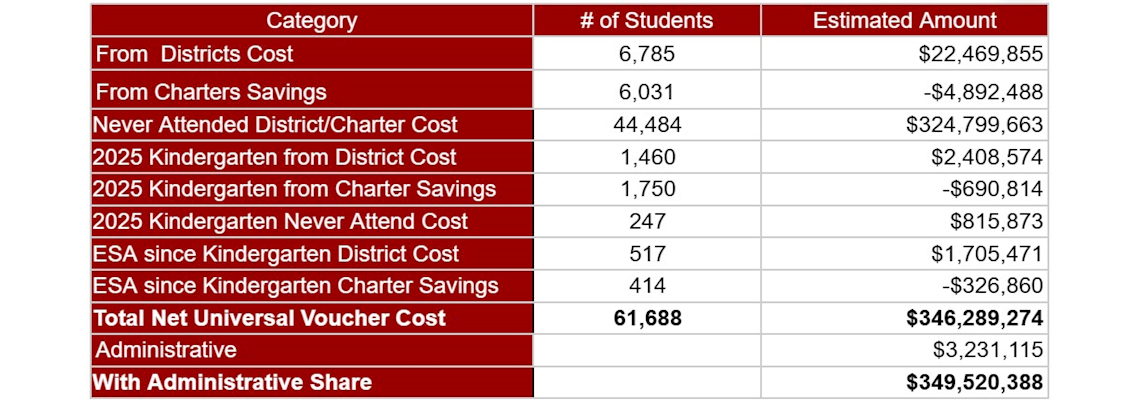
Governor Ron DeSantis has done everything possible to destroy education in Florida. He apparently hates public schools. He pushed through an expansion of vouchers that provides a subsidy to every student in the state, no matter if the family is rich or poor. Of course, most of those using the voucher never attended public schools. Most vouchers go to students in religious schools. Florida currently spends $4 billion annually on vouchers, a sum sure to increase.

Bad as public K-12 education is, the state’s public higher education system is in worse shape. DeSantis has placed political cronies in charge of every state university. He took charge of tiny New College (700 students) because he was offended that Florida had one progressive institution of higher education where students were encouraged not to conform. DeSantis replaced the board with conservatives who put a political extremist in President. What was once a haven for free-thinking students was transformed into a school for jocks and business majors.

The editorial board of the Sun-Sentinel summarized DeSantis’s record of using higher education as patronage for political cronies:

When Gov. Ron DeSantis won his landslide re-election in 2022, a half-fawning and half-fearful Florida Legislature gave him whatever he wanted.

The Harvard graduate could have used that power to burnish Florida’s celebrated universities. He could have chosen the best and brightest to lead schools already among the nation’s best. He could have been the education governor.

That — not a bellyflopping bid for the White House — could have cemented his legacy.

Instead, DeSantis has earned a doctorate in cronyism. He’ll be remembered as the governor who did everything in his power to erode higher education and independent thought. He puts politics above merit and qualifications, with sham “searches” and secret deals.

College and university campuses are now soft-landing patronage pads for Republican allies, at sky-high salaries.

Former House Speaker Richard Corcoran was installed as president of New College in Sarasota. Another politician, former House Majority Leader Adam Hasner, was handed the FAU presidency. A run-of-the-mill former legislator, Fred Hawkins, won the presidency of a state college in Avon Park despite lacking academic qualifications.

Former Lt. Gov. Jeanette Nuñez is now president of Florida International University. Former U.S. Sen. Ben Sasse of Nebraska was given the prestigious UF presidency, then flamed out amid reports of over-the-top spending.

It’s no surprise, then, that Education Commissioner Manny Diaz, a former Republican legislator from Hialeah who oversees state colleges and K-12 education, will slide into the presidency of the University of West Florida in Pensacola.

For DeSantis and Diaz, no university is too big and no kindergarten picture book is too small to escape being recast in the governor’s philosophy.

Step 1: Stack the board

First, DeSantis stacked UWF’s board of trustees. Then, newly appointed trustee Zach Smith quickly made clear that UWF president Martha Saunders was unwelcome.

Smith, a Heritage Foundation fellow, had to reach back to six years ago to find even a speck of mud to throw: Two student-organized drag shows in 2019; social media messaging about a Black Lives Matter co-founder and a book, “How to be an Antiracist,” once recommended by university librarians.

It’s true that best-seller is full of provocative opinions. But so is Smith’s book, “Rogue Prosecutors,” which pushes dark conspiracies about prosecutors corrupted by a wealthy Jew.

That did not stop his nomination to the UWF board by DeSantis, who only last year declared war on campus antisemitism amid great fanfare.

The widely popular Saunders saw the writing on the wall, and she resigned.

A farcical scene

That board meeting was an ambush, said trustee Alonzie Scott. The next one was a farce.

Without a job posting or a search, Diaz’s name alone surfaced as a replacement. Just as quickly, a special meeting was called by UWF trustees. There would be no search for a temporary president and no effort to pick an interim leader from the university.

There was only a perfunctory vote to install Diaz. Then, farce upon farce, the board voted with a straight face to begin looking for a permanent replacement for Diaz.

Barring a political earthquake, that will be Diaz. As former Pensacola mayor and UWF alum Jerry Maygarden said at the meeting, what serious candidate would apply for a job that smacks of a done deal?

Even Diaz’s roots defy all logic.

UWF’s strength is its strong community support among residents and businesses, including Republican leaders. Diaz’s Miami-Dade home is a 10-hour drive, 700 miles and culturally worlds apart from Escambia County in “Lower Alabama.”

None of this is about rescuing students who feel intimidated and indoctrinated.

After all, a state-mandated 2022 Intellectual Freedom and Viewpoint Diversity report found that a majority of UWF students surveyed felt the school provided them the freedom to express their own opinions. Half said they had no idea if their professors were liberal or conservative.

New College 2.0

Never mind. In April, DeSantis told UWF to “buckle up,” announcing he would do for them what he did for New College.

It’s hard to see the success story in New College since the governor declared war on it. DeSantis’ hostile takeover of the tiny liberal arts college has devolved into a money pit: The state’s cost for each New College student shot to more than $90,000. Other state universities average roughly $8,000.

Last month, New College and the University of South Florida were found to be secretly working on a deal to “transfer” USF’s Sarasota-Manatee campus to New College. It’s dead for the moment. Community leaders, kept in the dark as usual, demand answers.

Meanwhile, USF has become the latest fertile field for DeSantis to reward his friends. USF’s president said she will resign, creating yet another job opportunity for a like-minded crony.

The Sun Sentinel Editorial Board consists of Opinion Editor Steve Bousquet, Deputy Opinion Editor Dan Sweeney, editorial writers Pat Beall and Martin Dyckman, and Executive Editor Gretchen Day-Bryant. To contact us, email at letters@sun-sentinel.com.

Secretary of Education Linda McMahon released her budget proposal for next year, and it’s as bad as expected.

Carol Burris, executive director of the Network for Public Education, reviewed the budget and concluded that it shows a reckless disregard for the neediest students and schools and outright hostility towards students who want to go to college.

We know that Trump “loves the uneducated.” Secretary McMahon wants more of them.

Burris sent out the following alert:

Image

Linda McMahon, handpicked by Donald Trump to lead the U.S. Department of Education, has just released the most brutal, calculated, and destructive education budget in the Department’s history.

She proposes eliminating $8.5 billion in Congressionally funded programs—28 in total—abolishing 10 outright and shoving the other 18 into a $2 billion block grant. That’s $4.5 billion less than those 18 programs received last year.

Tell Congress: Stop McMahon From Destroying Our Public Schools

And it gets worse: States are banned from using the block grant to support the following programs funded by Congress:

  • Aid for migrant children whose families move frequently for agricultural work
  • English Language Acquisition grants for emerging English learners
  • Community schools offering wraparound services
  • Grants to improve teacher effectiveness and leadership
  • Innovation and research for school improvement
  • Comprehensive Centers, including those serving students with disabilities
  • Technical assistance for desegregation
  • The Ready to Learn program for young children

These aren’t just budget cuts—they’re targeted strikes

McMahon justifies cutting support for migrant children by falsely claiming the program “encourages ineligible non-citizens to access taxpayer dollars.” That is a lie. Most migrant farmworkers are U.S. citizens or have H-2A visas. They feed this nation with their backbreaking labor.

The attack continues for opportunity for higher education:

  • Pell Grants are slashed by $1,400 on average; the maximum grant drops from $7,395 to $5,710
  • Federal Work-Study loses $1 billion—an 80% cut
  • TRIO programs, which support college-readiness and support for low-income students, veterans, and students with disabilities, are eliminated
  • Campus child care programs for student-parents are defunded

In all, $1.67 billion in student college assistance is gone—wiped out on top of individual Pell grant cuts. 

Send your letter now

And yet, McMahon increased funding for the federal Charter Schools Program to half a billion dollars for a sector that saw an increase of only eleven schools last year. Meanwhile, her allies in Congress are pushing a $5 billion private school and homeschool voucher scheme through the so-called Educational Choice for Children Act (ECCA).

And despite reducing Department staff by 50%, she only cuts the personnel budget by 10%.

This is not budgeting. It is a war on public education.

This is a blueprint for privatization, cruelty, and the systematic dismantling of opportunity for America’s children.

We cannot let it stand.

Raise your voice. Share this letter: https://networkforpubliceducation.org/tell-congress-dont-let-linda-mcmahon-slash-funding-for-children-college-students-and-veterans-to-fund-school-choice/  Call Congress.

Let Congress know that will not sit silently while they dismantle our children’s future.

Thank you for all you do,

Carol Burris

Network for Public Education Executive Director

Peter Greene nails one of the many flaws of school choice. The choice movement hurtles forward despite its record of failure to fulfill any of its promises but one: It provides choice. Not necessarily good choice or better choice. Just choice.

Greene writes:

When researcher Josh Cowen is talking about the negative effects of school vouchers on education, he often points at “subprime” private schools— schools opened in strip malls or church basements or some other piece of cheap real estate and operated by people who are either fraudsters or incompetents or both.

This is a feature, not a bug. Because as much as choice advocates tout the awesomeness of competition, the taxpayer-funded free market choice system that we’ve been saddled with has built in perverse incentives that guarantee competition will be focused on the wrong things.

The free market does not foster superior quality; the free market fosters superior marketing. Now, the marketing can be based on superior quality, but sometimes it’s just easier to go another way.

The thing about voucher schools is that quality is not what makes them money. What makes them money is signing people up.

That’s it. Voucher school operators don’t have to run a good school; they just have to sell the seats. Once the student is signed up and their voucher dollars are in the bank, the important part of the transaction is over. There is no incentive for the school to spend a pile of money on doing a good job; all the incentive is for the school to come up with a good marketing plan.

Betsy DeVos liked to compare the free market for schools with a row of food trucks, which was wrong for a host of reasons, but one was the market speed. Buy lunch at a food truck, and you become part of the marketing very quickly. Within minutes, you are either a satisfied customer telling your friends to eat there, or warning everyone to stay away. Reputations are built quickly.

But for schools, the creation of a reputation for quality takes a long time, time measured in years. The most stable part of the voucher school market is schools that already have their reputation in place from years of operation. But if you are a start-up, you need to get that money for those seats right now. If you are a struggling crappy private school with a not-so-great reputation, you don’t have time to turn that around; you’ve got to up your marketing game right now.

So the focus (and investment) goes toward marketing and enrollment.

Won’t your poor performance catch up with you? Maybe, but the market turns over yearly, as students age out and age in to school. And you don’t have to capture much of it. If you are in an urban center with 100,000 students and your school just needs to fill 100 seats, disgruntled former families won’t hurt you much– just get out there and pitch to the other 99,900 students. And if you do go under, well, you made a nice chunk of money for a few years, and now you can move on to your next grift.

This is also why the “better” private schools remain unavailable to most families holding a voucher. If a reputation for quality is your main selling point, you can’t afford to let in students who might hurt that record of success.

Meanwhile, talk to teachers at some of the less-glowing private and charter schools about the amount of pressure they get to make the student numbers look good.

Because of the way incentives are structured, the business of a voucher school is not education. The business of the voucher school is to sell seats, and the education side of the business exists only to help sell seats. Our version of a free market system guarantees that the schools will operate backwards, an enrollment sales business with classrooms set up with a primary purpose of supporting the sales department, instead of vice versa.

Charter schools? The same problem, but add one other source of revenue– government grants. Under Trump, the feds will offer up a half a billion dollars to anyone who wants to get into the charter biz, and we already know that historically one dollar out of every four will go to fraud or waste, including charter businesses that will collect a ton of taxpayer money and never even open.

“Yeah, well,” say the haters. “Isn’t that also true for public schools”

No, it is not. Here’s why. Public schools are not businesses. They are service providers, not commodity vendors. Like the post office, like health care in civilized countries, like snow plows, like (once upon a time) journalism, their job is to provide a necessary service to the citizens of this country. Their job should be not to compete, but to serve, for the reasons laid out here.

And this week-ass excuse for accountability– if you do a bad enough job, maybe it will make it harder for your marketing department– has been sold as the only accountability that school choice needs.

School choice, because its perverse incentives favor selling seats over educating students, is ripe for enshittification, Cory Doctorow’s name for the process by which operators make products deliberately worse in order to make them more profitable. The “product” doesn’t have to be good– just good enough not to mess up the sales. And with no meaningful oversight to determine where the “good enough” line should be drawn, subprime voucher and charter schools are free to see just how close to the bottom they can get. It is far too easy to transform into a backwards business, which is why it should not be a business at all.

If your foundational belief is that nobody ever does anything unless they can profit from it (and therefor everything must be run “like a business”) then we are in “I don’t know how to explain that you should care about other people” territory, and I’m not sure what to tell you. What is the incentive to work in a public education system? That’s a whole other post, but I would point to Daniel Pink’s theory of motivation– autonomy, mastery and purpose. Particular a purpose that is one centered on making life better for young human beings and a country better for being filled with educated humans. I am sure there are people following that motivation in the school choice world, but they are trapped in a model that is inhospitable to such thinking.

On May 10, Dana Goldstein wrote a long article in The New York Times about how education disappeared as a national or federal issue. Why, she wondered, did the two major parties ignore education in the 2024 campaign? Kamala Harris supported public schools and welcomed the support of the two big teachers’ unions, but she did not offer a flashy new program to raise test scores. Trump campaigned on a promise to privatize public funding, promote vouchers, charter schools, religious schools, home schooling–anything but public schools, which he regularly attacked as dens of iniquity, indoctrination, and DEI.

Goldstein is the best education writer at The Times, and her reflections are worth considering.

She started:

What happened to learning as a national priority?

For decades, both Republicans and Democrats strove to be seen as champions of student achievement. Politicians believed pushing for stronger reading and math skills wasn’t just a responsibility, it was potentially a winning electoral strategy.

At the moment, though, it seems as though neither party, nor even a single major political figure, is vying to claim that mantle.

President Trump has been fixated in his second term on imposing ideological obedience on schools.

On the campaign trail, he vowed to “liberate our children from the Marxist lunatics and perverts who have infested our educational system.”Since taking office, he has pursued this goal with startling energy — assaulting higher education while adopting a strategy of neglect toward the federal government’s traditional role in primary and secondary schools. He has canceled federal exams that measure student progress, and ended efforts to share knowledge with schools about which teaching strategies lead to the best results. A spokeswoman for the administration said that low test scores justify cuts in federal spending. “What we are doing right now with education is clearly not working,” she said.

Mr. Trump has begun a bevy of investigations into how schools handle race and transgender issues, and has demanded that the curriculum be “patriotic” — a priority he does not have the power to enact, since curriculum is set by states and school districts.

Actually, federal law explicitly forbids any federal official from attempting to influence the curriculum or textbooks in schools.

Education lawyer Dan Gordon wrote about the multiple laws that prevent any federal official from trying to dictate, supervise, control or interfere with curriculum. There is no sterner prohibition in federal law than the one that keeps federal officials from trying to dictate what schools teach.

Of course, Trump never worries about the limits imposed by laws. He does what he wants and leaves the courts to decide whether he went too far.

Goldstein continued:

Democrats, for their part, often find themselves standing up for a status quo that seems to satisfy no one. Governors and congressional leaders are defending the Department of Education as Mr. Trump has threatened to abolish it. Liberal groups are suing to block funding cuts. When Kamala Harris was running for president last year, she spoke about student loan forgiveness and resisting right-wing book bans. But none of that amounts to an agenda on learning, either.

All of this is true despite the fact that reading scores are the lowest they have been in decades, after a pandemic that devastated children by shuttering their schools and sending them deeper and deeper into the realm of screens and social media. And it is no wonder Americans are increasingly cynical about higher education. Forty percent of students who start college do not graduate, often leaving with debt and few concrete skills.

“Right now, there are no education goals for the country,” said Arne Duncan, who served as President Barack Obama’s first secretary of education after running Chicago’s public school system. “There are no metrics to measure goals, there are no strategies to achieve those goals and there is no public transparency.”

I have been writing about federal education policy for almost fifty years. There are things we have learned since Congress passed the Elementary and Secondary Education Act in 1965. That law was part of President Lyndon B. Johnson’s agenda. Its purpose was to send federal funds to the schools enrolling the poorest students. Its purpose was not to raise test scores but to provide greater equity of resources.

Over time, the federal government took on an assertive role in defending the rights of students to an education: students with disabilities; students who did not speak English; and students attending illegally segregated schools.

In 1983, a commission appointed by President Reagan’s Secretary of Education Terrell Bell declared that American schools were in crisis because of low academic standards. Many states began implementing state tests and raising standards for promotion and graduation.

President George H.W. Bush convened a meeting of the nation’s governors, and they endorsed an ambitious set of “national goals” for the year 2000. E.g., the U.S. will be first in the world by the year 2000; all children will start school ready to learn by 2000. None of the goals–other than the rise of the high school graduation rate to 90%–was met.

The Clinton administration endorsed the national goals and passed legislation (“Goals 2000”) to encourages states to create their own standards and tests. President Clinton made clear, however, that he hoped for national standards and tests.

President George W. Bush came to office with a far-reaching, unprecedented plan called “No Child Left Behind” to reform education by a heavy emphasis on annual testing of reading and math. He claimed that because of his test-based policy, there had been a “Texas Miracle,” which could be replicated on a national scale. NCLB set unreachable goals, saying that every school would have 100% of their students reach proficiency by the year 2014. And if they were not on track to meet that impossible goals, the schools would face increasingly harsh punishments.

In no nation in the world have 100% of all students ever reached proficiency.

Scores rose, as did test-prep. Many untested subjects lost time in the curriculum or disappeared. Reading and math were tested every year from grades 3-8, as the law prescribed. What didn’t matter were science, history, civics, the arts, even recess.

Some schools were sanctioned or even closed for falling behind. Schools were dominated by the all-important reading and math tests. Some districts cheated. Some superintendents were jailed.

In 2001, there were scholars who warned that the “Texas Miracle” was a hoax. Congress didn’t listen. In time the nation learned that there was no Texas Miracle, never had been. But Congress clung to NCLB because they had no other ideas.

When Obama took office in 2009, educators hoped for relief from the annual testing mandates but they were soon disappointed. Obama chose Arne Duncan, who had led the Chicago schools but had never been a teacher. Duncan worked with consultants from the Gates and Broad Foundations and created a national competition for the states called Race to the Top. Duncan had a pot of $5 billion that Congress had given him for education reform.

Race to the Top offered big rewards to states that applied and won. To be eligible, states had to authorize the creation of charter schools (almost every state did); they had to agree to adopt common national standards (that meant the Common Core standards, funded wholly by the Gates Foundation and not yet completed); sign up for one of two federally funded standardized tests (PARCC or Smarter Balanced) ; and agree to evaluate their teachers by the test scores of their students. Eighteen states won huge rewards. There were other conditions but these were the most consequential.

Tennessee won $500 million. It is hard to see what, if anything, is better in Tennessee because of that audacious prize. The state put $100 million into an “Achievement School District,” which gathered the state’s lowest performing schools into a new district and turned them into charters. Chris Barbic, leader of the YES Prep charter chain in Houston was hired to run it. He pledged that within five years, the lowest-performing schools in the state would rank among the top 20% in the state. None of them did. The ASD was ultimately closed down.

Duncan had a great fondness for charter schools because they were the latest thing in Chicago; while superintendent, he had launched a program he called Renaissance 2010, in which he pledged to close 80 public schools and open 100 charter schools. Duncan viewed charters as miraculous. Ultimately Chicago’s charter sector produced numerous scandals but no miracles.

I have written a lot about Race to the Top over the years. It was layered on top of Bush’s NCLB, but it was even more punitive. It targeted teachers and blamed them if students got low scores. Its requirement that states evaluate teachers by student test scores was a dismal failure. The American Statistical Association warned against it from the outset, pointing out that students’ home life affected test scores more than their teachers.

Duncan’s Renaissance 2010 failed. It destroyed communities. Its strategy of closing neighborhood schools and dispersing students encountered growing resistance. The first schools that Duncan launched as his exemplars were eventually closed. In 2021, the Chicago Board of Education voted unanimously to end its largest “school turnaround” program, managed by a private group, and return its 31 campuses to district control. Duncan’s fervent belief in “turnaround” schools was derided as a historical relic.

Race to the Top failed. The proliferation of charter schools, aided by a hefty federal subsidy, drained students and resources from public schools. Charter schools close their doors at a rapid pace: 26% are gone in their first five years; 39% in their first ten years. In addition, due to lax accountability, charters have demonstrated egregious examples of waste, fraud, and abuse.

The Common Core was supposed to lift test scores and reduce achievement gaps, but it did neither. Conservative commentator Mike Petrilli referred to 2007-2017 as “the lost decade.” Scores stagnated and achievement gaps barely budged.

So what have we learned?

This is what I have learned: politicians are not good at telling educators how to teach. The Department of Education (which barely exists as of now) is not made up of educators. It was not in a position to lead school reform. Nor is the Secretary of Education. Nor is the President. Would you want the State legislature or Congress telling surgeons how to do their job?

The most important thing that the national government can do is to ensure that schools have the funding they need to pay their staff, reduce class sizes, and update their facilities.

The federal government should have a robust program of data collection, so we have accurate information about students, teachers, and schools.

The federal government should not replicate its past failures.

What Congress can do very effectively is to ensure that the nation’s schools have the resources they need; that children have access to nutrition and medical care; and that pregnant women get prenatal care so that their babies are born healthy.

Jennifer Berkshire has both good news and bad news about vouchers. The idea of public funding for religious and private schools had some big wins this year, especially in Texas. But most vouchers are subsidizing kids who never attended public schools; that’s a feature, not a bug as it creates strong support for the giveaway among the highest-income people. But, lo! The real cost of have the state pay for everyone’s tuition is beginning to get the attention of taxpayers. And that could cause a backlash against welfare for the wealthy. Florida is already paying $4 billion a year for vouchers. Will taxpayers object?

She writes:

Champagne corks, storm clouds—I’m mixing my metaphors here. But as we survey the steaming wreckage of the 2025 state legislative sessions, both are present in spades. Let’s start with the popping corks: the school voucher movement really did notch some big wins this year, adding Tennessee, South Carolina, Idaho and the biggest prize of all, Texas, to the list of states with “education freedom.” Now add in the sneaky move to slip a voucher program that is really a tax shelter for the wealthy into the tax code and it’s easy to feel despondent, and not just about the future of public education. 

Listen in on the debates that played out in these states, though, and you’ll come away with a very different view. As the economy sours and the tide of red ink rises, alarm bells are sounding and a backlash is brewing.

Let’s start with a quick trip to my neighboring state, New Hampshire, where a familiar series of events has transpired. Now, in the Granite State, vouchers are known as Education Freedom Accounts, and they were sold to notoriously thrifty Yankees as a way to save money as students abandoned “government schools” for less expensive private religious schools, home schools, microschools. But nothing of the sort happened, leaving taxpayers to foot the bill for thousands of students who’d never attended public schools. Meanwhile, New Hampshire’s revenue situation has been deteriorating rapidly thanks to yet another round of slashing taxes on businesses. 

All of which adds up to some pretty bleak math as the state must now figure out how to pay for an expensive—and expanding—school voucher program even as New Hampshire’s budget pie keeps shrinking. Which is how GOP lawmakers seem to have landed on the worst of both worlds: an austerity budget that slashes funding for the state’s public higher education budget in order to pay for the cost of further undermining the state’s public education system. (If you’re wondering why this recipe sounds familiar, you’re thinking of Indiana, star of a recent episode of Have You Heard, and a cautionary tale about what happens when a state expands school choice while simultaneously cutting school funding and divesting from public higher education.)

Different state, same story

While the libertarian paradise known as New Hampshire may be unique, the dynamic playing out here is the same as in virtually every state that has now adopted school vouchers. 1) Ever-shifting goal posts regarding the purpose of these programs? Check. 2) Ballooning voucher costs as states now pick up the tab for students already attending private schools? Check. 3) Deep tax cuts on the wealthy and corporations, meaning less revenue to spend on public education and other social programs? Check. 

Consider Louisiana, which last year enacted the so-called LA GATOR program—short for Giving All True Opportunity to Rise. Now if you know anything about the recent history of school vouchers in Lousiana (spoiler: not good!), this is the time for a chuckle of the bitterest variety. What IS rising rapidly is the program’s cost—nearly $100 million in its second year, estimated to reach as much as $520 million as the program scales up. But when Governor Jeff Landry tried to collect the cash from lawmakers, something interesting happened. They said no, or at least, not so much. 

“I was not remotely expecting that,” [Senate President Cameron] Henry said about Landry seeking an extra $50 million for the program. “Somehow there was a misunderstanding, which we will rectify.” Despite Landry’s request, Henry said he will hold firm to spending roughly the same amount as vouchers cost this school year: $43.5 million “It will be no more” than that, he said, “because that was the original agreement.”

And it wasn’t just Louisiana. Over in Missouri, lawmakers axed their governor’s request for $50 million to scale up the voucher program known as MoScholars. The GOP senator behind the move offered a simple explanation. “I want to make sure that we’re fully funding our obligation to public schools before we start spending 10s of millions of general revenue dollars on private schools.”

If you’re wondering what’s going on, the answer is fairly simple. As voucher programs have ballooned in size and cost, they’ve become a bigger target, especially in states where they’re now hoovering up state funding at the expense of the public schools—which are still attended by most children in every state. And years of tax slashing in these same states is exacerbating what we might call the ‘pie’ problem. Factor in the worsening national economic forecast and things look even more dire. Texas, which is now on the hook for $1 billion a year to pay for vouchers, plummeting oil prices due to Trump’s tariffs is likely to lead to a recession as soon as this summer. 

Theory of change

As regular readers of this newsletter know, I’m an avid reader of conservative treatises. As I type, I’m surrounded by anti-public-education screeds by Pete Hegseth, Kevin Roberts, Betsy DeVos, and Corey DeAngelis. It’s the last one, Parent Revolution: Rescuing Your Kids from the Radicals Ruining Our Schools, that has proven to be a particularly useful guide to our times. How, for example, did school choice for the very wealthy become the civil rights cause of our times? Dr. DeAngelis explains:

“Allowing politically advantaged groups to benefit from the program is also a smart way to keep the policy protected for years to come.”

You see, there’s a theory here: that as monies grow scarce and one state after another devolves into a pitched battle over what’s left, the richest and most connected will fight the hardest to keep what’s theirs. For a preview of what this looks like, I recommend a pitstop in West Virginia, where lawmakers just wrapped up another session by shoveling money at tax cuts for the wealthy and school vouchers, while cutting programs that help people get clean water, find work after struggling with addiction and get child care. Oh well…

But for the theory of change to work, people have to want to live in a West Virginia-like reality, and I’m not at all convinced that that’s the case. Don’t believe me? Let’s head to Florida, which school choice proponents like to point to as a model for the rest of our states, and which now spends $4 billion a year on vouchers. Since the state made the program available to even the wealthiest Floridians, surprise, surprise, they’ve leaped at the opportunity to have tax payers pay their children’s private school tuition:

More than 122,000 new students started using vouchers for the first time in the 2023-24 school year, and nearly 70 percent were already in private school, many in some of Florida’s priciest institutions.

But Florida is also an example of the bad math, and shoddy assumptions, that drive the push for school privatization. As public education advocate and blogger extraordinaire Sue Woltanski has been tirelessly documenting, vouchers are indeed succeeding in defunding Florida’s public schools:

This isn’t because the money follows public school students fleeing to private options, but because, when families, whose children are ALREADY in private schools, are offered a tax-funded discount for their private school tuition, they flock to apply, and private schools encourage it.

As Sue keeps pointing out, the big flaw in the school choice lobby’s theory is that Florida’s public schools aren’t going away. A state that used to brag about how little it spent on its students is now funding two parallel education systems: “one for the nearly 3 million students still enrolled in public schools, and another for the hundreds of thousands already in private or home education, all out of the same funding formula.”

So what gives? The GOP’s solution is to slash funding for popular programs in public schools: AP, IB, CTE. When I asked a reader in Florida what he thought was motivating the lawmakers, he saw a longer-term conspiracy at work. Get rid of programs that parents care about and eventually they’ll abandon their local public schools. But that assumes that these parents are powerless and that lawmakers can eviscerate programs and institutions that matter to them without paying a price. I’m not so sure. 

A few weeks ago I had the pleasure of visiting Sarasota to speak to a group called Support Our Schools. SOS is a phenomenal advocacy group, and in partnership with a youth-led group that’s “organizing school boards to fight fascism, protect democracy, and build power from the ground up,” they’re having a real impact in a community that’s been ground zero for the right-wing takeover of public education. I headed south anticipating that my hosts would be despondent over the state of Florida and the nation, but what I found was the opposite. These local activists were energized, convinced that their cause—defending and strengthening public education—is finally breaking through. In their words, the situation for Florida public schools is now so dire that it’s impossible to ignore. 

Throughout my visit, one theme echoed repeatedly. A backlash is coming. It can’t come soon enough.

www.instagram.com/reel/DJkOywKPU2u/

Josh Cowen of Michigan State University read the latest GOP tax bill closely. He explains what it contains for schools. It’s a plan to set up tax havens in every state for the wealthiest Americans. It forces vouchers for religious and private schools into every state, even states that don’t want them. It allows every voucher school to determine its own admissions policy.

It enables discrimination. It enriches those who are already rich.

It is a spike in the heart of public schools, which admit everyone and bring people from different backgrounds together.

Cowen is the author of the recently published book about vouchers, called THE PRIVATEERS: HOW BILLIONAIRES CREATED A CULTURE WAR AND SOLD SCHOOL VOUCHERS.

Project 2025’s section on education proposes that the U.S. Department of Education’s largest funding streams for K-12 schools be turned into block grants to the states with minimal oversight. The two big programs are Title 1 for poor kids and the funding for students with disabilities (IDEA).

The states would be free to convert these funds into vouchers, instead of spending them on low-income students or students with disabilities.

The National Education Association explains here:

Block Grant Overview

Typically, the deal between the federal government and states when specific program funds are block-granted is that the federal government will provide less funding in return for less regulation and requirements. With less regulation, the assumption is that states should be able to do as much or more with less money. While it may be appealing initially to those who administer federal grants at the state and local level, in reality, fewer dollars mean fewer programs and services. States and school districts may have more flexibility in using federal funds but it comes at the expense of the students the federal grant program was designed to help in the first place.

 Many states already underfund their commitment to public education. If states and districts don’t cover the shortfall, students receiving Title I and IDEA services will suffer. Furthermore, both Title I and IDEA have maintenance of effort and supplement, not supplant requirements to ensure states and districts hold up their levels of spending when receiving federal funds. Those requirements will fall away, too, and, most likely, so will the funding commitments by states and districts.

Title I of the ESEA and IDEA were created to ensure all students have equal access to an education, regardless of family income or disability. Many states were failing to adequately educate students in these populations, if at all. The federal role here was clear: where a student lived or their circumstances should not determine the quality of their education. ESEA and IDEA enshrined this principle and attached specific conditions and requirements that states must follow, in return for federal financial assistance, to ensure that students from lower-income families and communities and those with disabilities have the same opportunity to learn as any other student. “No-strings-attached” block grant funding turns the clock back 60 years on education policy and progress, and turns its back on our nation’s commitment to educating all students. While one would like to think that we can trust states to do the right thing on behalf of all students, history tells us differently. 

Providing states with federal aid and fewer requirements leaves the door open for states to do as they wish. Title I of ESEA and IDEA include important requirements and protections for students and families precisely because they were lacking previously. At its core, the Department of Education is a civil rights agency, providing dollars, regulations, requirements, guidance, technical assistance, research, monitoring, and compliance enforcement to preserve and protect students’ access to a free and appropriate education. Strip it away, and you strip away the rights of certain students to a meaningful education.  


The National Education Association analyzed Trump ‘s proposed budget and finds that it contains deep cuts and massive support for privatization by promoting vouchers and charter schools. The proposal mirrors Project 2025 by turning Titl 1 for low-income students and IDEA funding into block grants that can be converted to vouchers. The overall goal is to undermine public schools and cut funding.

FY2026 Budget Request Slashes Education Funding, Shortchanges Students

…………………………………………………………………….……….

President Trump’s FY2026 “skinny” budget request to Congress, released on May 2, cuts non-defense domestic spending by 22.6%.  The Department of Education sustains a $12 billion reduction, a cut of approximately 15.3%. 

! Since the President’s budget does not list specific funding requests for every federal program, the 46-page document is a “skinny” budget. Congress ultimately has the power of the purse, but the proposal is a clear signal of the White House’s priorities: a massive 24 percent cut to U.S. domestic spending, and, privitazing our nation’s public education system.  


 The narrative says the budget “maintains full funding for Title I,” but the numbers tell a different story. Title I and 18 unidentified programs are combined to create a single block grant, dubbed the “K-12 Simplified Funding Program,” then that block fund is cut by $4.535 billion cut.


 All seven Individuals with Disabilities Education Act (IDEA) programs are combined to create a single block grant called the “Special Education Simplified Funding Program.” The approach perpetuates the current shortfall—the federal government now covers 13% of special education costs, far short of the 40% Congress promised when the law was passed. 


 Programs slated for elimination include English Language Acquisition (Title III) and the Teacher Quality Partnership, which addresses the teacher shortage through deep clinical practice. 


 The budget shifts costs to states and institutions of higher education to reduce the federal investment in today’s students—our nation’s future leaders and workforce—as much as possible.  


 Regrouping specific, separate programs into block grants, in theory gives states more flexibility on how the money is spent. In reality, block grants usually lead to less funding and less accountability for our most vulnerable students. As the strings attached to the funding are cut, many states could maneuver block grant funds over to private school voucher programs. 


 Amidst these cuts, the proposal calls for investing $500 million, an increase of $60 million, to expand the number of charter schools across the country. Charter schools, along with private school vouchers, drain scarce resources for traditional public schools. 


May 2025

You know the Bad MAGA, the one that wants to drag us back a century.

There is also a good MAGA: Mothers Against Greg Abbott.

It’s led by Nancy Thompson, who spends her time trying to help others, unlike the other MAGA.

My leading nominee for silliest bill of the year is this one: “Rep. Stan Gerdes filed HB 54, a bill that aims to ban non-human behaviors in Texas public schools.” This is an adult man who took seriously the absurd claim that some children asked for litter boxes because they identify as cats. That’s a wack-a-doo rumor, not a reality. Why not legislate about the best way to respond to men in flying saucers if they should land and disembark in Texas?

This her latest report on the Republican-dominated legislature in Texas, which does nothing to help others:
 

TX LEGE BREAKDOWN

📚 Education Legislation 📚

  • On April 24th, the Texas Senate voted to redirect $1 billion in taxpayer funds to their favored private schools in passing Greg Abbott’s school voucher bill. We (and tens of thousands of folks across Texas) organized hard to stop it, but a final phone call from Donald Trump sealed the deal. This scam on the taxpayers, I mean voucher bill, has just been signed into law by Abbott.
  • While voucher programs and charter schools are getting our hard-earned pennies, the TX Lege hasn’t passed a single public education funding bill yet this session. This is BS.

🏠 Housing and Water Legislation 🏠

  • HB 32 and its Senate companion, SB 38, would escalate the Texas housing crisis by making evictions faster, easier, and far more common. These are being sold as a fix for “squatters,” but in reality, the bills are Trojan horse policies that would dismantle due process, weaken eviction warnings, and reduce opportunities for legal protections for all renters in Texas.

😵‍💫 Wtf Legislation 😵‍💫

  • The Texas legislature has considered a record number of bills this year that only serve to bully transgender people. On April 23rd, the Senate approved SB 240, the ridiculously named “Texas Women’s Privacy Act,”which requires Texans to use bathrooms and locker rooms that correspond with the gender assigned on their birth certificate — even if they’ve transitioned.
  • The Texas House passed HB 366, a bill that would make it a crime to distribute altered media, including political memes, without a government-approved disclaimer. Violators could face up to a year in jail. WTF?
  • Rep. Stan Gerdes filed HB 54, a bill that aims to ban non-human behaviors in Texas public schools.
  • The Texas Senate passed SB 1870, a bill that would prohibit cities from putting any citizen initiative on local ballots that would decriminalize marijuana.
  • The Texas House is expected to consider House Bill 2436, to exempt law enforcement officers from being charged for “deadly conduct” (killing members of the public) while in the line of duty. The Senate approved a similar bill in early April. This is a dangerous escalation of the power of state violence and a lack of accountability for the harm it causes.
  • The Texas Senate also approved SCR 42, which declares that the state only recognizes two genders. Let’s be clear: trans and intersex people have always existed. This is just more dangerous bullying toward a vulnerable minority from Texas Republicans.

HOW YOU CAN GET INVOLVED

  • Follow us on social media — we’ll be posting live updates, actions you can take to speak out on legislation, and more.

  FOLLOW ON BLUESKY    FOLLOW ON FACEBOOK  

  DONATE  
It’s important to be clear-eyed about the damage Texas Republicans — arm in arm with the Trump Administration — are inflicting on our state. When the consequences come, like underfunded classrooms, law enforcement officers shielded from legal consequences, and discrimination and violence against vulnerable people, we need to be ready to make sure Texans know who to hold accountable – Texas Republicans.

Get ready to use your voice when the time comes.

Nancy Thompson

One of the most determined opponents of vouchers in Texas was the Pastors for Texas Children. While some faith leaders celebrated the opportunity to get public money for their religious schools, the PTC stood firm for separation of church and state. They believe it is the state’s responsibility to provide good public schools, and it is the duty of religious groups to support their own faith.

They know the research. They know that most of the $1 billion in vouchers will be used to subsidize students already enrolled in private schools. They know that many private schools will raise their tuition in response to the state subsidy. They know that the public schools, which serve the vast majority of students, will continue to be underfunded.

PTC sent out the following message:

The Signing of HB 3

An old preacher once said that God’s Justice was figuring out what belongs to whom and giving it to them.

Universal education for ALL children is God’s Justice. A $1 billion voucher subsidy program for children already in private schools— mostly religious schools that use Caesar to support their religion— is not.

Texans know that. They have rejected voucher programs for 30 years.

Gov. Greg Abbott had to rely on a Philadelphia billionaire to give him over $12 million dollars to defeat conservative, rural Republican state representatives who opposed vouchers on deep conviction and moral principle.

We take no pleasure in calling out our governor’s lies and bullying against these decent public servants. God is not mocked by Gov. Abbott’s corruption.

The voucher bill was signed on Saturday. Also on Saturday Texans all over the state overwhelmingly approved public school bond programs and elected pro-public ed trustees as a direct response to Abbott’s voucher scam.

We will have another opportunity to express our will on public education and against the privatization of it:

The 2026 primary and general elections.

DONATE TO PTC

PO Box 471155, Fort Worth, Texas, 76147

***************************************

What Happened After Passage of HB 3.

A statewide rejection of extremism.

In the aftermath of the passage of the voucher bill, voters in several districts responded by ousting hard-line conservative school board members. Texan Michelle H. Davis described the devastating losses of MAGA school board members across the state.

It was a tough night for MAGA-aligned candidates in Texas. In the May 3, 2025, local elections, voters across the state decisively rejected far-right candidates, particularly in school board and city council races. From Tarrant County to Collin County, and from San Antonio to Dallas, communities chose leaders who prioritize public education, inclusivity, and pragmatic governance over culture wars and partisan agendas. This widespread shift signals a growing resistance to extremist politics at the local level. 

Last night, voters across Texas sent a message loud enough to rattle the far-right out of their echo chambers: we’re done with your culture wars, your book bans, and your crusade against public schools. Voters chose community over chaos, educators over agitators, and progress over extremism.

The local elections weren’t just a series of wins but a sweep. MAGA-backed candidates got absolutely trounced across the state. This was the result of deep organizing, years of work by local Democrats, and voters who are fed up with the far-right hijacking of school boards and city councils to push their agenda.

Texas isn’t turning blue overnight, but make no mistake: the MAGA movement had a very bad night, and the momentum is shifting.

Tarrant County. 

The Republican Party poured money, endorsements, and out-of-state personalities into these Tarrant County races, and they got wiped. Every single candidate backed by Patriot Mobile, the far-right Christian nationalist group trying to take over school boards, lost. That’s losses in Mansfield ISD, Keller ISD, and Grapevine-Colleyville ISD. A clean sweep.

The Tarrant County GOP went 0-for-11 in the county’s three largest cities: Fort Worth, Arlington, and Mansfield. Let that sink in. They didn’t just lose a few races. They got shut out entirely. In Mansfield, Republican Rep. David Cook’s backyard, where Allen West himself came out to rally the troops, the GOP lost all five races they backed.

Meanwhile, Democrats made real gains on the Fort Worth City Council. One of the biggest victories was Debrah Peoples’s victory in her race. A longtime activist and former Tarrant County Democratic Party Chair, Peoples gave progressive voters a reason to celebrate in a city that’s often overlooked on the statewide map.

Huge, huge shout out to the Tarrant County Young Democrats. They didn’t just show up, they organized, knocked on doors, made calls, and fought for every single school board seat they were targeting. And guess what? They swept them all. That’s the kind of ground game that wins elections. That’s the kind of energy we need to keep building.

Open the link to continue reading about the pushback in Texas against bookbanning rightwing MAGA culture warriors.