Archives for category: Vouchers

Max Londberg of the Cincinnati Enquirer conducted an investigation of the academic results of vouchers in Ohio. His findings were appalling. The legislature doesn’t care about results or evidence or facts. It wants more vouchers, more students to fall behind their peers in public schools. Meanwhile, the public schools lose funding to pay for the vouchers. The story was originally published in August 2020, and I missed it. Scores of school districts in Ohio are suing to block the expansion of vouchers, which will undermine the quality of their schools.

He begins:

Since 2018, hundreds of millions of taxpayer dollars have been shifted away from Ohio’s public schools and into private, mainly religious ones in the form of vouchers, all to enhance academic success.

Yet those same private schools mostly failed to meet the academic caliber set by their neighboring public school districts, according to a Cincinnati Enquirer analysis of nearly 2.5 million test scores from schools in more than 150 Ohio cities during the 2017-18 and 2018-19 school years.

The analysis found that in 88% of the cities in the analysis, a public district achieved better state testing results than those private schools with an address in the same city. A majority of the eight largest urban districts — including Akron and Canton — were among those that outperformed privates.

So Ohio shifts money from successful public schools to underperforming religious and private schools. This is stupid.

Jill Lepore is a historian at Harvard University and a writer for The New Yorker. In this recent article, she reviews a history of attacks on one of our nation’s most important democratic institutions: our public schools. To read the complete article, subscribe to The New Yorker. It is a wonderful magazine.

She begins:

In 1925, Lela V. Scopes, twenty-eight, was turned down for a job teaching mathematics at a high school in Paducah, Kentucky, her home town. She had taught in the Paducah schools before going to Lexington to finish college at the University of Kentucky. But that summer her younger brother, John T. Scopes, was set to be tried for the crime of teaching evolution in a high-school biology class in Dayton, Tennessee, in violation of state law, and Lela Scopes had refused to denounce either her kin or Charles Darwin. It didn’t matter that evolution doesn’t ordinarily come up in an algebra class. And it didn’t matter that Kentucky’s own anti-evolution law had been defeated. “Miss Scopes loses her post because she is in sympathy with her brother’s stand,” the Times reported.

In the nineteen-twenties, legislatures in twenty states, most of them in the South, considered thirty-seven anti-evolution measures. Kentucky’s bill, proposed in 1922, had been the first. It banned teaching, or countenancing the teaching of, “Darwinism, atheism, agnosticism, or the theory of evolution in so far as it pertains to the origin of man.” The bill failed to pass the House by a single vote. Tennessee’s law, passed in 1925, made it a crime for teachers in publicly funded schools “to teach any theory that denies the story of the Divine Creation of man as taught in the Bible, and to teach instead that man has descended from a lower order of animals.” Scopes challenged the law deliberately, as part of an effort by the A.C.L.U. to bring a test case to court. His trial, billed as the trial of the century, was the first to be broadcast live on the radio. It went out across the country, to a nation, rapt.

A century later, the battle over public education that afflicted the nineteen-twenties has started up again, this time over the teaching of American history. Since 2020, with the murder of George Floyd and the advance of the Black Lives Matter movement, seventeen states have made efforts to expand the teaching of one sort of history, sometimes called anti-racist history, while thirty-six states have made efforts to restrict that very same kind of instruction. In 2020, Connecticut became the first state to require African American and Latino American history. Last year, Maine passed “An Act to Integrate African American Studies into American History Education,” and Illinois added a requirement mandating a unit on Asian American history.

On the blackboard on the other side of the classroom are scrawled what might be called anti-anti-racism measures. Some ban the Times’ 1619 Project, or ethnic studies, or training in diversity, inclusion, and belonging, or the bugbear known as critical race theory. Most, like a bill recently introduced in West Virginia, prohibit “race or sex stereotyping,” “race or sex scapegoating,” and the teaching of “divisive concepts”—for instance, the idea that “the United States is fundamentally racist or sexist,” or that “an individual, by virtue of his or her race or sex, is inherently racist, sexist or oppressive, whether consciously or unconsciously.”

While all this has been happening, I’ve been working on a U.S.-history textbook, so it’s been weird to watch lawmakers try their hands at writing American history, and horrible to see what the ferment is doing to public-school teachers. In Virginia, Governor Glenn Youngkin set up an e-mail tip line “for parents to send us any instances where they feel that their fundamental rights are being violated . . . or where there are inherently divisive practices in their schools.” There and elsewhere, parents are harassing school boards and reporting on teachers, at a time when teachers, who earn too little and are asked to do too much, are already exhausted by battles over remote instruction and mask and vaccine mandates and, not least, by witnessing, without being able to repair, the damage the pandemic has inflicted on their students. Kids carry the burdens of loss, uncertainty, and shaken faith on their narrow shoulders, tucked inside their backpacks. Now, with schools open and masks coming off, teachers are left trying to figure out not only how to care for them but also what to teach, and how to teach it, without losing their jobs owing to complaints filed by parents.

There’s a rock, and a hard place, and then there’s a classroom. Consider the dilemma of teachers in New Mexico. In January, the month before the state’s Public Education Department finalized a new social-studies curriculum that includes a unit on inequality and justice in which students are asked to “explore inequity throughout the history of the United States and its connection to conflict that arises today,” Republican lawmakers proposed a ban on teaching “the idea that social problems are created by racist or patriarchal societal structures and systems.” The law, if passed, would make the state’s own curriculum a crime.

Evolution is a theory of change. But in February—a hundred years, nearly to the day, after the Kentucky legislature debated the nation’s first anti-evolution bill—Republicans in Kentucky introduced a bill that mandates the teaching of twenty-four historical documents, beginning with the 1620 Mayflower Compact and ending with Ronald Reagan’s 1964 speech “A Time for Choosing.” My own account of American history ends with the 2020 insurrection at the Capitol, and “The Hill We Climb,” the poem that Amanda Gorman recited at the 2021 Inauguration. “Let the globe, if nothing else, say this is true: / That even as we grieved, we grew.”

Did we, though? In the nineteen-twenties, the curriculum in question was biology; in the twenty-twenties, it’s history. Both conflicts followed a global pandemic and fights over public education that pitted the rights of parents against the power of the state. It’s not clear who’ll win this time. It’s not even clear who won last time. But the distinction between these two moments is less than it seems: what was once contested as a matter of biology—can people change?—has come to be contested as a matter of history. Still, this fight isn’t really about history. It’s about political power. Conservatives believe they can win midterm elections, and maybe even the Presidency, by whipping up a frenzy about “parents’ rights,” and many are also in it for another long game, a hundred years’ war: the campaign against public education.

Please subscribe and finish reading.
The latest from Michigan, where Betsy DeVos is leading a campaign for vouchers:

FOR IMMEDIATE RELEASE

News from For MI Kids, For Our Schools

***MEDIA ADVISORY***

March 15, 2022

Contact: Sam Inglot, 616-916-0574, sam@progressmichigan.org

New Coalition Forms to Stop DeVos Voucher Proposal

For MI Kids, For Our Schools launches campaign to oppose DeVos voucher effort to take hundreds of millions of dollars away from public schools

MICHIGAN – On Wednesday, March 16 at 1 p.m. EST, a coalition of organizations will announce the launch of the For MI Kids, For Our Schools ballot question committee (For MI Kids, for short) during a Zoom press call. For MI Kids is focused on defeating the DeVos-backed “Let MI Kids Learn” voucher proposal that would rip hundreds of millions of dollars away from public schools across Michigan. 

The coalition that makes up For MI Kids includes: 482Forward, American Federation of Teachers Michigan, K-12 Alliance of Michigan, Michigan Association of School Boards, Michigan Association of Superintendents & Administrators, Michigan Education Association, Michigan Education Justice Coalition, Michigan Parent Teacher Association, and the Middle Cities Education Association.

WHO: For MI Kids, For Our Schools

Casandra Ulbrich, PhD, who serves as the president of the State Board of Education

Andrew Brodie, Superintendent, Flat Rock Community Schools and MASA Board President

Arlyssa Heard, a Detroit schools special education parent, 482Forward education organizer

Twanda Bailey, a retired educator from Detroit with 30 years of teaching experience

Owen Goslin, a Cheboygan schools parent

Rick Catherman, a retired educator from South Haven with 30 years of teaching experience

WHAT: Zoom Press Call

Members of the media are asked to RSVP in advance. Contact sam@progressmichigan.org if you run into any issues.

WHEN: Wednesday, March 16 @ 1 p.m. EST

WHY: For MI Kids, For Our Schools is a ballot committee opposing the Let MI Kids Learn voucher proposal because it would take hundreds of millions of dollars away from public schools, hurting every public school across Michigan during a historic teacher shortage. The coalition is made up of parents, educators, support staff, administrators, and community-minded folks who love our public schools and want to see them improve and thrive so every student can get a great education.

###

The Georgia State Senate decisively rejected voucher legislation, by a vote of 29-20.

The Georgia Senate on Tuesday again rejected private school voucher legislation that would have offered annual subsidies to students who switched from public schools.

Senate Bill 601 failed 20-29 — an even wider margin than the rejection of a similar bill in 2019.

The new bill would have set aside $6,000 per year toward the private education of students who leave public school. The money, which would no longer have gone to the public school, could have been used to offset the student’s private school tuition or pay for associated private or home-school costs, such as fees, tutoring, curriculum, therapy, transportation or a computer.

“This is an opportunity for us to give students that are trapped in school systems that are underperforming an opportunity to move forward,” Senate President Pro Tem Butch Miller, R-Gainesville, said while presenting his bill on the Senate floor.

He introduced it despite House Speaker David Ralston’s announcement last month that he was blocking two similar House voucher bills. The Blue Ridge Republican was angered by a national voucher advocacy group that bombarded conservative voters with political mailers likening Republicans to liberals if they didn’t support the measures.

Georgia currently has a tax credit voucher program. House Republicans wanted to double the funding for this program to $200 million, but the Senate blocked that measure.

Jennifer Berkshire is on a roll. It seems she writes a great article every other day–or is it every day? She has a new article in The Nation about the New Hampshire school board elections. It is titled “How Progressives Won the School Culture War,” but I doubt that the people who won the school board races call themselves “progressives.” I would say they are sane, rational, intelligent citizens who did not want rightwing extremists in charge of their public schools.

She begins:


It wasn’t supposed to turn out this way. For months now, Republican Party leaders have trumpeted their intention to run hard on parent grievances en route to routing the Democrats in the midterms. According to this narrative—partially based on the 2021 elections in Virginia, then endlessly echoed by Democratic pundits—parents frustrated over school shutdowns, Covid restrictions and the focus on race and social justice in schools are the new swing voters, poised to flee the Democratic Party. 

But in New Hampshire, where bitter debates over school masks and “critical race theory” (CRT) have dominated local politics for more than a year, the season of parent rage ended in a stunning sweep of school board elections last week by progressive public school advocates. “It was a complete repudiation of the GOP’s attempt to drive a wedge between parents and schools,” says Zandra Rice Hawkins, executive director of Granite State Progress. Of 30 candidates designated by the group as “pro–public education,” 29 won their races—many in traditionally “red” regions of New Hampshire. Across the state, culture warriors and advocates of school privatization lost to candidates who pledged to protect and support public education.

Instead of resonating with voters, the right’s efforts to weaponize cultural grievances appears to have alienated them. With the GOP poised to make the education culture wars a central focus of its midterm appeal, New Hampshire offers some clear lessons for Democrats.

Michael Boucher chalks up his decision to run for the school board in the southern New Hampshire town of Atkinson to a single word: extremism. Last year, he watched as the debate over local schools grew steadily more rancorous, first over CRT, then masks. Boucher became a regular presence at board meetings, where he noticed that many of the loudest voices weren’t actually from the district. “Suddenly there were all of these groups coming in—the Government Integrity Project, Moms for Liberty, Americans for Prosperity. I realized that if I didn’t step up, one of their people would,” says Boucher.

Boucher, who works as a data analyst for a government contractor, says that he set a goal of talking to as many people in Atkinson as possible about the rising climate of extremism. He found a receptive audience. While the community has long leaned Republican, many voters remain what Boucher calls “classic” GOP. “They want to see tight budgets—but they also want to see opportunities for all kids and a welcoming culture in the schools. There are actually a lot of people who feel that way,” says Boucher. 

He campaigned on the need to teach history honestly against a candidate who ran on opposition to CRT. Boucher won resoundingly, claiming nearly three-quarters of the vote.

And Boucher wasn’t alone. Thirty miles north, in Bow, first-time candidate Angela Brennan, the subject of a Republican mailer calling her “anti-parent” and a “Biden-like progressive,” was the top vote getter in a five-person contest for two seats on the school board.

“All of these attacks on public education really backfired at the local level,” says Molly Cowen, a member of the select board in Exeter, which has also seen acrimonious debates over mask and vaccine mandates and school district diversity policies. In the lead-up to the election, a conservative parents’ PAC spent an estimated $20,000 on mailers making the case that the district’s focus on racial equity had led to a precipitous decline in academic achievement.

Voters in the district, which covers five towns, responded by booting two conservative members off the board and electing a number of pro–public education candidates.

Please open the link and learn how extremism was defeated in New Hampshire.

Andy Spears is the publisher of the Tennessee Education Report. He writes in the current issue of The Progressive about the well-funded effort to privatize education funding in Tennessee. Republican Governor Bill Lee and the legislature are determined to gut local control and to outsource taxpayer dollars to out-of-state organizations to open charter schools. This drive for privatization ignores the abject failure of the Tennessee Educational Achievement Authority, which burned through $100 million without achieving anything.

Spears writes:

If you are wondering what it looks like when school privatizers are close to total victory, Tennessee is a prime example. Here, the forces that want to take public money and hand it over to private entities are on the verge of completing their conquest.

Tennessee’s current legislative session features a range of attacks on public schools. Some of these would have immediate impacts, while others take a longer-term approach to fully privatizing K-12 education in the state.

First, it is important to understand that groups backing privatization in the form of charter schools and vouchers are among the top spenders when it comes to lobbying state legislators. For example, the American Federation for Children—an organization founded and previously led by the family of Betsy DeVos, a school privatization advocate and former President Donald Trump’s Secretary of Education—spent $887,500. Another big spender, the Tennessee Charter School Center, spent $732,500.

Based on this year’s full-frontal assault, these investments appear to be paying off. There are three key issues that currently pose the most significant threat to Tennessee’s public schools. They include: a partnership with Hillsdale College, a private fundamentalist Christian college in Michigan, to run fifty or more charter schools; legislation that would create a charter school real estate grab; and school funding reforms that set the stage for a statewide voucher program.

In his State of the State address, Governor Bill Lee restated his commitment to set aside $32 million to help launch new charters in Tennessee and announced the Hillsdale College partnership, which could bring close to fifty Hillsdale-run charter schools into the state.

Beyond the use of public funds to open schools run by a private, Christian college, there is reason to be concerned about the nature of the Hillsdale curriculum. As educator and blogger Peter Greene explained, “[Hillsdale President Larry] Arnn has been a Trump supporter, and the college has fallen right into MAGAland as well. . . . The college uses Trump mailing lists to raise money. They used to sponsor Rush Limbaugh’s show. They get grads placed on the staff of legislators such as Jim Jordan and Kevin McCarthy.”

Over the past decade, I have consistently referred to charters as part of the privatization movement, a first decisive step towards vouchers. Charter advocates have frequently written to insist that charter schools are “public schools.” They are, because the state law (drafter by charter lobbyists) calls them “public schools.”

But the Tennessee push for charter schools makes clear that they have become a Trojan horse for privatization. Governor Lee is rewriting the school funding formula so “the money follows the child,” a back door path to vouchers, which a state court ruled unconstitutional.

Spears writes:

Potentially millions of dollars worth of real estate assets in local districts across Tennessee could soon be up for grabs at prices below market value. No wonder privatizers tied to the charter industry have spent $8 million lobbying the legislature.

The final element in the push for privatization is being billed as a “reform” of the state’s school funding formula. Governor Lee recently released his plan to revamp how the state directs money to local school districts for public schools. The bottom line, according to Lee, is that the approach is “student-centered” and that funds “follow the child” no matter what. This plan is based on model legislation from the rightwing American Legislative Exchange Council (ALEC).

This statement, first of all, creates the erroneous impression that charter schools operate as “public” schools. Although called public schools under Tennessee law (as in most states), these schools function with less government oversight and an array of private operations, from real estate management to the sourcing of substitute teachers to overall school management.

Lee has been fighting to redirect public money to private schools since before he was elected governor.

Second, the proposed change to school funding is quite simply the gateway to a full-on voucher scheme. As Tennessee teacher Mike Stein wrote on his personal blog, the final form of funding reform is a workaround for a school voucher law that Lee enacted and was ruled unconstitutional.

Can the privatizers be stopped? Will charters pave the way for vouchers? Will Governor Lee succeed in destroying local control of public schools?

Stay tuned.

I’m posting again—this time with the link!

This interview with education journalist Jennifer Berkshire is worth reading. Good questions, sharp answers.

Shockingly, Berkshire predicts that several states will “phase out” public schools, presumably to be replaced by a smorgasbord of choices: charters, vouchers, online schooling, homeschooling, and more.

What do you think?

Tuesday’s school board election in New Hampshire was a triumph for parents and citizens who love their public schools!

This must have shocked Republican Governor Chris Sununu, the Republican-controlled legislature, and State Commissioner Frank Edelblut, who home-schooled his own children and is pushing a sweeping voucher plan for the state.

AfterGlenn Youngkin was elected Governor of Virginia by pandering to parents angry about “critical race theory,” mask mandates, and eager to control what children learned and what books they read, the media bombarded us with stories predicting that Republicans would win next November by running against public schools.

New Hampshire families and citizens said on Election Day, “Not so fast! We love our public schools.”

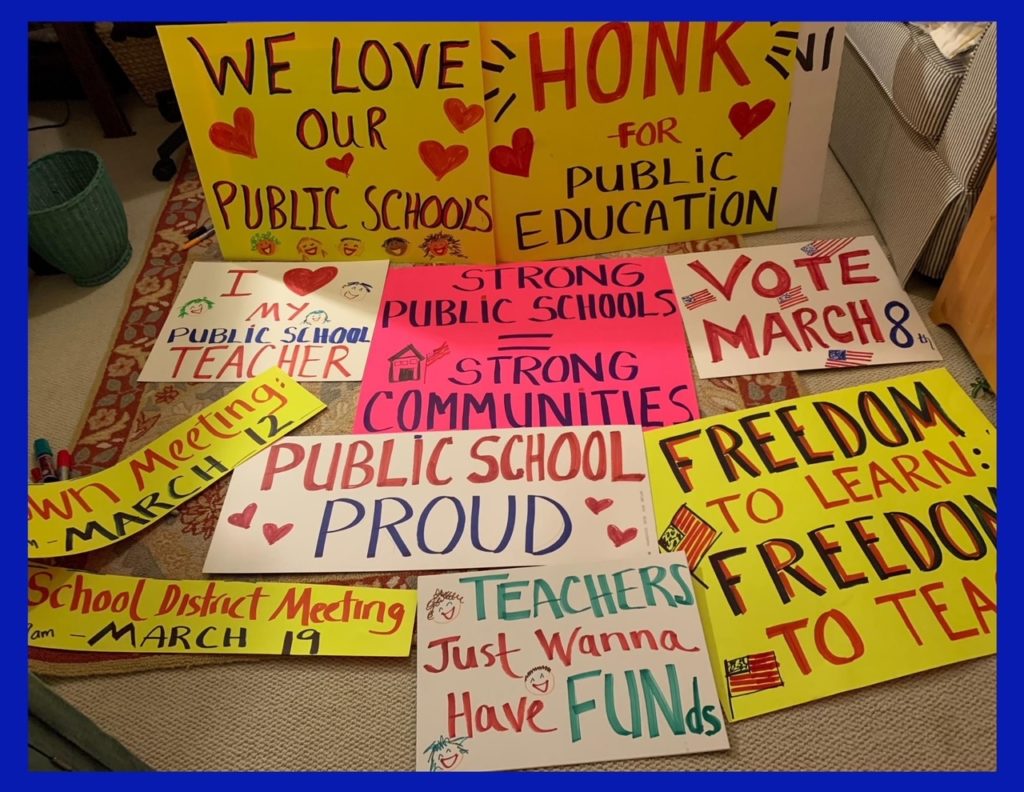
I Love Public Education Sign Visibility

In first town elections since onslaught of attacks on public education and a honest, accurate education, voters send clear message that they support strong public schools and a honest, accurate education

CONCORD, NH – In race after race across New Hampshire on Town Meeting Day, concerned parents and community members in communities large and small successfully organized to elect pro-public education candidates and reject those seeking to dismantle public education and censor history.

“These results should raise serious doubts about any Republican 2022 election strategy that is built around pitting parents against local public schools and educators,” said Zandra Rice Hawkins, Executive Director of Granite State Progress. “In nearly every school board race, Granite State voters chose out-spoken champions for public education and an honest, accurate, inclusive education. This is a big win for public schools and for our future. These leaders are committed to keeping our public schools strong and making sure every student’s history and experience is valued.”

The results from the election are all the more astounding for record-shattering voter turnout, and for the blatant differences between the candidates on everything from public education, COVID public health measures, and attempts to whitewash American history and censor educators. A priority list of school board results can be found here.

Key examples from around the state:

  • Merrimack Valley School District, home to some of the state’s most vocal anti-vaccine, anti-mask, and classroom censorship activists, experienced a 56% increase in voter turnout from 2019, and supported public education candidates while also defeating a classroom censorship/anti-equity warrant resolution.
  • Bedford experienced a 36% increase in voter turnout and elected pro-public education candidate and teacher Andrea Campbell with 2832 votes, compared to 1293 votes for Sean Monroe, a candidate supported by right-wing organization Defend Our Kids, and 856 for incumbent John Schneller; both of whom supported efforts to censor teachers and ban conversations about race and racism in public schools.
  • Londonderry elected pro-public education candidates Amanda Butcher and Kevin Gray, defeating vocal anti-masker Rachel Killian (seen here harassing school board members during a public meeting). Voters also rejected a warrant resolution to make masks completely optional and the sole decision of parents instead of school leaders and public health experts; a significant decision given Gov. Sununu’s recent decision to ban schools from enacting COVID public health measures like masks.
  • Governor Wentworth School District elected Republican State Rep. Brodie Deschaies over far-right activist Jessica Williams, who believes public schools are indoctrinating students and was arrested at a GWSD school board meeting on September 13, 2021.
  • Weare elected pro-public education candidates William “Bill” Politt and Alyssa Small, and passed full-day kindergarten; and Hollis elected pro-public education candidates Carryl Roy, Krista Whalan, and Holly Babcock.
  • Exeter and SAU 16 elected a full slate of pro-public education and honest education candidates, despite a nearly $20,000 effort by the opposition and months of voter mailings from those who oppose diversity, equity, and inclusion justice efforts in the school districts.

“We are in awe of how our communities have come together to protect and support public education,” said Sarah Robinson, Education Justice Campaign Director for Granite State Progress. “Parents, students, educators, and community leaders have been working for months to organize, recruit strong candidates, and support pro-public education campaigns. Watching the results come in and knowing that so many public education champions are going to be serving in these roles gives us all hope. Our schools have been under constant attack from privatization schemes, neo-Nazi’s, and of course Governor Sununu’s statewide ban on a honest education. We all know that serving on a school board right now is challenging, and we thank these leaders for stepping up for our students. We hope the folks at the State House are paying attention, because this showdown will play out again in November unless they stop the attacks on our public schools.”

The Georgia branch of Betsy DeVos’ American Federation for Children made a mass mailing to voters in Republican districts urging them to fight against the “radical left” agenda of President Biden, Kamala Harris, and Stacey Abrams, which denies school choice.

It backfired.

A national advocacy group promoting school vouchers bombarded conservative Georgia voters with glossy mailers tying Republican state legislators from their districts to Stacey Abrams and other “radical left” figures. It backfired in spectacular fashion.

Just days after the American Federation for Children financed the mailers in at least 16 Republican-controlled legislative districts, House Speaker David Ralston told The Atlanta Journal-Constitution that the voucher proposal the group sought to pass is dead for the year.

“I am livid. I’ve been around politics for a long time, but this is the dumbest thing I’ve ever seen in my career, and one of the most deceitful,” Ralston said. “These are people we have tried to help over the years, and they turned to attack us very viciously.”

Ralston added: “That voucher legislation will not move at all in the Georgia House of Representatives this year, period.”

The mailers were sent by the Washington-based group to back proposals that would give public school students what it calls “Promise Scholarships,” a state subsidy of about $6,000 a year to help cover private school tuition.

The measures had gained early traction in House committees…

The aggressive strategy was meant to pressure legislators to end a yearslong feud over public funding of private education in Georgia. Instead, the Capitol’s halls buzzed Tuesday with incredulous GOP lawmakers infuriated by the group’s approach.

“It’s very disappointing that this group is targeting lawmakers in the middle of the deliberative process,” said state Rep.

Pastors for Texas Children have worked with a bipartisan coalition to support public schools and stop privatization. Rural Republicans have been an important part of the coalition that has repeatedly stopped voucher legislation and slowed charters.

Big Night for Pro-Texas Public School Legislative Candidates

GOP Candidates Again Rebuke Extremist Insurgents Financed By Ultra-Right-Wing Billionaires

Candidates that support Texas public schools celebrated significant victories in the Republican primary last night. On the eve of Texas Independence Day, these incumbents declared their independence from the deep pockets of right-wing extremists that are trying to destroy your neighborhood schools. We congratulate those candidates: Stan Lambert, Ken King, David Spiller, Gary VanDeaver, Travis Clardy, Reggie Smith, Ernest Bailes, Giovanni Capriglione.

“Yesterday’s primary elections proved decisively, in the reelection of pro-public education incumbents, that Texans overwhelmingly support their neighborhood and community public schools – and oppose the privatization of them through vouchers and charters,” said Reverend Charles Foster Johnson, founder and Executive Director of Pastors for Children. “These House seats cannot be bought by a couple of right-wing billionaires, no matter how many millions they put up.”

Pastors For Children will continue the fight in the upcoming May runoffs and launch an unprecedented pro-public education campaign for the November General Election.

Pastors For Children stands firm for the belief that there is a moral obligation before God to educate every school kid in Texas. We are also strong proponents of Article 7 in the Texas Constitution, which mandates the State Legislature to support and maintain a free public school system. It is the only way for the Texas economy to continue to outpace the rest of the country.

Pastors For Children is a 501c4 that engages parents, teachers, and all Texans to fight for Texas neighborhood public schools through their votes in the ballot box.

PO Box 471155, Fort Worth, Texas, 76147