Archives for category: Vouchers

Dan and Farris Wilks are politically powerful billionaires who live in Cisco, Texas. They both finished high school but went no further. They got into fracking early on and sold their oil and gas business to the government of Singapore for $3.5 billion in 2011.

They are passionate evangelical Christians. They fund Christian nationalist groups. They fund anti-gay organizations and anti-abortion groups. They consider climate change a hoax. They are major funders of voucher advocacy. They would like to see every student enrolled in a private Christian school or home-schooled.

The brothers are closely associated with ALEC and the Koch network. They are big contributors to Senator Ted Cruz.

Dan and Farris Wilks are major funders of PragerU videos, which present history and economics from a rightwing perspective, echoing the views of Dennis Prager, the talk-show host who created the videos.

Read about Dan Wilks here.

Read about Farris Wilks here.

The Wilks brothers have been described as “the Koch brothers of the Christian right” for their funding of anti-abortion and anti-LGBTgroups. In addition to a variety of groups on the Religious Right, the brothers have funded organizations associated with the Koch brothers’ political network such as the American Legislative Exchange Council (ALEC) and the State Policy Network (SPN). Farris Wilks runs The Thirteen Foundation, which has been described as “one of the biggest and quietest anti-abortion donors in the United States.”

The Guardian summarized their negative influence here.

Experts who follow the influence of the Wilks brothers say their sprawling agendas and big checks spark strong concerns.Videos denying climate science approved by Florida as state curriculum

“Farris and Dan Wilks, who believe their billions were given to them by God, have spent the last decade working to advance a dominionist ideology by funding far-right organizations and politicians that seek to dismiss climate change as ‘God’s will’, remove choice, demonize the LGBTQ community, and tear down public education, all to turn America into a country that gives preference to and imposes their extreme beliefs on everyone,” said Chris Tackett, a Texas-based campaign finance analyst.

“The goal of [the] Wilks and those that share their ideology is to gain control of levers of power and control information. That’s why they invest heavily into politicians, agenda-driven non-profits and media organizations like PragerU and the Daily Wire. It is all connected.”

Texas Attorney General Ken Paxton was impeached by the Republican-controlled House of Representatives on multiple charges of corruption. The charges were based on statements by deputies who worked in his office and resigned. They filed whistleblower complaints. Paxton, they said, was accepting gifts and favors from a real estate investor. That individual even gave a job to Paxton’s paramour.

The judge of the trial in the Senate was Lt. Gov. Dan Patrick.

The Texas Observer reported that Dan Patrick received a gift of $1 million and a loan of $2 million from billionaires Tim Dunn and brothers Dan and Farris Wilks, who were supporting Paxton. As it happens, the biggest supporters of vouchers in Texas are Dan Patrick and those billionaires, These billionaires want to help Dan Patrick in his next campaign, which occurs in 2026.

The Wilks brothers and Dunn are rabid evangelicals who think that all children should attend religious schools.

Lt. Gov. Dan Patrick, who is presiding over the impeachment trial of suspended Attorney General Ken Paxton, received $3 million in campaign support last month from a top group campaigning against Paxton’s impeachment.

In a campaign-finance report published Tuesday, Patrick — who is not up for reelection until 2026 — reported a $1 million contribution and a $2 million loan from Defend Texas Liberty PAC. The political action committee was by far his biggest benefactor on the report, which covered Patrick’s fundraising from June 19-30. It was the first opportunity state officials had to fundraise since the House impeached Paxton in late May.

Meanwhile, impeachment trial over, the whistleblowers said they are not quitting but will pursue Justice in the courts:

The whistleblowers who helped trigger the impeachment trial of Attorney General Ken Paxton said Monday that they will continue the legal fight against their former boss in “real court” after the state Senate chose to acquit the Republican.

“The impeachment process is over, but we are not going away,” said Blake Brickman, the former deputy attorney general for policy and strategy initiatives under Paxton.

“For us, this case has always been about more than money,” he said. “It’s about truth. It’s about justice. And although political pressure may have thwarted justice this month, we will continue our fight.”

In their first public statement since the verdict, Brickman joined fellow former deputy attorney generals Mark Penley and Ryan Vassar at a news conference at the Texas Capitol on Monday. They sued Paxton’s office in late 2020, alleging they were fired for reporting him to the FBI for alleged corruption.

The sides had reached a tentative $3.3 million settlement agreement early this year, but the deal withered when the Texas House refused to fund it and instead launched its impeachment effort. The suit is now pending before the Texas Supreme Court.

Paxton, who was reinstated as attorney general last week, did not respond to a request for comment. On Monday, his office threatened legal action against the state’s comptroller for withholding Paxton’s salary while he was suspended from office awaiting trial.

At the news conference, the whistleblowers praised senators who voted to convict Paxton for not “wilting under political pressure” and criticized Lt. Gov. Dan Patrick for publicizing his disdain for the impeachment directly after the verdict. During the historic trial, they testified that they had no other option but to report Paxton to authorities and that their careers suffered as a result.

C’mon, when the staff you hired accuses you of corruption, but the Senate acquits you, the question naturally arises: is there Justice for public corruption in Texas? Can Justice be bought by the highest bidder? Will Paxton escape accountability? And will Tucker Carlson make him a national hero for beating the rap?

After I first listened to Chris Rufo’s infamous speech at Hillsdale College, something clicked. I saw the plan for the demolition of public education. Rufo spelled it out. He is a proponent of universal school choice, and he says the way to reach that goal is to create universal distrust of public schools. This is why we hear blarney about public school teachers “grooming” their students and indoctrinating them. It’s all part of the plan to create “universal distrust.” It’s a plan to privatize public education by disseminating lies and defaming teachers.

Peter Greene listened to Rufo’s speech and analyzes it closely. Please read to see the master plan, the hoax about “critical race theory,” and the rightwing plot to privatize public funding for education.

And though Peter says he summarized the speech to save you time, I urge you to listen to it. It’s scary.

Joshua Cowen, Professor of Education Policy at Michigan State University, has been researching and writing about vouchers for yearly 20 years. As you will read, school choice advocates were very angry about his criticisms of vouchers. They told him he was wrong. George Mitchell, a founder of School Choice Wisconsin wrote a comment on this blog, highly critical of negative judgments about vouchers. Here is Josh Cowen’s response.

Author: Josh Cowen

Affiliation: Professor of Education Policy, Michigan State University

Topic: Wisconsin Voucher Results

Recently, I made comments to the Wisconsin Examiner that were highly critical of Wisconsin’s system of school vouchers. The columnist for that piece had asked me as a researcher with 18 years of experience on the topic for my professional opinion about a new School Choice Wisconsin report purporting to show that Wisconsin vouchers are more cost-effective than the state’s public schools.

In response to my comments, the director of School Choice Wisconsin issued his second op-ed in one week, slamming both me and the Examiner columnist; a researcher from the Wisconsin Institute for Law and Liberty, which like School Choice Wisconsin is heavily subsidized by the voucher-advocating Bradley Foundation in Milwaukee, issued a similar social media thread; and George Mitchell himself, the co-founder of SCW, sent me not one but two angry and unsolicited emails trying to rebut me.

Among other things, I said to the Examiner: “If you took the report at its word, it’s possible to achieve exactly what they’re describing simply by exiting the children who are the most expensive to educate.”

I make similar assessments in other states, based on the large volume of data showing that voucher programs like Wisconsin’s have huge exit rates among the lowest scoring and lowest income students. I’m used to objections from conservative activists who are for ideological reasons supportive of vouchers, but the sheer volume in this case is frankly odd and warrants extra attention.

Wisconsin is also a bit different because that’s where I got much of my start on voucher research—and that’s where some of the more troubling patterns of student exits from voucher schools first emerged. As an early career analyst on the last official evaluation of vouchers—at the time, limited to the Milwaukee Parental Choice Program between 2005 and 2010—I helped study those data.

Here’s the thing: the Bradley Foundation financially supported that larger evaluation, and School Choice Wisconsin played an integral role in participant recruitment for the study.

What we found in not one but two papers published in the top education research journals in the country was that students left Milwaukee vouchers at high rates, roughly 15% of kids per year (in other states it’s above 20%), and did so in very systematic ways: the lowest scoring kids, lowest income children (even in a program targeted to lower income families to begin with) and students of color were far more likely to experience turnover out of the voucher program.

And crucially, those students did better once turning or returning to Milwaukee Public Schools. That last finding was important because kids who gave up their voucher did not enroll at the highest rated MPS schools, but they still appeared to have been better served there than when they had used a voucher.

That pattern alone can inflate the numerator in the fraction SCW used to claim voucher cost-effectiveness. By dividing the state’s accountability score by a simplistic calculation of the revenue schools receive per kid, SCW was able to claim more voucher bang for the buck. It’s simple algebra: “cost effective” can mean either a high score for a given dollar spent, or a smaller dollar spent for a given accountability score.

And if, as in our MPCP evaluation, students who leave voucher programs are especially low scoring on state exams, that would artificially push SCW’s voucher numerator high. Again, simple algebra.

That is not a particularly controversial statement among serious program evaluators who specialize in such data without an agenda. And while I’m not surprised that as the state’s chief voucher advocacy group, SCW took issue with my data-backed comments, I am surprised they’ve spent as much time as they have issuing new columns and sending me angry emails.

Of course, one way to settle lingering questions about Wisconsin’s voucher program would be to hold another multi-year evaluation, in which groups like School Choice Wisconsin, the Wisconsin Department of Public Instruction, and teacher stakeholder groups came together to agree on a third-party review of these programs.

That happened in 2005 Wisconsin Act 125, which helped create the data in our team’s reports that I cite above. But it has not happened since vouchers expanded statewide. If School Choice Wisconsin is as confident in their numbers as they claim, they should welcome such a new evaluation—just like they did back in the program’s early years.

If that happened, Wisconsin taxpayers wouldn’t have to take voucher advocates’ word for it—or mine for that matter. One of the findings from the last evaluation was that once DPI started reporting voucher results by school name (like public schools have to do), their performance improved. Voucher advocates should want new evaluations—if they don’t, what are they worried those new reviews will find?

Absent a new evaluation, what we know for certain based on what’s available to the research community is that voucher programs have extremely high rates of student turnover, and these rates are driven by particularly high rates among at-risk children. In that, the data are quite consistent with the startling report issued by journalists at Wisconsin Watch in May, documenting strategies that Wisconsin voucher schools use to select children out after admitting them originally.

In Wisconsin, as in other states, there is far more state oversight on entry into choice programs than on exits—and yet we know for a fact that exits are where modern voucher programs truly choose their students.

Either way, and based on the independent data we do have, when it comes to using vouchers it’s the school’s choice, not parental choice.

The Republican leadership of the House Education Committee held hearings on the threat posed by Communist China to American public and private schools. Read the summary and ask yourself the following questions: Would red states grant the Confucius Classrooms a charter to run their own schools? Would they let a school organized by the Confucius Classrooms accept voucher students? Are they equally concerned about the scores of Gulen schools that receive public funds and operate as charter schools? Gulen is a Turkish imam who lives in seclusion in Pennsylvania; the board of trustees of his schools are led by Turkish men; the Gulen schools have a large number of Turkish teachers on staff. When will the House Committee on Education investigate the Gulen schools?

The release from the committee begins:

Hearing Recap: Confucius Classrooms Edition

Today’s Early Childhood, Elementary, and Secondary Education (ECESE) Subcommittee hearing, led by Chairman Aaron Bean (R-FL), investigated the Chinese Communist Party’s (CCP) efforts to infiltrate America’s K-12 schools.

In postsecondary education, the CCP exerts soft power on the American education system through cultural exchange outposts known as Confucius Institutes. The K-12 arms of this propaganda machine, called Confucius Classrooms, were under the microscope today for their potential malignant influence.

Chairman Bean opened the hearing by pointing out, “The risk posed by the proliferation of Confucius Classrooms is threefold, threatening America’s national, geopolitical, and academic interests.”

Expert witnesses testifying today included Mike Gonzalez, Senior Fellow at the Heritage Foundation; Nicole Neily, President of Parents Defending Education (PDE); and Ryan Walters, State Superintendent of Public Instruction at the Oklahoma State Department of Education.

The seminal report on Confucius Classrooms, and therefore the spark for congressional investigation, was led by Nicole Neily and PDE. In her opening testimony, Ms. Neily laid out the key findings of her organization’s report: “Our research found that over the past decade, over $17 million has been given to 143 school districts and private K-12 schools across 34 states (plus DC) – impacting over 170,000 students in 182 schools.” Furthermore, these classrooms were identified near 20 U.S. military bases, posing a potential national security threat.

As a state education officer, Mr. Walters offered a perspective on the impact of these donations in Oklahoma schools. After one of his school districts was named in the PDE report, Mr. Walters ordered a further investigation, which uncovered that, “Through a series of non-profits, that school district maintains an active connection with the CCP through a program called Confucius Classrooms, even after the federal government cracked down on similar programs in 2020.”

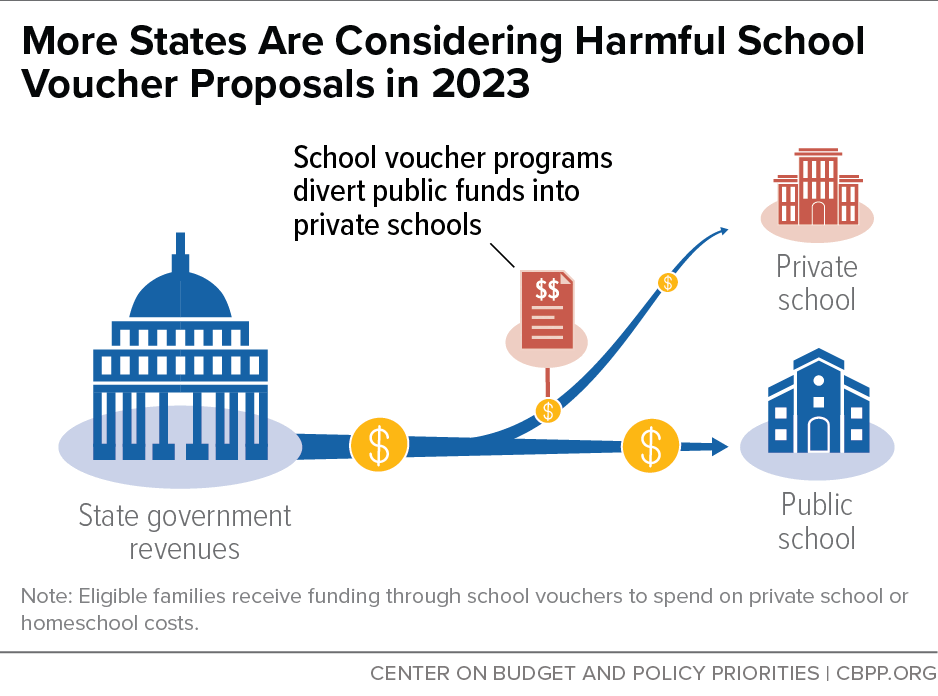
Gary Rayno of InsideNH writes about the expansion of the state voucher plan by Republicans in New Hampshire, who control both houses of the legislature and the governorship. Income requirements were raised. Enrollment increased. 75% of last year’s students never attended a public school. The biggest beneficiary is religious schools. When the voucher program was first proposed, public opposition was overwhelming. Governor Sununu and the legislators didn’t care.

Open the link to read it all.

Rayno writes:

The war over public education was on full display last week in the battle over PragerU’s financial literacy course and the State Board of Education’s 5-0 decision to approve it.

Despite opposition from the vast majority of speakers and letter writers, the board — stacked with school choice advocates by Gov. Chris Sununu — voted 5-0, with board chair Drew Cline abstaining.

While the controversial organization’s foot in the door was lamented by many after the vote, the on-line financial literacy course will not “cost” the state anything, which cannot be said about the biggest battleground in the education war, the Education Freedom Accounts program.

Last week, Kate Baker Demers, the executive director of the Children’s Scholarship Fund NH, which administers the program, told the freedom account oversight committee about 1,600 new students joined the program for this school year bringing the total number of students to around 4,200, but noted those were rough figures and the Department of Education should be posting the exact figures soon.

While the program is growing, only one major change was made the last legislative session, which increased the financial threshold from 300 percent of poverty to 350 percent.

That increases the threshold for the current school year from $59,160 for a family of two, to $69,020, and for a family of four from $90,000 to $105,000 annually.

Once a family qualifies for the program there are no future financial limits on earnings.

Demers told the oversight committee 200 plus students’ families qualified under the higher income threshold than would have under the former limit.

Last school year, the Department of Education data indicates 3,196 students participated in the program with the average grant per student $4,860 with a total cost of more than $15.5 million without administrative expenses.

The program for the first two years was about $24 million over budget as the department’s estimates of student participation was much lower than reality.

For this school year, there are about 1,000 more total students participating, Baker Demers said about 600 students left the program to either return to public schools, who graduated (111), moved away or for some other reason.

Along with the 1,000 increase in students, lawmakers increased the state’s basic adequacy grant from $3,787 per student to $4,100, and also increased the amount of additional aid for students in low-income families, and with special education needs.

That is likely to make the new average per pupil cost go over $5,200 per student.

That would increase the total costs not counting administrative costs from the scholarship fund organization — to about $22 million this year, an increase of about $7 million.

The state budget contains $30 million in each year of the biennium for the program, so total costs are likely to bump against the $60 million if there is much growth in the program next year.

Most programs with increases like this would be curtailed and limited with talk about halting runaway growth, but that does not appear to be a big concern of the majority party, which has pushed the program along with Education Commissioner Frank Edelblut and Sununu.

Democrats are the ones seeking to put guardrails around the program that draws its money from the Education Trust Fund, the source of all state education aid that is not the Statewide Education Property Tax….

The program was sold as an opportunity for low-income families to send their child to a program more appropriate for their learning skills than a public school.

But that has not been the biggest driver and represents a small percentage of the students enrolled.

About 75 percent of the participants in the past were enrolled in private schools — either religious or secular — and in home school programs.

Whether that figure remains in similar proportion is not something anyone will know until the Department of Education shares its data on its website.

Joshua Cowen of Michigan State University tweeted the following information from official sources in Florida:

Oh would you look at that—70% of expanded Florida #schoolvouchers users were already in private school.

Another 18% entering kindergartners.

Only 13% came from public school.


@FLBaloney @FloridaPolicy @DianeRavitch
drive.google.com/file/d/1yyl80J…

NBCT high school teacher Justin Parmenter frequently tweets (X’s) about politics and schools in North Carolina. He has been reviewing the religious schools that take vouchers. Here is the latest.

Fayetteville Christian got $1.3m NC taxpayer dollars this year. They deny admissions to non-Christians and LGBTQ (whom they refer to as “deviate and perverted”).

I don’t want my public dollars going to institutions that can discriminate this way. #nced #ncga #ncpol

His Twitter handle is his name.

Justin Parmenter, an NBCT-certified teacher in North Carolina, has been posting interesting facts on Twitter (X) about religious schools in North Carolina that accept voucher students. That is, the public is paying most or all of their tuition.

Here is the latest:

NC requires public school teachers to hold a license.

Durham, NC’s Mt. Zion Christian Acad receives public $ for vouchers. They require their teachers to demonstrate their relationship w/the Holy Spirit by speaking in tongues.

A license is optional. #nced #ncpol #ncga

@justinparmenter

While looking over my site, I came across this post written in 2014.

It is as timely now as it was then. Reformers worked with communications specialists to develop language that conceals its true meaning.

For example, reformers today don’t want to improve public schools. They want to defund them. Some want to destroy them. They think that public money should go to anyone, any organization that claims they are educating young people. They are fine with funding religious schools. No doubt, they would have no objection to funding Satanic schools, for fairness sake.

These reformers believe in tight accountability for public schools, their principal, their teachers, their students.

They believe in zero accountability for anyone taking public money for nonpublic schools. In most states with vouchers, voucher schools do not require students to take state tests. Students can’t be judged by test scores as public school students are; their teachers can’t be evaluated by test scores. Their schools can’t be closed because of test scores. There are no test scores.

Teachers in public schools must be college graduates who have studied education and who are certified. Teachers in voucher schools do not need to be college graduates or have certification.

Hundreds of millions, maybe billions, now fund homeschooling. With well-educated parents, home schooling may be okay, although the children do miss the positive aspects of meeting children from different backgrounds, working in teams, and learning how to get along with others. But let’s face it: not all home schoolers are well-educated. Poorly educated parents will teach their children misinformation and limit them to what they know, and no more.

Then there is the blessing that the US Supreme Court gave to public funding for religious schools. The purpose of most religious schools is to teach their religion. The long word for that is indoctrination. We have a long history of not funding religious schools. But now all of us are expected to foot the bill for children to learn the prayers and rituals of every religion. I don’t want to pay taxes for someone else’s religion to be inculcated. I also don’t want to pay taxes to inculcate my own religion.

But the Supreme Court has step by step moved us to a point where the government’s refusal to pay for Catholic schools, Muslim schools, Jewish schools, and evangelical schools—with no regulation, no accountability, and no oversight—violates freedom of religion. That’s where we are going.

Ninety percent of the people in this country graduated from public schols. Those who sent their children to private or religious school paid their own tuition. That arrangement worked. Over time, we became the leading nation on earth in many fields of endeavor. Our education system surely had something to do with our national success.

I believe that people should have choices. Most public schools offer more curricular choices than charter schools, private schools, or religious schools. Anyone may choose to leave the public school to attend a nonpublic school, but they should not ask the taxpayers to underwrite their private choice.

The public pays for a police force, but it does not pay for private security guards. The public pays for firefighters, highways, beaches, parks, and many other public services. Why should the public pay for your decision to choose a private service?

Saddest of all, the current trend toward school choice will lower the overall quality of education. The children of the affluent who attend elite private schools will get a great education, although they will not get exposed to real life on their $60,000 a year campus. None of those campuses will get poor voucher kids because all they bring is a pittance.

We are now learning that most public schools are superior to most of the voucher schools. Many charter schools are low-performing.

On average, school choice will dumb down our rising generation. It will deepen social and religious divisions. It will not produce better education or a better-educated society. It will widen pre-existing inequalities.

Books have been and will be written about this fateful time, when we abandoned one of our most important, most democratic institutions. Libertarians and religious zealots have worked for years, decades, on this project. By convincing leaders of both parties to follow them, they have betrayed the rest of us. They have lost sight of the common good.

Those two words are key. The “common good.” With them, we as a society can conquer any goal, realize any ideal. Without them, we are reduced to squabbling tribes, cliques, factions. We are becoming what the Founding Fathers warned about.

If it’s not too late, that is the banner behind which we should rally: the common good. An understanding that we are all in the same boat, and we must take care of others.