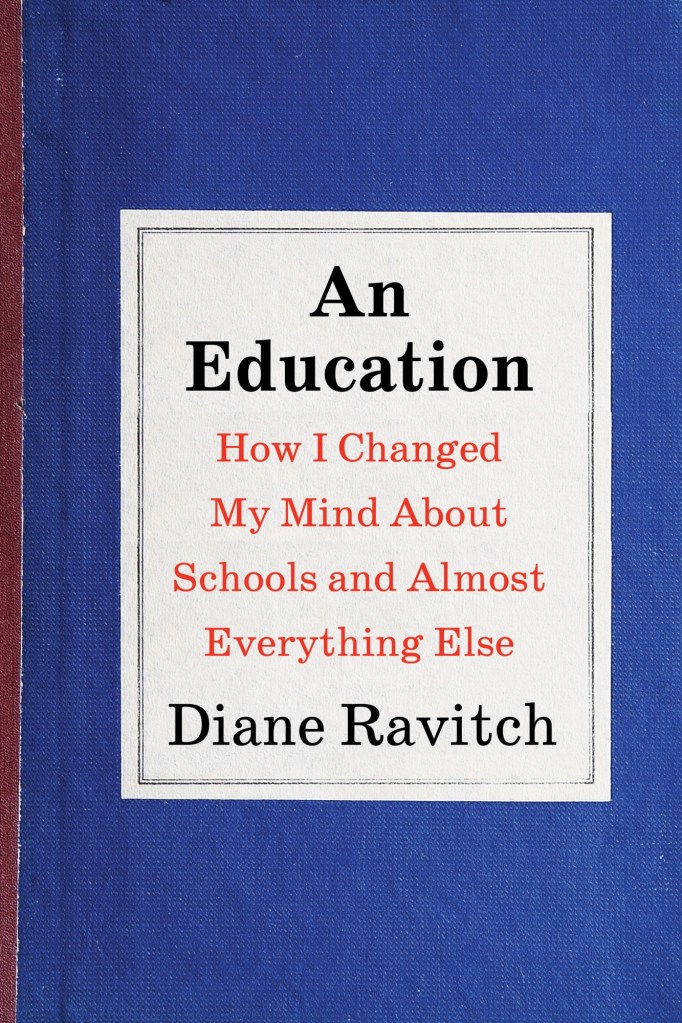
The Network for Public Education sponsored a conversation between me and Carol Burris about my new book: AN EDUCATION: HOW I CHANGED MY MIND ABOUT SCHOOLS AND ALMOST EVERYTHING ELSE.
I think you will enjoy it!
The Network for Public Education sponsored a conversation between me and Carol Burris about my new book: AN EDUCATION: HOW I CHANGED MY MIND ABOUT SCHOOLS AND ALMOST EVERYTHING ELSE.
I think you will enjoy it!
Garry Rayno of InDepthNH keeps a close watch over the legislature in New Hampshire. He is particularly interested in the state’s relatively new voucher plan. It was sold, as usual, as a plan to help poor kids “escape failing schools.”
That wasn’t what happened.
Predictably, the legislature removed income limits and the program now subsidizes affluent families whose children never went to public school.
The program this year will cost $51.6 million. Almost $50 million goes to students already enrolled in private or religious schools.
Meanwhile, the funding for vouchers is drawn from the state’s Education Trust Fund, which was intended for public schools. That means the subsidy for nonpublic schools comes right out of the public schools’ budget, with no tax increases to compensate public schools. The vast majority of New Hampshire’s students are now subsidizing the nonpublic schools.
There is a new regime at the Department of Education that has released more than the most basic information about the Education Freedom Account program.
For the program’s first four years, the department released spreadsheets detailing the numbers of students, where they live and how much each student received in grants with a total cost of the program and the quarterly state distributions to cover those grants.
The money does not really go to the parents, its goes to the Children’s Scholarship Fund NH, which takes its cut and sends the rest in the child’s name to ClassWallet, a company that received early stage investments twice from the Chinese-based venture capital firm Sinovation Ventures.
A 2018 Defense Department report flagged the company as participating in China’s “technology transfer strategy,” a state initiative to acquire foreign innovation.
Several states that also use ClassWallet for voucher money distribution have raised concerns about data security and foreign influence like Arizona and Missouri, but not New Hampshire, although Gov. Kelly Ayotte issued Executive Order 2025-04 which would appear to prohibit doing business with a company with investors like ClassWallet.
ClassWallet does not technically work for the state, but it was hired by a state contractor, Children’s Scholarship Fund of NH, which administers the EFA program.
How many parents of EFA students would want their education spending data potentially accessed by a foreign country like China?
That information is not what was released late last month by the Department of Education, but is easily found with a Google Search, which ironically also brings up that Sinovation Ventures was co-founded by former China Google President Kai-Fu Lee.
The information released last month provides far greater detail than released under former DOE Commissioner Frank Edelblut, who kept the program’s details out of the public’s eye, such as where the money went and if the children’s foundation was carefully vetting income levels and other requirements to access additional grant money.
A small sample compliance report by the now long gone DOE overseer of the EFA program, indicated it was not following guidelines.
The 100 applications sampled for the report over the first two years of the program had a 25 percent error rate that resulted in a rebate to the state for only those applications improperly approved not for 25 percent of the program’s costs.
One of the biggest criticisms of the program is that very few of the students using the state’s money are actually leaving public schools to join the program. Instead the vast majority of the students using EFAs were already in religious or private schools or homeschooled when their parents applied to participate in the state-funded program that draws its funding from the Education Trust Fund, which also pays for the bulk of state aid to public schools, no matter how meager compared to every other state in the country.
This year the program is projected to cost $51.6 million and will cost an additional $61.9 million next year, totaling $113.5 million for biennium, which makes it $26.7 million over budget.
And if you read the fine print of the data released last month, only $1.68 million on the low end, to $4.42 million on the high end for this school year, and $2.52 million if you use the four-year average is going to kids who were not in public schools when they joined the program out of the $51.6 million for this school year.
The data from the DOE notes that for the current school year only 343 students left public schools to join the program whose enrollment is now 10,510 students, which is nearly double what it was last year before the Republican-controlled legislature removed any earnings cap for the program.
That 3.26 percent of the students is the low end of the estimate above, and if you use the number of new students this year compared to last school year, which is 4,745, the new students from public schools is 7 percent and the high figure.
If you add the kids leaving public schools for the last four years, the number is 1,162 which compared to enrollment over those four years of 23,937 and the number is the four-year average.
That means state taxpayer money going to support students who were not in public schools when they joined the EFA program for this school year would be between $49.92 million and $47.18 million.
That is money the state was not paying to educate these kids because they were in religious or private schools or homeschooled and not supported by state dollars.
In essence that is a new education cost for the state, but no new taxes, or fees or anything was created to pay for it.
Instead, it is money drawn from the Education Trust Fund which was established after the Claremont education decisions to support public education.
As Rayno writes: For those receiving the money on the upper end of the income scale, the little less than $5,000 grant average is a subsidy that allows another ski trip to Aspen or Tahoe this winter.
So when lawmakers say the state doesn’t have the money to increase its share of public education costs, it really means “we do not want to increase the state’s share, but we are OK subsidizing religious and private schools and homeschooling.”
For those receiving the money on the upper end of the income scale, the little less than $5,000 grant average is a subsidy that allows another ski trip to Aspen or Tahoe this winter.
But the above figures are probably a little generous because they do not account for the kids who joined the EFA program from public schools and then returned to public schools either before or after one year.
Data released by the department indicates that last school year, 101 of the former public school students who switched to the EFA program, re-enrolled in public schools.
For the 2023-2024 school year, 75 EFA students returned to public schools, and for the 2022-2023 school year, 38 re-enrolled in public schools.
But those are not the only ones leaving the EFA program every year.
It also does not include EFA students who either graduated or completed their course of instruction that school year or left for unexplained reasons.
For the 2024-2025 school year, 151 EFA students left the EFA program because they graduated or completed their course of study along with the 101 who returned to public schools, and the 887 who left for unexplained reasons.
The total number of students leaving the program that school year was 1,139 or 21 percent of the total EFA enrollment for the year.
For the 2023-2024 school year, 108 students either graduated or completed their course of study, with the 75 who returned to public schools, and 525 who left for unexplained reasons.
The total number of students leaving the EFA program that school year were 708, or 19 percent of the total EFA enrollment.
For the 2022-2023 school year, 76 students graduated or completed their course of studies, along with the 38 who re-enrolled in public schools and the 344 who left for unexplained reasons.
The total number of students leaving the program was 458 students or 15 percent of the enrollment that year.
Total students leaving over the three-year period was 2,305 from a total three-year enrollment of 12,557 or 18.4 percent.
What would we say about a dropout rate of nearly 20 percent if it were a public school?
This is not the widely successful program its advocates tout on the floor of the House and Senate and does not save school districts the amount of money Edelblut used to claim because more than 90 percent of the students in the program were not in public schools, but he counted them as savings to school districts.
This program is not serving the children of low-income parents who want an alternative to public schools, but those parents who can already afford to pay for their children to attend those alternatives without the state’s taxpayers’ help.
That is not government helping the most vulnerable, it is Robin Hood in reverse, a system New Hampshire knows very well.
Garry Rayno may be reached at garry.rayno@yahoo.com.
I was interviewed by Brian Lehrer of WNYC, public radio about my latest book, probably my last. He is a great interviewer. He asks good questions, followed by people who called in to disagree with me.
It’s an excellent interview.
I apologize if I’m browbeating you with stuff about my book, but the book is really good; I worked on it for two years; the mainstream media has ignored it; and I think you will enjoy reading it.
In case you haven’t noticed, the title is:
An Education: How I Changed My Mind About Schools And Almost Everything Else (Columbia University Press). You can buy it from Columbia University Press, your local independent bookstore, or Amazon.
Parents in New Hampshire are outraged by the state’s new voucher law. It is siphoning money from public schools, which are attended by 90% of the state’s students, and 95% of those with disabilities. When the state legislature debated vouchers, parents overwhelmingly opposed them. But the legislature ignored the public and parent opposition and approved a modest voucher plan. The original plan was based on the claim that vouchers would “save poor kids from failing schools,”
That plan has since expanded dramatically; no longer modest, it now supplies vouchers to any student, regardless of family income. Currently, 80% of the vouchers are claimed by kids who never attended public schools. Now that the legislature has lifted income limits for those who seek vouchers, the program has become a subsidy for families that can afford to pay the tuition.
Garry Rayno of InDepthNH has the story:
CONCORD — Public education advocates said the state’s universal voucher program is putting students, taxpayers and education professionals at risk as more and more taxpayer money is diverted to the unaccountable program.
At a press conference celebrating American Education Week, Megan Tuttle, president NEA — NH, said the program takes money away from public schools as the state now funds two school systems, one public and the other private.
“As we celebrate American Education Week, let’s recommit to strengthening, not destabilizing public schools,” Tuttle said. “Public dollars belong in public schools. Our students deserve fully funded public schools, not policies that erode them. And our state’s future depends on getting this right.”
She noted private schools do not have to follow the same guidelines as public schools who have to accept all children no matter how expensive their education or their educational needs.
Nor are private schools bound by federal civil rights provisions, she said, such as the Disabilities Education Act, the Americans with Disabilities Act and the Every Student Succeeds Act.
“The only choice in a voucher system,” Tuttle said, “is that private and religious schools get to pick their students, not the other way around.”
The state voucher program, Education Freedom Account, was initially sold as providing opportunities to low-income parents to find the best educational environment for their students if they do not do well in the public school environment.
Initially the program was limited to students whose parents earned 300 percent of the federal poverty level or less, but earlier this year the program was opened to any parent whose child is eligible to attend public school in the state regardless of earnings.
The change doubled the number of students in the program from 5,204 last school year to 10,510 this school year and the cost increased from $28 million to $52 million this year to date.
While the program was sold as an alternative to public education, more than 80 percent of the students to date were in religious or private schools, or homeschooled when they joined the EFA program as is the case in other states with universal vouchers.
Public schools in New Hampshire educate 90 percent of the state’s students and 95 percent of those with disabilities.
Rep. Hope Damon, D-Croydon, who is the deputy ranking member of the House Education Funding Committee, said her party is fighting every day to ensure every child regardless of income or zip code has access to a high quality education, while the governor and Republican lawmakers have doubled down on their reckless school voucher scheme.
“A few years ago, we were promised that vouchers, these so-called EFAs, would serve families in need,” Damon said, “but it’s clear that was just a ploy for Republican lawmakers in Concord to open up the floodgates and push through an over-budget, universal school voucher program.”
Now some of the wealthiest families receive taxpayer-funded handouts that pay for private schools, she said, while just 19 percent of the students in the EFA program are from low-income families.
“Our most vulnerable families are being left behind,” Damon said. “Our public schools are already punching above their weight, scoring very well nationally despite extremely limited resources from the state. Vouchers just make their job harder.”
She said the program strains taxpayer dollars and increases property taxes, while it is already $12.3 million over budget at a time when the Republican controlled legislature voted to significantly cut funding for University of New Hampshire.
“This universal voucher scheme is expensive. It flies in the face of fiscal responsibility,” she said. “There’s very little accountability and oversight on how vouchers are used.”
New Hampshire’s future depends on its students having a high quality public education, she said.
Republicans have long argued parents should decide how best to educate their children and are in the best position to determine whether their child is receiving an adequate education.
Longtime school choice advocate, former Rep. Glenn Cordelli, R-Tuftonboro, argued repeatedly that if parents do not like the education their child receives in one EFA educational setting, they are free to move their child to a new one.
“Education freedom is not theory. It is accountability that begins at the kitchen table, where a mother or father can say this is not working and choose what does,” Cordelli said after he received an award earlier this year from the Children’s Fund of NH, the organization that administers the program for the state.
During the press conference David Trumble of Weare, a business owner, educator and former State Senate candidate, said the state has to invest more in its students just as a business has to invest to grow.
Republicans focus their efforts on diverting tens of millions of taxpayer dollars to fund private school education, he said, expanding the voucher program to cover wealthy families who can use these funds to pay for tuition or skiing lessons.
“The Republican voucher scheme is dangerous because public schools continue to go underfunded and students lose out on the resources they need to ensure long-term success,” Trumble said. “The state is long overdue in living up to its constitutional mandate to fund the public schools.”
He noted the current situation in Claremont where the school district faces a $5 million deficit building up over the past three school years due to fiscal mismanagement at the Supervisory Administrative Unit level.
He said the city would probably not be in this situation if the state had been meeting its constitutional obligation to fund public education.
Earlier this week, the Senate Education Committee approved a revolving loan program for the city to meet its cash flow needs this school year and into the future by allowing early borrowing from the state adequacy grants it will receive in the future.
That plan included a provision allowing the parents of students to apply for EFA grants mid year to remove their children from the school district, due to the uncertainty.
The plan also requires the city to place a school budget cap warrant article on its next annual school district meeting, both pet projects of GOP lawmakers.
“Claremont’s the canary in the coal mine,” Damon said. “It is not the only district that is in significant financial distress, but attaching even more unlimited vouchers to that bill is a further way to defund public schools. It’s a very, I think, inappropriate attachment.”
When asked what lawmakers could do to bring more transparency, accountability and fiscal constraints to the program, Damon said “the Free State-influenced Republican Party does not want vouchers to be diminished at all, but we’re not going to stop trying.”
Tuttle suggested voters make a change in the composition of the legislature.
“We know the majority of voters in New Hampshire, they believe public funds belong in public schools,” Tuttle said. “And looking ahead to 2026, we need to be electing leaders in the state of New Hampshire who are going to . . . put in some new policies.”
Garry Rayno may be reached at garry.rayno@yahoo.com.
Andy Spears of the Tennessee Education Report writes that a lawsuit has been filed in state courts challenging the Tennessee voucher plan. Not only does it violate the state constitution, the plaintiffs say, but the cost will bankrupt the public schools.
Spears writes:
Tennessee’s expanded, universal school voucher scheme violates a state requirement to maintain a system of free public schools, a new lawsuit says.
The Education Law Center, on behalf of a group of Tennessee parents, filed the suit in Davidson County Chancery Court.
“I taught for 12 years, and I fought to get my children into Rutherford County Schools because I knew the quality of education here,” said Jill Smiley, Rutherford County parent and former teacher. “Now the state is systematically defunding the very schools families like mine depend on. You can’t expect excellent schools on a shrinking budget.”
The suit cites the requirement in the Tennessee Constitution that the state establish and support a system of free public schools.
According to the plaintiffs:
The lawsuit argues the voucher law violates the Education Clause of the Tennessee Constitution in two ways:
Estimates by state analysts suggest the program will cost more than $140 million this year alone and may cost over $1 billion a year within 5 years.
Additionally, an issue advocacy group calling itself Tennessee Leads says it will fight to expand the school voucher program as well as the state’s charter schools so that as many as 450,000 students are removed from the state’s public school system by 2031.
Department after department, agency after agency, in the Federal government has been killed or destroyed by the Trump administration. Foreign aid, which had decades of bipartisan support, was virtually eliminated, meaning certain death for hundreds of thousand of children and families who count on the U.S. for food and medicine. The Department of Defense is now called the Department of War, without Congressional approval. The Consumer Financial Board is gone. The Department of Education has been eviscerated. Civil rights enforcement has been turned upside down, to exclude vulnerable groups for which it was intended.
Jan Resseger is a brilliant, thoughtful analyst of education. I encourage you to sign up for her blog. Here she takes a deep dive into what this chaos means for public schools and students:
Despite that the federal government shutdown has ended, SNAP funds are being distributed, and airplanes are returning to their expected schedules, many of us are feeling disoriented and troubled by the way the federal government seems to be operating under Donald Trump’s leadership. We have been observing the Trump administration violating core principles we learned in civics class are at the heart of our democratic society. And we thought the Constitution was supposed to protect every one of us. In today’s post, I’ll try to name and explore some of the principles that President Trump seems to be violating as he attempts to dismantle the U.S. Department of Education. On Thursday, in Part 2, I’ll explore three serious constitutional violations. All of this is undermining the well-being of our nation’s massive institution of K-12 public schools, the leaders of 13,000 public school districts, over three million public school teachers, and more than 50 million students enrolled.
NY Times economic reporter Tony Romm reflects on the deeper meaning of the recent federal government shutdown: “(T)he president has frequently bent the rules of (the) budget, primarily to reap political benefits or exact retribution. He has found new and untested ways to spare certain Americans, like the military, from the pain of the government closure, while claiming he has no power to help others, including low-income individuals who rely on benefits like SNAP. The result is a shutdown unlike any other, one that has posed disparate and debilitating risks for those unlucky enough to depend on the many functions of government that Mr. Trump has long aspired to cut… At the heart of Mr. Trump’s actions is a belief that the president possesses vast power over the nation’s spending, even though the Constitution vests that authority with Congress. Mr. Trump and his budget director, Russell T. Vought have dismantled entire agencies, fired thousands of workers and canceled or halted billions of dollars in federal spending—all without the express permission of lawmakers.” Romm is not writing about public education, but you will recognize that his concerns apply to public schools and all the rest of our society’s primary institutions.
Trump Seizes the Power of the Purse
The NY Times Editorial Board enumerates three ways the President has grabbed power from Congress by violating “the power of the purse” granted to Congress in the Constitution: “First, he has refused to spend money that Congress allocated… Second, Mr. Trump has spent money that Congress has not allocated… Third, the president has taken steps that effectively overturn Congress’s spending decisions. In these cases, he has not added or subtracted federal funds, but he has taken other steps that make it so an agency cannot carry out the mission that Congress envisioned for it.”
All year, and at a new and radical level during the recent federal shutdown, President Trump has ordered Education Secretary Linda McMahon and his other appointees in the Department of Education to usurp the power of the purse primarily by slashing the expenditure of Congressionally appropriated funds to staff the department, along with announcing the goal of eliminating the department and its federal role altogether. The administration’s imposition of permanent layoffs during the federal shutdown focused on firing the professionals responsible for carrying out the very reason a U.S. Department of Education was established back in the fall of 1979, during President Jimmy Carter’s administration: to gather together and administer programs that equalize opportunity for students across the states, where there had historically been unequal protection of students’ rights depending on children’s family income, race, primary language, immigrant status, sexuality or disability. Huge grant programs like Title I and IDEA and myriad smaller programs ensure that public schools, no matter where a student lives, meet the specific learning needs of all students including those whose primary language is not English and students with disabilities.
During the shutdown, the Trump administration appeared intent on violating the power of the purse at the U.S. Department of Education by radically reducing the staff who do the work—impounding funds congressionally appropriated for paying the staff who enable the Department of Education to fulfill its primary mission. For example, Education Week‘s Brooke Schultz examines the implication of the shutdown staff cuts for the Office for Civil Rights, on top of massive staff cuts last spring: “Though the latest layoffs are on hold, an enforcement staff that had 560 members spread across 12 offices… will shrink by more than 70% if they go through… Experts worry that without federal enforcement, a fractured interpretation of civil rights laws and protections could take shape across the country—leading to conflicting and politicized handling of cases depending on where students live and what laws are on the books. They worry students in one state might not have the same protections at school as students in another… (S)ome state lawmakers are worried about civil rights complaints not being handled at all.”
During the shutdown, the Trump administration also eliminated most of the remaining staff in the Office for Elementary and Secondary Education who administer the huge and essential Title I grants for school districts serving concentrations of students living in poverty. Trump and McMahon also reduced staff in the Office of Special Education Programs, which oversees IDEA grants, from around 200 to five. Everyone has understood those proposed shutdown layoffs as the Trump administration’s threat to move special education programming from the Department of Education to the Department of Health and Human Services, despite that the mission of that department emphasizes treatment instead of education. During the shutdown, Federal District Court Judge for the Northern District of California, Susan Illston temporarily blocked the proposed permanent staff layoffs and their implications for undermining the mission of the U.S. Department of Education, though, of course her pause on the staff firings had no effect while the shutdown continued.
The end of the shutdown did temporarily end all the shutdown layoffs. We shall have to wait a couple of months to see what happens. K-12 Dive‘s Kara Arundel explains: “The continuing resolution signed into law Wednesday funds federal education programs at fiscal year 2025 levels. This temporary spending plan expires Jan. 30, unless Congress agrees to a more permanent budget before that deadline. The deal nullifies the reduction-in-force notices sent to 465 agency employees on Oct. 10. The Education Department is also prohibited from issuing additional RIFs through the end of January and must provide back pay to all employees who did not receive compensation during the shutdown.” Clearly Trump and Vought’s power grab to eliminate much of the staff in a department established and funded by Congress has been blocked only temporarily.
Education Week‘s Mark Lieberman addsthat prior to the shutdown, “The Government Accountability Office, a nonpartisan federal watchdog funded by Congress, had been investigating more than 40 instances of the Trump administration potentially violating the Nixon-era federal law that prohibits the executive branch from impounding… funds appropriated by Congress… The GAO had already published decisions before Oct. 1 finding that the administration broke the law by withholding funding from programs supporting school infrastructure upgrades, library and museum services, Head Start, and disaster preparation.”
Supreme Court Gives Trump Power through the Shadow Docket
We have also watched all year as Federal District Court judges have temporarily blocked Trump’s executive orders, but lacked the power to declare them permanently unconstitutional or in violation of federal law. Only the U.S. Supreme Court can do that. These cases then become part of “the shadow docket”— cases decided temporarily on an emergency basis but awaiting a full hearing and final decision. The number of these cases derailed to “the shadow docket” has grown rapidly in this first year of Trump’s second term.
In March, the Department of Education fired nearly 2,200 of its 4,133 staff. After a Federal District Court judge blocked the layoffs temporarily, the case was subsequently appealed. On July 15, Diane Ravitch reported in her blog: “Yesterday, the Supreme Court ruled 6-3 that the President could continue to lay off the employees of the Department of Education while leaving aside the legal question of his power to destroy a Department created by Congress 45 years ago… If the Supreme Court ever gets around to deciding whether Trump has the legal authority to abolish the Department of Education, it will already be gone.”
After a Federal District Court case is appealed, the Supreme Court releases a temporary, emergency decision, putting off a formal hearing, oral arguments, and what the NY Times‘ Adam Liptak calls, “an explanation of the court’s rationale” until some future time when the case could be scheduled for hearings on what Liptak calls the Supreme Court’s “merits docket.” Liptak explains: “The question of whether the nation’s highest court owes the public an explanation for its actions has grown along with the rise of the ’emergency docket,’ which uses truncated procedures to produce terse, provisional orders meant to remain in effect only while the courts consider the lawfulness of the challenged actions. In practice, the orders often effectively resolve the case.” His implication here is what Diane Ravitch worries about. By the time the Supreme Court fully considers and decides the case, perhaps years from now, it may be too late.
The shutdown has ended, but it is not clear what will happen to the U.S. Department of Education and the many federal programs that support public school equity across our nation. Part 2 of this post on Thursday will explore what appear to be serious constitutional violations as they impact children and public schools.
Stephen Dyer is a former legislator who keeps watch on the ways that Ohio Republicans have cheated public school students. Ohio Republicans love charters and vouchers, even though taxpayers have been ripped off repeatedly for years by grifters.
He writes on his blog Tenth Period:
Look, I like Greg Lawson as a guy. We’ve been on panels together and fought over things on the radio and in other places.
But man, he really, really thinks y’all are stupid.
In an op-ed he had published in the Columbus Dispatch yesterday where he argued that public school districts whine too much about money, he made the following claim:
“State K-12 spending in 2023 was 39.5% higher than in 2010 — and school spending in 2024 and 2025 shows no sign of cooling off: “State funding for primary and secondary education totaled $11.64 billion in FY 23; was $13 billion in FY 24 (a $1.36 billion or 11.7% increase); and is estimated at $13.42 billion in FY 25, the second year of the state budget (a $415.8 million or 3.2% increase).”
See, Greg wants you to conclude something from these numbers: that public school districts are swimming in money and their griping over vouchers and his budget-sucking agenda is bullshit. It’s those greedy bastards in your local school districts that are causing your property taxes to skyrocket.
What he leaves out is that the numbers he’s using to make the districts-swimming-in-money claim include money for charter schools and vouchers.
That’s right.
He’s writing an entire article complaining that school districts whine too much about vouchers taking away money from public school kids by citing K-12 expenditure data that … includes money going to vouchers and charter schools.
Can’t make it up.
I’ll break down his ridiculous claim in two parts.
Part I — Overall K-12 Funding
First, let’s look at the overall claim — massive increases to K-12 spending. Forget about the fact that the voucher and charter money need to be deducted out of that number.
Let’s just look at Greg’s topline claim — the state’s spending tons more now than 15 years ago on K-12 education, so quit whining!
Yes. Spending is up. But you know what else is up?
Inflation.
See, in the 2009-2010 school year, the state spent a total of $7.9 billion on K-12 education. In the 2024-2025 school year, that number was $11.5 billion.
Big jump, right?
Well, if you adjust for 2025 dollars, that $7.9 billion spent on K-12 education in 2009-2010 is the equivalent of $11.9 billion, or about $400 million less than what the state spent on K-12 education last school year.
Let me repeat that.
The state is spending the equivalent of $400 million less on K-12 education than they did 15 years ago, adjusted for inflation.
Funny Greg didn’t mention that.
Part II — Privatizers Force Property Tax Increases
Now let’s look at charters and vouchers. Let’s just set aside how poorly charters prepare kids, or how the EdChoice program is an unconstitutional scheme that provides not a single dollar to a parent or child and voucher test scores aren’t great either, compared with school district counterparts.
Let’s just look at the money.
In the 2009-2010 school year, Ohio sent $768 million to charter schools and vouchers.
Last school year, that number was $2.3 billion.


For those of you scoring at home, that’s a more than 100% increase in funding for these privatization efforts … above inflation!
So while in 2009-2010 the state spent about same percentage of their K-12 spend on the percentage of kids who attended public schools at the time, last year the state spent 77% of their K-12 spend on the 84% of kids who attended public schools.

This cut in the share of state funding going to public school students can be directly tied to the state more than doubling the inflationary increase on charter schools and vouchers over the last 15 years.
Bottom line: What has this meant in funding for Ohio’s public school kids?
Well, in 2009-2010, the state, after deducting charter school and voucher funding, provided $7.1 billion for Ohio’s public school students.
Adjusted for inflation, that’s $10.7 billion in today’s dollars.
(I would also like to add that the 2009-2010 school year was the first year of the Evidence Based model of school funding that I shaped as the Chairman of the Primary and Secondary Education Subcommittee on the Ohio House Finance Committee. We pulled off this investment — greater than last school year’s investment, adjusted for inflation — in the middle of the Great Recession. So it’s not like we had shit tons of money lying around the way lawmakers do now. Which should tell you about the priorities back then vs. today.)
I digress.
Last school year, Ohio’s public school students received $9.1 billion.
That means that Ohio’s public school students are receiving $1.6 billion less, adjusted for inflation, than they did 15 years ago.
Should I mention here that not a single penny of the more than $1 billion going to vouchers is publicly audited to ensure the money goes to educate kids rather than Lambos for Administrators?
Anyway.
Put another way: If Ohio lawmakers and governors had simply kept the same commitment to charter schools and vouchers that they did 15 years ago and kept pace with inflation on their K-12 spend, Ohio’s public school students would have received $1.6 billion more last year than they actually did.
In other words, we’d have a fully funded Fair School Funding Plan.
I’m not asking the legislature or Governor to do anything crazy here. No elimination of vouchers and charters.
This is simply doing inflationary increases and making sure the percentage of state funding going to each sector (public, charter and voucher) matched the percentage of kids attending each sector.
Yes, ladies and gentlemen, if the state had actually let “money follow the child”, Ohio’s public school students would have a fully funded Fair School Funding Plan and there would stillhave a $1.2 billion charter and voucher program!
Instead, state leaders have so overvalued private school vouchers and charter schools that now we have an unconstitutional EdChoice voucher program that doesn’t send a single dollar to a parent or student, charter schools that spend about double the amount per pupil on administration that public schools spend while tragically failing to graduate students, and a school funding formula that’s severely underfunded for the 84% of students who attend public school districts.
While Greg might tell school districts, “Quit your bitching!”, I might humbly suggest that school districts haven’t bitched enough.
So when people complain about property taxes, directly point fingers at the Ohio legislature and Governor because they’re doing what they’ve always done — force you to fund the only thing — public schools — the Ohio Constitution requires them to fund.
It’s governmental malpractice. And our kids are the ones who suffer.
Garry Rayno of InDepth NH reports on the status of the New Hampshire voucher program, called Education Freedom Accounts. The program is growing beyond the budgeted amount, and the number of students it serves is expected to grow as family income limits are removed.
The program was sold, as it always is, as a way to save low-income children from low-performing schools. Actually, that claim is simply a hoax. By now, we know that vouchers mostly subsidize students who were already in private and religious schools. That’s the case in every state with vouchers. In New Hampshire, 80% of the students who take vouchers never were enrolled in public schools. In Arkansas, it’s 88%. The state is subsidizing their tuition, which was previously paid by their parents.
Garry Rayno writes:
CONCORD — Information released by the Department of Education this month shows the Education Freedom Account program has 10,510 students enrolled this school year.
The figure is based on average daily membership as of Oct. 1.
The program is capped at 10,000 students with exemptions for continuing students, students in the same family and students from households below 350 percent of the federal poverty level, or $74,025 for a two-member family and $112,525 for a four-member family.
According to the DOE information, the program with the current enrollment level will cost the state $51.6 million, while the program is budgeted for $39.3 million, or $12.3 million over budget this fiscal year.
Because the program hit the 10,000 cap this year, the cap will be increased to 12,500 next school year, which with similar distributions of children from lower income households, special education needs and English as a second language students, would project to be $61.4 million while $47 million is budgeted for fiscal year 2027, or $14.4 million over budget.
The total cost of the EFA program for the biennium would project to be $113 million, or $26.7 million over budget for the biennium.
The average grant under the program for this school year is $4,911, which is down from last school year when it was $5,204 when the program cost $28 million and served 5,321 students.
The percentage of low-income students who qualify for free and reduced lunch and receive additional money of $2,393 per student has fallen with the expansion of the program this school year to any student qualified to attend school in the state regardless of family earnings.
The percentage of students for low-income families dropped from 37 percent last school year to 19 percent this school year, while the percentage of students needing special education services increased from 7 to 9 percent, while English language learners totaled 20 this school year while there were only two students the year before.
Students qualifying for special education services receive an additional $2,185, and English language learners receive an additional $832 per student.
The base adequacy grant every EFA student receives is the same as public school students $4,266, which goes to the school district.
At the Joint Legislative Performance Audit Oversight Committee meeting Friday, the Legislative Budget Assistant’s Office said the audit of the EFA program is expected to be presented to the Joint Legislative Fiscal Committee by next summer.
Christine Young, director of the LBA’s Audit Division, said her agency is currently doing field analysis and reviewing observations, which are concerns raised about practices or following statutes or rules.
The performance audit is required by law, but the LBA was unable to access program data because the DOE and the Attorney General’s Office said that information belongs to the administrator of the program, Children’s Scholarship Fund NH, which the state hired.
The LBA sought the information from the company, but was denied under the advice of former Department of Education Commissioner Frank Edleblut and told the committee the audit would have to focus on the DOE’s oversight of the program.
Young told the committee to date 40 observations have been noted with 15 finalized, most dealing with eligibility.
She said another 20 observations are being drafted.
A compliance report done by the DOE several years ago of the first two years of the program found about 25 percent of the applications to the program and for additional money for services were approved without the required documentation by the Children’s Scholarship Fund NH.
The organization may retain up to 10 percent for administering the program, which would be over $10 million this biennium.
The program was touted as an opportunity for low-income parents to find alternative educational programs for their children if they do not do well in the public school environment.
But as is the case in other states with similar programs, the vast majority — or about 80 percent — of the students enrolled in the program were not attending public schools, but attended religious and other private schools, or homeschooled when they joined the program.
With the expansion this year, many families whose children attend religious and private schools or homeschools, receive what is essentially a state tax paid subsidy.
The cost of the program when it was expanded to all eligible students in Arizona nearly bankrupted the state, and similar problems occurred in Ohio and North Carolina.
In the only vendor listing published by the Children’s Scholarship Fund NH, was for the first year of the program and is no longer on the Children’s Scholarship Fund’s website, the vast majority of grants went to religious and private schools.
Critics of the program have long claimed it lacks guardrails and accountability, but program supporters say parents are the best judge whether their child is receiving a good education.
Garry Rayno may be reached at garry.rayno@yahoo.com.
Andy Spears is a veteran education journalist with a Ph.D. in education policy and a specialization in school finance. He lives in Nashville, but covers the national scene.
Spears writes:
In this post, he reports on an ominous development in Tennessee. A new organization in Tennessee has declared its intention to lure nearly 500,000 students out of public schools and into charter schools and voucher schools. The collapse in funding for public schools is likely to end public schools altogether.
Spears writes:
While state leaders consider expanding the state’s private school coupon program, a new nonprofit takes a bolder approach. A group calling itself Tennessee Leads registered with the Secretary of State as a 501(c)(4) issue advocacy organization with the goal of effectively ending public education in Tennessee by 2031.
The group was registered on October 14th and lists a business address of 95 White Bridge Road in Nashville. This is a nondescript business building in West Nashville.
The Registered Agent for Tennessee Leads is listed as “Tennessee Leads.” The group’s website says an IRS nonprofit application is pending.
In short, it is not yet clear who is backing this movement.
However, the group is not shy about its goals.
We support legislation to significantly increase the availability of Education Freedom scholarships, aiming to provide 200,000 scholarships annually by 2031. This initiative is designed to empower parents with more choices for their children’s education.
And:
Our efforts include advocating for the expansion of public charter schools, with a goal to increase student enrollment from 45,000 to 250,000. This initiative seeks to offer diverse educational opportunities and foster innovation in teaching.
If achieved, these two goals combined would take nearly half of all K-12 students in the state out of traditional public schools.
The group doesn’t really say the current model isn’t working – they just say they like “choice.”
The state’s current private school coupon scheme (ESA vouchers) has 20,000 students.
Moving that to 200,000 would cost at least $1.5 billion per year and take significant funds from local public schools.
Other states that rapidly expanded school vouchers saw huge budget hits to both state and local government.
[See Andy Spears’ post about Arizona’s universal school vouchers, which he refers to as “private school coupons for rich families.”]
[See his post on Indiana vouchers, where the costs rose neatly tenfold in less than a decade. The Indiana voucher is also a coupon for the rich to cash in at private schools. He predicts that Tennessee will be shelling out $1.4 billion a year for well-off kids to attend private schools by 2035.]
He writes that vouchers are a mess in Florida, because thousands of students are “double-dipping,” collecting voucher money while attending public schools.
[See his article on double-dipping and the voucher mess in Florida.]
He continues:
Florida relies on two official student counts each year — one in October and another in February — to allocate funding to school districts through the Florida Education Finance Program (FEFP). But after the October 2024 Count, major red flags appeared. Nearly 30,000 students (at an estimated cost of almost $250 million) were identified as both receiving a voucher and attending a public school. In some districts, almost all (more than all in one district) of their state funding had been absorbed by voucher payouts.
So, the Tennessee Leads plan would lead to a rapid decrease in state funds available for public schools – or, a significant increase in local property taxes – possibly, both.
It’s also not clear how Tennessee Leads plans to build charter school capacity to house an additional 200,000 students. Unless the plan is to just hand existing public schools over to charter operators – you know, like the failed Achievement School District model.
Oh, and there’s something else.
Tennessee Leads wants all schools to use Direct Instruction at all times for all students.
We advocate for the implementation of Direct Instruction methodologies across all public schools, ensuring that teaching practices are grounded in research and proven to be effective in enhancing student achievement.
Except studies on Direct Instruction suggest the opposite – that it does not improve student learning – in fact, it may be harmful to student academic and social growth.
Here’s more from a dissertation submitted by an ETSU student:
No statistically significant results (p = .05) were found between the year before implementation and the year after implementation with the exception of one grade level. Furthermore, no significant differences were found at any grade level between students participating in Corrective Reading and students not participating in Corrective Reading on the 2003-2004 TCAP Terra Nova test.
To be clear, Direct Instruction is highly-scripted learning – down to the pacing, word choice, and more – the “sage on the stage” delivers rote learning models and students are told exactly how to “do” certain things – the “one best way” approach with little room for student discovery.
A remarkable body of research over many years has demonstrated that the sort of teaching in which students are provided with answers or shown the correct way to do something — where they’re basically seen as empty receptacles to be filled with facts or skills — tends to be much less effective than some variant of student-centered learning that involves inquiry or discovery, in which students play an active role in constructing meaning for themselves and with one another.
That is: Scripted learning/Direct Instruction is not evidence-based if the evidence you’re looking for is what actually improves student learning.
It holds true not only in STEM subjects, which account for a disproportionate share of the relevant research, but also in reading instruction, where, as one group of investigators reported, “The more a teacher was coded as telling children information, the less [they] grew in reading achievement.”
It holds true when judged by how long students retain knowledge,7 and the effect is even clearer with more ambitious and important educational goals. The more emphasis one places on long-term outcomes, on deep understanding, on the ability to transfer ideas to new situations, or on fostering and maintaining students’ interest in learning, the more direct instruction (DI) comes up short.8
One wonders who, exactly, wants to advance an extreme privatization agenda while also mandating that those students remaining in traditional public schools are subjected to a learning model proven not only not to work, but also shown as likely harmful in many cases.
Eventually, an IRS determination letter will be issued, or the Registered Agent will be updated on the Secretary of State’s site. Or, perhaps, the “about us” section will offer some insight into the actors who would end public schools in our state.
On the day after this post appeared, Spears learned that a well-known political consulting firm was behind the proposal for Tennessee Leads. The firm had previously worked for the Tennessee Republican Party and for Governor Bill Lee. He wrote a new post.
It’s not at all clear why Governor Lee and his fellow Republicans are so enamored of charters and vouchers. Tennessee was the first state to win Race to the Top funding from the Obama administration. It collected a grand prize of $500 million. With that big infusion of new funding for “reform,” the public schools should be reformed by now. But obviously they are not.
Worse, Tennessee put $100 million into a bold experiment that was supposed to demonstrate the success of charter schools. The state created the Educational Achievement Authority, hired a star of the charter movement to run it, and gathered the state’s lowest-performing public school into a non-contiguous all-charter district. The EAA promised that these low-scoring schools would join the state’s top schools within five years. Five years passed, and the targeted schools remained at the bottom of the state’s rankings.
In time, the legislature gave up and closed the EAA.
Similarly, the evidence is in in vouchers. In every state that had offered them to all students, the vast majority are scooped up by affluent families whose kids never attended public schools. When public school students took vouchers, they fell far behind their public school peers.
Are Republican leaders immune to reading evidence?
Jan Resseger recently read Arne Duncan’s cheerful hopes for the Trump education agenda and encouraged the public to look at the bright side. Then Jan remembered Arne’s disastrous Race to the Top, which even the U.S. Department of Education rated as a waste of money, and Jan looked elsewhere for advice. She found Kevin Welner’s sage thoughts.
My view is that Trump, his budget director Russell Vought, and Secretary of Education Linda McMahon ultimately hope to turn all federal funding into block grants to the states, no strings attached. No money dedicated to students with disabilities, no money for schools enrolling large numbers of low-income students. Federal regulations drafted by hard-hearted zealots of the Trump administration will be directed to vouchers, charters, cyber schooling and home schooling.
Don’t be fooled: The Trump administration wants to destroy public schools.
In a recent column in the Washington Post, Arne Duncan suggested that even Democrat-led states can opt into the One Big Beautiful Bill’s tax credit school voucher program and redirect the funds into public schools or at least into programs that support achievement in public schools as a way to replace COVID American Rescue Plan funds that have run out. “This solution is a no-brainer,” he declares.
Here is Arne’s prescription: “The new federal tax credit scholarship program, passed as part of the One Big Beautiful Bill Act, allows taxpayers to claim a dollar-for-dollar federal tax credit for donations to scholarship-granting organizations, or SGOs. These SGOs can fund a range of services already embraced by blue-state leaders, such as tutoring, transportation, special education services and learning technology. For both current governors and gubernatorial candidates, it’s a chance to show voters that they’re willing to do what it takes to deliver for students and families, no matter where the ideas originate. By opting in, a governor unlocks these resources for students in their state. Some Democratic leaders have hesitated, however, worried that the program could be seen as undermining public schools, since private scholarships are also eligible. But that misses the point.”
Remember that Arne Duncan launched Race to the Top, which brought No Child Left Behind’s test-and-punish regime into the Obama years by offering gigantic federal grants as a bribe for states to turn around their lowest scoring 5% of public schools with rigid improvement plans—with the schools that failed to improve being closed or charterized—and with the teachers being held accountable and punished if they couldn’t quickly raise test scores. Because none of Arne’s programs worked out, I am hesitant to take Arne Duncan’s advice.
It is wiser to heed Kevin Welner’s warning in a new policy memo: Governors Beware: The Voucher Advocates in DC Are Not Serious about Returning Education to the States. Welner is a professor of education policy at the University of Colorado, Boulder and the director of the National Education Policy Center.
Welner explains that the One Big Beautiful Bill requires the governors of the states to opt into the federal tax credit vouchers (or choose to opt out). As Welner lists how the money can be used, it is clear that the federal dollars can be spent on private education but that, in addition, some programs supporting public schools themselves or their students could qualify: “Under the OBBB, nonprofit Scholarship Granting Organizations (SGOs) in states opting into the program are authorized to pool the donated money and then hand out “scholarships” for students’ ‘qualified elementary or secondary education expense[s].’ This is limited to the expenses allowed for Coverdell Savings Accounts,¹ which are tied to school-related needs, such as tuition, fees, and academic tutoring; special needs services in the case of a special needs beneficiary; books, supplies and other equipment; computer technology, equipment, and Internet access for the use of the beneficiary; and, in some cases, room and board, uniforms, transportation, and extended day (after-school) programs.”
Welner continues: “This idea of ensuring that each state could implement the program in ways that allow all flexibility is consistent with the Trump administration’s vociferous embrace of “returning education quite simply back to the states where it belongs.” Welner, however, remains skeptical that the Trump administration really plans to return control of federal dollars back to the states:
“Unfortunately, the U.S. Treasury Department rulemaking is likely to deny states the promised flexibility, notwithstanding the administration’s rhetoric about ‘returning education to the states.’ While the law’s ardent supporters may want Democratic governors to participate, they don’t want to give them the flexibility permitted by the law itself… (T)he key issues for state leaders, particularly the governors who will make the opt-out or opt-in decision in most states, involve whether they can shape the program as it is implemented in their states.” Welner lists key concerns for governors and for those of us who have watched the damage done by the voucher programs now established by many state legislatures. “Governors will want to know… if they can:
Welner warns, however, that powerful advocates at the federal level are “pushing hard for regulations that slam the door on any approach that does not further the growth of largely unregulated voucher programs.”
He recounts many of the problems with state level private school tuition vouchers: Josh Cowen’s research documenting low academic achievement in voucher programs in Louisiana, Indiana and Ohio; the failure of voucher programs to protect students’ civil rights; “free-exercise” justification for public dollars diverted to religious schools; failure to provide programs for disabled students; diversion of massive state dollars to support private school tuition for wealthy students; and states’ failure to regulate teacher qualifications, curriculum, equal access, and oversight of tax dollars.
Welner thinks governors might do well to wait to make the decision about opting in until they can review the formal guidance which will eventually be provided by the U.S. Treasury Department. “(F)or state leaders who are tempted to opt in, that decision could be publicly announced as conditional on the Treasury regulations allowing the state the flexibility to include specified access, quality, and non-discrimination protections for the state’s students. “
He concludes: “In sum, the federal scholarship tax credit may look to some state leaders like an opportunity to secure additional resources for students, but the risks are profound. The structure of the law, coupled with the likely direction of Treasury rulemaking, points toward a program designed not to empower states but to constrain them—pushing states into a rigid, federally controlled voucher system that undermines educational equity and quality and presents long-run threats to the fiscal stability of public schools.”
¹https://www.law.cornell.edu/uscode/text/26/530 The term “Coverdell education savings account” means a trust created or organized in the United States exclusively for the purpose of paying the qualified education expenses of an individual who is the designated beneficiary of the trust (and designated as a Coverdell education savings account at the time created or organized), but only if the written governing instrument creating the trust meets the following requirements….”

 Diane Ravitch's blog