Archives for category: Vouchers

Thomas Ultican of California has become a regular attendee at the annual meetings of the Network for Public Education. He attended every keynote and many panels, and he reports here on what he heard.

Ultican wrote:

NPE met at the Capitol Hilton for a weekend conference beginning on Friday, October 27. The old hotel seemed well maintained. That first evening, Diane Ravitch interviewed James Harvey who was a key contributor to “A Nation at Risk.”We gathered in a large conference room which caused Mr. Harvey to comment, “I remember being at a meeting in this room fifty years ago when we heard that Alexander Butterfield had just testified that there were tapes of the oval office.” With that historical reference, the conference was off to a wonderful start.

A Nation at Risk” is seen as an unfair turning point that undermined public education. Mr. Harvey’s job was to synthesize the input from members of the National Commission on Excellence in Education, which was created by Secretary of Education Terrence Bell to produce the report. He shared with us that two famous academics on the panel, Nobel Prize winner Glen Seaborg and physicist Gerald Holton, were the driving forces for politicizing public education.

Diane Ravitch and James Harvey

That first night’s presentation was actually an added event for the benefit of us coming in on Friday afternoon. The conference had three keynote addresses, two panel discussions and seven breakout sessions. The difficult problem was choosing which of the six offerings in the breakout sessions to attend.

Pastors for Children

For session one, I attended “Mobilizing Faith Leaders as Public Education Allies.” The amazing founder of Pastors for Children, Charles Foster Johnson, and his two cohorts were well reasoned and did not proselytize us. Their movement really does seem to be about helping communities and not building their church. Among Johnson’s points were,

  • “Privatized religion teachers believe “God likes my tribe best.”
  • “We are the reason there is not a voucher program in Texas.”
  • “Conservatives and liberals come together over education.”
  • “Faith leaders have a different effect when lobbying politicians.”
  • “We are making social justice warriors out of fundamentalist Baptist preachers.”

Houston School Takeover

I have no intention of writing about each of the 7 sessions I attended, but the session on the Houston School District takeover needs mention.

Texas took-over Houston Independent School District (ISD) on June 1, 2023. It is the largest school district in the state and eighth largest in the country with more than 180,000 students attending 274 schools. The student demographics are 62% Hispanic, 22% African-American, 10% White and 4% Asian with 79% identified as economically disadvantaged.

In 2021, Millard House II was selected by a unanimous vote of the Houston ISD school board to be Superintendent. Under his leadership, Houston ISD was rated a B+ district and the school in one of Houston’s poorest neighborhoods that was used to excuse the takeover received a passing grade on Texas’s latest STAR testing. The take-over board replaced House with Mike Miles, a charter school operator from Colorado who previously only lasted 2 years of his five year contract to lead the Dallas ISD.

Ruth Kravetz talked at some length about the how angry Houstonians are and their effective grassroots organizing. Kravetz stated, “We want Mike Miles gone.” She noted that the local media started turning against the takeover when citizens were locked out of the first takeover board meetings. Kravetz intoned,

  • “Teachers no longer need a certificate or college degree to teach in Houston ISD.”
  • “Seven year-olds are not allowed to use restrooms during instructional times. They must wait.”
  • “People are being fired for ridiculous reasons. Five people were fired last week over a made up story.”
  • Expect more student action against the takeover.
  • “Rolling sickouts are coming.”

Jessica Campos is a mother in one of Houston’s poorest communities. She said her school is made up of 98% Mexicans with 68% of them being Spanish speakers. Jessica claims, “Our school community has been destroyed” and reported that all teachers were removed with many being replaced by uncertified teachers.

Daniel Santos (High School social studies teacher) said,

“It is all about dismantling our school district. We wear red-for-Ed every Wednesday and Mayor Turner lights up city hall in red.”

The Keynote Addresses

Gloria Ladson-Billings from the University of Wisconsin Madison delivered the first Keynote address on Saturday morning.

She mentioned that we were really dealing with 4 pandemics:

  1. Covid-19
  2. George Floyd murder
  3. Economic Shesession” (Large numbers of women were forced to leave the workforce.)
  4. Climate catastrophe

Professor Ladson-Billings claims the larger agenda is the complete eradication of public education in what she sees as an evolving effort.

  • The evacuation of the public spaces which are being privatized.
  • Affordable, Reliable and Dependable (public space keys) is being undermined.
  • Public housing is closing.
  • The last domino is public education!

Ladson-Billings says, “choice is a synonym for privatization.” There is money in the public and wealthy elites do not think the public should have it.

She noted, “We are in the business of citizen making.” We do not want to go back to normal because it was not that great.

Ladson-Billings ended on a positive note about the attack on public education in Florida, “All is not lost – people on the ground in Florida are working hard to reverse it.”

History Professor Marvin Dunn from Florida was our lunch time keynote speaker. Professor Dunn has been working hard to educate the children of Florida about the states racist past including giving guided tours of the site of the 1923 Rosewood Massacre of an African American community.

He noted that “Racism is in our national DNA” and shared that George Washington owned 500+ slaves. When he was 11 years-old, Washington was given his first slave. Still, 500 black soldiers were with him at the crossing of the Delaware river.

Another American icon mentioned by Professor Dunn was Thomas Jefferson. The third president of the United States was 41 years-old when first having sexual relations with Sally Hemings; she was 14.

Julian Vasquez Heilig, Josh Cowen and Jon Hale held a public discussion late in the afternoon on Saturday. The moderator, Heilig, made the point that instead of funding one system, now many states are funding three systems with the same amount of dollars.

Josh Cowen, from Michigan State University, noted that using evidence based data, since 2013, vouchers have been catastrophic. If we were using evidence informed education policy, vouchers would have died 5 years ago. Test score losses from voucher students are greater than those experienced in either Katrina or Covid-19. He also noted that 20% – 30% of children give up their voucher each year.

Cowen added don’t believe a word coming out of Iowa Governor Kim Reynolds’ mouth. She has instituted vouchers, opposed abortion and supported child labor. Reynolds is pushing Christian nationalism.

Jon Hale, from the University of Illinois says white architects of choice have a 70 year history. He says it was never about improving schools. The white supremacist movement sprung up after Brown versus the Board of Education in 1954…

What I Found

Several participants showed up kind of down in the mouth. However, by the end of the conference they were heading back home with new energy and resolve. Billionaires are spending vast sums of money trying to end public school because if public education goes then all of the commons will follow. Their big problem is that vast wealth and spending is not a match for the grassroots organizing that is happening throughout America.

Diane Ravitch, Carol Burris and the members of NPE have become a bulwark for democracy and public education.

The Texas Tribune reports that Catholic leaders are leading supporters of Governor Abbott’s push for vouchers, which would offset enrollment declines.

As the Texas Legislature debates school vouchers, one of the staunchest supporters of the initiative has been the Catholic Church.

Texas Catholic leaders have been among the longest-running advocates for Gov. Greg Abbott’s top current legislative priority, which would allow parents to use taxpayer money for private education expenses. That’s true even as some other religious leaders have firmly opposed the legislation.

Why are they divided? Catholic leaders say other religious leaders don’t fully appreciate the voucher program’s benefits, particularly its potential to expand access to private education. Voucher critics say Catholic leaders are acting in the interest of their own schools, which have experienced declining enrollment for decades, while promoting a program that could harm public schools.

A voucher program would give parents the opportunity to choose a religious education regardless of their income level, said Jennifer Allmon, executive director of the Texas Catholic Conference of Bishops, which oversees all 254 Catholic schools in Texas.

“It’ll take a few years, but our primary hope is that it will open the doors of our schools to even more low-income families and provide even greater access for those who wish to use Catholic schools for the education of their children,” Allmon said.

Julie Vassilatos, public school parent, is shocked that Governor J.B. Pritzker has reversed course on his campaign pledge to let the state’s voucher program die. Vouchers are a zombie policy. They were sold over the past 30 years as a surefire way to “save poor kids from failing schools,” but poor kids do worse in voucher schools, and the primary beneficiaries are kids who never attended public schools, families who get a break on their private school tuition. Vouchers have failed. They are nothing more than a trick to fund families whose children attend private and religious schools.

She writes:

Just in time for Halloween, Illinois Gov. Pritzker says he’ll sign whatever “Invest in Kids” legislation crosses his desk. 

Hearing this news gave me a crickly, creepy feeling up the back of my neck. I honestly thought legislators had decided to allow this thing to die its timely death, reach its expected and planned demise. The legislation was originally supposed to sunset in 2023. But it sounds like it’s creeping back from wherever bad policy goes to die. Crawling back from the mostly dead, only to be reanimated, dressed up in a new school uniform, all its awful secrets covered up.

Secrets like: unaccounted-for dollarsOpaque student outcomesMore than $250M in taxes unpaid by the wealthiest Illinoisans. Private schools, with private school rules, getting public moneyDiscrimination against disabled students, non-religious students, LGBTQ students and familiesExpansion of wealth gaps and inequityDisinvestment of public schools

Subscribe

And worst of all? Tax-credit scholarship programs have demonstrated not just bad, but downright terrifying longterm results

Catastrophically bad results. I’m not being hysterical about this, either—these are results drawn from long term research by universities all over the country. Anyone concerned with education outcomes for children—for our most vulnerable children—should care about this data. Because offering children “choice” through vouchers does not help them. It looks like this:

— In Arizona, its recently implemented universal Empowerment Scholarship Accounts divert, on average, $300,000 away from every neighborhood school. The program—granting a $7300 scholarship per child to use for homeschooling or private school—is approaching $1B in cost, funds things like European trips, Disney+, and trampolines,supports “fly-by-night” unaccredited, unlicensed pop-up schools, and may bankrupt the state. Like Illinois’ program, accountability is thin and there is little transparency about the use of tax dollars or the actual results for children

— In Milwaukee, one of the longest running voucher programs in the country has failed to yield positive outcomes. “Among black eighth-graders in 13 urban school districts, Milwaukee—where black students make up more than 70 percent of all voucher recipients—ranked last in reading and second-to-last in math.” In 25 years we should be seeing something better than this—especially given the cost of these programs, both in tax dollars and in the financial hit taken by public schools. In 25 years, more importantly, the vulnerable children subjected to these programs should be flourishing, not failing. 

— In Florida, tuition tax credit program students made no gains in reading or math; in Louisiana, a University of Arkansas study found “large negative impacts after 4 years” for participants in the program

— Indiana University researchers have found that the larger voucher or tax credit scholarship programs become, the worse the results they generate. Large programs generate negative results that are shockingly bad, equaling or exceeding the impacts of natural disasters and the pandemic

Ignoring the damning data, proponents of tax credit scholarships depend on emotional rhetoric to support their cause—who could possibly be against “saving our scholarships”? They also depend on your tax dollars. Up to 5% of donations to the scholarship funds are used for lobbying and marketing purposes. So when you read about busloads and busloads of people wearing matching t-shirts arriving in Springfield, and fancy lobbyists flooding the zone, know that that’s your tax dollars at work. 

Those folks will tell you that “the teacher’s union” is against this good wonderful policy and everyone else supports it. They don’t tell you that 65 organizations are united against this legislation, including Access Living, Illinois PTA, the Network for Public Education, the League of Women Voters, and the American Association of University Women Illinois. 

Share

People. We have gone over this. This is not confusing, complicated, or even a close call. “Invest in Kids” should be called “Disinvest in Kids,” or, according to the nonpartisan Institute on Taxation and Economic Policy, “Invest in Inequality.” (I strongly encourage you to click that link and read a short, elegant explanation of how this “peculiar tax policy” works and what its impact is.) 

“Invest in Kids” should not, under any circumstances, be extended past its already-extended expiration date of January 2024. But in Eric Zorn’s recent clear, precise column about the drawbacks of “Invest in Kids,” he notes that Gov. Pritzker has “gone squishy” on this issue, which he opposed in 2018. Squishy, maybe. Scary, certainly. That he’ll sign whatever “Invest in Kids” legislation might come crawling back across his desk should frighten us all.

Tell your legislator you want this program to end here.

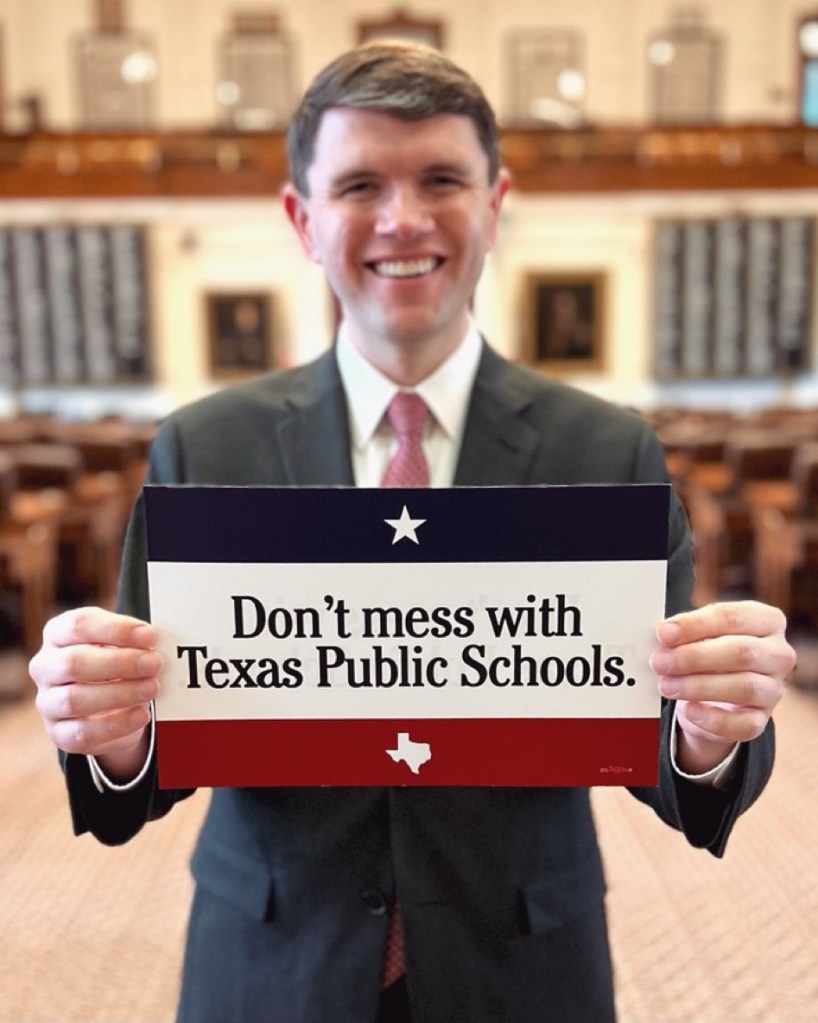
James Talarico is a state legislator in Texas who stands up for public schools. He is a Democrat who supports gun control and expanded health care (he calls it “health care for y’all)”). He graduated from public schools in Round Rock, Texas, then earned his BA at the University of Texas and his MA in education policy at Harvard. He joined Teach for America and taught at a middle school in San Antonio, where his class had 45 students.

I’m usually skeptical about TFA teachers, but knowing Gary Rubinstein—an early TFA corps member—has taught me not to be so judgmental.

Talarico is a phenomenon. He’s an effective, outspoken opponent of vouchers. If you are still on Twitter (aka X), watch his powerful debunking of voucher myths. Vouchers are not “school choice,” because schools choose, and they can discriminate against anyone they want, for any reason.

Talarico recently co-sponsored a bill called “Fully Fund Our Schools,” which increases funding for the state’s public schools and provides a $15,000 raise for every teacher. Texas can afford it; the state has a $33 billion budget surplus.

Politico wrote about Talarico a few months ago and suggested that he might be the Democrat who is able to win a statewide office. He might run against Greg Abbott for governor in 2026. Talarico Represents a better future for Texas.

Talarico is a devout Christian. As the Politico story explains, he is taking classes at a seminary and hopes to be ordained as a pastor. He is steeped in Biblical knowledge, and he can respond to bigoted evangelicals and fundamentalists with the sense of love, hope, kindness, and charity that represents progressive Christian thought.

For his leadership, for his determined support for the public schools attended by 5 million students, for his enlightened support for progressive values, I am pleased to add James Talarico to the honor roll of this blog.

Ryan J. Higgins is a captain in the U.S. Arny Reserve who received an Ed.D. in education at TCU. He is a strong supporter of public schools.

The state commissioner of education in New Hampshire, Frank Edelblut, homeschooled his 10 children. He knows nothing about public schools and the role they play in communities. Appointed by Governor Chris Sununu, Edelblut has devoted his time in office to promoting anything but public schools.

He pushed voucher legislation and projected it would cost $3.3 million in its first two years. The actual cost was $22.7 million. The vast majority of children who use vouchers never attended public schools.

New Hampshire has about 160.000 students who attend public schools. In the first year of the voucher program, 90% of the students who claimed vouchers were already enrolled in religious and private schools. The proportion now remains over 80%. Vouchers are now claimed by about 2.6% of the state’s students. About 1/2 of 1% of the voucher users previously were enrolled in public schools.

Vouchers are a subsidy for private school students.

Garry Rayno of IndepthNH writes:

CONCORD — In three years, the enrollment in the Education Freedom Account program has grown 158 percent, while the cost has increased 174 percent in figures released this week by the Department of Education.

For the current school year, 4,211 students are in the program, up from 3,025 at the same point last year, and from 1,635 for the 2021-2022 school year.

The costs have grown from $8.1 million the first year, to $14.7 million the second year and $22.1 million this school year.

This year the financial threshold to participate in the program was raised from 300 percent of the federal poverty level to 350 percent.

That increases the threshold for the current school year from $59,160 for a family of two, to $69,020, and for a family of four from $90,000 to $105,000 annually.

Once a family qualifies for the program there are no future financial limits on earnings.

Department of Education Commissioner Frank Edelblut, who championed the program before the legislature, was pleased more and more students are participating in the EFA program

“It has been three years since the launch of New Hampshire’s successful Education Freedom Account program, and it is apparent that New Hampshire families are taking advantage of this tremendous opportunity that provides them with different options and significant flexibility for learning,” said Edelblut. “With three years of data under our belt, we know that students are coming and going from the program, which is exactly how it was designed – to allow various options for personal learning needs that may fluctuate from year-to-year based on whatever path is appropriate in the moment.”

The program was sold by Edelblut and others as an opportunity for lower-income parents to find the best educational fit for their children if they have problems within the public school system.

However the vast majority of the money spent through the expansive voucher program has gone to pay the religious and private school tuition of students in those schools prior to the EFA program’s creation. [Emphasis added]…

A larger number of EFA students this year left public schools to go into private or parochial schools, 444 students, compared to 282 last school year, and 286 in the 2021-2022 school year.

Overall there are 1,577 new students to the EFA program this school year, while 109 students left the program due to graduation, 75 returned to public schools, and 524 students left the program for other reasons.

The 1,577 new students are 128 more students than the previous year.

When the program first began, the Department of Education projected its first two years would cost about $3.3 million and instead the state paid $22.71 million.

The advocacy group Illinois Families for Public Schools were shocked by Governor Pritzker’s decision to extend the state voucher program. They were shocked because of his campaign promises not to support schools that discriminate, and they were shocked by the data showing that discrimination against students with disabilities and LGBT students is widespread among voucher schools. Most voucher schools are religious, and they are free to exclude any student they don’t want.

Illinois Families for Public Schools’ Statement on Gov. Pritzker’s Vow to Sign an Extension of the Illinois Voucher Program

Friday October 20, 2023

Illinois Families for Public Schools is profoundly disappointed at Governor Pritzker’s statement yesterday that he is committed to signing any bill sent to him that would extend the Invest in Kids voucher program.

This commitment contradicts the statements he made when he ran for governor in 2018, including his response to our candidate questionnaire:

“I oppose Bruce Rauner’s backdoor voucher program that was inserted into the school funding reform bill last year. As governor, I will work to repeal that measure.”

Worse yet, it conflicts with the values Pritzker has espoused again and again in his time in office: That Illinois is a welcoming and inclusive state where it is unacceptable to treat individuals differently because of their identity, where justice and equity make Illinois a safe space for all, where we want our young people “to become critical thinkers, exposed to ideas that they disagree with, proud of what our nation has overcome, and thoughtful about what comes next”, where K-12 schools are “liberatory learning environments that welcome and affirm LGBTQ+ young people, especially those how are transgender, nonbinary, intersex, Black, Indigenous, people of color, people with disabilities, and all communities that experience marginalization.

Since 2018, the Invest in Kids voucher program has diverted more than $250 million in state funds to private schools, 95% of which are religious. Religious schools, even those getting public dollars, can and do legally discriminate against nearly any protected category of student, family or staff:

  • At least 85 schools in the Invest in Kids program, nearly 1 in 5, have anti-LGBTQ+ policies.
  • Only 13% of private schools in the Invest in Kids program last year reported to the Illinois State Board of Education that they served any special education students. The majority of schools in the program are Catholic schools, and four of six Catholic dioceses in Illinois have policies that say schools may refuse to accommodate students with disabilities.
  • Policies that discriminate against pregnant and parenting students, students who have had an abortion, English-language learners, students with disabilities, undocumented students, and more are widespread in Illinois voucher schools as well.

Due to recent Supreme Court decisions, there is essentially no way to have a state voucher program that only funds non-religious schools or alternatively prohibits religious schools from discriminating based on religious belief. As such, there is no way to end discrimination in voucher schools in Illinois short of ending the program altogether.

Extending the voucher program is supported by anti-public good extremist groups, including Betsy DeVos-funded Illinois Federation for Children, the Koch-funded Americans for Prosperity, Awake Illinois, and Moms for Liberty Lake County.

Access to a well-resourced public education is a fundamental right. Illinois public schools are still short billions of dollars in state funding needed to educate their students.

Public dollars must be for used public schools that welcome and educate all children, as well as protect their civil rights. Strong public schools are the foundation of a healthy, pluralistic democracy and are a public good that benefits everyone in Illinois.

It is unacceptable to continue the Invest in Kids program in any form.

Why is Governor Pritzker thinking so small when it comes to our public schools?

###

Contact: 

Cassie Creswell, 773-916-7794, info@ilfps.org

About Illinois Families for Public Schools

Illinois Families for Public Schools (IL-FPS) is a grassroots advocacy group that represents the interests of families who want to defend and improve Illinois public schools. Founded in 2016, IL-FPS’ efforts are key to giving public ed parents and families a real voice in Springfield on issues like standardized testing, student data privacy, school funding and more. IL-FPS connects families and public school supporters in more than 100 IL House districts. More at ilfps.org.

The National Education Policy Center at the University of Colorado invited scholar Chris Lubienski of Indiana University to review a recent publication of EdChoice (the new name of the Milton and Rose Friedman Foundation), which summarizes what voucher advocates believe about the efficacy of vouchers. The publication is titled “The 123s of School Choice: What the Research Says About Private School Choice Programs, 2023 Edition.”

Not surprisingly, EdChoice concludes that vouchers are effective. Lubienski, however, is critical of the studies they include and those they exclude. In short, EdChoice engages in cherry-picking to bolster its cause.

While the report confidently asserts that school choice works, Lubienski says that the authors ignore recent studies that show the opposite to be true. For many students, vouchers are harmful.

If your district or state is under pressure to endorse vouchers, be sure to read this review.

The New Republic convened a meeting to discuss Trump, book banning and the culture wars. Randi Weingarten described the attack on schools as a coordinated strategy to destroy public schools and promote vouchers. Edith Olmsted of The New Republic interviewed her. None of this is new to readers of this blog, but the American public needs to hear this message. Again and again.

Book Bans Are a Conservative Plot to Destroy Public Schools, Says Randi Weingarten, The teachers union head denounced the “extremist strategy,” which also includes voucher campaigns and manufactured outrage over critical race theory.

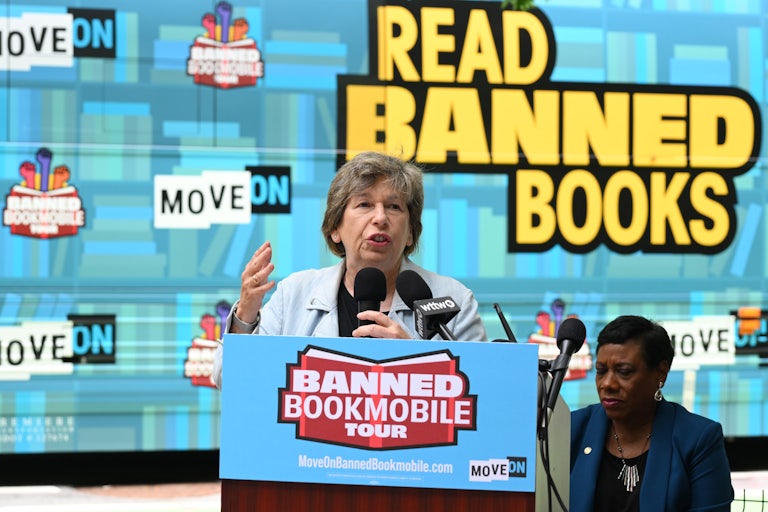
DANIEL BOCZARSKI/GETTY IMAGES FOR MOVEON

Teachers union head Randi Weingarten says that the campaign by conservatives to ban books isn’t about the books at all, but part of a broader strategy to destroy public schools—one that was supercharged by the pandemic.

“You take the agita and the anxiety that people had at Covid, that fear, and you combine it with a right wing who has wanted to kill public schools for years and take that money for vouchers, and you have the scenario we have,” Weingarten, the president of the American Federation of Teachers, said Wednesday at The New Republic’s Stop Trump Summit.

Vouchers, which use public education dollars to fund private and religious school attendance, are just one pillar of the conservative campaign to “undermine, destroy, and defund” public schools, she said. The other two are book banning and manufactured outrage over critical race theory.

Weingarten pointed to conservative activist Chris Rufo and a comment he made at Hillsdale College, a Christian nationalist school, in which he admitted that focusing on these issues was all part of a master plan to promote universal vouchers: “To get to universal school choice, you really need to operate from a premise of universal public school distrust.”

In an interview with TNR after the event, Weingarten explained the “extremist strategy” Rufo and other conservatives have used to defund public schools. “The hook was trust. If you really create as much distrust as possible in public schooling, then parents will look at privatization as an option,” she said.

That’s where critical race theory comes in.

“[Rufo] tried to make a term that nobody knows so toxic, so that you can weaponize it and make fear,” she said. “Conversations about hard subjects became weaponized as indoctrination. Which is patently ridiculous, and dangerous.”

Race, as well as gender, is the subject conservatives have focused on in their campaigns to ban books in public schools and libraries.

“What [Republican Governor Ron] DeSantis is doing in the so-called ‘war on woke,’ is exactly part of their playbook—to make people afraid of books, and afraid of what we do in school,” Weingarten said. According to Pen America, Florida passed 15 “educational intimidation” bills in the last two and a half years.

The “parents’ rights” movement is made up of a loud minority, Weingarten said, and actively undermines what most parents want. “What we see in Florida is that 60 percent of the book banning has been done by 11 people,” she said.

The AFT has partnered with The New Republic in fighting back against such bans. TNR’s Banned Books Tour has been delivering thousands of banned books across the country this month, most recently in Florida.

Charles Foster Johnson is the founder of Pastors for Texas Children. He actively supports full funding of public schools and separation of church and state. He, along with other faith leaders, wrote the following article in The Dallas News.

Don’t Defund Public Schools

Voucher scheme wastes money, violates Constitution

The education community in Texas has remained patient and courteous throughout the spring general session of the Legislature despite the record $32.7 billion surplus. They have upheld the values of kindness and respect that society expects. However, there comes a point when patience wears thin, and the truth must be spoken: it is time to allocate the necessary resources to educators and school districts.

Simply put, it’s time to provide the funding our educators and school districts need. This funding is not a luxury; it is a necessity. It is essential for Texas teachers to keep pace with the rising cost of living. School districts must fulfill their role in shaping the future workforce of Texas, which boasts the ninth-largest economy in the world. It is imperative to honor the trust placed in you by Texas taxpayers, who expect their hard-earned money to be invested wisely in the education of over 5 million Texas students.

The time for political games and holding funds hostage for private schools must end. Public schools are the heart of our educational system and need their fair share of resources. Even after passing tax relief measures earlier this summer, there remains a surplus of $14 billion, not to mention the over $21 billion in the state’s rainy day fund. Moreover, inflation ensures that surplus funds will continue to accumulate in the foreseeable future. This is not the government’s money to wield for hardline negotiations; it belongs to the people of Texas.

Over 90% of Texas students attend public schools, yet the state has not increased funding to school districts since 2019. Operating costs have significantly risen during this period. Additionally, our teachers, who demonstrated unwavering dedication during the global pandemic, have yet to receive sufficient salary increases to keep pace with inflation.

It is high time to allocate the necessary resources to public schools to address these issues.

Due to legislative inaction during the spring, school boards across Texas were forced to approve deficit budgets merely to survive this academic year. For example, Dallas ISD approved a $186 million deficit budget, Garland ISD faced a $69 million deficit, and Plano ISD had to manage a $24 million shortfall. This approach is akin to depleting one’s savings to pay the electric bill — it is unsustainable and morally unacceptable.

What is most disheartening is the lack of significant funding for schools this year and the mounting frustration within the education community: educators, administrators and parents alike. It should not have come to this point.

Instead of prioritizing public schools, Gov. Greg Abbott has traversed the state promoting a program that redirects tax dollars to private schools, masquerading under the banner of “education freedom.” Comparable programs in other states have proven to be financially burdensome. Arizona’s private school subsidy program, initially allocated at $65 million, is estimated to cost $900 million next year. In Florida, a similar program has been used for non-educational purposes like theme park tickets, kayaks and televisions (https://www.firstcoastnews.com/article/news/verify/yes-school-vouchers-in-florida-can-be-used-for-tvs-skateboards-theme-park-tickets/77-49577639-1a29-4acd-86ac-af50efc107e9).

Voucher programs like these do not align with the principles of fiscal conservatism. Moreover, the effectiveness of private school subsidies in improving student achievement remains highly questionable. In other states, established private schools have yet to embrace these subsidies due to limited capacity and high costs. Consequently, makeshift private schools have arisen, unable to match the offerings of public schools, resulting in most students returning to the public system.

The notion that funding for Texas public schools has been delayed to channel resources to private schools should anger the parents of millions of children and the thousands of educators who tirelessly serve them. Our students have only one chance to experience their current grade level; they should not be made to wait.

In a disturbing breach of the American principle of separation between church and state, Abbott has called upon ministers and pastors to advocate for this subsidy program from their pulpits on Sunday, Oct. 15. Texans understand a fundamental truth that eludes the governor: Genuine faith must be voluntary and cannot be endorsed or supported by state authority. Using tax dollars to subsidize religious instruction is a violation of this principle.

Abbott’s threats against state representatives who support public education constitute a desperate attempt to intimidate them. The Texas House has consistently opposed private school subsidies for over two decades, and there is no reason for that stance to change now.


The time for delay has passed; enough is enough.


Charles F. Johnson is executive director of Pastors For Texas Children. George A. Mason is senior pastor emeritus at Wilshire Baptist Church. Victoria Robb Powers is senior pastor at Royal Lane Baptist Church. Andy Stoker is interim executive director at Interfaith Alliance Texas. Neil G. Thomas is senior pastor at Cathedral of Hope United Church of Christ. They wrote this column for The Dallas Morning News.