I wa despairing because no prominent candidate has mentioned education. Kamala Harris spoke about public schools and teachers when she addressed the AFT yesterday in Houston. I expected that. She went to public schools and has always supported them, and that’s what a candidate says to a nation Union of teachers.
But on Jen Psaki’s show on MSNBC, Governor Tim Walz of Minnesota denounced vouchers and book bans. I had never seen him speak. He was excellent! Please watch.
You are an exciting candidate, and I am thrilled to help in any way I can to see you become President of the United States. I admired President Biden and his courage in selecting you to be his Vice-President.
Now I see you in the campaign trail, happy and spreading joy. Quite a contrast to Trump, who is always scowling, angry, and promising to wreak vengeance on his enemies.
I have one piece of advice: Please do not choose Josh Shapiro as your Vice President. I know he is popular in Pennsylvania, and you need Pennsylvania.
But Josh Shapiro is a supporter of vouchers. Vouchers are a hoax. Their boosters are right-wing foundations who oppose abortion, gun control, and climate action. Vouchers hurt public schools. Vouchers are the pet project of Betsy DeVos, Charles Koch, the Bradley Foundation, the Olin Foundation, and Texas evangelical billionaires Wilks and Tim Dunn. Another huge voucher supporter is multibillionaire Jeff Yass, the richest man in Pennsylvania, who has spread money to other states to promote vouchers and is rumored to have encouraged Shapiro to push vouchers.
Vouchers are bad not only because of their supporters but because they fail to help poor kids. In fact, the evidence from evaluations in Louisiana, Ohio, Indiana, and D.C. demonstrate that vouchers damage the academic outcomes of poor kids.
Most students who use vouchers are already enrolled in private schools. Why should the state subsidize families who don’t need the money but would be happy to have it as a gift from the state?
I know you don’t have a lot of time for reading these days, but I urge you to read anything that voucher researcher Josh Cowen has written since 2022. In that year, he declared that vouchers had failed and were hurting the kids they were supposed to help. His new book, The Privateers: How Billionaires Created a Culture War and Sold School Vouchers, lucidly describes the origins of vouchers in the fight against desegregation in the 1950s and their utter failure to help “poor kids escape from failing schools.”
You have a great list of potential VPs. Governor Josh Shapiro of Pennsylvania should not be on that list.
In a short period of time, friends of public schools in Nebraska collected enough signatures to get on the November ballot. That is, if a hostile state official doesn’t kick off enough names to render their petition invalid, as happened in Arkansas. Voucher pushers are terrified of referenda; vouchers always lose—by big margins.
Public school supporters surpass signature goal to put repeal of LB1402 voucher scheme on the November ballot
LINCOLN – They had only 67 days – the shortest timeline for a petition drive in the state’s history – and Nebraska public school supporters rose to the occasion, again.
The Support Our Schools Nebraska coalition needed to collect 61,621 signatures to let voters repeal or retain a bill that spends millions of public tax dollars to pay for private schools. Today, the coalition submitted more than 86,000 signatures to the Nebraska Secretary of State to ensure the issue will appear on the November ballot. The group also exceeded the 38-county requirement with 5% of voters signing the petition in more than 60 of the state’s 93 counties.
“Since last summer we’ve collected more than 200,000 signatures from Nebraskans who believe voters should decide whether public funds should be used to pay for private schools,” said Jenni Benson, Support Our Schools Nebraska sponsor and president of the Nebraska State Education Association. “The incredibly short timeline was a huge challenge, but Nebraskans wanted to sign this petition – many were appalled that LB1402 was passed to block citizens from voting on the issue and to impose a costly new voucher scheme on taxpayers.”
This is the second time Support Our Schools Nebraska has collected enough signatures to ensure voters have a say on a legislative bill that diverts public tax dollars to pay for private schools.
Last summer, the group gathered 117,415 signatures in 85 days to put the repeal of a previous voucher bill, LB753, on the November 2024 ballot. Even after the Secretary of State certified that the LB753 petition met all statutory and constitutional requirements to put the issue on the ballot for voters to decide, the bill’s sponsor, Sen. Lou Ann Linehan tried to have the Secretary of State take it off the ballot. When her attempt failed, she introduced LB1402, a bill that denied Nebraskans their right to vote on LB753’s voucher scheme while imposing a new costly voucher plan on Nebraska taxpayers.
“Despite attempts by a few politicians and some wealthy special interests to ignore the will of the people, Nebraskans have once again affirmed their support for public schools. This direct democracy effort is a testament to the resolve of the people of Nebraska and highlights the immense importance of public schools in our communities,” said Brad Christian-Sallis, Director of Power Building, Nebraska Table.
“Our Nebraska neighbors have made two things very clear: they expect that the state of Nebraska will make responsible investments with their tax dollars, and they love their public schools. That’s why they have turned out once again to have the chance to vote to repeal this legislation in November,” said Dr. Rebecca Firestone, Executive Director of OpenSky Policy Institute. “They have seen costs for similar programs balloon across the nation, like in Iowa, where the cost of the program is expected to triple, reaching $345 million in just two years, or Arizona, where the cost of its universal voucher program has exceeded budget projections by 1,346%.”
“The underestimated anger among voters about being denied their earlier chance to vote is palpable. I heard this sentiment frequently, often unsolicited, as voters lined up to sign the petition,” said Cynthia Peterson, president of the League of Women Voters of Lincoln-Lancaster County and representing the League of Women Voters of Nebraska.
“Nebraskans deserve the opportunity to vote on school vouchers—yes or no. Recently, even a nun signed our petition, jokingly acknowledging potential consequences but steadfast in her belief that voters should have the final say. Every Nebraska voter has a voice in our system of government. This referendum petition all boils down to letting the people decide.”
“Today, the people of Nebraska have once again exercised their constitutionally protected right to referendum, ensuring that their voices will always be heard. This moment stands as a testament to the deep and unwavering love Nebraskans have for their public schools, which remain the heart and soul of our communities. In this defining moment, we celebrate the power of democracy and the enduring spirit of our great state,” said Dunixi Guereca, Executive Director of Stand for Schools.
“PTA’s mission is to make every child’s potential a reality by engaging and empowering families and communities to advocate for all children. We value collaboration, commitment, diversity, respect, and accountability. Nebraska PTA is proud to stand with the Support Our Schools Nebraska Coalition. We align with the National PTA in advocating for the improvement of public education for all children and to guarantee that public funds are not diverted to any private school choice proposal and/or voucher systems,” said Christine Clerc, Executive Committee of the Nebraska PTA. “Public dollars must remain invested in public schools for the benefit of all students and the future of our nation. We are so grateful for all the individuals who have signed the petition and collected signatures so that we might continue the Nebraska tradition of strong public schools in every corner of our state.”
“Public Education is the great equalizer in ensuring that all children regardless of geographical or social location have access to learning, growing, achieving and giving back in service,” said Rev. Dr. Karla Cooper, LPS Foundation Board of Directors.
“The overwhelming success of the Support Our Schools campaign falls in line with what the majority of Nebraskans believe and support. According to the Institute’s 2023 public opinion poll, 64 percent of Nebraskans said they oppose using public dollars to subsidize private, religious, or charter schools. Simply put, state lawmakers should respect the will of the people and support our public education system, instead of undermining our community’s interests and priorities,” said Hadley Richters, CEO of the Holland Children’s Movement.
“Nebraskans have wisely rejected public funding of private institutions at the ballot box three times previously and we need to do so again,” said Tim Royers, a sponsor of Support Our Schools Nebraska and president of the Millard Education Association. “All we have to do is look at states with similar voucher programs. Those states and their taxpayers are struggling with the skyrocketing cost of these programs, as well as with the lack of transparency and accountability. Arizona’s voucher program is a fiasco with the governor there saying it will likely bankrupt the state, that it does not save taxpayers money, and it does not provide a better education for students. Our neighboring state of Iowa passed a voucher program last year. It led to a huge spike in private school tuition while the cost to state taxpayers far exceeds the initial estimates, growing to nearly $180 million for this coming year. We can avoid those problems by voting to repeal LB1402’s voucher scheme at the ballot box this November.”
This year’s sprint to collect signatures was a grassroots effort from a broad base of nonprofits supporting public schools.
The effort included more than 2,800 volunteers who circulated petitions and coordinated more than 800 signing events. More than 1,300 individuals have donated to the effort with an average donation of $42.
The Secretary of State will forward the petitions to local election officials, who have 40 days to verify the petitions and the signers’ information. Once all petitions have been reviewed and requirements met, the Secretary of State will certify the measure for the November 2024 General Election ballot.
For more information on the effort to repeal LB1402’s voucher scheme, please visit:
Matthew Stone of Education Week described the plans for K-12 education in a second Trump term, as they appear in Project 2025, a document written by hundreds of former Trump officials. The 44-page education section emphasizes eliminating the U.S. Department of Education, distributing its functions to other agencies, converting categorical funds (like Title I for low-income children) into block grants, and rooting out “critical race theory” and any recognition of the existence of LGBT students. The document emphasizes the primacy of parental rights.
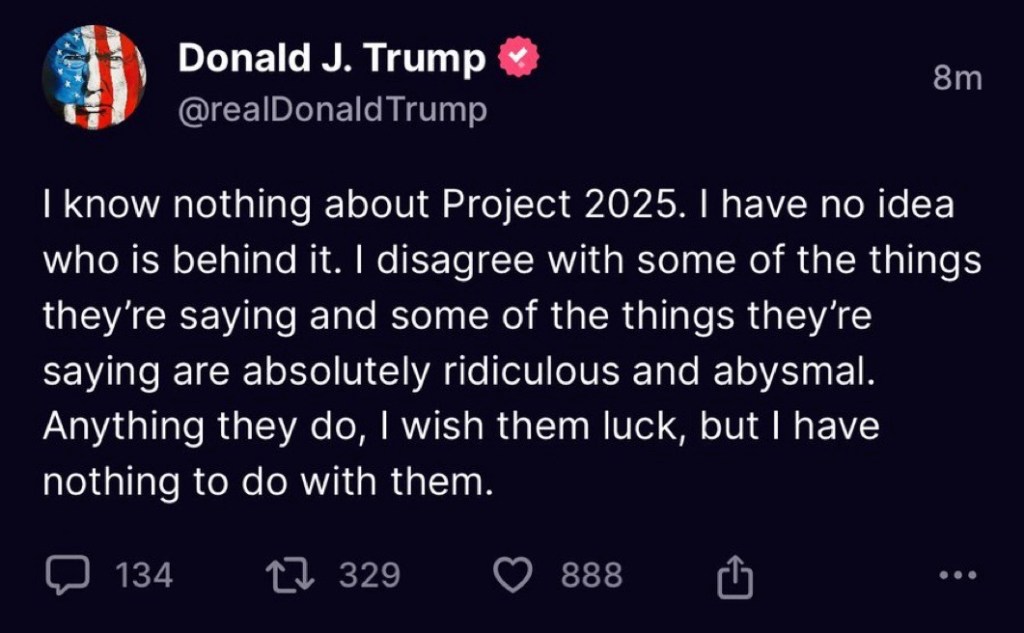
Trump has distanced himself from the document, because its recommendations are so radical, but it was prepared under the watchful eye of Kevin Roberts, president of the ultra-rightwing Heritage Foundation. Roberts is a close associate of Trump’s.
Stone wrote:
What would Donald Trump do in the realm of K-12 if voters return the former president to the White House?
He and his campaign haven’t outlined many specifics, but a recently published document that details conservative plans to completely remake the executive branch offers some possibilities. Among them:
Title I, the $18 billion federal fund that supports low-income students, would disappear in a decade.
Federal special education funds would flow to school districts as block grants with no strings attached, or even to savings accounts for parents to use on private school or other education expenses.
The U.S. Department of Education would be eliminated.
The federal government’s ability to enforce civil rights laws in schools would be scaled back.
The proposals are contained in a comprehensive policy agenda that’s part of a Heritage Foundation-led initiative called Project 2025: Presidential Transition Project, which includes nearly 900 pages of detailed plans for virtually every corner of the federal government and a database of potential staffers for a conservative administration. It will also feature a playbook for the first 180 days of a new term.
The agenda is designed to be ready for a conservative president to implement at the start of a new administration next year, depending on the outcome of November’s election.
Project 2025 involves former Trump administration officials and other allies of the former president, as well as dozens of aligned advocacy organizations. One of those is Moms for Liberty, the Florida-based group that rose to national prominence fighting school boards over COVID-19 safety protocols and has endorsed conservative school board candidates across the country in recent years.
But because he’s released little in the way of detailed plans, Project 2025’s 44-page agenda for the U.S. Department of Education offers the clearest picture yet of the education priorities Trump could pursue in a second term, and how a second Trump administration could use the federal government to advance conservative policies like private school choice and parents’ rights that have taken root in many Republican-led states.
Trump is trying to distance himself from Project 2025 because it is so radical. But no one takes his protestations seriously.
The editorial board of the Capitol Broadcasting Company wonders why voucher schools in North Carolina are exempt from the same accountability as public schools. The answer is simple: They don’t want the public to know. They don’t want them to know that most kids who use vouchers never attended public schools. They don’t want them to know that the few public school kids who sought vouchers are falling behind their peers in public schools.
It is not an unrealistic expectation that North Carolinians hold elected officials – whether executive, legislative or judicial – accountable for how tax dollars are spent.
When legislators dole out — say more than half-a-billion dollars – to private schools it should go without mention there would be clear provisions for taxpayers to know how much money goes where, whether the money is being spent for the purpose intended and whether that purpose is being achieved.
Accountability isn’t simply to the parents of students. Achievement isn’t merely a matter of the parents’ happiness.
All North Carolinians – particularly every taxpayer who is paying the tab – have a right to know how their money is being spent and whether it is in the hands of competent and qualified people to deliver the services intended – educating school children.
When it comes to private school vouchers, the leaders of the General Assembly want to pump as much as $632 million into them so that even wealthy families can gain taxpayer subsidies for their kids’ tuition. Nearly 20% of the likely beneficiaries are families with annual household incomes exceeding $259,000 (representing the top 7% of families in the state).
Accountability is overlooked. More than overlooked, it seems legislative leaders are actually blocking the kinds of routine accountability that other recipients of taxpayer money must adhere to.
A recent examination of 200 private schools that receive the greatest share of taxpayer-funded vouchers by the Public School Forum of North Carolina revealed little oversight and few of the basic requirements that are in place for public schools, so taxpayers can see if their schools are properly staffed and kids are learning.
It is the law that students in public schools be taught by state-certified teachers. Voucher-supported private schools have no teacher-certification requirements. Only 2% of private schools require teachers have state certification.
Public schools must operate at least 185 days for classroom instruction. There’s no requirement of any minimum on instruction for voucher-supported private schools.
Public schools – including charter schools – must administer state end of grade tests. Voucher private schools can administer a nationally-normed standardized test of their choice to students. They must pay if they choose to use the state’s end of grade tests (see clarification below).
Current funding schemes for private school vouchers – even if funding for students from low- and modest-income families – needs to be accountable.
And there’s certainly no urgency to act on the unwise expansion of private school vouchers. The reality is that none of the families who might be awaiting word on the availability of the subsidies, is dependent upon them to send their kids to ANY school of their choice – public or private.
There are certainly some circumstances when the education needs of students cannot be met in public schools. Having a taxpayer-financed option for those students who need it – and need financial assistance – is appropriate.
But every taxpayer should be able to know – by transparency and accountability set out in state law – that their dollars are being spent as intended by competent teachers and there’s a demonstrable way to determine the effectiveness of the instruction.
Schools that discriminate in admissions or hiring, schools that don’t require basic teacher certification, classroom attendance, schools that don’t show student achievement through the same end-of-grade testing used in public schools and schools that don’t make that information available as public schools do, should not be subsidized with taxpayer dollars.
That’s just basic accountability our legislators should demand and schools willingly provide.
CLARIFICATION: An earlier version of this editorial stated that North Carolina private schools receiving taxpayer-financed vouchers were prohibited from using state end of grade tests. Private schools, including those receiving vouchers, are not prohibited from participating in the state’s end of grade and/or end of course tests, according to the state Department of Public Instruction. If the private schools pay they can participate and some do, according to the department.
Leaders of the pro-public school organization called Public Schools First in North Carolina discovered that many public school parents and advocates are unaware that the state’s General Assembly has passed a budget that gives vouchers to the rich. They are distributing the following opinion piece from the Greensboro News to inform the public:
Our Opinion: Five words for GOP candidates: ‘And you’re OK with That?’
“And you’re OK with that?”
As Republican candidates for the state legislature begin to the make the rounds this fall, they should be hearing those five words over and over from constituents of all political stripes.
At every stop, on every stump, they should be pressed to give straight answers to that simple question on three issues:
Private-school vouchers
Even as they’ve increased taxpayer funding for private school tuition, adding wealthy families to the dole, many local public districts, including our own in Guilford and Forsyth counties, complain that they are seriously underfunded.
To be more specific, your party plans to plow hundreds of additional millions in taxpayer money into private school tuition assistance. Although 40% of that money ($96 million) would go to middle-class and working-class families earning between $57,721 to $115,440 a year (for a family of four), 44% (or $107 million) would go families earning $115,441 to $259,740.
And 16% (or $39 million) would go to those who need it the very least: wealthy families earning more than $259,741 annually.
One Democratic lawmaker likened it to asking low- and moderate-income taxpayers to help pay for a wealthy kid’s Porsche.
How do you square that with your rhetoric against “the welfare state” and profligate spending of other people’s money?
How do you square it with public school funding gaps throughout the state?
And how do you tell public schools no, that’s all we have to spend and then turn around and tell rich families y’all come. Who do we make the check out to?
Keeping secrets
Your party also slipped a provision into the state budget bill last fall that allows state lawmakers to decide for themselves whether they will make any of their documents accessible to the public.
By law, they also get to choose whether to destroy or sell documents. They’re the decider. Which means they’re creating their own deep state right here and now on Tobacco Road.
What are they trying to hide and why?
And what gives them the right to membership in this exclusive club, but not others (the governor, the lieutenant governor, the attorney general and other North Carolina officials who are elected statewide need not apply)?
Easy money
Then there’s the provision the Republican-controlled legislature embedded within an (unnecessary) anti-masking bill that allows more “dark money” donations to political candidates in North Carolina.
As the current law stands, candidates must disclose the names of donors to their campaigns. They also are prohibited from taking donations from corporations, and contributions from individuals and political groups may not exceed $6,400.
This bill would change all that by making it legal for political parties in the state to take money from “Super PACs,” which are allowed to keep their donors secret and may receive unlimited amounts of money.
Those Super PACs would be able to collect the money and pass it on to the political parties, which could then funnel it to candidates, no questions asked.
At least your party has made no secret of the fact that it designed this new rule specifically with the GOP gubernatorial candidate in mind. Mark Robinson substantially trails his Democratic opponent, Josh Stein, in fundraising.
To recap, are you OK with:
Channeling taxpayer money to rich people as public schools go wanting?
Keeping documents and correspondence a secret from the public … unless you decide to share it?
And allowing anonymous cash to flow unfettered to candidates of both parties?
If the answer is yes, please explain how any of this benefits most North Carolinians and why we should vote for you anyway.
And how this in any way resembles government for, by and of the people.
Lisa Haver is a former Philadelphia teacher. She is co-founder and coordinator of the Alliance for Philadelphia Public Schools. She warns about the absurdity of defunding the state’s public schools while expanding vouchers to subsidize students currently in private and religious schools. This article appeared in the Philadelphia Hall Monitor.
Lisa Haver writes:
Musician and entrepreneur Jay-Z last month joined the ranks of out-of-town billionaires lobbying to expand voucher programs in Pennsylvania. Representatives from his Roc Nation came to Philadelphia to push for passage of PASS (Pennsylvania Award for Student Success), legislation that would divert more tax dollars from the state’s education budget to private schools. Roc Nation representatives repeated claims by voucher supporters, including Governor Josh Shapiro and suburban billionaire Jeffrey Yass, that PASS would give the students an alternative to the city’s “failing schools.” Jay-Z’s spokespersons told reporters that after seeing students “struggling in the public education system, within the lowest performing schools, we wanted to do something to help the community.”
Not being from around here, Jay-Z and his representatives, apparently, are not up on the history of underfunding and privatization in the city and the state and the many schemes over the years that have failed to deliver on promises for a better education and stronger communities. They seemed unaware of how vehemently Philadelphians oppose the idea of diverting even more money from underfunded public schools to affluent private schools.
The proposed expanded voucher legislation allows for even less accountability than the state’s existing programs. Since their passage in 2001, the Education Improvement Tax Credit (EITC) and the Opportunity Scholarship Tax Credit (OSTC) have sent over $2 billion in taxpayer funds to private schools. Education Voters PA estimates that 78% of EITC and OSTC funds go to religious schools that do not have to be accredited or adhere to the same curriculum standards that public schools do. This means public money going to schools that teach creationism or that slavery wasn’t really that bad and to schools that can and do discriminate against LGBTQ students and those with special needs. School choice has always meant the schools’ choice. And a feature, not a bug, of EITC and OTSC is the absence of data. Ed Voters PA points out that Act 46, passed in 2005, “explicitly prohibits the state from collecting data about voucher programs or students” who participate in them.
There is already conflicting information about how PASS would work, who would be eligible, and the size of the scholarships, which range from $2500 to $15,000 depending on grade and level of need. But even the maximum allowance wouldn’t cover the tuition of the exclusive private schools whose tuition ranges from $25,000 to almost $50,000. The reality is that most of the voucher money goes to families with students already in private schools, not to students transferring from public schools.
Republican legislators and pro-school choice lobbyists maintain that distributing public funds to privately managed schools with a minimum of public oversight will help the city’s children get a better education. Where have we heard that before?
In 1997, the state legislature passed the Pennsylvania Charter Law. Privatizing public schools, they assured us, would rescue the children trapped in failing public schools. The reality? Yearly assessments–using the framework formulated by charter operators themselves–show that Philadelphia charters rarely outperform district schools in academics. The district has spent millions in years-long legal proceedings to close substandard schools. Other charters have closed due to financial malfeasance of the schools administrators, or in the recent case of Math Science Civics, the whims of the charter CEO. The state charter law allows substandard charters to operate for years while they appeal non-renewal actions.
Parents who had hoped to find better schools in charters are returning to their neighborhood schools, with over half of the city’s charters now under-enrolled. Since the passage of No Child Left Behind, which enabled the privatization of public schools, students have been subjected to learn-to-the-test scripted curricula, with test prep classes replacing interesting and challenging electives. Their schools have been branded as failures, and many of their neighborhoods have lost the schools that served as community anchors.
Does Jay-Z really believe that the children of Philadelphia will win in a “hunger games” approach to education?
Last year, school districts in Pennsylvania won a significant victory when the Commonwealth Court ruled that the state must provide, as mandated in the state constitution, a “thorough and efficient system of public education to serve the needs of the Commonwealth.” Jay-Z should join the parents, students, educators and community members urging the state legislature to pass a budget that will fund smaller class size, school libraries, and healthy school buildings–in every school in every Philadelphia neighborhood.
Peter Greene, who taught for 39 years in Pennsylvania, wrote recently in The Progressive about Corey DeAngelis, who travels the nation to trash public schools and to advocate for vouchers. If you hate public schools and unions, he’s your guy. If you adore Betsy DeVos and her plans to destroy local communities and to get more children into discriminatory religious schools, he’s your guy.
Greene writes:
Corey DeAngelis is an influential, if not the most influential, voice in the rightwing campaign to demonize public schools and privatize public education. The guy’s résuméhits all the bases in the libertarian gameplan. After earning a doctorate at the University of Arkansas’s education reform program (funded bythe pro-school choice Walton family), DeAngelis helped found the Education Freedom Institute, became a senior fellow at the Reason Foundation, worked as an adjunct scholar at the CATO Institute, took up an appointment as a senior fellow at the Hoover Institution, and was hired on as a senior fellow at Betsy DeVos’s American Federation for Children.
He still holds all of those jobs, but his more common title is “school choice evangelist.” As the recent school voucher wave has surged in state after state, DeAngelis has been there to spread the word. While on tour in support of his new book, he distills the current pro-voucher argument.
In a recent talk at the Heritage Foundation, DeAngelis touched on most of the main arguments for vouchers (many of them false) and revealed a few truths about the pro-voucher strategy.
1. The Evil Unions and COVID
The villainy of the teachers union is a thread that runs through much of DeAngelis’s argument, especially related to the COVID-19 pandemic narrative. DeAngelis blames the unions (and American Federation of Teachers president Randi Weingarten) for “fear mongering” and accuses them of extorting ransom payments by holding schools hostage. The unions, he charged, used the pandemic to empower themselves and the “government schools” that he calls “a jobs program for adults.”
There’s no recognition that teachers had a legitimate fear during the pandemic or that hundreds of educators died of COVID-19. Nor did he mention the many private and non-union charter schools that also closed their doors. Every problematic decision that he cited from pandemic times is blamed on the union, with no mention that Betsy DeVos’s Department of Education provided little or no guidance to districts facing difficult decisions in an evolving situation.
DeAngelis’s narrative argues that parents viewing Zoom school were appalled and awakened by what they saw. That oft-repeated tale stands in contrast to polls that show the vast majority of parents were satisfied with how their schools handled COVID-19. A 2022 Gallup poll found that, while the general public’s opinion of public schools is “souring,” parents’ favorable opinion of their own school matched pre-pandemic levels. The common sense conclusion to draw from this data is that people who don’t have first-hand experience with public schools are developing a low opinion of them based on some other source of information.
DeAngelis’s argument has other flaws. He claimed that the unions extracted a huge ransom from schools. But he also argued that pandemic relief funds given to schools never reached teachers and were, instead, soaked up by administrative bloat, which would seem to be a big tactical blunder on the unions’ part.
2. The Evil Unions and the Democratic Party
DeAngelis made the unusual claim that Democrats aren’t having kids, but Republicans are. But that, he said, won’t save conservatives because schools are fully “infiltrated by radical leftist union teachers.” The left uses schools as a way to control other people’s children. The Democratic Party, he added, is a fully owned subsidiary of the teachers’ union.
DeAngelis also repeated a false narrative of the National School Board Association’s supposed campaign to muzzle parents. In fall 2021, local school boards found their usually sleepy meetings had turned into wild, threatening, and even violent chaos. The NSBA turned to the Biden Administration for help, calling some of the actions “the equivalent of a form of domestic terrorism or hate crimes.” This was quickly and inaccurately cast as the Democratic administration calling parents domestic terrorists.
The resulting controversy caused the NSBA to lose some members, which DeAngelis seemed happy about. “Play stupid games, win stupid prizes,” he said.
This narrative that smears public school-friendly groups fits a general pattern of conservative attacks on groups seen as Democratic Party supporters.
Open the link to read more about the DeVos-funded public school hater who is spreading his propaganda across the nation.
Blogger Aaron Rupar, writing at “Public Notice,” sums up the goal of Project 2025, which is a lengthy tome describing the plans of the next Trump administration. The main goal, Rupar writes, is to abolish the 22nd Amendment—the one that sets limits for Presidents at two terms. Their hope: Trump for life. In recent days, Trump insisted that he knows nothing about Project 2025 or those who wrote it. That’s hard to believe since the authors served in his administration, and the project was sponsored by the Heritage Foundation. There’s a photo of Trump shaking hands with Kevin Roberts, the President of the Heritage Foundation, on the Heritage Twitter feed. Trump must have forgotten that he knows him.
Rupar writes:
Project 2025, the Republican plan to functionally annihilate not just the federal government but democracy as well if Trump wins in November, is an unceasing parade of horrors.
Banning the abortion pill nationwide? Check. Rolling back protections for LGBTQ people? Check. Deporting literally millions of undocumented immigrants? Check. But amid each objectively horrible aim is an even more more insidious one: abolishing the 22nd Amendment, which limits presidents to two terms. It’s an unvarnished, right-out-in-the-open plan to keep Trump in office well past 2028.
It’s not as if this is genuinely unexpected. By July 2019, Trump had “joked” at least six times about being president for life. Floating that as a possibility, as Peter Tonguette did last week over at The American Conservative, is a great opportunity to show fealty to a candidate who values loyalty over all else.
The American Conservative is a “partner” of Project 2025, along with such luminaries as Stephen Miller’s America First Legal law firm (currently suing everyone over the mildest of diversity efforts) and the Claremont Institute, which gave us Christopher Rufo and Moms for Liberty.
As Media Matters notes, the reasoning in Tonguette’s piece is dubious at best, but that doesn’t really matter. Project 2025 doesn’t rest on solid law, respect for democracy, or an understanding of history. It rests only on the notion that Trump should be allowed to exhibit raw, vicious, and unchecked power.
Tonguette’s piece doesn’t even bother with the pretense that getting rid of the 22nd Amendment would strengthen democracy overall. Instead, the piece is predicated on the utterly unfounded notion that when the amendment was passed, no one could have foreseen that a president would be elected to nonconsecutive terms.
While Tonguette does mention Grover Cleveland, who every schoolchild learns did indeed serve two nonconsecutive terms, he seems to think that people were perhaps unaware of him when the 22nd Amendment was passed in 1951. Tonguette handwaves away the existence of Cleveland by simply writing, “In modern times, it is virtually inconceivable that any of the ousted one-term presidents would have seriously thought of running anew against the same opponent (now the occupant of the White House) who had bested them four years earlier.”
It’s also inconceivable that millions of Americans would line up for a candidate who incited an insurrection, is facing 91 criminal charges, was found liable for sexually abusing E. Jean Carroll, and was just recently rich-guy panhandling to pay his massive bond to appeal his civil fraud penalty in a different case, but here we are.
Embracing autocracy … for this guy?
Like many other projects of the modern Republican Party, a newfound loathing of the 22nd Amendment is wildly hypocritical.
Though there were multiple unsuccessful pushes for presidential term limits before the passage of the 22nd amendment, the GOP House majority prioritized the issue after Franklin Delano Roosevelt’s death in 1945. No Republicans broke the party line during key congressional votes on the amendment, but they were helped along by southern Democrats who were mad that President Harry Truman continued FDR’s liberal economic policies.
To be fair, vaguely kicking around the idea of a third term has been standard procedure for a lot of two-term presidents, with President Barack Obama saying he thought he would likely have won a third election and President Bill Clinton saying he would probably have run for a third term if possible. However, the only serious push for a third term came from President Ronald Reagan, who said in 1987 that he “would like to start a movement” to repeal the amendment because it interfered with the right to “vote for someone as often as they want to do.” Reagan said he didn’t want this for himself but would press for it going forward, but like many things he said, that was somewhat less than truthful, as Republicans fundraised off the possibility of a Reagan third term starting in 1986.
Returning to Tonguette’s argument, it rests largely on his assertion that Trump is incredibly, historically popular, so he should get a third term. This, of course, ignores the fact that Trump is not actually that popular. He lost the popular vote in both 2016 and 2020. In 2016, Hillary Clinton trounced him by 2.87 million votes, while in 2020, Biden bested him by over 7 million.
Much of the post-2020 discussion from Republicans — the parts not about unhinged conspiracy theories — has centered around outrage that anyone could disregard Trump’s 74 million votes. It’s unclear what conservatives mean by that, save for that even when they have less support and don’t win elections, they should still run things.
And that’s what Project 2025 is all about. Republicans want to permanently enshrine their minority policies into law despite the fact that what they want is broadly unpopular. Fifty-nine percent of Americans want abortion to be legal. Over half of registered and likely voters do not want to vote for someone who makes robbing transgender youth of health care their core issue. Nearly three-quarters of American adults want the government to take bold steps to fight climate change.
Project 2025 is all about enacting minority rule in America immediately upon Trump’s election. To do so, Trump would first need to gut civil serviceprotections, which ensure that federal workers don’t have to adhere to the politics of any given president.
Trump tried this at the end of his term, issuing an executive order that would have made thousands of federal civil servants at-will employees. When he didn’t win a second term, he didn’t have time to implement it. Those apolitical employees — as many as 50,000 people — would be replaced with Trump loyalists. Power would be wholly consolidated in the executive branch.
Of course, Republicans hate that the executive branch, currently led by a Democratic president, wields any power and have been engaged in a decades-long project to dismantle the administrative state. Conservatives on the Supreme Court are helping along nicely with this project. But that pendulum would swing the other way fast if Trump retakes power, at which point conservatives will again love consolidating all power in the executive branch because the administrative state will be completely beholden to Trump.
Comparisons to historic fascist leaders once felt overblown, but with Trump declaring he’d be a dictator on day one of his presidency, those comparisons no longer seem so hyperbolic. However, Trump has much more modern analogs. Russia’s Vladimir Putin has thrashed that country’s nascent attempts at democracy, amending the constitution twice to allow him to stay in power as long as he wants. With his most recent victory last month in an election that was really no election at all thanks to widespread coercion and censorship, Putin may end up being ruler for life.
Then there’s Benjamin Netanyahu, Israel’s prime minister. In the summer of 2023, he forced a vote to curtail the power of Israel’s Supreme Court, a project his conservative government had been pursuing for months because the court doesn’t vote in lockstep with his goals. There’s also the fact that Netanyahu, like Trump, faces corruption charges and needs to be sure the courts can’t take action against him.
And finally, there’s Hungarian Prime Minister Viktor Orbán. Orbán has been the king of the culture wars in a way that Republicans can’t get enough of. In 2022, he gave a speech joking about gas chambers and warning against Europeans becoming “peoples of mixed race.” Unsurprisingly, this did not result in him getting disinvited to the Conservative Political Action Conference a short while later. Instead, Republicans loved his nationalist rhetoric so much that there is now a CPAC Hungary, where in 2023, Orbán complained about “the woke movement and gender ideology.”
If you want a preview of what would happen in a second Trump term, look to Hungary, which now bans anything with LGBTQ content whatsoever being shared with minors, and where the constitution was amended in 2020 to define “family” only as “based on marriage and the parent-child relation. The mother is a woman, the father a man.” Orbán also hates migrants and refugees, saying that people fleeing from war in places like Syria are a threat to Christianity. He has said he will defend Hungary against “tens of millions” of immigrants.
Trump’s vision for America is impossibly grim. It’s fueled by hate and disrespect for democracy, and the only way it can be stopped is at the ballot box in 2024, so that Project 2025 never comes to fruition.
Voucher advocates are justly frightened of state referenda. They claim that “polls show” that vouchers have public support. They don’t. The voucher forces know that every state referendum about sending public money to private schools has failed. In state after state, vouchers have been turned down by voters, typically by large margins.
I wrote a few days ago that concerned citizens in Arkansas were trying to collect enough signatures to get a referendum on the ballot for voucher school accountability. They were outmatched by big money. More than $1 million in spending defeated $8,217.
Supporters of public schools in Arkansas wanted the state to hold voucher schools to the same accountability standards as public schools. Why not? The voucher lobby has boasted for years about the superiority of private and religious schools. But the lobby goes to great lengths to shield those wonderful private schools from taking the same tests as public schools! The evidence is in: when poor kids use vouchers, they fall behind their peers in public schools. In Arkansas right now, almost all the voucher money is going to kids who never attended public schools.
Despite the efforts of some 1,200 volunteers in Arkansas, they collected only about 70,000 of the 90,704 signatures needed to put the referendum on the ballot this November. They promise to try again in 2026.
The anti-voucher group is called For AR Kids, which includes the Arkansas Conference of the NAACP, Arkansas Education Association, Arkansas Public Policy Panel, Citizens First Congress, Arkansas Retired Teachers Association and Stand Up Arkansas.
Opposition to the referendum was funded by the multibillionaire Walton family and the multibillionaire Jeff Yass from Philadelphia.
Arkansans for Students and Educators and Stronger Arkansas have received a total of $986,000 and $375,000, respectively, in campaign contributions, according to June financial disclosure documents. Meanwhile, For AR Kids received a total of $8,217 from donors.
Bottom line: the billionaires spent about $1.3 million to protect voucher schools free of any accountability.
The anti-voucher group had $8,217 to spend in hopes of getting the same standards for voucher schools and public schools.