Archives for category: Supporting public schools

Carol Burris, executive director of the Network for Public Education, and Johann Neem, a professor of history of education at Western Washington University, discussed the meaning and purpose of public schools in a forum organized by the History of Education Quarterly.

Why care about public schools? Why resist the “school choice” movement for charters and vouchers? Why stand up for public schools? Why do public schools matter?

Burris and Neem’s dialogue will answer your questions. It’s a well-informed discussion about why public schools are central to our democracy, not merely a consumer choice.

Their conversation was sponsored by the History of Education Society.

Open the link and read the responses of two very knowledgeable people who understand the importance of public schools.

Nancy Flanagan is a retired veteran teacher. Her blogs are always insightful because she sees the issues from the perspective of her long career in the classroom. In this post, she explains why some conferences work and some don’t. She wrote it after returning home from the Network for Public Education conference.

She writes:

I am just back from the Network for Public Education conference, held this year in Columbus, Ohio. Columbus is an eight-hour drive from my house, and we arrived at the same time as ongoing flood warnings. But—as usual—it was well worth the time and effort expended.

For most of my career—35 years—I was a classroom teacher. Garden-variety teachers are lucky to get out of Dodge and attend a conference with their peers maybe once a year. Teachers don’t get airfare for conferences in other states and often end up sharing rides and rooms, splitting pizzas for dinner. They go with the intention of getting many new ideas for their practice toolboxes—lesson plans, subject discipline trends and tips, cool new materials—and to connect with people who do what they do. Be inspired, maybe, or just to commiserate with others who totally get it.

In the real world (meaning: not schools), this is called networking. Also in the real world—there’s comp time for days missed at a weekend conference, and an expense form for reimbursements. Conversely, in schools, lucky teachers get a flat grant to partially compensate for registration, mileage, hotel and meals. In many other schools, nobody goes to a conference, because there’s just not enough money, period.

When you hear teachers complaining about meaningless professional development, it’s often because of that very reason—there’s not enough money to custom-tailor professional learning, so everyone ends up in the auditorium watching a PowerPoint and wishing they were back in their classrooms.

Back in 1993, when Richard Riley was Secretary of Education, his special assistant, Terry Dozier, a former National Teacher of the Year, established the first National Teacher Forum. (In case you’re wondering, the Forums lasted just as long as the Clinton administration, and Riley, were in the WH.) Teachers of the Year from all 50 states attended. The purpose of the conference was to engage these recognized teachers in the decision-making that impacted their practice. In other words, policy.

It was probably the most memorable conference I ever attended. I took nothing home to use in my band classroom, but left with an imaginary soapbox and new ideas about how I could speak out on education issues, engage policymakers, and assign value to my experience as a successful teacher. The National Teacher Forum literally changed my life, over the following decades.

But—the idea that teachers would start speaking out, having their ideas get as much traction as novice legislators’ or Gates-funded researchers, was a hard sell. Education thinkers aren’t in the habit of recognizing teacher wisdom, except on a semi-insulting surface level. In the hierarchy of public education workers, teachers are at the lowest level of the pyramid, subject to legislative whims, accrued data and faulty analyses, and malign forces of privatization.

Which is why it was heartening to see so many teachers (most from Ohio) at the NPE conference. The vibe was big-picture: Saving public education. Debunking current myths about things like AI and silver-bullet reading programs. Discussing how churches are now part of the push to destabilize public schools. New organizations and elected leaders popping up to defend democracy, school by school and state by state.  An accurate history of how public education has been re-shaped by politics. The resurgence of unions as defenders of public education.

Saving public education.  A phrase that has taken on new and urgent meaning, in the last three months. Every single one of the keynote speakers was somewhere between on-point and flat-out inspirational.

Here’s the phrase that kept ringing in my head: We’re in this together.

The last two speakers were AFT President Randi Weingarten and MN Governor Tim Walz. I’ve heard Weingarten speak a dozen times or more, and she’s always articulate and fired-up. But it was Walz, speaking to his people, who made us laugh and cry, and believe that there’s hope in these dark times.

He remarked that his HS government teacher—class of 24 students, very rural school—would never have believed that Tim Walz would one day be a congressman, a successful governor and candidate for Vice-President. It was funny—but also another reason to believe that public schools are pumping out leaders every day, even in dark times.

In an age where we can hear a speaker or transmit handouts digitally—we still need real-time conferences. We need motivation and personal connections. Places where true-blue believers in the power of public education can gather, have a conversation over coffee, hear some provocative ideas and exchange business cards. Network.

Then go home–and fight. 

After nearly a year of bargaining, the Chicago Teachers Union reached a landmark agreement with the City of Chicago and the school board. Karen Lewis, the late President of the Chicago Teachers, was a champion for the city’s children, their teachers, and the public schools. She must be smiling in heaven to see what the CTU has accomplished.

The CTU announced:

Chicago Teachers Union

NEWS ADVISORY: 
For Immediate Release

April 2, 2025

CONTACT:312-329-9100
Communications@ctulocal1.org

CTU to Hold Press Conference to Announce Results of Special House of Delegates Meeting

Union to announce results of next step to transform Chicago Public Schools after the 60+ rank and file members of the Big Bargaining Team sent tentative agreement to the House of Delegate members for approval.

What: Press conference announcing results of House of Delegates vote

Where: Chicago Teachers Union, 1901 W Carroll Ave; enter through the East entrance off Wolcott; parking will be available for camera trucks in the South lot (on Fulton)

When: Immediately following House of Delegates meeting (Meeting starts at 4:45pm and we will alert press once the media is adjourned)

Who: CTU officers, big bargaining team members, and elected delegates

In the next step toward ratifying a contract that represents a major leap forward in the process of transforming Chicago Public Schools started by CTU in 2012, the union will hold a special House of Delegates meeting on Wednesday, April 2nd. At the meeting, the elected delegates of the union will vote on whether or not the tentative agreement landed by the 60 rank and file members of the Big Bargaining Team shall be sent to the full membership for a vote as early as next week.

The union will hold a press conference immediately following the meeting to announce whether the tentative agreement that creates smaller class sizes, a historic investment in sports, grants recess students were being denied, and enshrines protections for Black history and academic freedom – among more than 150 other items – is going to a full membership vote or back to the bargaining table for improvements.

BACKGROUND

After more than eleven months of bargaining, working without a contract throughout the entire school year, and for the first time in more than 15 years of doing so without a strike or strike vote, the Chicago Teachers Union announced their big bargaining team made up of rank and file members approved a tentative agreement with Chicago Public Schools.

The tentative agreement will go to CTU’s House of Delegates Wednesday which will decide whether or not to advance it to CTU’s 30,000 members for a ratification vote. If accepted, it will represent a major leap forward in the transformation of a district that is still recovering from the gutting and financial irresponsibility carried out by Trump’s Project 2025 style efforts under Rahm Emanuel, Arne Duncan, Paul Vallas, and other privatization forces that closed over 200 public schools between 2002 and 2018.

Despite the efforts of right wing actors like Paul Vallas, The Liberty Justice Center, and Illinois Policy Institute, and the MAGA forces that seek to deny the investments Chicago’s students deserve, this proposed contract builds upon the past several contracts won by CTU in 2012, 2016, and 2019. It charts a new direction of investment, expansion of sustainable community and dual language schools, increased staffing, and a focus on reparatory equity to provide the educational experience Chicago students deserve no matter what neighborhood they live in.

The 2012 strike won the air conditioning that kept CPS open during the back-to-school heatwave at the beginning of the school year. 2016 established the model of 20 sustainable community schools, a program that helped to stabilize and resource schools like Dyett High School whose boy’s basketball team won the state championship this year. 2019 won social workers and nurses in every school and established the sanctuary status that protected CPS students from Trump’s federal agents earlier this year.

In 2025, some highlights of the Chicago Teachers Union contract include:

  • Doubles the number of libraries and librarians for our schools
  • Enforceable and smaller class sizes for all grade levels
  • Ensuring social workers and nurses serve students in every school, every instructional day
  • Doubles the bilingual education staffing supports for students 
  • Additional staffing, curricular and enrollment supports for Early Childhood education students and programs. 
  • Creates 215 more case manager positions district-wide to support students with disabilities. 
  • A cost of living adjustment of 17-20% compounded (tied to inflation) over the four years of the contract
  • Provide new steps that compensate veteran educators for their experience
  • Increases in prep time for clinicians, elementary and special education teachers so students arrive to classrooms ready for them
  • Expanded benefits for dental, vision, infertility and abortion care, gender-affirming care, hearing aids, speech therapy, physical therapy, occupational therapy, chiropractic services
  • A more than tripling of the number of Sustainable Community Schools, from 20 to 70, over the course of the agreement. 
  • Provides CTU, CPS, City and sister agency coordination for the first time to provide housing support, section 8 vouchers, rental assistance and affordable units to CPS families in need. 
  • Enshrines 12 weeks paid parental leave, equal parental, personal illness, and supplemental leave rights for PSRPs to teachers
  • A Green Schools initiation of additional resources and collaboration to remediate lead, asbestos and mold in aging school buildings while upgrading to green energy with environmentally sustainable technology, materials and practices. 
  • Protections for academic freedom, Black history, and culturally relevant curriculum for the first time in the contract. 
  • An additional $10 million annual investment in sports programming
  • Protections for academic freedom that enshrine educators’ ability to teach Black, indigenous, and other history
  • Continuation of Sanctuary School procedures
  • A new article that creates LGBTQIA+ safe schools

See the full list of tentative agreements at https://www.ctulocal1.org/movement/contract-2024.

“Our union is bargaining for what every parent wants for their child in our school communities. It shouldn’t be a fight for children to get access to arts, sports, wrap around supports, and libraries. It’s what should already exist,” explains CTU Local 1 President Stacy Davis Gates. “We’re proud to have landed a transformative contract that turns away from decades of disinvesting in Black children and turns toward creating the world-class education system for every single student in CPS no matter their zip code. If the contract is ratified by our members, we will be one major leap forward toward the educational experience Chicago’s children and the mainly women workers who serve them in our schools deserve.”

Additional Information:

###

The Chicago Teachers Union represents nearly 30,000 teachers and educational support personnel working in schools funded by City of Chicago School District 299, and by extension, more than 300,000 students and families they serve. The CTU is an affiliate of the American Federation of Teachers and the Illinois Federation of Teachers and is the third-largest teachers local in the United States. For more information, please visit the CTU website at www.ctulocal1.org.

Thomas Mills writes a blog called PoliticsNC. In this post, he explains how a Democrat won the Governor’s race in North Carolina, which is now a red state. North Carolina used to be considered the most progressive state in the south, electing Democrats to state level offices and the General Assembly with regularity.

But in 2010, the Tea Party Republicans swept the state legislature. They gerrymandered the state so adeptly that Democrats had no chance to win control of the legislature again.

While the legislature has a Republican supermajority, the governorship has been captured by a Democrat in the last three elections: by Dr. Roy Cooper in 2016 and 2020, and by Josh Stein in 2024.

Governor Josh Stein

Political observers have long wondered about North Carolina’s split ticket voting. The state routinely elects Democrats to top statewide jobs like governor and attorney general while voting for Republicans for president and US Senate in the same election cycle. Josh Stein has won three elections, two for attorney general and one for governor, while Trump carried the state. His State of the State address offers insight into how Democrats win here. National Democrats should take notice. 

Stein delivered his address to the legislature on Wednesday night. At its core, the speech was people-oriented. He put the struggles of the state in human terms instead of political ones. He downplayed political divisions and his swipes at Republicans were muted. 

He led off with the recovery from Hurricane Helene, recognizing several families and business owners who are recovering from the disaster. He praised their resilience and the commitment of both individuals and community organizations like Baptists on Mission. He declared, “[T]he people who have been aiding folks out west don’t care a whit about the politics of the people they are helping.”

Stein never mentioned FEMA. His only reference to the federal response to the disaster was his declaration that he’s working with the Trump administration and Congress to get more money into the state. He kept the focus on the people who were most affected by the storm. His only political shot was urging the GOP led legislature to pass a bill giving $500 million more to disaster recovery. 

He moved from disaster recovery to job development. He leaned heavily into apprentice programs and community colleges. The focus was inherently working class. Stein said, “Folks should not have to get a bachelor’s degree to get a good-paying job and provide for their family.” He never mentioned the university system. 

Stein next shifted to child care and education. He highlighted the shortage and expense of child care in the state, calling for a task force to find “innovative solutions.” He called for family friendly tax cuts instead of reducing the corporate income tax. He called for raising teacher pay and pointed out that North Carolina is 48th in the nation in per pupil spending. He proposed a $4 billion bond to build more schools and fix existing ones.

He challenged the Republicans on their voucher program. While he didn’t focus on the vouchers themselves, he called out the tax breaks offered to wealthy families who receive voucher money and the unregulated schools that tax dollars support. He framed the debate in terms favorable to Democrats, looking for wins on accountability and shifting resources to working families instead of wealthy ones. 

Stein also built on one of his priorities as attorney general, combatting fentanyl. He highlighted the death of a young man and asked the legislature to fund a Fentanyl Control Unit. He’s getting on the right side of an issue that concerns much of rural North Carolina and setting up a challenge for Republicans if they rebuke his request. 

Stein stayed away from divisive cultural issues. He was inclusive in the broadest sense of the word. He focused on shared priorities that cross ethnic, racial, and gender lines. 

Stein’s overall tone was bipartisan or nonpartisan. He laid out priorities that are widely shared—Helene recovery efforts, creating jobs and developing our workforce, increasing access to child care, improving public education, combatting fentanyl deaths—while acknowledging we might differ in how to achieve these goals. He offered hope instead of pointing fingers. 

When Stein did pick fights, they were subtle and put Democrats on the side of working people —child care tax breaks for working families instead of the corporate tax cuts, raising teacher pay instead of subsidizing tuition of wealthy families. He brought a populist tone to his education and tax arguments. He made direct appeals to the working class voters that Democrats need to attract. 

Democrats across the country should take notice. Stein turned down the heat instead of inviting divisions. He gave very little red meat to the base, but stayed true to core Democratic values, like supporting public education and helping working families. While he set up subtle contrasts with Republicans in the legislature, he also celebrated bipartisan victories like Medicaid expansion. 

Stein gave a unifying speech, one that was hard for Republicans to attack. He laid down the foundation for working across party lines. He focused on solutions instead of problems. He set priorities that were largely noncontroversial. He made clear that he would be governor of the whole state, not just the leader of a party. He offered a sharp contrast to the divisive politics of Washington. That’s how Democrats win in a state like North Carolina.

In Sarasota, supporters of public schools are pushing back against Trump’s plan to abolish the U.S. Department of Education.

Residents, students lobby school board amid Department of Education uncertainty

By Heather Bushman, Sarasota Herald-Tribune

The biggest story from this week’s Sarasota County School Board meeting didn’t comefrom the agenda, or even from inside the board chambers: All eyes were on Washington and how the board will respond to turmoil over national education policy.

About 40 Sarasota County students and residents rallied outside the School Board chambers before Tuesday’s meeting to question the potential elimination of the U.S. Department of Education by the Trump Administration and what it could mean for local schools. The group, which packed the meeting chambers, voiced concern for a potential loss of funding to public schools and asked the board for clarity on the possible local impacts.

Local advocates said they worried any reduction in federal funding could put disabled and underprivileged students at risk, with threats to Title I allocations and other programs permeating the national conversation. Attendees of the pre-meeting rally, which was organized by local education advocacy group Support Our Schools, waved signs and echoed chants asking the board to put “students before politics” and to ensure “government for all every day.”

Zander Moricz, a Pine View School alumnus and founder of the SEE Alliance, said the School Board needs to ensure local programs remain funded if the national department dissolves.“There is no plan to make sure that those resources are maintained and that those impacted students have the support structure that they need,” Moricz said. “We need to ask, ‘What is the plan? How are you going to make one? What are you going to do about it?’”

The ultimate effect of potential Department of Education cuts on Sarasota County Schools is unclear. Funding marked specifically for special programs could be distributed as general block grants to be used at the states’ discretion, which would mean each state receives a lump sum and can decide how to distribute it.

Also in question are 504 plans, which are unfunded mandates that require accommodations for students with disabilities. Florida is among 17 states that joined a lawsuit seeking to find section 504 of the Rehabilitation Act — the section that outlines the 504 plans — unconstitutional.

Sarasota County Schools received more than $71.8 million in total federal funding this school year, according to its adopted 2024-25 budget. Parts of that allocation include $11.4 million in Title I funds and $12.3 million in Individuals with Disabilities (IDEA) funds, which account for a combined almost 40% of the district’s $60 million in special revenue grants.

Sixteen Sarasota County schools are listed as Title I schools, and Support Our Schools calculated that the IDEA funds translate into 170 special education teachers across the county.

About 15 speakers implored board members to provide guidance on how they’ll keep these plans and funds in place. Sebastian Martinez, a Sarasota County Schools alum, said he understands national Department of Education proceedings are out of the district purview, but he urged them to prepare for potential impacts at the local level.

“As an individual School Board, I’m not asking you to fight the feds,” Martinez said. “I’m asking you to be proactive.”

Speakers asked the board to pass a resolution affirming it will maintain its current fundingto programs even if the federal funds are allocated as a block grant. Several referenced board member Bridget Ziegler’s resolution to reject Title IX protections against gender identity discrimination brought forth by the Biden Administration last May and pushed the board to take a similar stance against federal policy — albeit this time from the other side of the aisle.

Ziegler said federal cuts will focus on cutting costs at the federal level, not on reducing program funding. Though she said she’s not certain what will happen, Ziegler cited the $80 billion in operational costs that the federal government would save if the department dissolved and said she supports deregulating the department in the name of efficiency.

“Those are the monies that will actually be reduced, not the dollars geared toward those specified families and students,” Ziegler said. “It’s creating an unfair narrative that’s causing a lot of heartburn.”

Board member Tom Edwards assured the audience that the school district will do its due diligence in funding its programs. He noted the board had moved past budget difficulties before and said they would continue to stay on top of its budget.

“I promise you that we’re going to survive this,” Edwards said. “All I can do is the very best I can do.”

Other Sarasota County School Board business

In agenda-related business, the board unanimously voted to renew the charters of Island Village Montessori School and Sarasota Military Academy, whose current contracts expire in June, for 15 years. Island Village currently has 527 students in kindergarten through eighth grade, and Sarasota Military Academy currently has 997 students in sixth through 12th grade.

The board also approved Dreamers Academy’s request to expand their enrollment to middle school students, adding sixth-, seventh- and eighth-grade students to their current kindergarten through fifth-grade enrollment. Dreamers Academy has 519 students in kindergarten through fifth grade, and with the approval of its amended contract, it willenroll middle school students beginning with sixth-graders later this year and adding seventh- and eighth-graders in 2026 and 2027.

All three charters gave presentations to the board at a Jan. 7 workshop.

Contact Herald-Tribune Reporter Heather Bushman at hbushman@gannett.com. Follow her on Twitter @hmb_1013.

Tom Ultican is a retired teacher of physics and advanced mathematics. He is now a tireless blogger who unearths the machinations of the elites and billionaires intent on privatizing public education. Tom has been a strong supporter of the Network for Public Education. He explains here why he will attend the next NPE conference in Columbus, April 5 and 6.

He writes:

I am going to Columbus, Ohio for the 2025 NPE conference the weekend of April 5 and 6. Since 2015, these conferences have been a forward looking delight for me. (I missed the 2014 conference in Austin, Texas.) It is a place to hear from heroes of human rights and amazing defenders of public education. It is here where we unite and organize to take on ruthless billionaires; out to end taxpayer funded free education for all. Meeting and hotel reservations are still available.

Chicago 2015

My first NPE conference, in 2015, was held in the historic Drake Hotel on the shore of Lake Michigan. I had been reading blogs by Diane Ravitch, Mercedes Schneider and Anthony Cody. They were all there. In fact, when I arrived the quite tall Cody was walking down a staircase to greet new arrivals. This got my conference off to a thrilling start. Yong Zhao, the keynote speaker, was amazing plus I personally met Deborah Meier and NEA president, Lily Eskelsen García. Always close to my heart will be the wonderful and all too short relationship I developed with our host, Karen Lewis.

Raleigh 2016

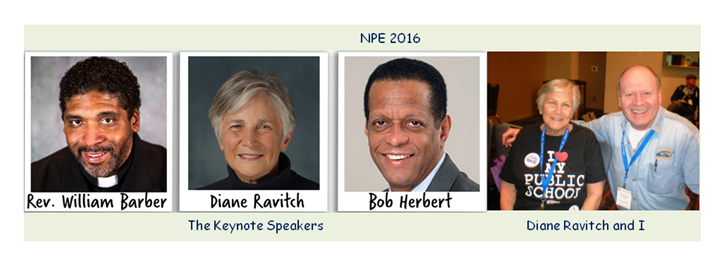
In Raleigh, I met Andrea Gabor, who was working on a book that was released in 2018, After the Education Wars; How Smart Schools Upend the Business of Reform.” She had been an agnostic on charter schools until she went to New Orleans and discovered a mess. The amazing speaker, Rev. William Barber, gave the keynote address. This leader of the “poor people’s campaign” is a truly gifted speaker.

Oakland 2017

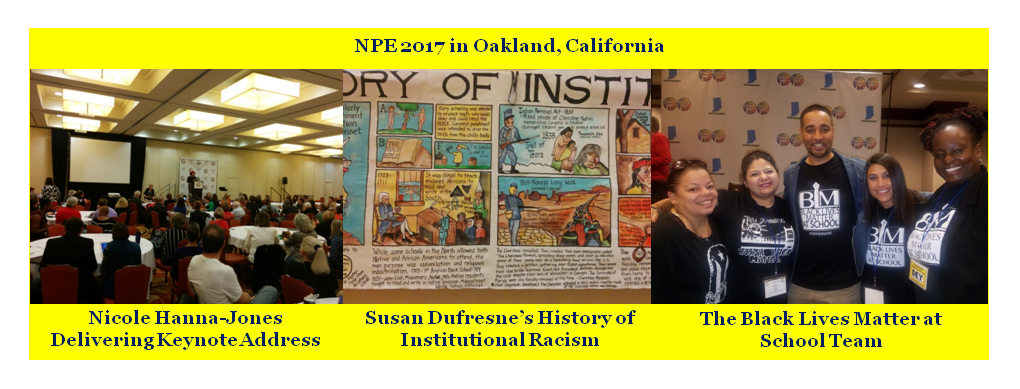
Nicole Hanna-Jones who had just won the MacArthur Foundation genius award and recently published “The 1619 Project” was our keynote speaker. Susan Dufresne lined the walls of the Oakland Marriot’s main conference room with her art depicting institutional racism that was published in book form 6-months later (The History of Institutional Racism in U.S. Public Schools). At a KPFA discussion featuring Diane Ravitch and Dyett High School hunger strike hero, Jitu Brown, I ran into Cindy Martin, then the Superintendent of San Diego Unified School District. She has been the number two at the Department of Education for most of the past four years. Too bad she was not the number one.

Indianapolis 2018

Diane Ravitch opened the conference declaring, “We are the resistance and we are winning!” Finnish educator, Pasi Sahlberg, coined the apt acronym for the worldwide school privatization phenomena by calling it the “Global Education Reform Movement (GERM).” In Indianapolis, we met many new leaders in the resistance like Jesse Hagopian from Seattle. In his introduction, Journey for Justice leader, Jitu Brown, declared, “Jesse is a freedom fighter who happens to be a teacher.” Jesse’s new book “Teach Truth; the Struggle for Antiracist Education was just released.

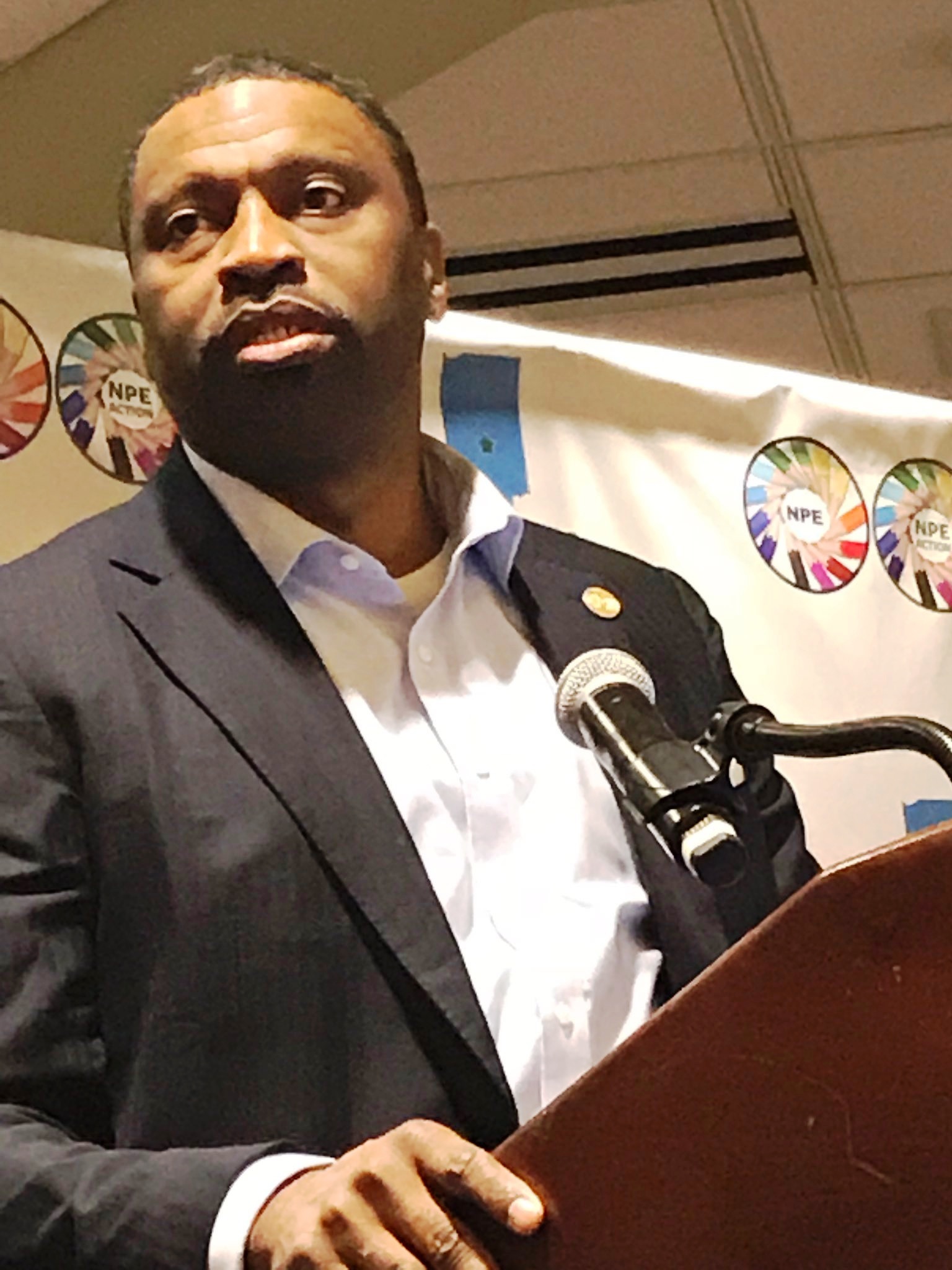
America’s leading civil rights fighter and president of the NAACP, Derrick Johnson, was our keynote speaker. He said the NAACP was not opposed to charter schools, but is calling for a moratorium until there is transparency in their operations and uniformity in terms of requirements is repaired. Derrick noted the NAACP had conducted an in depth national study of charter schools and found a wide range of problems that needed to be fixed before the experiment is continued.

Derrick Johnson, President of NAACP, Speaking at #NPE18Indy – Photo by Anthony Cody

Philadelphia 2022

Like the entire world, NPE activities were seriously interrupted by COVID-19. We were finally able to meet on Broad Street in Philadelphia March 19-20, 2022. This gathering was originally scheduled in 2020. My good friend Darcie Cimarusti, who worked for NPE, called me about joining her for a breakout session on The City Fund, the billionaire founded organization pushing the portfolio model of school management. By 2022, she was so weakened by cancer that I ended up leading the session. Sadly, Darcie passed a few months after the conference.

At the 2022 meeting, we also paid tribute to Phyllis Bush, an NPE founding board member and wonderful person. She was dealing with cancer at the Indianapolis conference and passed some time afterward.

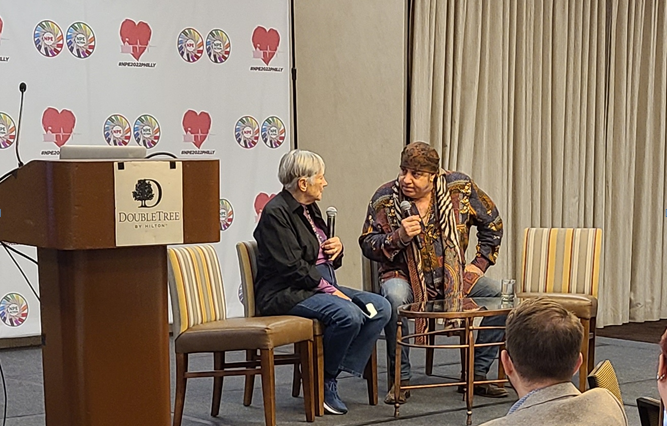
The lunchtime conversation between Diane Ravitch and social activist, musician and actor, Stevie Van Zandt, was special. “Little Stevie” co-founded South Side Johnny and the Asbury Jukes, became a member of the E-Street band with Bruce Springsteen and starred on the Sopranos. It turned out that Diane and Stevie became friends when they were walking a picket line in support of LA teachers.

Ravitch posted afterwards, “I wish you had been in Philly to hear the wonderful “Little Stevie” (formerly the EST band and “The Sopranos”) talk about his love for music, kids, teachers, and arts in the schools at #npe2022philly. Everyone loved his enthusiasm and candor.”

Diane Ravitch and Steven Van Zandt at NPE Philadelphia

Washington DC 2023

October 28-29, 2023, brought the Washington DC NPE conference, a special event. Of particular interest to me was the preconference interview (October 27 evening) of James Harvey by Diane Ravitch. Harvey is known as the author of a “Nation at Risk.” There were so many more of us there than expected; the interview was moved to the old Hilton Hotel’s large conference room. After the change and everyone settled down, Harvey commented, “I remember being at a meeting in this room fifty years ago when we heard that Alexander Butterfield had just testified that there were tapes of the oval office.” There is nothing like being there with people who made and witnessed history.

James also shared that the two famous academics on the panel, Nobel Prize winner, Glen Seaborg, and physicist, Gerald Holton, were the driving forces for politicizing the report. Strangely these two scientists did not come to their anti-public school conclusions based on evidence and they were significant to the reports demeaning public schools using phony data.

Gloria Ladson-Billings from the University of Wisconsin Madison delivered the first Keynote address on Saturday morning. She claimed, “Choice is a synonym for privatization.”  And also stated there is money in the public which wealthy elites do not think common people should have. She also noted, “We are in the business of citizen making.” Ladson-Billings indicated that we do not want to go back to normal because it was not that great.

Conclusion

From the beginning, NPE has not sought donations from wealthy elites. The organization is 100% grass roots supported mainly by educators. When it holds a conference, the information has one purpose and that is protecting public education. If you can break free on the first weekend in April and you regard saving public education important, I encourage joining us in Columbus, Ohio for the 2025 NPE conference.

Is it an accident? Trump made a good choice for Secretary of Labor. The NEA said good things about her. Let’s hope he doesn’t notice.

The NEA issued this press release:

National Education Association President Becky Pringle released the following statement reacting to the selection of Lori Chavez-DeRemer as Labor Secretary:

“Across America, most of us want the same things – strong public schools to help every student grow into their full brilliance and good jobs where workers earn living wages to provide for their families. 

“During her time in Congress, Lori Chavez-DeRemer voted against gutting the Department of Education, against school vouchers, and against cuts to education funding. She cosponsored the Public Service Freedom to Negotiate Act, the PRO Act, and other pro-student, pro-public school, pro-worker legislation.  

“This record stands in stark contrast to Donald Trump’s anti-worker, anti-union record, and his extreme Project 2025 agenda that would gut workplace protections, make it harder for workers to unionize, and diminish the voice of working people.  

“During his first term, Trump appointed anti-worker, anti-union National Labor Relations Board members. Now he is threatening to take the unprecedented action of removing current pro-worker NLRB members in the middle of their term, replacing them with his corporate friends. And he is promising to appoint judges and justices who are hostile to workers and unions.  

“Educators and working families across the nation will be watching Lori Chavez-DeRemer as she moves through the confirmation process and hope to hear a pledge from her to continue to stand up for workers and students as her record suggests, not blind loyalty to the Project 2025 agenda.” 

-###-

The National Education Association is the nation’s largest professional employee organization, representing more than 3 million elementary and secondary teachers, higher education faculty, education support professionals, school administrators, retired educators, students preparing to become teachers, healthcare workers, and public employees. Learn more at www.nea.org


In an interview with the New York Times. NYC Schools Chancellor spoke up for immigrants and the public schools. It was refreshing to see his refusal to fall into the traps set by naysayers who badmouth the schools.

Troy Closson interviewed Mr. Banks:

As the school year opens for an American education system facing multiple crises, one education leader is staking out a curious stance. He is sublimely optimistic.

Public schools in the United States lost more than one million students between 2019 and 2022. The deluge of cash relief distributed during the coronavirus pandemic is drying up. And in a politically polarized era, fresh fights over what students learn in class are continuing to emerge.

But David C. Banks, the New York City schools chancellor, whose national profile rose this spring after his unyielding testimony at a House hearing on antisemitism in schools, argues in a recent interview that the state of urban education is not so bad.

All the woes of urban school districts can be found in New York, a diverse city that is contending with a major influx of homeless migrants. But in a departure from Mayor Eric Adams’s warnings that the migrant crisis is upending city life, Mr. Banks described the arrival of immigrant children as a boon.

As many states retreat from the teaching of race and identity in schools amid rising controversies, the chancellor doubled down on the value of those lessons in New York.

And he said that the rise of artificial intelligence did not represent an alarming threat of chatbot-enabled cheating, but a chance to transform education for the better.

As half of American adults say the education system is heading in the wrong direction, Mr. Banks argued that the “No. 1 thing” his administration had achieved was starting to rebuild faith in public schools.

The interviewer’s question are printed in bold.

New York City has enrolled nearly 40,000 new migrant children since July 2022. Are schools feeling the strain?

For some of the schools, the migrants coming here has been a godsend because we’ve lost so many other kids. Some schools were being threatened with whether we’re going to be able to keep the doors open. 

I push back on a lot of the kind of negative politics that people talk about with migrants. This is a city of immigrants. I mean, that’s the uniqueness of New York. 

We never make it easy for immigrants who are coming. But they find their way. And the same thing is going to happen here.

Many schools spent the earliest stages of the migrant crisis meeting basic needs. Now what do teachers and principals tell you is their biggest challenge in supporting new arrivals?

We’ve got over 5,000 teachers who are either bilingual or English-as-a-new-language teachers who are doing everything that they can possibly do. We need more. 

If you want to see New York City schools at their best, look at how these teachers have responded to the migrant crisis. It’s incredible. They’ve partnered kids with other kids who are serving as buddies for them. They’ve got mentors from older grades.

So I don’t hear a major cry from schools.

This administration has championed expanding popular programs to win back families, and celebrated last year’s enrollment uptick. But New York City has 186,000 fewer children and teenagers today than it did in 2020, and birthrates are on the decline. What does that mean for the future of the school system?

New York City is a very expensive place to live in. But we didn’t go from one million to 100,000. We still have over 900,000 kids and families.

Some of these things are happening beyond anything that I can do. There was a huge migration of Black folks back to the South. It’s more affordable for them to be in a place like South Carolina. Nothing I can do about that.

A big part of my job is to make the case for why we think the public schools would be a great place for you and your family. For years, the Department of Education used to play defense on media, the narrative. And I think we’re doing a better job with getting that word out.

GOOD JOB, CHANCELLOR BANKS!

This is wonderful news!

I heard it this morning and could not believe it. It seemed too good to be true, but it was true!

Kamala Harris chose Tim Walz to run with her on the Democratic ticket.

She intended to announce it at 5:30 pm today in Philadelphia. It leaked.

It’s a great choice.

Governor Walz is a strong supporter of public schools. He graduated from public school in Nebraska in a graduating class of 25.

He grew up in a rural area, and he is able to discuss complicated issues in plain language.

He has a way of speaking that is wise, smart, direct, and easy. He has a twinkle as he speaks.

He launched the word “weird” as a description of Trump and Vance.

He has a net worth of $13,500.

He taught social studies for 20 years.

His masters degree is in educational leadership.

He served from 2007-2019 as a member of Congress, where he headed the Committee on Veteran Affairs.

He served in the National Guard for 25 years.

Walz will be a great addition to the Harris campaign.

Hurrah!

Back in February, long before President Biden stepped back and Vice-President Kamala Harris became the Democratic nominee for President, two red-state Governors spoke out against vouchers. Both are Democrats who understand the importance of public schools for their communities. They are Governor Roy Cooper of North Carolina, whose gerrymandered legislature has a Republican supermajority, and Governor Andy Beshear of Kentucky, whose legislature is controlled by Republicans. When Beshear ran, he picked a teacher as Lieutenant Governor.

The two Governers wrote this article in USA Today:

In North Carolina and Kentucky, public schools are the center of our communities. We’re proud public school graduates ourselves – and we know the critical role our schools play in teaching our students, strengthening our workforces and growing our economies.

We’ve seen record-high graduation rates of almost 90% in our public schools. North Carolina and Kentucky rank in the top 10 for National Board-certified teachers, one of the highest recognition teachers can earn.

In Kentucky, we’ve seen significant improvement in elementary school reading, even with setbacks from the pandemic like many states experienced. In North Carolina last year, public school students completed a record 325,000 workforce credentials in areas like information technology and construction. The bottom line? Our public schools are critical to our success and an overwhelming number of parents are choosing them for their children.

That’s why we’re so alarmed that legislators want to loot our public schools to fund their private school voucher scheme. These vouchers, instituted in the 1950s and 1960s by Southern governors to thwart mandatory school desegregation, are rising again thanks to a coordinated plan by lobbyists, private schools and right-wing legislators.

Voucher programs chip away at the public education our kids deserve

This is their strategy: Start the programs modestly, offering vouchers only to low-income families or children with disabilities. But then expand the giveaway by taking money from public schools and allowing the wealthiest among us who already have children in private schools to pick up a government check.

In North Carolina, the Republican legislature passed a voucher program with no income limit, no accountability and no requirement that children can’t already go to a private school. This radical plan will cost the state $4 billion over the next 10 years, money that could be going to fully fund our public schools. In Kentucky, legislators are trying to amend our constitution to enshrine their efforts to take taxpayer money from public schools and use it for private schools.

Both of our constitutions guarantee our children a right to public education. But both legislatures are trying to chip away at that right, leaving North Carolina and Kentucky ranked near the bottom in per-pupil spending and teacher pay.

Public schools are crucial to our local economies. In North Carolina, public schools are a top-five employer in all 100 counties. In many rural counties, there are no private schools for kids to go to – meaning that those taxpayer dollars are torn out of the county and put right into the pockets of wealthier people in more populated areas.

Governor Roy Cooper, North Carolina

In fact, in Kentucky, 60% of counties don’t even have a certified private school. This has caused rural Republicans in red states like Texas and Georgia to vote against voucher schemes that would starve their rural schools.

Governor Andy Beshear, Kentucky

Private schools get taxpayer dollars with no real accountability

As governors, we’ve proposed fully funding our public schools, teacher pay raises to treat our educators like the professionals they are and expanded early childhood education. We know that strong public schools mean strong communities. Families in Kentucky and North Carolina know that too. In North Carolina, nearly 8 in 10 children go to public schools.

Our public schools serve all children. They provide transportation and meals and educate students with disabilities. And they’re accountable to taxpayers with public assessments showing how students and schools are doing and where they need to improve.

But private schools that get this taxpayer money have little to no accountability. They aren’t even required to hire licensed teachers, provide meals, transportation or services for disabled students. They don’t even have to tell the taxpayers what they teach or how their students perform. North Carolina’s voucher system has been described as “the least regulated private school voucher program in the country.”

Studies of student performance under school voucher programs not only showed that they don’t help them, but that they could actually have harmful effects. Results from a 2016 study of Louisiana’s voucher program found “strong and consistent evidence that students using an LSP scholarship performed significantly worse in math after using their scholarship to attend private schools.” In Indiana, results also showed “significant losses” in math. A third study of a voucher program in Ohio reported that “students who use vouchers to attend private schools have fared worse academically compared to their closely matched peers attending public schools.”

We aren’t against private schools. But we are against taxpayer money going to private schools at the expense of public schools.

The future of our nation goes to class in public schools, and all Americans must be on guard for lobbyists and extremist politicians bringing similar plans to their states. Our segregationist predecessors were on the wrong side of history, and we don’t need to go back.

We are going to keep standing up for our public school students to ensure that they have the funding they need, and that teachers are paid like the professionals they are. It’s what’s best for our children, our economy and our future.

Roy Cooper is the governor of North Carolina. Andy Beshear is the governor of Kentucky.