Archives for category: Separation of church and state

Marta W. Aldrich reported in Chalkbeat that Governor Bill Lee will make universal vouchers his top priority in education this coming year. Tennessee currently has a voucher program that is limited to three urban districts and is not fully enrolled. The Governor, who is a graduate of public schools, wants all students, rich and poor alike, to have a public subsidy to pay for private and religious schooling.

Republicans have made universal vouchers a high priority, knowing that it will drain students and funding from their local public schools.

Governor Lee’s effort to pass universal vouchers failed last year because of opposition by urban Democrats and rural Republicans. However, some of the Republican opponents were defeated with the help of out-of-state money spent to elect voucher-friendly Republicans who were willing to undercut their local public schools.

The extremist Republicans were funded by an organization called 1776 Project PAC, whose purpose is to elect school boards who will oppose “woke” policies and support privatization. Its leader is a GOP operative named Ryan James Gidursky. Here is a video where he discusses “the Marxist takeover of America’s schools.” Check out the merchandise on their website, which says more about their purposes than the other parts of the website. The 1776 Project PAC was funded by a rightwing billionaire, Richard Uihelein, who wants to destroy public schools because they are “woke.”

From what we already know about vouchers, we can predict that the great majority of them will be used by affluent families whose children are already enrolled in nonpublic schools. In his recently published book, The Privateers, Josh Cowen of Michigan State University has shown that the low-income students who transfer to nonpublic schools do not make academic gains and frequently experience “catastrophic” declines in their outcomes.

A new universal school voucher proposal will be the first bill filed for Tennessee’s upcoming legislative session, signaling that Gov. Bill Lee intends to make the plan his No. 1 education priority for a second straight year.

Senate Majority Leader Jack Johnson said this week that he’ll file his chamber’s legislation on the morning of Nov. 6, the day after Election Day. He expects House Majority Leader William Lamberth will do the same.

The big question is whether House and Senate Republican leaders will be able to agree on the details in 2025. The 114th Tennessee General Assembly convenes on Jan. 14 as Lee begins his last two years in office.

During the 2024 session, the governor’s Education Freedom Scholarship proposal stalled in finance committees over disagreements about testing and funding, despite a GOP supermajority, and even as universal voucher programs sprang up in several other states….

Similar to last year’s proposal, the new bill would provide about $7,000 in taxpayer funds to each of up to 20,000 students to attend a private school beginning next fall, with half of the slots going to students who are considered economically disadvantaged. By 2026, all of Tennessee’s K-12 students, regardless of family income, would be eligible for vouchers, though the number of recipients would depend on how much money is budgeted for the program.

“This story was originally published by Chalkbeat. Sign up for their newsletters at ckbe.at/newsletters”.

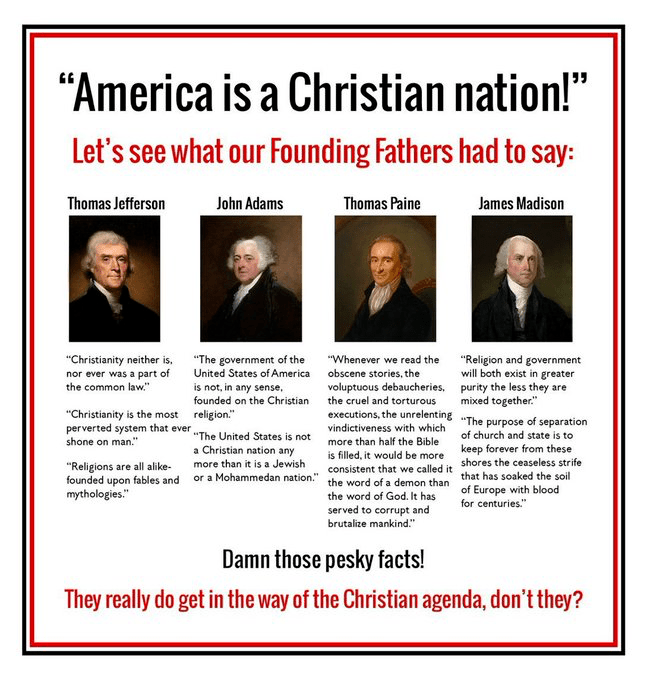
The Founding Fathers went to great lengths to separate church and state. They knew the history of religious wars in Europe, and they wanted the new nation to be free of such rivalries. They inserted into the Constitution the clear mandate that there would be no religious test to hold office. They added in the First Amendment to the institution that Congress was not allowed to establish a state religion and guaranteed freedom to practice one’s own religion.

Someone created this handy compilation of quotes from some of our most prominent men of the Founding era:

Jennifer McCormick was the last elected state superintendent of schools. She switched parties because of the Republicans’ hostility to public schools.

She is running for Governor of Indiana against Senator Mike Braun, who is a far-right Republican. Braun and his running mate, an evangelical extremist, want to get rid of public schools.

The 74 reports:

U.S. Sen. Mike Braun, a conservative Republican, is still ahead in the state’s gubernatorial race but his lead among Indiana voters over Democrat Jennifer McCormick has shrunk in recent weeks.

Polling released this week by the Democratic Governors Association shows Braun just three points in front of McCormick, 44% to 41%. That’s a dropoff from the Sept. 17 results of an Emerson College Polling/The Hill voter survey that had Braun with roughly 45% of the vote and McCormick with 34. Libertarian candidate Donald Rainwater also picked up more support but less dramatically so, going from 5.8% to 8%.

Indiana has not elected a Democratic governor since 2000 and Republican presidential candidate Donald Trump holds a comfortable 14 percentage point lead, 57% to 43%, over Democrat Kamala Harris, according to an ActiVote poll released Tuesday.

If elected to succeed Republican Gov. Eric Holcomb, Braun and his running mate, pastor, podcaster and far-right Christian nationalist Micah Beckwith, have pledged universal school choice for every Indiana family while focusing on parental rights and school safety. 

McCormick, a career educator, was the last person elected to the superintendent of public instruction’s office before it became an appointed position in 2021. She seeks to expand affordable child care, fight what she believes is excessive state-mandated testing and call for an equitable school funding formula. 

She also wants to place limits on the state’s private school voucher initiative: The program grew to encompass more than 70,000 children in 2023-24, a 31% increase from the year before. The state allocated $439 million in tuition grants to private parochial or non-religious schools last year — up from nearly $312 million the year before.

McCormick said the program, which might have been intended for lower-income children, is often utilized by white suburban families and is too expensive. 

“We can’t afford it,” she told The 74, “and it is sucking the resources out of our traditional schools.” 

Braun, 70, wants to expand school choice by removing the $220,000 annual family income cap from the voucher program, known as the Choice Scholarship Program, and doubling the $10 millionallocated to the state’s Education Scholarship Account Program. The program, which has also seen tremendous growth in participation, gives special education students and their siblings funds for tuition and support services. 

Braun did not make himself available for an interview and attempts to reach various supporters were not successful.

“School choice programs put parents in the driver’s seat, allowing them to choose schools that prioritize their children’s needs,” he states in his education plan. “Providing universal school choice will ensure every Hoosier family has the same freedom to choose their best-fit education.”

A former school board member, Braun also wants to create an Indiana Office of School Safety to streamline the efforts of several departments, including the state police — and implement age-appropriate cyber training for students regarding online safety. He said, too, that the state should limit cellphone use on campus. 

Braun wants to increase Indiana’s public teacher base salary — and financially reward educators whose students perform well. 

Keith Gambill, president of the Indiana State Teachers Association, said his group endorsed McCormick, 54, because of her commitment to funding traditional public schools. 

He noted she did not have the group’s endorsement when she initially ran for the state superintendent’s office as a Republican. But, Gambill said, after filling the role and understanding the state’s educational needs, she switched parties and her values more closely aligned with the union’s. 

“She really stood up to members of — at that time — her own party in working toward what was best for our schools,” he said, speaking of her time in office. “And, of course, as soon as they were challenged, they didn’t like that. She realized that if she was going to make a difference in public education, she would have to move in a different direction.”

McCormick aims to secure a minimum base salary of $60,000 for pre-K-12 educators, and adjust veteran teacher salaries to reflect their non-educator peers. She wants to increase academic freedom, safeguard university tenure and protect the ability of teachers unions to collectively bargain for wages and benefits. 

Her running mate, Terry Goodin, a former state representative, was a teacher, assistant principal and public school superintendent at Crothersville Community Schools.

Braun, in his education plan, said he wants schools to notify parents about their child’s request to change their name or use different pronouns on campus. He has denounced gender-affirming surgery for minors and opposes transgender students playing on girls’ sports teams. Braun has the backing of Americans for Prosperity and CPAC — and maintains high ratings from the NRA. 

Braun was endorsed by Trump in 2023 and won his party’s nomination for governor in May after beating out a crowded field of GOP contenders. He acknowledged last month, according to Axios, that Harris’s presence at the top of the presidential ticket has complicated down-ballot races, including his own.

“I think that’s had an impact,” he said, “but I’m going to plow through that because this is a lot about kitchen table issues once you’re starting to run for governor.”

 Jo Napolitano is a senior reporter at The 74.

This story was produced by The 74, a non-profit, independent news organization focused on education in America.

Mother Jones published an excellent article by Reverend Rob Schenck about how he became a leader of the Christian nationalist movement and why he decided to leave it. He recalls when real estate developer and playboy Donald Trump was first introduced to the world of evangelicals. And he describes his own role in connecting rich donors to Republican Supreme Court justices.

Reverend Schenck begins:

In 2014, at an elegant gala inside the Supreme Court’s gilded Great Hall, a tuxedoed Justice Clarence Thomas turned to me and voiced his approval for my work. I glanced over to where Chief Justice John Roberts and his wife, Jane, were entertaining two of my associates, trustees of the Supreme Court Historical Society, a private, nongovernmental entity for which Roberts served as honorary chair. At that moment, I knew the secretive operation I had run, aimed at emboldening Thomas and his conservative colleagues to render the strongest possible decisions in favor of our right-wing Christian agenda, had succeeded.

My organization, Faith and Action in the Nation’s Capital, had created an initiative we called “Operation Higher Court” that trained wealthy couples as “stealth missionaries,” befriending Thomas and his wife, Ginni; Samuel and Martha-Ann Alito; and Antonin and Maureen Scalia—­lavishing­ them with meals at high-end restaurants and invitations to luxurious vacation properties. Alongside these amenities, our ministry offered prayers, gift Bibles, and the assurance that millions of believers thanked God for the decisions this trio of justices rendered on abortion, health care, marriage, and gun ownership….

But Reverend Schenck began to understand that his activities and beliefs were toxic to democracy. What triggered his change? Perhaps it was his late-in-life doctoral studies, when he read about the German Christian movement in the 1930s, which supported the Nazi party. He wrote: One of the most respected Bible scholars of that period, Paul Althaus, declared Hitler’s ascent to the chancellorship to be a “gift and miracle from God.

He was shaken by his research. He began to change his views. He wondered whether Christian evangelicals in the U.S. were on the same dangerous path.

Following the insurrection of January 6, when Christian banners, Bibles, and prayers in Jesus’ name appeared in the assault on the Capitol, I felt even greater urgency in warning my fellow evangelicals of the grave danger Trump and his MAGA cult posed to Christianity and US democracy.

My change of course so late in life has been painful, disorienting, and costly. Besides losing decades-long friendships and enduring menacing threats, my wife and I have faced a significantly reduced income. I’ve even driven Uber to cover household expenses. One night, I picked up an organizer of the National Prayer Breakfast, an event in which I had once played a significant role. I was wearing a mask and said little, but then, with trepidation, I realized I would be dropping him at the home of a congressman I had worked with closely for more than 20 years. When my passenger got out, I was relieved to have gone unrecognized. Still, I’ve never questioned the decisions that brought me to that moment.

In my third conversion, I realized that when religion is placed at the service of a political party, it corrupts both. To claim that one political figure uniquely represents God’s will for the body politic is a form of anti-Christian idolatry. To elevate one set of spiritual beliefs above another and do it by force of law removes a nonnegotiable tenet of evangelical faith—free will. We are born again when we choose to believe in the Lord Jesus Christ, not when we’re forced to do so.

Because it is immoral, I believe Christian nationalism is inevitably doomed. But in the meantime, the pain, suffering, and injury it will inflict will be enormous—just consider women facing difficult pregnancies, trans children seeking care, librarians attacked for certain books. “We want to fill our culture again with the Christian spirit. We want to burn out all the recent immoral developments in literature, in the theater, and in the press—in short, we want to burn out the poison of immorality, which has entered into our whole life and culture as a result of liberal excess.” This may sound familiar—maybe some overheated Republican talking points. In fact, it’s what Adolf Hitler promised the German people in 1933.

In an unprecedented move that shatters the historic wall of separation between church and state, Ohio has passed legislation to fund the construction and renovation of religious schools. It also directly violates the explicit language of the Ohio state constitution.

ProPublica reports on the latest move to defund public schools and divert money to religious schools.

The state of Ohio is giving taxpayer money to private, religious schools to help them build new buildings and expand their campuses, which is nearly unprecedented in modern U.S. history.

While many states have recently enacted sweeping school voucher programs that give parents taxpayer money to spend on private school tuition for their kids, Ohio has cut out the middleman. Under a bill passed by its Legislature this summer, the state is now providing millions of dollars in grants directly to religious schools, most of them Catholic, to renovate buildings, build classrooms, improve playgrounds and more.

The goal in providing the grants, according to the measure’s chief architect, Matt Huffman, is to increase the capacity of private schools in part so that they can sooner absorb more voucher students.

“The capacity issue is the next big issue on the horizon” for voucher efforts, Huffman, the Ohio Senate president and a Republican, told the Columbus Dispatch.

Huffman did not respond to ProPublica’s requests for comment.

Following Hurricane Katrina and the start of the COVID-19 pandemic, some federal taxpayer dollars went toward repairing and improving private K-12 schools in multiple states. Churches that operate schools often receive government funding for the social services that they offer; some orthodox Jewish schools in New York have relied on significant financial support from the city, The New York Times has found.

But national experts on education funding emphasized that what Ohio is doing is categorically different.

“This is new, dangerous ground, funding new voucher schools,” said Josh Cowen, a senior fellow at the Education Law Center and the author of a new book on the history of billionaire-led voucher efforts. For decades, churches have relied on conservative philanthropy to be able to build their schools, Cowen said, or they’ve held fundraising drives or asked their diocese for help.

They’ve never, until now, been able to build schools expressly on the public dime.

“This breaks through the myth,” said David Pepper, a political writer and the former chairman of the Ohio Democratic Party. Pepper said that courts have long given voucher programs a pass, ruling that they don’t violate the constitutionally mandated separation of church and state because a publicly funded voucher technically passes through the conduit of a parent on the way to a religious school.

With this latest move, though, Ohio is funding the construction of a separate, religious system of education, Pepper said, adding that if no one takes notice, “This will happen in other states — they all learn from each other like laboratories.”

The Ohio Constitution says that the General Assembly “will secure a thorough and efficient system of common schools throughout the state; but no religious or other sect, or sects, shall ever have any exclusive right to, or control of, any part of the school funds of this state.”

Yet Troy McIntosh, executive director of the Ohio Christian Education Network — several of whose schools received the new grants — recently told the Lima News that part of the reason for spending these public dollars on the expansion of private schools is that “we want to make sure that from our perspective, Christian school options are available to any kid who chooses that in the state.”

Ohio started funding vouchers in Cleveland only. They were supposed to “help poor kids escape failing public schools.” Initially, vouchers were only for kids already enrolled in public schools and only for kids from low-income families.

When they were implemented in the 1990s, vouchers in Ohio, like in many places, were limited in scope; they were available only to parents whose children were attending (often underfunded) public schools in Cleveland. The idea was to give those families money that they could then spend on tuition at a hopefully better private school, thus empowering them with what was called school choice.

Over the decades, the state incrementally expanded voucher programs to a wider and wider range of applicants. And last year, legislators and Gov. Mike DeWine extended the most prominent of those programs, called EdChoice, to all Ohio families.

Now, vouchers subsidize the children of families who never attended public schools, including affluent families. They have become a welfare program for families who previously paid their full tuition. As in every other voucher state, most students who take vouchers were already enrolled in private and religious schools.

Encouraged by Americans for Prosperity, a Koch brothers political advocacy group, the Ohio legislature added the religious school funding bill to the state budget.

Led by Huffman, Republicans slipped at least $4 million in grants to private schools into a larger budget bill. There was little debate, in part because budget bills across the country have become too large to deliberate over every detail and, also, Republicans have supermajorities in both chambers in Ohio.

According to an Ohio Legislative Service Commission report, the grants, some of them over a million dollars, then went out to various Catholic schools around the state. ProPublica contacted administrators at each of these schools to ask what they will be using their new taxpayer money on, but they either didn’t answer or said that they didn’t immediately know. (One of the many differences between public and private schools is that the latter do not have to answer questions from the public about their budgets, even if they’re now publicly funded.)

The total grant amount of roughly $4 million this year may seem small, said William L. Phillis, executive director of the Ohio Coalition for Equity & Adequacy of School Funding. But, he noted, Ohio’s voucher program itself started out very small three decades ago, and today it’s a billion-dollar system.

“They get their foot in the door with a few million dollars in infrastructure funding,” Phillis said. “It sets a precedent, and eventually hundreds of millions will be going to private school construction.”

The total grant amount of roughly $4 million this year may seem small, said William L. Phillis, executive director of the Ohio Coalition for Equity & Adequacy of School Funding. But, he noted, Ohio’s voucher program itself started out very small three decades ago, and today it’s a billion-dollar system.

“They get their foot in the door with a few million dollars in infrastructure funding,” Phillis said. “It sets a precedent, and eventually hundreds of millions will be going to private school construction.”

The only statewide evaluation of Ohio’s EdChoice voucher program was published in 2016. The evaluation was funded by the choice advocacy group, The Thomas B. Fordham Foundation. TBF has a special relationship to Ohio Republicans in the legislature because it originated in Ohio and maintains an office in Ohio. It also authorizes charter schools in Ohio.

The evaluation concluded that students who left to use vouchers in a private school performed worse than their peers who remained in public schools.

So, the Republican supermajority has known for at least eight years that vouchers don’t “save” poor kids; in fact, those kids are likely to fall farther behind. Now that the Republicans have adopted universal choice, they know that they are helping kids who are already enrolled in private and religious schools. So now, it’s a logical step to throw in millions more for construction and renovation of voucher schools.

The National Coalition for Public Education published valuable information contrasting the actual cost of vouchers to overly optimistic projections by their advocates. In every state that has adopted vouchers, most vouchers are used by students already enrolled in private schools. In states such as Florida and Arizona, vouchers are “universal,” meaning there are no income limitations or other restrictions on their accessibility. In essence, vouchers provide public dollars to subsidize the tuition of students in private and religious schools. They are a welfare program for the affluent.

The NCPE concluded:

When lawmakers consider expanding or creating private school voucher programs, their projections often drastically underestimate the actual costs. They sell a false promise that vouchers will save money, do not budget adequate funds, and then wind up with million dollar shortfalls, necessitating cuts from public education and even tax increases. 

Some voucher advocates incorrectly claim that if the amount of the voucher is less than the average expenditure spent to educate a student in public school, the state will save money. Existing voucher programs prove this false.  

First, it costs less than the average expenditure to educate some students, and much more to educate others who need additional support and services–like those with disabilities, English language learners, and low-income students. The students who are most expensive to educate, however, tend to remain in public schools  because they cannot find a private voucher school willing to accept them. Yet, because of the voucher program, the public schools are left with fewer resources. Furthermore, in a voucher program, the state now pays tuition for private school students who never attended public schools, which is an altogether new cost for taxpayers.

This all adds up to more, not less, spending.


Here are several examples of the skyrocketing costs of voucher programs:

ARIZONA’S VOUCHER IS COSTING 1,346% MORE THAN PROJECTED, CONTRIBUTING TO A $400 MILLION BUDGET DEFICIT.

  • The fiscal note attached to Arizona’s universal voucher program projected the program would cost the state about $65 million in 2024 and $125 million in 2025. But once students’ applications started to come in, state leaders realized these estimates were woefully inadequate. The Arizona Governor’s Office now estimates that the price tag is more than 1,346% higher at a cost of $940 million per year. This is one of the main causes of a $400 million budget shortfall in the state’s general fund, which funds the state’s public schools, transportation, fire, police, and prisons.

THE FLORIDA VOUCHER IS ALREADY MORE THAN $2 BILLION OVER BUDGET IN YEAR ONE.

  • The Florida Senate projected that its voucher expansion would cost $646 million. But independent researchers estimated that the program would actually cost almost $4 billion, and actual costs are already approaching that amount—$3.35 billion in the first year. In just one county, Duval, school officials report a $17 million budget shortage due to funds lost to the vouchers.

WEST VIRGINIA’S VOUCHER DRAINS MORE THAN $20 MILLION FROM PUBLIC SCHOOLS PER YEAR.

  • During the 2024 – 2025 school year, the West Virginia voucher program is expected to funnel $21.6 million away from the state’s public schools–enough to pay the salaries for 301 professional teachers and 63 school service workers. As a result of the voucher and other declines in enrollment, multiple school districts are already warning residents that they need to impose property tax increases in order to continue to pay current teachers’ salaries.

The National Education Policy Center is hosting a webinar on the implications of federal funding of religious schools. Actually, two webinars, on September 26. Sign up here.

NEPC writes:

Should religious schools be publicly funded? And what are the implications when they are?

These questions have become increasingly relevant in the United States in the wake of Espinoza v. Montana (2020) and Carson v. Makin (2022), two U.S. Supreme Court cases that forced states, under certain circumstances, to provide public funding to private religious schools. But questions raised by such public funding are not unique to our nation. In fact, many of the issues currently confronting the United States have already been wrestled with in other countries around the world.

On September 26th, two back-to-back webinars will explore these trends and issues, with an eye to helping parents, teachers, administrators, scholars, advocates, journalists, and other education stakeholders better understand the history and impact of state-funded religious education in the U.S. and abroad.

The webinars, which are free to register for and attend, feature the authors of articles in a new special issue of the Peabody Journal of Education, a peer-refereed publication. This special issue on publicly funded religious schools considers research findings around equity, segregation, and discrimination as they relate to state-funded religious education. Studies presented in the special issue were conducted in Canada, Spain, and the U.S., and they examine how state-funded religious education has shifted over time as a result of factors such as legal rulings, politics, demographic changes, global migration, and education privatization.

The webinars are sponsored by NEPC, which invites the public to attend either or both.

Law and Public Discourse is the title of the first webinar in the series, which runs from noon to 1 pm Eastern Time.

Kathleen Sellers of Duke University will moderate. Panelists are Sue Winton of York University in Canada and NEPC Fellows Bruce Baker of the University of Miami, Suzanne Eckes of the University of Wisconsin, Preston Green of the University of Connecticut, and Kevin Welner of the University of Colorado.

The second webinar, Catholic Culture and Market Concerns, will be held right after the first one, from 1 to 2 pm Eastern on September 26th.

Joel Malin of Miami University will moderate. Panelists will be James CovielloStephen Kotok, and Catherine DiMartino, all of St. John’s University, Clara Fontdevila of the University of Glasgow in Scotland, Adrián Zancajo and Antoni Verger of the Universitat Autònoma de Barcelona, Spain, and Ee-Seul Yoon of the University of Manitoba, Canada.

Click here now to register for one or both of these two webinars.

For those interested in reading the underlying articles in the Peabody journal, they’re available (although some are behind a paywall) as follows:

Fontdevila, C., Zancajo, A., & Verger, A. (2024). Catholic Schools in the Marketplace: Changing and Enduring Religious Identities

Green, P., Baker, B., & Eckes, S. (2024). The Potential for Race Discrimination in Voucher Programs in a Post-Carson World

Kotok, S., DiMartino, C.C., & Coviello, J. (2024). New York City Catholic Schools Operating in the Public Space in a Post-Makin World

Welner, K. (2024). Charting the Path to the Outsourcing of Discrimination Through School Choice

Winton, S. (2024). Same Arguments, Different Outcomes: Struggles Over Private School Funding in Alberta and Ontario, Canada

Yoon, E.S. (2024). Unequal City and Inequitable Choice: The Neoliberal State’s Development of School Choice and Marketization in the Publicly Funded Catholic School Board in Toronto, Canada

Yoon, E.S., Malin, J.R., Sellers, K.M., & Welner, K.G. (2024). Should Religious Schools Be Publicly Funded? Issues of Religion, Discrimination, and Equity

Public Schools First NC posted the following statement about the passage of additional funding for the state’s voucher program. The General Assembly has a veto-proof majority in both houses, thanks to the defection of one Tricia Cotham, who ran as a Democrat who opposed abortion and vouchers, then changed parties. The bill raises voucher spending to over $600 million this year and to nearly $1 billion annually in a decade.

Here is the statement:

This week the House and Senate majority passed House Bill 10 “Require ICE Cooperation & Budget Adjustments” in a process that allowed no adjustments to any part of the bill. The new bill added a number of budget items to the previous bill, including massive increases in North Carolina’s voucher programs

The bill added millions in OS vouchers and ESA+ vouchers, bringing the total for 2024-25 to $616.1 million. The new appropriations were made to ensure that all voucher applicants this year received a voucher regardless of their income. As described in our September 7 newsletter, the majority of OS applicants on the waitlist have incomes too high to have been eligible for vouchers before the income cap was removed this year

In 2024-25, the OS vouchers pay up to $7,468 toward the private school tuition for each student. The voucher amount is tied to state per-pupil funding and increases each year. 

The wealthiest applicants—those making more than $260,000/year for a family of four—will receive $3,360 per child from the state. 

The bill does not increase teacher pay, so veteran teachers in their 15th through 24th years of teaching will receive a raise of only $820 in 2024-25.

The bill also sets out additional increases for both voucher programs through 2032-33 and establishes spending “for each fiscal year thereafter.” The result, as shown in the chart, is a whopping $937.6 million scheduled to be spent in 2033-34 alone. This is stunning and a total disregard for our underfunded public schools.

North Carolina will have spent a total of nearly $9 billion on private school vouchers by 2033-34. Those dollars would have fully funded the Comprehensive Remedial Plan (Leandro) to provide a sound basic education for all public school students—and much more. In November 2022, the North Carolina Supreme Court ordered the legislature to appropriate funds according to the Leandro plan, but legislative leaders are still fighting the ruling. 

Taxpayers may wonder whether the billions spent on private schools are helping students learn. We do know, based on national data, that private schools do not outperform public schools. Taxpayers won’t get answers—at least not yet – about NC students since private schools are not required to publicly report information on student achievement, unlike traditional public schools and charter schools.

Last year’s budget bill required private schools to administer the ACT to 11th grade students whose tuition was at least partially funded by vouchers starting this school year (public school 11th graders already take the ACT). It also required the Superintendent of Public Instruction to recommend a test to be administered in 3rd and 8th grade to both public school students and private school voucher students. There has been no word yet on what test Superintendent Truitt recommended and whether it will be administered this spring. 

Governor Cooper has signaled that he will veto House Bill 10 this week due to the massive voucher increases and other provisions in the bill that he has previously come out against such as the ICE requirement. 

It’s NOT TOO LATE to take action to STOP HB 10!

Legislators will be back in session on October 9. Governor Cooper is expected to veto the bill this week. Legislators will then be asked to vote to override his veto. What can you do to make sure the veto holds?

  • Contact legislators to urge them to reject this voucher expansion.
  • Contact all other elected officials and local business leaders to let them know how harmful the voucher expansion is to communities. They should contact legislators too. 
  • Encourage your local school board to submit a resolution rejecting vouchers (see examples here).
  • Support your local PTA as they advocate for public schools.
  • Sign our petition urging legislators to reject HB 10 and support the VETO.

PSFNC’s Statement on Voucher Expansion

Legislators, when sworn in, pledge to uphold the NC state constitution to provide a free public education. They should not be sending nearly a billion dollars of our tax money to private school vouchers while starving our public schools as they ignore the NC Supreme Court’s ruling to fully fund Leandro. By adding school voucher funding to clear the voucher waitlist of mostly wealthy families, this bill gives our hard earned tax dollars to wealthy families who can afford to pay their own tuition bills. In contrast, salary increases for teachers with 5 or more years of experience were less than $950, which amounts to pay cuts given cost of living increases. 

This bill prioritizes private schools over public schools, urban families over rural families, and wealthy families over our teachers and the nearly 1.4 million children who attend our public schools. Now, with no income limits to determine eligibility and no prior public school attendance required, it has become a handout to wealthy families to underwrite their private school tuition. This is the wrong path for our state. It undermines the social and economic fabric of our state–a state that used to be known nationwide for putting our public schools first- we need to do it again.

Republican-controlled states have been on a crusade to enact vouchers, with the alone stimulus of billionaire lobbying dollars. We know from Michigan State University scholar Josh Cowen that most students who use vouchers were already enrolled in private schools. Thus, vouchers are a subsidy for people who can afford private schools, not for low-income students. Cowen also has demonstrated that the academic outcomes of vouchers are disastrous for kids who transfer from public schools (the evidence is contained in Cowen’s excellent new book: The Privateers).

The South Carolina State Supreme Court just overturned the state’s voucher program. Three judges recognized that the program violated the state constitution. Courts in other Republican-controlled states have decoded that the state constitution does not mean what it says.

Peter Greene writes in Forbes:

In many states, the challenge of creating a school voucher program is a constitutional requirement that public tax dollar are designated only for public schools. South Carolina’s legislature thought they had found a workaround; today the State Supreme Court said no.

The 3-2 decision came as a surprise. But the basis for the “relief granted in part” was straightforward.

The petitioners in the case make the claim that the voucher program violates Article XI, Section 4 of the South Carolina Constitution:

“No money shall be paid from public funds nor shall the credit of the State or any of its political subdivisions be used for the direct benefit of any religious or other private educational institution.”

The language is exceptionally direct and clear, but legislators thought they had created a workaround in the form of the Education Scholarship Trust Fund. The premise, seen in many taxpayer funded voucher programs in other states, is that once the money passes into the hands of a third party, it somehow sheds its public nature.

As the ruling puts it:

Respondents’ primary argument is that the funds start out as public funds but lose their public character once the Treasurer places the funds in the ESTF.

The court is unconvinced that the ESTF is a true trust. And the court points out that even if it is a trust, the nature of a trust is that the trustee holds legal title to the estate, and in this case, the trustee is the state. The court notes that “this is not the first time we have encountered an attempt to deploy a trust to avoid constitutional limits on the use of public funds” and cites O’Brien v. S. C. ORBIT.

The other argument by the state is that ESTF funds benefit the families, and do not provide “direct benefit” to the private schools. “[T]hey read our Constitution as allowing public funds to be directly paid to private schools as tuition as long as the funds are nudged along their path by the student.”

The state argues that this is not like the last time vouchers were struck down (Adams v. McMaster) because this time the vouchers can be used for private or public schools. Therefor the program does not provide direct benefits for private schools. However, responds the court, “just because the benefit is diffuse does not mean it is not direct.”

State Superintendent of Education Ellen Weaver responded to the ruling.

“Families cried tears of joy when the scholarship funds became available for their children, and today’s Supreme Court ruling brings those same families tears of devastation. The late timing of the initial filing and subsequent ruling on this case midway through the first quarter of the new school year wreaks havoc on the participating students and their families.”

The ruling is certainly inconveniently timed for those students who have already used the vouchers to start their new school year. It’s not clear what will happen to them.

Previously, Kentucky’s Supreme Court also struck down their state’s voucher program, arguing that the twists and turns built into the program did not conceal it’s fundamental nature—the use of public taxpayer dollars to fund private and religious schools in violation of the state constitution. In Kentucky, that has led to an attempt to rewrite the constitution. We’ll see what the South Carolina legislature tries next.

Public Schools First, North Carolina’s premier parent-advocacy group, warns that the GOP-controlled legislature plans to expand the state’s voucher program on Monday. It asks parents and concerned citizens to sign a petition and get active to stop the ongoing campaign to defund public schools.

Public Schools First NC writes:

In a familiar move, voucher supporters in the legislature are adding a $248M voucher expansion to an existing bill instead of proposing a stand-alone bill that can be debated and voted on separately. 

House Bill 10 “Require Sheriffs to Cooperate with ICE” has been newly branded “Require ICE Cooperation & Budget Adjustments.” This is where they have included an additional $248 million for private school vouchers in 2024-25.

With the school year underway, parents have already had to make schooling decisions for their children. This means that the $248 million is primarily for private school tuition for students who are already enrolled in a private school this year. In other words, families that can already afford private school will simply receive a tax-funded tuition rebate. 

Left out of the ICE/Budget Adjustments bill are any additional funds for teacher pay, which leaves the average pay increase at 3% for teachers this year. Due to inflation increases, the 3% raise is effectively a pay cut unless local communities add salary supplements large enough to make up the difference. Even worse, teachers with more than 4 years of experience received increases of less than 2% this year.  

Why aren’t legislators spending the $248 million boosting teacher salaries so they’re not getting a pay cut?

Put into specific dollar amounts, the proposed voucher expansion would give $4,480 to families (of 4) making up to $259,740 per year and $3,360 to millionaires, while teachers with 10 years of experience make just $49,350 per year and are stuck with a skimpy $920 salary increase. Is this fair? Is this how we strengthen and support our public schools?

Also missing are dollars to support early childhood education or fund North Carolina Pre-K. Currently just 53% of eligible children are enrolled in NC Pre-K, leaving nearly 24,000 low-income children without an adequate pre-k option

Instead of clearing the private school voucher waitlist to fund wealthy families, perhaps the legislature should spend the $248 million to clear the NC Pre-K waitlist and support low-income families.

There are many, many more important issues the legislature should be addressing during their time in Raleigh than adding dollars to a program that harms public schools and sends dollars to private schools that are completely unaccountable to the public.

It is critical that you act now! The NC Senate will open their session at noon. Join us if you can.

Please sign our petition to let legislators know you want them to OPPOSE THIS THREAT TO OUR PUBLIC SCHOOLS – TELL THEM VOTE NO TO ANY PRIVATE SCHOOL VOUCHER EXPANSION!Sign the Petition

Need help explaining this to your neighbors and friends? Public Schools First NC just released a short video explaining vouchers in NC. Please share it widely!

video