Archives for category: School Choice

Jan Resseger, warrior for children, wrote this post about the deceptive sales pitch for vouchers. For at least thirty years, we have heard again and again that vouchers will “save poor kids from failing public schools.” Maybe someone believed it, but now we know: Vouchers do not save poor kids from “failing” public schools.

As voucher researcher Joshua Cowen has explained, kids who use a voucher to leave public schools fall behind their public school peers academically. In addition, public funds are now flowing freely to schools that openly discriminate against kids on the basis of religion, LGBT status, special education status, or any grounds they choose. They also subsidize home schoolers and evangelical schools that openly indoctrinate their students.

Now we begin to understand who benefits most from vouchers: families whose children never attended public schools. Families whose kids are already enrolled in religious and private schools. Wealthy families.

Jan Resseger writes:

This year may go down as the year of the school voucher. Seven states passed new voucher programs and ten states expanded private school tuition vouchers in 2023. This year’s trend was marked by an especially disturbing development: many of the state legislatures turned school privatization into an entitlement for the children of the wealthy.

For POLITICO, Andrew Atterbury recently highlighted the explosion of private school vouchers across more than a dozen states this year, “fueled, in part, by groups like the American Federation for Children—founded by former Trump administration Education Secretary Betsy DeVos.” But while advocates used to promote vouchers as a way to expand opportunity for poor children, many of these states are making wealthy children eligible: “That dynamic—the wealthy benefiting from vouchers while the poor are stuck—appears to be playing out nationally. While school choice is especially popular for families with incoming kindergarteners, data shows students who are accessing thousands of dollars in taxpayer funds are often already enrolled in private schools. In Florida, 84,505, or 69 percent, of these new voucher recipients were already enrolled in private school. A much smaller group—16,096, or 13 percent of voucher students—left their public schools to enter the program. Another 22,294 students began kindergarten with a scholarship… More than half of the voucher funding in Arizona is going to students previously enrolled in private school, homeschooling or other non-public options… In a similar trend, nearly all students participating in the $32.5 million Arkansas voucher program—95 percent—were either entering kindergarten, or enrolled in a private school the previous year.”

And what about family income? “Nearly half of new enrollees to Florida’s expanded scholarship program—53,828 students—are above the previous income thresholds for scoring Florida’s scholarships…. In Arizona, 45 percent of scholarship applicants came from the wealthiest quarter of students in the state.”

When Ohio’s legislature expanded school vouchers as part of the state budget, the state did so by raising the income eligibility level—creating a government-funded entitlement for all families no matter how high their income.

NPR’s George Shillcock reports that, according to November 29, 2023 data, while, “the Ohio Legislative Services Commission initially estimated the EdChoice Voucher program would cost $397 million this fiscal year for the new vouchers… the numbers are now out and show over 66,000 families applied to the new program costing $412 million this year alone. In total, over 90,000 families applied to the school voucher program… including renewals from previous years and the Cleveland Scholarship Program, costing more than $580 million.”

Blogger and former member of the Ohio House of Representatives, Steve Dyer examines which families are benefiting from Ohio’s 2023 school voucher entitlement: “According to state data, more new EdChoice Expansion Voucher high school recipients come from families making more than $150,000 a year than families making less than $120,000 a year… There are more new vouchers flowing to subsidize private high school students whose families make as much as $250,000 a year… than there are flowing to subsidize private high school students whose families make less than 1/2 that much. An astounding $1.3 million of your tax dollars went to subsidize the private school tuition of families who make more than $250,000 a year!” Data is not available to document how many of Ohio’s new vouchers are being awarded to simply cover tuition for children already enrolled in private schools.

No state has established a new tax to pay for its new voucher program. States expanding their investment in vouchers will pay for the private school vouchers at the expense of their public schools, thereby dismantling the one public institution with the capacity to serve the educational needs and protect the rights of all children. Private schools, on the other hand, may select their students and push out those whose test scores lag or who struggle with behavior problems; may charge tuition above the value of the voucher; may neglect to provide school transportation or free school lunch for children who cannot afford the school’s lunch; and in many states are not required to hire certified teachers. Public schools serve children everywhere, including the rural counties and small towns with too few school-aged children to have any private schools where students might use a voucher.

The Ohio Education Association’s president Scott DeMauro reminds taxpayers what only a strong system of public schools can accomplish: “The reason that it is so important to have a strong, fully funded public school system is because only public schools have the responsibility and the duty to serve all students, regardless of their race, their gender, their family income, regardless of who they are or their abilities.” While public schools are far from perfect, dogged educators and advocates have achieved progress over the past half century improving racial equity, equalizing school funding across communities, developing programming for English language learners, and developing the capacity for public schools to serve children with specific disabilities.

At the same time many states are enacting voucher expansions that serve comfortable and wealthy families, funding for federal programs that support poor children seems unusually fragile in Congress. In 2021, as part of COVID relief, Congress expanded the Child Tax Credit and made it fully available to America’s poorest families, but child poverty doubled at the end of 2022, when Congress cancelled those reforms.

Congress avoided a government shutdown in early December by passing a continuing budget resolution to protect existing funding into the New Year. But after the holidays, a severely divided Congress must pass the federal budget for the current fiscal year. Here are merely some of the programs to protect poor children that are at risk:

  • Federal COVID-era support for child care providers expired in September. Despite President Biden’s October 25th request to Congress for $16 billion in supplemental funding to keep vulnerable child care centers operational, the request awaits action in Congress after the new year.
  • The Center on Budget and Policy Priorities describes threats to funding the Special Supplemental Nutrition Program for Women, Infants, and Children: “Unfortunately, WIC is facing a funding shortfall for the first time in decades due to higher-than-expected participation and food costs, jeopardizing access to this highly effective program and risking disproportionate harm for Black and Hispanic families… With a shortfall looming and no assurance that additional funding is coming, states may soon take steps to try to slow enrollment and reduce spending.”
  • The controversial education budget proposed in the Republican dominated U.S. House Education Committee (but never voted on by the full House of Representatives) included an 80 percent cut in funding for Title I, the massive program dating back to the War on Poverty, that provides additional funding for school districts serving concentrations of children living in poverty. The level of funding for Title I will be determined when Congress acts on the 2024 budget.

The expansion of school vouchers across Red state legislatures is a symptom of a much larger problem. Perhaps, however, the shocking explosion of this government entitlement for the wealthy will force us to ask ourselves what kind of society forgets its obligation to to its most vulnerable children.

The authors of The School Voucher Illusion: Exposing the Pretense of Equity encapsulate the meaning of this year’s school voucher expansion: “As currently structured, voucher policies in the United States are unlikely to help the students they claim to support. Instead, these policies have often served as a facade for the far less popular reality of funding relatively advantaged (and largely White) families, many of whom already attended—or would attend—private schools without subsidies. Although vouchers are presented as helping parents choose schools, often the arrangements permit the private schools to do the choosing… Advocacy that began with a focus on equity must not become a justification for increasing inequity. Today’s voucher policies have, by design, created growing financial commitments of taxpayer money to serve a constituency of the relatively advantaged that is redefining their subsidies as rights—often in jurisdictions where neighborhood public schools do not have the resources they need.” (The School Voucher Illusion: Exposing the Pretense of Equity, p. 290)

Chalkbeat reports that the Chicago school board wants to de-emphasize school choice and reinvigorate neighborhood schools. Chicago has been through a quarter-century of school choice, and leaders believe it’s time for a change.

Chalkbeat says:

Chicago school leaders want to move away from the district’s system of school choice — in which families apply to a myriad of charter, magnet, test-in, or other district-run programs — according to a resolution the Board of Education will vote on this week.

The move puts in motion Mayor Brandon Johnson’s campaign promise to reinvigorate Chicago Public Schools’ neighborhood schools. On the campaign trail, Johnson likened the city’s school choice system to a “Hunger Games scenario” that forces competition for resources and ultimately harms schools, particularly those where students are zoned based on their address.

District leaders’ goals include ensuring “fully-resourced neighborhood schools, prioritizing schools and communities most harmed by structural racism, past inequitable policies and disinvestment,” the resolution, which was released Tuesday, said.

The board wants to pursue that policy goal — and several others — as part of the district’s five-year strategic plan, which will be finalized this summer. In an interview with reporters on Tuesday, CPS CEO Pedro Martinez, Board President Jianan Shi, and Board Vice President Elizabeth Todd-Breland declined to specify changes or say how far they want to move away from the choice system. That’s because they want to collect community feedback on how far the district should go, which would be outlined in a final five-year strategic plan this summer, they said.

The board is expected to vote Thursday on the resolution, which doesn’t create or get rid of any policies; rather, it formalizes and publicizes the district’s goals.

The district wants to “transition away from privatization and admissions/enrollment policies and approaches that further stratification and inequity in CPS and drive student enrollment away from neighborhood schools,” the resolution says.

This marks the first time the board has formally stated it wants to move away from selective admissions and enrollment policies. It says the school choice system, as it exists today, “reinforces, rather than disrupts, cycles of inequity” and must be replaced with “anti-racist processes and initiatives that eliminate all forms of racial oppression.”

Some selective enrollment and magnet schools lack the diversity of the city, enrolling larger shares of white and Asian American students, while others remain largely segregated by race and class.

Martinez said it is painful to hear of students traveling far distances to attend school, or when parents ask if they should get their 4-year-old child tested for gifted programs. He said he can “scream as loud as I can” about all that he believes neighborhood schools can offer to families versus highly sought-after magnet or selective enrollment schools — but “it’s not going to be enough.”

“We see this as an opportunity to, again, build trust, because I want to keep calling that out — that is a huge challenge for us,” Martinez said.

The board will scrutinize charter schools carefully when they apply for renewal.

A complicating factor in the board’s action is that the board is about to make a major change from a mayoral-appointed board to an elected board.

The board’s policy priorities come less than a year before Chicago will for the first time elect school board members. State law currently says 10 members will be elected and the mayor is to appoint another 11. That shift is one reason the board is focused on getting a lot of community feedback on their vision, so new board members “understand this is the direction that the district is moving in,” Shi said.

Political shifts, such as this transition to an elected school board, could upend what the current board wants to do, said Jack Schneider, an education policy expert and professor at the University of Massachusetts at Amherst.

When Betsy DeVos was Secretary of Education, she gave $10 million to establish a research center on school choice; she chose carefully. Given who she is, she was not likely to give the money to academics likely to throw cold water on her life’s work. She gave the grant to Tulane, smack dab in the middle of the only city that has no public schools. The organization she funded is called the National Center Research on Education Access and Choice (REACH), led by economist Douglas Harris.

REACH has not been a cheerleader for choice but neither has it been notably critical. The all-charter New Orleans district has not offered much to cheer about. Just days ago, the Orleans Parish School Board closed The Living Charter, which has a large proportion of English learners, because of its test scores. It was the ninth charter school closed in New Orleans since 2018.

Two of the nation’s most active funders of charter schools just awarded nearly $1 million to REACH: the Walton Foundation and the City Fund.

Walton is the single largest private funder of charter schools in the nation. The City Fund was created by billionaires Reed Hastings (Netflix) and John Arnold (ex-Enron) specifically to spur the growth of charter schools.

Tulane announced:

The latest research on school choice suggests that the availability of charter schools alongside other options is producing impacts across entire school systems. However, what works in New Orleans may not work in Arizona. How can we better understand variations across contexts in order to design more effective policies at the system-level?

The National Center for Research on Education Access and Choice (REACH) at Tulane University received a total of $975,964 in funding from both the Walton Family Foundation ($485,914) and City Fund ($490,050) to jointly support a three-year research project on the system-level effects of charter schools at the national level. The goal is to learn how charter schools improve student outcomes and better understand the role of policy in fueling these changes.

Is it too much to suggest that their sponsorship is akin to cigarette companies funding research on the benefits and risks of nicotine?

Harris implied in his comments on the grant that a district with 100% market share was subject to “diminishing returns.” Does he mean that it’s useful to have some public schools to take the students that the charters don’t want?

According to REACH Director and Tulane School of Liberal Arts Professor of Economics Douglas Harris, “This funding will help us improve the functioning of the charter sector by better understanding the roles played by factors such as access to quality teachers and the design of charter policies, including charter school funding. We will also learn about the various mechanisms throughout which charter schools affect students, including indirect effects on traditional public schools. Finally, places like New Orleans have gone 100% charter, but we see some evidence of ‘diminishing returns’ to charter market share.” He added, “We are thankful to both The Walton Family Foundation and City Fund for their generous support of our work.”

The following post by Jess Piper was reposted by the Network for Public Education. Jess Piper is a fearless rural mom in Missouri who supports public schools.

New post on Network for Public Education.

Jess Piper: Poisoned Water in Missouri Public Schools? Let The Kids Eat Cake.

Jess Piper is a powerful defender of public education on TikTok and other social platforms. In this post, she talks about a recent run-in with Jean Evans, head of Betsy DeVos’s advocacy group in Missouri.

As a former public school teacher, with 16 years in the classroom, and an outspoken advocate for rural public schools, I have had more than my fair share of dealings with Jean. A few stand out in particular: one in which she said that “educational freedom” in rural Missouri is not a brick and mortar building staffed with certified teachers, but one in which rural kids could attend online schools and hire private tutors. That sure would free up some time for these kiddos to go to work, am I right?

Yes, she knows there is no school choice in rural Missouri, but our kids don’t deserve it anyway. I mean, we are just hayseeds out here and what do we expect?

That response is very indicative of the thought pattern for the grifters who want to privatize public schools…whose intentions are to siphon taxpayer money to private hands. But, what I loathe, yet enjoy, so much about Jean Evans is her ability — no, her insistence— on saying the quiet part out loud.

Yes, she works for a billionaire to defund Missouri schools. Yes, she is willing to say that defunding rural schools will displace children and close their schools.

But, what else is she willing to say publicly?

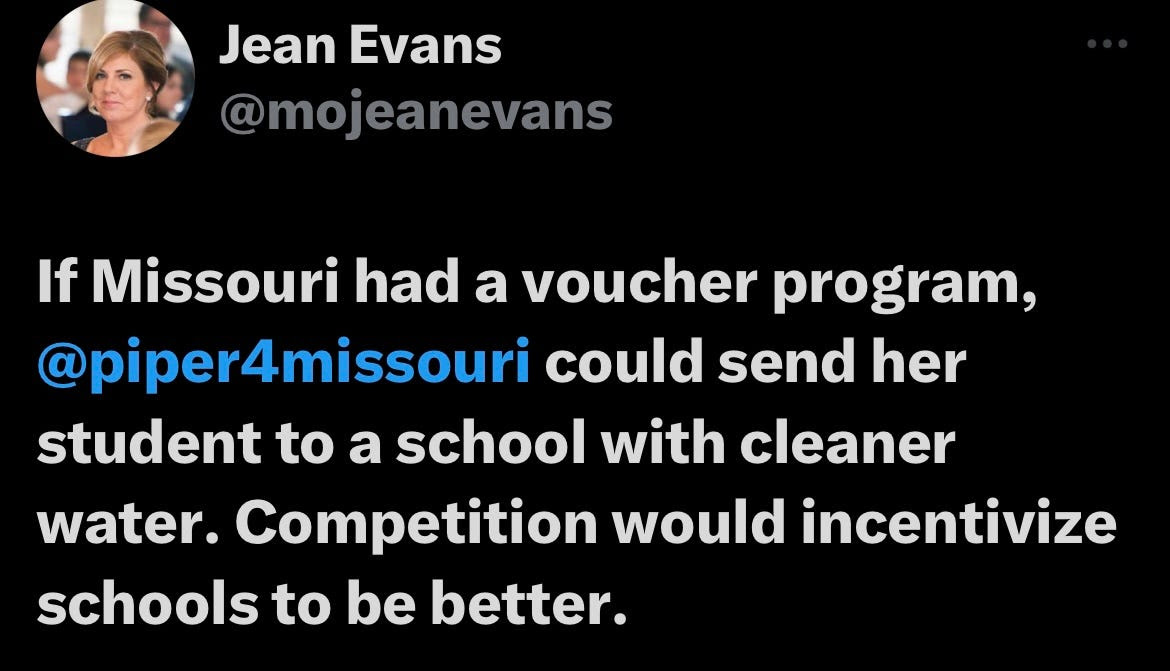
She was willing to tell me that the rural kids at my local public school would be deserving of clean drinking water if only Missouri would pass a voucher program. One may wonder if Jean herself snacked on too many lead paint chips as a child?

It all started with a letter from my local school reporting on the findings of lead in the water at the school. Most water sources were within EPA levels of lead in the water—not particularly great news, but I suspect most old schoolhouses reported much of the same. One faucet, in the nurse’s office, reported an elevated level more than four times the recommended limit. The school is addressing the water faucet and is attempting remediation. No children will drink this water.

I tweeted the findings and reminded my Twitter audience that over 80% of Missouri children test positive for lead in their blood. Jean responded by tweeting this:

Yes, if only we would expand Missouri’s current ESA scheme to defund schools and agree to a full-on voucher scheme, maybe the kids in my town wouldn’t be drinking poisoned water? If only rural folks would acquiesce to closing our schools and going along with the plan to keep our rural kids at home for online learning, and the occasional visit from a tutor, our kids wouldn’t be drinking lead.

Read the full post here.You can view the post at this link : https://networkforpubliceducation.org/blog-content/jess-piper-poisoned-water-in-missouri-public-schools-let-the-kids-eat-cake/

Peter Greene has been following the debate over voucher legislation in Wyoming, where they have failed until now. Surely some Republicans must be following what happened to vouchers in Texas, where a significant number of Republicans representing rural districts voted them down to protect their community public schools. They knew their schools needed funding, not competition. What states like Wyoming need is a public referendum on vouchers: let the public decide. Could it be that the politicians know that no state referendum on vouchers has ever passed?

Greene writes:

Attempts have been made to sell a school voucher bill in the Wyoming legislature, like the Wyoming Freedom Scholarship Act (because “scholarship” and “freedom” are more popular terms than “voucher”) earlier this year, but they have all failed. Now a new variation on the theme is aiming at a place on the 2024 schedule.

Oddly enough, the bill comes from Speaker of the House Albert Sommers, a Republican who actually helped block the Freedom Scholarship Act. But he thinks this alternate form will work better. Opponents disagree. Actually, some supporters disagreed, too– State Senator Bo Biteman said this new version was too watered down and was a “crap sandwich,” and so, as we’ll see, GOP reps managed to un-water the bill.

Some key features.

The bill runs on $40 million taken from the general fund. Of that $40 million, $12 million (30%) goes to fund preschool education. Because if there’s one technique that voucher proponents have learned, it’s to team up your unpopular voucher plan with something that people want.

The rest of the funding would go to ESA vouchers.
The bill uses the usual foot-in-the-door feature of an income cap for receiving the vouchers. This bill sets the cap at 250% of federal poverty limit, which adds up to $75,000 for a family of four. Median household income in Wyoming is $68,000. One legislator unsuccessfully tried to boost this up to 350% ($105K). At this point, nobody should be fooled by the “we’re just doing this to rescue the poor kids” line, as we have seen multiple states modify their program with ever-increasing caps or simply getting rid of the cap entirely.

With that expansion of eligibility, we keep seeing voucher program costs explode to budget-busting extremes.

Voucher amount would be up to $5,000. According to the website Private School Review, average private school tuition in Wyoming is $8,719 per year.

In one feature that is not common to voucher laws, the bill proposes that the Department of Education would certify vendors eligible to be paid with the taxpayer-funded vouchers. (That was not part of the Freedom Scholarship Act.) But a legislator successfully added an amendment, typical of current voucher law, that the state can’t interfere with the private school’s curriculum or admission policies, meaning that the school could teach religion, flat earth science, creationism, and racial supremacy if it so desired, as well as discriminating against whatever applicants it so desired.

In practice, what that means is that religious schools can accept vouchers while offering religious indoctrination and religion-based discrimination (e.g. the Illinois voucher school that requires families to be born-again Christians)
And another legislator successfully stripped the portion of the bill that voucher-using students had to take the same state tests as public school students. Rep. Karlee Provenza pretty well captured what all these changes mean.

“When we remove that testing standard, we are moving away from saying is government money being well spent?” Provenza said. “We’re not regulating choice, we’re regulating accountability of our state funds.”

True enough, but current voucher theory says that a voucher bill isn’t non-crappy unless it’s stripped of accountability and oversight. So if Wyoming is going to have school vouchers, they should be as unaccountable and unregulated as possible. Kiss those dollars goodbye, taxpayers, and don’t ask where they went or how effectively they were spent. Freedom!

The bill will still have to clear some hurdles, including a state constitution that prohibits the use of “any portion of any public school fund” for private schools (Article 7, Section 8).

Wyoming voucher advocates have struggled with this, and the argument seems to boil down to:

1) Once we hand the money over to the parents, it is transformed into private money and so there’s no problem!

2) Supreme Court thinks public money should absolutely finance the exercise of religion, so if this makes it all the way to SCOTUS, they will be on our side.

So we’ll see. There are unique features to a voucher initiative in Wyoming. For one, funding vouchers by having “the money follow the child” would never fly, because Wyoming schools have wildly different per pupil costs. In 2019-2020, Laramie #1 spent $14,582 per student, but the very rural Sheridan district (90 students) spent $41,176 per student. That means Wyoming is better inclined to fund vouchers separately from public education. They could, in fact, be the first legislature to be honest and say, “We believe in choice so much that we are going to raise your taxes to fund it.”

For another, there’s that state constitution, exactly the same sort of challenge that sank a voucher proposal in Kentucky.

Other state constitutions, such as Florida and Ohio, ban public funding for religious schools, but that has not been an obstacle to GOP politicians.

The Network for Public Education reposted this excellent review of a book about vouchers. The review and the book summarize the findings about who benefits from vouchers and how they affect the public schools. The place to begin is with recognition of the handsomely funded propaganda campaign on behalf of vouchers. The promise was equity. The reality was inequity, diverting public funds to subsidize students who never attended public schools. Were vouchers intended as a scam or did they unexpectedly turn into one?

New post on Network for Public Education. Jan Resseger: New Book Contrasts What Voucher Proponents Promise to the Inequitable Results

Jan Resseger writes:

Jan Resseger looks at a new book edited by Kevin Weltner of the National Education Policy Center entitled The School Voucher Illusion. Reposted with permission.

Teachers College Press recently published The School Voucher Illusion: Exposing the Pretense of Equity, a dispositive analysis of the failure of publicly funded private school tuition voucher programs.

The book is a collection of essays edited by Kevin Welner, Director of the Education Policy Center and professor at the University of Colorado; Gary Orfield, Director of the Civil Rights Project and professor at UCLA; and Luis Huerta, professor at Teachers College, Columbia University. Contributors include the editors as well as Derek Black, author of Schoolhouse Burning and professor at the University of South Carolina; Christopher Lubienski, author of The Public School Advantage and professor at Indiana University; Preston Green, professor at the University of Connecticut; and Suzanne Eckes and Julie Mead, professors at the University of Wisconsin, and many other scholars. The list includes academic experts on constitutional law, civil rights, public policy, and the social foundations of education.

In the final chapter, after 270 pages of data and theoretical exploration, Welner, Orfield, and Huerta contrast what the promoters of school privatization promise to the damage caused by the school voucher programs spreading across the states today: “If the real choice is not access to a superior, idealized school with an excellent faculty, but instead to a segregated religious school that is also struggling with concentrated poverty plus a weak and inexperienced teaching force, then vouchers are offering a fundamentally different experience than what’s been advertised.” (p. 276)

What about the diversion of states’ education budgets to private schools?

“What began in Cleveland and Milwaukee as small-scale pilots targeted to ‘save’ students of color from ‘failing public schools’… quickly transformed into a movement to give all students a taxpayer subsidy to incentivize them to leave their public schools and, then, into subsidies for students who were in private schools anyway—simply a transfer of money, usually to families without the financial exigency.” (p. 278)

Through the research reported by contributors to this book, the editors conclude that measuring the fiscal impact of transferring tax dollars to private schools is complicated due to all the ways: “vouchers interact with public budgets… Any measure of the immediate fiscal and educational efficiency of vouchers must… account for significant cost differentials compared to a comprehensive public school system… and must include measures of quality and the amount of services provided to all students. For example, public schools routinely enroll greater numbers of special education, vocational education, and English language learner students, who require more expensive educational services than those that private schools typically provide.” (p. 284)

There is also the problem of fixed costs that do not change when students leave public schools with a voucher: “A reduction in public school enrollments must also be taken into account due to effects on the economies of scale that support public school infrastructure…. When policies move students out of public school systems, the schools often have fixed costs… that cannot be lowered to match declining per-student aid from state governments, leaving less money for educational operations.” (p. 284)

And what about the vouchers taken up by students already in private schools? “Voucher programs only realize financial savings for state governments when the cost of providing vouchers to families is offset by corresponding reductions for students opting out of the public school system… Advocates who claim voucher and neovoucher programs are a savings to taxpayers use very high switcher rates, which can result in a gross overestimate of public-coffer savings.” (p. 284-285)

What have we lost through the erosion of the Constitutional protection of the separation of church and state?

The First Amendment to the U.S. Constitution begins: “Congress shall make no law respecting an establishment of religion, or prohibiting the free exercise thereof.” Although previous U.S. Supreme Courts used to interpret the separation of government and religion under the Establishment Clause, in three recent Supreme Court precedents, today’s justices have relied on the Free Exercise Clause—opining that if a state provides vouchers to private schools, it may not interfere with the free exercise of religion by denying vouchers to private schools that are run by faith communities, even those private schools that explicitly teach religion as part of the curriculum.

Welner, Orfield and Huerta explain how the Supreme Court’s new definition of church/state separation complicates voucher expansion across the states: “A state-established church is, after all, a formalized entanglement between the two institutions. Connected leadership and decision-making, finances and personnel, beliefs and positions…. Each of these is… a type of entanglement, in the sense that a move taken by one of the two institutions is directly felt by the other… We cannot yet know how far the current Supreme Court will take its elevated Free Exercise concerns about bias against religious institutions—perhaps all religiously motivated discrimination will be given heightened legal protection, or perhaps the Court will treat discriminatory practices as beyond the protection of the Free Exercise Clause, or perhaps racial discrimination will trigger greater scrutiny and protection than discrimination based on sexual orientation or gender identity. It is not difficult to see the slippery slope of unregulated funding combined with extreme protection of religious freedom. While religious beliefs are often caring and comforting, some of these beliefs are hostile to outsiders…. (D)iscrimination against members of the LGBTQ+ community is not unusual in private religious schools.” (pp. 280-283)

Are the most vulnerable children the ones who actually receive the vouchers? And what about protecting children’s civil rights?

“Advocates for expanding vouchers argue that students of color and low income students, particularly those with special needs, are otherwise denied the choices available to middle-class families. Vouchers, they say, will provide a large step toward equity of educational opportunity. Yet as described throughout this book, actual voucher policies tend to reach a different set of students. Choice research across the globe finds that unregulated choice creates stratification and disadvantages the disadvantaged.” (p. 286)

I wish the National Education Policy Center, of which Welner is the director, would publish, as a resource brief, the list of 13 questions (pp. 286-287) which advocates, critics, and regulators should ask when voucher programs are proposed. These questions are designed to expose a voucher program’s violations of standards of equity and opportunity. Here are just three examples: “Under what conditions are voucher-receiving schools allowed to reject applicants and expel students?” “Do the voucher-receiving schools have the staff and training to educate successfully and responsively with a community’s diverse population?” “Does the voucher program increase (or diminish) stratification by race and class? For students with special needs and students whose first language is other than English?” (pp. 286-287)

When students bring vouchers to private schools, there are myriad ways their rights are likely to remain unprotected: “State laws should mandate that, with the receipt of public funds, all participating schools become fully responsible to comply with all civil rights laws. For instance, they must agree to comply with the nondiscrimination provisions of the 1964 Civil Rights Act (or a substantially equivalent state civil rights act), including the antidiscrimination policies protecting students and all job discrimination components of staffing. They must also agree to comply with federal laws on special education rights and prohibitions against sex discrimination. Without such policies (which mirror those in many European countries that have voucher-like funding systems), taxpayer dollars are subsidizing open discrimination against some groups.” (p. 288)

The editors conclude The School Voucher Illusion: Exposing the Pretense of Equity with a warning: “As currently structured, voucher policies in the United States are unlikely to help the students they claim to support. Instead, these policies have often served as a facade for the far less popular reality of funding relatively advantaged (and largely White) families, many of whom already attended—or would attend—private schools without subsidies. Although vouchers are presented as helping parents choose schools, often the arrangements permit the private schools to do the choosing… If publicly stated social justice goals are to be anything more than empty and misleading rhetoric, lawmakers will need to address the concerns raised by the authors throughout this volume. Advocacy that began with a focus on equity must not become a justification for increasing inequity. Today’s voucher policies have, by design, created growing financial commitments of taxpayer money to serve a constituency of the relatively advantaged that is redefining their subsidies as rights—often in jurisdictions where neighborhood public schools do not have the resources they need.” (p. 290)You can view the post at this link : https://networkforpubliceducation.org/blog-content/jan-resseger-new-book-contrasts-what-voucher-proponents-promise-to-the-inequitable-results/

Please open the link to read the post in full.

Mothers Against Greg Abbott is celebrating because Governor Gregg Abbott’s voucher proposal—his highest priority—was defeated for the fifth time this year. Once, in the regular legislative session, then again and again and again and again in four special sessions.

Abbott offered bribes: more funding for public schools, a pay raise for teachers—but the bribes didn’t persuade the rural Republicans who saw vouchers as a threat to their small community public schools.

Abbott threatened to primary Republicans who didn’t vote for vouchers. That didn’t work either. Now the Moms (MAGA!) have to go back to work to get their public schools funded.

This is their message, issued within hours after vouchers went down for the fifth time:

From Mothers Against Greg Abbott:

The Texas House has just voted down school vouchers.

This is a huge victory for Texas public schools… and for mothers, and others, like us. Today’s victory  wouldn’t have been possible without the help you provided over the last several months. We asked you to help us support public schools, and you stepped up time and again.

Our hard work paid off. 

I don’t want to spike the football to celebrate our success. Not least because our public schools might not have a football to spike if the voucher plan had succeeded. (Yes, I know that spiking the football in a high school game is a 15-yard penalty, but let’s go with the metaphor...)

The same people who tried to strip our public schools of funding, and to give that money to rich private schools instead, aren’t going away. They will be back. 

And so will we: We defended our public schools today, and we will defend them again.

At Mothers Against Greg Abbott, we believe in high quality, free public education for our children. We support our public school teachers and our public school children. And we won’t let a handful of anti-school activists steal our children’s futures from us.

We’re here in support of public education, and we aren’t going anywhere. The next time public education is on the legislative table, we’ll be there to defend it. 

We won’t spike the football then either. We’ll celebrate because our public schools will still be there — to educate our children, to help them become our future leaders, to create the civic engagement that we all need.

And, yes, to give our kids a football, a softball, a volleyball, a tennis ball, a baseball, a basketball, arts programs, orchestra, school plays, reading specialists, school counselors, beloved school librarians, and so much more. 

With love for our public schools and our public school educators,

Nancy Thompson, Founder
Mothers Against Greg Abbott

This week, our Mothers For Democracy Institute shares the mic with YOU this week on the newest episode of The Voucher Scam! 

Hosts Claire O’Neal and Nichole Abshire ask listeners this week to share their love of public schools and their worries about vouchers. With today’s VICTORY on school vouchers in the Texas House, there is no better time to start streaming. Tune in to the conversation, here ›››

And, if you like what you hear, shoot over a donation and help support our podcast series.

Mothers for Democracy Institute is a 501(c)(3) and
donations are Tax Deductible. We just launched our podcast series The Voucher Scam, but we more planned for 2024 to further support democracy and civics education. And we
would love your support.
https://bit.ly/voucherscam

Mothers For Democracy / Mothers Against Greg Abbott is the largest coalition dedicated to defeating the extremist MAGA movement in Texas. While we don’t agree on every topic, we all agree the Texas GOP isn’t Texas values.

Since 2021, we’ve been helping lead the Democratic resistance in Texas, we’ve organized thousands of local voters and our public issue campaigns have reached millions of Texans in key battleground areas. Now, we’re backed by thousands of Texas parents who are mobilizing in their own neighborhoods to ensure the Texas we hand over to the next generation is better than the one we’ve inherited. 

We’re sick and tired of being linked to a handful of extremist MAGA spokesmen—divisive politicians like Ken Paxton and Ted Cruz. We know it’s going to take all of us to defeat them this election cycle. The power of mothers and others like us means we know we can do it: It’s time for democracy to prevail. 

100% of our work is powered by individual donations and our average donation is just $23. We can’t stop until our children have the future they deserve. So this election cycle, we’re taking down Ted Cruz and dozens more of his Texas MAGA cronies. With you by our side, we’ll deliver the kind of leadership everyone living in Texas can be proud of. 

Support Our Work

Maurice Cunningham, a retired professor of political science and an expert on dark money in education elections, prepared A CITIZEN’S GUIDE TO SCHOOL PRIVATIZATION.

It is posted on the website of the Network for Public Education.

It is a glossary of the organizations and individuals who lead the effort to privatize education.

Please open the guide and see if you have names and groups to add. The GUIDE is meant to be built on the foundation created by Cunningham. Please send your suggestions. Are there groups active in your community that were not included? Send them to the Carol Burris at the Network for Public Education.

cburris@networkforpubliceducation.org.

Carol will forward your tips to Maurice Cunningham for review and possible inclusion.

Recently, there has been a trend in states with a supermajority of Republicans in the Legislature to seize the reins of power in every realm. First, they gerrymander the state to assure that the other party has no chance to win control. Then they strip power where Democrats exercise any authority. In North Carolina, the Republican Legislature removed power from the Democratic governor. In Wisconsin, the Republican Legislature followed suit. In Ohio, with a Republican Legislature and Governor, the Governor took control of education away from the mostly elected State Board of Education.

The Ohio State Board resisted. It even sued. But a judge ruled that the governor had the authority to take control of education policy away from the State Board, even though voters gave those powers to the State Board in 1953.

Bill Phillis of the Ohio Coalition for Equity and Adequacy provided the context:

Judge rules that state level governance of education can return to the Governor’s office, notwithstanding that Ohioans, in 1953, transferred education governance from the Governor’s office to the State Board ofEducation via a constitutional amendment.

Article VI, section 4 was added to the Constitution in 1953 by the citizens of Ohio. At that time, the governance of education was embedded in the governor’s office. Ohioans passed a constitutional amendment to have education governed with the same model as used at the local level—citizens elected on a non-partisan basis to govern school districts. Local districts were not and are not now governed by other governmental jurisdictions—mayors, city councils, county commissions, township trustees.

In Ohio’s current political climate, the will of the people is summarily disregarded, even though the Ohio Constitution states that “all political power is inherent in the people.” (Article I, section 2) Notwithstanding this powerful constitutional safeguard for the folks, a Senate leader in Ohio recently said publicly, “We kinda do what we want…”

The Court, in other words, overturned the will of the voters and the state constitution.

Jan Resseger, who lives in Ohio, describes the evisceration of the State Board of Education.

She writes:

Education Week‘s Libby Sanford recently covered the education governance battle in Ohio, where the legislature just seized control of public education standards and curriculum by eviscerating the power of the Ohio State Board of Education and moving control of the state’s public schools under the political control of the governor and his appointees.

Sanford explains how the leaders of Ohio’s gerrymandered, supermajority Republican legislature folded the school governance takeover into the state budget after the legislature had failed on its own to enact the the plan to gut the power of the State Board of Education: “(T)he Republican-led Ohio state legislature passed a two-year budget that included a provision converting the Ohio Department of Education, led by a superintendent chosen by the State Board of Education, into the Ohio Department of Education and Workforce, led by a director appointed by the governor. The budget also… includes a requirement that schools adopt a state-approved reading program by the next school year and a ban on the use of the three-cueing method in literacy instruction. The move changing how education is overseen in The Buckeye State strips the 19-member State Board of Education—of which 11 members are elected and eight are appointed by the governor—of its powers to… set academic standards and set frameworks for school curricula, limiting the board to decisions on teacher disciplinary and licensure cases and disputes over school boundaries.”

According to the provisions of a 1953 state constitutional amendment, Ohio’s state board of education will continue to exist but will lack any power to control significant policy. Its members will continue to appoint a state superintendent of public instruction, but that individual will serve as a mere advisor to the governor’s appointee who will control the state’s primary public education governance and operations.

In Ohio, two members of the State Board and another parent, on behalf of their children enrolled in public schools, along with the Toledo Board of Education filed a lawsuit to block the governor’s seizure of the powers of the state board. A judge has allowed the takeover to move forward, however, while the case makes its way through the courts. On November 3, 2023, plaintiffs’ attorneys submitted a brief in support of the plaintiff’s objections to the magistrate’s decision.

Sanford examines the political takeover of Ohio’s public schools in the context of a broader national trend among legislatures and governors to introduce partisan bias into governance of an institution that has historically been protected: “(T)he state (Ohio) isn’t the first to make a move of this kind… (E)specially over the past few years, lawmakers and state leaders have taken more aggressive action on state education policy, enacting laws that limit what teachers can talk about in the classroom, greatly expanding school choice, and requiring that schools notify parents when their children seek to use pronouns or names that don’t align with their sex assigned at birth.”

Sanford interviews Jeffrey Henig, a professor of education and political science at Teachers College, Columbia University, who identifies Ohio’s insertion of politics into the governance of the state’s public schools as part of a growing trend across the states.  He calls the move, nonetheless, “a high-risk proposition.” Henig explains: “(A)t the start of the 20th century, around two-thirds of states elected their chief school officers. By 2010 that number had dropped to less than 30 percent. Many states, like Ohio, gave the power to choose a state school officer to state boards, while others gave that power to the governor. ‘The general story is there’s been this long, slow shift in formal authority… but more recently governors getting more directly involved.”

Citing examples like Governor Ron DeSantis in Florida and Governor Kim Reynolds in Iowa, Henig hopes that perhaps the new trend will run its course: “Public education can be a hot potato issue… You can get your hands burned by being too closely involved… General-purpose politicians will realize that education isn’t a sure winner for them and succumb to the pressures, many of which are legitimate, to make their mark in other areas of domestic policy rather than stick their noses right in the middle of these swirling waters of culture wars.”

As a citizen in Ohio who values public schooling, I hope Henig is correct. The danger for our children of inserting politics and ideology into the public schools has become clearer not only through the insertion of culture war bias into state legislation, but also as lobbyists pressure politicians to adopt ideology-driven education theories and even specific curricula from think tanks with known political biases. Ohio is an example. Dee Bagwell Haslam, whose family owns the Cleveland Browns, is a major contributor to the campaigns of Ohio’s Republican politicians. She also serves on the board of Jeb Bush’s ExcelinEd.  Dee Haslam has lobbied Governor Mike DeWine and the Ohio Legislature to promote one of ExcelinEd’s priorities: the Science of Reading. In this year’s state budget, the Ohio Legislature mandated that all Ohio public schools will adopt the Science of Reading as their sole reading curriculum.

In Schoolhouse Burning, his excellent exploration of the history of public education, Derek Black, an attorney and professor of constitutional law, describes the reasons why, in the period immediately following the Civil War, the authors of many of the state constitutions created state boards of education that would be independent and resistant to political meddling in public schools’ standards and curriculum:

“States… guarded against the politicization of education by vesting constitutional authority in the hands of education professionals (or at least people solely focused on education)… Following the Civil War, state constitutions increasingly established a state superintendent and/or state board of education. Doing so ensured that the individuals entrusted with administering education and setting various education policies would not be wedded to any geographic or political constituency. They were to act on behalf of all the state’s children and exercise their best judgment, hopefully devoid of the normal politics of the state house. And unlike the heads of transportation, agriculture, commerce, and police, for instance, these education officials would not serve at the pleasure of the governor or legislature.” (Schoolhouse Burning, pp. 220-221)

The National Education Policy Center at the University of Colorado invited scholar Chris Lubienski of Indiana University to review a recent publication of EdChoice (the new name of the Milton and Rose Friedman Foundation), which summarizes what voucher advocates believe about the efficacy of vouchers. The publication is titled “The 123s of School Choice: What the Research Says About Private School Choice Programs, 2023 Edition.”

Not surprisingly, EdChoice concludes that vouchers are effective. Lubienski, however, is critical of the studies they include and those they exclude. In short, EdChoice engages in cherry-picking to bolster its cause.

While the report confidently asserts that school choice works, Lubienski says that the authors ignore recent studies that show the opposite to be true. For many students, vouchers are harmful.

If your district or state is under pressure to endorse vouchers, be sure to read this review.