Archives for category: Religion

Josh Cowen kindly agreed to write a review of Pete Hegseth’s book about American education, which appears on this blog exclusively!

Hegseth has a simple answer to the problems of education: give all students a voucher and expect that most will choose a classical Christian education.

Josh Cowen is Professor of Education Policy at Michigan State. His latest book is The Privateers: How Billionaires Created a Culture War and Sold School Vouchers (Harvard Education Press).

As you know, Pete Hegseth was a FOX News host who was nominated by President-Elect Trump to be Secretary of Defense. However, his appointment appears to be in jeopardy at this moment, due to allegations about his sexual exploits and drunken behavior.

Josh Cowen wrote:

Pete Hegseth’s Education Book: American Culture on the Decline, and Only Taxpayer-Funded Classical Christian Schools Can Save Us

I read Pete Hegseth’s book on education, Battle for the American Mind, so you don’t have to. Hegseth is Donald Trump’s nominee for U.S. Defense Secretary [at this writing], and a Fox News contributor, which means his various views on the military and his trove of televised commentary are going to get more scrutiny. But as someone who understands just how important education is to right-wing plans to remake America, I was neither surprised to learn that the would-be defense secretary had thoughts about schooling, nor hesitant to look at what Hegseth had to say.

So here are a few quick thoughts. Technically, Battle is a co-authored volume with a man named David Goodwin, an activist in the classical Christian education movement. The book is presented as a joint effort that melds Goodwin’s “research about Christianity, America’s founding, history, and education” with Hegseth’s apparently probing questions about those topics. It is, however, largely written in Hegseth’s own voice (being the relative celebrity between the two). 

When the book was first published in 2022, it became a bestseller. 

The first half of Battle is something of an indictment of American culture, politics, and education. Or more specifically, of the damage that progressives have done to all three. The second half of the book poses classical Christian education as the panacea. 

Hegseth (and Goodwin) try to establish early on the notion of “paideia,” which Goodwin apparently read about through the scholars Lawrence Cremin and Werner Jaeger, and in which Hegseth seems to have been taken interest. What is “paideia?” If you’re not terribly concerned with the various buzzwords in classical Christian education circles, it’s not especially important. But in those circles it’s something between an article of faith and what passes for an intellectual framework for their goals.

Basically, paideia is what creates culture: “Paideia is contained in that human part of the soul that makes us who we are…is common to a community…made up of ideas, presumptions, beliefs, affections, and ways of understanding that defines us (p. 52).”

Crucially, “paideia is shaped during childhood” and can be cultivated. And the “Western Christian Paideia (WCP) is a unique form of paideia in that it was intentionally developed and cultivated beginning with the Greeks” who proved “that education was a powerful influencer of paideia (p. 53).” Which makes education attractive to all belief systems. What gives American paideia so much appeal is its potential to meld the Greek tradition with a right-wing version of Christian virtue for future generations.

In typical right-wing fashion, Hegseth accuses Progressives from a century ago, and “the Left” today of what his own sect is doing. It’s the Left’s “indoctrination” of children that makes it so dangerous. Except, most of Battle is a half-screed, half-baked plan to focus on children generally and on their education specifically in a cultural (and, if needed, political) uprising against the Left. As Hegseth says: “the real battlefield isn’t colleges, it’s kindergartens.”

Along the way we meet the familiar bugaboos of right-wing American ideology today’s GOP party politics: Alexandria Ocasio-Cortez, the teachers’ unions, critical race theory, DEI, Black Lives Matter, Howard Zinn, “cultural Marxism,” the Warren Court and—in a turn of a phrase that seems to have evoked any number of self-satisfied high-fives in right-wing media green rooms—the scourge of the “Covid-(16)19 Virus” in American schools. Get the idea?

Meanwhile, approved pop culture touchstones that serve almost as sources for the book’s counter-material include the movie Gladiator, Indiana Jones, Star Wars, the heroes in both the C.S. Lewis and J.R.R. Tolkein series, (said to be a favorite of J.D. Vance as well), and more spot-quotes of dead philosophers than I care to count for this blog post. 

Honestly, Battle reads like a couple of 10th Grade AP History students crammed with a video series from Hillsdale College before knocking out their final term papers and hitting “send” before hitting the gym. It’s that profound. 

It would also be silly, if it weren’t also entirely an artifact of very real, very potent, and very present intentions on the American Right for education and for child-related policy. It’s easy to make fun of a couple of bros taken in by a smart-sounding Greek word like “paideia.” But when a possible future defense secretary draws from his experience in Afghanistan as evidence that paideia exists, and while malleable, cannot be imposed on other cultures, only grown from within—the “Afghan paideia” was too strong for Americans to impose our own on it, but now “we are losing it at home” (p. 57)—it’s worth paying attention. 

In this telling, American “democracy” is simply progressive “gospel” (p. 89) and is secondary to restoring the promise of American…paideia. 

It’s that kind of mindset—more than trust in the market, more than purported concerns for COVID-era learning loss, more than a genuine desire for all kids to have the education that best fits their needs—that truly gives the Right’s push for educational privatization its energy. 

Enter school vouchers—a “key element” of their goal. Hegseth and Goodwin close Battle with a call for voucher tax credits—not the direct appropriation kind coming from state budgets at the moment. The reason for that detail is mostly due to a desire to avoid government as a middle man (though make no mistake, the impact on public funding is the same). The goal here is to rebuild the American paideia through classical Christian education:

“Our hope (and plan),” Hegseth and Goodwin write, “is that most parents are clamoring to get their kids into the best local classical Christian school,” with “Jesus Christ at the center of all of it.” (p. 237). That hope and plan requires the “battle” in the book’s title—an insurgency protected by “the full Armor of God,” as they put it.

That phrase comes from the book of Ephesians in the Bible:

Put on the full armor of God, so that you can take your stand against the devil’s schemes.  For our struggle is not against flesh and blood, but against the rulers, against the authorities, against the powers of this dark world and against the spiritual forces of evil in the heavenly realms. 

Understand that this “full armor” phrase comes specifically as the authors are discussing their “hope (and plan)” for publicly funded classical Christian schools.

As a Christian man myself—one who grew up in the same network of Catholic covenant communities as Justice Amy Coney Barrett—I know how prevalent this kind of thinking is among some members of my faith tradition. I would even call it fringe, and not widely held or fairly representative of a modest Christian.

Except that fringe is at the center of right-wing politics today, of right-wing education policymaking, and—quite possibly—at the highest levels of government, up to and including a Hegseth Pentagon and the Trump White House.

Editor’s note: We should be grateful that Hegseth was not chosen to be Secretary of Education.

Evangelicals want to destroy the wall of separation between church and state and use public schools and public funds to indoctrinate others. we have seen this in many states, such as Texas, where Governor Abbott is using billionaire money to enable the state to pay for indoctrination of more students in religious schools.

One unusually active religious group is called Lifewise Academy. A friend in New Jersey wrote to tell me that parents are pushing back.

She wrote:

LifeWise Academy has ambitious plans which take advantage of Zorach v. Clauson to pull kids out of public school classes, bringing them off campus for “bible studies.” In Ocean City, NJ, near where I live, an Evangelical Church is fighting to have the school board accept it. This map shows the scope of LifeWise’s current efforts

There is a grassroots movement to push back against these changes. https://parentsagainstlifewise.online/

Here is a recording of an informative zoom they conducted with NJ activists https://vimeo.com/1033697670/83f2dd97ea

Peter Greene writes here about the financial success of Lifewise Academy in Ohio.

He writes:

Christianists continue doing their best to force public education to bend to their brand of faith. In Ohio, legislators are now trying to create a whole new church-issued Get Out Of School Free card.

It has long been an option for schools to release students from school for part of the day to receive religious instruction, and districts have chosen to exercise that option or not as they see fit. The bill proposed on Ohio makes one simple change–instead of “may,” the law would read “shall.”

In other words, if parents demand their child be released for religious instruction, the schools must comply.

A key focus has been LifeWise Academy, an organization that has been capitalizing on the original Supreme Court ruling by delivering Bible study during the school day. Their focus is called The Gospel Project, and it is aimed at encouraging “true transformation that comes only from the gospel, not from behavior modification.” Every session is “doctrinally sound and thorough,” though whose doctrine, exactly, it follows is not made clear.

LifeWise is the brainchild of Joel Penton, who was a defensive tackle for the Ohio State football team. He graduated in 2007 (BA in Communications and Media Studies), then after what appears to be a two year gap, Penton got into the Christian Speakers Biz, starting Relevant Speakers Network, Stand for Truth Outreach, and LifeWise Academy, all based in Hilliard, Ohio.

Stand for Truth was an earlier version of the release time Bible study model as well as school assemblies, with a filed purpose of assisting “youth, youth organizations, schools and churches by providing seminars, educational materials, inspirational and motivational materials, books and other programs to help youth reach their full potential.”

The LifeWise 990 shows that it is, for legal purposes, a Stand for Truth under a new name, with the purpose unchanged. At SfT, Penton was drawing an $87K salary to handle a million-and-a-half dollar budget. The 2022 990 for LifeWise shows Penton with $41K in salary and $69K in other compensation, while LifeWise is handling $13 mill on revenue (more than double 2022) from “contributions, gifts, grants” and paying almost $6 mill in employee benefits and compensation to… I don’t know. The only other paid officials listed are Steve Clifton (COO) with $108K salary and $57K other, and treasurer David Kirkey with $31K salary. Almost $5 mill is listed as other salaries and wages, including program service expenses. They list no lobbying expense, but some mid-six figure numbers for advertising, office expenses, and travel. In all they took in almost $14 mill and spent about $9.5 mill.

Board members include Rev. Stephen Hubbardpastor at Ebeneezer Baptist Church in Logan, Ohio; Brad Hulls, a real estate agent “and remodeling specialist” from Columbus. Figuring in the group’s history is Tim Stoller, a founding board member for Cross Over The Hill, an organization with a similar message. It was Stoller who approached Penton, leading to a combining of Stand for Truth and Cross Over The Hill to form LifeWise Academy.

LifeWise has expanded to multiple states, and it’s their work that the new Ohio bill is primarily aimed at, by requiring every school in Ohio to offer a LifeWise option (or something like it).

LifeWise has not experienced large growth by playing softball. One school board member recounted a story of being approached by LifeWise, first pleasantly, and then with veiled threats about re-election. “As a church, we can’t endorse political candidates, but we can educate people.” And last summer LifeWise got in a big fight with an Indiana father who volunteered for the group so that he could gain access to their materials, which he then posted on his website. LifeWise took him to court.The parent made a point that ought to be familiar to the culture panic crowd–that parents ought to be able to review the materials that were being used with students. LifeWise has also gone after a manwho created a map showing the locations of LifeWise schools.

The Akron Beacon Journal is among those opposing the proposed law, calling it “a dangerous crack forming in the wall that separates church and state.

The article continues. To finish reading, please open the link.

Curmudgucation is free today and forever. Your pledge is a lovely vote of confidence, and passing along a post is even better. Subscribing is best of all. 

Justin Parmentier, an NBCT-certified high school teacher in North Carolina, has been scrutinizing the nonpublic schools that receive voucher money from the state. he found that nearly 90% are religious schools where discrimination and indoctrination are commonplace.

Parmenter remembers when now-disgraced Lt. Governor Mark Robinson opened a search for public schools that indoctrinate and came up with nothing.

Public funds in NC support religious schools that openly and egregiously indoctrinate students. Not a peep from the culture warriors. It wasn’t indoctrination they objected to; it was public schools.

Parmenter wrote the following in March 2024, before Robinson was disgraced by the CNN report on his history of posting on pornography websites. To call Robinson a hypocrite would be an understatement:

With billions of dollars now on tap for North Carolina’s private schools, and 88.2% of those dollars going to religious schools, scrutiny is rising over exactly what our taxes are supporting.

Private schools are legally able to discriminate against children, and many of North Carolina’s Christian schools deny admissions to students based on religious beliefs, sexual orientation, or learning disabilities.

For example, Fayetteville Christian School, which pocketed nearly $2 million in voucher dollars this school year, expressly bans students who practice specific religions like Islam and Buddhism, and they also bar LGBTQ+ students–whom they brand “perverted”–from attending.

North Raleigh Christian Academy won’t accept children with IQs below 90 and will not serve students who require IEPs (a document which outlines how a school will provide support to children with disabilities).

If this public funding of widespread discriminatory school practices rubs you the wrong way, I have bad news for you.

It gets worse.

That harmful indoctrination Mark Robinson was howling about a couple years ago in his disingenuous attempt to generate political momentum?  Turns out it’s real.  It just isn’t happening in the traditional public schools Robinson was targeting.

The Daniel Christian Academy is a private school in Concord, NC.  This school has received public dollars through school vouchers every year since Republicans launched the controversial Opportunity Scholarship voucher program in 2014-15 for a grand total of $585,776.

Daniel Academy’s mission is to “raise the next generation of leaders who will transform the heart of our nation” by equipping students “to enter the Seven Mountains of Influence.”

The Seven Mountains of Influence (also referred to as the Seven Mountains of Dominion or the Seven Mountains Mandate) refers to seven areas of society:  religion, family, education, government, media, arts & entertainment, and business.  Dominionists who follow this doctrine believe that they are mandated by God to control all seven of society’s “mountains,” and that doing so will trigger the end times.

The Seven Mountains philosophy has been around since the 70s, but it came to prominence about ten years ago with the publication of Lance Wallnau’s book Invading Babylon:  The Seven Mountains Mandate.  Wallnau touts himself as a consultant who “inspires visions of tomorrow with the clarity of today—connecting ideas to action,” and his book teaches that dominionists must “understand [their] role in society” and “release God’s will in [their] sphere of influence.”

Wallnau does caution his followers that messaging about taking control over all seven areas of society on behalf of God might freak out non dominionists, saying in 2011 that “If you’re talking to a secular audience, you don’t talk about having dominion over them. This … language of takeover, it doesn’t actually help…”

So why should North Carolinians care that their tax dollars are subsidizing this sort of indoctrination of children through private school vouchers?

I posed that question to Frederick Clarkson, a research analyst who has studied the confluence of politics and religion for more than three decades and lately has been focusing on the violent underbelly of Christian nationalists who want to achieve Christian dominion of the United States at all costs.  Here’s what Clarkson said:

North Carolina taxpayers should be concerned that they are helping to underwrite an academy for training children to become  warriors against not only the rights of others, but against democracy and its institutions.  The idea of the Seven Mountain Mandate is for Christians of the right sort to take dominion — which is to say power and influence — over the most important sectors of society. It is theocratic in orientation and its vision is forever. 

This is not something that is about liberals and conservatives . Most Christians including most evangelicals, Catholics, and mainline Protestants are deemed not just insufficiently Christian, but may be viewed as infested with demons, and standing in the way of the advancement of the Kingdom of God on Earth. And they will need to be dealt with.

Edward McKinley of the Houston Chronicle reports that the Texas State Board of Education is on track to approve Bible-based teaching in public schools. The Christian evangelicals are running the show in Texas, with help from Governor Gregg Abbot. They are knocking down the wall of separation between church and state with a sledgehammer. What about the rights of children whose parents are secular or not Christian?

He writes:

The Texas State Board of Education appeared on track to endorse a controversial set of new state-written lesson plans after narrowly defeating an effort to block it on Tuesday.

The lessons and textbooks, known collectively as Bluebonnet Learning, were drafted by the Texas Education Agency. The reading and language arts lessons integrate Biblical stories and characters and are viewed by many as connected to a national effort to return Christianity and prayer into public schools. 

They would likely face a legal challenge if adopted. The SBOE will vote on the curriculum as one of more than 100 sets of lesson plans and textbooks later this week. 

If approved, schools would have the option to use the plans and would receive extra funding if they do. 

The lesson plans have faced criticism from Democrats and some Republicans. Academics have warned that they include teachings from the Bible without contextualizing them as religious beliefs and downplay the role of racism and slavery in American history, while some on the right have argued they teach material too advanced for younger children.

But proponents say the materials are based on a scientific understanding of the best way to teach reading and they believe it will lead to higher standardized test scores.

“There’s a line between indoctrination or evangelism and education. In my view, these stories are on the education side and are establishing cultural literacy,” said Will Hickman, a Houston-area Republican who supported the Bluebonnet curriculum. Hickman added that districts can still choose whether or not to use the lesson plans….

The Bluebonnet curriculum covers kindergarten through 5th grade mathematics and reading, as well as middle school math and algebra…. 

A report from religious scholar David Brockman and the Texas Freedom Network, which has been critical of the lesson plans, said they could effectively turn public schools to Sunday schools by introducing Christian stories and ideas to young kids without contextualizing them properly as religious beliefs. There’s far more focus on Christianity and Jesus Christ than on other world religions, the report says. 

The lesson plans also faced criticism for their teaching of history and downplaying the role of slavery and racism in American history and to the founding fathers and other important American figures. 

James Talarico is a Texas legislator who is studying to be a minister.

He gave this speech recently in response to the claims of Christian nationalists. It has received more than 500,000 views.

The clip is from Instagram. I hope you can open it.

I loved it. I hope you do too. You don’t have to be religious to applaud his message.

If you want to be inspired more by this remarkable man, watch this. James Talarico explains that there is nothing Christian about Christian nationalism.

John Thompson describes Ryan Walters’ frenzied campaign to be chosen as Trump’s Secretary of Education. In Oklahoma, where he is State Superintendent, Walters has been pushing the Trump agenda long before the election. He wants religion in the schools, he wants to dismantle the Department of Education, he wants to destroy public schools, he wants to purge the curriculum. He’s practically screaming, “Take me!”

Thompson writes:

We Oklahomans need to apologize to the nation for what some of us have been thinking since the election. But, how can we not hope that State Superintendent Ryan Walters gets a job in the Trump administration? As Oklahoma Watch has reported, Ryan Walters seems to be campaigning for an appointment to be Trump’s U.S. Secretary of Education. Walters has been “rumored to be angling for the post; he’s been on a taxpayer-funded national media blitz for months.” And after all, maybe Walters’s incompetence would make it harder to destroy the U.S. Department of Education than to realize his goal of destroying Oklahoma’s public schools.

Of course, I’m kidding, mostly. But at times like this, education supporters have no choice but to seek comfort in humor, no matter how absurd such jokes may be.

During the last week, as the Oklahoman reports, Walters has promised on social media that “President Trump’s agenda will be enacted in Oklahoma.” Moreover, as the Tulsa World explained, “’Freedom to pray’ is among the education policy tenets listed by Trump’s re-election campaign.” And Walters issued a memorandum to parents and school superintendents advocating for the elimination of the U.S. Department of Education and replacing its functions with block grants.”

The Oklahoman further explains that Walters has “sent a five-point memo to public school superintendents and parents, detailing what he has described as Oklahoma’s plan to implement Trump’s agenda in schools. The memo covered topics such as ‘ending social indoctrination in classrooms’ and ‘stopping illegal immigration’s impact on our schools.’” And he also complained that “‘well-funded, out of state groups’ had ‘bullied’ an Oklahoma teacher into removing quotes from the Bible from a classroom.”

Walters now promises a “new office would help protect teachers in similar situations in the future.” So, “Walters said the Office of Religious Liberty and Patriotism would promote its namesake principles and make sure students and teachers can freely practice their religion.” While doing so, he blamed teachers unions for undermining faith and family.

The Oklahoma Voice adds, “Walters said public schools have been “ground ‘zero’ for erosion of religious liberty. While calling church-state separation a ‘myth,’ he ordered Oklahoma districts to teach from the Bible, sought to buy Bibles with taxpayer funds and advocated for opening a Catholic charter school in the state.”

Walters falsely argued:

It is no coincidence that the dismantling of faith and family values in public schools directly correlates with declining academic outcomes in our public schools. … In Oklahoma, we are reversing this negative trend and, working with the incoming Trump Administration, we are going to aggressively pursue education policies that will improve academic outcomes and give our children a better future.

The Oklahoma Watch also explains, contrary to Walters’ promises:

Due to the courts and lawmakers’ interpretation of the 10th Amendment, the federal government and Department of Education are not involved in determining curricula or educational standards or establishing schools or colleges.

Mostly, the department gives out money, some of which has strings attached, ensuring that schools adhere to federal non-discrimination laws.

Even so, we are likely to see Walters ramping up his attacks on Oklahoma schools in order to impress Trump. After all, “Trump proposes having parents elect school principals, abolishing teacher tenure and adopting merit pay. He vows to encourage prayer in schools and expel more disruptive students from classrooms.”

Real world, I’ve been asking whether Walters could impose more actual damage on his home state than on the country as a whole. Could we hope that his record of incompetence would be more likely to bring his MAGA agenda down if he tackles the more complicated battles with the U.S. Department of Education (or any other national institutions targeted by the new President)? And, wouldn’t his irrational zealotry be more politically damaging to Trump if he attacks government on the federal level?

Or, are Oklahomans just worn down by the stress Walters inflicted on us, which is what he wants to dump on the nation?

This post appeared originally in the Louisville Courier-Journal. It has since been posted by The Network for Public Education, whose contents are curated by Peter Greene.

Liam Amick: Trinity won’t let me write about Amendment 2. Here’s why I’m against it.

Liam Amick is a senior at Trinity High School, a Catholic school in Kentucky, where vouchers are on the ballot next week in Amendment 2, a proposed amendment to the state constitution that would okay vouchers. Trinity has made support of the Amendment mandatory. Amick would like to disagree, and does so in the Courier Journal.

Every day when I drive into school, I’m greeted by yard signs blazing with the message “YES on 2!” To see these put up at Trinity, a school that generally requests little political discussion at school, was quite a shock.

I’m a “private school kid.” I went to St. Francis of Assisi for first through eighth grades, and I am now a senior at Trinity High School. I will always be indebted to those schools for providing me with fantastic educations and experiences in the most formative years of my life. But to say I am disappointed with Trinity’s stance on Amendment 2 — a Kentucky ballot measure that would allow public tax funding to be used for private schools — would be an understatement.

An even bigger disappointment has been Trinity’s and the Archdiocese of Louisville‘s responses to criticism of their position. When both Trinity’s Student Government and Faculty Senate asked if the “YES on 2!” signs could be taken down, they were told that the archdiocese had asked us to put them up and there was absolutely no chance of them being taken down. Also, the administration doesn’t allow our school journalism program to report on any political topics and or criticisms of Trinity and its policies, so I felt that to share my views I had to look outside of the school.

In my opinion, the desire of non-public schools to support Amendment 2 is logical, but closed-minded. What’s important to remember is that, in Kentucky, 65% of non-public schools are found in Louisville, Lexington and the general Northern Kentucky area. Out of 120 counties in Kentucky, 89 have no access to a non-public school, and well-run, accredited non-public schools aren’t going to magically appear in those counties after the passage of Amendment 2. So, the “school choice” amendment would in fact offer students in these areas no “choice” to go to a different school.

Supporters of Amendment 2 often bring up Kentucky’s 2023 $1 billion budget surplus, claiming that that money will be used to provide funding to public schools and said schools will lose no money. However, that surplus money already has a destination. According to House Appropriations and Revenue Chair Jason Petrie, the extra money has “provided the opportunity to invest more than $2.7 billion over the next two years to improve road, rail, river, air, and water infrastructure.” Although Petrie claims they are also making “targeted investments in school facilities,” the bottom line is that significantly fewer tax dollars would go to public schools, leaving no replacement funding in their wake.

Read the full op-ed here. You can view the post at this link : https://networkforpubliceducation.org/blog-content/liam-amick-trinity-wont-let-me-write-about-amendment-2-heres-why-im-against-it/

A group of scholars at the Brookings Institution analyzed Project 2025’s proposals for education and their implications.

What struck me as most bizarre about Project 2025 was not its efforts to block-grant all federal funding of schools, nor its emphasis on privatization of K-12 schools. (Block-granting means assigning federal funding to states as a lump sum, no strings attached, no federal oversight).

No, what amazed me most was the split screen between the report’s desire to hand all power over education to states and communities, and the report’s insistence on preserving enough power to punish LGBT students, especially trans students and to impose other far-right mandates, like stamping out critical race theory. You know, either you let the states decide or you don’t. The report wants it both ways.

It’s also astonishing to realize that the insidious goal of the report is eventually abandon federal funding of education. That’s a huge step backward, taking us to 1965, before Congress passed the Elementary and Secondary Education Act, whose purpose was to raise spending in impoverished communities. I essence, P2025 says that decades of pursuing equitable funding “didn’t work,” so let’s abandon the goal and the spending.

Here is the Brookings analysis:

Project 2025 outlines a radical policy agenda that would dramatically reshape the federal government. The report was spearheaded by the right-wing Heritage Foundation and represents the policy aims of a large coalition of conservative activists. While former President Trump has attempted to distance himself from Project 2025, many of the report’s authors worked in the previous Trump administration and could return for a second round. Trump, himself, said in 2022, “This is a great group, and they’re going to lay the groundwork and detail plans for exactly what our movement will do.”

In other words, Project 2025 warrants a close look, even if the Trump campaign would like Americans to avert their gaze.

Project 2025’s education agenda proposes a drastic overhaul of federal education policy, from early childhood through higher education. Here’s just a sample of the Project 2025 education-related recommendations:

  • Dismantle the U.S. Department of Education (ED)
  • Eliminate the Head Start program for young children in poverty
  • Discontinue the Title I program that provides federal funding to schools serving low-income children
  • Rescind federal civil rights protections for LGBTQ+ students
  • Undercut federal capacity to enforce civil rights law
  • Reduce federal funding for students with disabilities and remove guardrails designed to ensure these children are adequately served by schools
  • Promote universal private school choice
  • Privatize the federal student loan portfolio

It’s an outrageous list, and that’s just the start of it.

We’ve reviewed the Project 2025 chapter on education (Chapter 11), along with other chapters with implications for students. We’ve come away with four main observations:

1. Most of the major policy proposals in Project 2025 would require an unlikely amount of congressional cooperation

Project 2025 is presented as a to-do list for an incoming Trump administration. However, most of its big-ticket education items would require a great deal of cooperation from Congress.

Proposals to create controversial, new laws or programs would require majority support in the House and, very likely, a filibuster-proof, 60-vote majority in the Senate. Ideas like a Parents’ Bill of Rights, the Department of Education Reorganization Act, and a federal tax-credit scholarship program fall into this category. Even if Republicans outperform expectations in this fall’s Senate races, they’d have to attract several Democratic votes to get to 60. That’s not happening for these types of proposals.  

The same goes for major changes to existing legislation. This includes, for example, a proposal to convert funding associated with the Individuals with Disabilities Education Act (IDEA) to no-strings-attached block grants and education savings accounts (with, presumably, much less accountability for spending those funds appropriately). It also includes a proposal to end the “negotiated rulemaking” (“neg-reg”) process that ED follows when developing regulations related to programs authorized under Title IV of the Higher Education Act (HEA). The neg-reg requirement is written into HEA itself, which means that unwinding neg-reg would require Congress to amend the HEA. That’s unlikely given that HEA reauthorization is already more than a decade overdue—and that’s without the political baggage of Project 2025 weighing down the process.

The prospect of changing funding levels for existing programs is a little more complicated. Programs like Title I are permanently authorized. Eliminating Title I or changing the formulas it usesto allocate funds to local educational agencies would require new and unlikely legislation. Year-to-year funding levels can and do change, but the vast majority of ED’s budget consists of discretionary funding that’s provided through the regular, annual appropriations process and subject to a filibuster. This limits the ability of one party to make major, unilateral changes. (ED’s mandatoryfunding is more vulnerable.)

In sum, one limiting factor on what an incoming Trump administration could realistically enact from Project 2025 is that many of these proposals are too unpopular with Democrats to overcome their legislative hurdles.

2. Some Project 2025 proposals would disproportionately harm conservative, rural areas and likely encounter Republican opposition

Another limiting factor is that some of Project 2025’s most substantive proposals probably wouldn’t be all that popular with Republicans either.

Let’s take, for example, the proposed sunsetting of the Title I program. Project 2025 proposes to phase out federal spending on Title I over a 10-year period, with states left to decide whether and how to continue that funding. It justifies this with misleading suggestions that persistent test score gaps between wealthy and poor students indicate that investments like Title I funding aren’t paying off. (In fact, evidence from school finance reforms suggests real benefits from education spending, especially for students from low-income families.)

The phrase “Title I schools” might conjure up images of under-resourced schools in urban areas that predominantly serve students of color, and it’s true that these schools are major beneficiaries of Title I. However, many types of schools, across many types of communities, receive critical support through Title I. In fact, schools in Republican-leaning areas could be hit the hardest by major cuts or changes to Title I. In the map below, we show the share of total per-pupil funding coming from Title I by state. Note that many of the states that rely the most on Title I funds (darkest blue) are politically conservative.

[Open the link to see the map.]

Of course, the impact of shifting from federal to state control of Title I would depend on how states choose to handle their newfound decision-making power. Given that several red states are among the lowest spenders on education—and have skimped on programs like Summer EBT and Medicaid expansion—it’s hard to believe that low-income students in red states would benefit from a shift to state control.

What does that mean for the type of support that Project 2025 proposals might get from red-state Republicans in Congress? It’s hard to know. It’s worth keeping in mind, though, that the GOP’s push for universal private school voucher programs has encountered some of its fiercest resistance from rural Republicans across several states.

3. Project 2025 also has significant proposals that a second Trump administration could enact unilaterally

While a second Trump administration couldn’t enact everything outlined in Project 2025 even if it wanted to, several consequential proposals wouldn’t require cooperation from Congress. This includes some actions that ED took during the first Trump administration and certainly could take again.

Here are a few of the Project 2025 proposals that the Trump administration could enact with the authority of the executive branch alone:

  • Roll back civil rights protections for LGBTQ+ students
  • Roll back Title IX protections against sex-based discrimination
  • Dismantle the federal civil rights enforcement apparatus
  • Eliminate current income-driven repayment plans and require higher monthly payments for low-income borrowers
  • Remove protections from predatory colleges that leave students with excessive debt

Federal education policy has suffered from regulatory whiplash over the last decade, with presidential administrations launching counter-regulations to undo the executive actions of the prior administration. Take, for example, “gainful employment” regulations that Democratic administrations have used to limit eligibility for federal financial aid for colleges that leave students with excessive loan debt. A second Trump administration would likely seek to reverse the Biden administration’s “gainful employment” regulations like the first Trump administration did to the Obama administration’s rules. (Then again, with the Supreme Court striking down Chevron, which provided deference to agency expertise in setting regulations, the Trump administration might not even need to formally undo regulations.)

Other Project 2025 proposals, not explicitly about education, also could wreak havoc. This includes a major overhaul of the federal civil service. Specifically, Project 2025 seeks to reinstate Schedule F, an executive order that Trump signed during his final weeks in office. Schedule F would reclassify thousands of civil service positions in the federal government to policy roles—a shift that would empower the president to fire civil servants and fill their positions with political appointees. Much has been written about the consequences of decimating the civil service, and the U.S. Department of Education, along with other federal agencies that serve students, would feel its effects.

4. Project 2025 reflects a white Christian nationalist agenda as much as it reflects a traditional conservative education policy agenda

If one were to read Project 2025’s appeals to principles such as local control and parental choice, they might think this is a standard conservative agenda for education policy. Republicans, after all, have been calling for the dismantling of ED since the Reagan administration, and every administration since has supported some types of school choice reforms.

But in many ways, Project 2025’s proposals really don’t look conservative at all. For example, a large-scale, tax-credit scholarship program would substantially increase the federal government’s role in K-12 education. A Parents’ Bill of Rights would require the construction of a massive federal oversight and enforcement function that does not currently exist. And a proposal that “states should require schools to post classroom materials online to provide maximum transparency to parents” would impose an enormous compliance burden on schools, districts, and teachers.

Much of Project 2025 is more easily interpretable through the lens of white Christian nationalism than traditional political conservatism. Scholars Philip Gorski and Samuel Perry describe white Christian nationalism as being “about ethno-traditionalism and protecting the freedoms of a very narrowly defined ‘us’.” The Project 2025 chapter on education is loaded with proposals fitting this description. That includes a stunning number of proposals focused on gender identity, with transgender students as a frequent target. Project 2025 seeks to secure rights for certain people (e.g., parents who support a particular vision of parental rights) while removing protections for many others (e.g., LGBTQ+ and racially minoritized children). Case in point, its proposal for “Safeguarding civil rights” says only, “Enforcement of civil rights should be based on a proper understanding of those laws, rejecting gender ideology and critical race theory.”

These types of proposals don’t come from the traditional conservative playbook for education policy reform. They come from a white Christian nationalist playbook that has gained prominence in far-right politics in recent years.

At this point, it’s clear that the Trump campaign sees Project 2025 as a political liability that requires distance through the election season. Let’s not confuse that with what might happen during a second Trump administration.

Marta W. Aldrich reported in Chalkbeat that Governor Bill Lee will make universal vouchers his top priority in education this coming year. Tennessee currently has a voucher program that is limited to three urban districts and is not fully enrolled. The Governor, who is a graduate of public schools, wants all students, rich and poor alike, to have a public subsidy to pay for private and religious schooling.

Republicans have made universal vouchers a high priority, knowing that it will drain students and funding from their local public schools.

Governor Lee’s effort to pass universal vouchers failed last year because of opposition by urban Democrats and rural Republicans. However, some of the Republican opponents were defeated with the help of out-of-state money spent to elect voucher-friendly Republicans who were willing to undercut their local public schools.

The extremist Republicans were funded by an organization called 1776 Project PAC, whose purpose is to elect school boards who will oppose “woke” policies and support privatization. Its leader is a GOP operative named Ryan James Gidursky. Here is a video where he discusses “the Marxist takeover of America’s schools.” Check out the merchandise on their website, which says more about their purposes than the other parts of the website. The 1776 Project PAC was funded by a rightwing billionaire, Richard Uihelein, who wants to destroy public schools because they are “woke.”

From what we already know about vouchers, we can predict that the great majority of them will be used by affluent families whose children are already enrolled in nonpublic schools. In his recently published book, The Privateers, Josh Cowen of Michigan State University has shown that the low-income students who transfer to nonpublic schools do not make academic gains and frequently experience “catastrophic” declines in their outcomes.

A new universal school voucher proposal will be the first bill filed for Tennessee’s upcoming legislative session, signaling that Gov. Bill Lee intends to make the plan his No. 1 education priority for a second straight year.

Senate Majority Leader Jack Johnson said this week that he’ll file his chamber’s legislation on the morning of Nov. 6, the day after Election Day. He expects House Majority Leader William Lamberth will do the same.

The big question is whether House and Senate Republican leaders will be able to agree on the details in 2025. The 114th Tennessee General Assembly convenes on Jan. 14 as Lee begins his last two years in office.

During the 2024 session, the governor’s Education Freedom Scholarship proposal stalled in finance committees over disagreements about testing and funding, despite a GOP supermajority, and even as universal voucher programs sprang up in several other states….

Similar to last year’s proposal, the new bill would provide about $7,000 in taxpayer funds to each of up to 20,000 students to attend a private school beginning next fall, with half of the slots going to students who are considered economically disadvantaged. By 2026, all of Tennessee’s K-12 students, regardless of family income, would be eligible for vouchers, though the number of recipients would depend on how much money is budgeted for the program.

“This story was originally published by Chalkbeat. Sign up for their newsletters at ckbe.at/newsletters”.

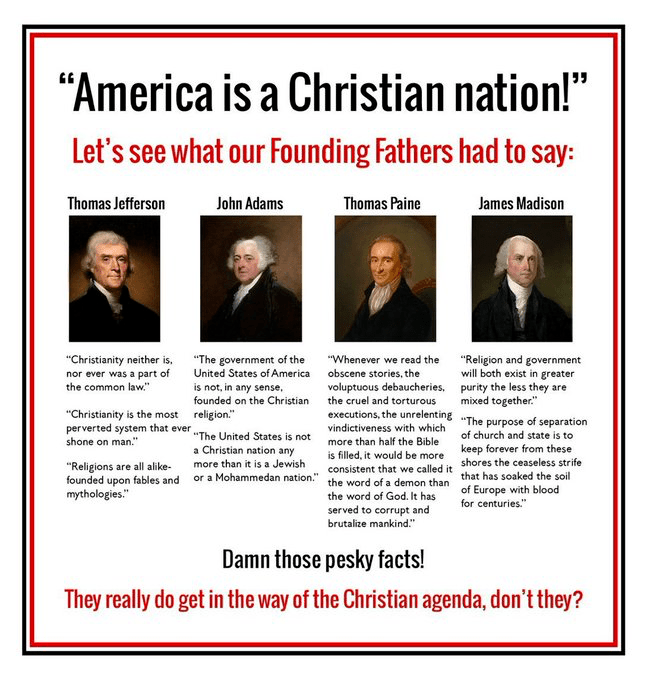
The Founding Fathers went to great lengths to separate church and state. They knew the history of religious wars in Europe, and they wanted the new nation to be free of such rivalries. They inserted into the Constitution the clear mandate that there would be no religious test to hold office. They added in the First Amendment to the institution that Congress was not allowed to establish a state religion and guaranteed freedom to practice one’s own religion.

Someone created this handy compilation of quotes from some of our most prominent men of the Founding era: