Archives for category: Racism

Education Week reported the results of a poll that showed that half of Americans don’t want children to learn about racism today. How will they understand the events of the day? What will they make of the national protests after the murder of George Floyd? How do they sense of hate crimes? How do they make sense of persistent segregation and inequality?

Madeline Will writes:

The public is divided on whether schools have a responsibility to ensure that all students learn about the ongoing effects of slavery and racism, a new national survey shows.

And as debates over how children learn about sensitive subjects bubble up across the country, Americans are also split on whether parents or teachers should have “a great deal of” influence over what is taught in schools, the survey shows. Republicans tend to defer to parents of schoolchildren, while Democrats tend to think teachers should get to decide how to teach about certain issues.

“These results suggest that not only are we divided about what’s the best curriculum, but we’re also divided about who gets to figure that out and who gets to decide,” said Eric Plutzer, a professor of political science and sociology at Pennsylvania State University who co-authored the report. “That makes it hard to solve a problem if we can’t even agree on the process, and it suggests that these kinds of issues are going to continue to come up at the local level, and we won’t be able to solve by consensus.”

The nationally representative survey of 1,200 U.S. adults, conducted in early December, was designed by the McCourtney Institute for Democracy at Penn State and analyzed by the American Public Media Research Lab. The goal was to understand how Americans think three controversial subjects should be taught in school: slavery and race, evolution, and sexual education.

While most Americans think schools have a responsibility to teach about slavery, only about half think schools should teach about the ongoing effects of racism. However, responses differed when separated by race: 79 percent of Black Americans think that students should learn about the ongoing impacts of slavery and racism, while 48 percent of white Americans think schools should teach about historical slavery but not contemporary race relations.

The survey also found that 10 percent of Americans don’t think that schools have a responsibility to ensure that all students learn about the history of slavery and racism in the United States.

As Orwell wrote, “ignorance is strength,” and in this day and age, it’s growing by leaps and bounds.

John Oliver explained the Republican hysteria over “critical race theory.” At bottom, as he shows, the GOP goal is to persuade parents to escape “CRT” by abandoning their local public schools and enrolling in charter schools or seeking vouchers. The leading anti-CRT crusader, Chris Rufo, made this linkage explicit, as Oliver demonstrates, as did Betsy DeVos. The big money supporting the anti-CRT campaign is coming from the same people funding school choice. And, as Oliver explains, “school choice” has its roots in the fight to block school desegregation in the 1950s.

The fight against CRT is being used to silence any teaching about racism today. Teachers are supposed to teach slavery and racism as a strange aberration from our founding principles and to pretend that it no longer exists.

But if it really were the terrifying problem that people like Rufo describe, why was there no uprising against it in the past 40 years? Why didn’t George W. Bush speak up about CRT? WhY was Trump silent about it until 2020? Why now? Is it mere coincidence that the anti-CRT madness took off after the murder of George Floyd and the nationwide protests against racism?

Kate McGee of the Texas Tribune writes that Lt. Governor Dan Patrick has threatened to kill tenure in Texas universities to compel compliance with his wish to stop any teaching about race or racism, which he calls “critical race theory.”

Dan Patrick is a phony Texan. He wears boots, but he was born and raised in Baltimore. His birth name was Dannie Scott Goeb. He was the little Rush Limbaugh of Texas until he entered politics. He has never abandoned the politics of hatred and division that have made him successful. He has advocated for teaching creationism in the schools and backed legislation last year to prevent public schools from requiring that students read writings by prominent civil rights figures, such as Susan B. Anthony, Cesar Chavez, and Martin Luther King Jr., when covering women’s suffrage and the civil rights movement in social studies classes.” He is a 21st century Know-Nothing.

McGee writes:

Lt. Gov. Dan Patrick said Friday that he will push to end professor tenure for all new hires at Texas public universities and colleges in an effort to combat faculty members who he says “indoctrinate” students with teachings about critical race theory.

“Go to a private school, let them raise their own funds to teach, but we’re not going to fund them,” said Patrick, who is running for reelection. “I’m not going to pay for that nonsense.”

Patrick, whose position overseeing the Senate allows him to drive the state’s legislative agenda, also proposed a change to state law that could make teaching critical race theory grounds for revoking tenure for professors who already have it. His announcement tees up the next major fight at the Texas Capitol over how college students learn about the history of race and racism in the United States.

Tenure is an indefinite appointment for university faculty that can only be terminated under extraordinary circumstances. Academics said Friday that tenure is intended to protect faculty and academic freedom from exactly the kind of politicization being waged by Patrick.

“This kind of attack is precisely why we have faculty tenure,” said Michael Harris, a professor at Southern Methodist University studying higher education, who likened tenure to lifetime appointments given to federal judges. “The political winds are going to blow at different times, and we want faculty to follow the best data and theory to try to understand what’s happening in our world.”

Patrick on Friday also proposed making tenure review an annual occurrence instead of something that takes place every six years. At the press conference, he said his proposals already have the support of state Sen. Brandon Creighton, R-Conroe, who chairs the Senate Higher Education Committee…

Patrick’s plan drew swift condemnation from the American Association of University Professors, the body that helped develop the 1940 Statement of Principles on Academic Freedom and Tenure that has been adopted by universities and colleges nationwide.

“There’s always been attempts to interfere in higher education, but I have never seen anything as egregious as this attack,” said Irene Mulvey, president of the AAUP. “This is an attempt to have government control of scholarship and teaching. That is a complete disaster. I’ve never seen anything this bad…”

Patrick said his latest priority is in response to the UT-Austin Faculty Council after it passed a nonbinding resolution Monday to reaffirm instructors’ academic freedom to teach on issues of racial justice and critical race theory.

“Legislative proposals and enactments seek to prohibit academic discussions of racism and related issues if the discussion would be ‘divisive’ or suggest ‘blame’ or cause ‘psychological distress,’” the resolution stated. “But fail to recognize that these criteria … chill the capacity of educators to exercise their academic freedom and use their expertise to make determinations regarding content and discussions that will serve educational purposes.”

One day after the resolution passed, Patrick signaled on Twitter that he would continue the fight against teaching the discipline in the next legislative session.

“I will not stand by and let looney Marxist UT professors poison the minds of young students with Critical Race Theory,” Patrick wrote on Twitter. “We banned it in publicly funded K-12 and we will ban it in publicly funded higher ed. That’s why we created the Liberty Institute at UT.…”

The proposal to end tenure would fundamentally change the way Texas universities operate in terms of hiring, teaching and research. Faculty members warn it’s likely to impose major challenges for Texas universities to recruit and retain researchers and scholars from across the country…

Harris said even the headlines to propose ending tenure could hurt Texas universities that are hiring faculty members for next year who might think twice about whether to take a job at a public university.

A few strategic phone calls from public university presidents to their alumni in the state legislature could shut down Dan Patrick mighty quick. He is an embarrassment to the state of Texas.

This is when 21st century McCarthyism gets serious.

Dan Patrick, the talk-show host who is now Lieutenant Governor of Texas, wants to ban the teaching of “critical race theory” in higher education. Critical race theory, the study of systemic and institutionalized racism, has been taught and debated in law schools and colleges since the mid-1980s.

Patrick wants to quash academic freedom in higher education. He thinks he can prevent professors who have devoted their academic careers to the study of racism from talking about it. Maybe, he believes, if they don’t talk about and study racism, no one will know it exists. Or maybe it will just go away.

Erica Grieder wrote in the Houston Chronicle about Patrick’s plans to restrict academic freedom and to have the state spend $6 million on a “think tank” called the “Liberty Institute” to prevent errant professors from exercising their freedom to teach and speak. Last year, the state passed a law to ban CRT in K-12 schools, where (he thinks) children are being stuffed with left wing propaganda and with the claim that racism is real.

“I will not stand by and let looney Marxist UT professors poison the minds of young students with critical race theory,” he announced in a tweet.

“We banned it in publicly funded K-12 and we will ban it in publicly funded higher ed,” he continued, adding: “That’s why we created the Liberty Institute at UT.”

This was in response to a report, in the Austin American-Statesman, that the Faculty Council of the University of Texas at Austin had passed a resolution defending academic freedom.

In other words, Patrick, hearing of an innocuous nonbinding resolution in support of freedom, responded by threatening to pursue even more aggressive restrictions on freedom, while also wrapping himself in the banner of “liberty.” Naturally. This is from the lieutenant governor, arguably the state’s most powerful elected official.

Patrick, a rabid supporter of vouchers, as well as limits on free speech, is a public nuisance who menaces the freedom of students, teachers, and professors in Texas.

Paul Bowers, previously the education journalist for the Charleston, South Carolina, Post & Courier, writes his own blog. In this post, he calls on the state legislators not to pass voucher legislation that would predictably defund the state’s already underfunded public schools. South Carolina has a large budget surplus and one of the lowest tax rates in the nation. Governor Henry McMaster announced that the surplus would be used to lower taxes instead of funding public schools and other public services.

Paul wrote the members of the S.C. Senate Education Committee in opposition to Senate Bill 935, which is an attempt to divert public school funding to private schools.

Senators Massey, Jackson, Hutto, Rice, and Talley:

I write to you as a South Carolinian and parent of 3 public school students asking you to scrap Senate Bill 935, the so-called “Put Parents in Charge Act,” which would redirect public funds to private schools via the creation of Education Savings Accounts.

Every few years, South Carolina teachers and parents have to band together to fight the latest iteration of the school voucher meme, which has spread virally across the states thanks to millions upon millions of dollars of dark-money political contributions, astroturfed special-interest groups, and a network of libertarian billionaires’ pet thinktanks. We fought this idea when New York real estate investor Howard Rich tried to buy a voucher law here in the early 2000s, and we’re fighting it again now that ALEC, Palmetto Promise, and the like are trying to ram the same idea through the Statehouse in Year of Our Lord 2022. There is truly nothing new under the sun.

As the educator Steve Nuzum has pointed out several times this year, the bill you will be considering in a subcommittee meeting on Feb. 16is largely copied from a piece of “model legislation” churned out by the American Legislative Exchange Council, a right-wing bill mill. I posit that we have enough terrible ideas to go around in this state without borrowing worse ones.

If enacted, this bill would be an obvious violation of the South Carolina Constitution, Article XI, Section 4, which states:

No money shall be paid from public funds nor shall the credit of the State or any of its political subdivisions be used for the direct benefit of any religious or other private educational institution.

Now, I am sure our attorney general would happily defend such an act against the inevitable lawsuits that would follow. I am no legal scholar, but I think it’s reasonable to assume he would employ some of the same arguments used to defend Gov. Henry McMaster when, in the thick of a global pandemic, he tried diverting $32 million worth of federal emergency funding from public schools to private schools. Notably, he lost that fight.

So, I suppose you and your colleagues in the General Assembly could enact this law, and you could win the legal battle that follows. Stranger things have happened. But the question remains whether you should go down this road.

I say no, you should not.

South Carolina’s most reactionary politicians have been clamoring for public divestment from the school system ever since radical Black Republicans created a free public school system for all in the Constitution of 1868. White supremacists clawed back at the notion of public goods with the Jim Crow Constitution of 1895; the Interposition Resolution of 1956; and the cavalcade of privatization laws, segregation academies, and district-level resegregation efforts that have continued without ceasing since Brown v. Board of Education was decided in 1954.

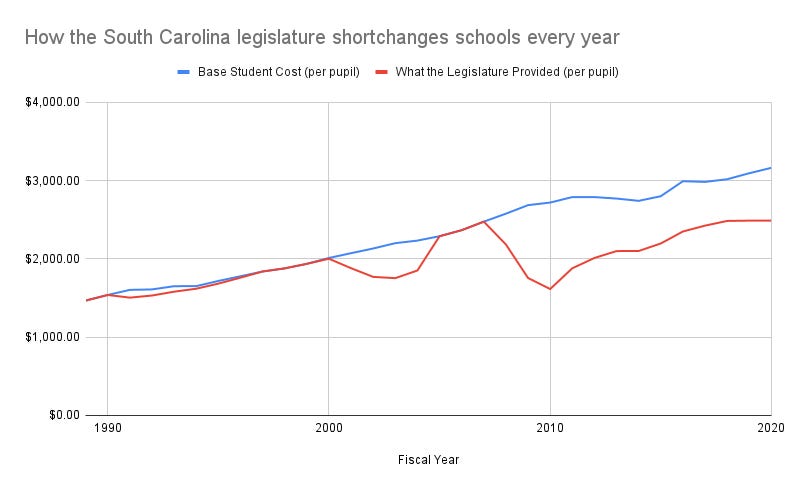
Data compiled by Steve Nuzum, via S.C. Revenue and Fiscal Affairs Office

As a matter of policy, you and your colleagues in the General Assembly have been steadily defunding public education since the start of the Great Recession. You have broken your own promises as outlined in the Education Finance Act and are currently under-funding the Base Student Cost by about a half-billion dollars per year. The results have been disastrous: Our teachers are underpaid and quitting by the thousands, classroom sizes have ballooned, our rural schools are in physical shambles, and a system of separate and unequal education along racial and economic lines has returned with a vengeance.

It is difficult to predict how much money public schools would lose as a result of Education Savings Accounts, which would allow public funds to “follow” individual students to private schools. Our state’s Revenue and Fiscal Affairs Office has tried to guess, though. According to a fiscal impact summary published in December, the ESA program could divert as much as $35 million to private schools within the first year it takes effect, depending how many families participate in the program. By 2026, they estimated the program could cost the state as much as $2.9 billion. Compounded by the General Assembly’s ongoing policy of public disinvestment, this could constitute a death blow to public schools.

The bill is built on a few faulty premises, including the underlying assumption that private schools could or would serve South Carolina students better. The authors of the bill also seem to believe that our state’s private schools could handle a sudden influx of new enrollment while accommodating students’ learning, transportation, and health needs. These are dicey propositions at best.

S. 935 is a direct attack on the notion of education as a public good. Its authors would leave us all to fend for ourselves as atomized individuals, cut loose from mutual obligations that once tied us together. For a certain type of doctrinaire conservative, this may sound like a dream scenario. For the rest of us living in the real state of South Carolina, it is a nightmare come true.

Regards,

Paul Bowers

North Charleston, S.C.

Katherine Stewart has been writing for years about Christian nationalism and its pernicious influence on American society, especially public schools. Her latest book is The Power Worshippers: Inside the Dangerous World of Religious Nationalists.

She wrote this article about the January 6 insurrection for The New York Times:

The most serious attempt to overthrow the American constitutional system since the Civil War would not have been feasible without the influence of America’s Christian nationalist movement. One year later, the movement seems to have learned a lesson: If it tries harder next time, it may well succeed in making the promise of American democracy a relic of the past.

Christian nationalist symbolism was all over the events of Jan. 6, as observers have pointed out. But the movement’s contribution to the effort to overturn the 2020 election and install an unelected president goes much deeper than the activities of a few of its representatives on the day that marks the unsuccessful end (or at least a temporary setback) of an attempted coup.

A critical precondition for Donald Trump’s attempt to retain the presidency against the will of the people was the cultivation of a substantial population of voters prepared to believe his fraudulent claim that the election was stolen — a line of argument Mr. Trump began preparing well before the election, at the first presidential debate.

The role of social and right-wing media in priming the base for the claim that the election was fraudulent is by now well understood. The role of the faith-based messaging sphere is less well appreciated. Pastors, congregations and the religious media are among the most trusted sources of information for many voters. Christian nationalist leaders have established richly funded national organizations and initiatives to exploit this fact. The repeated message that they sought to deliver through these channels is that outside sources of information are simply not credible. The creation of an information bubble, impervious to correction, was the first prerequisite of Mr. Trump’s claim.

The coup attempt also would not have been possible without the unshakable sense of persecution that movement leaders have cultivated among the same base of voters. Christian nationalism today begins with the conviction that conservative Christians are the most oppressed group in American society. Among leaders of the movement, it is a matter of routine to hear talk that they are engaged in a “battle against tyranny,” and that the Bible may soon be outlawed.

A final precondition for the coup attempt was the belief, among the target population, that the legitimacy of the United States government derives from its commitment to a particular religious and cultural heritage, and not from its democratic form. It is astonishing to many that the leaders of the Jan. 6 attack on the constitutional electoral process styled themselves as “patriots.” But it makes a glimmer of sense once you understand that their allegiance is to a belief in blood, earth and religion, rather than to the mere idea of a government “of the people, by the people, for the people.”

Given the movement’s role in laying the groundwork for the coup attempt, its leaders faced a quandary when Mr. Trump began to push his repeatedly disproven claims — and that quandary turned into a test of character on Jan. 6. Would they go along with an attempt to overthrow America’s democratic system?

Some attempted to rewrite the facts about Jan. 6. The former Republican Representative Michele Bachmann suggested the riot was the work of “paid rabble rousers,” while the activist and author Lance Wallnau, who has praised Mr. Trump as “God’s chaos candidate,” blamed “the local antifa mob.” Many leaders, like Charlie Kirk, appeared to endorse Mr. Trump’s claims about a fraudulent election. Others, like Michael Farris, president and chief executive of the religious right legal advocacy group Alliance Defending Freedom, provided indirect but no less valuable support by concern-trolling about supposed “constitutional irregularities” in battleground states.

None appeared willing to condemn Mr. Trump for organizing an attempt to prevent the peaceful transfer of power to President-elect Joe Biden. On the contrary, the Rev. Franklin Graham, writing on Facebook, condemned “these ten” from Mr. Trump’s “own party” who voted to impeach him and mused, “It makes you wonder what the thirty pieces of silver were that Speaker Pelosi promised for this betrayal.”

At Christian nationalist conferences I have been reporting on, I have heard speakers go out of their way to defend and even lionize the Jan. 6 insurrectionists. At the Road to Majority conference, which was held in Central Florida in June 2021, the author and radio host Eric Metaxas said, “The reason I think we are being so persecuted, why the Jan. 6 folks are being persecuted, when you’re over the target like that, oh my.” At that same conference, the political commentator Dinesh D’Souza, in conversation with the religious right strategist Ralph Reed, said, “The people who are really getting shafted right now are the Jan. 6 protesters,” before adding, “We won’t defend our guys even when they’re good guys.” Mr. Reed nodded in response and replied, “I think Donald Trump taught our movement a lot.”

Movement leaders now appear to be working to prime the base for the next attempt to subvert the electoral process. At dozens of conservative churches in swing states this past year, groups of pastors were treated to presentations by an initiative called Faith Wins. Featuring speakers like David Barton, a key figure in the fabrication of Christian nationalist myths about history, and led by Chad Connelly, a Republican political veteran, Faith Wins serves up elections skepticism while demanding that pastors mobilize their flocks to vote “biblical” values. “Every pastor you know needs to make sure 100 percent of the people in their pews are voting, and voting biblical values,” Mr. Connelly told the assembled pastors at a Faith Wins event in Chantilly, Va. in September.

“The church is not a cruise ship, the church is a battleship,” added Byron Foxx, an evangelist touring with Faith Wins. The Faith Wins team also had at its side Hogan Gidley, a deputy press secretary in the Trump White House, who now runs the Center for Election Integrity, an initiative of the America First Policy Institute, a group led in part by former members of the Trump administration. Mr. Gidley informed the gathering that his group is “nonpartisan” — and then went on to mention that in the last election cycle there were “A lot of rogue secretaries of state, a lot of rogue governors.”

He was presumably referring to Brad Raffensperger, the Republican secretary of state of Georgia who earned the ire of Trumpists by rebuffing the former president’s request to find him an additional 11,780 votes. “You saw the stuff in Arizona, you’re going to see more stuff in Wisconsin, these are significant issues, and we can’t be dismissed out of hand anymore, the facts are too glaring,” Mr. Gidley said. In fact, the Republican-backed audit of votes in Arizona’s largest county confirmed that President Biden won Arizona by more votes than previously thought. But the persecution narrative is too politically useful to discard simply because it’s not true.

Even as movement leaders are preparing for a possible restoration of a Trumpist regime — a period they continue to regard as a golden age in retrospect — they are advancing in parallel on closely related fronts. Among the most important of these has to do with public education.

In the panic arising out of the claim that America’s schools are indoctrinating young children in critical race theory, or C.R.T., it isn’t hard to detect the ritualized workings of the same information bubble, persecution complex and sense of entitlement that powered the coup attempt. Whatever you make of the new efforts in state legislatures to impose new “anti-C.R.T.” restrictions on speech and teaching in public schools, the more important consequence is to extend the religious right’s longstanding program to undermine confidence in public education, an effort that religious right leaders see as essential both for the movement’s long-term funding prospects and for its antidemocratic agenda.

Opposition to public education is part of the DNA of America’s religious right. The movement came together in the 1970s not solely around abortion politics, as later mythmakers would have it, but around the outrage of the I.R.S. threatening to take away the tax-exempt status of church-led “segregation academies.” In 1979, Jerry Falwell said he hoped to see the day when there wouldn’t be “any public schools — the churches will have taken them over again and Christians will be running them.”

Today, movement leaders have their eye on the approximately $700 billion that federal, state, and local governments spend yearly on education. The case of Carson v. Makin, which is before the Supreme Court this term and involves a challenge, in Maine, to prohibitions on using state tuition aid to attend religious schools, could force taxpayers to fund sectarian schools no matter how discriminatory their policies or fanatical their teachings. The endgame is to get a chunk of this money with the help either of state legislatures or the Supreme Court, which in its current configuration might well be convinced that religious schools have a right to taxpayer funds.

This longstanding anti-public school agenda is the driving force behind the movement’s effort to orchestrate the anti-C.R.T. campaign. The small explosions of hate detonating in public school boards across the nation are not entirely coming from the grass roots up. The Family Research Council, a Washington, D.C.-based Christian right policy group, recently held an online School Board Boot Camp, a four-hour training session providing instruction on how to run for school boards and against C.R.T. and to recruit others to do so. The Bradley Foundation, Heritage Action for America, and The Manhattan Institute are among those providing support for groups on the forefront of the latest public school culture wars.

A decade ago, the radical aims at the ideological core of the Christian nationalist movement were there to see for anybody who looked. Not many bothered to look, and those who did were often dismissed as alarmist. More important, most Republican Party leaders at the time distanced themselves from theocratic extremists. They avoided the rhetoric of Seven Mountains dominionism, an ideology that calls explicitly for the domination of the seven “peaks” of modern civilization (including government and education) by Christians of the correct, supposedly biblical variety.

What a difference a decade makes. National organizations like the Faith & Freedom Coalition and the Ziklag Group, which bring together prominent Republican leaders with donors and religious right activists, feature “Seven Mountains” workshops and panels at their gatherings. Nationalist leaders and their political dependents in the Republican Party now state quite openly what before they whispered to one another over their prayer breakfasts. Whether the public will take notice remains to be seen.

School choice is rooted in a history of segregation and racism. Katherine Stewart wrote about this sordid history in her book The Power Worshippers: Inside the Dangerous Rise of Religious Nationalism. I wrote about that history in The New York Review of Books in an essay called “The Dark History of School Choice,” where I reviewed Stewart’s book, Derek Black’s Schoolhouse Burning: Public Education and the Assault on American Democracy, and Steve Suitts’ Overturning Brown: The Segregationist Legacy of the Modern School Choice Movement.

Nancy MacLean, the William Chafe Professor of History at Duke University, is the author of the brilliant book Democracy in Chains, which dug deep into the roots of libertarianism, the role of the Koch brothers in funding it, and the danger to democracy of unfettered libertarianism. She and I will join in a webinar to discuss the coordinated attack on public schools on February 3; you are invited to join us.

MacLean wrote in The Washington Post about the perverse way that the school choice movement distorts the meaning of “freedom” and “choice” to hide their true goal, which is to protect racial segregation and privatize public education.

She wrote:

The year 2021 has proved a landmark for the “school choice” cause — a movement committed to the idea of providing public money for parents to use to pay for private schooling.

Republican control of a majority of state legislatures, combined with pandemic learning disruptions, set the stage for multiple victories. Seven states have created new school choice programs, and 11 others have expanded current programs through laws that offer taxpayer-funded vouchers for private schooling and authorize tax credits and educational savings accounts that incentivize parents moving their children out of public schools.

On its face, this new legislation may sound like a win for families seeking more school options. But the roots of the school choice movement are more sinister.

White Southerners first fought for “freedom of choice” in the mid-1950s as a means of defying the U.S. Supreme Court’s 1954 Brown v. Board of Education decision, which mandated the desegregation of public schools. Their goal was to create pathways for White families to remove their children from classrooms facing integration.

Prominent libertarians then took advantage of this idea, seeing it not only as a means of providing private options, but also as a tool in their crusade to dismantle public schools altogether. This history reveals that rather than giving families more school options, school choice became a tool intended to give most families far fewer in the end.

School choice had its roots in a crucial detail of the Brown decision: The ruling only applied to public schools. White Southerners viewed this as a loophole for evading desegregated schools.

In 1955 and 1956, conservative White leaders in Virginia devised a regionwide strategy of “massive resistance” to the high court’s desegregation mandate that hinged on state-funded school vouchers. The State Board of Education provided vouchers, then called tuition grants, of $250 ($2,514 in 2021 dollars) to parents who wanted to keep their children from attending integrated schools. The resistance leaders understood that most Southern White families could not afford private school tuition — and many who could afford it lacked the ideological commitment to segregation to justify the cost. The vouchers, combined with private donations to the new schools in counties facing desegregation mandates, would enable all but a handful of the poorest Whites to evade compliance.

Other Southern states soon adopted voucher programs like the one in Virginia to facilitate the creation of private schools called “segregation academies,” despite opposition from Black families and civil rights leaders. Oliver Hill, an NAACP attorney key to the Virginia case against “separate but equal” education that was folded into Brown, explained their position this way: “No one in a democratic society has a right to have his private prejudices financed at public expense.”

Despite such objections, key conservative and libertarian thinkers and foundations, including economists Milton Friedman and Friedrich Hayek, Human Events editor Felix Morley and publisher Henry Regnery, backed the White Southern cause. They recognized that White Southerners’ push for “freedom of choice” presented an opportunity to advance their goal of privatizing government services and resources, starting with primary and secondary education. They barely, if ever, addressed racism and segregation; instead, they spoke of freedom (implicitly, White freedom).

Friedman began promoting “educational freedom” in 1955, just as Southern states prepared to resist Brown. And he praised the Virginia voucher plan in his 1962 book, “Capitalism and Freedom,” holding it up as a model for school choice everywhere. “Whether the school is integrated or not,” he wrote, should have no bearing on eligibility for the vouchers. In other words, he knew the program was designed to fund segregation academies and saw it as no barrier to receiving state financing.

Friedman was far from alone. His fellow libertarians, including those on the staff of the William Volker Fund, a leading funder on the right, saw no problem with state governments providing tax subsidies to White families who chose segregation academies, even as these states disenfranchised Black voters, blocking them from having a say in these policies.

Libertarians understood that while abolishing the social safety net and other policies constructed during the Progressive era and the New Deal was wildly unpopular, even among White Southerners, school choice could win converts.

These conservative and libertarian thinkers offered up ostensibly race-neutral arguments in favor of the tax subsidies for private schooling sought by white supremacists. In doing so, they taught defenders of segregation a crucial new tactic — abandon overtly racist rationales and instead tout liberty, competition and market choice while embracing an anti-government stance. These race-neutral rationales for private school subsidies gave segregationists a justification that could survive court review — and did, for more than a decade before the Supreme Court ruled them unconstitutional.

When challenged, Friedman and his allies denied that they were motivated by racial bigotry. Yet, they had enough in common ideologically with the segregationists for the partnership to work. Both groups placed a premium on the liberty of those who had long profited from white-supremacist policies and sought to shield their freedom of action from the courts, liberal government policies and civil rights activists.

Crucially, freedom wasn’t the ultimate goal for either group of voucher supporters. White Southerners wielded colorblind language about freedom of choice to help preserve racial segregation and to keep Black children from schools with more resources.

Friedman, too, was interested in far more than school choice. He and his libertarian allies saw vouchers as a temporary first step on the path to school privatization. He didn’t intend for governments to subsidize private education forever. Rather, once the public schools were gone, Friedman envisioned parents eventually shouldering the full cost of private schooling without support from taxpayers. Only in some “charity” cases might governments still provide funding for tuition.

Friedman first articulated this outlook in his 1955 manifesto, but he clung to it for half a century, explaining in 2004, “In my ideal world, government would not be responsible for providing education any more than it is for providing food and clothing.” Four months before his death in 2006, when he spoke to a meeting of the conservative American Legislative Exchange Council (ALEC), he was especially frank. Addressing how to give parents control of their children’s education, Friedman said, “The ideal way would be to abolish the public school system and eliminate all the taxes that pay for it.”

Today, the ultrawealthy backers of school choice are cagey about this long-term goal, knowing that care is required to win the support of parents who want the best for their children. Indeed, in a sad irony, decades after helping to impede Brown’s implementation, school choice advocates on the right targeted families of color for what one libertarian legal strategist called “forging nontraditional alliances.” They won over some parents of color, who came to see vouchers and charter schools as a way to escape the racial and class inequalities that stemmed from White flight out of urban centers and the Supreme Court’s willingness to allow White Americans to avoid integrating schools.

But the history behind vouchers reveals that the rhetoric of “choice” and “freedom” stands in stark contrast to the real goals sought by conservative and libertarian advocates. The system they dream of would produce staggering inequalities, far more severe than the disparities that already exist today. Wealthy and upper-middle-class families would have their pick of schools, while those with far fewer resources — disproportionately families of color — might struggle to pay to educate their children, leaving them with far fewer options or dependent on private charity. Instead of offering an improvement over underfunded schools, school choice might lead to something far worse.

As Maya Angelou wisely counseled in another context, “When people show you who they are, believe them the first time.” If we fail to recognize the right’s true end game for public education, it could soon be too late to reverse course.

Kimberlé Williams Crenshaw is a professor of law at Columbia and UCLA and one of the leading figures in the field of critical race studies. She wrote the following article for the Los Angeles Times, where she demonstrates that the new laws banning the study of systemic racism simultaneously ban Dr. King’s views of America’s racial problems, which were not solved by passing civil rights laws. The furor over CRT shows that racism remains a powerful force today. Critics of CRT maintain illogically that teaching the history of racism is racist, that uncomfortable facts must not be taught at all, and that history must be scrubbed clean of divisive realities. As Crenshaw points out, King would have fought the current effort to cleanse U.S. history; his own words and works cannot be taught.

For the first time, we’re observing the Rev. Martin Luther King Jr. holiday under new laws in multiple states that ban the instruction of “divisive” interpretations of our racial past. The assaults have given new weapons to an enduring faction in American society that has long resisted the reckoning that his life’s work demanded.

In King’s day, this faction was known as the “Massive Resistance,” an effort to organize and frustrate the Supreme Court’s 1954 Brown vs. Board of Education ruling and efforts to build multiracial classrooms. Today, this faction is known as the “anti-CRT” effort, which seeks to proscribe race-related curricula, books or trainings that offer a discomforting view of our past and its current implications.

Teachers, public officials and students are in a particularly unsustainable bind. They’re charged with honoring King as a figure while disavowing the ideas that he lived and died to advance. They’re being asked not merely to defer King’s dream of racial equality but to decommission it altogether.

King would likely take bitter note of the all-too-familiar dynamics behind today’s backlash. After the 2020 global movement for racial justice in the United States and beyond in the wake of the savage police killing of George Floyd, legislatures in 32 states have relied on what is patently a lie — that antiracism is antiwhite — to fuel the antidemocratic crusade against what they call “critical race theory.”

For more than 30 years, scholars have employed critical race theory as an analytical tool. The right has rebranded it as the new racism, as wokeness run amok, as a threat to innocent schoolchildren and as a stalking-horse for the demise of “Western civilization” itself. The theory has become the target of coordinated efforts to stigmatize and erase generations of antiracist knowledge, advocacy and history. The objective is both to disappear antiracism’s history and to deny its contemporary salience.

King himself is a prime casualty in this effort. Apostles of the McCarthyite crackdown on critical race theory have exploited him as a mouthpiece for their cause, reducing him to a solitary, decontextualized line from the “I Have a Dream” speech about a future in which his four children were to be judged not “by the color of their skin, but by the content of their character.”

Some use King’s words to erase his deeds and those of millions more who rose up to “make good the promises” since Reconstruction. In Tennessee, for example, the Moms for Liberty sought to ban Frances E. Ruffin’s children’s book “Martin Luther King Jr. and the March on Washington” by framing its descriptions of segregation and the violence meted out against King and others as traumatizing and racist. The Moms argue that Ruffin’s portrayal of white racism against people of color “will sow the seeds of racial strife, neo-racism, neo-segregation, and is an affront” to King’s ideals. This reveals precisely what comes of a persistent and willful ignorance of King’s legacy.

The sheer power on display to turn King against himself — a process that has been underway since the first day this holiday was celebrated — is a grim reflection of the way opponents have long subjected antiracist thinking and activism to distortion, misappropriation and redefinition. The brazen casting of critical race theory as the contemporary villain following 2020’s racial reckoning is no surprise.

The King holiday and Black History Month are an excellent opportunity — perhaps the only opportunity — to course-correct, contest and redirect the misconceptions about King’s legacy and its interface with critical race theory. Recovering the real King begins by freeing his image from the clutches of those seeking to substitute truthful education with a saccharine narrative built on illusions, delusions and lies.

Dr. King was an “inconvenient truth teller.” His insistence on the urgency of racial justice put him at odds with moderate whites in the South, and his denunciation of imperialism put him at odds with allies more narrowly focused on the freedom struggle within U.S. borders.

For telling these truths, in life, King was often criticized rather than celebrated. At the time of his death, polls showed that most white people held an unfavorable view of him. The FBI, under J. Edgar Hoover, framed him as a national security threat. Some Black leaders were hardly convinced of his tactics — his civil disobedience was too radical for some, his nonviolence too accommodationist for others. But for King, the demands for racial justice were not to be won through a popularity contest or by painting a comforting picture of the U.S. social order. Nor was King’s an identity-obsessed demand for recognition. He offered a clear-eyed assessment of a would-be democracy in a state of disrepair. Confronting it at its source was the only way forward.

It’s no accident that the firestorm over critical race theory has singed King’s message: King was, in fact, a critical race theorist before there was a name for it. A core observation of the theory is the recognition that the promise of liberation extends beyond the elimination of formal segregation and individual-level prejudice. Critical race theory explores how racial inequality was historically structured into the fabric of the republic, reinforced by law, insulated by the founding Constitution and embedded into the infrastructure of American society. Similarly, King observed in 1967 that “the doctrine of white supremacy was embedded in every textbook and preached in practically every pulpit,” entrenched as “a structural part of the culture.”

Accordingly, King’s appeal in the March on Washington in 1963 was grounded in the assertion that the promise of a fully inclusive American democracy — one that lived up to its oft-stated ideals — required creative confrontation with a republic out of step with its promises. He rebuffed those who found fault in the tensions created by placing our norms and our realities in sharp relief.

King famously wrote a letter rejecting the counsel of white moderate allies who argued for a gradualist accommodation to the prioritized sensibilities of those who didn’t experience the sting of segregation. As a father, he conveyed the anguish of his own children, who couldn’t understand why they weren’t allowed into the Funtown amusement park, which barred Black visitors, while the joy of white children was privileged. He argued elsewhere that “justice for black people cannot be achieved without radical changes in the structure of our society.”

King centered the promise of equal access to the ballot — now under concerted assault — at the heart of his prophetic mission. He fought to win passage of both the Civil Rights Act and the Voting Rights Act, and he understood that the provisions of each law were part and parcel of the same struggle for true and lasting racial justice. While he hailed the landmark voting reform as “a great step forward in removing all of the remaining obstacles to the right to vote,” he also insisted that the vote be used to “rid the American body politic of racism.” King would instantly recognize the mutually reinforcing objectives of denying the ballot, an indispensable instrument of reform, while also silencing the substantive case for reform by whitewashing the country’s racial past.

Contrary to countless assertions from the right, King did not endorse colorblindness. It wasn’t the remedy for dismantling the ugly realities that white supremacy had produced. Like today’s critical race theorists, King understood that American racism was systemic and demanded systemic remedies. He was forthright in acknowledging that anti-Black racism “was not a consequence of superficial prejudice but was systemic.” Throughout his career, King set his sights on institutional-level change, calling for solutions built on the race-conscious analysis of inequalities across our society.

King invoked a “bank of justice” to be mobilized against the many structures of racial oppression to ultimately realize “the security of justice” for all Americans. This commitment explicitly extended to the mode of race-conscious practice that now goes by the name of affirmative action.

When questioned whether he would support such outlays, King bluntly replied, “I do indeed,” and went on to explain: “Can any fair-minded citizen deny that the Negro has been deprived? Few people reflect that for two centuries the Negro was enslaved and robbed of any wages — potential accrued wealth which would have been the legacy of his descendants. All of America’s wealth today could not adequately compensate its Negroes for his centuries of exploitation and humiliation.”

Much of King’s legacy may never be taught in public schools, if this manufactured panic that demands critical thinking about racism be expunged from curricula and libraries continues. In North Dakota, for example, King’s understanding of structural racism would contradict the state’s newly minted edict that racism cannot be taught as anything more than an individual’s prejudice and bias. His understanding of the historical debt created by centuries of uncompensated labor flies directly in the face of Oklahoma’s prohibition of material suggesting that current generations bear any responsibility for the actions of their ancestors.

Not only did King clearly recognize that antiracism must address built-in headwinds that unnecessarily disadvantage some groups over others, but so does, incidentally, the Supreme Court, as seen in its many rulings. Yet an instructor seeking to explain King’s expansive vision of justice or a professor highlighting legal cases about institutional discrimination will be in jeopardy if they teach these ideas in some states that have adopted such laws.

King’s ideas could also fall under efforts in states such as Oklahoma or Texas that forbid the use of classroom materials that might create guilt or discomfort in public school students. King’s description of a social order in need of repair would trigger complaints that current generations are made to feel responsible for the sins of our past. New Hampshire, meanwhile, has proposed legislation forbidding antiracist critiques of the nation’s founding and history.

Indeed, under most of these laws, King’s concrete work and documented analysis of racism’s enduring legacy in American society would be suspect. In his final speech, on the eve of his death, he said he might not get to the promised land with us. This prophecy would rest uneasily in curricula that sanction assumptions that we haven’t already become that society that King dreamed we would one day be.

This imposition of a fairy-tale account of America makes King’s sacrifice utterly illegible. It is a memory-holed vision of the past better suited to George Orwell’s dystopian reveries than to a nation seeking to redeem its promise of genuine, expansive and democratic self-rule.

Nationwide, lawmakers are legislating that our schools and workplaces turn away from King’s mandate to make good on the country’s broken promises, and wallow instead in the wages of this ignorance. It is an ignorance that grows out of an earlier effort to impose an approved orthodoxy about the American past. One of the enduring consequences of the United Daughters of the Confederacy’s textbook campaigns was the persistence of Confederate propaganda and Lost Cause mythology masquerading as the truth about the history of the Civil War and its aftermath. The United Daughters ensured that millions of children inherited a view of America’s past grossly warped by the whitewashing of slavery and the violent Redemption, when white Southerners called for a return to white supremacy, that followed Reconstruction. The democratic crisis we face today is an unrecognizable spasm from that past, illegible in part because our educational system and national myths have not overcome these past manipulations to embrace this history.

To truly honor King’s memory, then, we must defeat the faction that facilitated the U.S. Capitol riot, put democracy on life support, and continues to demand that critical interrogation of its past be censored by law. King implored that we put our bodies on the line to face the organized forces of white reaction in his day — and it’s clear that he’d be fighting in exactly the same way to preserve his prophetic legacy in our own day, when the right to equal education, to vote freely and to realize true cross-racial justice are once more under bitter attack.

Reclaiming his legacy is to realize that there is no daylight between a truly democratic society and a racially just one.
Jesse Hagopian is an activist teacher in the Seattle Public Schools, a leader in Black Lives Matter at School and editor of the book More Than a Score: The New Uprising Against High-Stakes Testing. This article appeared in the Seattle Times:

State Republican Rep. Jim Walsh recently introduced HB 1807 and Republican Rep. Brad Klippert introduced HB 1886 for this legislative session — two bills designed to mandate educators lie to Washington’s students about structural racism and sexism.

This copycat legislation is lifted from a growing number of bills around the country that seek to ban an honest account of history in K-12 education, including many of the long struggles against oppression. These bills especially target the teaching of critical race theory (CRT), the 1619 Project, the Zinn Education Project and Black Lives Matter at School.

It’s fitting that Rep. Klippert’s bill is numbered “1886,” as that was the year a mob of white people in Seattle rounded up more than 200 Chinese people, forced them into wagons, and hauled them to Seattle docks where they were placed on a ships and deported. Though 15 people were tried in court in relation to the riot — including Chief of Police William Murphywho helped the mob round up Chinese people illegally — not a single one was ever convicted of a crime.

It’s similarly appropriate that Rep. Walsh’s bill is numbered “1807” because this bill seeks to return us to the early 19th century — a time when the nation was accelerating the attack on Black people’s rights in the North and colonizing the land of Native Americans. In 1807, New Jersey took away the right to vote for Black people. On April 1, 1807, Ohio outlawedBlack people from testifying in cases with white people. For the next 40 years, white people could act with impunity in filing baseless lawsuits and commit crimes — even violent attacks — against Black people who could not testify to defend themselves or give any evidence against them…

HB 1886 states that educators would be banned from teaching that, “The United States is fundamentally or structurally racist or sexist.” But consider these facts: The average white family has 10 times the amount of wealth of the average Black family.

∙ A Black woman is three times more likely to die from pregnancy or childbirth-related causes than a white woman.

∙ Black students are more than three times more likely to be suspended from school than white students.

· The median household income for Native Americans was 60% of median white household income. And that was before the COVID-19 pandemic. Recent estimates reveal inequities have worsened, especially for Native American women.

· At least 44 transgender and gender nonconforming people were violently killed in 2020, with Black transgender women accounting for two-thirds of total recorded deaths since 2013.

· Anti-Asian hate crimes surged over 169% last year.

For teachers who believe in accurate history, there is no real choice here — we will always teach students about the reality of structural racism and other intersecting oppressions. Revealing these facts in the classroom is not about shaming white students — in fact, it is those who deny structural racism who end up leading white children to suspect that they are personally responsible for the racial disparities they see, rather than understanding the way systems can work to perpetuate inequities sometimes regardless of the intentions of the individuals who work in these systems.

Glenn Youngkin’s campaign for Governor of Virginia was fueled in large part by attacks on public schools. Youngkin said that the state’s public schools were indoctrinating students with critical race theory. He pledged to put an end to it. After he took office, he continued his rant against CRT; he even set up an email site where parents can complain about teachers. And to add to his rightwing cred, he banned mask mandates. A number of school districts are suing him to preserve their mask mandates.

Dana Milbank wrote about the elite private schools where Youngkin sent his own children. They very explicitly teach critical race theory. Youngkin knew what was going on: he was a member of the board.

Milbank wrote:

Not only is Virginia’s new Republican Gov. Glenn Youngkin banning the fictional menace of critical race theory from public schools, but he’s also turning the commonwealth into a little Stasi State. He’s setting up a tip line so parents can report to the government any school official they consider to be teaching something “divisive.”

“We’re asking for folks to send us reports,” he told a conservative radio host Monday, The Post reported. “We’re going to make sure we catalogue it all,” he added, “to make sure we’re rooting it out.”

The state’s deputizing of residents to act as informants will have the obvious effect of deterring even mentions of slavery or race, which means Youngkin has imposed a de facto “memory law” whitewashing Virginia’s, and the country’s, deep and ongoing history of white supremacy…

The public schools of Virginia do not teach critical race theory.

But do you know which schools do teach “divisive” concepts, including something resembling critical race theory? The private D.C. schools Youngkin had his children attend. And you know who was on the board of governors of one of those schools while it was beefing up its anti-racism policies? Glenn Youngkin.

Youngkin, a professed fan of public school parents’ rights, exercised his own parental rights not to send his children to Virginia public schools but rather to National Cathedral School and St. Albans School, twin private all-girl and all-boy schools in D.C. under the auspices of the Episcopal Church.
National Cathedral’s website listed Youngkin as a member of its governing board from 2016 through 2019, and he was chair of its finance committee. To their credit, both National Cathedral and St. Albans were, during that time, leaders in developing anti-racism teachings, even before the murder of George Floyd heightened national awareness of systemic racism. Youngkin’s spokeswoman, Macaulay Porter, said that Youngkin “stepped off the board after 2019” and that both schools “changed a lot over the years.”

DEI — Diversity, Equity and Inclusion — has been a priority at National Cathedral for many years. The school has an extensive staff devoted to the initiative, as well as programming that includes affinity groups such as diversity forums, an equity board, an intersectionality council and a student diversity leadership conference. A National Cathedral strategic plan approved by the board in 2018 — during Youngkin’s tenure — “includes the mandate to ‘Advance an Inclusive Educational Environment,’ ” which involved “integrating related action steps into the fabric of everything we are and do as a school community.”

Among the other things National Cathedral has done: made time in the school schedule for “critical conversations around topics of race, anti-racism, social justice, and inclusion”; added courses such as “Black Lives in Literature” and “Courageous Dialogues”; developed new hiring protocols “as a result of our anti-bias work” and required diversity training for all staff members; and included in the school’s summer reading list books such as Robin DiAngelo’s “White Fragility: Why It’s So Hard For White People To Talk About Racism….”

St. Albans has undertaken similar anti-racism initiatives. Among the books promoted on the school’s website are “White Fragility,” “Critical Race Theory: An Introduction,” Henry Louis Gates Jr.’s “Stony the Road: Reconstruction, White Supremacy and the Rise of Jim Crow,” and Ibram X. Kendi’s “Stamped from the Beginning: The Definitive History of Racist Ideas in America.”
St. Albans also directed faculty to read Kendi’s “How to Be an Antiracist.” Fox News and other conservative outlets this past fall blasted a St. Albans’s “anti-bias” policy draft.

Youngkin’s own children were lucky to have attended schools that make its students grapple with uncomfortable and, yes, “divisive” issues. So why is he now using the powers of the state to intimidate teachers who would give Virginia’s public school students the same advantage?