Archives for category: Racism

Historian Heather Cox Richardson writes on her blog that Republicans want to remove federal protections on many issues and restore states’ control. Several Republican senators have spoken out against Supreme Court decisions that overturned state laws on abortion, contraception, same-sex marriage, even interracial marriage. It was Senator Mike Braun of Indiana who said that the states should decide whether people of different races should be allowed to marry, but when the negative reactions poured in, he claimed he misunderstood the question. He was unusually clear for someone who “misunderstood the question.”

It’s sad that any Republican would question the right of people of different races to marry at the very moment that the Senate is questioning a Black woman judge who is married to a white man.

The Republicans who seek to revive a system of states’ rights and long-discredited laws reveal that they long to return to the 1950s, when segregation was legal in some states, women were not allowed to buy contraceptive devices or have an abortion, and gays were in the closet.

On Friday, a large continent of Black students walked out of North Star Academy, a high-scoring no-excuses charter school in Newark, New Jersey. The students were protesting the mistreatment of Black students and teachers.

Chalkbeat reports:

Hundreds of students walked out of a Newark charter school and rallied outside City Hall on Friday to call attention to what students said is the frequent mistreatment of Black students and faculty.

Around 9 a.m., students began streaming out of the Lincoln Park High School campus of North Star Academy, which is New Jersey’s largest charter school operator with more than 6,000 students in Newark and Camden. After marching from the Central Ward campus to nearby City Hall, student organizers and a former teacher gave speeches about a culture of anti-Blackness they said pervades the school, while scores of students cheered and waved signs.

“We’re tired and we’ve been fed up,” 12th grader Kwadjo Otoo called out from the steps of the historic building, adding that some Black teachers and students continue to feel disrespected despite efforts by the charter operator’s leadership to address complaintsabout the schools. “Now they’re trying to pretend like something changed, but we know it’s the same school we’ve been going to forever now.”

Several students said multiple Black teachers over the years have left the school, which the students said is because the teachers felt overworked and undervalued. When well-liked Black teachers depart, their absence can leave students feeling isolated, they said.

“It’s very upsetting for us to build bonds with our teachers, to build relationships and connect,” said L. Drummond, a senior at the Lincoln Park campus, “and then see them chased out by the school.”

The school went into lockdown during the protest, and students who left were not allowed back in after they returned from City Hall. Locked out of school, the students began to disperse around 10:30 a.m.; some said they planned to walk home while others set out for a different North Star campus downtown.

Jill Lepore is a historian at Harvard University and a writer for The New Yorker. In this recent article, she reviews a history of attacks on one of our nation’s most important democratic institutions: our public schools. To read the complete article, subscribe to The New Yorker. It is a wonderful magazine.

She begins:

In 1925, Lela V. Scopes, twenty-eight, was turned down for a job teaching mathematics at a high school in Paducah, Kentucky, her home town. She had taught in the Paducah schools before going to Lexington to finish college at the University of Kentucky. But that summer her younger brother, John T. Scopes, was set to be tried for the crime of teaching evolution in a high-school biology class in Dayton, Tennessee, in violation of state law, and Lela Scopes had refused to denounce either her kin or Charles Darwin. It didn’t matter that evolution doesn’t ordinarily come up in an algebra class. And it didn’t matter that Kentucky’s own anti-evolution law had been defeated. “Miss Scopes loses her post because she is in sympathy with her brother’s stand,” the Times reported.

In the nineteen-twenties, legislatures in twenty states, most of them in the South, considered thirty-seven anti-evolution measures. Kentucky’s bill, proposed in 1922, had been the first. It banned teaching, or countenancing the teaching of, “Darwinism, atheism, agnosticism, or the theory of evolution in so far as it pertains to the origin of man.” The bill failed to pass the House by a single vote. Tennessee’s law, passed in 1925, made it a crime for teachers in publicly funded schools “to teach any theory that denies the story of the Divine Creation of man as taught in the Bible, and to teach instead that man has descended from a lower order of animals.” Scopes challenged the law deliberately, as part of an effort by the A.C.L.U. to bring a test case to court. His trial, billed as the trial of the century, was the first to be broadcast live on the radio. It went out across the country, to a nation, rapt.

A century later, the battle over public education that afflicted the nineteen-twenties has started up again, this time over the teaching of American history. Since 2020, with the murder of George Floyd and the advance of the Black Lives Matter movement, seventeen states have made efforts to expand the teaching of one sort of history, sometimes called anti-racist history, while thirty-six states have made efforts to restrict that very same kind of instruction. In 2020, Connecticut became the first state to require African American and Latino American history. Last year, Maine passed “An Act to Integrate African American Studies into American History Education,” and Illinois added a requirement mandating a unit on Asian American history.

On the blackboard on the other side of the classroom are scrawled what might be called anti-anti-racism measures. Some ban the Times’ 1619 Project, or ethnic studies, or training in diversity, inclusion, and belonging, or the bugbear known as critical race theory. Most, like a bill recently introduced in West Virginia, prohibit “race or sex stereotyping,” “race or sex scapegoating,” and the teaching of “divisive concepts”—for instance, the idea that “the United States is fundamentally racist or sexist,” or that “an individual, by virtue of his or her race or sex, is inherently racist, sexist or oppressive, whether consciously or unconsciously.”

While all this has been happening, I’ve been working on a U.S.-history textbook, so it’s been weird to watch lawmakers try their hands at writing American history, and horrible to see what the ferment is doing to public-school teachers. In Virginia, Governor Glenn Youngkin set up an e-mail tip line “for parents to send us any instances where they feel that their fundamental rights are being violated . . . or where there are inherently divisive practices in their schools.” There and elsewhere, parents are harassing school boards and reporting on teachers, at a time when teachers, who earn too little and are asked to do too much, are already exhausted by battles over remote instruction and mask and vaccine mandates and, not least, by witnessing, without being able to repair, the damage the pandemic has inflicted on their students. Kids carry the burdens of loss, uncertainty, and shaken faith on their narrow shoulders, tucked inside their backpacks. Now, with schools open and masks coming off, teachers are left trying to figure out not only how to care for them but also what to teach, and how to teach it, without losing their jobs owing to complaints filed by parents.

There’s a rock, and a hard place, and then there’s a classroom. Consider the dilemma of teachers in New Mexico. In January, the month before the state’s Public Education Department finalized a new social-studies curriculum that includes a unit on inequality and justice in which students are asked to “explore inequity throughout the history of the United States and its connection to conflict that arises today,” Republican lawmakers proposed a ban on teaching “the idea that social problems are created by racist or patriarchal societal structures and systems.” The law, if passed, would make the state’s own curriculum a crime.

Evolution is a theory of change. But in February—a hundred years, nearly to the day, after the Kentucky legislature debated the nation’s first anti-evolution bill—Republicans in Kentucky introduced a bill that mandates the teaching of twenty-four historical documents, beginning with the 1620 Mayflower Compact and ending with Ronald Reagan’s 1964 speech “A Time for Choosing.” My own account of American history ends with the 2020 insurrection at the Capitol, and “The Hill We Climb,” the poem that Amanda Gorman recited at the 2021 Inauguration. “Let the globe, if nothing else, say this is true: / That even as we grieved, we grew.”

Did we, though? In the nineteen-twenties, the curriculum in question was biology; in the twenty-twenties, it’s history. Both conflicts followed a global pandemic and fights over public education that pitted the rights of parents against the power of the state. It’s not clear who’ll win this time. It’s not even clear who won last time. But the distinction between these two moments is less than it seems: what was once contested as a matter of biology—can people change?—has come to be contested as a matter of history. Still, this fight isn’t really about history. It’s about political power. Conservatives believe they can win midterm elections, and maybe even the Presidency, by whipping up a frenzy about “parents’ rights,” and many are also in it for another long game, a hundred years’ war: the campaign against public education.

Please subscribe and finish reading.

Last week, I reported a poll in Educatuon Week, which found that half the public thinks that schools should not teach about racism today. With opinion polls, the results are influenced by many factors, including how the questions are worded. A poll by CBS got very different results.

Greg Sergeant writes in the Washington Post that Democrats should take heart from a CBS News poll: Most Americans oppose book banning. Democrats should stop being defensive.

He writes:

As Democrats debate the GOP’s all-culture-war-all-the-time campaign strategy, here’s a maxim worth remembering: If you’re wasting political bandwidth denying lies about yourselves, you’re losing.

A new CBS News poll offers data that should prod Democrats into rethinking these culture-war battles. It finds that surprisingly large majorities oppose banning books on history or race — and importantly, this is partly because teaching about our racial past makes students more understanding of others’ historical experiences.

The poll finds that 83 percent of Americans say books should never be banned for criticizing U.S. history; 85 percent oppose banning them for airing ideas you disagree with; and 87 percent oppose banning them for discussing race or depicting slavery.

What’s more, 76 percent of Americans say schools should be allowed to teach ideas and historical events that “might make some students uncomfortable.” And 68 percent say such teachings make people more understanding of what others went through, while 58 percent believe racism is still a serious problem today.

Finally, 66 percent say public schools either teach too little about the history of Black Americans (42 percent) or teach the right amount (24 percent). Yet 59 percent say we’ve made “a lot of real progress getting rid of racial discrimination” since the 1960s.

This hints at a way forward for Democrats. Notably, large majorities think both that we’ve made a good deal of racial progress and that we should be forthrightly confronting hard racial truths about our past and present, even if it makes students uncomfortable.

Culture warriors in the Republican Party want to ban all teaching about racism, in the past or present. They pass vague laws that are meant to intimidate teachers.

Their rhetorical game works this way: If you focus too much on the persistence of racial disparities in the present, you’re denying the racial progress that has taken place. You’re telling children that race still matters. You’re not telling a positive or uplifting story about our country. You’re saying America is irredeemable. You’re trying to make children hate our country, each other and themselves.

But this polling suggests many Americans doesn’t necessarily see things this way. Place proper emphasis on the idea that racial progress has been made, and it’s fine to highlight the problems that remain, even if it creates feelings of discomfort. It’s possible to tell a story that is in some ways about progress but also doesn’t whitewash our past.

Education Week reported the results of a poll that showed that half of Americans don’t want children to learn about racism today. How will they understand the events of the day? What will they make of the national protests after the murder of George Floyd? How do they sense of hate crimes? How do they make sense of persistent segregation and inequality?

Madeline Will writes:

The public is divided on whether schools have a responsibility to ensure that all students learn about the ongoing effects of slavery and racism, a new national survey shows.

And as debates over how children learn about sensitive subjects bubble up across the country, Americans are also split on whether parents or teachers should have “a great deal of” influence over what is taught in schools, the survey shows. Republicans tend to defer to parents of schoolchildren, while Democrats tend to think teachers should get to decide how to teach about certain issues.

“These results suggest that not only are we divided about what’s the best curriculum, but we’re also divided about who gets to figure that out and who gets to decide,” said Eric Plutzer, a professor of political science and sociology at Pennsylvania State University who co-authored the report. “That makes it hard to solve a problem if we can’t even agree on the process, and it suggests that these kinds of issues are going to continue to come up at the local level, and we won’t be able to solve by consensus.”

The nationally representative survey of 1,200 U.S. adults, conducted in early December, was designed by the McCourtney Institute for Democracy at Penn State and analyzed by the American Public Media Research Lab. The goal was to understand how Americans think three controversial subjects should be taught in school: slavery and race, evolution, and sexual education.

While most Americans think schools have a responsibility to teach about slavery, only about half think schools should teach about the ongoing effects of racism. However, responses differed when separated by race: 79 percent of Black Americans think that students should learn about the ongoing impacts of slavery and racism, while 48 percent of white Americans think schools should teach about historical slavery but not contemporary race relations.

The survey also found that 10 percent of Americans don’t think that schools have a responsibility to ensure that all students learn about the history of slavery and racism in the United States.

As Orwell wrote, “ignorance is strength,” and in this day and age, it’s growing by leaps and bounds.

John Oliver explained the Republican hysteria over “critical race theory.” At bottom, as he shows, the GOP goal is to persuade parents to escape “CRT” by abandoning their local public schools and enrolling in charter schools or seeking vouchers. The leading anti-CRT crusader, Chris Rufo, made this linkage explicit, as Oliver demonstrates, as did Betsy DeVos. The big money supporting the anti-CRT campaign is coming from the same people funding school choice. And, as Oliver explains, “school choice” has its roots in the fight to block school desegregation in the 1950s.

The fight against CRT is being used to silence any teaching about racism today. Teachers are supposed to teach slavery and racism as a strange aberration from our founding principles and to pretend that it no longer exists.

But if it really were the terrifying problem that people like Rufo describe, why was there no uprising against it in the past 40 years? Why didn’t George W. Bush speak up about CRT? WhY was Trump silent about it until 2020? Why now? Is it mere coincidence that the anti-CRT madness took off after the murder of George Floyd and the nationwide protests against racism?

Kate McGee of the Texas Tribune writes that Lt. Governor Dan Patrick has threatened to kill tenure in Texas universities to compel compliance with his wish to stop any teaching about race or racism, which he calls “critical race theory.”

Dan Patrick is a phony Texan. He wears boots, but he was born and raised in Baltimore. His birth name was Dannie Scott Goeb. He was the little Rush Limbaugh of Texas until he entered politics. He has never abandoned the politics of hatred and division that have made him successful. He has advocated for teaching creationism in the schools and backed legislation last year to prevent public schools from requiring that students read writings by prominent civil rights figures, such as Susan B. Anthony, Cesar Chavez, and Martin Luther King Jr., when covering women’s suffrage and the civil rights movement in social studies classes.” He is a 21st century Know-Nothing.

McGee writes:

Lt. Gov. Dan Patrick said Friday that he will push to end professor tenure for all new hires at Texas public universities and colleges in an effort to combat faculty members who he says “indoctrinate” students with teachings about critical race theory.

“Go to a private school, let them raise their own funds to teach, but we’re not going to fund them,” said Patrick, who is running for reelection. “I’m not going to pay for that nonsense.”

Patrick, whose position overseeing the Senate allows him to drive the state’s legislative agenda, also proposed a change to state law that could make teaching critical race theory grounds for revoking tenure for professors who already have it. His announcement tees up the next major fight at the Texas Capitol over how college students learn about the history of race and racism in the United States.

Tenure is an indefinite appointment for university faculty that can only be terminated under extraordinary circumstances. Academics said Friday that tenure is intended to protect faculty and academic freedom from exactly the kind of politicization being waged by Patrick.

“This kind of attack is precisely why we have faculty tenure,” said Michael Harris, a professor at Southern Methodist University studying higher education, who likened tenure to lifetime appointments given to federal judges. “The political winds are going to blow at different times, and we want faculty to follow the best data and theory to try to understand what’s happening in our world.”

Patrick on Friday also proposed making tenure review an annual occurrence instead of something that takes place every six years. At the press conference, he said his proposals already have the support of state Sen. Brandon Creighton, R-Conroe, who chairs the Senate Higher Education Committee…

Patrick’s plan drew swift condemnation from the American Association of University Professors, the body that helped develop the 1940 Statement of Principles on Academic Freedom and Tenure that has been adopted by universities and colleges nationwide.

“There’s always been attempts to interfere in higher education, but I have never seen anything as egregious as this attack,” said Irene Mulvey, president of the AAUP. “This is an attempt to have government control of scholarship and teaching. That is a complete disaster. I’ve never seen anything this bad…”

Patrick said his latest priority is in response to the UT-Austin Faculty Council after it passed a nonbinding resolution Monday to reaffirm instructors’ academic freedom to teach on issues of racial justice and critical race theory.

“Legislative proposals and enactments seek to prohibit academic discussions of racism and related issues if the discussion would be ‘divisive’ or suggest ‘blame’ or cause ‘psychological distress,’” the resolution stated. “But fail to recognize that these criteria … chill the capacity of educators to exercise their academic freedom and use their expertise to make determinations regarding content and discussions that will serve educational purposes.”

One day after the resolution passed, Patrick signaled on Twitter that he would continue the fight against teaching the discipline in the next legislative session.

“I will not stand by and let looney Marxist UT professors poison the minds of young students with Critical Race Theory,” Patrick wrote on Twitter. “We banned it in publicly funded K-12 and we will ban it in publicly funded higher ed. That’s why we created the Liberty Institute at UT.…”

The proposal to end tenure would fundamentally change the way Texas universities operate in terms of hiring, teaching and research. Faculty members warn it’s likely to impose major challenges for Texas universities to recruit and retain researchers and scholars from across the country…

Harris said even the headlines to propose ending tenure could hurt Texas universities that are hiring faculty members for next year who might think twice about whether to take a job at a public university.

A few strategic phone calls from public university presidents to their alumni in the state legislature could shut down Dan Patrick mighty quick. He is an embarrassment to the state of Texas.

This is when 21st century McCarthyism gets serious.

Dan Patrick, the talk-show host who is now Lieutenant Governor of Texas, wants to ban the teaching of “critical race theory” in higher education. Critical race theory, the study of systemic and institutionalized racism, has been taught and debated in law schools and colleges since the mid-1980s.

Patrick wants to quash academic freedom in higher education. He thinks he can prevent professors who have devoted their academic careers to the study of racism from talking about it. Maybe, he believes, if they don’t talk about and study racism, no one will know it exists. Or maybe it will just go away.

Erica Grieder wrote in the Houston Chronicle about Patrick’s plans to restrict academic freedom and to have the state spend $6 million on a “think tank” called the “Liberty Institute” to prevent errant professors from exercising their freedom to teach and speak. Last year, the state passed a law to ban CRT in K-12 schools, where (he thinks) children are being stuffed with left wing propaganda and with the claim that racism is real.

“I will not stand by and let looney Marxist UT professors poison the minds of young students with critical race theory,” he announced in a tweet.

“We banned it in publicly funded K-12 and we will ban it in publicly funded higher ed,” he continued, adding: “That’s why we created the Liberty Institute at UT.”

This was in response to a report, in the Austin American-Statesman, that the Faculty Council of the University of Texas at Austin had passed a resolution defending academic freedom.

In other words, Patrick, hearing of an innocuous nonbinding resolution in support of freedom, responded by threatening to pursue even more aggressive restrictions on freedom, while also wrapping himself in the banner of “liberty.” Naturally. This is from the lieutenant governor, arguably the state’s most powerful elected official.

Patrick, a rabid supporter of vouchers, as well as limits on free speech, is a public nuisance who menaces the freedom of students, teachers, and professors in Texas.

Paul Bowers, previously the education journalist for the Charleston, South Carolina, Post & Courier, writes his own blog. In this post, he calls on the state legislators not to pass voucher legislation that would predictably defund the state’s already underfunded public schools. South Carolina has a large budget surplus and one of the lowest tax rates in the nation. Governor Henry McMaster announced that the surplus would be used to lower taxes instead of funding public schools and other public services.

Paul wrote the members of the S.C. Senate Education Committee in opposition to Senate Bill 935, which is an attempt to divert public school funding to private schools.

Senators Massey, Jackson, Hutto, Rice, and Talley:

I write to you as a South Carolinian and parent of 3 public school students asking you to scrap Senate Bill 935, the so-called “Put Parents in Charge Act,” which would redirect public funds to private schools via the creation of Education Savings Accounts.

Every few years, South Carolina teachers and parents have to band together to fight the latest iteration of the school voucher meme, which has spread virally across the states thanks to millions upon millions of dollars of dark-money political contributions, astroturfed special-interest groups, and a network of libertarian billionaires’ pet thinktanks. We fought this idea when New York real estate investor Howard Rich tried to buy a voucher law here in the early 2000s, and we’re fighting it again now that ALEC, Palmetto Promise, and the like are trying to ram the same idea through the Statehouse in Year of Our Lord 2022. There is truly nothing new under the sun.

As the educator Steve Nuzum has pointed out several times this year, the bill you will be considering in a subcommittee meeting on Feb. 16is largely copied from a piece of “model legislation” churned out by the American Legislative Exchange Council, a right-wing bill mill. I posit that we have enough terrible ideas to go around in this state without borrowing worse ones.

If enacted, this bill would be an obvious violation of the South Carolina Constitution, Article XI, Section 4, which states:

No money shall be paid from public funds nor shall the credit of the State or any of its political subdivisions be used for the direct benefit of any religious or other private educational institution.

Now, I am sure our attorney general would happily defend such an act against the inevitable lawsuits that would follow. I am no legal scholar, but I think it’s reasonable to assume he would employ some of the same arguments used to defend Gov. Henry McMaster when, in the thick of a global pandemic, he tried diverting $32 million worth of federal emergency funding from public schools to private schools. Notably, he lost that fight.

So, I suppose you and your colleagues in the General Assembly could enact this law, and you could win the legal battle that follows. Stranger things have happened. But the question remains whether you should go down this road.

I say no, you should not.

South Carolina’s most reactionary politicians have been clamoring for public divestment from the school system ever since radical Black Republicans created a free public school system for all in the Constitution of 1868. White supremacists clawed back at the notion of public goods with the Jim Crow Constitution of 1895; the Interposition Resolution of 1956; and the cavalcade of privatization laws, segregation academies, and district-level resegregation efforts that have continued without ceasing since Brown v. Board of Education was decided in 1954.

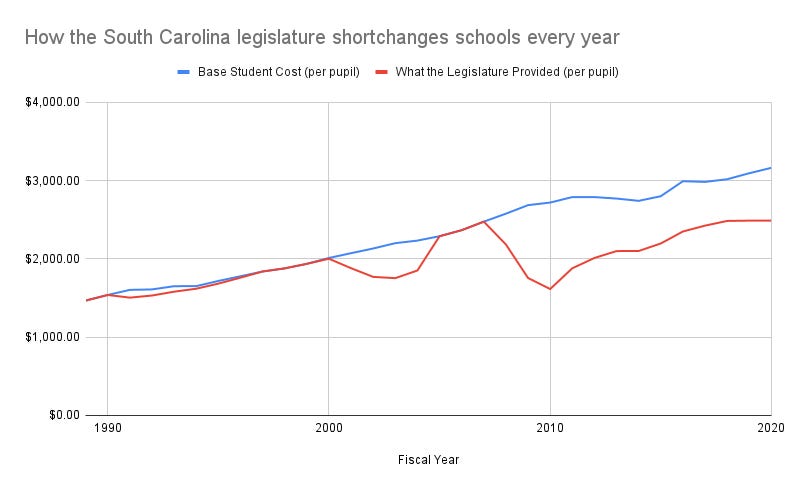
Data compiled by Steve Nuzum, via S.C. Revenue and Fiscal Affairs Office

As a matter of policy, you and your colleagues in the General Assembly have been steadily defunding public education since the start of the Great Recession. You have broken your own promises as outlined in the Education Finance Act and are currently under-funding the Base Student Cost by about a half-billion dollars per year. The results have been disastrous: Our teachers are underpaid and quitting by the thousands, classroom sizes have ballooned, our rural schools are in physical shambles, and a system of separate and unequal education along racial and economic lines has returned with a vengeance.

It is difficult to predict how much money public schools would lose as a result of Education Savings Accounts, which would allow public funds to “follow” individual students to private schools. Our state’s Revenue and Fiscal Affairs Office has tried to guess, though. According to a fiscal impact summary published in December, the ESA program could divert as much as $35 million to private schools within the first year it takes effect, depending how many families participate in the program. By 2026, they estimated the program could cost the state as much as $2.9 billion. Compounded by the General Assembly’s ongoing policy of public disinvestment, this could constitute a death blow to public schools.

The bill is built on a few faulty premises, including the underlying assumption that private schools could or would serve South Carolina students better. The authors of the bill also seem to believe that our state’s private schools could handle a sudden influx of new enrollment while accommodating students’ learning, transportation, and health needs. These are dicey propositions at best.

S. 935 is a direct attack on the notion of education as a public good. Its authors would leave us all to fend for ourselves as atomized individuals, cut loose from mutual obligations that once tied us together. For a certain type of doctrinaire conservative, this may sound like a dream scenario. For the rest of us living in the real state of South Carolina, it is a nightmare come true.

Regards,

Paul Bowers

North Charleston, S.C.

Katherine Stewart has been writing for years about Christian nationalism and its pernicious influence on American society, especially public schools. Her latest book is The Power Worshippers: Inside the Dangerous World of Religious Nationalists.

She wrote this article about the January 6 insurrection for The New York Times:

The most serious attempt to overthrow the American constitutional system since the Civil War would not have been feasible without the influence of America’s Christian nationalist movement. One year later, the movement seems to have learned a lesson: If it tries harder next time, it may well succeed in making the promise of American democracy a relic of the past.

Christian nationalist symbolism was all over the events of Jan. 6, as observers have pointed out. But the movement’s contribution to the effort to overturn the 2020 election and install an unelected president goes much deeper than the activities of a few of its representatives on the day that marks the unsuccessful end (or at least a temporary setback) of an attempted coup.

A critical precondition for Donald Trump’s attempt to retain the presidency against the will of the people was the cultivation of a substantial population of voters prepared to believe his fraudulent claim that the election was stolen — a line of argument Mr. Trump began preparing well before the election, at the first presidential debate.

The role of social and right-wing media in priming the base for the claim that the election was fraudulent is by now well understood. The role of the faith-based messaging sphere is less well appreciated. Pastors, congregations and the religious media are among the most trusted sources of information for many voters. Christian nationalist leaders have established richly funded national organizations and initiatives to exploit this fact. The repeated message that they sought to deliver through these channels is that outside sources of information are simply not credible. The creation of an information bubble, impervious to correction, was the first prerequisite of Mr. Trump’s claim.

The coup attempt also would not have been possible without the unshakable sense of persecution that movement leaders have cultivated among the same base of voters. Christian nationalism today begins with the conviction that conservative Christians are the most oppressed group in American society. Among leaders of the movement, it is a matter of routine to hear talk that they are engaged in a “battle against tyranny,” and that the Bible may soon be outlawed.

A final precondition for the coup attempt was the belief, among the target population, that the legitimacy of the United States government derives from its commitment to a particular religious and cultural heritage, and not from its democratic form. It is astonishing to many that the leaders of the Jan. 6 attack on the constitutional electoral process styled themselves as “patriots.” But it makes a glimmer of sense once you understand that their allegiance is to a belief in blood, earth and religion, rather than to the mere idea of a government “of the people, by the people, for the people.”

Given the movement’s role in laying the groundwork for the coup attempt, its leaders faced a quandary when Mr. Trump began to push his repeatedly disproven claims — and that quandary turned into a test of character on Jan. 6. Would they go along with an attempt to overthrow America’s democratic system?

Some attempted to rewrite the facts about Jan. 6. The former Republican Representative Michele Bachmann suggested the riot was the work of “paid rabble rousers,” while the activist and author Lance Wallnau, who has praised Mr. Trump as “God’s chaos candidate,” blamed “the local antifa mob.” Many leaders, like Charlie Kirk, appeared to endorse Mr. Trump’s claims about a fraudulent election. Others, like Michael Farris, president and chief executive of the religious right legal advocacy group Alliance Defending Freedom, provided indirect but no less valuable support by concern-trolling about supposed “constitutional irregularities” in battleground states.

None appeared willing to condemn Mr. Trump for organizing an attempt to prevent the peaceful transfer of power to President-elect Joe Biden. On the contrary, the Rev. Franklin Graham, writing on Facebook, condemned “these ten” from Mr. Trump’s “own party” who voted to impeach him and mused, “It makes you wonder what the thirty pieces of silver were that Speaker Pelosi promised for this betrayal.”

At Christian nationalist conferences I have been reporting on, I have heard speakers go out of their way to defend and even lionize the Jan. 6 insurrectionists. At the Road to Majority conference, which was held in Central Florida in June 2021, the author and radio host Eric Metaxas said, “The reason I think we are being so persecuted, why the Jan. 6 folks are being persecuted, when you’re over the target like that, oh my.” At that same conference, the political commentator Dinesh D’Souza, in conversation with the religious right strategist Ralph Reed, said, “The people who are really getting shafted right now are the Jan. 6 protesters,” before adding, “We won’t defend our guys even when they’re good guys.” Mr. Reed nodded in response and replied, “I think Donald Trump taught our movement a lot.”

Movement leaders now appear to be working to prime the base for the next attempt to subvert the electoral process. At dozens of conservative churches in swing states this past year, groups of pastors were treated to presentations by an initiative called Faith Wins. Featuring speakers like David Barton, a key figure in the fabrication of Christian nationalist myths about history, and led by Chad Connelly, a Republican political veteran, Faith Wins serves up elections skepticism while demanding that pastors mobilize their flocks to vote “biblical” values. “Every pastor you know needs to make sure 100 percent of the people in their pews are voting, and voting biblical values,” Mr. Connelly told the assembled pastors at a Faith Wins event in Chantilly, Va. in September.

“The church is not a cruise ship, the church is a battleship,” added Byron Foxx, an evangelist touring with Faith Wins. The Faith Wins team also had at its side Hogan Gidley, a deputy press secretary in the Trump White House, who now runs the Center for Election Integrity, an initiative of the America First Policy Institute, a group led in part by former members of the Trump administration. Mr. Gidley informed the gathering that his group is “nonpartisan” — and then went on to mention that in the last election cycle there were “A lot of rogue secretaries of state, a lot of rogue governors.”

He was presumably referring to Brad Raffensperger, the Republican secretary of state of Georgia who earned the ire of Trumpists by rebuffing the former president’s request to find him an additional 11,780 votes. “You saw the stuff in Arizona, you’re going to see more stuff in Wisconsin, these are significant issues, and we can’t be dismissed out of hand anymore, the facts are too glaring,” Mr. Gidley said. In fact, the Republican-backed audit of votes in Arizona’s largest county confirmed that President Biden won Arizona by more votes than previously thought. But the persecution narrative is too politically useful to discard simply because it’s not true.

Even as movement leaders are preparing for a possible restoration of a Trumpist regime — a period they continue to regard as a golden age in retrospect — they are advancing in parallel on closely related fronts. Among the most important of these has to do with public education.

In the panic arising out of the claim that America’s schools are indoctrinating young children in critical race theory, or C.R.T., it isn’t hard to detect the ritualized workings of the same information bubble, persecution complex and sense of entitlement that powered the coup attempt. Whatever you make of the new efforts in state legislatures to impose new “anti-C.R.T.” restrictions on speech and teaching in public schools, the more important consequence is to extend the religious right’s longstanding program to undermine confidence in public education, an effort that religious right leaders see as essential both for the movement’s long-term funding prospects and for its antidemocratic agenda.

Opposition to public education is part of the DNA of America’s religious right. The movement came together in the 1970s not solely around abortion politics, as later mythmakers would have it, but around the outrage of the I.R.S. threatening to take away the tax-exempt status of church-led “segregation academies.” In 1979, Jerry Falwell said he hoped to see the day when there wouldn’t be “any public schools — the churches will have taken them over again and Christians will be running them.”

Today, movement leaders have their eye on the approximately $700 billion that federal, state, and local governments spend yearly on education. The case of Carson v. Makin, which is before the Supreme Court this term and involves a challenge, in Maine, to prohibitions on using state tuition aid to attend religious schools, could force taxpayers to fund sectarian schools no matter how discriminatory their policies or fanatical their teachings. The endgame is to get a chunk of this money with the help either of state legislatures or the Supreme Court, which in its current configuration might well be convinced that religious schools have a right to taxpayer funds.

This longstanding anti-public school agenda is the driving force behind the movement’s effort to orchestrate the anti-C.R.T. campaign. The small explosions of hate detonating in public school boards across the nation are not entirely coming from the grass roots up. The Family Research Council, a Washington, D.C.-based Christian right policy group, recently held an online School Board Boot Camp, a four-hour training session providing instruction on how to run for school boards and against C.R.T. and to recruit others to do so. The Bradley Foundation, Heritage Action for America, and The Manhattan Institute are among those providing support for groups on the forefront of the latest public school culture wars.

A decade ago, the radical aims at the ideological core of the Christian nationalist movement were there to see for anybody who looked. Not many bothered to look, and those who did were often dismissed as alarmist. More important, most Republican Party leaders at the time distanced themselves from theocratic extremists. They avoided the rhetoric of Seven Mountains dominionism, an ideology that calls explicitly for the domination of the seven “peaks” of modern civilization (including government and education) by Christians of the correct, supposedly biblical variety.

What a difference a decade makes. National organizations like the Faith & Freedom Coalition and the Ziklag Group, which bring together prominent Republican leaders with donors and religious right activists, feature “Seven Mountains” workshops and panels at their gatherings. Nationalist leaders and their political dependents in the Republican Party now state quite openly what before they whispered to one another over their prayer breakfasts. Whether the public will take notice remains to be seen.