Archives for category: Privatization

Gary Rubinstein has been following the Tennessee Achievement School District since its inception and reporting annually on its failure. The ASD was funded by $100 million from the Obama-Duncan “Race to the Top.” The theory behind the ASD was that students had low test scores because they attended public schools with bad teachers. Take the same students in the same schools, turn them over to charter operators, and their test scores would soar. The theory was wrong.

Gary writes about it here. 

Since 2011 I have been following the biggest, and most predictable, disasters of the education reform movement — the Tennessee Achievement School District (ASD).  It was formed in a perfect storm of reform theory.  First, Tennessee won Race To The Top money.  Then they hired a TFA-alum and the ex-husband of Michelle Rhee, Kevin Huffman to be their state commissioner.  Then he hired TFA-alum and charter school founder Chris Barbic to design and run the ASD.  The initial promise of the ASD was that they would take schools in the bottom 5% and convert them into charter schools in order to ‘catapult’ them into the top 25% in five years.  They started with 6 schools in 2012 and grew to over 30 schools within a few years.

They completely failed at this mission.  Chris Barbic resigned, Kevin Huffman resigned, Barbic’s replacement resigned, Barbic’s replacement’s replacement resigned.  Of the 30 schools they nearly all stayed in the bottom 5% except a few that catapulted into the bottom 10%.

The new education commissioner of Tennessee is also a TFA alum with ideas similar to Huffman.  She promised, however, to get a handle on the ASD and what to do about its failure.  After a listening tour around the state she made, it seemed at first, a decision that was long overdue.

Chalkbeat TN recently had a post with the enticing title ‘All 30 schools in Tennessee’s turnaround district would exit by 2022 in a massive restructuring proposal.’  It would seem like this is good news.  The ASD was such a costly failure, costing about $100 million over the years I think, the only thing to do was to put it out of its misery and dissolve it completely.

But I’ve been studying reformers enough over the years not to get too excited about this.  The headline would make the most optimistic readers think that the 30 schools going back to the district would again become public schools.  The charter schools supposedly traded flexibility for accountability so their failure to deliver on their promises should result in them being sent packing.

But according to the article, it is not clear yet if being returned to the district means that they will become public schools again.  Also they say that there still will be an ASD after this.  Now there can’t be a school district with zero schools, so what’s going on?

I think, and I hope I’m wrong about this, that with the failure of the ASD there was no way that they could justify adding more schools to it.  But by ‘returning’ the 30 schools back to their districts, and probably keeping them as charters, there will now be room to add more schools in the bottom 5% to the re-booted ASD.  If this is what happens, the ASD won’t be disappearing or even shrinking, it will be expanding.  There will be the 30 schools that are still charters, but just operating as part of the district they have been returned to.  And then there will be another 20 schools, maybe, that are in the new ASD.  (They actually call it the ASD 2.0 in the state slide show)

Gary suspects a bait-and-switch, like a businessman declaring bankruptcy, then reappearing with a new name and more money.

He will keep watch for us.
Tom Ultican, retired teacher of physics and advanced mathematics, is a specialist in the Destroy Public Education movement.

In this post, he describes the effort underway to take over the Providence public schools, a tactic that has not worked anywhere else.

He begins:

November 1, 2019, Angélica Infante-Green, Rhode Island’s new Commissioner of Education, announced the state was taking over Providence Public Schools. A neoliberal Democratic governor, a like minded mayor and the chamber of commerce appear to be instituting a school privatization agenda.

All power over schools in the state is held by the governor and mayors. Citizens do not have the right vote for local school leaders and school system leaders are subordinates of mayors. This structural weakness in Rhode Island has left public education vulnerable to the whims of a governor or mayor that does not respect professional educators and public education. [CORRECTION: A READER POINTED OUT THAT PROVIDENCE HAS AN APPOINTED SCHOOL BOARD, BUT OTHER LOCAL BOARDS ARE ELECTED.]

Governor Gina Raimondo holds the non-distinction of being the least popular governor in the nation, with a favorability rating of only 36%.

Gina attended private school while growing up in Providence. She studied economics at Harvard and sociology at Oxford University. Following Oxford she earned a juris doctorate from Yale Law..

Raimondo worked in Massachusetts at the venture capital firm Village Ventures which was backed by Bain Capital before she ran for to be Rhode Island State Treasurer in 2010. A puff piece in News Week describes how Gina defeated labor union opposition to roll back pension funds. The piece states, “The changes she persuaded the Democrat-controlled Legislature to pass over union opposition will save about $3 billion by delaying retirement, suspending cost-of-living increases and offering workers 401(k)-type savings plans.”

Her neoliberal pension reform plan matches the thinking of Charles Koch and the Cato Institute. The corporate supported American Legislative Exchange Council provides legal templates for reforming pension funds that look very much likeRaimondo’s Rhode Island pension reforms…

Raimondo is all in for charter schools. She especially admires Achievement First, a no-excuses charter chain based in Connecticut.

Raimondo selected a new state commissioner of education in the spring of 2019,

Angélica Infante-Green, who trained under Joel Klien and Michael Bloomberg in New York City. Infante-Green is a former Teach for America Corp member who began her career in New York City.

According to Angélica’s LinkedIn page, she taught at PS 4M, CS 77X, and South Park High School between 1994 and 1998. All of her administrative experience appears to revolve around bilingual education. She has never been a superintendent or a principal, which makes her an odd choice to lead Rhode Island’s schools.

However, she was in the first cohort of future chiefs at Jeb Bush’s Chief’s for Change. Their official comment on Angélica’s hiring came from Chief’s for Change Board member Pedro Martinez. He said, “We applaud Gov. Gina Raimondo for selecting a commissioner with a deep commitment to creating and expanding opportunities for all students.” Martinez is the Broad trained administrator who is instituting the billionaire financed portfolio model of education reform in San Antonio, Texas; a model that posits disruption as good and democracy as a hindrance.

Researchers from John Hopkins University conducted a review of Providence Public Schools. Their report begins,

“In May 2019, the Johns Hopkins Institute for Education Policy led a review of the Providence Public School District (PPSD). We did so at the invitation of the Rhode Island Department of Education (RIDE) Commissioner, Ms. Angélica Infante-Green, with the support of Governor Gina Raimondo and Mayor Jorge Elorza. The Partnership for Rhode Island funded the review.”

Infante-Green officially assumed her position on April 29 and in May she already had arranged for corporate money to finance a study of PPSD.

The corporate money came from The Partnership for Rhode Island, a group of leading CEO’s in the state. The Governor and the Mayor supported the new Commissioner of Education’s invitation for the study to be done. When the report was released, media, politicians and business executive started vehemently denouncing PPSD as a dysfunctional failure….

An amazing fact:

The Johns Hopkins study was commissioned in May and presented in June and by July 19th Mayor Elorza officially petitioned the state to takeover PPSD.

What kind of a study is commissioned in May and presented in June?


The Los Angeles County Board of Education has denied renewal to a troubled charter school in the Inglewood school district.

The school has a long history of self-dealing, conflicts of interest, and a mixed academic record. This charter demonstrates that even “non-profits” can be very profitable to its owners.

The California Charter Schools Association is on high alert because of a change in state  law that allows local districts to weigh in on the future of charter schools, especially their fiscal impact on public schools and whether they duplicate what the public schools are already doing.

The Los Angeles County Board of Education voted Tuesday to close an Inglewood charter school with a lengthy history of financial problems and mixed academic performance that illustrated flaws in California’s oversight system.

The board’s unanimous decision marks the third time it has attempted to shut down a charter school run by Today’s Fresh Start, a nonprofit started by a wealthy couple, Clark and Jeanette Parker of Beverly Hills. The group currently operates two charters on three campuses in Los Angeles, Compton and Inglewood.

A Times investigation published last year found that although the Parkers have portrayed themselves as philanthropists, they have made millions from their charter schools.

The schools paid more than $800,000 annually to rent buildings the couple own, financial documents showed. They contracted out services to the Parkers’ nonprofits and companies and paid Clark Parker generous consulting fees, all with taxpayer money.

The couple spent tens of thousands of dollars on lobbyists and campaign contributions to many of the people responsible for regulating their schools, including school board members and state elected officials.

The Parkers have denied any wrongdoing, calling the claims against them baseless and manufactured by opponents of their schools.

The board’s Tuesday vote, which affects only the Inglewood charter, leaves the future of the school, its staff and its more than 400 students in doubt.

Jeanette Parker declined to comment following the decision.

Under current California law, Today’s Fresh Start can appeal the county’s decision to the State Board of Education. A possible appeal would most likely be heard before July, when a new law takes effect that significantly limits the state board’s power to approve charter schools that have been rejected elsewhere.

Decisions like the county board’s vote to close Today’s Fresh Start are rare. Los Angeles County is home to more than 350 charter schools, most of which are routinely renewed every five years by the local school districts where they are located. Only six schools appealed renewal denials to the county in 2017-18 — the last time appeals were heard — and three were denied.

In their recommendation to close the school, consultants hired by the county voiced concern about students’ stagnant performance on the state’s standardized English language arts tests and said the school hadn’t met the necessary academic criteria to be renewed. On both English and math tests, students’ scores increased between 2015 and 2017 and spiked upward in 2018 before declining last year. The overall picture, they wrote, was “troubling.”

The consultants also raised questions about the nonprofit’s management and fiscal practices, adding that many of their concerns had surfaced more than a decade ago when the county board last tried to close one of the organization’s schools.

“It should be noted that concerns regarding conflicts of interest and self-dealing were significant bases for revocation 12 years ago,” the report stated. “Those concerns regarding conflicts of interest and self-dealing have continued to follow [Today’s Fresh Start] to this day.”


The far-right Goldwater Institute has filed a lawsuit claiming that the state has no right to regulate how parents spend their voucher money, the money that is paid by taxpayers. Goldwater says that if the parents misspent the money, it should be refunded to parents so they can try again. The Goldwater Institute, along with the DeVos family and Charles Koch, have sponsored efforts to expand the voucher program to cover all students in the state. They began with the “camel’s nose” under the tent, offering vouchers for students with disabilities (who abandon their federally-protected rights when they go to private schools); then added students in foster care; then added students in “failing” public schools; then students on reservations; then students from military families. They won’t be satisfied until every student in the state gets a voucher to leave public schools for a private school.

The Arizona Republic reports:

The Goldwater Institute, a conservative think tank, has filed suit against the state Department of Education contending it doesn’t have the authority to enforce rules governing Arizona’s school voucher program.

The suit — which was filed in Maricopa County Superior Court and names the state attorney general as a defendant — alleges the Department of Education didn’t follow the state’s rule-making process when it created the ESA handbook, a set of rules that outlines the Empowerment Scholarship Account program. The ESA program grants parents money to send their children to private school.

The suit also contends the Department of Education does not have the authority to require that parents who have misspent ESA money reimburse the state for those funds. It is demanding the Department of Education instead put that misspent money back into parents’ accounts. 

Finally, the lawsuit claims the department has no right to make funding conditional on parents filing expense reports to document how they spent the taxpayer money. It calls the quarterly reports “cumbersome and time-consuming” and says as a result payments to participants are often late, breaching their contract and causing them to miss payments to private schools.

Under the ESA program, parents receive 90% of the state funding that would otherwise go to their local public school districts. Children in six categories, such as those with special needs, in foster care, from failing schools and others, are allowed to enroll in the program. 

The voucher money, loaded on debit cards, is intended to cover specific education expenses such as private- or religious-school tuition, home-school expenses and education-related therapies.

Dawn Penich-Thacker, spokeswoman for Save Our Schools Arizona, which has opposed expansion of the ESA program, said the suit is really about stripping power from Kathy Hoffman, the Democratic superintendent of public instruction elected in 2018.

“They (Goldwater) don’t want her having any say over it,” Penich-Thacker said. 

Parents have complained about the expense reports for years but Goldwater only now filed suit, Penich-Thacker said. 

Last year, two bills in the Arizona Legislature would have stripped oversight of the ESA program from Hoffman and given it to the Treasurer’s Office, which is overseen by Republican Kimberly Yee.

“Suddenly, this is when the school choice community is up in arms,” Penich-Thacker said. “Parents are saying this is happening since day one, but it took the election of 2018 for anything to actually become a problem.” 

The Goldwater Institute has been involved in shaping the ESA program since before the voucher program became law in 2011. 

The think tank was instrumental in writing the legislation that created the program. It was also deeply involved in the numerous expansions of the law, which were often copied from model legislation written by special interests.

It was a big backer of the universal voucher expansion that would have allowed all 1.1 million Arizona public school students to use public money to go to private school. The number of students receiving the funds would have been capped at 30,000. Voters overturned the voucher law in November 2018 by a vote of 65% to 35%.

Goldwater also has wielded an “iron-like grip level of influence” behind the scenes with the Department of Education, attempting to dictate how the program should be implemented and acting as if it retained ownership of the program.

Jersey Jazzman, aka New Jersey teacher Mark Weber, analyzes the false promises of choice advocates.

He demonstrates their repeated claims that charters and vouchers will give poor kids “the same choices” as rich kids.

This is nonsense.

Wealthy Right-wingers have been trying to destroy public education for decades. This is their latest hoax.

The private schools where rich families send their children cost between $35,000-$60,000. A voucher is seldom equal to the cost of public school tuition. Its promoters tout vouchers as a money-saver. In North Carolina, for example, a voucher is worth less than $5,000. What kind of schooling does that pay for? A school with uncertified teachers, and a Bible Belt curriculum.

That’s not the same schooling that rich kids get.

Charter schools? The day-lilies of American education. The big corporate chains administer tough discipline. Kids are punished if their shirt tail isn’t tucked in. They get demerits if they talk in the hall. Kids sit in front of computers for half the day. This is not what rich kids get.

The New York Daily News reports that lobbyists for billionaires who support charter schools had a cozy meeting with Democrats in the State Senate. 

Even though pro-public education progressives swept control of the State Senate away from the charter-crazy Republicans in the State Senate, the lobbyists know that money is still green, no matter who is in power.

Jeffrey Cook-McCormac, a lobbyist working under Dan Loeb, one of the state’s most prolific political bundlers and once a pariah among Dems for racist comments made about now-Senate Majority Leader Andrea Stewart-Cousins (D-Yonkers), can be heard on the tape praising Democrats for not taking steps to scale back charters.

“I just want to say that I think a lot of people are breathing a sigh of relief on how you governed in your first few months in the majority,” Cook-McCormac told an audience that included Senate Deputy Leader Michael Gianaris (D-Queens) as well as Sens. Brian Benjamin (D-Manhattan) and Jim Gaughran (D-Long Island)…

The comments came in the wake of a legislative session in which Dems, in control of both chambers for the first time in years, were bolstered by a slate of progressive members who are either openly wary of charters or the moneyed interests behind them….

Cook-McCormac’s presence at the Nov. 4 fundraiser at the swanky Midtown outpost Aquavit was especially surprising to some Dems considering his boss’ past comments about Stewart-Cousins.

In 2017, Loeb came under fire for a Facebook post saying that the Senate Democratic Leader had done “more damage to people of color than anyone who has ever donned a hood.”

Lawmakers, including Benjamin, staged protests outside of Success Academy charter schools at the time, calling for the billionaire founder of the Third Point hedge fund to be fired from his position as chairman of the board for the city’s largest charter-school operator. Loeb later apologized.

While Dems accepting cash from charter proponents isn’t new, some were stunned by the chumminess on display.

So, to be clear, billionaire Dan Loeb implies that State Senator Stewart-Cousins–now the majority leader– is worse than the Ku Klux Klan.

But that is no reason not to take Loeb’s money, right?


Thousands of teachers in Florida are rallying at the state capitol today to demand higher wages and better working conditions. The Republican-dominated legislature has been handing out public monies to charter schools and for voucher programs, but ignoring the public schools that enroll 85% of the state’s students. Several of the key legislators are related to charter operators. Conflicts of interest are not a problem in Florida. The State Commissioner of Education Richard Corcoran–former Speaker of the House–is married to a charter operator.

Bernie Sanders wrote a message of support to the teachers who are speaking out. It appeared in the Sun Sentinel. 

Every Democratic candidate should heed Senator Sanders’ advice (except, of course, billionaire Michael Bloomberg, who wants more privatization, merit pay, and larger class sizes).

This week, tens of thousands of teachers from across Florida are rallying outside the state capitol to demand real support for their public schools. They are taking this action despite the outrageous threats from Republican officials to fire them just for standing up for their students. These educators are part of a massive nationwide movement, from Maine to California, that’s fighting back against years of underfunding, privatization, and draconian high-stakes testing. I am proud to stand with them in this struggle.

Florida educators have good reason to be angry. Their pay is among the lowest in the nation and far too many support staff live below the poverty line. Gov. Ron DeSantis and his fellow Republicans have refused to increase pay for veteran teachers, and yet just last year, they gave corporations half a trillion dollars in tax breaks. As a result, large numbers of teachers are leaving the profession and this year, more than 300,000 children entered classrooms without a full-time teacher.

The indignities and stresses of high stakes testing are another reason teachers are quitting in droves. Like in other states, educators are being made to teach to the test and schools are being forced to sacrifice important subjects like arts education. But in Florida, children are required to take their first standardized test within 30 days of beginning kindergarten and Governor DeSantis wants to extend harsh accountability requirements to preschoolers. That’s not only absurd, it’s also pointless given that testing such young children in this way does not yield reliable results.

Florida’s Republican leaders are also forcing children with severe cognitive disabilities to take standardized tests. This is downright abusive. In one case, the state required the teacher of a critically ill boy with cerebral palsy to regularly document his medical condition. They did not stop even when he lay in a coma on his deathbed. Sadly, the list of such horror stories in the state of Florida goes on and on.

Florida is ground zero of a school privatization movement intent on destroying public education. It has the largest private school voucher program in the country, and each year almost $1 billion in state money goes to private instead of public schools. These private schools operate with little to no accountability and in many cases their students’ math and reading skills have declined.

Moreover, almost half of the charter schools in the state are run by for-profit corporations. These schools perform no better than traditional public schools, yet they still benefit from public support. Between 2006 and 2014, more than a third of the Florida charter schools that received federal funding — almost $35 million — have either closed or never opened to begin with.

It is long past time we put an end to these attacks on public education. Under my Thurgood Marshall Plan, taxpayer money will be used to invest in our teachers and students, and not in corporate welfare. We will establish a national minimum salary of $60,000 for educators; triple funding for Title I schools; and strengthen the Individuals with Disabilities in Education Act (IDEA) by ensuring that the federal government provides 50 percent of the support for students with special needs. We will combat privatization by eliminating school voucher programs and placing a moratorium on the expansion of charter schools. And we will put an end to high-stakes testing once and for all.

Betsy DeVos and her billionaire friends in the Walton and Koch families do not want any of this to happen. If it were up to them, we would continue to give corporations trillions of dollars in tax breaks and starve our public education system of the resources it needs to be the best in the world.


Larry Lee, native Alabaman, follows the charter confusion in his home state, where the law describes precisely how charter schools should be authorized.

But, as Lee notes, the actual process of creating new charters has proceeded with complete disregard for the law, and no one seems to care.

Public schools in Montgomery will be replaced by charter schools, but the local board did not agree (the law said it should).

The charter mess has created disruption and chaos in Montgomery.

Count on it: charters will open and close. Public schools will founder as students “choose” to go to a flailing charter.

Staff will turnover. Principals will come and go.

Disruption.

That is the  point, isn’t it?


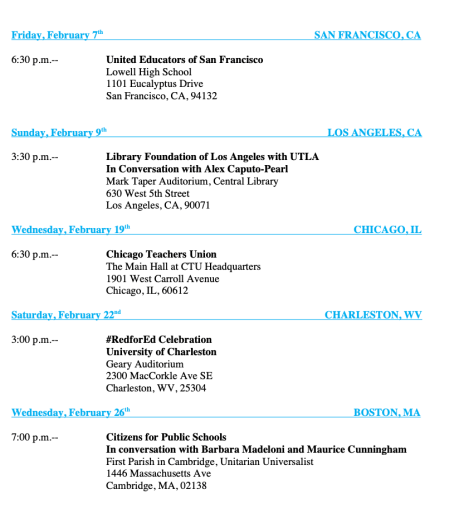
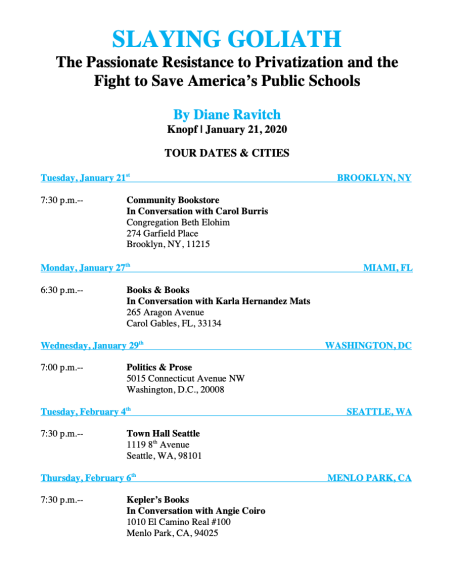
This is the current (and evolving) list of my speaking engagements in connection with the publication of my new book: SLAYING GOLIATH: THE PASSIONATE RESISTANCE TO PRIVATIZATION AND THE FIGHT TO SAVE AMERICA’S PUBLIC SCHOOLS.

I am trying not to wear myself out. Ten years ago, I hopped from city to city like a mountain goat.

But now I am 81 years old, and my knees are worn out. I have to pace myself.

Come out and say hello if you are in one of these cities.

SLAYING GOLIATH is a pro-public education, pro-teacher, pro-social justice, pro-common-good book. It is a book meant to give hope and encouragement to those who stand up to the billionaires and fight the status quo of choice and high-stakes testing. It contains inspiring stories of parents, students, teachers, and civil rights activists who took action against the powerful and won. At some of these events, the bookstore charges a modest fee to cover its expenses. Most are free.

Screen Shot 2020-01-11 at 10.07.57 PMScreen Shot 2020-01-11 at 10.08.06 PM

Nimet Eren, principal of the public Kensington Health Sciences Academy, runs a public school for 465 students that is open to all and offers four career pathways. Recently the school learned that a new charter would open nearby offering the same program. 

The principal was told that the competition would “help” her school by providing a “model” of what her school was already doing successfully.

She writes:

During the summer of 2019, the Philadelphia School Partnership (PSP), a nonprofit organization that invests in educational projects across the city, met with me to discuss the goals we had for our school. We talked extensively about what we have learned from the partnerships we have created, especially in medical settings. Then, PSP asked to visit us on Sept. 25 for the morning. It was a wonderful visit, and our teachers and students were engaged in great learning, as they are every day. The day finished with an in-depth conversation about the challenges of building partnerships with settings such as hospitals and clinics.

Then, before Thanksgiving break, I received an email from PSP stating that they had “an exciting opportunity for KHSA” and that they wanted to share it with me. I was, of course, elated and scheduled a meeting with them on Dec. 2.

The news they wanted to share was that they were giving seed money to a potential charter founder to form a health sciences charter high school in North Philly. I was confused. How was this an exciting opportunity for KHSA?

It actually felt like creating unfair competition for my school for resources that are already scarce, especially because charters can manipulate admissions and enrollment policies to their benefit, and neighborhood schools cannot.

I asked PSP how this charter school would be helpful to KHSA, and they said that my school “could learn from their charter model.” I replied that we are trying to build a model for our neighborhood students and that we need support. They then explained what I believe is the real answer as to why they were not investing in us: Because KHSA is a neighborhood school and not a charter school, they cannot control enrollment for their dream school.

Although it might appear that KHSA does not want a health sciences charter school to exist just because they copied our school’s theme, that is not the reason. The reason actually is that many charter schools create the illusion that they are educating children better than neighborhood high schools. The reality is that neighborhood high schools are serving our highest-needs children and that society should be investing the most in them.

The children who come to my school each day are the most resilient, charismatic, and loving people I have ever known. Some of my students’ reading and math levels are not as high, but that’s not their fault. It is society’s fault for not better supporting the children who are most in need. PSP’s explanation of why it is not investing in a neighborhood high school perpetuates this inequity.

I testified at the school board meeting on Dec. 12 and a charter school hearing on Dec. 20. I have had countless conversations with colleagues and opponents and have thought tirelessly about the charter vs. traditional school debate. I have heard so many arguments for both sides of the story, but the idea that I find the most compelling is one shared by one of my teachers, Jenifer Felix: Parents want what’s best for their own children. Teachers want what’s best for all children.

The problem with school choice is that it creates segregation. Choice takes away limited resources from inclusive neighborhood schools and leads to even fewer resources being spent on our students who are most in need.