Archives for category: Privatization

What do you think the Walton Family Foundation has in mind when they seek out “innovative” approaches to schooling? We know that they speak their mind when they hand out millions every year to charter schools, school choice organizations, privatization advocacy groups, and Teach for America. They usually drop a few dollars in the bucket of their Bentonville, Arkansas, public schools, peanuts compared to the money for privatization.

Media Contact: Vanessa Steinhoff, 240-432-1428, vsteinhoff@wffmail.com                  

Walton Family Foundation Announces 

#SchoolsIN Campaign to Inspire, Spotlight 

Innovative Educational Approaches During COVID-19


Families, Students and Educators Invited to Share Their Creative, Surprising 

and All-Too-Real Moments This School Year on Social Media

BENTONVILLE, Ark. – Today the Walton Family Foundation launched #SchoolsIN, a national campaign to provide inspiration, spotlight innovation and build an inclusive community in support of student learning. With COVID-19 shifting how learning happens across the country, the campaign is an opportunity to build awareness about creative approaches and emphasize the importance of continuing learning amid adversity. 

At this pivotal moment, America’s students, families and educators are reinventing when, where and how learning happens,” said Marc Sternberg, K-12 Education Program Director at the Walton Family Foundation. “As challenging as this school year is and will be, I’m inspired and energized by families and educators channeling frustration into inspiration in all settings. From parents to policymakers, we all must do whatever it takes to ensure learning continues and #SchoolsIN for students.”

The four-week campaign encourages families, students and educators to share on social media the ups and downs of keeping school in session – with a focus on student success during a difficult school year. From brilliant ideas to flashes of inspiration, and occasional moments of chaos, the campaign will chronicle and celebrate the wide range of experiences people across the country are having in all different types of educational settings, linked by the hashtag #SchoolsIN.  

The Walton Family Foundation has been supporting innovative approaches to teaching and learning for over 30 years, guided by the belief that a great education can put opportunity and a self-determined life in reach for every child, regardless of background. The foundation works alongside and sources ideas from families, educators, innovators and community leaders who have a bold vision for student success. This surfaces new ideas and practices that challenge traditional assumptions about where and how learning happens and what’s possible for children.

To learn more, visit www.schoolsin.org

# # #

About the Walton Family Foundation
The Walton Family Foundation is, at its core, a family-led foundation. Three generations of the descendants of our founders, Sam and Helen Walton, and their spouses, work together to lead the foundation and create access to opportunity for people and communities. We work in three areas: improving K-12 education, protecting rivers and oceans and the communities they support, and investing in our home region of Northwest Arkansas and the Arkansas-Mississippi Delta. In 2019, the foundation awarded more than $525 million in grants in support of these initiatives. To learn more, visit waltonfamilyfoundation.org and follow us on FacebookTwitter and Instagram….

[Message clipped]  View entire message
A new reader to the blog posted her own recipe to describe “reform,” which has an unfortunate habit of failing again and again but being revived by Betsy DeVos and/or Bill Gates and the Walton Family:

Sandy Dixon Forrest Recipe for sucking in public tax money and making obscene profits on the backs of public school teachers and students: FINANCE inappropriate “standards” to be implemented by all teachers, REQUIRE the use of products which financially benefit the creator of the “goals,” SMILE as hired “cheerleaders” tout the benefits of the mandated program, BEAM proudly as profits roll into the companies producing the “magic” solution, CRINGE privately at dismal results, REWRITE the “cheerleader” script, AND THEN…drum roll, please.. BLAME the teachers for disappointing results of the non-educators’ (but obscenely wealthy) magic elixir to cure the problems of all public school students. RESULTS?! The sponsors of this hoax made buckets of money! Wave goodbye to the career teachers; TFA folks are cheaper and more (desperate) cooperative anyway. Don’t worry about the kiddos; just give them a double dose of grit. It’s all good…right?


David R. Taylor is a veteran teacher and blogger. He asks the important question of what to expect the consequences to be for public education if Trump is re-elected.

Very likely, it means four more years of Betsy DeVos and her crusade to destroy public education and shower federal money on charter schools, private schools, and religious schools.

Taylor reviews some of her worst actions, such as favoring predatory lenders and favoring for-profit colleges that rip off students. Such as, abandoning the kids who need her most by downplaying civil rights complaints and stripping transgender students of any protections. Such as, trying to starve her own department of funding.

Between the return of DeVos and a voucher-loving majority on the Supreme Court, public schools are in for a rough ride. We can’t change the composition of the Supreme Court (unless there is a genuine effort to expand it and add balance), but we can vote to make sure Betsy goes back to Michigan and her ten yachts.

For the past thirty years, school choice advocates have claimed that the best way to improve education was to give families public money to send their child to a private or religious school. The very fact of “privateness,” they said, meant better quality. This turns out not to be the case. Students never receive a voucher that is enough to pay for elite private schools. Typically, the voucher schools are lesser quality than the public school the cHold leaves, because voucher schools are not required to have certified teachers. In recent years, numerous studies show that children who leave a public school and go to a voucher school lose ground academically.

This study was published in 2018. Its findings are consistent with studies of voucher effects in the District of Columbia, Ohio, Indiana, and other states. Voucher schools are free to teach scientific nonsense and fake history. In Florida and elsewhere, they are free to discriminate against groups of people they don’t like.

Atila Abdulkadiroğlu, Parag A. Pathak, and Christopher R. Walters write in the Journal of the American Economic Association that participation in Louisiana’s voucher program “lowers math scores by 0.4 standard deviations and also reduces achievement in reading, science, and social studies. These effects may be due in part to selection of low-quality private schools into the program.”

Despite the negative effects of vouchers, Betsy DeVos, Charles Koch, and a host of school choice advocacy groups have continued to demand more and more funding for low-quality, unaccountable voucher schools. This funding is subtracted from public school funding, through a variety of schemes. Whether it’s a tax creditor a “scholarship,” individuals and corporations are diverting money to private schools that belongs in the state coffers to support public schools.

The National Center for the Study of Privatization in Education at Teachers College, Columbia University, recently released a major study of segregation and charter schools by Dr. Helen Ladd and Muvzana Turaeva of Duke University.

Dr. Samuel Abrams introduced it here.

The issue of school choice and segregation has been central to education policy debates for decades. In his initial argument for vouchers, published in 1955, Milton Friedman conceded that segregationists stood to employ vouchers to enroll their children in all-white private schools instead of public schools mandated to integrate a year earlier by Brown v. Board of Education. But to Friedman, the answer was not regulation but moral suasion. Friedman’s opinion was rendered technically moot in 1976 by Runyon v. McCrary, which barred private schools from making admissions decisions based on race, yet it nevertheless indicated a fundamental problem with systems of school choice.

With the introduction of charter schools in the early 1990s, commentators raised concerns about school location, inadequate transportation, contracts mandating significant parental involvement, and shared parental proclivities as implicit mechanisms or pathways to segregation. In “Parental Preferences for Charter Schools in North Carolina: Implications for Racial Segregation and Isolation,” Helen F. Ladd and Mavzuna Turaeva add substantially to the literature validating these concerns.

Using data for the nearly 11,000 North Carolina families who transferred their children from traditional public schools to charter schools in 2015-16, Ladd and Turaeva document that the migration of white, though not minority, switchers from traditional public schools to charter schools increased segregation. “We find that by switching to charter schools that are whiter than the traditional public schools they leave behind,” they write, “white switchers contribute to racial segregation across schools.” At the elementary level, 67 percent of white switchers enrolled in charter schools with lower shares of minority students; at the middle-school level, 72 percent of white switchers did so.

To buttress their analysis, Ladd and Turaeva employ a conditional logit model to estimate revealed preferences. To infer parental preferences by race as well as socioeconomic status, Ladd and Turaeva use five criteria to define the value of charter schools for parents: racial composition; proximity; academic achievement; availability of transportation and lunch; and mission. Ladd and Turaeva conclude that with these dimensions considered together, it is clear that white parents disproportionately favored white charter schools and exhibited a pronounced aversion to significantly minority charter schools.

With this working paper, Ladd, a professor emerita of public policy and economics at Duke University, and Turaeva, a doctoral candidate in public policy (with a specialization in economics) at Duke as well as a research associate at the Duke Center for Analysis of Longitudinal Data in Education Research, build on research Ladd did with Charles Clotfelter and John Holbein for an article published by Education Finance and Policy in 2017 on growing segregation across the charter sector in North Carolina from 1999 to 2012. In addition, Ladd and Turaeva’s analysis complements a 2019 NCSPE working paper on charter schools in Kansas City by Patrick Denice, Michael DeArmond, and Matthew Carr, who found a disproportionate number of white students transferring from traditional public schools to new charter schools from 2011 to 2015.

Lucid, rigorous, and supported with eight tables of telling data, this study advances our understanding of school choice and raises important questions about how choice systems should be designed.

Samuel E. Abrams
Director, NCSPE

The Tennessee Court of Appeals upheld a lower court decision that Governor Bill Lee’s voucher plan is unconstitutional.

The voucher plan was supposed to be installed only in Memphis and Nashville, over the objections of their representatives. The deciding vote was cast by a legislator from Knoxville, after he was promised that the voucher program would not include his district.

A victory for friends of public schools and communities in Tennessee!

[intro]

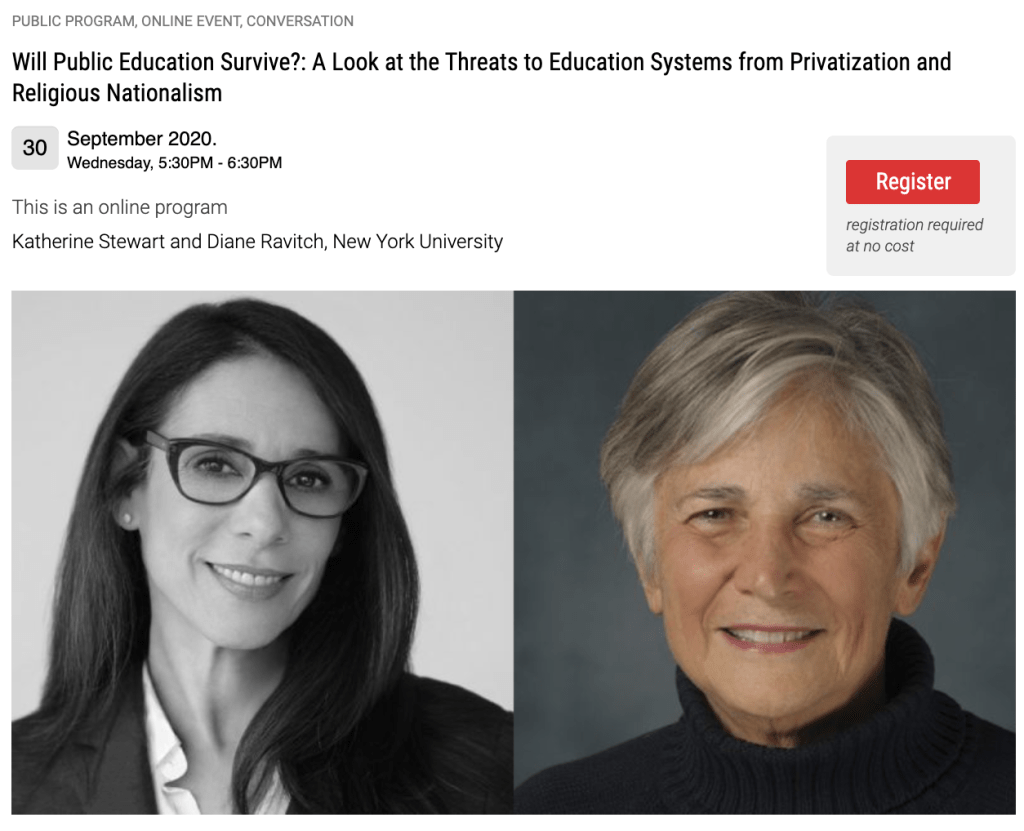
The rise of the Religious Right has coincided with the privatization movement in public schools. While some may feel that this is coincidental, there is reason to believe there is a directly causal relationship between these two factors. Two scholars, from different disciplines, will discuss how their work comes together to help explain the history and current state of efforts to diminish, if not dismantle, the American public education system. Katherine Stewart has written on the rise and increasing power of the Religious Right in her book The Power Worshipers. She will be joined by Diane Ravitch who has written extensively on education and, in her recent book Slaying Goliath, explores the history of the school privatization movement and the efforts to oppose it.

Please note, this is an online event held on the video conference platform, Zoom. Registrants will receive an email with links to join the program.

Link to register: https://18308a.blackbaudhosting.com/18308a/Will-Public-Education-Survive-A-Look-at-the-Threats-to-Education-Systems-from-Privatization–Reli

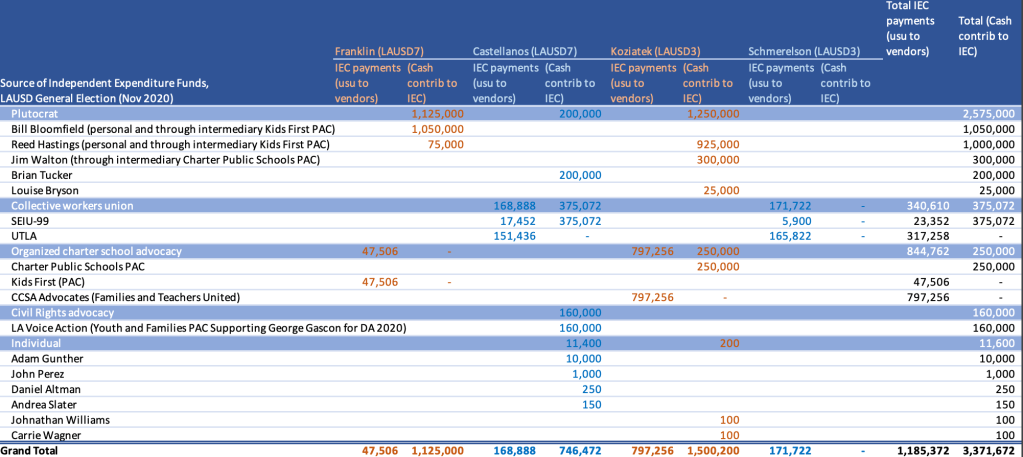
Once again, control of the Los Angeles Unified School Distict school board is up for grabs, and once again the billionaires hope to buy control so they can expand the number of charter schools. The latest financial disclosures show that Reed Hastings of Netflix has contributed $925,000 to try to defeat veteran educator Scott Schmerelson. Billionaire Jim Walton of the Walmart family added another $300,000. The charter lobby is flush with money to buy TV ads and flyers that smear Schmerelson and use vicious anti-Semitic tropes in their attack ads. The charter lobby is angry at Schmerelson for two reasons: 1. He fights fearlessly for the 80% of students in public schools. 2. He released the explosive fact that 80% of Los Angeles’ charter schools have vacancies, not waiting lists. His opponent Marilyn Koziatek has no experience in the public schools; she holds an administrative job in a charter school.

Download the .pdf here.

Note: Sara Roos of Los Angeles (blogger Red Queen in LA) prepared the graph of political expenditures based on public records.

Leonie Haimson reports that Success Academy is dropping plans to open three new high schools because it doesn’t have enough students.

Parent activist Brooke Parker wrote the report as a guest blogger.

No waiting lists. Not enough students.

Dr. Jennifer McCormick, state superintendent of education in Indiana, is a hero of public education. She has steadfastly sided with public schools and defied her own party’s embrace of charters and vouchers.

Blogger Steve Hinnefeld reports that Superintendent McCormick has endorsed Democratic candidates who support public schools instead of members of her own party aligned with the Mitch Daniels-Mike Pence privatization agenda.

Hinnefeld writes:

There was a time when Indiana Republicans supported public schools; at least, they supported their local public schools. The shift came in 2011, when Gov. Mitch Daniels got the GOP-controlled legislature to adopt school vouchers and expand charter schools. Today, many Hoosier Republicans have come very close to embracing the late economist Milton Friedman’s vision of a “universal” voucher program of unrestricted state support for private schools.

But McCormick, former superintendent of Indiana’s Yorktown school district, has been an outspoken advocate for public schools. Every time she spoke out for public school districts, you could see Republicans edging further away. When she announced in 2018 that she wouldn’t seek re-election, she implied that she was being elbowed aside. Legislators promptly changed the law so Indiana’s governor will appoint the state’s next chief education officer, starting in 2021.

Yes, support for public schools used to be bipartisan. Indiana has a long tradition of valuing public schools. But party leaders followed the Pied Piper, Milton Friedman, and determined to promote private school choice while defunding the public schools that enroll the vast majority of the state’s children.

Meanwhile, Hinnefeld writes, McCormick has endorsed Democrats because they, like her, believe in the importance of public schools.

I hereby add Jennifer McCormick to the Honor Roll of the blog, for her principled support of public schools and the common good and for her uncommon courage.