The Georgia branch of Betsy DeVos’ American Federation for Children made a mass mailing to voters in Republican districts urging them to fight against the “radical left” agenda of President Biden, Kamala Harris, and Stacey Abrams, which denies school choice.
A national advocacy group promoting school vouchers bombarded conservative Georgia voters with glossy mailers tying Republican state legislators from their districts to Stacey Abrams and other “radical left” figures. It backfired in spectacular fashion.
Just days after the American Federation for Children financed the mailers in at least 16 Republican-controlled legislative districts, House Speaker David Ralston told The Atlanta Journal-Constitution that the voucher proposal the group sought to pass is dead for the year.
“I am livid. I’ve been around politics for a long time, but this is the dumbest thing I’ve ever seen in my career, and one of the most deceitful,” Ralston said. “These are people we have tried to help over the years, and they turned to attack us very viciously.”
Ralston added: “That voucher legislation will not move at all in the Georgia House of Representatives this year, period.”
The mailers were sent by the Washington-based group to back proposals that would give public school students what it calls “Promise Scholarships,” a state subsidy of about $6,000 a year to help cover private school tuition.
The measures had gained early traction in House committees…
The aggressive strategy was meant to pressure legislators to end a yearslong feud over public funding of private education in Georgia. Instead, the Capitol’s halls buzzed Tuesday with incredulous GOP lawmakers infuriated by the group’s approach.
“It’s very disappointing that this group is targeting lawmakers in the middle of the deliberative process,” said state Rep.
It is a mystery of our times why so many billionaires have assumed the power to meddle in education. Gates, Waltons, Bloomberg, Koch, DeVos, Rock, and many more like to play the role of education minister. I have an almost complete list of the billionaires who dabble in education in my book “Slaying Goliath.” I say “almost” because after the book was published, I found more billionaires who were messing up schools, like Tim Dunn in Texas and the Albertsons in Idaho. I am sure I missed others.
The Charles Koch Foundation announced that it is funding a competition for “new models” of education.
Launched on January 25, The Catalyze Challenge will bring together leading philanthropies and nonprofits to support a grant challenge that will generate new models focused on empowering learners to discover their aptitudes and develop new skills toward a more fulfilling career pathway. Consistent with its efforts to remove barriers facing learners across the country, the Charles Koch Foundation is proud to partner with the Catalyze Challenge. Brennan Brown, the foundation’s director of partnership development, will serve as an adviser.
The Catalyze Challenge will provide funding for education entrepreneurs to develop and scale learner-centric, career-connected models and experiences. The contest is managed by Common Group. Funders include the Walton Family Foundation, the American Student Assistance, the Charter School Growth Fund, and Arnold Ventures.
We know that Charles Koch has one overriding goal: to privatize education and cut costs by passing them on to families. If anyone can decipher the bromides behind hisCatalyze Challenge, give it a try.
The charter industry has set its sights on Texas, since the state has a rightwing Governor and Lieutenant Governor and Republicans control the state legislature.
So charter money is flowing to candidates for State Board of Education. In El Paso, board member Georgina Perez decided not to run again, so the charter industry is backing a charter school leader to take her place. Perez is a charter critic who recently joined the board of the Network for Public Education.
The money behind the money: billionaires Reed Hastings and Jim Walton.
Charter Schools Now reported spending more than $1 million on various primary candidates throughout the state from Jan. 21-Feb. 19. That includes a $1,000 donation to state Sen. César Blanco, D-El Paso, who is unopposed in the March 1 primary, according to the PAC’s Feb. 22 filing.
The PAC gave to three Republican incumbent SBOE members’ reelection campaigns in addition to three Republican primary candidates and five Democratic primary candidates.
Charter Schools Now is heavily funded by two well-known charter advocates: Netflix co-founder and CEO Reed Hastings and Jim Walton, a member of the Walmart family.
Hastings is on the board of directors of KIPP Public Schools, a national charter school chain with campuses in Austin, San Antonio, Houston and the Dallas-Fort Worth area. He was previously on the national board of Rocketship Public Schools, which is opening its first Texas campus in August in Fort Worth.
Hastings gave $1.5 million to Virginia-based Educational Equity PAC on Feb. 15, the same day that PAC gave $570,000 to Charter Schools Now. Days earlier, Educational Equity gave Charter Schools Now $70,000.
Walton gave Charter Schools Now $450,000 in December 2021. The Walton Family Foundation has invested millions over the years to support public charter schools across the country.
One way to win elections is to buy them.
Reed Hastings lives in California.
Jim Walton lives in Arkansas.
Neither lives in Texas but they arrogantly assume that their money gives them the power to buy seats on the Texas Board of Education.
The charter industry wants to eliminate public schools or keep them as dumping grounds for students the charters don’t want.
I may not look like your typical public school advocate. I’m not opposed to private schools, and I even use a voucher for my son. I’ve also always loved public schools and advocated for our elected representatives to do a better job of funding and resourcing these valuable community institutions. Frustratingly, I’ve watched as morally-bankrupt radical special interests have spent decades undermining our public schools, chipping away at them year after year, until they start to buckle under the shear strain.
I would love to enroll my son at our local community public school. But I live in Arizona and my son has special needs, meaning the resources to educate my child here had already been stripped away through a myriad of defunding schemes. So my school choices were taken from me and I had to look around and see what options there were to find an education for my son. It turns out that I was the one who got an education. An education in the realities of living in a state at the forefront of “school choice” with a child who has unique and resource-intensive needs.
I decided to withdraw my son from our public school and take an Empowerment Scholarship Account voucher to help find him a place where his needs would be best met. Because of his disability, he qualified for roughly $40,000 per year on Arizona’s ESA voucher program, enough to fully cover the tuition at almost any school in the state. So we had choices. Or, we thought we had choices.
An often overlooked aspect of these voucher programs is they end up being publicly-funded education discrimination programs. Everywhere we went we were told my son would not be a good fit for their school and we were discouraged from even applying. We visited highly-rated private academies that touted their resources for special needs students only to be told his needs were too great, or that they weren’t right for us, and that they ended their special needs enrollment, while others who demanded to view my son’s files beforehand refused to even see us.
This entire situation is exacerbated by the reality that people pushing these privatization schemes and destroying public schools also require families like mine to give up federal protections for their children, as I had to do for my son because of his needs. We had to waive our federal Individual with Disabilities Education Act (IDEA) rights to be allowed to use the vouchers, meaning any private school that did accept him wasn’t legally required to provide him with adequate services. These issues could be addressed simply with minor legislation, but the lawmakers pushing these vouchers, while often parading special needs families around as the face of their privatization campaigns, have shown no interest in fixing these obvious problems. And that’s because they don’t really care about us. They didn’t care about my son when they diminished our public school’s capacity to care for and educate him, and they don’t care about my son when he’s using their prized vouchers.
We eventually found a microschool, one of the latest privatization schemes, that would take my son, only to find they were essentially abandoning him throughout the day and providing negligently minimal supervision, and this took us almost three years of continual searching to find.
It’s almost impossible to understand the environment that these “choice” programs create for desperate families. The amount of work I’ve had to invest just trying to find a private school simply willing to let my son in their doors has been exhausting. And that’s in addition to all the other resources necessary to make a private school work. I have to provide or secure transportation every day my son is in school. The workload is a lot for any family to take on, and in some cases the assault on public schooling is driving us to have no satisfying options.
John Oliver explained the Republican hysteria over “critical race theory.” At bottom, as he shows, the GOP goal is to persuade parents to escape “CRT” by abandoning their local public schools and enrolling in charter schools or seeking vouchers. The leading anti-CRT crusader, Chris Rufo, made this linkage explicit, as Oliver demonstrates, as did Betsy DeVos. The big money supporting the anti-CRT campaign is coming from the same people funding school choice. And, as Oliver explains, “school choice” has its roots in the fight to block school desegregation in the 1950s.
The fight against CRT is being used to silence any teaching about racism today. Teachers are supposed to teach slavery and racism as a strange aberration from our founding principles and to pretend that it no longer exists.
But if it really were the terrifying problem that people like Rufo describe, why was there no uprising against it in the past 40 years? Why didn’t George W. Bush speak up about CRT? WhY was Trump silent about it until 2020? Why now? Is it mere coincidence that the anti-CRT madness took off after the murder of George Floyd and the nationwide protests against racism?
On February 3, Duke University historian Nancy MacLean and I held a Zoom conversation called “Public Education in Chains,” about the nefarious conspiracy to undermine and privatize our public schools. The discussion was sponsored by Public Funds Public Schools and the Network for Public Education.
Dr. MacLean is the author of many books, including the brilliant Democracy in Chains: The DeepHistory of the Radical Right’s Stealth Plan for America.
We discussed the historical origins of the movement, calling out the privatizers as a combination of libertarians, anti-government ideologues, the radical right, segregationists, and rightwing evangelicals, funded by billionaires who hate taxes, public institutions, and unions. Their movement threatens not only public schools but our democracy.
When a bright young man or woman gets an idea to replace experienced educators with inexperienced tyros and is quickly funded by billionaire foundations, you can guess that the ultimate goal is privatization. For one thing, the enterprise rests on a base claim that “our schools are failing,” and that experience is irrelevant and probably harmful.
The idea was so spot-on that the organization attracted millions of dollars from the plutocrats of privatization: Eli Broad, Bill Gates, the Walton Family Foundation, and many more.
Where are the miracle schools led by New Leaders? That’s a hard question to answer.
What Ultican demonstrates is the continuing relevance of New Leaders for New Schools. One of its illustrious graduates was behind the recent decision by the board of the Oakland Unified School District to resume closing schools, despite overwhelming opposition by students, parents, and educators.
Paul Bowers, previously the education journalist for the Charleston, South Carolina, Post & Courier, writes his own blog. In this post, he calls on the state legislators not to pass voucher legislation that would predictably defund the state’s already underfunded public schools. South Carolina has a large budget surplus and one of the lowest tax rates in the nation. Governor Henry McMaster announced that the surplus would be used to lower taxes instead of funding public schools and other public services.
Paul wrote the members of the S.C. Senate Education Committee in opposition toSenate Bill 935, which is an attempt to divert public school funding to private schools.
Senators Massey, Jackson, Hutto, Rice, and Talley:
I write to you as a South Carolinian and parent of 3 public school students asking you to scrap Senate Bill 935, the so-called “Put Parents in Charge Act,” which would redirect public funds to private schools via the creation of Education Savings Accounts.
Every few years, South Carolina teachers and parents have to band together to fight the latest iteration of the school voucher meme, which has spread virally across the states thanks to millions upon millions of dollars of dark-money political contributions, astroturfed special-interest groups, and a network of libertarian billionaires’ pet thinktanks. We fought this idea when New York real estate investor Howard Rich tried to buy a voucher law here in the early 2000s, and we’re fighting it again now that ALEC, Palmetto Promise, and the like are trying to ram the same idea through the Statehouse in Year of Our Lord 2022. There is truly nothing new under the sun.
No money shall be paid from public funds nor shall the credit of the State or any of its political subdivisions be used for the direct benefit of any religious or other private educational institution.
Now, I am sure our attorney general would happily defend such an act against the inevitable lawsuits that would follow. I am no legal scholar, but I think it’s reasonable to assume he would employ some of the same arguments used to defend Gov. Henry McMaster when, in the thick of a global pandemic, he tried diverting $32 million worth of federal emergency funding from public schools to private schools. Notably, he lost that fight.
So, I suppose you and your colleagues in the General Assembly could enact this law, and you could win the legal battle that follows. Stranger things have happened. But the question remains whether you should go down this road.
I say no, you should not.
South Carolina’s most reactionary politicians have been clamoring for public divestment from the school system ever since radical Black Republicans created a free public school system for all in the Constitution of 1868. White supremacists clawed back at the notion of public goods with the Jim Crow Constitution of 1895; the Interposition Resolution of 1956; and the cavalcade of privatization laws, segregation academies, and district-level resegregation efforts that have continued without ceasing since Brown v. Board of Education was decided in 1954.
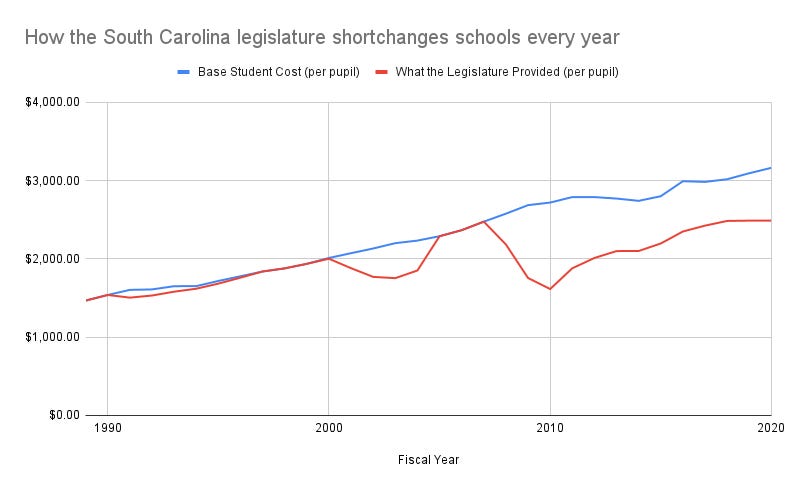
Data compiled by Steve Nuzum, via S.C. Revenue and Fiscal Affairs Office
As a matter of policy, you and your colleagues in the General Assembly have been steadily defunding public education since the start of the Great Recession. You have broken your own promises as outlined in the Education Finance Act and are currently under-funding the Base Student Cost by about a half-billion dollars per year. The results have been disastrous: Our teachers are underpaid and quitting by the thousands, classroom sizes have ballooned, our rural schools are in physical shambles, and a system of separate and unequal education along racial and economic lines has returned with a vengeance.
It is difficult to predict how much money public schools would lose as a result of Education Savings Accounts, which would allow public funds to “follow” individual students to private schools. Our state’s Revenue and Fiscal Affairs Office has tried to guess, though. According to a fiscal impact summary published in December, the ESA program could divert as much as $35 million to private schools within the first year it takes effect, depending how many families participate in the program. By 2026, they estimated the program could cost the state as much as $2.9 billion. Compounded by the General Assembly’s ongoing policy of public disinvestment, this could constitute a death blow to public schools.
The bill is built on a few faulty premises, including the underlying assumption that private schools could or would serve South Carolina students better. The authors of the bill also seem to believe that our state’s private schools could handle a sudden influx of new enrollment while accommodating students’ learning, transportation, and health needs. These are dicey propositions at best.
S. 935 is a direct attack on the notion of education as a public good. Its authors would leave us all to fend for ourselves as atomized individuals, cut loose from mutual obligations that once tied us together. For a certain type of doctrinaire conservative, this may sound like a dream scenario. For the rest of us living in the real state of South Carolina, it is a nightmare come true.
A friend of public schools in Missouri sent the following excerpt of a report by the League report by the state League of Women Voters.
EDUCATION Senate Education Committee Votes Out Bills
The committee voted out all bills heard thus far this session on February 10, including:
SB 869 (Koenig) to revise the law specifying payments to charter schools and shift more local school funds to charter schools. The League opposes this, based on our position on charter schools and support for public school funding.
SB 650 (Eigel) to allow charter schools to be sponsored by outside entities (other than the local school board) and operate in many districts around the state. Sen. Eigel also offered a proposed SCS version that would add several other provisions, including moving school board elections to the November election, adding restrictions on approval of debt service levies, preventing schools from requiring face masks, and preventing school districts from requiring students or staff to have COVID vaccinations. The League opposes the bill.
House Elementary & Secondary Education Committee
The committee met on February 8 and heard HB 2428 (Dogan) to impose restrictions on instruction relating to race and history. The bill authorizes lawsuits against school employees for violations of the new requirements in the bill. The League opposes the bill.
Arthur Rock, a California billionaire who has given many millions to Teach for America and charter schools, has given $399,500 to support the recall.
If you set aside the pandemic and the renaming of schools and look at the long term, one of the major issues facing San Francisco Unified School District, and other districts around the country, is the rise of charter schools.
Charter school proponents, led by the likes of Michael Bloomberg and Betsy DeVos, are in essence trying to privatize public education. They want to create a market system where parents get vouchers and can send their kids to private schools or public charters (which typically do not have unionized teachers), starving the public-school system of money.
We all know the outcome: The charters and private schools, which set their own admission policies, will take the students who have the most advantages and need the least help. The public schools will wind up having to educate, with far less money, the most vulnerable populations, who will wind up will lower-quality schools—and economic inequality will get worse, which is fine with the billionaires.
Rock is a big charter-school and voucher proponent.
Again, set aside the pandemic for a moment. The current members of the SF School Board who are facing a recall have been dubious, at best, about charter schools. That may mean a lot more to Rock and his pals that whether Lincoln High School gets a new name.
The Mayor has endorsed the recall. If the recall passes, she gets to choose the new members. If the recall succeeds, the path will open for more charter schools.

 Diane Ravitch's blog