Archives for category: Privatization

The latest from Michigan, where Betsy DeVos is leading a campaign for vouchers:

FOR IMMEDIATE RELEASE

News from For MI Kids, For Our Schools

***MEDIA ADVISORY***

March 15, 2022

Contact: Sam Inglot, 616-916-0574, sam@progressmichigan.org

New Coalition Forms to Stop DeVos Voucher Proposal

For MI Kids, For Our Schools launches campaign to oppose DeVos voucher effort to take hundreds of millions of dollars away from public schools

MICHIGAN – On Wednesday, March 16 at 1 p.m. EST, a coalition of organizations will announce the launch of the For MI Kids, For Our Schools ballot question committee (For MI Kids, for short) during a Zoom press call. For MI Kids is focused on defeating the DeVos-backed “Let MI Kids Learn” voucher proposal that would rip hundreds of millions of dollars away from public schools across Michigan. 

The coalition that makes up For MI Kids includes: 482Forward, American Federation of Teachers Michigan, K-12 Alliance of Michigan, Michigan Association of School Boards, Michigan Association of Superintendents & Administrators, Michigan Education Association, Michigan Education Justice Coalition, Michigan Parent Teacher Association, and the Middle Cities Education Association.

WHO: For MI Kids, For Our Schools

Casandra Ulbrich, PhD, who serves as the president of the State Board of Education

Andrew Brodie, Superintendent, Flat Rock Community Schools and MASA Board President

Arlyssa Heard, a Detroit schools special education parent, 482Forward education organizer

Twanda Bailey, a retired educator from Detroit with 30 years of teaching experience

Owen Goslin, a Cheboygan schools parent

Rick Catherman, a retired educator from South Haven with 30 years of teaching experience

WHAT: Zoom Press Call

Members of the media are asked to RSVP in advance. Contact sam@progressmichigan.org if you run into any issues.

WHEN: Wednesday, March 16 @ 1 p.m. EST

WHY: For MI Kids, For Our Schools is a ballot committee opposing the Let MI Kids Learn voucher proposal because it would take hundreds of millions of dollars away from public schools, hurting every public school across Michigan during a historic teacher shortage. The coalition is made up of parents, educators, support staff, administrators, and community-minded folks who love our public schools and want to see them improve and thrive so every student can get a great education.

###

Andy Spears is the publisher of the Tennessee Education Report. He writes in the current issue of The Progressive about the well-funded effort to privatize education funding in Tennessee. Republican Governor Bill Lee and the legislature are determined to gut local control and to outsource taxpayer dollars to out-of-state organizations to open charter schools. This drive for privatization ignores the abject failure of the Tennessee Educational Achievement Authority, which burned through $100 million without achieving anything.

Spears writes:

If you are wondering what it looks like when school privatizers are close to total victory, Tennessee is a prime example. Here, the forces that want to take public money and hand it over to private entities are on the verge of completing their conquest.

Tennessee’s current legislative session features a range of attacks on public schools. Some of these would have immediate impacts, while others take a longer-term approach to fully privatizing K-12 education in the state.

First, it is important to understand that groups backing privatization in the form of charter schools and vouchers are among the top spenders when it comes to lobbying state legislators. For example, the American Federation for Children—an organization founded and previously led by the family of Betsy DeVos, a school privatization advocate and former President Donald Trump’s Secretary of Education—spent $887,500. Another big spender, the Tennessee Charter School Center, spent $732,500.

Based on this year’s full-frontal assault, these investments appear to be paying off. There are three key issues that currently pose the most significant threat to Tennessee’s public schools. They include: a partnership with Hillsdale College, a private fundamentalist Christian college in Michigan, to run fifty or more charter schools; legislation that would create a charter school real estate grab; and school funding reforms that set the stage for a statewide voucher program.

In his State of the State address, Governor Bill Lee restated his commitment to set aside $32 million to help launch new charters in Tennessee and announced the Hillsdale College partnership, which could bring close to fifty Hillsdale-run charter schools into the state.

Beyond the use of public funds to open schools run by a private, Christian college, there is reason to be concerned about the nature of the Hillsdale curriculum. As educator and blogger Peter Greene explained, “[Hillsdale President Larry] Arnn has been a Trump supporter, and the college has fallen right into MAGAland as well. . . . The college uses Trump mailing lists to raise money. They used to sponsor Rush Limbaugh’s show. They get grads placed on the staff of legislators such as Jim Jordan and Kevin McCarthy.”

Over the past decade, I have consistently referred to charters as part of the privatization movement, a first decisive step towards vouchers. Charter advocates have frequently written to insist that charter schools are “public schools.” They are, because the state law (drafter by charter lobbyists) calls them “public schools.”

But the Tennessee push for charter schools makes clear that they have become a Trojan horse for privatization. Governor Lee is rewriting the school funding formula so “the money follows the child,” a back door path to vouchers, which a state court ruled unconstitutional.

Spears writes:

Potentially millions of dollars worth of real estate assets in local districts across Tennessee could soon be up for grabs at prices below market value. No wonder privatizers tied to the charter industry have spent $8 million lobbying the legislature.

The final element in the push for privatization is being billed as a “reform” of the state’s school funding formula. Governor Lee recently released his plan to revamp how the state directs money to local school districts for public schools. The bottom line, according to Lee, is that the approach is “student-centered” and that funds “follow the child” no matter what. This plan is based on model legislation from the rightwing American Legislative Exchange Council (ALEC).

This statement, first of all, creates the erroneous impression that charter schools operate as “public” schools. Although called public schools under Tennessee law (as in most states), these schools function with less government oversight and an array of private operations, from real estate management to the sourcing of substitute teachers to overall school management.

Lee has been fighting to redirect public money to private schools since before he was elected governor.

Second, the proposed change to school funding is quite simply the gateway to a full-on voucher scheme. As Tennessee teacher Mike Stein wrote on his personal blog, the final form of funding reform is a workaround for a school voucher law that Lee enacted and was ruled unconstitutional.

Can the privatizers be stopped? Will charters pave the way for vouchers? Will Governor Lee succeed in destroying local control of public schools?

Stay tuned.

By now, we have observed that the Koch-Walton-DeVos oligarchs take every opportunity to undermine public confidence in public schools. Wherever there is an organized attack on public schools and their teachers, it’s a safe bet that there’s dark money from libertarian billionaires.

John Merrow wrote recently about the new “parents rights” groups that have led the fight against public schools. His post was condensed by the blog of the Network for Public Education. Read the full post here on John Merrow’s blog..

Opportunistic politicians are also attempting to limit classroom discussion of other controversial topics. In late February Florida’s House of Representatives passed a bill to ban “classroom discussion about sexual orientation or gender identity” in the state’s primary schools. Governor DeSantis has indicated that he will sign the bill if the Senate passes it. [The legislature passed the bill and DeSantis will sign it.]

Of course, the GOP maintains that it’s doing this for parents “Speaking to legislators on the House floor, Rep. Joe Harding, the Republican who introduced the bill, said the measure is about “empowering parents” and improving the quality of life for the state’s children.” Florida isn’t alone. According to the highly regarded publication Chalkbeat, at least 36 states have adopted or introduced laws or policies that restrict teaching about race and racism.

As New York Times columnist Jamelle Bouie wrote recently, “Defenders of this push for censorship say they are simply working to protect the nation’s children from prejudice, psychological distress and inappropriate material. ‘To say there were slaves is one thing, but to talk in detail about how slaves were treated, and with photos, is another,’ said Tina Descovich, a leader of (a Florida chapter of) Moms for Liberty, a conservative group that seeks to enshrine ‘parental rights’ into law.”

Ms. Descovich, who lost her seat on a local school board in 2020, is a parent, but many of the adults who have been disrupting local school board meetings not only do not have children enrolled in those schools; they are classic outside agitators, perhaps even from neighboring states.

Simply reviewing curricula and banning discussion aren’t enough for some. Legislators in Florida, Iowa, and Mississippi want cameras installed in classrooms so parents can watch what’s going on. “The Iowa bill, H.F. 2177, would require that cameras be placed in every public school classroom in the state, except for physical education and special education classes. The cameras would feed to livestreams that could be viewed on the internet by parents, guardians and others.” Educators who fail to keep the cameras operational would lose 5% of their salary, per infraction. The bill died in Committee, but its supporters haven’t given up.

The pandemic has created opportunities for opponents of public education. Twenty-two states created or enlarged school voucher programs in 2021, and more are in the offing. “School voucher proponents in statehouses across the country have spent much of the past year working to pass legislation that transfers critical public school funding to the private sector. Framing these debates around education “reform” and the inauthentic culture wars surrounding public schools, voucher proponents have been steadily working to undermine public education on the state level.” That’s from the publication of the National Education Association, which explains the loaded language.

But the NEA numbers are correct, as others have reported. ”Nearly half of all state legislatures last year increased funding for school choice programs in their state budgets or passed laws to expand or create new Education Savings Accounts or scholarship programs. They also notably expanded eligibility requirements to include home-schooling, charter schools and private schools. Four states created entirely new programs; three created new and expanded programs, and Ohio created the most improved programs of them all, according to the analysis. The majority, 14, either expanded or improved their existing school choice programs.”

While this isn’t the time or place to debate vouchers, let’s stipulate that money dedicated to vouchers would otherwise have gone to public schools.

COVID and the ensuing closure of most public schools frustrated many parents, some of whom felt that teachers cared more about their own health than their students’ learning. Teacher unions, a favorite whipping boy of the right, may have hurt their own cause by defending members who did not want to risk contracting COVID–but defending their members is what unions are supposed to do.

But what’s happening now has very little to do with education and far more to do with politics. Republicans feel that being ‘pro-parent’ is a winning position, even though barely 20% of households have school age children. I don’t think most Republican politicians really care whether parents dig deeply into curriculum. What they hope is that the other 80%–those without children–will be outraged at the idea of meddling teachers indoctrinating America’s children. Their goal is for the other 80% to go to the polls and vote Republican.

Tuesday’s school board election in New Hampshire was a triumph for parents and citizens who love their public schools!

This must have shocked Republican Governor Chris Sununu, the Republican-controlled legislature, and State Commissioner Frank Edelblut, who home-schooled his own children and is pushing a sweeping voucher plan for the state.

AfterGlenn Youngkin was elected Governor of Virginia by pandering to parents angry about “critical race theory,” mask mandates, and eager to control what children learned and what books they read, the media bombarded us with stories predicting that Republicans would win next November by running against public schools.

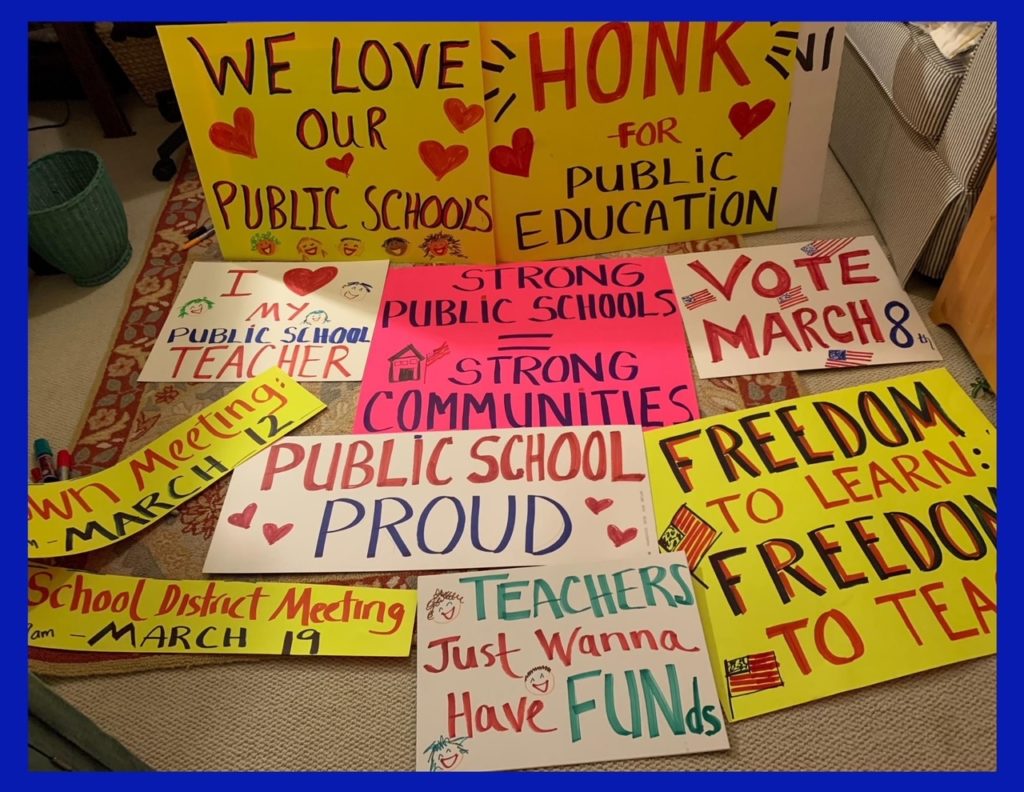
New Hampshire families and citizens said on Election Day, “Not so fast! We love our public schools.”

I Love Public Education Sign Visibility

In first town elections since onslaught of attacks on public education and a honest, accurate education, voters send clear message that they support strong public schools and a honest, accurate education

CONCORD, NH – In race after race across New Hampshire on Town Meeting Day, concerned parents and community members in communities large and small successfully organized to elect pro-public education candidates and reject those seeking to dismantle public education and censor history.

“These results should raise serious doubts about any Republican 2022 election strategy that is built around pitting parents against local public schools and educators,” said Zandra Rice Hawkins, Executive Director of Granite State Progress. “In nearly every school board race, Granite State voters chose out-spoken champions for public education and an honest, accurate, inclusive education. This is a big win for public schools and for our future. These leaders are committed to keeping our public schools strong and making sure every student’s history and experience is valued.”

The results from the election are all the more astounding for record-shattering voter turnout, and for the blatant differences between the candidates on everything from public education, COVID public health measures, and attempts to whitewash American history and censor educators. A priority list of school board results can be found here.

Key examples from around the state:

  • Merrimack Valley School District, home to some of the state’s most vocal anti-vaccine, anti-mask, and classroom censorship activists, experienced a 56% increase in voter turnout from 2019, and supported public education candidates while also defeating a classroom censorship/anti-equity warrant resolution.
  • Bedford experienced a 36% increase in voter turnout and elected pro-public education candidate and teacher Andrea Campbell with 2832 votes, compared to 1293 votes for Sean Monroe, a candidate supported by right-wing organization Defend Our Kids, and 856 for incumbent John Schneller; both of whom supported efforts to censor teachers and ban conversations about race and racism in public schools.
  • Londonderry elected pro-public education candidates Amanda Butcher and Kevin Gray, defeating vocal anti-masker Rachel Killian (seen here harassing school board members during a public meeting). Voters also rejected a warrant resolution to make masks completely optional and the sole decision of parents instead of school leaders and public health experts; a significant decision given Gov. Sununu’s recent decision to ban schools from enacting COVID public health measures like masks.
  • Governor Wentworth School District elected Republican State Rep. Brodie Deschaies over far-right activist Jessica Williams, who believes public schools are indoctrinating students and was arrested at a GWSD school board meeting on September 13, 2021.
  • Weare elected pro-public education candidates William “Bill” Politt and Alyssa Small, and passed full-day kindergarten; and Hollis elected pro-public education candidates Carryl Roy, Krista Whalan, and Holly Babcock.
  • Exeter and SAU 16 elected a full slate of pro-public education and honest education candidates, despite a nearly $20,000 effort by the opposition and months of voter mailings from those who oppose diversity, equity, and inclusion justice efforts in the school districts.

“We are in awe of how our communities have come together to protect and support public education,” said Sarah Robinson, Education Justice Campaign Director for Granite State Progress. “Parents, students, educators, and community leaders have been working for months to organize, recruit strong candidates, and support pro-public education campaigns. Watching the results come in and knowing that so many public education champions are going to be serving in these roles gives us all hope. Our schools have been under constant attack from privatization schemes, neo-Nazi’s, and of course Governor Sununu’s statewide ban on a honest education. We all know that serving on a school board right now is challenging, and we thank these leaders for stepping up for our students. We hope the folks at the State House are paying attention, because this showdown will play out again in November unless they stop the attacks on our public schools.”

The St. Louis Post-Dispatch published a front-page story about the financial shenanigans associated with a charter school founded by two TFA teachers (one of whom was the son of the former mayor). The school has a large number of uncertified teachers and an uncertified high school principal and boasts of its staff’s lack of credentials. Its teachers have a high attrition rate. And its academic performance is mediocre. The school handbook says that staff must keep all financial records confidential. Nonetheless, the school Hoovers up millions of taxpayer dollars from local, state and federal governments and claims it wants to “proselytize” about its “method.” Whether they mean to spread their “method” of sucking up public funds or producing unimpressive academic results is not clear.

Despite stories like this one, the Republican-led legislature wants to authorize more charters.

ST. LOUIS — The sponsor of Kairos Academies, a charter school in the Marine Villa neighborhood, has raised red flags over the school’s financial and leadership practices involving a shadow group that employs nearly two-thirds of the staff.

The school’s founders created Kairos Academies Vanguard for “charitable and educational purposes” before the school opened three years ago, according to records with the Missouri Secretary of State. The nonprofit has since grown to employ 36 staff members out of 56 who work at the school, including 10 teachers and all administrators.

Kairos has funneled millions of taxpayer dollars to Vanguard for bookkeeping, human resources, student recruitment, special education and other services, all without a contract. While Vanguard staff members work full time at Kairos, are listed in the school directory and share a staff handbook, school leaders say they are exempt from state laws requiring the release of financial information and participation in an educators’ pension fund.

Vanguard qualifies as a quasi-governmental body subject to Missouri Sunshine Law because its primary purpose is to contract with a taxpayer-funded school, said St. Louis lawyer Elad Gross.

“Schemes like this one to spin off a nonprofit organization are trying to do what a lot of corporations do,” Gross said. “Folks are using those same Wall Street-type practices to avoid liability and public transparency.”

In a “letter of concern” sent this month, the Missouri Charter Public School Commission that sponsors Kairos outlined a 13-point correction plan for the school to complete by March 31. The plan calls for an approved contract with Vanguard, separate audits of the school and the nonprofit, and legal oversight and training on open records laws.

Kairos violated Missouri regulations by not following policies regarding its relationship with Vanguard including approval from its sponsor, according to Robbyn Wahby, the charter school commission’s executive director.

“These requirements exist to ensure that public funds for the education of Missouri students are managed transparently and appropriately,” Wahby wrote in the Feb. 4 letter.

After receiving Wahby’s letter, Kairos set up a mailbox for Vanguard at a coworking space across the street from the school on south Jefferson Avenue. The Kairos board held a special meeting Wednesday to approve a temporary contract through March that pays Vanguard $282,480 per month. Clayton lawyer Hugh Eastwood serves as president of the board of both organizations.

The charter commission “is demanding that the school have a detailed contract with Vanguard so that the commission and taxpayers will know how public funds are used” by the March 31 deadline, Wahby said. “We are pleased that Kairos Academies’ board agrees with our findings and is working to put in place the remedies we are requiring of them.”

$3.3 million

Kairos Academies opened in fall of 2019 led by CEO Gavin Schiffres and chief strategy officer Jack Krewson, son of then-mayor Lyda Krewson. The founders were both 25 at the time and graduates of the two-year Teach for America program. The education reform group Opportunity Trust contributed more than $300,000 in startup costs and continues to provide annual grants.

Kairos now enrolls about 400 students in fifth through eighth grades and will start a high school with ninth graders in the fall. Last spring, 35% of students tested proficient in English and 33% in math on state standardized tests. Only eight current staff members, including Krewson and Schiffres, were with the school when it opened in fall of 2019, according to the school directory.

Schiffres said Vanguard was formed with the “idea of creating a vehicle where we could take what we learned and potentially bring it to other regions, take the Kairos method and proselytize that.”

Charter schools are publicly funded and independently operated. Under Missouri law, charter school employees are required to participate in the Public School Retirement System of the City of St. Louis. Kairos pays 15% of the salaries of 20 teachers into the retirement fund, according to an audit of fiscal year 2021 by St. Louis accounting firm KEB.

The school’s administrators, plus Spanish, art and special education teachers, the principal and head of athletics and secretarial staff are considered contractors who are exempt from the fund. Those 36 employees can receive up to a 3% match for a separate retirement fund, according to the Kairos staff handbook.

The audit of Kairos included Vanguard as an affiliate because “the entities are commonly managed.” It shows the two organizations combined received $3.3 million in local, state and federal tax revenue in fiscal 2021.

No certification

A review of state and school records shows other examples of Kairos operating like a private organization:

• Eight teachers including three English teachers have no Missouri teaching certificates. An additional seven have substitute certificates, according to the Missouri Department of Elementary and Secondary Education. Nilesh Patel, who is slated to lead Kairos’ high school this fall, has no state certification. The Kairos community handbook reads, “Please assume that your child’s teachers are not certified to teach in their assigned grade level or subject. Although most are, Kairos takes cues from the best private schools around the country and recruits talent with diverse, real-world experience.”

• Like traditional public schools, charter schools are not allowed to discriminate in admissions. The Kairos staff handbook suggests that family income can play a role. “Enrolling another low-income student will make it harder to get the high academic results my team is striving for … disadvantaged students tend to come in below grade level,” the handbook describes as a hypothetical admissions decision. “On the other hand, our Finance Team understands the economic value associated with any student: they’re ‘customers’ the state pays us to educate.”

• Kairos received $163,000 in 2020 through the U.S. Small Business Administration’s Paycheck Protection Program. The school also anticipates receiving about $2 million in coronavirus relief for public schools from the U.S. Department of Education, according to its records.

• The Kairos handbook says staff must keep financial information, vendor contracts and curriculum confidential.

Do it the Kairos way!
The Georgia branch of Betsy DeVos’ American Federation for Children made a mass mailing to voters in Republican districts urging them to fight against the “radical left” agenda of President Biden, Kamala Harris, and Stacey Abrams, which denies school choice.

It backfired.

A national advocacy group promoting school vouchers bombarded conservative Georgia voters with glossy mailers tying Republican state legislators from their districts to Stacey Abrams and other “radical left” figures. It backfired in spectacular fashion.

Just days after the American Federation for Children financed the mailers in at least 16 Republican-controlled legislative districts, House Speaker David Ralston told The Atlanta Journal-Constitution that the voucher proposal the group sought to pass is dead for the year.

“I am livid. I’ve been around politics for a long time, but this is the dumbest thing I’ve ever seen in my career, and one of the most deceitful,” Ralston said. “These are people we have tried to help over the years, and they turned to attack us very viciously.”

Ralston added: “That voucher legislation will not move at all in the Georgia House of Representatives this year, period.”

The mailers were sent by the Washington-based group to back proposals that would give public school students what it calls “Promise Scholarships,” a state subsidy of about $6,000 a year to help cover private school tuition.

The measures had gained early traction in House committees…

The aggressive strategy was meant to pressure legislators to end a yearslong feud over public funding of private education in Georgia. Instead, the Capitol’s halls buzzed Tuesday with incredulous GOP lawmakers infuriated by the group’s approach.

“It’s very disappointing that this group is targeting lawmakers in the middle of the deliberative process,” said state Rep.

It is a mystery of our times why so many billionaires have assumed the power to meddle in education. Gates, Waltons, Bloomberg, Koch, DeVos, Rock, and many more like to play the role of education minister. I have an almost complete list of the billionaires who dabble in education in my book “Slaying Goliath.” I say “almost” because after the book was published, I found more billionaires who were messing up schools, like Tim Dunn in Texas and the Albertsons in Idaho. I am sure I missed others.

The Charles Koch Foundation announced that it is funding a competition for “new models” of education.

Launched on January 25, The Catalyze Challenge will bring together leading philanthropies and nonprofits to support a grant challenge that will generate new models focused on empowering learners to discover their aptitudes and develop new skills toward a more fulfilling career pathway. Consistent with its efforts to remove barriers facing learners across the country, the Charles Koch Foundation is proud to partner with the Catalyze Challenge. Brennan Brown, the foundation’s director of partnership development, will serve as an adviser.

The Catalyze Challenge will provide funding for education entrepreneurs to develop and scale learner-centric, career-connected models and experiences. The contest is managed by Common Group. Funders include the Walton Family Foundation, the American Student Assistance, the Charter School Growth Fund, and Arnold Ventures.

We know that Charles Koch has one overriding goal: to privatize education and cut costs by passing them on to families. If anyone can decipher the bromides behind hisCatalyze Challenge, give it a try.

The charter industry has set its sights on Texas, since the state has a rightwing Governor and Lieutenant Governor and Republicans control the state legislature.

So charter money is flowing to candidates for State Board of Education. In El Paso, board member Georgina Perez decided not to run again, so the charter industry is backing a charter school leader to take her place. Perez is a charter critic who recently joined the board of the Network for Public Education.

The charter industry has donated more than $200,000 to Omar Yanar. Yanar leads a small charter called the El Paso Leadership Academy.

The money behind the money: billionaires Reed Hastings and Jim Walton.

Charter Schools Now reported spending more than $1 million on various primary candidates throughout the state from Jan. 21-Feb. 19. That includes a $1,000 donation to state Sen. César Blanco, D-El Paso, who is unopposed in the March 1 primary, according to the PAC’s Feb. 22 filing.

The PAC gave to three Republican incumbent SBOE members’ reelection campaigns in addition to three Republican primary candidates and five Democratic primary candidates.

Charter Schools Now is heavily funded by two well-known charter advocates: Netflix co-founder and CEO Reed Hastings and Jim Walton, a member of the Walmart family.

Hastings is on the board of directors of KIPP Public Schools, a national charter school chain with campuses in Austin, San Antonio, Houston and the Dallas-Fort Worth area. He was previously on the national board of Rocketship Public Schools, which is opening its first Texas campus in August in Fort Worth.

Hastings gave $1.5 million to Virginia-based Educational Equity PAC on Feb. 15, the same day that PAC gave $570,000 to Charter Schools Now. Days earlier, Educational Equity gave Charter Schools Now $70,000.

Walton gave Charter Schools Now $450,000 in December 2021. The Walton Family Foundation has invested millions over the years to support public charter schools across the country.

One way to win elections is to buy them.

Reed Hastings lives in California.

Jim Walton lives in Arkansas.

Neither lives in Texas but they arrogantly assume that their money gives them the power to buy seats on the Texas Board of Education.

The charter industry wants to eliminate public schools or keep them as dumping grounds for students the charters don’t want.

Pamela Lang, a parent of a child with special-needs in Arizona, wrote for Public Voices for Public Schools about her terrible experience finding a school for her son.

She writes:

I may not look like your typical public school advocate. I’m not opposed to private schools, and I even use a voucher for my son. I’ve also always loved public schools and advocated for our elected representatives to do a better job of funding and resourcing these valuable community institutions. Frustratingly, I’ve watched as morally-bankrupt radical special interests have spent decades undermining our public schools, chipping away at them year after year, until they start to buckle under the shear strain.

I would love to enroll my son at our local community public school. But I live in Arizona and my son has special needs, meaning the resources to educate my child here had already been stripped away through a myriad of defunding schemes. So my school choices were taken from me and I had to look around and see what options there were to find an education for my son. It turns out that I was the one who got an education. An education in the realities of living in a state at the forefront of “school choice” with a child who has unique and resource-intensive needs.

I decided to withdraw my son from our public school and take an Empowerment Scholarship Account voucher to help find him a place where his needs would be best met. Because of his disability, he qualified for roughly $40,000 per year on Arizona’s ESA voucher program, enough to fully cover the tuition at almost any school in the state. So we had choices. Or, we thought we had choices.

An often overlooked aspect of these voucher programs is they end up being publicly-funded education discrimination programs. Everywhere we went we were told my son would not be a good fit for their school and we were discouraged from even applying. We visited highly-rated private academies that touted their resources for special needs students only to be told his needs were too great, or that they weren’t right for us, and that they ended their special needs enrollment, while others who demanded to view my son’s files beforehand refused to even see us.

This entire situation is exacerbated by the reality that people pushing these privatization schemes and destroying public schools also require families like mine to give up federal protections for their children, as I had to do for my son because of his needs. We had to waive our federal Individual with Disabilities Education Act (IDEA) rights to be allowed to use the vouchers, meaning any private school that did accept him wasn’t legally required to provide him with adequate services. These issues could be addressed simply with minor legislation, but the lawmakers pushing these vouchers, while often parading special needs families around as the face of their privatization campaigns, have shown no interest in fixing these obvious problems. And that’s because they don’t really care about us. They didn’t care about my son when they diminished our public school’s capacity to care for and educate him, and they don’t care about my son when he’s using their prized vouchers.

We eventually found a microschool, one of the latest privatization schemes, that would take my son, only to find they were essentially abandoning him throughout the day and providing negligently minimal supervision, and this took us almost three years of continual searching to find.

It’s almost impossible to understand the environment that these “choice” programs create for desperate families. The amount of work I’ve had to invest just trying to find a private school simply willing to let my son in their doors has been exhausting. And that’s in addition to all the other resources necessary to make a private school work. I have to provide or secure transportation every day my son is in school. The workload is a lot for any family to take on, and in some cases the assault on public schooling is driving us to have no satisfying options.

John Oliver explained the Republican hysteria over “critical race theory.” At bottom, as he shows, the GOP goal is to persuade parents to escape “CRT” by abandoning their local public schools and enrolling in charter schools or seeking vouchers. The leading anti-CRT crusader, Chris Rufo, made this linkage explicit, as Oliver demonstrates, as did Betsy DeVos. The big money supporting the anti-CRT campaign is coming from the same people funding school choice. And, as Oliver explains, “school choice” has its roots in the fight to block school desegregation in the 1950s.

The fight against CRT is being used to silence any teaching about racism today. Teachers are supposed to teach slavery and racism as a strange aberration from our founding principles and to pretend that it no longer exists.

But if it really were the terrifying problem that people like Rufo describe, why was there no uprising against it in the past 40 years? Why didn’t George W. Bush speak up about CRT? WhY was Trump silent about it until 2020? Why now? Is it mere coincidence that the anti-CRT madness took off after the murder of George Floyd and the nationwide protests against racism?