Archives for category: Privatization

This post is so important that it is the only one I have scheduled today. Please read it and share it with your friends, your local newspaper, your local radio station, your elected representatives, social media, anyone who cares about the future of our society. This is not a reprint. The author, Josh Cowen, wrote this post for this blog.

Josh Cowen, a professor at Michigan State University, has been studying vouchers for more than 20 years. He has been a member of the teams conducting major studies of vouchers. When I read his article in The Hechinger Report, where he declared that he was convinced that vouchers were disastrous for students who use them, I wanted to know more about him and his experience. I wanted to ask him, “Why did you change your mind?” That’s the question that’s been asked of me hundreds of times. I have a simple answer and a complicated answer: the simple answer is “I was wrong.” The complicated answer is contained in my recent books, starting with The Death and Life of the Great American School System: How Testing and Choice Are Undermining Education.

I invited Josh to explain his views for my blog, and he graciously accepted. I consider this piece to be one of the most important statements I have posted in the decade this blog has been live. Please note two points he makes:

One, vouchers harm the children who leave public schools to use them.

Two, most of the early voucher research was conducted by researchers who were partisan supporters of vouchers.

Josh Cowen writes:

It’ll be a few more days for the final election results to be tallied nationwide, but it seems clear that with midterm wins by voucher supporters in places like Oklahoma, Texas and even Pennsylvania—where even the Democratic gubernatorial victor is on record in cautious favor—voucher opponents are going to have to keep working hard to block public funding of private and religious schools.

School vouchers have devastating effects on student outcomes. Full stop. That’s something even the nation’s voucher advocate-in-chief Betsy DeVos has had to admit, because the data are so stark.

Large-scale independent studies in D.C.,Indiana, Louisiana, and Ohio show that for kids who left public schools, harmful voucher impacts actually meet or exceed what the pandemic did to test scores. That’s also a similar impact in Louisiana to what Hurricane Katrina did to student achievement back in 2005.

Think about that next time you hear a politician or activist claim we need taxpayer support for private schools to offset what the pandemic did to student learning. Here, their cure would in test score terms be quite literally worse than the disease.

There’s another data point you need to know up front: vouchers overwhelmingly fund children who were already in private school without them. In states that have released those numbers—Arizona, New Hampshire, and Wisconsin—we know more than 75% of voucher applicants came from private schools.

The bottom-line: most kids using vouchers didn’t need them to go to private school, and the few kids who actually did use vouchers to transfer sectors schools suffer average test score drops on par with what a once-in-a-generation pandemic did to test scores too.

If you’re a picture person, our friends at the National Coalition for Public Education were kind enough to put their considerable talents into two graphics based on these data I provided to them.
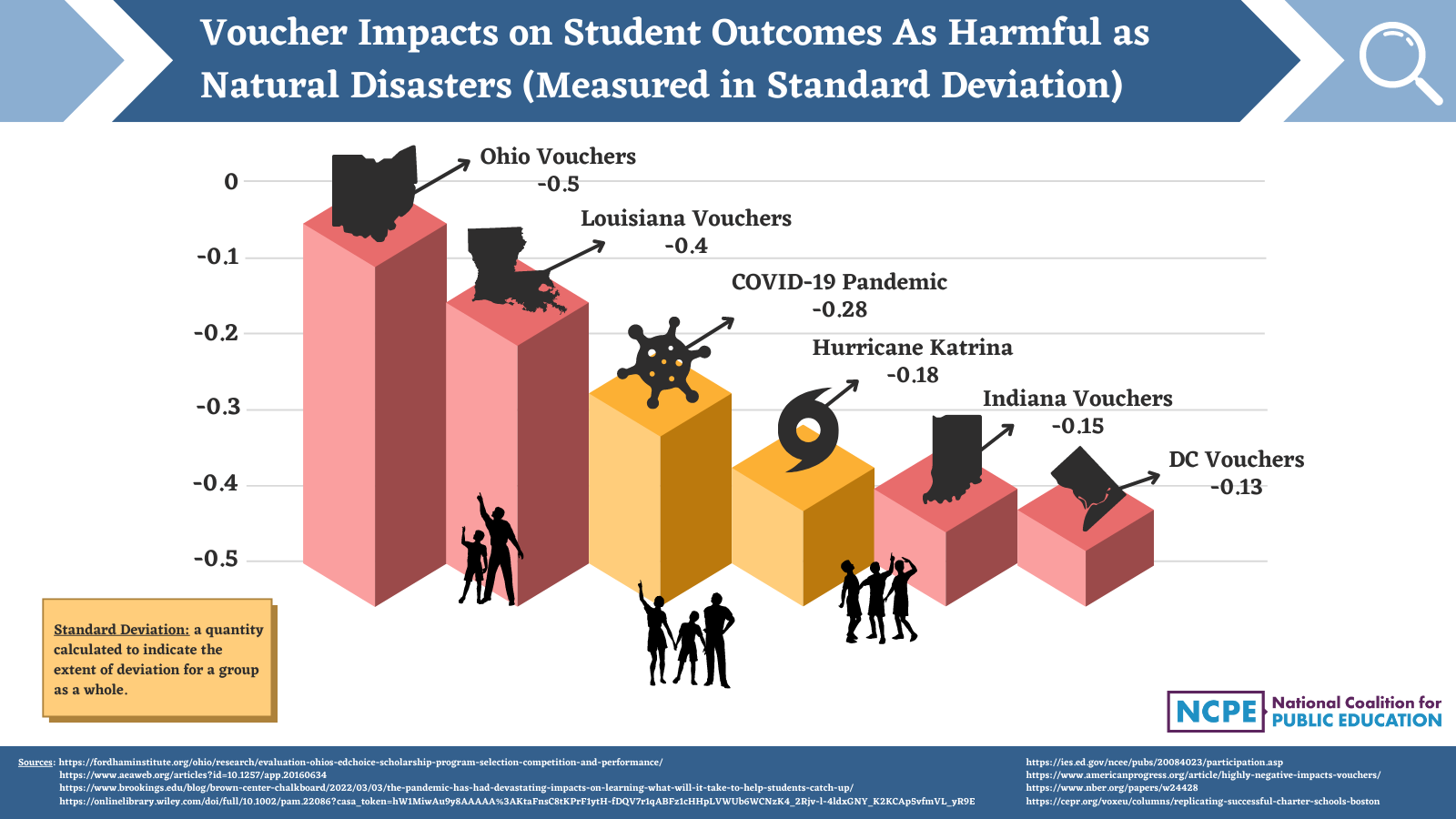
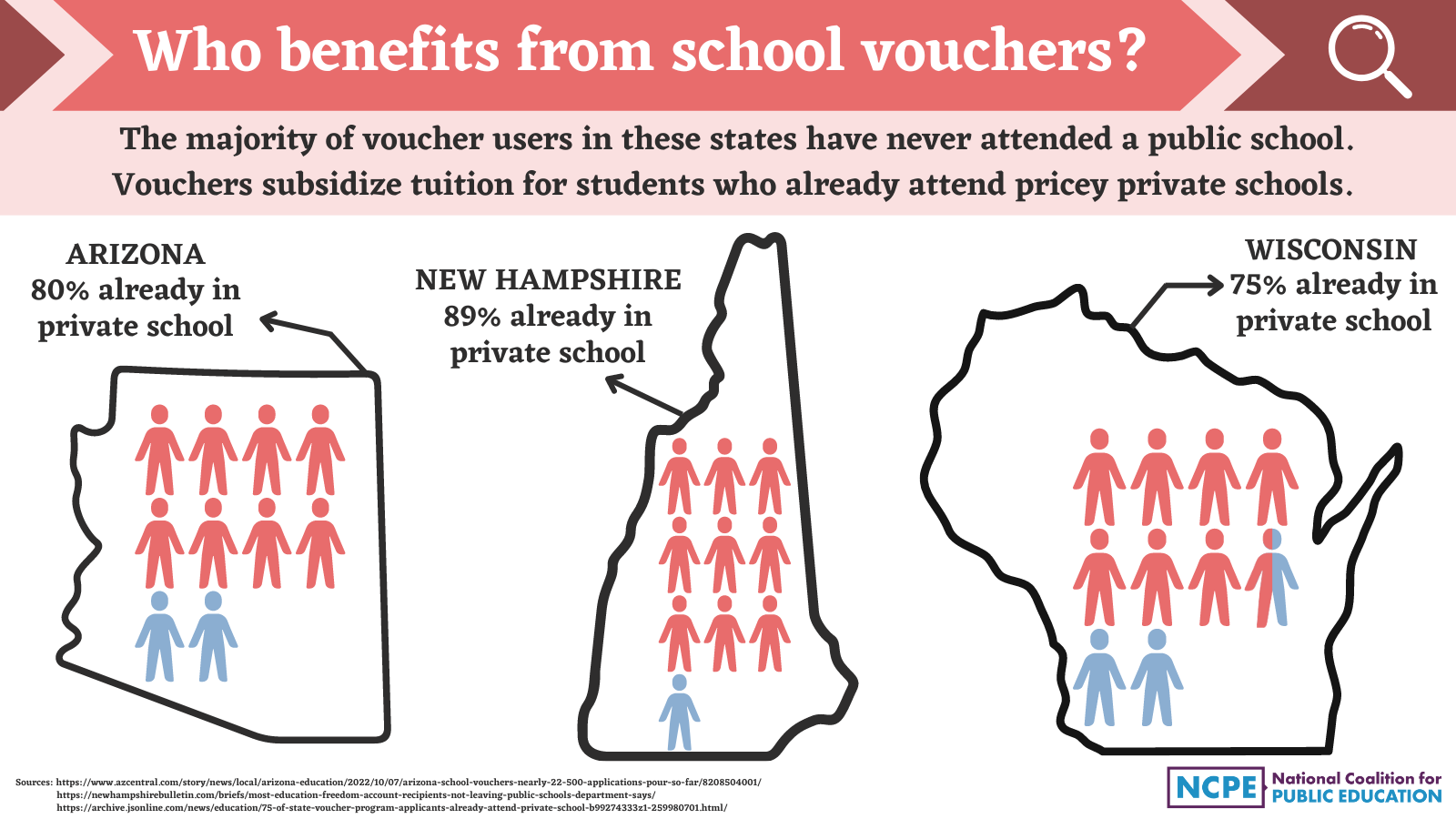
Notice the citations these graphs include. They’re the same as the hyperlinks above. These data come from independent sources and from non-partisan journalists. That’s a critically important part of this story.

And then there’s this, before we get into the details: the same people pushing vouchers are the same people working to undermine fair elections and the right to vote.

None of these are metaphors, and this is not a drill.

So how did we come to this?

1. A Quick History of Voucher Research

First let’s talk about the evidence.

I came into the school voucher research community early. It was around 2001 or so, as a young graduate student assistant for a study of privately funded vouchers led by the conservative professor Paul E. Peterson who was based at both Harvard and the conservative Hoover Institution at Stanford (never heard of Hoover? Think Condoleeza Rice.)

Peterson and his protégé Jay Greene had already done one study of Milwaukee’s publicly funded voucher program, as well as the one in Cleveland that was about to be the subject of the U.S. Supreme Court’s first favorable ruling on voucher funding. That work generally showed positive results for vouchers. As did the research of a young academic named Cecilia Rouse, who is now President Biden’s chief economist.

But they were small programs. What policymakers and researchers call a “pilot phase.” Back then when both parties cared at least nominally about evidence, you wouldn’t expand a program like vouchers without testing it. So those early tests seemed somewhat positive.

The first research I joined was Peterson and team’s next project: multi-site studies in Dayton, New York City, and Washington D.C. Those programs were also pilot-size. And the New York site in particular showed some limited evidence of voucher success. But overall the lead researchers focused as much on things like parental satisfaction and measures of civic engagement as metrics. That work resulted in a book called The Education Gap. You can find my name in the credits if you own a copy. If you don’t own one, don’t waste your money.

No one knew it at the time, but the mixed results documented in The Education Gap were to be the best vouchers were ever going to do—and ever have done since by an academic based team looking at voucher test scores.

Just a short time later in 2005, I joined a new voucher evaluation led by Patrick Wolf, another Peterson protégé and contributor to The Education Gap. Wolf was by then ensconced with Jay Greene at the University of Arkansas Department of Education Reform, a Walton Family-funded academic group that was about to train a new generation of voucher advocates. Most notably Corey DeAngelis, now at Betsy DeVos’s 501(c)4 voucher lobbying group American Federation for Children.

The Milwaukee evaluation, which was officially done for the state of Wisconsin, lasted from 2005-2010. We found no evidence in five years that voucher kids outperformed public school kids. Two exceptions: we found limited evidence that graduation rates and college enrollment were somewhat higher for the voucher kids. We also found that voucher kids improved when the state required private schools to participate in the same No Child Left Behind-style accountability systems as public schools. In particular once voucher schools knew their performance would be made public they—shockingly!—improved their outcomes.

At the same time as the Milwaukee evaluation, Patrick Wolf and other Arkansas colleagues were working on a new evaluation of Washington D.C.’s federally funded voucher program. That study showed no difference in test scores, but large positive graduate results.

That pattern of “no test score benefits, some attainment benefits” has stuck in the research narrative even among voucher skeptics. But as I recently explained in a piece for the Brookings Institution, it’s just that: a narrative. Other studies in New York, Louisiana and Florida all show no real advantages for vouchers on educational attainment.

And certainly nothing to offset the cataclysmic results that began to come out after the early-stage evaluations I just described. The newer D.C., Indiana, Louisiana, and Ohio studies that took place after 2013 and have showed pandemic and Katrina-sized harm to student test scores are all of at-scale voucher programs.

What do I mean by “at scale?” I mean that despite limited evidence in those pilot programs, vouchers have been steadily expanding across the country, and within states. So those D.C., Indiana Louisiana and Ohio studies represent our best understanding to date of what happens when you expand vouchers beyond the initial test phase. The answer: horrific impacts on student outcomes.

There are a number of reasons this could be, but I tend to argue we need not overthink this. Vouchers just don’t work. The kids who stand to gain from private schooling were and are already there. For the vast majority of kids, they’re better off in public schools. That’s what the latest voucher research shows.

As an example of what I mean: consider that in Wisconsin (which has not had a statewide study since ours ended in 2010), 41% of voucher-receiving schools have opened and then closed and failed since public funding began in the early 1990s.

That’s what happens when policymakers divert tax dollars to private schools: it’s like venture capitalism for education. It’s like Theranos but for private schooling. New providers race to gobble up new taxpayer money, but most of them have no business near kids.

Now, to fully understand why these terrible policies exist and in fact have never spread faster and further than they are today, we need to understand the politics. And to understand the politics, we need to understand the money.

On the one hand it’s pretty simple. Once you understand that the same people pushing vouchers are the same people funding groups that insist Donald Trump won the election and are now organizing a similar “Big Lie” for 2022’s results, you understand a lot. But read on.

2. Funding Vouchers, Funding Election Lies

It’s difficult to tell how much money has been spent to advocate for school vouchers over the years. But we know perhaps the biggest single funder—perhaps even larger than Betsy DeVos herself—is the Lynde and Harry Bradley Foundation. The Bradley Foundation is a little-known group based in Wisconsin and they’ve given tens of millions of dollars to voucher activism over the years.

Bradley not only funds voucher activism, it funds voucher research too. It was a major funder of the Milwaukee evaluation I was part of and described above. I don’t think they directly influenced our results, but generally speaking you don’t want activism and research funding to mix. Think about it this way: should the Sackler family fund research on the addictive properties of oxycontin? Should Exxon fund studies about the existence of climate change?

For me though, the real problem today is that the Bradley Foundation is hardly limiting itself to supporting research and political advocacy for private schooling. As the New Yorker’s Jane Mayer has meticulously documented in her reporting on financing behind Big Lie activism sowing doubts about President Biden’s 2020 victory, the Bradley Foundation is the convening funder around those activities—the “extraordinary force”, in Mayer’s words, funding and coordinating the Big Lie and other efforts to undermine the integrity of democratic elections.

Bradley is not alone. The Heritage Foundation, a right-wing organization known for its pro-voucher advocacy is, according to Mayer, “working with the American Legislative Exchange Council (ALEC)—a corporate-funded nonprofit that generates model laws for state legislators—on ways to impose new voting restrictions.”

In recent months, Heritage has also distributed talking points that under the guise of objective research attack school diversity and inclusion and directly question health care support for LGBTQ children. Heritage has recently released a report-card style rubric rating state laws on a so-called “Education Freedom” index for tax-supported private tuition. That report card includes the extent to which issues like diversity or sexual preference are components of public school teaching curricula.

The author of each of these documents is a Heritage Senior Fellow named Jay P. Greene. The same Jay Greene who while a conservative scholar at the University of Arkansas was co-director of that Bradley-funded voucher project that hired me back in 2005.

Greene is not alone in the Heritage-Bradley nexus. Cleta Mitchell, a lawyer who participated in Donald Trump’s infamous phone call to the Georgia Secretary of State demanding evidence that would overturn the state’s election results, was actively training poll watchers to question voters leading up to the 2022 midterms in places like my own state of Michigan. The night before the election, the New York Times even ran a story about Mitchell’s work in Michigan. The headline read: “Fueled by Falsehoods, a Michigan Group is Ready to Challenge the Vote.”

Mitchell is a known elections conspiracy theorist, according to CNN, and figures prominently in Mayer’s New Yorker reporting on broader election-related organizing. In her spare time Mitchell is on the Board of Directors of—wait for it!—the Lynde and Harry Bradley Foundation. She’s actually an officer on the Board too.

Michigan is important because we have a voucher proposal waiting to go to the state legislature—even though voucher opponent Gretchen Whitmer has won reelection. That proposal, backed by billionaire and privatization advocate Betsy DeVos, exploits a quirk in the state law allowing lame-duck Republicans to pass the voucher plan without the governor’s signature.

The spokesman for the DeVos voucher campaign is a man named Fred Wszolek. Wszolek is also the strategist for a group that tried unsuccessfully to prevent abortion access from becoming enshrined in the Michigan state constitution. And he heads a political action committee (PAC) called Michigan Strong, which has worked to elect now-defeated DeVos-backed GOP gubernatorial candidate Tudor Dixon.

Also working for Dixon was Kyle Olson of the Education Action Group, an entity devoted to right-wing education reform that’s received money from Charles Koch, the DeVos Family and Harry Bradley—he of the Bradley Foundation.

That’s just one example, but you get the idea: the same people working to push school vouchers are the same people working to undermine elections. And in some cases even reproductive rights.

3. So Why Now?


I’ve spent the last six months writing column after column in opinion pages across the country trying to warn ordinary readers who aren’t education lifers about the dangers of vouchers. You can read samples here or here or here or here if you like. There are more than 10 in all.

Because of my long career working in the middle of all these voucher advocates and researchers, I’ve been asked multiple times what changed my mind. Or, more specifically, why am I speaking out today?

I hope the story I’ve told you above answers some of that. But the reality is, I was also doing other things. I had a young family, other research interests, and other professional tasks like editing the country’s premier education policy journal.

Most of all I had a naïve sense that the facts would speak for themselves. Remember, those pandemic-sized voucher failures began appearing back in 2013. I was an associate professor then, newly arrived at Michigan State University after receiving tenure at the University of Kentucky.

To me, after a decade of mixed-at-best results that I outlined here, I assumed that catastrophic results like those in Louisiana—and then confirmed in Indiana, Ohio, and D.C.—would have killed vouchers a thousand times over.

It’s sort of quaint now, that assumption of mine. In my research community, which is centered in the Association for Education Finance and Policy, we talk a lot about using evidence to inform policy. It’s a nice idea, but vouchers are the big, glaring and alarming counterpoint. We have never seen such one-sided, consistently negative research results as we have for school vouchers in the education research community.

And yet they thrive.

To me, the piece to that puzzle is politics. Negative voucher results aren’t the only thing to happen since 2013.

2016 happened. Donald Trump happened. January 6th happened. Dobbs v. Jackson happened.

Voucher advocates are overwhelmingly on one side of those events. And they’ve racked up some wins.

We know voucher programs exist today not for how they might help some kids, but for how they might exclude others. We know private schools taking public money can and often do discriminate against certain children. In Florida for example, one private school barring LGBTQ kids has received $1.6 million so far in taxpayer funding. In Indiana, more than $16 million has gone to schools refusing to admit LGBTQ kids—or even kids with LGBTQ parents!—or about 1 out of every 10 private schools on the taxpayer dime.

I wish I had come around earlier to the level of alarm I’m raising today. Others have even without having to take a kind of road to Damascus like I did.

I’m a tenured full professor now. I’ve had a successful career working hard to bring evidence to public policy. I firmly believe that school vouchers are a fundamental threat not just to student learning, but also to democracy and to human rights.

So on vouchers I’ve come to the same view any number of us would if we stumbled onto a massive fraud in our workplace, or if we saw a young child being bullied simply for being who they are. None of it is okay.

And if you see something, you have to say something.

You can find Josh Cowen on Twitter

@joshcowenMSU

Denis Smith is a retired educator in Ohio. He urges voters to take Republicans at their word. When they say they will cut Social Security and Medicare, believe them. When they say they will enact a national ban on abortion, believe them. When they say they will cut taxes for big corporations, believe them.

He writes:

What Are You (We) Going to Do About It? It’s Very Simple. Take Republicans at Their Word.


According to some recent polling, Americans, concerned about rising energy and consumer prices, are expected to give control to Republicans for at least one house of Congress, most likely the House of Representatives. Yet other polls show that the Democrats are on the rebound, with many House and Senate races still too close to call.
How appolling is this? Pun.


Eugene Robinson of the Washington Post framed the ambiguous forecasting this way:

“Will an issue such as abortion motivate voters who usually skip midterms, turbocharging Democratic turnout? Will unease about the economy tip the scales toward change, boosting the GOP across the board?”


“The fact that we don’t know is unnerving…”


But while the result of the midterms might be in doubt, all of us should have no doubt about what will happen if Republicans regain control of one or both houses of Congress.


In their own words, Republicans have told us what to expect if they are victorious on November 8. We should have learned to trust them by now in looking at what they’ve said as a predictor of what they will do.

Some examples:


Social Security and Medicare. The two most popular government programs may be subject to attempts to sunset them as a way to wreak havoc on the debt ceiling. How ironic that the mastermind of the sunset plan is Florida Senator Rick Scott, who famously took the Fifth Amendment 75 times in a case involving the biggest Medicare fraud in American history that occurred during his tenure as CEO at healthcare giant Columbia/HCA.


Tax Cuts for Corporations. The GOP has promised to make permanent corporate tax levels enacted five years earlier in the first months of the Trump administration, reverting to their modus operandi of starving other programs to pay for such largesse. But to be a Republican means that you are a walking contradiction, driven to revert to past bad behavior by favoring corporations and high-income taxpayers at the expense of everyone else, including seniors.

The Post’s Jeff Stein painted this picture of what to expect in a Republican victory.


“Many economists say the GOP’s plans to expand the tax cuts flies against their promises to fight inflation and reduce the federal deficit, which have emerged as central themes of their 2022 midterm campaign rhetoric.”


Defund the IRS. Republicans plan to curtail plans for increased spending at the IRS to replace 1970s systems and increase customer service levels to avoid future backlogs on processing tax returns. Some of the new funding would go toward
hiring additional auditors to “crack down on high-income and corporate tax evaders who cost the American people hundreds of billions of dollars each year.” At least 50,000 IRS staff are expected to retire soon, but the GOP has spread wild
claims that staffing levels will increase by 87,000 when in fact the funding will be needed to replace retiring staff, invest in new technology, and add more robust auditing for tax cheats, both individual and corporate.


Defund Ukraine. From the looks of it, the defense of democracy may be waning in the Republican congressional caucus. In the last month, House Leader Kevin McCarthy has warned about not giving a “blank check” in the future for more aid to
Ukraine, as have other Republicans who want more money to build a wall on the southern border. Never mind that any pullback from support for Ukraine will seriously undermine NATO, something that Donald Trump wanted to do all along by his desire back in 2018 to withdraw American membership from the North
Atlantic Alliance.

“These guys don’t get it. It’s a lot bigger than Ukraine – it’s Eastern Europe. It’s NATO. It’s real, serious, serious consequential outcomes,” said Joe Biden about GOP plans to cut support for Ukraine.

Help Big PharmaAt Your Expense. In the recently enacted Inflation Reduction
Act, you will be shocked, shocked to learn that Republicans want to help pharmaceutical companies at the expense of consumers. The Ranking Republican on the House Ways and Means Committee has vowed to roll back caps on drug
costs allowed in the IRA “because those drug provisions are so dangerous, by discouraging investment in life-saving cures.” The legislation allows Medicare to negotiate its costs for the most expensive drugs and cap out-of-pocket costs for
seniors at $2,000 per year.

Investigations Ad Nauseum. Remember Benghazi, Benghazi, Benghazi? In an interview on Fox News a full year before the 2016 presidential election, House Leader Kevin McCarthy opined that “…everybody thought Hillary Clinton was
unbeatable, right? But we put together a Benghazi Special Committee, a select committee. What are her numbers today? Her numbers are dropping.”
You can bet your bottom dollar that if Republicans take control of Congress, we won’t have to wait long to discover probes into the Departments of Justice for alleged prosecutorial activism, Homeland Security for border issues, and for the
current president for having the same surname as Hunter Biden. You can also bet that all active congressional probes related to the January 6 insurrection will be stopped as quickly as you can say stop the steal, with the effect of absolving
possible criminal behavior on the part of some members of Congress and White House staff who may have aided and abetted the aborted coup in some fashion.


And we also need to be reminded that if the Republicans take control of the
House of Representatives, the likely new chairman of the Judiciary Committee will be Jim Jordan, the less than urbane resident of Urbana who helped to give us Benghazi, Benghazi, Benghazi a decade ago. His clownish antics back then may
prove to be his dress rehearsal for wielding a gavel to create more chaos and circus-like behavior in what was in another era referred to as the people’s house. In order to drive home the strong probability of chaos in the new Congress,
consider Jordan’s new 1,000 page report, where he alleges that both the FBI and the Justice Department have been politicized. Hmm, he must have never heard of William Barr. At any rate, the “report” is filled with air, containing hundreds of
pages of letters, signature pages, and only 46 pages of narrative. As is typical with Jordan, there is nothing but hot air and bluster as he wrestles in incessant witch hunts.

And last but not least:


Impeachment. Revenge. Payback. Impeachment will be on the table if the Republicans win in November. Ask Ted Cruz. Ask Marjorie Taylor Greene. For that matter, just ask the lunatic fringe that is now in control of the Republican Party. And the reason for a new impeachment? No, not for a president pressuring the Ukrainian leader to help him with collecting dirt on a political opponent, not for violation of the Emolument Clause in charging the Secret Service more than $1,600 per night for lodging in his properties, and certainly not for being central to a conspiracy for overthrowing a democratic (small d) election that led to the January 6 coup attempt at the nation’s Capitol. And the charges? Details. Details. They’ll fabricate something later because after all, the subject is revenge. Payback. “What’s good for the goose is good for the gander,” Ted Cruz said in September.
For once, Lyin’ Ted, as Trump christened him, was being straightforward.

So if you know all of this now, what are you going to do about it? In 1871, the great cartoonist Thomas Nast posed that same question.
When it comes to the Republicans’ upcoming agenda, we should believe Ted Cruz. And Kevin McCarthy. And all the rest of an anti-democracy, anti-government, election denying lunatic cult that once was identified as a responsible, conservative political party.


But perhaps the scariest part is that what has been detailed here merely represents the short list of Republican objectives in January if they win. After all, that’s what the GOP (Great Obstructionist Party), with no plan for providing principled governance yet having a detailed plan for obstruction and mayhem, is all about.


Yes, that is the GIP.


No, that’s not a typo. The GOP is also becoming known as the GIP, the Great Insurrectionist Party. When you threaten to cut Medicare and Social Security and take funds from Ukraine, a democratic country fighting for its life against an authoritarian onslaught, the result is that we’ve been GIPped.


And never forget that the leader of the rape of Ukraine is a former KGB agent who was defended by Donald Trump in 2018 at a meeting in Helsinki against allegations by 17 American intelligence agencies that Russia interfered in the 2016 presidential election.


“No prior president has ever abased himself more
abjectly before a tyrant, the late Senator John McCain said at the time about
Trump’s performance in defending a brutal dictator who murders journalists and
jails those who dare to object to his tyranny.


In the end, if you now know about this agenda that the GOP is expected to unleash but you go ahead and vote for any Republican who denies the validity of elections and supports the authoritarianism personified by Donald Trump, you are guilty of aiding and abetting the dissolution of our democracy.


Election Day is at hand. What are you – and what are we – going to do about it? From the looks and sounds of it, we are running out of time.

Journalist Nora de la Cour describes the dire situation in Wisconsin, where incumbent Governor Tony Evers is in a close race with an election denier/school privatizer, Tim Michels. There are many other states where education is on the ballot. Wisconsin was once known for its great public schools and public universities. Former Governor Scott Walker declared war on both. Twenty-five years ago, the far-right Bradley Foundation funded the voucher movement in Milwaukee, which has spread to other parts of the state and to other states. The Trumpist base of the Republican Party has declared war on public schools, based on lies and fantasies spun by rightwing think tanks.

She begins:

New research finds that market-style education reforms, like those pioneered in Wisconsin decades ago, have devastating consequences for students. This election, Wisconsin and the rest of the nation must choose whether to plow ahead or reverse course.

Wisconsin’s Democratic governor Tony Evers is neck and neck with his challenger, Trump-endorsed Tim Michels, whose campaign has lauded abortion bans, election denialism, and a beefed up carceralpolicestate. Robert Asen, who studies political discourse at the University of Wisconsin, Madison, told Jacobin that because education has gotten relatively less airtime, it is “a bit of a stealth issue analogous to [labor law in] Scott Walker’s 2010 gubernatorial campaign,” which didn’t prepare voters for Walker’s vicious attacks on workers. But make no mistake: this election will determine the existential future of K-12 schooling in the state.

Following the now-familiar Chris Rufo playbook, Michels plans to sign a restrictive “parents’ rights” bill and move up the timeline on a universal school choice plan that would destroy what’s left of Wisconsin’s once-great public schools. Formerly the state’s superintendent of public instruction, Evers has pledged to increase school funding and prioritize the public system. In reality, though, even if Evers prevails he’ll at best continue to be “the man of a thousand vetoes,” given that Republican opposition will prevent him from pursuing his agenda. So as Marquette University senior fellow and veteran education reporter Alan Borsuk put it when speaking to Jacobin, this governor’s race amounts to a choice between treading water and veering hard right.

In many ways, Wisconsin blazed a trail for the rest of the country with market-style reforms that increase competition by weakening teachers’ unions and privatizing schools. Decades later, researchers have mapped the devastating impact of these reforms on Wisconsin students. So, as voters across the United States face grave education questions up and down the ballot, it makes sense to look back at what’s happened in the Badger State.

Please open the link and read this important article.

The Walton Family Foundation has poured hundreds of millions, possibly billions, into privatizing America’s schools via charter schools. It recently announced that it would add another $100 million, in alliance with the PNC bank, to enable charters to grow.

The curious aspect of Walton’s devotion to charter schools is its complete indifference to the failures, poor performance, scandals, and frequent closures of charters.

Clearly the foundation has a goal that is unrelated to performance or success. The funders criticize public schools for poor performance, but in many states, the public schools outperform the charter schools. Nonetheless, Walton keeps pouring in more money.

Its goal seems clear: not to provide better opportunities for kids, but to undermine and disrupt public schools.

If they cared about students, the Waltons would pour hundreds of millions into improving public schools, which enroll 85-90% of American students.

Arthur Camins—teacher, scientist, technologist— argues in The Daily Kos that it’s time for Democrats to abandon their support for charter schools. Are you listening, Senator Corey Booker of New Jersey, Senator Michael Bennett of Colorado, Governor Jared Polis of Colorado, Rep. Hakeem Jeffries and other charter allies?

Camins writes:

It is time for Democrats–voters and the politicians who represent them–to abandon charter schools as a strategy for education improvement or to advance equity. Charter schools, whether for- or non-profit, drain funds from public schools that serve all students, increase segregation, and by design only serve the few. Continuation of tax generated funds for charter schools, all of which are privately governed, support the current broader assault on democracy. That should not be the way forward for democracy loving Democrats. In addition, public support for private alternatives to public education suborns the lie that government cannot be the agency for solving problems.

The United States is tilting sharply toward, if not rushing headlong into, a less equitable, less democratic, more authoritarian, more racially divided, and meaner way of governing and living together. Out-for-youselfism is alarmingly rampant. Sadly, continued bipartisan state and federal support for charter schools that pit parents against one another for limited student slots reflects those tendencies.

We have been heading in that direction for decades, led by pro-wealth, anti-regulation billionaires and corporations allied with Christian religious extremists and ideological libertarians. Exacerbating extant racist, xenophobic, and misogynistic resentment is their core strategy. It is represented by a Republican Party whose only moral compass is power and for whom democracy is an expendable inconvenience.

Republican opposition to equity advances for all people, such as the National Labor Relations Act, Unemployment Insurance, Social Security, and Medicare, is nothing new. However, until the emergence of the Republican-light Democratic Leadership Council, there was a strong pro-government, pro-worker, if frequently inconsistent, opposition political party. In the absence of an explicit effort by Democrats to articulate a rationale for a multi-racial, working-class coalition, resentment flourished. Instead, many Democrats embraced deregulation and campaign cash, including contributions from the charter school industry.

This Republican-light Democratic shift could not have come at a worse time, as globalization and automation threatened the livelihood of many Americans, shaking the foundations of post-WWII perception of security, especially for many white working- and middle-class Americans. As scarcity and inequity came to be accepted as the unalterable norm, advances for some–left-out people of color, recent immigrants, and women–came to seen as coming at the expense of others. In that context, charter schools appealed social and economic insecurity.

Nonetheless, Democratic politicians from Bill Clinton to Barrack Obama embraced charter schools. The essential notion was that take-all-comers schools governed by locally elected school boards for the common good were an old-school failure. The supposed evidence was the failure to close the achievement gaps between kids from poor and well-off households. The fact that family socio-economic status explains most of the achievement gaps was ignored in favor of a blame-the-teacher and their unions ethos and test-driven blame. In supporting charter schools Democrats implicitly endorsed a competitive watch–out-for-my-own kid ethos. It is time for a new direction.

Even with substantial evidence of rampant corruption and increased segregation, national Democratic leadership has yet to fully abandon the belief in charter schools as an improvement strategy. In doing so, they abet the ongoing Republican claim that government and democracy are incapable of effective problem solving. Opposition to for-profit charter school and vouchers is insufficient. Increased oversight and rejection of for-profit charter schools is, of course, a positive step. However, the notion of schools as primarily a personal rather than a social benefit and that market-competition as an improvement driver remains intact.

Step away from charter schools, Democrats. Instead, embrace full equitable funding for all schools. Embrace professional salaries, respect, and working conditions for teachers. Embrace union protection. Embrace community schools to meet the needs of children and their families. Embrace small class size so every child can get the academic, social, and emotional supportthey need. Embrace schools to develop socially responsible citizens for a democratic equitable society.

That is the way forward for Democrats and Democracy!

There are three things that privatizers hate: public schools, democracy, and teachers’ unions.

In New Hampshire, the privatizers are on the move.

Jacob Goodwin writes about them in The Progressive:

New Hampshire has a proud tradition of public schools, one that, in some towns, dates back to single-room school houses of early America when students would take horse-drawn sleighs to school in the winter. Our schools—and towns, for that matter—are known for operating largely under “local control,” meaning that school boards are made up of parents and community members and are designed to act as sentinels of democracy, tasked with uplifting the highest civic ideals and aspirations.

Historically, the state has had a limited role in determining how schools are run. Consequently, New Hampshire has provided a minimal amount of school funding. While the concept of local control can be both empowering and a burden of responsibility, students and teachers cannot carry out their important work without adequate funding.

Recently, school privatizers seized curricula as a new front in their pressure campaign against teachers, determined to further squeeze public schools financially. Lacking widespread public support, New Hampshire’s legislature restricted classroom conversations about race and gender in 2021—enacting a law which drew ire for its disproportionate penalties and vague requirements. The confusing act prompted the New Hampshire Department of Justice to issue a statement of guidance, confirming the harsh penalties and doing little to protect teachers from potentially career-ending false accusations. The law has placed additional costs on districts in terms of teacher retention and recruitment, compounding staffing shortages in the profession.

Privatizers advance their damaging agenda by undermining the public confidence in schools. Each teacher that leaves due to the relentless attacks is one less trusted adult for children. And the loss of experienced professionals is a way of further loosening communal ties. Traditional, deliberative decision making of small-town New England is rooted in neighborly relational knowledge, but this is now being undercut. Privatizers only see profits by cutting costs, not the most important thing in schools—the people.

Nationwide, attacking teachers and neighborhood schools has become part of a broader strategy to divert taxpayer money away from public accountability. Profiteering and mismanagement scandals in states like Florida and Pennsylvania warn of the danger of moving decision-making from parent volunteers in the auditorium to executives in corporate board rooms.

Despite the odds, teachers are speaking up for their community schools and mounting legal challenges to unjust laws that seek to erode the essential public good of education. On September 14, the presiding federal judge declared that he would rule on the state’s motion to dismiss a suit brought by a coalition including the state’s largest teachers union within sixty to ninety days. But while the speech-chilling law remains in place, teachers fear stifled classroom discussions and even loss of licensure. And the forces of privatization have continued to stretch the civic fabric of our communities through swiftly changing our state with little public input or oversight.

After failing to pass a stand-alone voucher bill in previous legislative sessions, the state Commissioner of Education shepherded a significant voucher bill through the state legislature and into the budget. He promised that the measure would be limited and require a budget of $130,000 in the first year. In October 2021, however, the voucher law was already costing New Hampshire taxpayers $6.9 million…

Distracting the public from the actual needs of over 90 percent of students who attend public schools is part of the coordinated strategy against local control in New Hampshire. The refusal to address funding adequacy, meaningful mental health support for students, and building maintenance are among the major issues that are seldom addressed.

Two women are competing to be Governor of Arizona. Katie Hobbs, the current Secretary of State, is the Democratic candidate. Kari Lake, a former talk show host, is the Republican candidate, endorsed by Trump.

The differences between them on education are stark. Hobbs would roll back the recently passed universal voucher plan. Lake is an enthusiastic supporter of charters and vouchers.

Both pledged to raise teacher pay, but Lake would tie raises to test scores.

If Lake is elected, she would impose extremist ideas that would undermine education in the state. She promises privatization and censorship. If she is elected, she will destroy public schools.

The Arizona Republic described their views:

In the coming year, Arizona schools face key challenges.

A newly minted school voucher program will steer millions of taxpayer dollars to lightly regulated private schools. A major staff shortage has left schools across the state scrambling for teachers, bus drivers and kitchen staff. Total public school spending is nearing a limit that could force massive budget cuts if the Legislature doesn’t act.

The governor has significant sway in shaping the future of education in Arizona. They can propose priorities for legislative action, choose bills to sign, call special legislative sessions, appoint members to the State Board of Education and issue executive orders.

Arizona’s candidates for governor offer voters a stark choice on education policy.

Democrat Katie Hobbs supports repealing the new universal school voucher program and putting more public dollars into public schools. Republican Kari Lake wants all education funding tied to students, not schools, which could send even more public money to private schools.

Here’s what else we know about where they would try to lead Arizona’s education system if elected.

Funding schools, public and private

At the core of Lake’s education plan is a proposal to allow families to decide where state money allocated for their children’s education will go. The funding that would typically go to their local district public school to support their children’s education could be spent at a public district school, a public charter school, a private school, or for “alternative learning arrangements, such as neighborhood pods.”

“Parents and students can mix and match the best educational opportunities available to them,” Lake said on her campaign website. “As parents, you decide where you want your kid to go to school, send them there, and their state funding will follow them. No waitlists, no applications, no hurdles or hoops to jump through, period.”

While district schools usually are expected to welcome any student zoned to the school, some charter schools reach capacity and institute waitlists. Private schools routinely require families to apply for a spot.

That “backpack funding” approach would significantly shift how public school funding works in Arizona. Currently, public schools get a mix of funding from federal, state, and local sources. State funding depends on the number of students in a school and students’ specific needs. High-performing schools can also get additional funding, and many schools qualify for grant funding or other special financial support.

The recently expanded education voucher program shifted the funding dynamic by allowing any family with a school-age child in Arizona — regardless of whether they previously attended a public school — to apply for about $7,000 in public education funding to put toward education-related endeavors, including private schools, tutors and homeschooling.

If elected, Hobbs said she would work to roll back universal vouchers.

On school funding, Hobbs said she wants to direct more of Arizona’s budget surplus, $5 billion in fiscal year 2023, to education. Right now, Arizona ranks near the bottom nationally in per-pupil spending, which educators said accounts for crumbling classrooms, outdated books and low-paid staff.

Hobbs also wants to ensure Arizona schools receive matching federal dollars for early childhood education. “To say that increased funding of schools does not result in better student success is willful ignorance of the needs of Arizona children and families,” said Hobbs’ plan.https://www.usatodaynetworkservice.com/tangstatic/html/pphx/sf-q1a2z37a5af424.min.html

Both would increase teacher pay

Both Lake and Hobbs said they want to increase the number of new teachers and retain current teachers by boosting pay. But they have different ideas about how to go about it.

Hobbs’ promises to support educators and tackle the teacher shortage are at the forefront of her platform. Among her positions are increasing educator annual salaries by an average of $14,000, expanding a state program that subsidizes tuition for college students studying education, promoting mentorship programs and ensuring teachers can access affordable healthcare.

Much of Hobbs’ plan relies on existing systems for low-cost teacher training, including the Arizona Teacher Residency at Northern Arizona University and the Arizona Teachers Academy, a scholarship program that subsidizes tuition at public, in-state higher education institutions. Hobbs said she would also work to convince the Legislature that more base funding for schools is needed.

Lake challenged the connection between more money for schools and higher student achievement. She said Arizona teachers deserve better pay, but any raises should be performance-based. She blamed stagnating teacher salaries on administrators taking ever-larger earnings. “Government-run school leaders appear to be deliberately keeping teacher pay low so they can be used as sympathetic figureheads in a quest for additional funds,” Lake said.

An Arizona Auditor General analysis of instructional spending in the 2021 fiscal year found that the percentage of money spent on instructional spending had fallen to 55.3% from its peak of 58.6% in 2004. While administrative spending is part of what districts spend their non-classroom dollars on, those costs also include food service and transportation.

Instead, Lake said she would provide bonuses for educators whose students perform well and show improvement. She would fund that through Proposition 301, an education sales tax first approved in 2000 and renewed in 2018. “We cannot trust school districts to direct allocated funds to teachers,” she said, explaining her support for performance-related raises. “I want our best teachers to be recognized and to be the highest paid in the country.”

Differences on school spending cap

The aggregate expenditure limit is a constitutional cap put in place in the 1980s on how much all Arizona district-run schools can spend. Last year, schools hit the limit, and the Legislature temporarily lifted the cap. This year, schools are on track to hit it again, and if lawmakers don’t act, school districts will collectively have to cut billions from their budgets.

Hobbs wants to eliminate the constitutional limit. “Each year our school districts are held hostage by political gamesmanship,” she said.

A constitutional fix could take various forms. The Legislature could increase the spending ceiling or exempt from the limit the money that comes in from the Proposition 301 sales tax. An end to the limit altogether would require a public referendum.

Lake did not respond to The Republic’s questions about her education plan, including a question about her position on the spending limit. In a social media statement earlier this year, Lake was critical of efforts to lift the cap. In a February tweet, as lawmakers voted on a bill to temporarily lift the spending cap, Lake encouraged her followers to vote in favor of legislators who did not support raising the aggregate expenditure limit….

Banning ideas, how to teach U.S. history

Lake wants to prohibit several ideas from being discussed in schools.

She’d like to strengthen Arizona’s ban on a college-level theory that teaches people of different races experience aspects of U.S. society differently, restrict teaching systems that aim to improve interpersonal skills and decision-making, and eliminate diversity, equity and inclusion programs. Lake said on the campaign trail that she would consider putting cameras into classrooms to keep these programs from being taught.

Lake also said she would align state standards to the Hillsdale 1776 curriculum, a history and civics program of study created by a conservative private college in Michigan that has been criticized as taking a too rosy view of the U.S. past.

In response to a question from The Republic, Hobbs’ campaign said she opposed using the Hillsdale 1776 curriculum in Arizona schools because it did not offer a comprehensive understanding of civics and history. It would “ultimately be a disservice to Arizona children,” the campaign statement said.

Hobbs’ education plan doesn’t take an explicit position on the teaching of race and history or other political questions that have riled both the Legislature and some Arizona school boards.

Lake pledged to replace the Arizona state test with the National Assessment of Educational Progress, a federal test that is not available for use by schools or states.

Pastors for Children has never made a political endorsement before. But the stakes are so high for children, families, communities, and public schools that they could not sit on the sidelines. The Lt. Governor is a very important political position in Texas. The Pastors for Children is endorsing Mike Collier. Pastors for Children is the 501c4 arm of Pastors for Texas Children.

Collier’s opponent Dan Patrick is the current Lt. Governor. He is a strong supporter of vouchers. He was a rightwing talk show host before he ran for office.

Pastors For Children Endorses Mike Collier For Texas Lieutenant Governor

Current Lt. Gov. Dan Patrick has defunded public education and allowed Texas homeowners’ property taxes to skyrocket.

Fort Worth, TX – Pastors for Children, an independent 501(C)4 organization, announced today their endorsement of Mike Collier in the race for Texas Lieutenant Governor. Along with their endorsement, they have launched a 30-second television spot focused on Tarrant County.

“Mike Collier has a proven track record as a successful Certified Public Accountant, businessman, and consultant in the Oil and Gas industry,” said Pastor Charles Foster Johnson, Executive Director of Pastors For Children. “We believe the combination of these analytical and professional skills, intelligence, and high moral character make Mike Collier the far superior choice for Lieutenant Governor.”

Mike Collier has the endorsements of well-respected members of both parties, including Republicans Sen. Kel Seliger, Tarrant County Judge Glen Whitley, State Rep. Lyle Larson, former Lt. Gov. Bill Ratliff, former State Rep. Byron Cook, former State Rep. Bennett Ratliff, and former Dallas Mayor and US Congressman Steve Bartlett. He also has the endorsement of Pastors For Children’s close allies in education, the Association of Texas Professional Educators, the Friends of Texas Public Schools, the Texas State Teachers Association, and the Texas AFT.

“The bipartisan support for Collier is evidence of his appeal as a candidate to folks in urban and rural counties, who want to see the polarization of the Texas Legislature stop and return to getting things done for the people of Texas,” said Pastor Johnson. “Mike Collier is the best candidate to make that happen. It is time for the voters of Texas – Republicans, Democrats, and Independents, to send Dan Patrick into retirement.”

Mike Collier will focus on keeping our Texas school-children safe, providing adequate funding for our public schools, and returning good policy and competence to the office of Lt. Governor. For these reasons, Pastors for Children is proud to endorse Mike Collier for Lt. Governor.

Pastors for Children is a nationwide network of faith leaders and community partners dedicated to school service and fair and equitable public school funding

This is one of the best summaries I have seen of what Republicans will do if they are elected and gain control. It’s about two minutes. Please watch and share.

She leaves out one salient point, made by Kevin McCarthy. The Republicans will cut aid to Ukraine and use the money to finish building Trump’s Great Wall (that Mexico was supposed to pay for).

In recent years, there has been a full-court press to persuade seniors to transfer from traditional Medicare to private, for-profit plans called “Medicare Advantage.” [MA]

MA plans include prescription coverage and lots of bells and whistles. But something is sacrificed to enable the plans to make a profit. What is sacrificed? Your preferred doctor may not be covered, and you may be denied coverage of some procedures.

Two progressive Congressmen—Ro Khanna and Mark Pocan—have introduced legislation to bar private for-profit plans from using the label “Medicare,” because it confuses seniors into thinking it’s a government plan, the one they paid into for many years. It’s not.

The New York Times wrote a scathing article about MA plans, calling them “cash monsters.”

By next year, half of Medicare beneficiaries will have a private Medicare Advantage plan. Most large insurers in the program have been accused in court of fraud.

The health system Kaiser Permanente called doctors in during lunch and after work and urged them to add additional illnesses to the medical records of patients they hadn’t seen in weeks. Doctors who found enough new diagnoses could earn bottles of Champagne, or a bonus in their paycheck.

Anthem, a large insurer now called Elevance Health, paid more to doctors who said their patients were sicker. And executives at UnitedHealth Group, the country’s largest insurer, told their workers to mine old medical records for more illnesses — and when they couldn’t find enough, sent them back to try again.

Each of the strategies — which were described by the Justice Department in lawsuits against the companies — led to diagnoses of serious diseases that might have never existed. But the diagnoses had a lucrative side effect: They let the insurers collect more money from the federal government’s Medicare Advantage program.

Medicare Advantage, a private-sector alternative to traditional Medicare, was designed by Congress two decades ago to encourage health insurers to find innovative ways to provide better care at lower cost. If trends hold, by next year, more than half of Medicare recipients will be in a private plan.

Medicare Advantage is on track to enroll most Medicare beneficiaries by next year….

But a New York Times review of dozens of fraud lawsuits, inspector general audits and investigations by watchdogs shows how major health insurers exploited the program to inflate their profits by billions of dollars.

The government pays Medicare Advantage insurers a set amount for each person who enrolls, with higher rates for sicker patients. And the insurers, among the largest and most prosperous American companies, have developed elaborate systems to make their patients appear as sick as possible, often without providing additional treatment, according to the lawsuits.

As a result, a program devised to help lower health care spending has instead become substantially more costly than the traditional government program it was meant to improve.

Eight of the 10 biggest Medicare Advantage insurers — representing more than two-thirds of the market — have submitted inflated bills, according to the federal audits. And four of the five largest players — UnitedHealth, Humana, Elevance and Kaiser — have faced federal lawsuits alleging that efforts to overdiagnose their customers crossed the line into fraud.

The fifth company, CVS Health, which owns Aetna, told investors its practices were being investigated by the Department of Justice.

Many of the accusations reflect missing documentation rather than any willful attempt to inflate diagnoses, said Mark Hamelburg, an executive at AHIP, an industry trade group. “Professionals can look at the same medical record in different ways,” he said.

The government now spends nearly as much on Medicare Advantage’s 29 million beneficiaries as on the Army and Navycombined. It’s enough money that even a small increase in the average patient’s bill adds up: The additional diagnoses led to $12 billion in overpayments in 2020, according to an estimate from the group that advises Medicare on payment policies — enough to cover hearing and vision care for every American over 65.

Another estimate, from a former top government health official, suggested the overpayments in 2020 were double that, more than $25 billion.

The increased privatization has come as Medicare’s finances have been strained by the aging of baby boomers. But for insurers that already dominate health care for workers, the program is strikingly lucrative: A study from the Kaiser Family Foundation, a research group unaffiliated with the insurer Kaiser, found the companies typically earn twice as much gross profit from their Medicare Advantage plans as from other types of insurance.

For people choosing between traditional Medicare and Medicare Advantage, there are trade-offs. Medicare Advantage plans can limit patients’ choice of doctors, and sometimes require jumping through more hoops before getting certain types of expensive care.

But they often have lower premiums or perks like dental benefits — extras that draw beneficiaries to the programs. The more the plans are overpaid by Medicare, the more generous to customers they can afford to be.

“Medicare Advantage is an important option for America’s seniors, but as Medicare Advantage adds more patients and spends billions of dollars of taxpayer money, aggressive oversight is needed,” said Senator Charles Grassley of Iowa, who has investigated the industry. The efforts to make patients look sicker and other abuses of the program have “resulted in billions of dollars in improper payments,” he said.

Many of the fraud lawsuits were initially brought by former employees under a federal whistle-blower law that allows them to get a percentage of any money repaid to the government if their suits prevail. But most have been joined by the Justice Department, a step the government takes only if it believes the fraud allegations have merit. Last year, the department’s civil division listed Medicare Advantage as one of its top areas of fraud recovery….

In contrast, regulators overseeing the plans at the Centers for Medicare and Medicaid Services, or C.M.S., have been less aggressive, even as the overpayments have been described in inspector general investigations, academic research, Government Accountability Office studies, MedPAC reports and numerous newsarticles, over the course of four presidential administrations.

Congress gave the agency the power to reduce the insurers’ rates in response to evidence of systematic overbilling, but C.M.S. has never chosen to do so. A regulation proposed in the Trump administration to force the plans to refund the government for more of the incorrect payments has not been finalized four years later. Several top officials have swapped jobs between the industry and the agency….

The popularity of Medicare Advantage plans has helped them avoid legislative reforms. The plans have become popular in urban areas, and have been increasingly embraced by Democrats as well as Republicans. Nearly 80 percent of U.S. House members signed a letter this year saying they were “ready to protect the program from policies that would undermine” its stability.

“You have a powerful insurance lobby, and their lobbyists have built strong support for this in Congress,” said Representative Lloyd Doggett, a Texas Democrat who chairs the House Ways and Means Health subcommittee.

Some critics say the lack of oversight has encouraged the industry to compete over who can most effectively game the system rather than who can provide the best care.

“Even when they’re playing the game legally, we are lining the pockets of very wealthy corporations that are not improving patient care,” said Dr. Donald Berwick, a C.M.S. administrator under the Obama administration, who recently published a series of blog posts on the industry. “When you skate to the edge of the ice, sometimes you’re going to fall in….”

Almost immediately, companies saw ways to exploit that system. The traditional Medicare program provided no financial incentive to doctors to document every diagnosis, so many records were incomplete. Under the new program, insurers began rigorously documenting all of a patient’s health conditions — say depression, or a long-ago stroke — even when they had nothing to do with the patient’s current medical care….

According to the lawsuit, some patients were diagnosed with cancer and heart disease. Nurses were told to especially look for patients with a history of diabetes because it was not “curable,” even if the patient now had normal lab findings or had undergone surgery to treat the condition.

The company declined to comment. “We will vigorously defend our Medicare Advantage business against these allegations,” Cigna said in an earlier statement regarding the lawsuit.

Adding the code for a single diagnosis could yield a substantial payoff. In a 2020 lawsuit, the government said Anthem instructed programmers to scour patient charts for “revenue-generating” codes. One patient was diagnosed with bipolar disorder, although no other doctor reported the condition, and Anthem received an additional $2,693.27, the lawsuit said. Another patient was said to have been coded for “active lung cancer,” despite no evidence of the disease in other records; Anthem was paid an additional $7,080.74. The case is continuing.

The most common allegation against the companies was that they did not correct potentially invalid diagnoses after becoming aware of them. At Anthem, for example, the Justice Department said “thousands” of inaccurate diagnoses were not deleted. According to the lawsuit, a finance executive calculated that eliminating the inaccurate diagnoses would reduce the company’s 2017 earnings from reviewing medical charts by $86 million, or 72 percent….

Kaiser, which both runs a health plan and provides medical care, is often seen as a model system. But its control over providers gave it additional leverage to demand additional diagnoses from the doctors themselves, according to the lawsuit.

“The cash monster was insatiable,” said Dr. James Taylor, a former coding expert at Kaiser who is one of 10 whistle-blowers to accuse the organization of fraud.

Last year, the inspector general’s office noted that one company “stood out” for collecting 40 percent of all Medicare Advantage’s payments from chart reviews and home assessments despite serving only 22 percent of the program’s beneficiaries. It recommended Medicare pay extra attention to the company, which it did not name, but the enrollment figure matched UnitedHealth’s.

A civil trial accusing UnitedHealth of fraudulent overbilling is scheduled for next year. The company’s internal audits found numerous mistakes, according to the lawsuit, which was joined by the Justice Department. Some doctors diagnosed problems like drug and alcohol dependence or severe malnutrition at three times the national rate. But UnitedHealth declined to investigate those patterns, according to the suit…

“Medicare Advantage overpayments are a political third rail,” said Dr. Richard Gilfillan, a former hospital and insurance executive and a former top regulator at Medicare, in an email. “The big health care plans know it’s wrong, and they know how to fix it, but they’re making too much money to stop. Their C.E.O.s should come to the table with Medicare as they did for the Affordable Care Act, end the coding frenzy, and let providers focus on better care, not more dollars for plans.”