If you live anywhere near Rochester, New York, you will have the opportunity to see the amazing anti-privatization film, “Backpack Full of Cash.” Don’t miss it!
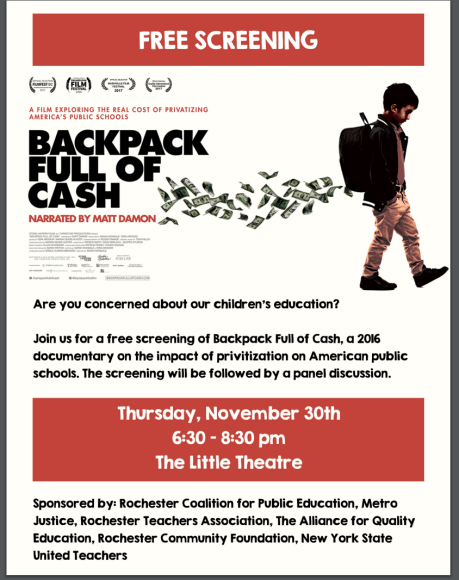
If you live anywhere near Rochester, New York, you will have the opportunity to see the amazing anti-privatization film, “Backpack Full of Cash.” Don’t miss it!
New Republican Governor Eric Greitens has gained control of the state board of education, and he is pressuring them to fire the state commissioner, Margy Vandeven, who has some centrist nonpolitical ideas about helping improve the public schools.
One of the new board members is balking at the pressure from the governor. He doesn’t think he knows enough to fire the state commissioner.
The governor wants to bring in a chum who is committed to opening charter schools.
The state constitution says the board is supposed to be independent and nonpolitical.
The governor is politicizing the board so he can push the DeVos agenda. Apparently he wants to bring in a friend named Kenneth Zeff, who is allegedly a charter school expert. The two of them worked together as White House Fellows during the second Bush administration. Jeff has his BA in economics from the University of Michigan and an MBA in business from the Wharton School at the University of Pennsylvania. He is a Broadie who worked in the Fulton County (Atlanta) schools and before that for the Green Dot Charter chain in Los Angeles.
The Missouri Association of School Administrators is unhappy about the governor’s effort to take control of the state board.
Melissa Randol, executive director of the Missouri School Boards’ Association, said the governor’s moves are “troubling.”
She said Zeff’s apparent support for charter school expansion “could have a negative impact on all public schools, but especially in rural areas where charter expansion would encourage school district consolidation.”
“We must preserve the integrity of our state constitution to ensure the commissioner does not become a political appointee of the governor,” Randol said.
Vandeven, who earns $191,544 annually, took the helm as commissioner in January 2015, replacing Chris Nicastro. Her goals then included expanding access to early childhood education, improving teacher quality and increasing accountability for teaching colleges.
In recent months, Vandeven, the state education department and state board have also taken a hard hand in demanding charter school quality by heightening pressure on charter school sponsors.
Just today: a challenge to the governor on his removal of state board members:
http://www.kansascity.com/news/local/news-columns-blogs/the-buzz/article184779833.html
I was tempted to give an entire day to this post about the Dark Money group deceptively called Families for Excellent Schools.
The “families” are financiers, billionaires, and garden-variety multimillionaires. They enjoyed great success in New York, where they made an alliance with Governor Cuomo and launched a $6 Million TV buy to promote charter schools. Under pressure from Cuomo, the state legislature compelled the City of New York to provide free space to charter schools and to give Eva Moskowitz whatever she wanted.
Then, Families for Excellent Schools opened shop in Massachusetts, where they launched a multimillion dollar campaign to increase the number of charter schools.
Parents, teachers, the teachers unions, Rural and suburban communities turned against charter schools. Bernie Sanders and Elizabeth Warren joined the opponents of charter schools. Before the vote, the backers of Question 2 were revealed in the media (though not all of their names), and the referendum to expand the charter sector went down to a crashing defeat.
After the election, things went bad for FES.
“This September, the Massachusetts Office of Campaign and Political Finance fined Families for Excellent Schools a comparatively nominal $426,500. But it also forced the charter group to reveal its donors — a who’s who of Massachusetts’ top financiers, many of whom are allies of Gov. Charlie Baker — after it had promised them anonymity.”
In addition to the fine, FES was banned from the Bay State for four years.
One of the big donors to FES was the rightwing, anti-union Walton Family, which gave FES more than $13 Million between 2014 and 2026. The chairman of the Massachusetts Board of Education gave FES nearly $500,000.
Now FES is trying to redefine itself.
Here is a suggestion: support the public schools that enroll nearly 90% of children. Open health clinics in and near schools. Invest in prenatal care for poor women. Lobby for higher taxes for the 1%.
Nine school boards have filed suit in Florida Supreme Court, asking the court to block HB 1069, passed by the legislature in May.
The law is a giveaway to charter schools and covers a hodgepodge of subjects, all intended to cripple public education.
“The school boards late Monday filed a constitutional challenge at the Supreme Court to the bill, which has become known in the education world by the shorthand HB 7069. The 274-page bill, spearheaded by House Speaker Richard Corcoran, dealt with a wide range of issues, including controversial subjects such as charter schools and teacher bonuses.
“The challenge contends the law violates part of the Florida Constitution that requires legislation to deal with single subjects. It alleges HB 7069 is a “prototypical example of logrolled legislation” — legislation that puts together a patchwork of issues.
“School districts also have filed two lawsuits challenging HB 7069 in Leon County circuit court. But the new case filed directly to the Supreme Court involves different legal grounds and contends that immediate action is needed to block the law from moving forward.
“Waiting for a trial court determination and its subsequent appellate review will allow irreversible damage to the function of the public education system to occur throughout the state of Florida,” the lawsuit said.
“Plaintiffs named in the case are the school boards of Alachua, Bay, Broward, Hamilton, Lee, Polk, St. Lucie, Volusia and Wakulla counties.
“In arguing the Supreme Court should take up the case, the school boards are seeking what is known as a “writ of quo warranto” finding that the Legislature violated the Constitution because of the single-subject issue. They also are seeking what are known as “writs of mandamus” that, in part, would direct Education Commissioner Pam Stewart to stop carrying out the law and direct Secretary of State Ken Detzner to expunge the law from official records.”
Read more about the legislation here.
A regular reader of the Blog who calls herself or himself “New York City Public School Parent” decided to fact check Eva Moskowitz’s claim that she does not cherrypick the students at her Success Academy charter chain. Like NYCPSP, I have long been troubled by the media’s tendency to accept test scores on state tests without considering such important questions as demographics (Does she really enroll the same proportion of students with disabilities, including serious disabilities, as nearby public schools? The same proportion of English learners?), attrition (what percent of the students who are enrolled in third grade remain until eighth grade?). On another thread, NYCPSP pointed out that 87:000 economically disadvantaged students In grades 3rd through 8th grade scored proficient or above on the NY State Math exam. “To put that in perspective — Those 87,000 3rd through 8th grade students living in poverty who attend NYC public schools who score proficient and above is more than 4 times the TOTAL 3rd through 8th grade population of the entire Boston Public School system.” Thus, if a charter school or chain chooses carefully and removes the laggards, It can produce spectacular results.
She/he writes:
“Moskowitz urges those who would “try to explain away our results” to consider Bronx 2, a school in the network whose demographics are similar to nearby PS 55. Yet this is a misleading suggestion, because an overall comparison shows that Success still serves fewer students from both groups and therefore can maintain higher scores.”
“In my opinion, this is the big lie. Moskowitz’ challenges people to “explain away our results” but critics don’t spend the time to gather the numbers and figures from the NYSED data website that would allow them to debunk this great lie. Bronx 2 doesn’t have “similar demographics to PS 55” and it doesn’t have similar demographics to Bronx District 9 where it is supposed to draw its students.
“It is easy to check the data at NYSED. On the state math tests, only 259 of the 413 Success Academy Bronx 2 students taking the state math tests were economically disadvantaged. That’s 63%. It is a shockingly low figure when you consider that Bronx 2 serves the students in Bronx District 9, where over 90% of the students taking the state exams were economically disadvantaged.
“And at nearly PS 55, which Moskowitz claims has similar demographics, over 92% of the students taking the state math test were economically disadvantaged! PS 55 serves even MORE of its’ share of the very poorest students while Success Academy Bronx 2 teaches 30% fewer poor students than they should be teaching. It takes a special chutzpah for Eva Moskowitz to claim Bronx 2 serves similar demographics. But she is smug in her knowledge that journalists almost never bother to analyze the data themselves. Instead her critics use unconvincing vague arguments “she doesn’t serve her share of special needs kids” which Moskowitz loves because she can easily dismiss it as “but that doesn’t even begin to explain my 99% passing rates”.
“Moskowitz can’t explain away the extraordinarily low number of poor students she serves in districts that have over 90% poor students that easily.
“And that very low % of economically disadvantaged students in Bronx 1 should have been a huge red flag whenever a journalist reports on a charter network who justifies its expansion by their claim of wanting to teach at-risk students failed by public schools.
“Here is the second red flag that journalists ignore:
“Despite Eva Moskowitz convincing lots of affluent white folks that getting 259 poor students in Bronx District 9 to pass a state test is a “miracle”, it turns out that in the District 9 pool from which she draws students there were 2,777 economically disadvantaged students passing state math tests who were taught in underfunded public schools. That is TEN TIMES the number of proficient students in the surrounding District 9 public schools than at Success Academy Bronx 2. There are too many truly ignorant and racist Success Academy cheerleaders who act as if there are no high performing children among the economically disadvantaged so how could Moskowitz cherry pick enough to fill her school? But that is another great lie that she gets away with. There are 10 times as many very poor students doing well in the public schools surrounding her district. It is just that they are not concentrated in a single, very rich charter school.
“Now how do we know that Eva Moskowitz cherry picks those few hundred economically disadvantaged students in SA Bronx 2 from among the thousands of proficient students? Because of Moskowitz own actions.
“Some of Moskowitz’ longest wait lists are in the Bronx. But in that very poor District 9 where her single Success Academy school has nearly 1/3 fewer poor students than it should have, has she opened a second school to address this great need for good schools?
“The answer is, of course, that Moskowitz still has only ONE school in all of District 9. One of the poorest NYC districts, and she has only one school.
“Compare that to District 2, Manhattan, one of the very richest districts where Moskowitz’ first two schools served MORE middle class and affluent students than economically disadvantaged ones. Guess where Moskowitz just located a 3rd school? District 2. What about all those poor kids stuck in failing schools in the Bronx where she challenged critics to prove that she could have possibly have cherry picked her students?
“But Moskowitz could very easily could and did cherry pick students in Bronx 2 and the fact that she has 3 times as many schools that give priority to the students who live in one of the richest NYC school districts than schools that give priority to the students who live in one of the poorest demonstrates exactly how ridiculous her claims that she doesn’t cherry pick really are. If she didn’t cherry pick and believed her own lies that she is doing this for poor kids trapped in failing schools, she would have 3 times as many schools in Bronx District 9 than she has in Manhattan District 2. Not the other way around.
“I wish a journalist would ask her to her face why she keeps opening new schools in rich districts where her wait lists are shortest.
“The very few times that a journalist does their research and asks a follow-up question — as John Merrow did in that PBS report — Eva Moskowitz sputters and shifts and looks like a liar. That should be happening every time she is interviewed by a journalist. Instead they just let her get away with her dishonest premises as she did here when she claims Bronx 2 shows that she is a miracle worker! Without her schools not a single poor kid in the entire district would ever get a good education. The fact that there are 10x as many District 9 public school students doing as well as her far less disadvantaged cherry picked group is never ever mentioned and she gets away with that very big lie. Without the need to squirm and prevaricate and look like the dishonest person she is during the John Merrow interview.
“It’s nice to have everyone accept your dishonest premise when you are promoting yourself as the savior. Eva Moskowitz feels very good because she knows that very few journalists ever bother to do their homework. They read the press releases and ask a question and write down her “response to critics” without including the data that shows just how much of an outright lie her claims were. It’s similar to the reporting we saw during the campaign where Trump would say so many outright lies and the reporters would say “but the other side says this” and leaves the public to think that the truth is a matter of opinion and not fact.
“There are reams of data that prove that Success Academy cherry picks. I didn’t even mention Success Academy’s own commissioned 2017 MDRC study that buried a few very inconvenient facts in footnotes. Do you know that in this charter school that parents are supposedly desperate to send their children, half the lottery winners don’t enroll their kids? “Of the lottery winners in the sample (both kindergarten and first-grade entrants), about 82 percent attended a welcome meeting. Approximately 61 percent of lottery winners attended student registration, 54 percent attended a uniform fitting, and 50 percent attended a dress rehearsal. With few exceptions, lottery winners who did not attend an activity did not attend subsequent activities. Ultimately, about 50 percent of lottery winners enrolled in Success Academy schools in the 2010-2011 school year.”
“Mysteriously – throughout all those “pre-enrollment” meetings – Success loses an extraordinarily number of students. 82% of those parents desperate for the great SA education attended an enrollment meeting but only 61% attend student registration. And then Success loses another chunk of students who registered and only 50% make it to the first day of school.
“The fact that Success Academy’s documented attrition rate — which includes ONLY those 50% of lottery winning students whose parents didn’t give out their supposedly coveted spots after attending during those pre-enrollment meetings — is STILL higher than almost every other charter network in NYC should also be a huge red flag. Even among the most motivated families who stick it out through all the pre-enrollment meetings, Success still rids themselves of a number that SHOULD make every journalist and certainly their oversight agency ask questions.
“The data shows exactly how Success Academy cherry picks. The fact that Moskowitz gets away with that challenge shows how little journalists understand the data.”
Johanna Garcia, a New York City public school parent and president of her district’s Community Education Council, has lodged a formal complaint to the U.S. Department of Education about the city Department of Education’s policy of turning over student records to charter schools for their marketing and recruitment campaigns.
Here is the press release.
Question: we have heard for years about charter school waiting lists, about their need for more seats. Why do they need to spend so much effort and money on recruitment and marketing if these wait lists actually exist? Why do they need to extract students names and addresses (and more) from the public schools if they have wait lists?
Leonie Haimson writes about Johanna Garcia’s complaint here:
“In her complaint, Johanna questions whether charter operators are receiving students’ test scores, grades, English learner and/or disability status from DOE in addition to their contact information, based on her personal experience with the selective charter recruitment of her three children. More evidence for this possibility is also implied by an email that I received from the DOE Chief Privacy Officer Joe Baranello, in response to my inquiry about the legal status of these disclosures.
“DOE has voluntarily supplied the contact information for students and families without parental consent to Success Academy and other charter schools since at least 2006 and perhaps before, as revealed in emails FOILed by reporter Juan Gonzalez in 2010 and cited below.
“As Eva Moskowitz wrote Klein in December 2007, she needed this information to “mail 10-12 times to elementary and preK families” so that she could grow her “market share.” Attention has been paid recently to Moskowitz’ current goal of expanding to 100 charter schools, and her aggressive expansion plans will be facilitated by SUNY’s recent agreement to change their regulations, exempting her from teacher certification rules and allowing her to hire teachers with just a few weeks of training to staff her schools.
“Just as critical to her plans for rapid expansion is her ability to send multiple mailings to families for recruiting purposes. In 2010, it was estimated that Success Academy spent $1.6 million in the 2009-2010 school year alone on recruitment and promotion costs, including mailings and ads, amounting to $1300 for each new enrolled student. The need to do a massive amount of outreach to fill seats is intensified by the fact that only half of the students who win Success Academy admissions lotteries actually enroll in her schools, according to a new study.
“In stark contrast to DOE’s voluntary and continuing practice of helping charter schools recruit students by providing them with the personal information of NYC public school students, the Nashville school board has recently refused to provide their students’ contact information to charter schools, prompting a lawsuit filed against them by the State Education Commissioner. The Commissioner cites a Tennessee law passed by the Legislature in August that she claims requires the district to share student contact information with charters.
“In response, Nashville attorneys argue that the release of information to charter operators for the purpose of marketing their schools to families is forbidden by FERPA, as this would be a commercial use of the data. Last spring, a Nashville charter school agreed to pay parents $2.2 million to settle a class action lawsuit against them for spamming them with text messages urging them to enroll their children in the school.”
Open the post to read it in full and to follow the links.
The charter industry has its eyes on the schools of Puerto Rico, which were devastated by Hurricane Maria.
This is the time for disaster capitalism.
The Island was in fiscal distress before the hurricane.
“Efforts are underway in Puerto Rico to reform the island’s education system, with post-Katrina New Orleans—the only city in the country to have a school system that is entirely composed of charter schools—as a point of reference. But teachers and local residents are fighting back with a guerrilla campaign to reopen the public schools themselves.
“There are currently no charter schools in Puerto Rico. But the Intercept’s Aida Chavez wrote, “Last month, Puerto Rico’s Public-Partnership Authority director spoke optimistically about leveraging federal money with companies interested in privatizing public infrastructure.” As NPQ and others have noted repeatedly, this response is part of the crisis capital playbook known as Shock Doctrine.
“Puerto Rico has been in an economic depression for over a decade and its schools were struggling before Hurricane Maria. Between 2006 and 2016, 700,000 students left the island. Earlier this year, Puerto Rico closed 200 schools as part of its austerity effort.
“Further, 90 percent of the island’s public-school students were low income before the hurricane. Last year, fewer than half of the island’s students scored proficient in Spanish, math, English, or science. The graduation rate is at 75 percent.”
Today, I am launching a new format for this blog.
You will not see five or seven posts. Or more.
You will receive only one post today, unless there is breaking news of great importance.
Instead of filling up your computer, I offer you one article that I hope you will read and digest and react to.
I am going to ask you to forward this article to your friends and colleagues, to anyone you know who cares about the future of this country.
Katherine Stewart just published a very important article that appears in The American Prospect called “The Proselytizers and the Privatizers.”
The subtitle is: “How religious sectarian school voucher extremists made useful idiots of the charter movement.”
She is also is the author of The Good News Club: The Christian Right’s Stealth Assault on America’s Children.
It is one of the most significant articles I have read in weeks about the current situation in American education.
It documents in detail how we have all been snookered by the religious right, who are now gobbling up taxpayers’ dollars to spread their doctrine.
It begins like this:
At the Heritage Academy, a publicly funded charter school network in Arizona, according to a lawsuit in U.S. District Court, high school students are required to learn that the Anglo-Saxon population of the United States is descended from one of the lost tribes of Israel. They are asked to memorize a list of 28 “Principles” of “sound government,” among which are that “to protect man’s rights, God has revealed certain Principles of divine law” (the ninth Principle) and that “the husband and wife each have their specific rights appropriate to their role in life” (the 26th Principle). To complete the course, students are further required to teach these principles to at least five individuals outside of school and family.
Over in Detroit, the Marvin L. Winans Academy of Performing Arts charter school—also taxpayer-funded—is a subsidiary of the Perfecting Church, a religious organization headed by Marvin L. Winans himself. Until recently, the board of WAPA consisted almost entirely of clergy, “prophets,” or prominent members of the Perfecting Church, and it appears that the views of the board are expressed directly in the practices of the school; students are required to recite a “WAPA Creed” that invokes “a super-intelligent God.”
In Texas, Allen Beck, the founder of Advantage Academy, a four-campus charter school funded by taxpayers, has said he established the schools in order to bring “the Bible, prayer, and patriotism back into the public school system, legally.”
And the American Heritage Academy, a two-campus charter school also located in Arizona, describes itself as a “unique educational experience with old-fashioned principles that have worked for hundreds of years.” The school boasts a list of “Principles of Liberty” that include “The role of religion is foundational,” “To protect rights God revealed certain divine laws,” and “Free market and minimal government best support prosperity.”
You might think that these egregious examples of church-school fusion are anomalies in the emerging charter school universe. But they are not. The charter school movement has provided shelter for religious and ideological activists who have specific theological and political goals for public education. Many of them are opposed to the very idea of public schools in the first place.
The Barney Charter Initiative’s former mission statement, which has since been taken down, declared that its goal was to “redeem” American public education and “recover our public schools from the tide of a hundred years of progressivism.” Here, a kindergarten class waits for recess at the Barney-supported Mason Classical Academy in Naples, Florida
To be clear, the charter movement in the United States is large, fragmented, and complex, and includes many individuals and groups that sincerely wish to promote and improve public education. Many charter advocates respect the separation of church and school. But a wing of the charter movement that is ideologically or religiously opposed to “government schools” was present at the charter movement’s creation, and has grown to comprise a sizable segment of the charter universe. With the election of Donald Trump and the appointment of Betsy DeVos as education secretary, it is presently empowered as never before.
In the decades before her appointment, DeVos was one of the primary architects of a First Amendment anomaly—the public funding of religious academies. In the months since she took the helm at the Department of Education, that still seems her first priority. Her meetings with educators have been populated with leaders and teachers from private, religious, and charter schools, as well as homeschooling advocates. Trump’s first budget allots $1.4 billion to bolster the school choice movement—enough funding to enable DeVos to ramp up her campaign for taxpayer-supported sectarian schools.
WHILE CHARTER SCHOOLS are supposed to be nonsectarian, many are run by operators with a distinctly religious or partisan political agenda. In order to understand the impact of this particular segment of the charter movement, one must begin with the history of the pro-voucher movement.
Vouchers first came to prominence as a way to funnel state money to racially segregated religious academies. In the aftermath of the Brown v. Board of Education decision of 1954, white Americans in the South organized massive resistance against federal orders to desegregate schools. While some districts shut down public schools altogether, others promoted “segregation academies” for white students, often with religious programming, to be subsidized with tuition grants and voucher schemes. Today, vouchers remain popular with supporters of religious schools, many of whom see public education as inherently secular and corrupt.
Vouchers are also favored among disciples of the free-market advocate Milton Friedman, who see them as a step on the road to getting government out of the education business altogether. Speaking to an audience at a convention of the American Legislative Exchange Council in 2006, Friedman said, “The ideal would be to have parents control and pay for their school’s education, just as they pay for their food, their clothing, and their housing.” Acknowledging that indigent parents might be unable to afford their children’s education in the same way that they might suffer food or housing insecurity, Friedman added, “Those should be handled as charity problems, not educational problems.”
Up in western Michigan, the combination of religious conservatism and economic libertarianism in the voucher movement found a natural home.
Up in western Michigan, the combination of religious conservatism and economic libertarianism in the voucher movement found a natural home. A century and a half ago, members of the Christian Reformed Church, a strict sect of Dutch Calvinists, settled the area around Holland, Michigan, where the conservative nature of the religion is still felt. Until several years ago, it was forbidden to serve alcohol at restaurants on Sundays. The area has also produced more than its share of ultra-conservative billionaires, among them Richard DeVos Sr., the co-founder of Amway; Jay Van Andel, his business partner; and Edgar Prince, an auto-parts magnate. In 1979, Prince’s daughter Betsy married Richard’s son, Dick Jr., making her Holland’s version of a crown princess.
Since the 1970s, Richard DeVos and his wife and children, including Dick and Betsy, have been major funders of the leading national groups on the religious right. Amway co-founder Van Andel, meanwhile, endowed and served as a trustee of Hillsdale College, which the religious right likes to cast as “the conservative Harvard.” In 1983, Betsy’s father, Edgar Prince, substantially contributed to the creation of the Family Research Council. The Edgar and Elsa Prince Foundation is a key backer to groups such as the Alliance Defending Freedom, the legal juggernaut of the religious right; and right-wing ministries and policy groups such as Focus on the Family.
The initiatives that Betsy DeVos and her husband have funded are not of the “social gospel” variety. Through their foundation, they donate money to the Foundation for Traditional Values, a nonprofit with a mission “to restore and affirm the Judeo-Christian values upon which America was established.” Shortly after its inception, the FTV distributed a book, America’s Providential History, which asserted, “A civil government built on Biblical principles provides the road on which the wheel of economic progress can turn with great efficiency.” A chapter titled “Principles of Christian Economics” posed the question “Why Are Some Nations in Poverty?” It goes on to explain that “[t]he primary reason that nations are in poverty is lack of spiritual growth. … Today, India has widespread problems, yet these are not due to a lack of food, but are a result of people’s spiritual beliefs. The majority of Indians are Hindus.”
In the mid-1990s, the FTV founded the Student Statesmanship Institute, which describes itself as “Michigan’s premier Biblical Worldview & Leadership Training for High School Students.” Betsy DeVos was listed on the SSI advisory board as recently as 2015, and has been featured as an active SSI program participant nearly as far back as the program had a functional website. SSI functions as a pipeline for Christian teens, many of whom are homeschooled or attend religious schools, seeking to engage in far-right politics. According to the SSI website, SSI “Legislative Experiences” instruct students in topics such as “Laying a Biblical Foundation, Ambassadors for Christ, Christian Citizenship, Worldviews in Action, Science and the Bible, and Debate and Communication.”
ADVERTISEMENT
James Muffett, who heads FTV and is also the founder and head of SSI, appears from time to time on the Christian homeschooling circuit, where public schools—or “government schools” as they are frequently called—are routinely maligned. He spoke at one homeschooling convention where attendees were invited to watch the anti–public education film IndoctriNation. The film casts public schools as “a masterful design that sought to replace God’s recipe for training up the next generation with a humanistic, man-centered program that fragmented the family and undermined the influence of the Church and its Great Commission.”
If you want to better understand why the pious elite of Holland, Michigan, think of public education the way they do, a good place to start might be the 2003 report from the Synod, or general assembly, of the Christian Reformed Church in North America. The church warns that “government schools” have “become aggressively and increasingly secular in the last forty years,” and claims they are engaged in “a deliberate program of de-Christianization” that is at odds with Christian morality. “Not only does there exist a climate of hostility toward the Christian faith,” the report continues, “the legitimate and laudable educational goal of multi-culturalism is often used as a cover to introduce pagan and New Age spiritualities such as the deification of mother earth (Gaia) to promote social causes such as environmentalism.” The report goes on to decry efforts, by “powerful lobbying groups” to resist “alternatives to public education such as charter schools and vouchers.”
Alan Singer did not like the editorial in the New York Times declaring that certain charters with high test scores should be allowed to hire uncertified teachers.
If only they read the news stories in their own newspaper, he writes, they would have known better.
He writes:
“Do the editors of the New York Times read their own newspaper? The opening line of their pro-charter school editorial offered faint praise for charter schools. Apparently, “New York City is one of the rare places in the country where charter schools generally have made good on the promise to outperform conventional public schools.” If the statement is true that New York City charter schools “generally” outperform conventional public schools, what about the rest of the charter school industry in the United States?
“According to the National Alliance for Public Charter Schools, “In 2016-17, there are more than 6,900 charter schools, enrolling an estimated 3.1 million students.” In New York City there are only 227 charter schools that enroll a little over 100,000 students. That means 97% of charter schools in the country and 97% of the children attending charter schools are outside New York City and many do underperform. In Michigan, 70% of the charter schools score in the bottom half of the state’s school rankings. As a result of “charterization,” Michigan declined from being an average performing state on math and reading tests to one of the worst. These do not seem like a reason to endorse an expansion of charter schools in New York City or to advocate for removing regulations from the existing schools.
“I visited two excellent New York City charter secondary schools, one in Queens and one in Brooklyn. Neither is part of a “not-for-profit” charter school network or a private for-profit charter school company. Part of what makes them good schools is that they function just like regular public schools, educating diverse young people without making exaggerated claims for student performance or lobbying state officials for extra privileges and waivers.”
North Carolina decided to copy Tennessee’s failed “Achievement School District” by creating a special district to take over low-scoring schools, giving them to charter operators, and claiming victory. Despite the abysmal failure in Tennessee, North Carolina created an “Innovative School District” and identified 48 Low-scoring prospects. One by one, they got off the state takeover list, after protests by parents and local boards. Finally, only one was left, and its school Board decided to close the school rather than let it go into the takeover District.
“Without a school to take over, ISD Superintendent Eric Hall says the district may have to pick up additional schools when they take up the matter next year. Leaders were expected to choose two schools this year and another two next fall, but this month’s developments are likely to shift that timetable.”
A letter to the editor following the article:
“Learn as they proceed….”??? Really?? The ISD Superintendent will make more than the governor of NC to oversee only ONE school?? A school that would actually be run by a for-profit charter company?? And he says they only chose one this year to learn as they go?? If they don’t ALREADY know what they are doing, how do they expect to turn around a “failing school”?? What a bunch of goobers… #WAKEUPNC!! #PUBLICservants??!!
“Hall described the program’s slow roll-out as an opportunity for North Carolina officials to learn as they proceed with the new district.”
Another big victory for reform.


