Archives for category: Ohio

Stephen Dyer is a very insightful and reliable analyst of school issues in Ohio. He used to be a legislator. He reads bills and budgets. He keeps everyone informed about the intellectual fraud that perpetuates the diversion of public funds to failing charters and voucher schools. In this post, he dissects a recent paper by the Fordham Institute, which is an outspoken advocate of school privatization. Fordham, writes Dyer, said the quiet part out loud. A few years ago, Fordham funded a study by David Figlio on vouchers in Ohio that showed their negative effects, but they try to ignore their own study.

Dyer writes:

There’s been some news coverage today of Fordham’s latest foray into fantasy — a study they claim proves EdChoice vouchers are perfectly fine and dandy for kids and taxpayers.

However, tucked away in one of their “findings” is a kind of startling admission — that EdChoice forces local school districts to rely more on property taxes to pay for educating the students in public schools.

“Combined with the decrease in enrollments, this dynamic led to a 10-15 percent increase in local revenue per pupil.”

I’m sure the study’s author(s) had no idea what they had just done. But those of us who have been saying the same thing for years sure did. This is an admission that EdChoice means that students not taking EdChoice vouchers have to rely more on local, voter approved property taxes to pay for their educations — the exact thing that the Ohio Supreme Court ruled four different times made Ohio’s school funding system unconstitutional.

“The overreliance on local property taxes is the fatal flaw that until rectified will stand in the way of constitutional compliance,” ruled Justice Alice Robie Resnick in the 4th and final DeRolph decision in 2002.

So it was nice of Fordham to admit this. However, the report went on to spend a lot of time trying to minimize the potentially existential lawsuit Ohio’s voucher program faces, as well as mocking me and others as “Chicken Littles” (because those with a winning argument always use ad hominem attacks to strengthen their position).

The study blows minimal to zero impacts on student success into enormous justification for increasing taxpayer subsidies for private school tuitions. As Michigan State’s Josh Cowen put it: “First and most important: the study presents a ton of zero impacts and tiny effects. Mostly this is a #schoolvouchers report about statistical noise, packaged as a win.”

Exactly.

Take the information on segregation. The study compares the racial makeup of voucher students with the statewide racial makeup of Ohio students. The study’s author, Stephane Lavertu of Ohio State University (who taxpayers paid $132,968 in 2019 to educate students) was very careful to only compare the racial makeup of EdChoice recipients with public school students “statewide”.

Because he knows that EdChoice voucher students don’t come from every district. They come from majority-minority districts.

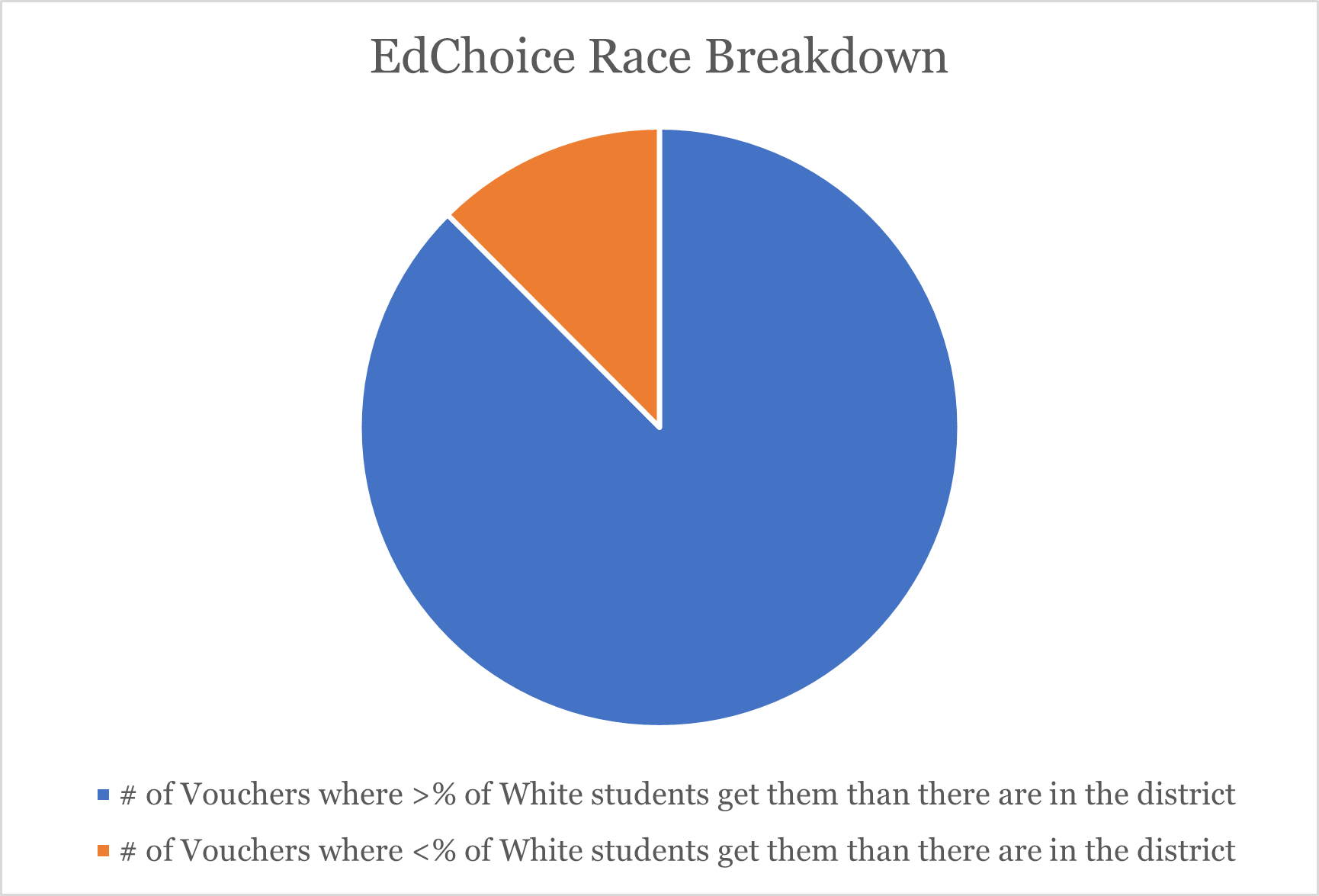
There are 95 districts that lose 10 students or more to EdChoice. In 76 of those districts, accounting for 87% of all vouchers given through the program, a higher percentage of white students take vouchers than there are in that district.

The average difference between white students taking vouchers and white students in those 76 districts was 76.2%. That means that in the districts where 87% of voucher students come from, voucher recipients are 76.2% more likely to be white than their public school counterparts.

My friends, that’s White Flight. Like, obvious White Flight.

Dear reader, do these data suggest — as Huffman wants you to think — that these segregation issues are “isolated examples”?

If 87% of voucher recipients are more likely to be white than the districts they come from, is that really “isolated”? Or is it “systemic”?

I mean in Huffman’s own district of Lima, Temple Christian takes 100% white voucher students. From a district that’s 35% white….

The vouchers worsen segregation. The students in voucher schools do worse on state tests than the public schools they left. What is more, “voucher students do worse on state tests the longer they take the voucher.”

A lose-lose, for students, for public schools, and for the state.

Nonetheless, despite failure, the state Teoublican legislature wants more vouchers and more failure!

Please open the link and keep reading this important post.

Bill Phillis, leader of the Ohio Coalition for Equity and Adequacy, reports good news in the battle against the state’s expensive and ineffective voucher program.

Private School Voucher Lawsuit Given Green Light to Go to Trial

Effort by Attorney General and Out-of-State Interest Groups to Dismiss Foiled

COLUMBUS – The lawsuit challenging the constitutionality of the harmful private school voucher program was given the green light on Friday to go to trial sometime in 2023.

Franklin County Common Pleas Judge Jaiza Page dismissed motions by Ohio Attorney General Dave Yost and out-of-state pro-private school interest groups like the Institute for Justice to dismiss the case, and instead gave the go ahead to the coalition of public schools suing the state to present their case.

“We are one step closer to proving that private school vouchers are unconstitutional, and hurt Ohio, our public school students, educators, parents, taxpayers and our communities,” said William L. Phillis, Executive Director for the Ohio Coalition for Equity & Adequacy of School Funding. “Facts matter in the court of law. The Ohio Constitution is clear. There shall be a single system of public schools, not a separate and unequal system of schools that can apply a discriminatory litmus test against students based on race, religion, income, or any disqualifying factor that strikes their fancy.”

“School board members like me owe it to our taxpayers to bring this lawsuit because my district, like so many others, has been forced to increase our property taxes with local levies to make up for the public tax dollars lost to private school vouchers. We know the vast majority of these parents are using the voucher as a refund or a rebate and they never intended to enroll their children in public schools,” said Dan Heintz, a school board member with plaintiff district Cleveland Heights-University Heights.

To read the Motion for Judgement on the Pleadings click here.

To read the Motion to Dismiss click here.

The Ohio Coalition for Equity & Adequacy of School Funding is working with Vouchers Hurt Ohio, a growing coalition of public school districts that have come together to sue the state over the unconstitutional and harmful private school voucher program.

Josh Cowen of Michigan State University reviewed a report by the rightwing Thomas B. Fordham Institute about for-profit charter schools in Ohio. It was published by the National Education Policy Center.

The summary:

The Thomas B. Fordham Institute recently published For-Profit Charter Schools: An Eval- uation of their Spending and Outcomes. The report examines academic outcomes in Ohio’s nonprofit and for-profit charter schools; in addition, it explores whether differences in contracted services in for-profits appear to correlate with differences in their outcomes. Although the report finds that charters generally have higher academic outcomes relative to traditional public schools, for-profit schools perform slightly lower academically than their nonprofit counterparts, and they perform worse than traditional schools in some areas as well. In addition, the report finds that for-profits typically contract for either staffing or other services and that those contracting for staffing perform especially poorly. Based on these findings, the report includes cautions about overregulation of for-profit charters but also raises concerns about virtual and charter schools that contract out for nearly all services. Contrary to the report’s enthusiastic Foreword, written by Fordham executives Amber Northern and Michael Petrilli and containing implications that somewhat vary from those in the report’s body, there is little in the report to remove skepticism from the debate over for-profit status. Rather, the report includes negative findings such as fewer students in for-profit charters earning diplomas, and it reinforces concerns about for-profit schools— particularly those that contract out for staff. In addition, the report is limited in its focus on only Ohio, which has substantially more transparency than many states require for school choice options. As a result, the report offers little to inform policy and practice in dissimilar or nationwide contexts.
http://nepc.colorado.edu/thinktank/for-profit-charters

Ohio is a state dominated by Republicans. When progressive candidates won seats on the state board in the recent election, Republicans moved swiftly to strip the state board of its powers and transfer them to a new state agency.

The state board has 19 seats. Eleven are elected. Eight are appointed by the Governor, Republican Mike DeWine.

News5 reported on the GOP plan to strip the state board of its powers.

For the first time in years, progressive candidates will control the elected seats on the executive agency, regulating if a resolution is able to pass or not. Candidates are voted on as nonpartisan candidates, however, each leans conservative or progressive and will be endorsed by a party. School board candidates tend to share their beliefs publically.

Three of the five seats up for grabs were taken by liberal candidates. Tom Jackson, of Solon, beat out incumbent Tim Miller by about 50,000 votes. Teresa Fedor, a now-former state senator from Toledo, beat opponent Sarah McGervey by more than 30,000 votes. Katie Hofmann, of Cincinnati, beat out incumbent Jenny Kilgore by around 30,000 votes.

“We’re just looking forward to getting back to Columbus and doing the people’s work,” Jackson told News 5.

Now, seven of the 11 elected seats are held by Democrats. The elected seats ensure that the total board can’t pass all resolutions it wants, since it needs a 2/3 majority. Of the 19 total seats, eight were appointed by Gov. DeWine. Now, with 12 GOP seats, a Democrat would need to switch over for policy to pass. This could change depending on attendance.

Even though Republicans hold a majority, they don’t have a 2/3 majority, and they won’t be able to pass resolutions without at least one Democrat.

Republican Governor Mike DeWine endorsed the plan to neuter the state board.

Gov. Mike DeWine said Wednesday he supports an Ohio Senate bill that would overhaul the Ohio Department of Education, gut powers from the Ohio State Board of Education and give his office more oversight of education.

“I think virtually every governor for 40 or 50 years has wanted to have more control in regard to the Department of Education,” DeWine, a Republican, told reporters. “So this governor is not going to be different. You know, I support the bill.”

Senate Bill 178 would put the Ohio Department of Education under a cabinet-level official in the governor’s office and rename the agency the Department of Education and Workforce, which would be called by the acronym DEW. The cabinet official would oversee the department, a task currently held by the state school board. The department would have two divisions: one for primary and secondary education and one for workforce training.

The 19-member state school board, made up of 11 elected members and eight members appointed by the governor, would continue to exist, but it would be stripped of most of its duties. It would oversee educator licensing and select the superintendent of public instruction, who would be a secretary to the board and an advisor to the DEW leader in the governor’s office.

“Candidly, the bill was not our idea, but I support the bill,” DeWine said. “I think what the public expects is accountability. And it’s hard to have accountability under our current system. You know, having the Department of Education with kind of a joint control between the governor’s office and the governor on certain areas, and other areas be the state elected Board of Education, I think is a very significant improvement.”

We have seen the same anti-democratic move in other states, like Indiana and North Carolina, where the legislature removed powers from the Governor or state superintendent so as to keep control of education in Republican hands, disregarding the voters’ wishes.

William Phillis, former deputy state superintendent of education in Ohio, is appalled by the waste and corruption in the charter sector. The state constitution requires a common school system, and charter schools and vouchers violate the state constitution. Ohio has had some of the biggest financial scandals in charter world (think ECOT), yet the Republican legislature continues to demand more funding for charters and vouchers. In this post, he likens charters to the one-room schools that were closed down long ago. He also notes that half of the 600 charters authorized in Ohio have closed.

William Phillis writes:

Charter Schools Conceptually and In Practice Are a Scourge on the Education Landscape In Ohio

Not all charter schools and their management companies are rife with fraud and corruption. Nor are all charters low-performing. Nor do all of them shortchange students to stack-up shameless profits. Nor do all of them practice nepotism in hiring, cherry-picking students, and closing without notice. However, the charter industry, as a whole, is rife with all of the above. Even if the charter industry would be free of all these negatives (and more), the concept and practice of chartering is wrong-headed.

The charter industry is inefficient within its own parameters and causes the whole of provisions for education to be inefficient. Historically the state has allocated between 34 to 45 percent of its General Revenue Fund (GRF) to K-12 education. Currently, about 40% of the state GRF is allocated to K-12 education.

Due to the demands of other state programs and services, the percentage of the state General Revenue Budget allocated to K-12 education will not likely increase substantially in the future.. Tax funds siphoned away from school districts for charters (and vouchers) duplicates facilities and programs which causes inefficient use of tax funds and reduces educational opportunities for students in both districts and charters.

Since 1900, the state forced school districts to consolidate to expand educational opportunities and to use tax dollars more efficiently. In 1900 there were about 3500 school districts. Ten thousand one room school buildings were in operation. Now there are 612 districts and no one room schools in operation. However, the state has issued more than 600 charters to private individuals, 300 or so of which have closed. Most charters serve less students than the school districts that the state forced to close. If smaller is finer, then why doesn’t the state force deconsolidation of school districts?

The smaller charter enrollments typically reduce breadth of programs and opportunities for students. The charters duplicate programs and services which exacerbates the inefficiencies. What are state officials thinking?

Charter schools are largely deregulated. For the sake of students and taxpayers there is no justification for a differential between public schools and charters in the matter of regulations. The original idea of chartering was that some teachers and parents would propose to a board of education that they would create innovative, creative programming and demonstrate better results in exchange for reduced regulations. As an industry, charters have been neither creative nor innovative. Nor has the charter industry outpaced traditional public schools in academic performance; however, reduced regulations have spawned fraud and corruption coupled with little or no accountability and transparency.

Charter schools have no constitutional basis.

The charter school experiment in Ohio has been rife with fraud and corruption and low performance. Billions in tax funding has been stolen and wasted. The experiment is a failure. There is no justification for this experiment to continue.

Learn more about the EdChoice voucher litigation

Like us on Facebook: https://www.facebook.com/OhioEandA

VOUCHERS HURT OHIO

William L. Phillis | Ohio Coalition for Equity & Adequacy of School Funding | 614.228.6540 |ohioeanda@sbcglobal.net| http://ohiocoalition.org

With the help of the teachers’ unions, the people of Ohio elected three new members of the state board of education who support public schools. This is great news because the politicians in the State House and the Legislature have been frantically diverting public funds to charter schools and vouchers, as well as endorsing extremist policies on race and gender. The state constitution explicitly authorizes a system of public schools and forbids public funding of religious schools. Ohio’s charter schools are among the lowest-performing in the nation and are lower performing than the state’s public schools. Half of those authorized by the state have closed.


Anti-culture war candidates win three seats on Ohio State Board of Education, with big boost from teachers’ unions

By Laura Hancock, cleveland.com

COLUMBUS, Ohio – Voters elected three candidates to the Ohio State Board of Education on Tuesday who oppose fights over LGBTQ students in bathrooms and attempts to control how American racism is discussed in social studies classes. The Ohio Federation of Teachers and the Ohio Education Association contributed tens of thousands of dollars to help the campaigns of former state senator Teresa Fedor of Toledo, Tom Jackson of Solon and Katie Hofmann of Cincinnati, who each won their races against more conservative candidates. Candidates the unions did not support, including one who ran unopposed, won races in two districts.

The unions were involved in recruiting the three candidates. Fedor and Hofmann are each former teachers and members of OFT. Jackson, a businessman, is a volunteer coach at Solon High School and serves on the Solon City Schools Strategic Planning Team. Their members volunteered to knock on doors and spread the word about the candidates.

They also gave their candidates a big fundraising boost. In addition to writing checks for each candidate’s campaign — OEA gave $13,700 to each candidate’s campaign and the OFT gave $12,000 to Fedor and Jackson and $13,700 to Hofmann — the unions spent at least $100,000 to get them elected through an independent super PAC called Educators for Ohio. The PAC is normally controlled by OEA, but OFT this year was also involved in it, said Melissa Cropper, president of the OFT.

The super PAC spent money only on the three state school board candidates, said Scott DiMauro, president of the OEA. “The three individuals who won those contested races are all strong advocates of public education, they have strong records on that,” DiMauro said. “I would anticipate they would work closely with other members of the state board who have been pushing back on some of those (culture wars) attacks. How everything is going to play out still remains to be seen, because you still have an extremist faction that is pushing some of those resolutions. Some of those members are still there.”

Fedor defeated Sarah McGervey, a Catholic school teacher who talked about parental rights against perceived liberal bias in education and keeping LGBTQ protections out of Title IX. Jackson defeated incumbent Tim Miller and Cierra Lynch Shehorn, who was ran further to the right of Miller. Hofmann defeated conservative incumbent Jenny Kilgore.

Hoffman, Jackson and Fedor vastly outraised their opponents. Kilgore individually raised $5,800 in 2022. Hofmann raised nearly $44,000. Jackson raised $53,000 this year, compared to Miller’s $7,600 and Lynch Shehorn’s $4,800.

Fedor’s and McGervey’s campaign finance reports are more complicated. McGervey ran for the Ohio House in August. After she lost that race she ran for the state board. Her total fundraising haul was $15,000. Fedor was a sitting senator in 2021, the beginning of the two-year funding cycle, and she raised $95,000 during the two-year period.

Other candidates who won but were not supported by the unions include incumbent member John P. Hagan, a conservative on the board, who beat a challenge from Robert R. Fulton. Neither candidate in that race received the unions’ endorsement. Ohio State Board of Education President Charlotte McGuire won reelection unopposed. Ohio Value Voters, a conservative Christian organization, backed the conservative slate of candidates, including Hagan.

As Ohio students fell academically behind from remote learning during the pandemic and Ohio has been without a permanent state superintendent for more than a year, conservatives on the state school board pressed to take on several controversial issues over the last year.

Last year, conservatives on the board successfully overturned an anti-racism resolution that the board had previously passed in the wake of George Floyd’s death. Two members of the state board who voted to overturn the anti-racism measure were defeated Tuesday night: Miller, of Akron, and Kilgore, of Hamilton County. A third supporter of the resolution, Kirsten Hill – who organized a bus from Lorain County to attend the “Stop the Steal” rally on Jan. 6 but said she never entered the U.S. Capitol – opted not to seek reelection.

More recently, conservatives on the board have been pushing a resolution that would urge local school districts to defy Title IX protections for LGBTQ students that are being proposed by President Joe Biden’s administration, potentially putting federal money for free and reduced lunch and special education in jeopardy. The resolution remains under consideration. Board members have spent 10 hours taking public testimony and discussing it since September.

Most of the state school board campaigning and fundraising took place in just the past two months, Cropper said.

“Remember, this election cycle, no one knew what the lines were going to be,” she said. Every 10 years, the boundaries for the Ohio State Board of Education shift when Ohio Senate boundaries are redrawn. Gov. Mike DeWine changed state school board boundaries Jan. 31, a move panned by critics as gerrymandering. DeWine didn’t change the school board map, even as state mapmakers shifted the Senate’s boundaries found to violate the Ohio Constitution, and on July 14, Ohio Secretary of State Frank LaRose notified county boards of election to use the Jan. 31 changes DeWine made. Candidates for the state school board, which are nonpartisan, had to file to run for the seats Aug. 10, which left just a few months to campaign.

“It really was a crunch in trying to get quality candidates to run,” Cropper said. “We had incumbents we know that were not pro-public education, who were in my opinion, pushing these culture war issues at the state board level. And it was just critical to us that we could get them out of there. So we definitely were looking for people who understand public education, who have been engaged in conversations about equity, social-emotional learning, the whole child approach, all the things that are really important to us.”

The whole child approach refers to the state board’s 2019-2024 strategic plan that says the state is concerned with the “whole child,” not just academics but stressors children experience at home that can influence learning. In 2019, the Ohio Department of Education unveiled social-emotional learning standards that aim to help children become successful in their interactions with others, to establish positive relationships, manage their emotions, and make healthy, drug-free choices in life.

“My estimation is that people rejected extremists and the extreme issues that they’re bringing to the table and children are caught in the middle,” Fedor said Wednesday. “I believe this is an overall rejection of using our children as political fodder.” Fedor had the most name recognition among the state school board candidates. In addition to her legislative career, she was on the Democratic gubernatorial ticket this spring with former Cincinnati Mayor John Cranley. Fedor said that as she campaigned, she talked about reducing the number of standardized tests kids have to take. She talked about her own time in the classroom, when she worked an additional part-time job at the Toledo Zoo to make money for classroom materials.

She said she learned that people were horrified that Hill led Ohioans to the Jan. 6 rally. “There was a flood of different ideas and thoughts about what’s going on,” she said. “And they did not support the extremists who are bringing the extreme issues forward. The culture wars in the classrooms have to end so we can get to the business of educating our children with quality public education.”

Billionaires have been pouring millions of dollars into state and local school board races for at least the last dozen years. These elections are often flooded with money from out-of-state billionaires who support expansion of charter schools and invalid ways of evaluating teachers.

It’s great to see the unions step up and support state school board members who care about public schools and teachers and care about issues that matter, rather than divisive conflicts that don’t help anyone. The amount of money spent by the unions was small compared to what the billionaires spend, but it made a difference.

The ever wise Jan Resseger points out that the Ohio House overwhelmingly voted 82-10 to end the policy of holding back third graders who don’t score proficient on the state reading test. Now, she hopes that the State Senate will complete the elimination of this disastrous experiment. The idea that children will become better readers if they are failed is nonsense. Years of experience and research shows that failure leads to negative consequences, causing a loss of confidence, a sense of failure and higher dropout rates in later years.

She writes:

Ohio’s Third Grade Guarantee, enacted by the legislature in 2012 and implemented beginning in the 2013-2014 school year, requires that students who do not score “proficient” on the state’s third grade reading test must be retained for another year in third grade. Brown reports that,”Ohio has retained around 3,628 students per year.”

Jeb Bush and his ExcelInEd Foundation have been dogged promoters of the Third Grade Guarantee, but last May, the Columbus Dispatch’s Anna Staver traced Ohio’s enthusiasm for the Third Grade Guarantee to the Annie E. Casey Foundation: “In 2010, the Annie E. Casey Foundation released a bombshell special report called ‘Early Warning! Why Reading by the End of Third Grade Matters.’ Students, it said, who don’t catch up by fourth grade are significantly more likely to stay behind, drop out and find themselves tangled in the criminal justice system. ‘The bottom line is that if we don’t get dramatically more children on track as proficient readers, the United States will lose a growing and essential proportion of its human capital to poverty… And the price will be paid not only by the individual children and families but by the entire country.’”

But it turns out that promoters of the Third-Grade Guarantee ignored other research showing that when students are held back—in any grade—they are more likely later to drop out of school before they graduate from high school. In 2004, writing for the Civil Rights Project, Lisa Abrams and Walt Haney reported: “Half a decade of research indicates that retaining or holding back students in grade bears little to no academic benefit and contributes to future academic failure by significantly increasing the likelihood that retained students will drop out of high school.” (Gary Orfield, ed., Dropouts in America, pp. 181-182)

Why does holding children back make them more likely to drop out later? In their book, 50 Myths & Lies That Threaten America’s Public Schools, David Berliner and Gene Glass explain the research of Kaoru Yamamoto on the emotional impact on children of being held back: “Retention simply does not solve the quite real problems that have been identified by teachers looking for a solution to a child’s immaturity or learning problems…Only two events were more distressing to them: the death of a parent and going blind.” Berliner and Glass continue: “Researchers have estimated that students who have repeated a grade once are 20-30% more likely to drop out of school than students of equal ability who were promoted along with their age mates. There is almost a 100% chance that students retained twice will drop out before completing high school.” (50 Myths & Lies That Threaten America’s Public Schools, pp. 9-97)

In a recent report examining the impact of Third-Grade Guarantee legislation across the states, Furman University’s Paul Thomas explainsthat short term gains in reading scores after students are held back are likely to fade out in subsequent years as students move into the upper elementary and middle school years. But, Thomas quotes the National Council of Teachers of English on how the lingering emotional scars from “flunking a grade” linger: “Grade retention, the practice of holding students back to repeat a grade, does more harm than good:

  • “retaining students who have not met proficiency levels with the intent of repeating instruction is punitive, socially inappropriate, and educationally ineffective;
  • “basing retention on high-stakes tests will disproportionately and negatively impact children of color, impoverished children, English Language Learners, and special needs students; and
  • “retaining students is strongly correlated with behavior problems and increased drop-out rates.”

Here is what Thomas recommends instead: “States must absolutely respond to valid concerns about reading achievement by parents and other advocates; however, the historical and current policies and reforms have continued to fail students and not to achieve goals of higher and earlier reading proficiency by students, especially the most vulnerable students who struggle to read.” Specifically, Thomas urges policymakers to eliminate: “high-stakes policies (retention) around a single grade (3rd) and create a more nuanced monitoring process around a range of grades (3rd-5th) based on a diverse body of evidence (testing, teacher assessments, parental input)…. Remove punitive policies that label students and create policies that empower teachers and parents to provide instruction and support based on individual student needs.”

Stephen Dyer is a former legislator in Ohio who keeps close watch on charters and vouchers in Ohio. He writes here about an article by Michael Petrilli of the Fordham Institute claiming that charter schools in Ohio are better than public schools.

Dyer disagreed with Petrilli. He has the facts. He wrote this post in response.

For nearly 20 years, the Electronic Classroom of Tomorrow was a darling of Ohio politicians. It’s founder, William Lager, made campaign contributions, mostly to Republicans, and Lager’s multiple companies collected nearly $1 billion for its online services. GOP luminaries we’re graduation speakers—names like Jeb Bush, John Kasich and other state officials.

Then the New York Times published a front-page article saying that ECOT had the lowest graduation rate of any school in the nation, and it described the many related companies that profited from the state’s funding.

The story began:

The Electronic Classroom of Tomorrow, an online charter school based here, graduated 2,371 students last spring. At the commencement ceremony, a student speaker triumphantly told her classmates that the group was “the single-largest graduating high school class in the nation.”

What she did not say was this: Despite the huge number of graduates — this year, the school is on track to graduate 2,300 — more students drop out of the Electronic Classroom or fail to finish high school within four years than at any other school in the country, according to federal data. For every 100 students who graduate on time, 80 do not.

The state auditor decided to audit ECOT (even though he was a recipient of Lager campaign funding.) The audit determined that large numbers of students didn’t exist and sought repayment of $67 million. Lager decided to declare bankruptcy rather than repay the state. ECOT had an online auction of stuff it had purchased with state funds.

Bill Phillis writes that the state is still trying to recover money from Lager:

Attorney General Yost Seeks a Court Order to Prevent the ECOT Man (William Lager) From Disposing of or Transferring Assets or Property. FREEZE LAGER’S ASSETS!

William Lager, via his operation of ECOT, Altair Learning Management, IQ Innovations, and Third Wave Communications illegally collected hundreds of millions from the state (school districts). The state has been attempting to recover at least part of the stolen revenue via the judiciary. Lager has put portions of his assets beyond the reach of his creditors.

The Ohio Attorney General, on September 27 filed a motion in Franklin County Common Pleas Court to freeze Lager’s assets.

Previously, the Court had identified that Lager had personally benefitted in the amount of $46,614,198.83. The Court had also specified that ECOT illegally paid Lager’s companies $161,602,806.30

It is amazing that Lager was empowered by campaign contributions to steal hundreds of millions of tax dollars over a couple decades before getting caught. A lot of state agencies—Ohio Department of Education, State Board of Education, Governor’s office, Attorney General offices, Auditor offices—were asleep at the switch, while enjoying favors from Lager. AMAZING!

Despite the multiple scandals, Ohio continues to divert more and more money to failing charters and vouchers.

Remember how voucher advocates claim that vouchers will “save” poor kids from “failing public schools”? T’aint so.

Stephen Dyer compared the progress of Ohio students in voucher schools to those in public schools. Guess what? The longer students are enrolled in voucher schools, the farther behind they fall.

He writes:

One thing you’d expect to hear a lot from voucher proponents is that students taking private school tuition subsidies do better the longer they’re in the private schools taxpayers are paying.

I mean, assuming these “choices” are so vastly superior to “failing” public schools, right?

Yet you never hear that argument. Now I know why: according to state test data, the longer students take vouchers, the worse they do on state tests — in some cases a lotworse. Especially in high school.

Here is how students perform on state High School proficiency rates, depending on how long they’ve been taking vouchers. You can see pretty clearly that especially in English and Math, students do markedly worse if they’ve been taking vouchers for 3 plus years than they do if they’ve only been taking it for a year.

This provides some pretty compelling evidence that students taking vouchers are better prepared by public schools, but once they enter the private system, that success wanes. Only in Social Studies is there an increase, but it’s only a 0.9% increase. Math drops by nearly 1/4. Overall, there’s, on average, a 12.1% drop in proficiency rates the longer a high school student takes a voucher….

Let me put it simply:

  • Generally, Voucher students do worse on state tests the longer they take vouchers.
  • The Black-White achievement gap is much greater among voucher students than public school students.
  • Private Schools that accept Vouchers take a Whiter population of students than the districts from whence the students come.

I just have one simple question: How is it again that Vouchers provide “better” opportunities for students of color who are being “failed” by public schools, as voucher proponents continuously claim?

Because Ohio data sure suggest that students of color are best served by their local public schools, not the private schools who are more reluctant to take them, even with significant taxpayer-funded tuition subsidies.