Archives for category: Mississippi

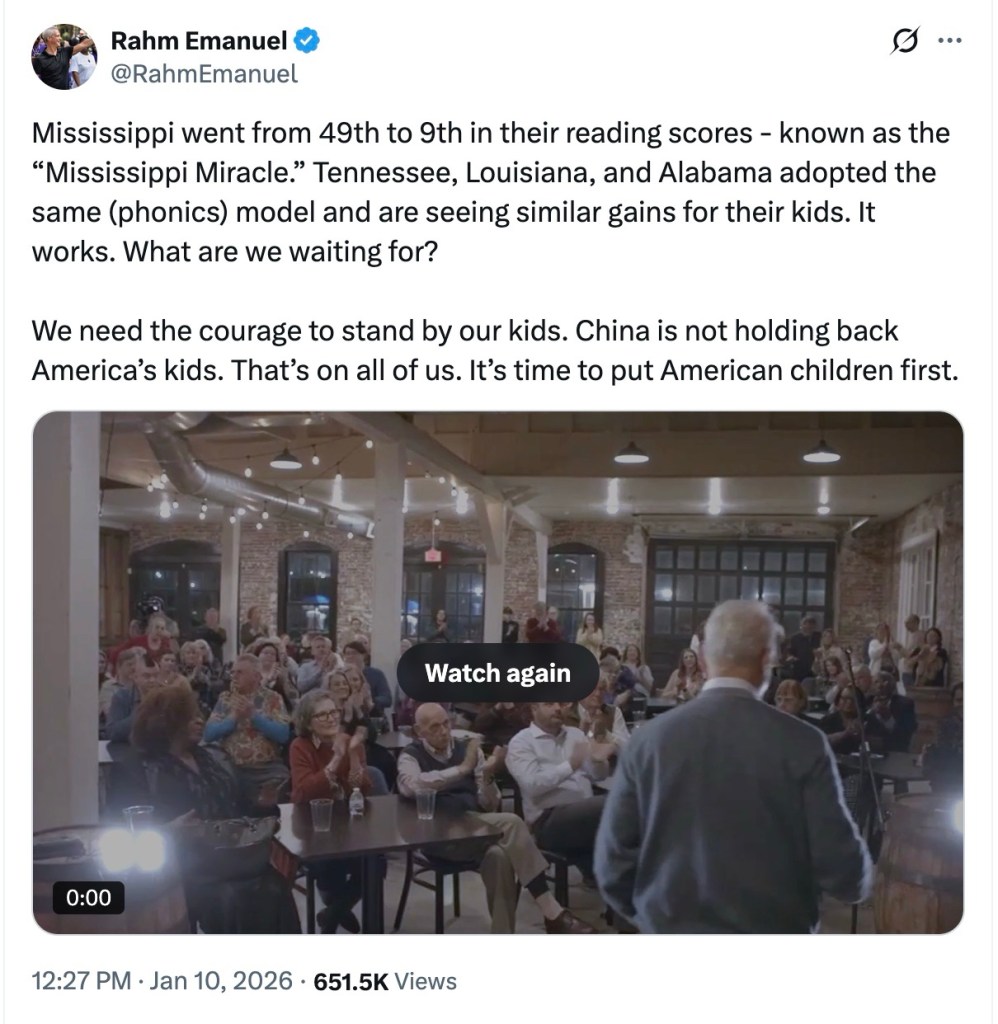
Oklahoma legislators are debating whether to follow the lead of Mississippi by adopting a phonics-based reading curriculum and requiring the retention of 3rd graders who can’t pass the reading test. Mississippi has been hailed for the dramatic rise in its 4th grade reading scores, which was initiated by the Barksdale Foundation in 1999 with a gift to the state of $100 million to improve reading.

The dominant Republicans in the Oklahoma legislature are taking advice from Jeb Bush’s ExcelinEd group, which enthusiastically supports school choice, privatization, high-stakes accountability, and holding back 3rd graders who don’t pass the state reading test.

The key to instant success in the Mississippi model (it worked in Florida too) is holding back 3rd graders who can’t pass the test. If the low-scoring students are retained, 4th grade scores are certain to rise. That’s inevitable. Is the improvement sustainable? Look at 8th grade scores on NAEP. Sooner or later, those kids who “flunked” 3rd grade either improve or drop out.

Many years ago, I attended a conference of school psychologists. While waiting my turn to speak, the president of the organization said that the latest research showed children’s three worst fears:

  1. The death of their parents
  2. Going blind.
  3. The humiliation of being left back in school

Let’s not lose sight of the pain of those left back and think about alternative ways to help these children .

John Thompson, historian and retired teacher in Oklahoma, urges the legislators to think again before enacting a punitive retention policy.

Thompson writes:

The appointments of Lindel Fields as Oklahoma State Superintendent (replacing  Ryan Walters), and Dr. Daniel Hamlin as Secretary of Education, create great opportunities for improving our state’s schools. In numerous conversations with a variety of advocates and experts, I’ve felt the hope I experienced during bipartisan MAPS for Kids coalition which saved the Oklahoma City Public School System, and working with the experts serving in the administrations of Sandy Garrett and Joy Hofmeister. 

On the other hand, we still face threats from ideology-driven politicians and lobbyists who spread falsehoods about the simplistic programs they push. 

Just one example is a legislative committee meeting on the “Science of Reading.” Although I admit to being slow to acknowledge the need for more phonics instruction, and “high-dose tutoring,” as long it is not a part of a culture of teach-to-the test, I remain skeptical of simple solutions for complex, interconnected, problems. So, I am more open to positive programs, like those that enhance the background knowledge that students need to read for comprehension, as opposed to increasing test scores. 

But I’m especially worried Oklahoma could focus on the punitive part of the so-called  “Mississippi Miracle,” which requires the retention of 3rd graders who don’t meet accountability-driven metrics. 

For instance, when Rep. Jacob Rosecrants, a former inner-city teacher who took over my classroom when I retired, expressed concern that their “highly structured teaching and testing approach … might actually discourage reading,” his reservations were “largely dismissed.” Instead, Rep. Rob Hall, who asked for the meeting, said, “What we’ve learned from other states is that wide-spread illiteracy is a policy choice.” 

In fact, it is unclear whether Rep. Hall’s policy choice has produced long-term improvements in reading comprehension. 

Based on my experiences in edu-politics, and the judgements of local experts, who saw how our 2012 high-stakes testing disaster unfolded, I’d be especially worried by how the Oklahoma School Testing Program could be used to hold back kids, and the reward-and-punish culture it could produce. The same persons pushing accountability for 3rd graders also seem to believe the lie that NAEP “proficiency” is “grade level,” and that setting impossible data-driven targets will improve student outcomes. 

If these regulations were used to determine whether 3rd graders are retained, the damage that would be done would likely be unthinkable. It is my understanding that 50% to 75% of the students in high-challenge schools might not be eligible for promotion. And like the latest expert who briefed me about 3rd grade testing, I’ve witnessed the humiliation that retention imposed on children as Oklahoma experimented on high-stakes End-of-Instruction tests, which undermined learning cultures, even when they were just a pilot program.

I would urge legislators to read this study by Devon Brenner and Aaron Pallas in the Hechinger Report on 3rd grade retention. Brenner and Pallas concluded, “We are not persuaded that the third grade retention policy has been a magic bullet; retention effects vary across contexts. Even in Mississippi, the evidence that retention boosts achievement is ambiguous.”

By coincidence, another reputable study of the “Mississippi Miracle”  was recently published. Chalkbeat’s Matt Barnum evaluated the “Southern Surge” in reading programs in Mississippi, Louisiana, Tennessee, and Alabama. And, yes, “Mississippi’s ascent has been particularly meteoric and long-running. Since 1998, the share of fourth graders reading at a basic level on NAEP has increased from 47 to 65%.” And, Louisiana’s 4th graders made progress.  

But, eighth graders’ results “have been less impressive for these Southern exemplars.” Alabama’s eighth grade reading scores have been falling and are among the lowest in the country. Louisiana’s eight grade reading scores remain at the 2002 level. And, Mississippi’s eighth grade reading scores are about the same as they were in 1998.

Barnum noted, “a number of studies have found that retention does improve test scores.” But:

The long-run effects of holding back struggling readers remain up for significant debate. A recent Texas study found that retaining students in third grade reduced their chances of graduating high school and decreased their earnings as young adults. A paper from Louisiana found that retention led more students to drop out. (Some studies find no long run effect on high school completion, though.)

I would also add that Tennessee’s huge School Improvement Grant, which was focused on test score gains, “did not have an impact on the use of practices promoted by the program or on student outcomes (including math or reading test scores, high school graduation, or college enrollment).”

Moreover, as the Tulsa World reported, Mississippi “spent two years and $20 million preparing for the rollout of the program.” It provided far more counselors and more intensive teacher training and student interventions. But it cites data suggesting “students who received intensive literacy instruction in third grade made only temporary gains, briefly besting their national peers in fourth grade but falling back behind in subsequent years.”

Even the most enthusiastic supporters of the “Mississippi Miracle”, like The 74, agree that it required “universal screenings to identify students with reading deficiencies early and to communicate those results to parents.”

And Mississippi’s success required the prioritization of “proactive communications and stakeholder engagement strategies around early literacy;” “building connections and coherence with other agency efforts across the birth through third grade continuum, especially pre-K;” and anticipating a “multi-year timeline to see changes in third grade outcomes, and invest in monitoring and evaluation strategies that can track leading indicators of progress and identify areas for improvement.”

What are the chances that Oklahoma would adequately fund such programs?

So, what will Superintendent Fields conclude after studying evidence from both sides of the debate?

The Tulsa World recently quoted Fields saying “that literacy is the building block. … So until we get that right, everything else is just going to be hard.” I’m impressed that he then added, “I’m learning about it myself.”

He then said:

What’s important to note about that is the Mississippi Miracle was not an overnight thing. It was more than a decade in the works. And I think if we were to model that and replicate it, you have to do the whole thing — we can’t walk around the block today and run a marathon tomorrow. I think replicating that and setting the tone for the next 8 or 10 years, we can expect to see the same kind of results. I think that’s an excellent example to look to.

Fields wants more than a “program.” He wisely stated:

We might disagree on how we actually get there, but I haven’t found anybody that disagrees that we have to get reading right before the other things.

He then called for “systemic, long-term dedication” to “a multi-faceted approach.” He also emphasized investments in teacher training, and the need to improve teachers’ morale.

In other words, it sounds like our new Superintendent is open to humane, evidence-based, inter-connected, and well-funded efforts that draw on the best of the “Mississippi Miracle,” but not simplistic, politicized, quick fixes, that ignore the damage that those ideology-driven programs can do to children. And I suspect he would think twice before holding back third graders before studying the harm it can do to so many students.

So, if I had just one recommendation to offer, I would urge a balanced effort that combines win-win interventions, not programs that can do unknown amounts of harm, especially to high-poverty children who have suffered multiple traumas. That would require a culture that uses test scores for diagnostic purposes, not for making metrics look better.

I am reposting this news because the earlier version did not have a link. I added additional information about the decision and the Judge.

This decision blocks all efforts to ban diversity, equity, and inclusion programs in the state of Mississippi. If ever there was a state that needs DEI to heal from the burden of a racist history, it’s Mississippi.

The Mississippi Free Press reported that Federal District Judge Henry Wingate blocked the implementation of the state’s ban on diversity, equity, and inclusion programs in public schools.

Mississippi’s ban on diversity, equity and inclusion programs in public schools remains blocked after a federal judge granted the plaintiffs’ request for a preliminary injunction in an Aug. 18 decision.

The U.S. District Court for the Southern District of Mississippi also denied the defendants’ requests to dismiss the case, calling the defendants’ points “moot.”

“This Court generally agrees with Plaintiffs’ view of the challenged portions of (House Bill 1193).

It is unconstitutionally vague, fails to treat speech in a viewpoint-neutral manner, and carries with it serious risks of terrible consequences with respect to the chilling of expression and academic freedom,” U.S. District Court Judge Henry Wingate wrote in the Court’s decision.

The law, which the Mississippi Legislature approved and Gov. Tate Reeves signed in April, prohibits Mississippi public schools and institutions of higher learning from teaching, creating or promoting diversity, equity and inclusion programs. The Republican-backed law also bans schools from requiring diversity statements or training during hiring, admission and employment processes in educational institutions.

Public institutions are also not allowed to teach or “endorse divisive concepts or concepts promoting transgender ideology, gender-neutral pronouns, deconstruction of heteronormativity, gender theory (or) sexual privilege,” the law says.

H.B. 1193 would prohibit public schools from requiring diversity statements or training in hiring, admission and employment processes at educational institutions.

Preliminary injunctions are dependent upon four qualities: “a substantial likelihood of success on the merits; the irreparable injury to the movants if the injunction is denied; whether the threatened injury outweighs any damage that the injunction might cause the defendant; and the public interest.”

Wingate Highlights Threat to Academic Freedom

Judge Wingate also granted the plaintiffs’ request to add class action claims to the lawsuit, meaning the injunction will apply to teachers, professors and students across the state. The plaintiffs’ lawyers sought the addition after a U.S. Supreme Court ruling in June limited the ability of federal judges to grant sweeping injunctions.

Judge Wingate was born in Jackson, Mississippi. He graduated from Grinnell College in Iowa and received his law degree from Yale Law School. He was appointed as a federal district judge by President Ronald Reagan.

Justice Henry Wingate

A few years bacon, the story of the “Mississippi Miracle” in reading was all the rage. The increase in scores of fourth grade students on NAEP scores was hailed as miraculous, a testament to the dramatic power of the “science of reading.” New York Times’ columnist Nicholas Kristof wrote a column praising Mississippi for raising the test scores of its fourth graders without spending any more money. Anyone could do it!

I was critical of Kristof’s enthusiasm and pointed out that the scores of fourth graders soared but the reading scores of eighth graders did not. The scores of the older students were among the lowest in the nation. What kind of “miracle” dissolves as students get older?

Thomas Ultican reviews the “Mississippi Miracle” and also finds it to be hype. But he sees it as good reason to kill NAEP, which Trump is now doing.

I don’t often disagree with Tom, who is a relentless researcher of scams and hoaxes perpetrated by the critics of public schools.

I oppose the misuse of high-stakes standardized tests to hold teachers, students, and schools “accountable,” because the tests are loaded with errors and inevitably reflect family income and family education, not the ability of students or teachers. I have written about the inherent flaw of standardized tests in my last three books.

What I like about NAEP is that it is a no-stakes test. It too reflects family income and family education, like all standardized tests. But no one is punished or rewarded for their test scores.

NAEP shows trends by states, cities, gender, race, ethnicity, special ed status, income, etc.

It is NAEP that reveals the lie behind the “Mississippi Miracle.” NAEP shows that fourth graders made dramatic progress and minimal sleuthing demonstrates that the lowest performing students were held back in third grade, excluded from the testing pool.

It’s NAEP that reveals that eighth graders placed 43rd of 50 states. The Miracle didn’t persist.

I think NAEP should remain and the federal mandate for testing every child every year in every school should be abandoned.

Ashton Pittman is the news editor of the Mississippi Free Press and a fine writer. I get my news about Mississippi by reading MFT, reported by people who live there. Pittman describes in this article why he debated whether to leave Twitter. When Musk bought Twitter, he knew it was going to be bad. He had spent years building up a following there and didn’t want to give it up. He investigated other social media platforms, but they weren’t right.

Then came the 2024 election, and Twitter turned into a political platform that favored Trump, where nasty trolls and bots created a toxic atmosphere.

Ashton joined BlueSky and very quickly gained a large number of followers close to what he (and the Mississippi Free Press) had had on Twitter.

He writes:

For a long time, it seemed like nothing was going to replace Twitter, even as it further devolved into a hellscape that seemed as if it were overrun by the trolls of 4chan, the neo-Nazis of Stormfront and the dullest AI bots Chat GPT ever powered. Twitter transformed into X, a place where racism, misogyny, homophobia and especially transphobia run rampant under the guise of “free speech,” but where using the word “cisgender” can get your account restrictedbecause Musk (who has described his very-much-alive transgender daughter as “dead”) considers it a slur.

I had really wanted one of the Twitter alternatives to take off, but one of the biggest impediments was the lack of buy-in from major journalists, publications, celebrities and other figures who could draw audiences away. A familiar pattern developed: People would leave X in hopes of joining another platform, then come back. 

Then came the election. Twitter turned into a Trump propaganda site. And Ashton was done.

But you know what I really enjoy about BlueSky? It doesn’t pigeonhole me. On other platforms, particularly X, you choose one facet of yourself and that’s the following you get, and the algorithm recommends you based on that. On BlueSky, I get to be a Mississippi journalist whose news stories draw engagement from people who care about news, but I also get to be a film photographer whose posts about my black-and-white film adventures spark conversations, too. None of us is just one thing, no matter what some lousy algorithm thinks, and it’s affirming to be able to build communities around shared interests beyond just news and politics. Social media should be social, not anti-social….

My experience as a journalist on BlueSky has reminded me that my job is to provide good information to those who want it, not to argue with trolls and validate attention-seeking behavior from the worst people on the internet. My desire to reach a diverse audience does not have to entail subjecting myself to constant abuse. I am not obligated to stay on a platform where Nazi trolls with 1488 in their usernames and cartoon frogs as their profile images regularly hurl the word “fagg-t” at me and issue veiled threats. I do not have to entertain the endless stream of incels who think “soy boy” is some sort of profound insult. I do not have to accept being under the thumb of an algorithm that prioritizes crypto scams, AI bots and conspiracy theorists over my voice.

And you know what? You don’t either.

Some of the smarter people among us have said that BlueSky is an echo chamber. Well, right now, it’s a place where I hear the echoes of artists, writers, cinephiles, scientists and neighbors caring about their neighbors. And that’s a hell of a lot better than being trapped in a chamber that’s increasingly filled with the echoes of Adolf Hitler.

So farewell, Twitter. I’m off to bluer skies.

Repeat after me: The school choice movement began in response to the Brown Decision of 1954.

School choice was a euphemism for using public dollars to fund segregation academies for whites, to enable them to escape anticipated desegregated schools.

Steve Suitts wrote an excellent book about the history of school choice, called Overturning Brown: The Segregationist Legacy of the Modern School Chhoice Movement.

I reviewed the book in The New York Review of Books. The review was titled “The Dark History of School Choice.”

Now, ProPublica reports, southern states are using voucher money to fund the same segregation academies founded in the 1950s and 1960s.

The latest ProPublica report begins:

On May 14, the final day for submitting new bills in the Mississippi Legislature, a bold new package of them landed on the desks of Mississippi lawmakers. The plans called for the creation of a voucher program that paid for students to attend private schools.

A few weeks later, in the heat of mid-June, the governor urged lawmakers to support the $40 million program, promising it “will bear the sound fruit of progress for a hundred years after this generation is gone.” Public school support would continue, he assured. But vouchers would “strengthen the total educational effort” by giving children “the right to choose the educational environment they desire.”

It was 1964.

Key backers of the move included a group of white segregationists that had formed after the U.S. Supreme Court ruled state-mandated public school segregation unconstitutional.

Across the South, courts had already rejected or limited similar voucher plans in Alabama, Louisiana, Virginia and Arkansas. But Mississippi lawmakers plowed forward anyway and adopted the program. For several years, the state funneled money to white families eager for their children to attend new private academies opening as the first Black children arrived in previously all-white public schools.

Now, 60 years later, ProPublica has found that many of these private schools, known as “segregation academies,” still operate across the South — and many are once again benefiting from public dollars. Earlier this week, ProPublica reported that in North Carolina alone, 39 of them have received tens of millions in voucher money. In Mississippi, we identified 20 schools that likely opened as segregation academies and have received almost $10 million over the past six years from the state’s tax credit donation program.

At least eight of the 20 schools opened with an early boost from vouchers in the 1960s.

“The origins of private schools receiving public funds were with the segregation academies,” said Steve Suitts, a historian and the author of “Overturning Brown: The Segregationist Legacy of the Modern School Choice Movement.”

Most private schools receiving money from the voucher-style programs exploding across the country aren’t segregation academies. But where the academies operate, especially in rural areas, they often foster racial separation in schools and, as a result, across entire communities.

Despite the passage of decades, most segregation academies across Mississippi remain vastly white — far more so than the counties where they operate, federal private school surveys show. Mississippi is the state with the highest percentage of Black residents.

At 15 of the 20 academies benefiting from the tax credit program, student bodies were at least 85% white as of the last federal private school survey, for the 2021-22 school year. And among the 20, enrollments at five were more than 60 percentage points whiter than their communities. Another 11 were at least 30 percentage points whiter.

In 1964, the White Citizens’ Council was among those pushing for the voucher plan. The pro-segregation group was founded in the Mississippi Delta town of Indianola in the 1950s by Robert “Tut” Patterson, who sought to “save our schools if possible” from integration and “if that failed, to develop a system of private schools for our children.”

For Patterson, it was personal. His family, including a young daughter who would start school that fall, lived on what he called a “plantation” with 35 Black families. As he later told an interviewer, “We took care of them. We practically lived with them. We loved them. We tended to them, but I didn’t want to mingle my children with them.”

Vouchers. This is the education idea that Republicans have been pushing for 30 years. This is the policy that is now universal in half a dozen red states. This is the main policy idea of the next Trump regime.

Segregation returns, funded by the taxpayers.

In a court case in Mississippi, a parent group is seeking to prevent the state from disbursing public funds to private schools. The parents rely on a clause in the state constitution that explicitly bars public funding of private schools.

The story was reported by the Mississippi Free Press. SUPPORT LOCAL JOURNALISM!

Schoolchildren could be heard playing less than a block away from the Mississippi Supreme Court building as attorneys argued over whether federal public funds should be awarded to the state’s private schools on Tuesday.

Rob McDuff, a Mississippi Center for Justice attorney representing the pro-public education nonprofit organization Parents For Public Schools, called a prohibition in the state’s constitution on funding for private schools “an ironclad principle” that “doesn’t have exceptions” during oral arguments.

Mississippi Supreme Court justices Leslie King, Robert Chamberlain and David Ishee also heard arguments from attorneys representing the Mid-South Association of Independent Schools and the Mississippi Attorney General’s Office defending the use of COVID-19 relief funds for private schools..

Parents for Public Schools filed the initial lawsuit in June 2022 after state lawmakers passed bills appropriating $10 million to help MAIS member schools pay for broadband, water and infrastructure projects. One bill Gov. Tate Reeves signed into law created the Independent Schools Infrastructure Grant Program. The other allocated American Rescue Plan funds for the program. The Legislature had set the grant to go into effect on July 1, 2022.

The pro-public education organization’s lawyers argued that awarding the funds to private schools violates Section 208 of the Mississippi Constitution and would give private schools a competitive advantage. That section of the Constitution says that “no religious or other sect or sects shall ever control any part of the school or other educational funds of this state; nor shall any funds be appropriated toward the support of any sectarian school, or to any school that at the time of receiving such appropriation is not conducted as a free school.”

“This is a case about a lot more than 10 million dollars,” Will Bardwell, an attorney from Democracy Forward, who also argued on behalf of Parents for Public Schools, told media after the Feb. 6 hearing. “This is a case about part of the Mississippi Constitution that reserves all of the state’s education funding for public schools. If we’re going to make exceptions to that for a 10 million dollar appropriation, then we can make exceptions about that for a 100 million dollar appropriation or a 500 million dollar appropriation. This is a simple case and it’s about a lot more than 10 million dollars.”

Please open the link to finish the story.

Congress extended a federal food program for hungry children in December 2022. Mississippi and several other Republican-controlled states chose not to accept the offer.

The Mississippi Free Press reported:

Nearly 21 million children in the U.S. and its territories are expected to receive food benefits this summer through a newly permanent federal program, but Mississippi will not be among them after the State rejected the funds. It is not clear whether the Mississippi Band of Choctaw Indians will participate.

The United States Department of Agriculture announced the program on Wednesday.

Thirty-five states, all five U.S. territories and four tribes opted into the Summer Electronic Benefits Transfer program, or Summer EBT, which the government says is meant to supplement existing programs during the summer that have had a more limited reach….

Alabama, Alaska, Florida, Georgia, Iowa, Louisiana, Mississippi, Nebraska, Oklahoma, South Carolina, South Dakota, Texas, Vermont and Wyoming chose not to participate this summer.

Nebraska, Iowa and Oklahoma cited existing programs that already feed children during the summer as reasons not to join Summer EBT.

Implementing a Summer EBT program this year was “not feasible” in Texas, state Health and Human Services Commission spokesperson Thomas Vazquez said in a statement to the AP. He said that was due to USDA guidance coming in late December, “the level of effort needed” to start a new program and the need for the state legislature to approve money for it.

Oklahoma Gov. Kevin Stitt said in a statement that he doesn’t want “a single Oklahoma child to go hungry, and I’ll keep working to accomplish that, but large, duplicative federal programs don’t accomplish that goal.

“They cause more bureaucracy for families to wade through.”

I wonder if poor families are delighted that Governor Stitt saved them the trouble of doing paperwork to get free food for their children.

Donna Ladd is the editor-in-chief of the Mississippi Free Press, which exemplifies the importance of brave, independent journalism. In this story, she relates her own journey from Mississippi to graduate school in New York City and back to Mississippi, where she leads a crucial news outlet whose staff and board is a model of racial integration. I am honored to be a member of the advisory board of the Mississippi Free Press.

She writes:

You may know that I grew up in Mississippi, but left the day after I got my political science degree from Mississippi State University, hightailing it north, vowing never to live in my racist, misogynistic state that tried to kill the spirit of smart young people like me ever again. I thought, naively, that I’d left all that ugly behind. The lessons about bigotry and sexism being a 50-state strategy were still ahead of me. Good Lord, there was so much I didn’t know.What I did know is that a bunch of political science profs believed in this child of an illiterate mother from Philadelphia, Miss.—Howard Ball, Ed Clynch, David Mason and Stephen Shaffer among them—and treated me like I was smart enough to learn what I didn’t know. My career path, I thought, was law school, even though I was always attracted to writing and truth-telling through journalism. Still, I didn’t exactly leave State with a lot of immediately marketable skills. I enrolled in George Washington University in Washington, D.C.—helped along by Dr. Ball’s reference; he compared me to an unsophisticated but promising Norma Rae—but the school and I didn’t match well. Truth be known, I wasn’t ready to succeed there.

So, I dropped out and became a club DJ. That ended up funding my teaching myself to be a writer and a journalist, first with dalliances with small newspapers in Colorado and New York City. I learned on the job.But it wasn’t until I was nearly 40 that I got more schooling—and remarkable for the daughter of Miss Katie, it was at Columbia Graduate School of Journalism where I honed my journalism skills and learned both what to do and what not to do as an editor and trainer. As any honest success story will tell you, I internalized that who you know and how they’ll help you get into a job to learn and grow inside is a major key to anybody’s success, regardless of your college major.We begin or 22nd year of Free Press Journalism in Mississippi on Sept. 22. Help us celebrate with a gift of $22, $222, $2,200 or $22,000 on #MFPGiving22Day!

Put simply: I didn’t need a fancy j-school degree to become a journalist, but it helped me improve my skills and meet people so that my work would be read—and, these days, funded. But it was other Columbia studies as part of my mid-career master’s, with more diverse instructors and thinkers than in the j-school then, that turned me into the writer, thinker, entrepreneur and mentor I am now—and taught me never to prop up false narratives wherever they spring from.Bottom line: I cared about racism deeply, and I came to understand that it was my job as a white journalist to expose the perils of “whiteness” (not the same as light-colored skin) to us all, that it was my work to do especially as a child of Neshoba County who knew some famous lynch mobsters. I already knew white folks all around me in Mississippi (and the whole U.S., so don’t get cocky) were either actively working to extend race inequity to keep the reins of power—I mean, nothing has ever been more obvious so stop the act, people—but also that my early censored Mississippi education kept me from understanding the connections and pathways out of this sick mess.My real grad-school education came after I crept shyly into the Institute for Research in African-American Studies and asked Dr. Manning Marable to allow me into his Black Intellectuals graduate seminar. And I read, listened, thought. A lot. I had no idea that I would soon return to Mississippi—but I know now that my studies with Dr. Marable and my white adviser Andie Tucker (a former PBS producer) urging me to come home to Mississippi and report about race, or “whiteness,” rewrote my future.Help grow Free Press journalism in Mississippi with your donation today.

Not to mention the future of others. I brought home everything I learned in that imperfect Ivy League institution among many people who loved to spit at the South without checking their own postage stamps. It was there that I first really understood just how bad de facto northern racism was, thanks to Dr. Marable. I first learned about so many Black American heroes who should, damn it, also be my heroes and all of yours. But they can’t be if I didn’t know they existed, or what motivated them, or the sheer bravery they mustered to face likely death for trying to make this country live up to its own constitutional and patriotic hype.Without the thinking and probing I did in my “soft” studies about humanity at Mississippi State and Columbia, Free Press journalism would not exist in Mississippi. I would not have influenced, trained, cheer-led, mentored, and recommended so many young Mississippians over the years, trying to help them believe that we can change the trajectory and inclusion of our state and, thus, the nation. And I sure as hell wouldn’t have so many white people of all ages walking up to me in the grocery store to tell me “I just didn’t know” about so many things they were lied to about in school and our textbooks.Not to mention, I wouldn’t be running the second and third publications I co-founded here, choosing truth and accuracy over blind partisanship, giving raises, recruiting, training teenagers in marketable skills and brainstorming with the most amazing team of journalists I would ever hope to share a newsroom with. And I wouldn’t be pinching myself because several of my profs from both my colleges donate to my newsrooms in Mississippi, even Sam Freedman, who challenged me the most. That’s full circle, baby.

Thank you, Mississippi State, Columbia, Andie, Sam and Dr. Marable (please rest in peace) for helping bring me to this place right now where I can sit on my porch and tell my Mississippians not to believe the political hype, to reject censorship, and to stop fearing education and the other. We sink or swim together, and heroes come in so, so many forms. Don’t deprive yourself.

Oh, and study whatever you need to to find your purpose and path. There is more to life, growth and prosperity than learning to code if that’s not your jam.

Donna Ladd, Editor and CEO

From the website of the Mississippi Free Press:

Founding Editor and CEO Donna Ladd is an award-winning journalist, editor and social entrepreneur from Philadelphia, Miss. After leaving the state the day after she graduated from Mississippi State, vowing to never live here again, she returned 18 years later with a master’s degree in journalism from Columbia. She co-founded the impactful Jackson Free Press in 2002 in order to bring an in-depth news source to the state that would not shy away from historic effects of structural, institutional and systemic racism—how the past connects to the present—in a way no other media outlet had done in Mississippi.

Donna, the daughter of illiterate parents, has won many awards for columns, political columns, editorials, feature writing and investigative work, and has shared in a number of public-service journalism awards for her work in Mississippi, from helping put an old Klansman, James Ford Seale, in prison for the kidnapping and murder of two black teenagers in 1964, to deep systemic work on the causes and solutions of crime and violence now in the capital city and the embedded racism in the criminal-justice system since the time of slavery.

In 2001, Donna received a Packard Future of Children fellowship to study the discriminatory application of school discipline on children of color and the cradle-to-jail pipeline. More recently, she was a three-year W.K. Kellogg Foundation leadership fellow, deep diving into systemic inequity and pathways to “truth, racial healing and transformation” in her home state. The fellowship led to her efforts to change the narrative about race through the Mississippi Youth Media Project, which she started to train young people to challenge the media narrative about them and their communities. She has trained many award-winning journalists over the years.

She also had two fellowships to study racism in the criminal-justice system, through John Jay College of Criminal Justice and Penn Law School’s Quattrone Center, and two grants from the Solutions Journalism Network for the same work, which brought several of her dozens of journalism awards. In 2019, she had a Logan non-fiction fellowship at the Carey Institute for Global Good, where she did a five-week writing residency in upstate New York.

Ladd publishes long-form features in The Guardian related to racism, whiteness and criminal justice. She and her journalism have been covered in Glamour and Reason magazines, Next Tribe, CNN, NPR, CBC, CBS Radio, the BBC, al Jazeera, among other outlets. In 2017, Southern Living magazine named her as one of the “Innovators Changing the South.”

In 2011, Ladd was honored with a Fannie Lou Hamer Humanitarian Award, a Dress for Success Women of Strength Award in 2009 and the 2009 Angel Award from the Center for Violence Prevention for her work against domestic abuse. After surviving breast cancer, Ladd is the 2020 Survivor of the Year for the Susan G. Komen Race for the Cure in Jackson on April 25, 2020. She also was a 2020 alumni award winner from the Columbia Graduate School of Journalism in 2020. In 2005, Ladd was named one of Mississippi’s 50 Leading Businesswomen by the Mississippi Business Journal, and she is the recipient of the 2006 Friendship Award, along with Mississippi (and now national) NAACP President Derrick Johnson, from Jackson 2000/Dialogue, a racial-reconciliation organization.

Mississippi is as red a state as any in the country but a white Democrat has a real chance of winning. His name is Brandon Presley. He’s a second cousin of Elvis, and he grew up dirt poor. He’s a genuine progressive. He has gone out of his way to court Black voters. Presley has a chance of upending politics in the state and perhaps the region.

The Daily Yonder reports that Presley must overcome the rural-urban divide:

American politics are defined by the rural-urban divide. Democrats own the major cities; Republicans dominate smaller cities and the countryside. Brandon Presley aims to change that, at least in Mississippi. The 46-year-old Democrat is challenging the GOP incumbent, Tate Reeves, for the governorship. If he wins, he would be the Magnolia State’s first Democratic governor in a generation.

But a Presley victory is potentially something more. To win, the Democrat must score well with Mississippi’s rural voters. Such a turnabout would redound across the nation. William Browning, a Mississippi-based reporter, claims “If Brandon Presley beats Reeves, this changes the way people view elections.” In other words, a Presley victory could shake the nation out of its rural-urban divide. It would prove that Democrats can win rural America, and prompt Republicans to woo the cities.

Presley’s campaign is an uphill climb. Mississippi is the definition of a Republican stronghold. The GOP controls every statewide office and possesses supermajorities in both the state Senate and House. The race will be decided by rural voters, a Republican-leaning demographic. Sixty-five of Mississippi’s 82 counties are designated as rural (using the nonmetropolitan definition) and more than half of the state population, 54%, qualify as the same.

Despite these realities, Presley has more than a puncher’s chance at victory. Reeves is vulnerable. A January 2023 survey showed 57% of state voters wanted an option beyond Reeves. A June poll was even more ominous for the incumbent. One-fifth of Republicans supported Presley over the GOP incumbent. A Mississippi political observer explained these numbers bluntly, “Reeves is not likeable and is kind of arrogant.”

Presley’s prospects go beyond an unpopular incumbent. Every observer of any political stripe agrees that he is a one-of-a-kind political talent. Brannon Miller, a longtime state political hand, calls him Mississippi’s “best retail politician.” One reporter already termed him the “second best politician in state history.”

Tall, gregarious, and oozing Southern charm, he is, as one Democratic official described him, “a back-pattin’ doesn’t-know-a-stranger Democrat.” He is also equipped with a biography straight from a Hollywood script. Second cousins with Elvis, Presley was born dirt poor. Raised just down the road from Elvis’s Tupelo, he came of age in tiny Nettleton, Mississippi (population 1,995). At age 8, his alcoholic father was murdered. Thereafter, his single mom struggled to provide for him and his two siblings, Greta and Greg. The family regularly lived without electricity, running water, or a phone.

In 2001, the 23-year-old came home from college and was elected mayor of Nettleton. He has been running ever since. In 2007, voters elected him Public Service Commissioner for northern Mississippi, a post he has been reelected to three times by successively wider margins.

Presley is not a standard issue “national” Democrat. He steers clear of divisive social issues. Pro-life on abortion, he is an evangelical Christian who hews to Mississippi’s cultural mainstream. He is also a self-described “populist.” Born from his rough-and-tumble childhood, Presley also draws upon the rich tradition of Southern economic populism. Dana Burcham, the Nettleton city clerk, sums up Presley’s philosophy in saying, “He’s for the little people.”

Presley’s populism is apparent in his rhetoric. He defines his politics as one in which, “you side with the people against a system that is set up against the people all day long.” But his populism is also obvious in his record. As mayor and public service commissioner, he focused upon bread-and-butter issues for his rural and small-town constituents. Nettleton’s current mayor, Phillip Baulch, and Burcham credit Presley as the source of the town’s turnaround. Mayor Presley turned abandoned property into parks, audited the city’s books, balanced the budget, and cut taxes. The results are tangible. Storefronts abound with commerce. Downtown is tidy. Nettleton, if not thriving, is surviving.

Read on to finish the story.

The New York Times says changes in the laws of Mississippi may have a large effect on the outcome of the Mississippi race.

Just three years ago, Mississippi had an election law on its books from an 1890 constitutional convention that was designed to uphold “white supremacy” in the state. The law created a system for electing statewide officials that was similar to the Electoral College — and that drastically reduced the political power of Black voters.

Now Mississippi is holding its first election for governor since those laws fell, the contest is improbably competitive in this deep-red state, and Black voters are poised to play a critical role.

Voters overturned the Jim Crow-era law in 2020. This summer, a federal court threw out another law, also from 1890, that had permanently stripped voting rights from people convicted of a range of felonies.

Black leaders and civil rights groups in Mississippi see the Nov. 7 election as a chance for a more level playing field and an opportunity for Black voters to exercise their sway: Roughly 40 percent of voters are Black, a greater share than in any other state.

Presley is going after Black voters.

“This election is going to be one that is historical,” said Charles V. Taylor Jr., the executive director of the Mississippi state conference of the N.A.A.C.P. “It’d be the first time we don’t have to deal with this Jim Crow-era Electoral College when it comes to the gubernatorial race. And also, we’re at a point in our state where people are fed up and frustrated with what’s currently happening.”

Democrats are trying to harness that energy behind Brandon Presley, the party’s nominee for governor. Mr. Presley, who is white, is seeking to ride his brand of moderate politics and his pledges to expand Medicaid to an underdog victory over Gov. Tate Reeves, an unpopular Republican incumbent who has been trailed by a welfare scandal.

Black Mississippians lean heavily Democratic: Ninety-four percent voted for Joseph R. Biden Jr. in 2020, according to exit polls. Any path to victory for a Democrat relies on increasing Black turnout and winning over some crossover white voters.

Mr. Presley, a member of the Mississippi Public Service Commission and a second cousin of Elvis Presley, has made outreach to Black voters central to his campaign, seeking to win them over on Medicaid expansion, addressing a rural hospital shortage and providing funding for historically Black colleges.

On a recent October weekend, Mr. Presley navigated the tents and barbecue smokers at the homecoming tailgate for Alcorn State University, one of six historically Black colleges in the state. As he darted from tent to tent, wearing a purple-and-gold polo to support the home team, Mr. Presley introduced himself to unwitting voters and took selfies with his backers, many who flagged him down amid the din of music and aroma of smoking ribs.

Presley needs a strong turnout to win. I plan to send him a donation.

“This election is going to be one that is historical,” said Charles V. Taylor Jr., the executive director of the Mississippi state conference of the N.A.A.C.P. “It’d be the first time we don’t have to deal with this Jim Crow-era Electoral College when it comes to the gubernatorial race. And also, we’re at a point in our state where people are fed up and frustrated with what’s currently happening.”

Democrats are trying to harness that energy behind Brandon Presley, the party’s nominee for governor. Mr. Presley, who is white, is seeking to ride his brand of moderate politics and his pledges to expand Medicaid to an underdog victory over Gov. Tate Reeves, an unpopular Republican incumbent who has been trailed by a welfare scandal.

If Mississippi voters elect Presley, it would affect th southern

This article was written by Margaret McMullan, an author and former professor of creative writing. She lives in Pass Christian, Mississippi. It appeared in the Washington Post. She recalls when she invited Supreme Court Justice Sonia Sotomayer to speak at the Mississippi Book Festival, no expenses paid. It was a long shot.

She wrote:

One rainy day in April 2019, my phone buzzed and the caller ID lit up with “Supreme Court.” I stared at the two words for a moment. Was I in trouble?

Then I remembered.

A few months earlier, I’d sent Supreme Court Justice Sonia Sotomayor a letter inviting her to speak at the Mississippi Book Festival, which runs every August. Our offer was the same as it had been for other authors: a $250 stipend, a ride to and from the airport and a large, appreciative audience. In addition, we would purchase 1,500 copies of Sotomayor’s books to give to students. Could the justice please travel to Jackson, Miss., to talk to kids for two days? In the hottest time of the year?

Sotomayor’s “Turning Pages,” aimed at children ages 4 to 8, had come out in 2018. In her 2013 memoir suitable for young adults, “My Beloved World,” Sotomayor wrote about reading and the importance of education in her life, as well as her challenges with diabetes. I was sure that both books would resonate with Mississippi students. During our call, Le said the offer was interesting; the justice had never been to Mississippi. I outlined the potential impact Sotomayor would have on students, noting our state’s high poverty rate and its problem with childhood diabetes.

Le said she would get back to me.

And she did, with a few more questions — details about flight connections, book-signing and so on. I said we would be happy to upgrade her flight. Nope, the publisher was handling her flight. I said we’d be happy to upgrade her hotel room. Nope, the justice was fine with a Marriott, plus her security detail was familiar with the layout.
So far, so good.

Subsequent emails and phone conversations were similar. No, Le said, the justice did not need us to provide lunch or dinner. No, she could not accept the $250 stipend.

Did Le urge me to buy more books? No. She did ask whether we wanted any of the copies of “My Beloved World” to be in Spanish. In fact, we did, and I hadn’t thought to order them.

When Sotomayor came to Jackson, we had her speaking in the sanctuary at Galloway Memorial United Methodist Church, the church where Eudora Welty once worshiped. Backstage, Sotomayor smiled when she saw my clipboard of questions. She helped me with my tote bag full of books. She then clapped her hands together and said something like, “Okay. Here’s what we’re going to do.”

In addition to our planned onstage interview, she said, she wanted the freedom to go off-script. “They’re children,” I recall her saying. “I want to be sure I get to their questions.”

“Perfect,” I said.

So the justice took a seat in one of the side pews and watched as Dav Pilkey, the author and illustrator of “Captain Underpants,” entertained a delighted audience of about a thousand students, drawing cartoons as he spoke. Then, it was our turn on the stage. I asked my clipboard questions and Sotomayor answered. Afterward, she got up and spoke from the heart, walking up and down the aisles.

In answer to the students’ questions, she told them about growing up in Puerto Rico, eating mangoes off the tree, going away to college for the first time and working in a male-dominated court system.
She talked to these kids. She asked them their names, what they liked in school, what they wanted to do with their lives. She hugged them and posed for pictures with them. After she finished, she signed their books and took more pictures.

“My success came about because I read,” she told them.

The following morning, we did it all over again for another packed sanctuary, with Sotomayor telling even more personal stories about her life and talking about a civics program she and Justice Neil M. Gorsuch work on. She also gave us homework: Go out and make friends with someone who doesn’t look like you.

My only regret is that we ran out of books. I wish we had ordered more.

There very well might be a culture of poor ethical conduct in the Supreme Court, but there is no moral equivalency between justices accepting rides on private jets to vacation with friends who had cases before the court and Sotomayor talking about her books and her life to a crowd of mesmerized young readers.

The standard royalty rate for authors is less than 10 percent of the sales price. I don’t know anything about Sotomayor’s deal with her publishers, but 10 percent would make her cut of the 1,500 books our foundation purchased approximately $2,250 — for which she had to fly to Mississippi and give two presentations. During the hottest month of the year.

Was that a bribe? You be the judge.